Journal of Chemical and Pharmaceutical Research, 2014, 6(7):481-490
Research Article
CODEN(USA) : JCPRC5
ISSN : 0975-7384
Study on the optimization algorithm of sediment particle Imshanage
Ying Xiao*, Bo Yuan, Lei Peng, Bing Zhu, Anmin Huan, Yuchun Wu and Xuage Peng
School of Electronic and Information Engineeering, Jinggangshan University, ji’an jiangxi, China
_____________________________________________________________________________________________ABSTRACT
The diversity and complexity of sediment particle image is the main bottleneck restricting river sediment image segmentation algorithm to establish. By comparing the data of basic particle swarm optimization (PSO) algorithm, a modified particle swarm optimization (MPSO) algorithm and chaos particle swarm optimization (CPSO) algorithm in the application of sediment particle image, this thesis puts forward a kind of sediment particle image adaptive chaotic particle swarm optimization (ACPSO)algorithm. In this algorithm,the chaotic sequence is
introduced to improve the local search ability of algorithm ,and at the same time, the algorithm dynamically adjusts weight factor and the variance of the population's fitness. The construction of Intelligent Transportation Systems (ITS) occupies a crucial position in the current wave of smart city. Effective and efficiency ITS needs two important conditions: plenty of traffic data and effective means of data analysis. Multi-source, heterogeneous, vague, uncertain traffic data fusion and sharing is the focus and difficulty of current research and application of ITS. The granular computing demonstrates a unique advantage in the information analysis and processing of massive, vague, uncertain and incomplete data. In this paper, we study the traffic information granular computing theory and build traffic information fusion model, framework and implementation program based on granular computing. We raise uncertainty reduction algorithms for traffic flow prediction and congestion recognition algorithms based on granular computing theory, which will provide new ideas and methods in the complex decision making under uncertainty problems of the transportation systems.
Key words: sediment particle image;chaos particle swarm optimization;adaptive chaotic particle swarm optimization
_____________________________________________________________________________________________
INTRODUCTION
Online monitoring of the river sediment content is the major problem facing both at home and abroad, the use of computer technology on the automatic interpretation of the river sediment images is an effective way to solve the online monitoring of the river sediment contents[1]. And the key link of river sediment in image processing is image segmentation technology, the precision of the count and the subsequent processing are affected directly by the segmentation result[2,3]. However, the diversity and complexity of water form sediment particle image is the main bottleneck restricting river sediment image segmentation algorithm to establish, and there is not a general segmentation method nowadays. So, an image segmentation algorithm is urgently needed to solve this problem[4-6].
smaller inertia weight value. In the result ,this thesis puts forward a kind of sediment particle image adaptive chaotic particle swarm optimization algorithm[12].
THE BASIC PRINCIPLE OF THE ALGORITHM PARTICLE SWARM OPTIMIZATION ALGORITHM
Particle swarm optimization algorithm is a stochastic optimization algorithm based on swarm intelligence, the basic idea is to guide the optimization search by making use of the swarm intelligence produced by cooperation and competition among particles in the population. The principle and the mechanism is simple, not only keeps deep swarm intelligence background of the evolutionary algorithm, but also has good performance of optimization. Therefore, the PSO algorithm can be widely used in many engineering fields[13].
PSO guides each feasible solution as a particle, the position and speed are two characteristics of each particle. First of all, initialize to a group of particles, so that all the particles have a fitness value. Then, let the particle swarm keeps tracking of the two best particles pbest and nbest. pbest is the best position of the current particles experienced, nbest is the best particle in the particle neighborhood.[14] In order to get the optimal solution or approximate optimal solution, the particles will according to the direction and distance to follow the current optimal particle in the solution space. If the neighborhood is the whole particle swarm, then nbest will change to the global best particle gbest.[15] So through multiple iterations can find the optimal solution or approximate optimal solution. When particles find both the optimal value,according to the evolution equation of PSO algorithm (1) and (2) to update their speed and the new location. It is important to note that there is a max limit of particle velocity to limit the search speed of the particles. Therefore, the PSO algorithm adaptive value is decided by the optimization function. The method is achieved by tracking individual extreme value and global extreme value, particles update their and to become after each iteration[16,17].
The objective function value corresponding to the particle coordinates can be used as the particle's fitness, particle quality measured by fitness,.The equation is shown as (1).
))
(
)
(
(
))
(
)
(
(
)
(
)
1
(
t
v
t
c
1 1p
t
x
t
c
2 2g
t
x
t
v
+
=
+
γ
best−
γ
best−
(1))
1
(
)
(
)
1
(
t
+
=
x
t
+
v
t
+
x
(2)In the equation,tmeans the current evolution algebra; c1,c2 means the study divisors, the general value is 2; r1 and r2 are random numbers which distributed in the range of [0, 1]; The best individual extreme value pbest, the global extreme value gbest; is the current optimal solution found by the whole particle swarm. When reaching the maximum number of iterations or algorithm searches the optimal solution which can meet the precision, iteration stopping. Ability of particle to jump out of local optimum condition is achieved by adding inertial coefficientω, the evolution equation is:
))
(
)
(
(
))
(
)
(
(
)
(
)
1
(
t
v
t
c
1 1p
t
x
t
c
2 2g
t
x
t
v
+
=
ω
+
γ
best−
+
γ
best−
(3)max min
max
max
(
)
T
t
×
−
−
=
ω
ω
ω
ω
(4)In this equation, t and Tmax means current number of iterations and the maximum number of iterations; ωmax and
ωmin are expressed as the maximum and minimum inertia coefficient. Equation (2)~(4) are commonly referred to the standard particle swarm optimization algorithm(SPSO).
CHAOTIC PARTICLE SWARM OPTIMIZATION ALGORITHM
In the initial stage of evolution, PSO convergence speed is fast, the need to adjust the parameters is less, is an efficient parallel search algorithm with simple concept and easy implement. However, there are problems such as premature convergence, easy to fall into local minima in the later evolution. The algorithm for multimodal function are more likely to appear premature phenomenon , there are large amount of computation and the accuracy is poor; for strictly convex function, monotone function or unimodal function, there is the problem of slow convergence speed near the optimal solution.
Chaotic motion is a kind of irregular motion state existing in the nonlinear system, with ergodicity, randomness and sensitivity to initial conditions and other characteristics. According to these characteristics, the chaos variables can ergodic according to the law of its own without repeatation to in a certain scope, optimize the search.
particle swarm optimization becomes a novel optimization technique which with optimization search and can avoid falling into local minimum, have the advantages of global. One of the most simple one-dimensional nonlinear mapping equation is shown as equation(5).
]
1
,
0
[
)
0
(
,
,
2
,
1
)
(
1
)(
(
)
1
(
∈
=
−
=
+
x
t
t
x
t
t
x
xL
µ
(5)The sequence {x(t)} in equation(5) is chaos variables when the system is in a state of complete chaos; µis the control parameters,when µ=4, Logsistic mapping is full mapping interval [0,1].
Chaotic particle swarm optimization algorithm based on adaptive optimal rate of change to determine whether premature. When the change rate is less than the set value, the speed and position update, while the better particle is mapped into chaos, after chaos optimization, and the particles are updated to form a new population; Meanwhile use chaos optimization method to disturb the current global optimal value in small scale, the population jumps out of the local optima through the chaos optimization operation, increase the probability of finding the global optimal solution.
SEDIMENT PARTICLE IMAGE OPTIMIZATION ALGORITHM BASED ON CHAOS PARTICLE SWARM OPTIMIZATION
An important problem in computer vision research in image processing is to distinguish the sediment particle of different regions in images, each region need to meet specific regional consistency, The disjoint of the consistency of a particular area has a special meaning . In computer vision, it can detect the sediment particles and finish feature extraction and object recognition from the segmentation of image quality.
THE BASIC PARTICLE SWARM PARTICLE IMAGE ALGORITHM
In D dimension sediment particle image search space, suppose there are m particles in the search space, each
particle's position represents a potential solution,
(
,
,
,
)
21 i id
i
x
x
x
x
=
L
→
represents the i particle’s position of the
particle swarm, ( , , , ) 2 1 i id i
i v v v
v = L
→
represents the i particle’s speed. The best place the i particle experienced is
wrote as ( , , , )
2 1 i id i
i p p p
p = L
→
, it’s called the individual extreme value
p
best. The best position that the particleswarm has searched so far is wrote as
(
,
,
,
)
21 g gd g
g
p
p
p
p
=
L
→
, it’s called the general extreme value
g
best. Everyparticle d(1≤d≤D)dimension according to the following equation changes:
=
=
+
=
−
+
−
+
=
+ + +d
d
m
i
v
x
x
x
p
c
x
p
c
v
v
i id i id i id i gd i gd i id i id i id i i id,
,
2
,
1
;
,
,
2
,
1
)
(
)
(
1 1 2 2 1 1 1L
L
γ
γ
ω
(6)In this equation: ω—Inertia factor; c1 and c2—learning factor; r1 and r2-the uniformly distributed random number between [0, 1]. Search factor c1 and c2 adjust the particles` own experience and social experience in the motion of the weight .If c1=0 then equation(6)is:
=
=
+
=
−
+
+
=
+ + +d
d
m
i
v
x
x
x
p
c
v
v
i id i id i id i gd i gd i id i i id,
,
2
,
1
;
,
,
2
,
1
)
(
0
1 1 2 2 1L
L
γ
ω
(7)Particles trapped into local optimal point easily .If c2=0 , then equation(6)is:
As can be seen, because there is no interaction between individual particles, particles has no groups sharing information. So the population of m size changes into m single particles movement, it is difficult to find the optimal solution.
IMPROVED PARTICLE SWARM OPTIMIZATION ALGORITHM OF SEDIMENT PARTICLE IMAGE During the basic particle swarm optimization algorithm in the process of sediment particle image optimization iteration, when one of the particles searching the current optimal position, the other particles would rapidly close to it, the algorithm gets a local optimum, then need to adjust key parameters (ω,r1,r2). In order to improve the global and the local search ability of PSO particle image algorithm(ω,r1,r2) were improved. Among them, ωis used to control the influence that the previous speed has on the current speed. If ω is smaller, the search solution in the current neighborhood, local search ability is strong; if ω is larger, then particles extend the search space and search in the global scope, capability of global search is strong; When ω =0, from equation (1) can be seen, the particle will fly to the weighted center of optimal position of individual and global best position, remain still. Therefore, find a biggerωduring the early process of sediment particle image to extend the search space; setting the smallerωwhen search near optimal solutions in the later,. From equation (9) can be seen ω from the maximum inertia weight to the linear minimum inertia weight reduction.
max min max max
'
iter
ω
ω
ω
ω
=
−
−
(9)ωmin—the minimum inertia factor, ωmax—the maximum inertia factor, itermax—the maximum number of iterations. It`s good for the global search when particle velocity vmax is larger, but there may be over the optimal solution; when particle velocity vmax is small, particles in a specific area of fine search, but easy to fall into local optimum, therefore, must limit the maximum speed on the particle flight.
−
<
−
=
>
=
max '
max '
max '
max '
V
v
V
v
V
v
V
v
id id
id id
(10)
vmax Is a constant preset, it determines the accuracy of the search in the solution space particles.
SEDIMENT PARTICLE IMAGE OF CHAOTIC PARTICLE SWARM OPTIMIZATION ALGORITHM The improved particle swarm optimization algorithm of sediment particle image is better than the two value image in sediment image segmentation, while because of the randomness of the maximum speed vmax of the initialization of sand particles, Inertia factor ωmax and ωmin, learning factor c1 and c2 and the maximum number of iterations itermax, When the pbest of some sand closes to the gbest of group, Speed and inertia factor is not zero, far from the best position and the algorithm does not converge, impact the segmentation effect. In the sediment particles image optimization algorithm experiment of chaos particle swarm, it`s found that particle swarm diversity slowly disappear when speed is more and more small and close to zero, This is algorithm precocious tendency .
In general, with the development of the iterative process, once a particle inertia, due to the influence of other particles, it also appears inert and gathers nearby and stop moving, gets into a local optimum and led to the prematurity of the algorithm, affect the convergence of the algorithm. Therefore, we use the randomness, ergodicity, and regularity of chaotic variables to search and disturb the best position of average time and the global position constantly, by setting the specific format of iterative to form chaotic sequence , we effectively avoid diversity decline and premature convergence.
We set the objective function of the problem as:
[
,
]
)
;
,
,
2
,
1
(
)
(
min
f
x
i
=
L
n
x
i∈
a
ib
i (11)Then after putting chaos into the chaotic particle swarm optimization algorithm (CPSO), its iteration steps are:
Step1:Initialize the maximum velocity of particle algorithm vmax, the scope of the inertial factor ωmax and ωmin, learning factor c1 and c2 the maximum number of iterations itermax.
Step2:And the initial velocity is set to
max 0
)
1
,
1
(
v
U
Step3:Set the particle swarm fitness of the optimal position of particles gbest, set the particle swarm fitness of the current position pbest and calculate the fitness of each particle fi.
Step4:If the convergence criteria are satisfied, the Step9 is executed to perform; otherwise.
Step5:Using ∆fi in equation(5) to judge whether to fall into local optimum. If the condition is satisfied for Nc continuous times in iteration, then perform the following steps, or jump to Step7. Where N is the set of constants, δ
is the set of constant threshold.
i p i
i
f
f
f
f
best
)
/
(
−
=
∆
(12)Step6:Generate a D dimensional random initial vectors
[
0,1,
0,2,
,
0,],
,(
0
,
1
)
0
,d
=
D nd∈
n
y
y
y
y
y
L
, besides, thereare minor differences in each component, and according to the formula (6) Logistic equation, chaotic sequence is began by the way of carrier .
4
0
)
1
(
,, '
,
1
=
−
≤
≤
+ d
µ
nd ndµ
n
y
y
y
(13)Put the chaotic iteration variable yn,d in equation (13) into a region, the region sees the particle current position xi,d as the center, Ri,d as the chaotic search radius. If meet fixed point, a small disturbance y/c can be added (a large positive). Then jump to Step8.
{
0
.
25
,
0
.
5
,
0
.
75
}
)
1
2
(
,
, , , '
,
∉
−
+
=
d n
d n d i d i d n
y
y
R
x
y
(14)
Step7:According to (7) update the position and velocity of the particle swarm optimization.
Step8:Compare the new particles with the previous, the optimal fitness individual selected is set to gbest.
Step9:Return to Step4.
Step10:Output the solution and end.
ADAPTIVE CHAOTIC PARTICLE SWARM OPTIMIZATION ALGORITHM OF SEDIMENT PARTICLE IMAGE
The convergence speed and search precision chaotic particle swarm algorithm is more suitable for the image of river sediment particles, but there is still the problem of local optimum, balance of the global and local chaos optimization, need accord to the characteristics of flow type sediment distribution form which is complex and changeable, balance in the inertia weight and group fitness variance, improve the effect of algorithm.
ADAPTIVE INERTIA WEIGHT
In order to enhance the adaptation of the flow form sediment type distribution of complex and changeable characteristics algorithm , this study proposed the inertia weight updating formula balancing between global and local search as shown in (15).
min 2
max min
max
)
exp(
(
)
)
(
ω
ω
τ
ω
ω
=
−
×
−
×
+
T
t
(15)
Among them,τ is determined by the value experience and generallyτ is in the range of [20,55]. At the beginning of the algorithm, need stronger global search ability, take the larger inertia weight value; Late need to improve local exploring ability, take the smaller inertia weight value.
THE VARIANCE OF THE POPULATION'S FITNESS
Definition: Set current average fitness is favg, the particle number of particle swarm is
n
, the numberi
fitness of a particle is fi, the group fitness variance σ2 can be defined as shown in equation (16).∑
=− =
− = n
i
avg i avg
i
f f f
f f f
n 1
2
] max
, 1 max[ ),
( 1
σ
(16)From (16) can be seen, the particle swarm aggregation degree of the variance of the population's fitness is determined byσ2, σ2 smaller, groups more convergence.
STEPS OF ADAPTIVE CHAOTIC PARTICLE SWARM OF SEDIMENT PARTICLE IMAGE OPTIMIZATION ALGORITHM
Steps of adaptive chaotic particle swarm of sediment particle image optimization algorithm are as follows:
Step1 Read the original image to be segmented, chaos initialize a swarm of particles, randomly set the particle number n in a certain range, the initial velocity v,i∈[1,n], the initial position X.
Step2 Set gbest to the best position of particles in the initial population and set the i particle’s pbest to the current position of the particle.
Step3 Put the data into (2), (3), (7) to figure out the new position and new velocity. Step4 According to the fitness function f(x), calculate the fitness f(xi),i∈[1,n] of particle i.
Step5 If the fitness of particle i is better than the current global extreme value gbest, then replace the global extreme
value gbest with current particle position
x
i.Step6 If the fitness f(xi) of particle i is better than the fitness f(pbest) of its individual extreme value pbest, then replace pbest with its current particle position xi.
Step7According to the definition of the equation (8) to calculate the aggregation degree of the population's fitness variance σ2.
Step8 Judging the convergence condition is whether satisfied, if do,go to step 10, otherwise go to step 9.
Step9 Using chaos search according to (5), (6), replace a random particle as soon as getting the best point, and then go to step 3;
Step10 The algorithm finally outputs the global optimal solution.
Follow the steps above, you can get the satisfied image. When the background for the target object is 0, there will be two obvious peaks in the figure, which is reflected in the histogram of target and background .
NUMERICAL EXPERIMENTS AND ANALYSIS
CONVERGENCE EXPERIMENT AND ANALYSIS OF ALGORITHM
Through the Matlab software programming, using improved particle swarm optimization algorithm based on chaos theory, figure 1 shows the algorithm flow chart.
In the initialization of the algorithm, if learning factor c1=2, c2=2, the maximum inertia factor ωmax=9.0, the minimum inertia factor ωmin=4.0, The biggest constraint speed vmax=1,The size of the particle number N=20, The dimensions of the function D=1,The biggest evolution algebra itermax=25, the chaos optimization parameters
µ=3,δ=le-5, r=0.1, c=10.
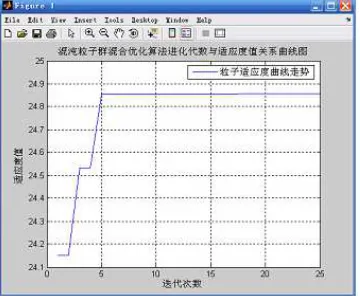
The convergence of the algorithm can be obtained through the analysis of type (17), the result is shown in figure 2 .
≤
≤
+
+
=
9
0
.
.
)
4
cos(
*
7
)
5
sin(
*
10
)
(
max
x
t
s
x
x
x
x
f
Fig. 1: iterative algorithm flow chart
Fig. 2: performance of optimization algorithm
Clearly, when iterating to the fifth step , the algorithm has been basically converges to the final optimal position: X=7.8562, The obtained maximum function f(x)max=24.8553. Its convergence speed is rapidly, it is not difficult to find that as a new optimization algorithm, chaotic particle swarm optimization algorithm is superior than other algorithms.
Analysis of chaotic particle swarm optimization algorithm
Analysis of particle position update:Chaotic variables in the process of the particle swarm movement control particle degree of chaos .When cid(t)→1,
i d i d id
d i
d id
id t x t M x t M M
x = − + × × − +ψ × −ψ ×
ψ
ψ exp( 7.5( ( 1) )) )
1 ( ( )
( (18)
Individual particles of chaos are at work mainly at this point. While when cid(t)→0,
)
(
)
1
(
)
(
t
x
t
V
t
[image:7.595.217.397.410.558.2]The relationship of the velocity vector in the algorithm is as shown in equation (20).
)
(
)
(
)
(
)
(
)
(
)
(
t
v
1t
v
2t
v
3t
v
4t
v
t
v
i=
i+
i+
i+
i+
L
+
id (20) [image:8.595.223.395.210.271.2]Incremental time complexity in the equation is O(d), only related to dimension, has nothing to do with the number of particles n, minimize the time cost to improve search accuracy. Figure 3 shows the vector relation, when the traditional particle swarm optimization algorithm updating, seeing vi(t) as a whole, directly update from the Xi (T) to Xi (t+1). The algorithm sees Vi (T) as dimensions and incrementally search each dimension’s update process, refine the search process, increase the search space and improve the accuracy of the search. Compared with the traditional particle swarm algorithm, the time complexity of the improved O (d) times. Compared to the existing chaotic particle swarm algorithm, time complexity is reduced by M times, wherein, M represents the chaos search step.
Fig. 3: the process of the particle position update
Numerical test of chaotic particle swarm optimization algorithm:Analysis of nonlinear dynamical behavior of the chaotic particle swarm model objective functions are as follows:
∑
=
−
+
=
ii
i
i
x
x
x
f
1
2
))
2
cos(
10
10
(
)
(
r
π
(21)
Among them, -5.12≤xi≤5.12, l=30, when the minimum value is in 30 dimension and variable x is 0, the global minimum value is 0. In the chaotic particle swarm algorithm: the inertia factor ω=0.7298, learning factor c1=c2=1.4962, the number of iterations is 1000 , the particle number N=20, the chaos factor r(I,d)=0.5+(0.005)rand, the initial value of chaotic variables ci,d(0)=0.999, search measureΨd=10.24, mobile factor mi=0.5.
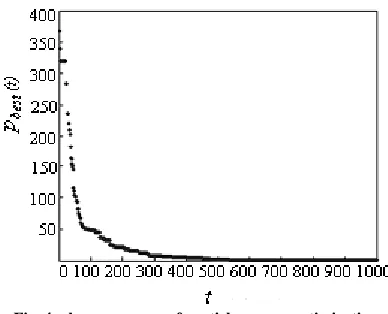
[image:8.595.208.402.479.636.2]Figure 4 is the change process of particle swarm optimization value, with iteration number increasing, the optimal value decrease. The final extreme optimization value is 4.8878×10⁻⁷, optimal position values of each dimension are less than 1×10⁻⁴.
Fig. 4: change process of particle swarm optimization
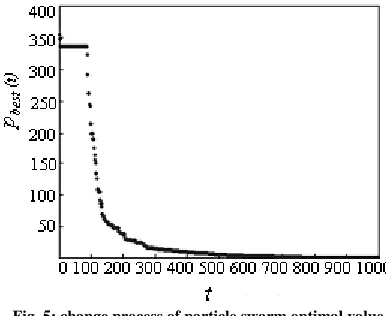
Among the parameters of the algorithm, the inertia factor and learning factor can be set based on particle swarm optimization algorithm , search measure and mobile factor can be calculated according to the initial search conditions, the initial chaotic variable cid(0)=0.999, the value of the chaos factor is more important parameter , which affects the initial chaotic search time. The numerical simulation was carried out when the chaos factor r(I,d)=0.1+(0.001)rand, that help explain the influence of chaotic parameters on the algorithm search process.
chaotic convergence process is longer. The final extreme optimization value is 1.38850×10⁻⁷, the optimal position of each dimension values are less than 1×10⁻⁴.
Fig. 5: change process of particle swarm optimal value
CONTRAST EXPERIMENT ANALYSIS OF ALGORITHM
The experiment used 5 function to test the performance of adaptive chaotic particle swarm particle image algorithm, and compared with the standard particle swarm optimization (SPSO), improved particle swarm optimization algorithm (IPSO) and chaos algorithm based on particle swarm optimization (CPSO) . The theory optimal value of test function was 0. All the experimental particle swarm scale n=50, ωmax=0.95,ωmin =0.4.
[image:9.595.348.482.586.708.2]In the standard particle swarm algorithm and adaptive chaotic particle swarm algorithm c1=c2=2, improved particle swarm optimization algorithm value c1=c2=1.5; value based on the chaos particle swarm optimization algorithm c1=1.5 c2=2.5. All the algorithms run 30 times for each function to get the average, the test results are shown in table 1.
TABLE1 Numerical test results of sediment particle image
Algorithm SPSO IPSO CPSO ACPSO Sphere 3.7004×10² 4.723 2.373610-3 2.027910-9
DeJong 4.3467×10 4.609 2.340210-47 2.0808910-17
Griewank 2.61×10⁷ 3.28×10³ 6.8481×10⁻² 9.90510-11
Rosenbrock 13.865 9.96×10 1.0404×10⁻² 2.906810-4
Rastrigin 1.065 5×10² 53.293 9.5258×10⁻¹ 4.374 1×10⁻⁴
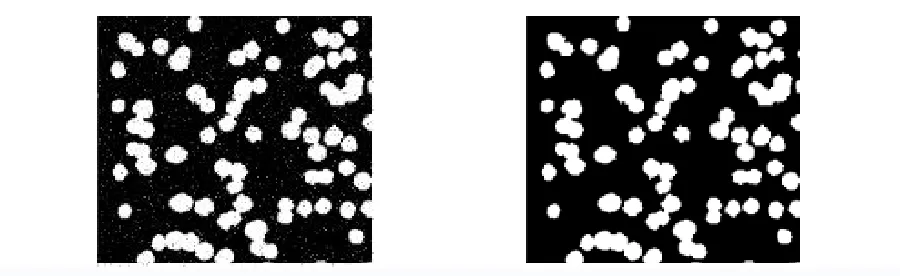
According to the results, the adaptive chaos particle swarm algorithm shows higher convergence precision and faster search speed by using the test functions used in this paper, its optimization performance is better than the other algorithms, it`s as shown in figure 6. From Figure 6 we can see that the bottom part of the sediment particles in Figure 6 (a) sediment background image were submerged, we can see the segmentation effect is poor; Figure 6 (b) segmentation is better than Figure 6 (a), but the sediment segmentation effect in the bottom of the image background is not better than Figure 6 (c), Figure 6 (d) segmentation effect is superior to the front three methods.
[image:10.595.81.531.64.202.2]
(c)Chaotic particle swarm optimization algorithm (d)adaptive particle swarm optimization algorithm
Fig. 6: comparison of sediment particle image segmentation results
CONCLUSION
The experimental results show that the adaptive chaotic particle swarm river sediment of optimization algorithm is an important means of detecting the silt content of river sediment in images. On the base of the sediment image feature, the image is converted into a specific type as the image recognition to search for the optimization by making use of randomness, ergodicity and regularity of chaos variables, disturbing the average best position and the global best position constantly. The beginning of operation can increase the diversity of the population and avoid premature convergence; chaotic sequence is generated from the set specific format of iteration and can effectively avoid the decline in diversity and premature convergence. The search in the global optimal region can be more refined at middle-late stage of the process and find the global optimal solution faster.
The main data of sediment image are disjoint and redundant, subject recognition of the sediment is achieved by directly using these low information, the algorithm solved the optimization problem of complex river sediment in a better way. It is an important research direction to put the chaos theory as well as other algorithm into the particle swarm optimization algorithm of river sediment .
Acknowledgments
This rescarch was supported by National Department of education in Jiangxi Province(No. GJJ13539) and Department of science and technology of Jiangxi Province(No. 20123BBE50076)
REFERENCES
[1]Xiao Y, Peng XG, Leng M, Zhu B. Journal of computes,2010,5(6):893-900. [2]Zhu B,Zhou XY,Tan B. Journal of software,2011,6(8):1437-1444.
[3]Xiao Y, Yuan B, Zeng DJ. 2012 International Conference on Computer Science and Electronic Engineering
(CSEE 2012). USA:IEEE,2012,258-262.
[4]Niu LC, Sun XH, Zuo XB. Concrete,2012, (1):10-12.
[5]Li YJ, Zeng B, Xu KF, Li Y. Journal of Electronics & Information Technology, 2012,34(2):388-392. [6]Zhao YL, Wang LM, Han Y. Journal of Missiles and Guided , 2010,30(2):59-62.
[7]Lan ZG, Jin WW, Zhu ML, Yu XinS, Guo JF, Zhou ZT, Li KB. Marine Science, 2011, 35(11):97-100. [8]Liu LLi, Wang Z.Microelectronics and Computer, 2010,27(11):37-39.
[9]Wei DD, Zhao YH. Computers and Applied Chemistry, 2010,27(1):99-102. [10]Yang YS, Zhang ZJ. Marine Environmental Science,2010,29(6):914-916. [11]Alatas B, Akin E, Ozer A B. Chaos Solitons & fractals, 2009, 40(4):1715-1734. [12]Coelho L D, Mariani V C. Chaos Solitons & Fractals, 2009,39(2):510-518. [13]Tian DP.Computer Engineering, 2010, 36(4): 180-182.
[14]Siahkali H,Vakilian M. Electric Power Systems Research , 2009,79(5):826-836 [15]Baskar G, Mohan M R. Electric Power Syst ems Research, 2009,79(4):615-621