DEVELOPMENT OF AN ERGONOMIC RISK ASSESSMENT TOOL FOR WORK POSTURES
MOHD NASRULL BIN ABDOL RAHMAN
A thesis submitted in fulfilment of the requirements for the award of the degree of Doctor of Philosophy (Mechanical Engineering)
Faculty of Mechanical Engineering Universiti Teknologi Malaysia
v
ABSTRACT
vi
ABSTRAK
vii
TABLE OF CONTENTS
CHAPTER TITLE PAGE
DECLARATION ii
DEDICATION iii
ACKNOWLEDGEMENTS iv
ABSTRACT v
ABSTRAK vi
TABLE OF CONTENTS vii
LIST OF TABLES xiii
LIST OF FIGURES xv
LIST OF ABBREVIATIONS xix
LIST OF SYMBOLS xx
LIST OF APPENDICES xxi
1 INTRODUCTION
1.1 Overview of the Study 1.2 Problem Statements 1.3 Objectives of the Study 1.4 Research Questions 1.5 Scope of the Study 1.6 Significance of the Study 1.7 Organization of the Thesis
1 4 6 7 7 8 9
2 LITERATURE REVIEW 2.1 Introduction
2.2 Ergonomic Methods for Work-related Musculoskeletal Disorders
viii
2.2.1 Self-Report Questionnaires 2.2.2 Observational Methods
2.2.3 Direct Measurement Techniques 2.3 Observational Methods for Work-related
Musculoskeletal Disorders
2.3.1 Ovako Working Posture Assessment System (OWAS)
2.3.2 Rapid Upper Limb Assessment (RULA) 2.3.3 Posture, Activity, Tools and Handling (PATH) 2.3.4 Rapid Entire Body Assessment (REBA) 2.3.5 Postural Loading on the Upper-Body
Assessment (LUBA)
2.3.6 Quick Exposure Check (QEC)
2.3.7 Back-Exposure Sampling Tool (Back-EST) 2.4 Concluding Remarks
13 14 14 15 16 17 19 21 22 24 27 29
3 RESEARCH METHODOLOGY
3.1 Introduction
3.2 Development of the WERA Method 3.2.1 Specification of the WERA Items 3.2.2 Refining of the WERA Scoring System 3.3 Validity Trials of the WERA Method
3.3.1 Sample Size and Job Selection 3.3.2 Data Collection
3.3.3 Data Analysis
3.4 Reliability Trials of the WERA Method
3.4.1 Description of the Training and Observers 3.4.2 Data Collection
3.4.3 Data Analysis
3.5 Development of the WERA Software Program 3.5.1 Development of the WERA Algorithm 3.5.2 Design of the WERA Graphic User Interface 3.5.3 WERA Coding System
ix
3.6 Verification of the WERA Software Program 3.6.1 Case Study 1: Company A
3.6.1.1 Sample Size and Job Selection 3.6.1.2 Data Collection
3.6.1.3 Data Analysis 3.6.2 Case Study 2: Company B
3.6.2.1 Sample Size and Job Selection 3.6.2.2 Data Collection
3.6.2.3 Data Analysis 3.6 Concluding Remarks
53 54 54 57 59 61 61 64 66 68
4 DEVELOPMENT OF THE WORKPLACE ERGONOMIC RISK ASSESSMENT (WERA) METHOD
4.1 Introduction
4.2 WERA Paper Checklist
4.2.1 Specification of the WERA Items
4.2.1.1 Shoulder Posture and Repetition 4.2.1.2 Wrist Posture and Repetition 4.2.1.3 Back Posture and Repetition 4.2.1.4 Neck Posture and Repetition 4.2.1.5 Leg Posture
4.2.1.6 Lifting the Load 4.2.1.7 Vibration 4.2.1.8 Contact Stress 4.2.1.9 Task Duration
4.2.2 Refining of the WERA Scoring System 4.2.2.1 WERA Scale and Scoring System 4.2.2.2 WERA Action Level
4.3 WERA Software Program 4.3.1 WERA User Menu 4.3.2 WERA Items Screenshot 4.3.3 WERA Final Report 4.7 Concluding Remarks
x
5 CASE STUDY AND RESULTS 5.1 Introduction
5.2 Validity Testing of WERA Method 5.2.1 Description of the Sample 5.2.2 Body Discomfort Survey
5.2.2.1 Wall Plastering Job 5.2.2.2 Bricklaying Job 5.2.2.3 Floor Concreting Job 5.2.3 WERA Assessment
5.2.3.1 Wall Plastering Job 5.2.3.2 Bricklaying Job 5.2.3.3 Floor Concreting Job 5.2.4 WERA Validation
5.2.4.1 Wall Plastering Job 5.2.4.2 Bricklaying Job 5.2.4.3 Floor Concreting Job 5.3 Reliability Testing of WERA Method 5.3.1 Description of the Observers 5.3.2 Inter-Observer Reliability
5.3.2.1 Task A 5.3.2.2 Task B 5.3.2.3 Task C
5.3.3 Percentage of Agreement
5.3.4 Feedback Survey from Observers 5.3.5 Validation of WERA Scale and Scoring
System
5.4 Verification of WERA Software Program : Case Study 1
5.4.1 Description of the Sample 5.4.2 Body Discomfort Survey
5.4.2.1 Wafer Saw Job 5.4.2.2 Wire Bond Job 5.4.2.3 Multi Plunger Job
xi
5.4.3 WERA Software Analysis 5.4.3.1 Wafer Saw Job 5.4.3.2 Wire Bond Job 5.4.3.3 Multi Plunger Job 5.4.4 WERA Verification
5.4.4.1 Wafer Saw Job 5.4.4.2 Wire Bond Job 5.4.4.3 Multi Plunger Job
5.5 Verification of WERA Software Program : Case Study 2
5.5.1 Description of the Sample 5.5.2 Body Discomfort Survey
5.5.2.1 Inspection Job 5.5.2.2 Transaction Job 5.5.2.3 Packaging Job 5.5.3 WERA Software Analysis
5.5.3.1 Inspection Job 5.5.3.2 Transaction Job 5.5.3.3 Packaging Job 5.5.4 WERA Verification
5.5.4.1 Inspection Job 5.5.4.2 Transaction Job 5.5.4.3 Packaging Job 5.7 Concluding Remarks
119 119 120 121 121 122 122 123 124 124 125 125 126 126 127 127 128 129 130 130 130 131 132
6 DISCUSSION 6.1 Introduction
6.2 Validity Testing of WERA Method 6.2.1 Wall Plastering Job 6.2.2 Bricklaying Job 6.2.3 Floor Concreting Job
6.3 Reliability Testing of WERA Method 6.3.1 Inter-Observer Reliability
xii
6.3.2 Percentage of Agreement
6.3.3 Feedback Survey from Observers 6.3.4 Validation of WERA Scale and Scoring
System
6.4 Verification of WERA Software Program: Case Study 1
6.4.1 Wafer Saw Job 6.4.2 Wire Bond Job 6.4.3 Multi Plunger Job
6.5 Verification of WERA Software Program: Case Study 2
6.5.1 Inspection Job 6.5.2 Transaction Job 6.5.3 Packaging Job 6.6 Concluding Remarks
140 141 142
144
144 146 148 150
150 152 153 155
7 CONCLUSIONS AND FUTURE WORKS 7.1 Introduction
7.2 Conclusions 7.3 Future Works
157 157 158
REFERENCES 162
xiii
LIST OF TABLES
TABLE NO. TITLE PAGE
1.1 Risk factors assessed by different assessment methods 4
1.2 Reliability and validity studies of different assessment
methods 5
2.1 Gaps of knowledge for in this research 30
2.2 Inclusion criteria for developing the WERA method 31
4.1 Combination of risk level, score and indicator 86
4.2 Combination of physical risk factors and scoring system
for WERA tool 86
4.3 Risk level, final score and action level of WERA tool 87
5.1 Demographics of the workers in three jobs of construction
industry (N=130) 100
5.2 WERA final score and risk level for wall plastering job 104
5.3 WERA final score and risk level for bricklaying job 105
5.4 WERA final score and risk level for floor concreting job 106
5.5 Chi-square statistical analysis (χ2-test) for wall plastering job
107
5.6 Chi-square statistical analysis (χ2-test) for bricklaying job 107
5.7 Chi-square statistical analysis (χ2-test) for floor concreting job
108
xiv
5.9 Inter-observer reliability for Task A 110
5.10 Inter-observer reliability for Task B 111
5.11 Inter-observer reliability for Task C 112
5.12 Observers ratings on the feedback survey of WERA tool 114
5.13 WERA Inter-Item Correlations Matrix (Spearman Correlation Coefficients)
115
5.14 Demographics of the operators in three jobs of manufacturing industry (N=115)
116
5.15 WERA final score and risk level for wafer saw job 120
5.16 WERA final score and risk level for wire bond job 120
5.17 WERA final score and risk level for multi plunger job 121
5.18 Chi-square statistical analysis (χ2-test) for wafer saw job 122
5.19 Chi-square statistical analysis (χ2-test) for wire bond job 123
5.20 Chi-square statistical analysis (χ2-test) for multi plunger job
123
5.21 Demographics of the operators in three jobs of manufacturing industry (N=118)
124
5.22 WERA final score and risk level for inspection job 128
5.23 WERA final score and risk level for transaction job 128
5.24 WERA final score and risk level for packaging job 129
5.25 Chi-square statistical analysis (χ2-test) for inspection job 130
5.26 Chi-square statistical analysis (χ2-test) for transaction job 131
xv
LIST OF FIGURES
FIGURES NO. TITLE PAGE
1.1 Occupational accidents by sector for the category of death until 2010
3
2.1 Characteristics of the different methods 12
2.2 Observational methods for assessing the WMSDs from 1977 to 2009
16
2.3 Rapid Upper Limb Assessment (RULA) 18
2.4 Posture, Activity, Tools & Handling (PATH) 20
2.5 Rapid Entire Body Assessment (REBA) 22
2.6 Postural Loading on the Upper-Body Assessment (LUBA)
23
2.7 Quick Exposure Check (QEC) 26
2.8 Back-Exposure Sampling Tool (Back-EST) 28
3.1 Development process of WERA method 33
3.2 The main WERA variables 34
3.3 The specification of the WERA items 35
3.4 Three different positions in wall plastering job: standing position (A), bending posture (B) and reaching overhead (C)
37
3.5 Two different positions for the bricklaying job, standing position (A) and bending posture (B)
xvi
3.6 Four different positions in floor concreting job: bending posture in left side (A), bending posture in right side (B), kneeling posture (C) and standing posture (D)
39
3.7 Research design for validity study 40
3.8 Data analysis for validity study 43
3.9 Training session of the Ergonomic and Manual Handling course
44
3.10 Research design and data collection for training session 46
3.11 WERA software algorithm 49
3.12 Design of the WERA Graphic User Interface 50
3.13 A sample of WERA code 53
3.14 Five tasks in wafer saw job: taking the wafer (T1), writing the log book (T2), cleaning the wafer (T3), inserting the wafer (T4) and operating the wafer machine (T5)
55
3.15 Four tasks in wire bond job: key in the data (T1), screen monitoring (T2), adjusting the wire (T3) and inspection the wire (T4)
56
3.16 Five tasks in multi plunger job: set up the resin tablet (T1), preparing the plunger bushes (T2), pressing the resin tablet (T3) checking the tablet loader (T4) and writing the log book (T5)
57
3.17 Research design for Case Study 1 58
3.18 Data analysis for Case Study 1 60
3.19 Five tasks in inspection job: inserting microchip roller tape (T1), rolling the microchip roller tape (T2), monitoring the microchip (T3), checking the microchip (T4) and writing the log book (T5)
xvii
3.20 Four tasks in transaction job: preparing microchip roller tape (T1), checking microchip roller tape (T2), key in the data (T3) and transferring microchip roller tape (T4)
63
3.21 Five tasks in packaging job: inserting microchip roller tape into cardboard (T1), packaging microchip roller tape into cardboard (T2), labelling the cardboard (T3), checking the cardboard (T4) and transferring the cardboard (T5)
64
3.22 Research design for Case Study 2 65
3.23 Data analysis for Case Study 2 67
4.1 Risk level for the shoulder posture item in the WERA tool
72
4.2 Risk level for shoulder repetition item in the WERA tool 72
4.3 Risk level for the wrist posture item of the WERA tool 74
4.4 Risk level for wrist repetition item in the WERA tool 75
4.5 Risk level for the back posture item in the WERA tool 76
4.6 Risk level for back repetition item in the WERA tool 77
4.7 Risk level for the neck posture item in the WERA tool 79
4.8 Risk level for the leg posture item in the WERA tool 80
4.9 Risk level for the lifting load item in the WERA tool 82
4.10 Risk level for vibration item in the WERA tool 83
4.11 Risk level for contact stress item in the WERA tool 84
4.12 Risk level for task duration item in the WERA tool 85
4.13 Screenshot of the WERA user menu 88
4.14 Screenshot of the WERA shoulder part 89
xviii
4.16 Screenshot of the WERA back part 91
4.17 Screenshot of the WERA neck part 92
4.18 Screenshot of the WERA leg part 93
4.19 Screenshot of the WERA lifting load part 93
4.20 Screenshot of the WERA vibration part 94
4.21 Screenshot of the WERA contact stress part 95
4.22 Screenshot of the WERA task duration part 95
4.23 Summary table for the WERA final score and action level 96
4.24 WERA final report 97
5.1 Percentage of workers reporting to body discomfort in wall plastering job
101
5.2 Percentage of workers reporting to body discomfort in bricklaying job
102
5.3 Percentage of workers reporting to body discomfort in floor concreting job
103
5.4 The percentage of agreement from observers 113
5.5 Percentage of operators reporting to body discomfort in wafer saw job
117
5.6 Percentage of workers reporting to body discomfort in wire bond job
118
5.7 Percentage of workers reporting to body discomfort in multi plunger job
119
5.8 Percentage of workers reported to body discomfort in inspection job
125
5.9 Percentage of workers reporting to body discomfort in transaction job
125
5.10 Percentage of workers reporting to body discomfort in packaging job
xix
LIST OF ABBREVIATIONS
Back-EST - Back Exposure Sampling Tool
BDS - Body Discomfort Survey
DOSH - Department of Occupational Safety and Health
LUBA - Postural Loading on the Upper-Body Assessment
MSDs - Musculoskeletal Disorders
NIOSH - National Institute of Occupational Safety and Health
OSHA - Occupational Safety and Health Administrative
OWAS - Ovako Working Posture Assessment System
PATH - Posture, Activity, Tools & Handling
QEC - Quick Exposure Check
REBA - Rapid Entire Body Assessment
RULA - Rapid Upper Limb Assessment
SHO - Safety and Health Officer
SPSS - Statistical Package for the Social Sciences
WERA - Workplace Ergonomic Risk Assessment
xx
LIST OF SYMBOLS
K - Cohen’s Kappa Coefficient
N - Sample Size
SD - Standard Deviation
X - Mean
° - Degree
± - Plus-Minus
% - Percentage
α - Alpha
χ2
- Chi Square
p - Pearson Chi-Square
xxi
LIST OF APPENDICES
APPENDIX TITLE PAGE
A Summary table of the observational method from 1976 to 2009
176
B WERA Paper Checklist 179
C Feedback Survey of WERA Tool 180
D Self-Report Chart (Body Discomfort Survey) 181
E WERA Coding System 182
F WERA Assessment (Validity Study)
- Wall Plastering Job
206
G WERA Assessment (Validity Study)
- Bricklaying Job
209
H WERA Assessment (Validity Study)
- Floor Concreting Job
211
I WERA Software Program (Verification Study) - Wafer Saw Job
214
J WERA Software Program (Verification Study) - Wire Bond Job
219
K WERA Software Program (Verification Study) - Multi Plunger Job
223
L WERA Software Program (Verification Study) - Inspection Job
228
M WERA Software Program (Verification Study) - Transaction Job
233
N WERA Software Program (Verification Study) - Packaging Job
CHAPTER 1
INTRODUCTION
1.1 Overview of the Study
Ergonomics is the one of main components of safety programs around the country, and many companies have begun implementing effective ergonomic programs in their workplaces (Brodie, 2008). A basic ergonomic assessment is often the starting point for a company to approach implementing such a program due to the ergonomics hazards at a workplace (Brodie, 2008; Burdorf, 2010). This approach helps the company determine whether the jobs or tasks expose employees to risk factors that could lead to musculoskeletal disorders (MSDs). By determining how the job exposes employees to ergonomic risk factors, this approach helps the company reduce the cost of occupational injuries and work-related illnesses (Li and Buckle, 1999a; Li and Buckle, 1999b; David, 2005; Brodie, 2008; Burdorf, 2010). An additional reason to invest in ergonomics at the workplace is that it helps improve the productivity of employees, which can result in increased bottom line profits of a company (Brodie, 2008; Burdorf, 2010).
2
Burdorf, 2010). The accurate measurement of workers’ exposure to the risk factors related to WMSDs are critical to both epidemiologists and ergonomists in conducting their research studies (David, 2005; Burdorf, 2010).
3
Figure 1.1 Occupational accidents by sector for the category of death until 2010
4
1.2 Problem Statements
Current techniques to assess the exposure of the risk factors related to WMSDs still utilize observational methods, mainly because they are inexpensive and practical for use in a wide range of workplaces whereas using the other methods would be difficult due to the disruption they would cause (Beek and Dressen,1998; Li and Buckle, 1999a; David, 2005; Brodie, 2008; Takala et al., 2010).
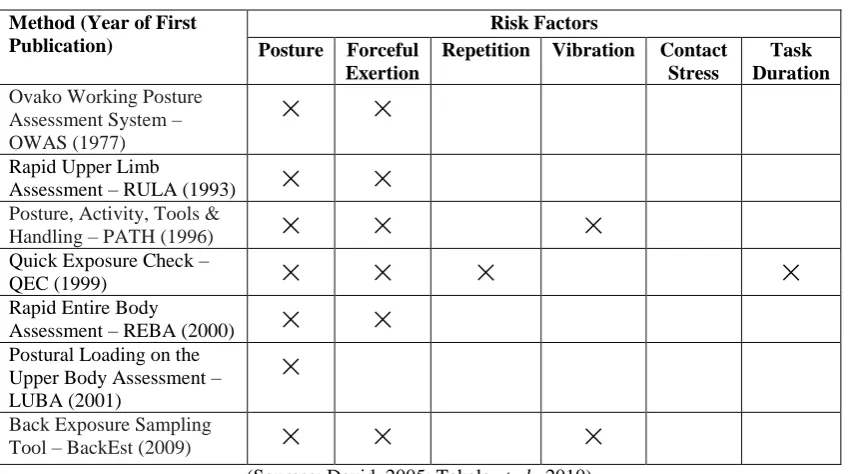
[image:22.595.109.535.425.662.2]However, there is no tool available to covers the wide range of physical risk factors in the workplace (Table 1.1), which include posture, repetition, forceful exertion, vibration, contact stress and task duration (David, 2005; Takala et al., 2010). There is a need to widen the existing range of physical risk factors and to consider the interactions among them (David, 2005). Most of the observational tools available only focus on postural assessments of various body parts rather than covering the critical physical exposure factors in the workplaces (David, 2005; Burdorf, 2010; Takala et al., 2010).
Table 1.1: Risk factors assessed by different assessment methods Method (Year of First
Publication)
Risk Factors Posture Forceful
Exertion
Repetition Vibration Contact Stress
Task Duration
Ovako Working Posture Assessment System – OWAS (1977)
×
×
Rapid Upper Limb
Assessment – RULA (1993)
×
×
Posture, Activity, Tools &
Handling – PATH (1996)
×
×
×
Quick Exposure Check –
QEC (1999)
×
×
×
×
Rapid Entire Body
Assessment – REBA (2000)
×
×
Postural Loading on the Upper Body Assessment – LUBA (2001)
×
Back Exposure Sampling
Tool – BackEst (2009)
×
×
×
(Sources: David, 2005; Takala et al., 2010)
5
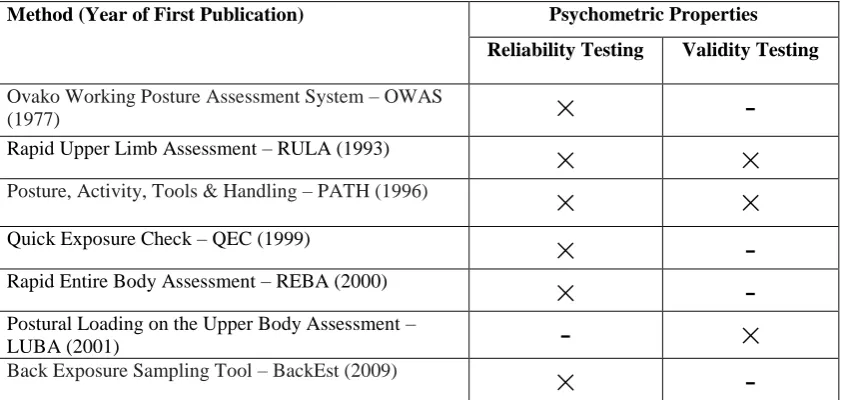
[image:23.595.110.531.305.505.2]2010; Takala et al., 2010). The evaluation of reliability and validity are critical to the development of ergonomic exposure assessment tools, particularly for research that attempts to establish a causal relationship between ergonomic risk factors and musculoskeletal health outcomes (David, 2005; Burdorf, 2010; Takala et al., 2010). Takala et al. (2010) stated that a major challenge in developing an observational tool is the validation of exposure assessment techniques. Poor performance of exposure assessment tools due to the lack of reliability and validity testing contributes to the scepticism regarding the work-relatedness of musculoskeletal disorders (David, 2005; Takala et al., 2010).
Table 1.2: Reliability and validity studies of different assessment methods Method (Year of First Publication) Psychometric Properties
Reliability Testing Validity Testing
Ovako Working Posture Assessment System – OWAS
(1977)
×
-
Rapid Upper Limb Assessment – RULA (1993)
×
×
Posture, Activity, Tools & Handling – PATH (1996)
×
×
Quick Exposure Check – QEC (1999)
×
-
Rapid Entire Body Assessment – REBA (2000)
×
-
Postural Loading on the Upper Body Assessment –
LUBA (2001)
-
×
Back Exposure Sampling Tool – BackEst (2009)
×
-
(Sources: David, 2005; Takala et al., 2010)
6
1.3 Objectives of the Study
The main objectives of this research are:
i. To develop a new ergonomic risk assessment technique which assesses the exposure of physical risk factors associated with WMSDs. ii. To establish the reliability and validity of the ergonomic risk
assessment tool during the development process.
iii. To evaluate the application of the ergonomic risk assessment tool on different tasks.
The specific objectives of this research are:
a. To develop the ergonomic risk assessment paper checklist (Phase 1) and to test its reliability and validity during the development process. b. To determine the validity of the ergonomic risk assessment tool that
corresponds with other valid methods in the workplace. A comparative study will be performed using the Body Discomfort Survey.
c. To investigate the inter-observer reliability of observers assessing the physical risk factors of workers performing tasks using the ergonomic risk assessment tool.
d. To develop the ergonomic risk assessment software program (Phase 2) based on the ergonomic risk assessment paper checklist in Phase 1. e. To verify that the ergonomic risk assessment software program
7
1.4 Research Questions
1) How valid is the ergonomic risk assessment tool in the workplace? Does the ergonomic risk assessment tool correspond to the Body Discomfort Survey?
2) How reliable is the ergonomic risk assessment tool between users and observers? Do the users and observers have good, moderate, or low levels of agreement when assessing the physical risk factors of tasks using ergonomic risk assessment tool?
3) How usable is the ergonomic risk assessment tool among the users and observers? Is the ergonomic risk assessment tool easy to use, applicable to the wide range of jobs, and valuable at work?
1.5 Scope of the Study
The scope of this research encompasses the development of the observational method, which is called the Workplace Ergonomic Risk Assessment (WERA) tool. This tool covers the physical risk factors associated with work-related musculoskeletal disorders (WMSDs) at workplaces; these factors include posture, repetition, lifting the load, vibration, contact stress and task duration. This tool assessed five main body regions: shoulders, wrists, back, neck and legs. This tool did not cover the specifics of environmental factors such as noise, lighting and thermal comfort since these factors focus more on the work environment and there already exist specific tools to evaluate these factors, such as the ACGIH Threshold Limit Value for Heat Stress and Strain (2006a) for thermal comfort risk factors, the ACGIH Threshold Limit Value for Noise (2006b) for noise risk assessment and the Cornell Task Lighting Evaluation (2007) for lighting risk assessment.
8
the manufacturing industry and included wafer sawing, wire bonding, and multi-plunging. Case Study 2 involved 118 operators (Female) from the ages of 20 to 35 years selected to perform three jobs at Company B located in Senawang Industrial Estate, Negeri Sembilan. These jobs in the manufacturing industry included inspection, transaction, and packaging job. This study focused on selection of participants of the working ages of 20 to 44 because the statistical data from the Bureau of Labor Statistics (2011) reported that workers who were 20 to 44 years of age had the highest incidence rate at 134 cases per 10,000 full-time workers in the construction and manufacturing industries. Department of Occupational Safety and Health (DOSH) reported that industries with the highest occupational accidents rates included the construction and manufacturing industries (DOSH, 2010). Therefore, the validity test and case studies have been focused on the construction and manufacturing industries. This research has aided in the development of two types of the WERA tool, the WERA paper checklist and the WERA software program.
1.6 Significance of the Study
The proposed method for this study will contribute to new knowledge in the ergonomic research field, especially to knowledge of methods in ergonomic exposure assessment tools. This is because the lack of well-designed exposure assessment methods is a primary issue for epidemiological studies of work-related musculoskeletal disorders (WMSDs) (David, 2005; Burdorf, 2010; Takala et al., 2010). To date, no tool has been developed to cover the range of physical risk factors related to WMSDs which carried out reliability and validity studies during the development process of the tool. This is the first ergonomic risk assessment tool that meets the research needs for practical methods to evaluate and define the ergonomics risks inherent to a job, especially factors associated with WMSDs in the workplace.
9
with the development of WMSDs; it is key to examine these hazards as part of any ergonomics activity in developing the assessment of biomechanical exposure at the workplace.
In addition, assessing exposure to risk factors for WMSDs is an essential stage in the management and prevention of WMDSs, and such assessment may even form part of an overall risk assessment programme in the industry (David, 2005; Brodie, 2008; Burdorf, 2010; Takala et al., 2010). Well-designed observational tools that assess the physical risk factors related to the WMSDs have been of vital importance to both epidemiologists and ergonomists in conducting research studies (David, 2005; Brodie, 2008; Burdorf, 2010; Takala et al., 2010).
1.7 Organization of the Thesis
This thesis contains seven chapters. The chapters are arranged according to the sequence of objectives and the rationale of the research. The seven chapters are: Chapter 1 (Introduction), Chapter 2 (Literature Review), Chapter 3 (Research Methodology), Chapter 4 (Development of the WERA Method), Chapter 5 (Results), Chapter 6 (Discussion) and Chapter 7 (Summary, Conclusions and Future Works).
Chapter 1 describes the background of the research, the objectives to be achieved, the research scope, the significance of the research and the organization of the thesis. Chapter 2 gives an overview of the literature and primarily focuses on the discussion of the ergonomic methods used in assessing work-related musculoskeletal disorders (WMSDs). These methods are divided into three main categories: self-report questionnaires, observational methods, and direct measurement techniques. Chapter 3 explains the research methodology and focuses on the development of the WERA method, the validity of the WERA method, the reliability of the WERA method, development of the WERA software program and verification of the WERA software program in two different case studies.
10
of the WERA software program (Phase 2). It is divided into six sections: introduction, validity testing of the WERA method, reliability of the WERA method, verification of the WERA software program by Case Study 1, and verification of WERA software program by Case Study 2. Chapter 6 discusses the findings from the Chapter 5, including the results of the validity and reliability testing of the WERA method (Phase 1) and verification of the WERA software program (Phase 2).
CHAPTER 2
LITERATURE REVIEW
2.1 Introduction
12
2.2 Ergonomic Methods for Work-related Musculoskeletal Disorders
Lower back pain and neck pain are categorised as work-related musculoskeletal disorders (WMSDs), which are commonly experienced among workers (Hales and Bernard, 1996; Malchaire et al., 2001; Punnett and Wegman, 2004). In a study by Bernard (1997), WMSDs became a serious health problem and a major cause of disabilities. WMSDs are caused by a range of physical, individual and psychological risk factors (Kuorinka, 1998; Punnet and Wegman, 2004). The physical demands include adaptation of work posture, forceful exertion, repetitive motion, vibration and task duration while performing a task (Bernard, 1997; Aptel et al., 2002).
Commonly used exposure quantification ergonomic methods in work-related musculoskeletal disorder (WMSD) studies are divided into three categories: self-report questionnaires, observational methods and direct measurement techniques (Winkel and Mathiassen, 1994). Each method has its own strengths and weaknesses and may be used for different applications or purposes. Figure 2.1 illustrates some general characteristics of each method and may be used as a guide to select a method.
[image:30.595.110.535.467.744.2]Source from Winkel and Mathiassen (1994)
13
In general, direct measurement with instrumentation results in the most specific and accurate exposure estimation, but involves significant costs. This method would be impractical for individual exposure assessment in very large populations of large-scale epidemiological studies because of the significant resources and expertise that would be required. Self-reporting using questionnaires or interview methods can be used to assess large populations but the data obtained by these methods have low validity to the level of exposure. Observational measurement methods are frequently used in field studies as a compromise between questionnaire and direct measurement methods, since the former contains strengths and weaknesses of the latter. Observational methods present the best compromise for individual exposure assessment in large-scale epidemiological studies. The following sections discuss details of the ergonomic methods, such as self-report questionnaires, observational methods and direct measurement techniques.
2.2.1 Self-Report Questionnaires
Kadefors and Forsman (2000) stated that data collection on exposure of physical risk factors in the workplace using self-reports can be obtained from workers’ diaries, interviews, and questionnaires. The most recent innovations in data collection using self-report are the written record, video film self-evaluation and the web-based questionnaires (Dane et al., 2002). Other information can also be collected, such as demographic variables, signs and symptoms of body parts and signs of discomfort.
14
frequencies of physical load compared to workers who were pain free in the same occupational groups (Viikari et al., 1996; Balogh et al., 2004).
The degree of difficulty of the self-report methods may vary depending on factors such as worker literacy, reading comprehension, or question interpretation (Spielholz et al., 2001). Although the self-report methods generate doubt in quantifying the level of exposure (Pope et al., 1998), other methods can be used to analyse the details of exposure risk of the occupational group (Burdorf et al., 1999). The levels of reliability and validity of self-report methods are too low for use as the basis for ergonomics intervention at the workplace (Li and Buckle, 1999a).
2.2.2 Observational Methods
The most commonly used method is the observational method, which is
applied to evaluate the ergonomic hazards at workplace, monitor the ergonomic
improvements, and conduct research on ergonomic issues. Although this is the best
method of approach, the density of the gathered data on ergonomic hazards is
limited. The quantitative measurement of the exposure, risk and data can be tracked.
The low cost of the assessment and its quick turnaround times are positive characteristics in the process of identifying ergonomics hazards in the workplace. A simple observational method can be used to recognize and control the ergonomic issues in the workplace. Section 2.3 discusses the details of the observational methods for work-related musculoskeletal disorders (WMSDs).
2.2.3 Direct Measurement Techniques
15
joint of the body part directly was developed (Biometric Ltd, 1998) together with corresponding systems for computerized data analysis (Radwin and Lin, 1993). Frievalds et al. (2000) developed the system, which recorded the concurrent movement of wrists, hand and fingers with grip pressure and directly connected to the computer. The Lumbar Motion Monitor is one of the tools developed to record body postures and movement assessment with combination appropriate software (Marras et al., 1992). It also used to record continuous data of three-dimensional components, including the trunk position, velocity and acceleration for subsequent analysis by computer (Hasson et al., 2001; Bernmark and Wiktorin, 2002). Li and Buckle (1999a) found that recording the body posture with the sensor attached to the worker’s body is a technique to determine the time spent in different postures during working hour. For investigating the simulation of task, the computing systems that record the three-dimensional coordinates of all body markers are more suitable. Electromyography (EMG) is another direct method that can be used to estimate muscle tension, but it requires careful interpretation due to the non-linear relationships involved (Schuldt et al., 1987; Wells et al., 1997). Although it may difficult to interpret, it useful in evaluating the fatigue of local muscles (Merletti and Parker, 1999). Highly accurate data can be obtained by using this method, but many practitioners assume this method is still impractical because of the time needed for analysis and for interpreting the data. To purchase the direct measurement tools, the initial investment and other resources need to be considered to accommodate the maintenance costs and the costs of highly trained and skilled staff (Li and Buckle, 1999a).
2.3 Observational Methods for Work-related Musculoskeletal Disorders
16
Observational Methods in the Work-related Musculoskeletal Disorders (WMSDs) (from 1977 to 2009)
Figure 2.2 Observational methods for assessing the WMSDs from 1977 to 2009
2.3.1 Ovako Working Posture Assessment System (OWAS)
The Ovako Working Posture Assessment System (OWAS) was developed to identify and evaluate poor working postures in workplaces (Karhu et al., 1977). The development of the OWAS tool has been conducted in the steel industry, which was used to define the various postures in workplaces such as the one adopted while overhauling iron smelting ovens. This method uses four digit-codes to describe the whole body posture involving back, arms, legs and the weight of the load handled. The range of risk factors includes posture and forceful exertion. There were two phases that occurred during the development of OWAS. The first phase was the classification of postures and the second phase was the evaluation of the defined postures.
Ovako Working Posture Assessment System (OWAS)
(Karhu et al., 1977)
Rapid Upper Limb Assessment (RULA) (McAtamney and Corlett, 1993)
Posture, Activity, Tools & Handling (PATH)
(Buchholz et al., 1996)
Quick Exposure Check (QEC)
(David et al., 2008)
Postural Loading on the Upper-Body Assessment (LUBA)
(Kee and Karwowski, 2001)
Rapid Entire Body Assessment (REBA)
(Hignett and McAtamney, 2000)
Back-Exposure Sampling Tool (Back-EST)
17
Over 12 work-study engineers were trained to analyse the 28 tasks in the steel plant using the OWAS tool in order to prove the reliability of the OWAS method. The results were found to be fairly good with 93% agreement between the two groups of work-study engineers (Karhu et al., 1977).
In conclusion, the OWAS tool was developed to identify and evaluate poor working postures in the workplace. In addition, the concept of its reliability may need more clarification. There is no formal study that has been conducted to determine its validity during its development process.
2.3.2 Rapid Upper Limb Assessment (RULA)
A survey method known as Rapid Upper Limb Assessment (RULA) was developed to analyse upper limb disorders which were related to work tasks (McAtamney and Corlett, 1993). Part of its development involved the operators, who performed five different tasks while standing in the garment making industry and were assessed using the RULA tool. The evaluation of exposure risk factors was based on a diagram of body posture and three scoring tables were provided. In this method posture and forceful exertion risk factors are covered. Three stages were involved in the development of the RULA tool: the working posture recording, the scoring system and the scale of action levels.
18
In conclusion, the RULA tool is more suitable to provide a rapid assessment of the posture, muscle functions, and forces that were applied. Figure 2.3 shows the Rapid Upper Limb Assessment (RULA).
Source from McAtamney and Corlett (1993)
[image:36.595.107.566.163.532.2]19
2.3.3 Posture, Activity, Tools & Handling (PATH)
A work sampling-based tool known as the Posture, Activity, Tools & Handling (PATH) tool has been developed to characterized the ergonomic hazards
present in highway construction work (Buchholz et al., 1996). The PATH tool has been specifically developed for the construction and agriculture industries and can easily be applied to non-repetitive work.
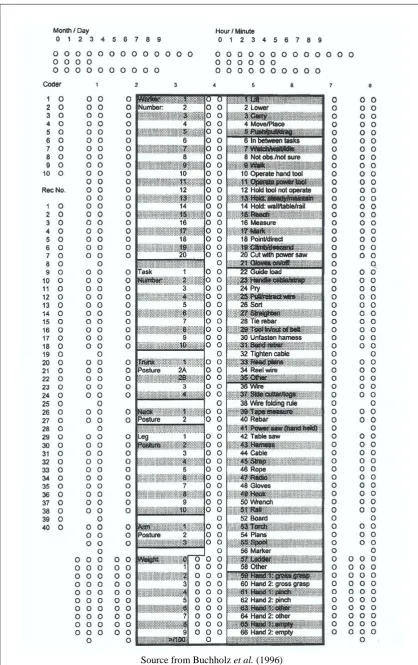
This method used a digit-code to describe a whole body posture. The coding system was based on a modification of the Ovako Work Posture Analysing System (OWAS) coding system, which described the activity of the worker, the type of the tool used, the size or type of handles and hand grasping. These also encompass the basics of posture code of the PATH method. The range of risk factors covered includes postures and forceful exertion.
During the development process, the results of the PATH analysis were compared with simulated real time analysis in order to determine the validity of the posture codes. For recording the postures of the back and shoulders, a simulated real time analysis method has been developed. There are two sections of work collection segments in the PATH tool: the manual material handling activities and the construction activities. In addition, a simulated real time method was established to define the codes of PATH trunk postures.
Multiple training sessions have been conducted to establish the reliability of the PATH tool; these include the exercises, coding sheets and templates practice, a two-dimensional mannequin and other visual aids. The participants were first introduced to an overview of the construction taxonomy and the PATH method. Next, the participants were taught about the PATH posture codes and were asked to apply the PATH posture codes to still photographs. This task was to be completed with the 5 seconds of observation time while coding the video was performed in real time. The participants were coding the postures of workers at the construction site in real time. Inter-observer agreement has been evaluated based on the coding posture of the workers, which was performed simultaneously by the trainees and experienced observers during the real-time coding.
20
[image:38.595.108.527.67.733.2]Source from Buchholz et al. (1996)
21
2.3.4 Rapid Entire Body Assessment (REBA)
The Rapid Entire Body Assessment (REBA) tool was developed and specifically designed for analysing the unpredictable working postures in healthcare and other service industries (Hignett and McAtamney, 2000). The evaluation of the exposure risk factors was based on the diagram of body postures and three scoring tables were provided. In this method, posture and forceful exertion risk factors are covered. Three stages were involved in the development of the REBA: the working posture recording, scoring system development and development of the scale of action levels, which provided the level of risk and further actions to be taken.
22
[image:40.595.109.565.79.456.2]Source from Hignett and McAtamney (2000)
Figure 2.5 Rapid Entire Body Assessment (REBA)
2.3.5 Postural Loading on the Upper-Body Assessment (LUBA)
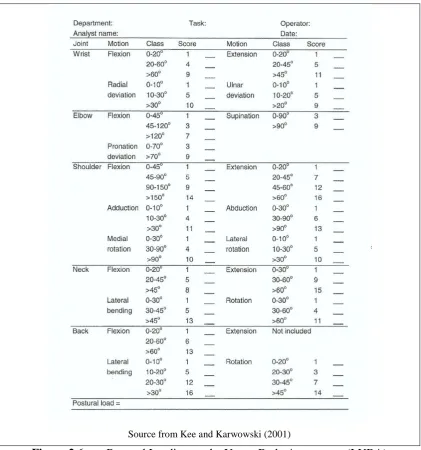
Postural Loading on the Upper-Body Assessment (LUBA) was developed as a survey method for gathering data on the discomfort ratio value of body parts corresponding to the task duration in static postures (Kee and Karwowski, 2001)
23
defined by the results of the same degrees of discomfort in statistical analysis. In this study, the reference point was determined by the relationship of the lowest score of numerical discomfort to the score of discomfort for the elbow flexion. Four categories of different actions have been proposed as criteria to evaluate postural stress during work in order to enable practitioners to make the necessary corrections.
In conclusion, the LUBA tool was developed based on experimental data that analysed postural discomfort depending on the task duration in static postures. However, no formal studies have been conducted to test the reliability of this tool during the development process. Figure 2.6 shows the Postural Loading on the Upper-Body Assessment (LUBA).
Source from Kee and Karwowski (2001)
[image:41.595.109.531.302.753.2]24
2.3.6 Quick Exposure Checklist (QEC)
David et al. (2008) have developed an observational tool called the Quick Exposure Checklist (QEC) to evaluate the ergonomics risk factors related to work-related musculoskeletal disorders (WMSDs). Development of the QEC tool involved two phases in which a total of 206 practitioners participated in order to test, modify and validate this tool using simulated and real workplace tasks. The QEC tool assesses the four main body areas and involves practitioners and employees in the assessment.
During the development process in Phase 1, the validity of the QEC tool was tested by 18 practitioners using the QEC tool to assess four task simulations which were compared to the results of the SIMI 3D computerised motion analysis by experts. The validation was also conducted by comparing the scores of six practitioners with expert assessments using the QEC tool (Li and Buckle, 1999a; Li and Buckle, 1999b). In Phase 2, the validity test was conducted at six organisations and five tasks were assigned to each organisation. Seven practitioners with two experts from the group assessed the each job (David et al., 2005).
In Phase 1, the reliability of QEC was based on comparison of the variation task score conducted by practitioners with the results of SIMI 3D computerised motion analysis by experts (Li and Buckle, 1999a; Li and Buckle, 1999b). Eighteen practitioners viewed the video recordings of 18 industrial static and dynamic activities, including the combination of repetitive and forceful characteristics in seated and standing participants. In Phase 2, the inter-observer reliability was designed to complement the trial results in Phase 1 using video film of the jobs (David et al., 2005).
Training on the QEC assessment involved six practitioners who performed QEC assessment on the small range of the tasks in the workplace. The trial assessment was focused on simulated tasks to familiarize the trainees with the QEC tool and to facilitate discussion with the experts. The practitioners were observed and evaluated on the three tasks involving laboratory work using the QEC tool.
162
REFERENCES
Abbas, M.F., Faris, R.H., Harber, P.I., Mishriky, A.M., El- Shahaly, H.A., Waheeb, Y.H. and Kraus, J.F. (2001). Worksite and personal factors associated with carpal tunnel syndrome in an Egyptian electronics assembly factory. Int J Occup Environ Health. 7, 31–6
ACGIH Threshold Limit Value for Heat Stress and Strain (2006a). Threshold limit values for chemical substances and physical agents and biological exposure indices. American Conference of Governmental Industrial Hygienists.
ACGIH Threshold Limit Value for Noise (2006b). Threshold limit values for chemical substances and physical agents and biological exposure indices.
American Conference of Governmental Industrial Hygienists.
Aldien, Y., Welcomeb, D., Rakhejaa, S., Dongb, R. and Boileauc, P.E. (2005). Contact pressure distribution at hand-handle interface: role of hand forces and handle size. International Journal of Industrial Ergonomics. 35(3): 267-286. Altman, D. G. (1991). Practical Statistics for Medical Research. London: Chapman
and Hall.
Antony, N. T. and Keir, P. J. (2010). Effects of posture, movement and hand load on shoulder muscle activity. Journal of Electromyography and Kinesiology. 20(2): 191-198.
Aptel, M., Aublet, C. A. and Cnockaert, J.C. (2002). Work-related musculoskeletal disorders of the upper limb. Joint Bone Spine. 69(6): 546-555.
Arvidsson, I., Åkesson, I. and Hanssona, G. A. (2003). Wrist movements among females in a repetitive, non-forceful work. Applied Ergonomics 34(4): 309-316. Arvidsson, I., Hansson, G.-Å., Mathiassen, S.E. and Skerfving, S. (2008). Neck
postures in air traffic controllers with and without neck/shoulder disorders.
Applied Ergonomics. 39(2): 255-260.
163
Balogh, I., Ørbæk, P., Ohlsson, K., Nordander, C., Unge, J. and Winkel, J. ( 2004). Self-assessed and directly measured occupational physical activities—influence of musculoskeletal complaints, age and gender. Appl Ergon. 35:49–56.
Beek, V. D. and Dressen, F. (1998). Assessment of mechanical exposure in ergonomic epidemiology. Occup Environ Med. 55: 291–299.
Bernard, B. P. (1997). Musculoskeletal disorders and workplace factors. A critical review of epidemiologic evidence for work-related musculoskeletal disorders of
the neck, upper extremity, and low back. National Institute for Occupational Safety and Health (NIOSH). Cincinnati, OH.
Boschman, J.S., Molen, V. D. H,F., Sluiter. J. K. and Frings-Dresen, M. H. (2011). Occupational demands and health effects for bricklayers and construction supervisors: A systematic review. Am J Ind Med. 54, 55-77.
Brodie, D. M. (2008). Ergonomics Risk Assessment: Determining When, Why, Who and How You Should Perform One (On-line). Occupational Hazard – Web E-Blast. (Accessed 8.7.2010).
Beach, T. A. C., Coke, S. K. and Callaghan, J. P. (2006). Upper body kinematic and low-back kinetic responses to precision placement challenges and cognitive distractions during repetitive lifting. International Journal of Industrial Ergonomics. 36(7): 637-650.
Bernmark. E. and Wiktorin, C. (2002). A triaxial accelerometer for measuring arm movements. Appl Ergon. 33:541–547.
Besa, A. J., Valero, F. J., Suñer, J. L. and Carballeira J. (2007). Characterisation of the mechanical impedance of the human hand-arm system: The influence of vibration direction, hand-arm posture and muscle tension. International Journal of Industrial Ergonomics 37(3): 225-231.
Bin, W. S., Richardson, S. and Yeow, P.H. (2010). An ergonomics study of a semiconductors factory in an IDC for improvement in occupational health and safety. Int J Occup Saf Ergon. 16(3),345-56.
Biometrics Ltd. (1998). Goniometer and Torsiometer Operating Manual. Biometrics Ltd, 1998; 1–24.
164
Buchholz, B., Paquet, V., Punnett, L., Lee, D. and Moir S. (1996). PATH: A work sampling-based approach to ergonomic job analysis for construction and other non-repetitive work. Applied Ergonomic. 27(3): 177-187.
Burdorf, A. (1999). Editorial; In musculoskeletal epidemiology are we asking the unanswerable in questionnaires on physical load? Scand J Work Environ Health.
25:81–83.
Burdorf, A. (2010). The role of assessment of biomechanical exposure at the workplace in the prevention of musculoskeletal disorders. Scand J Work Environ Health. 36(1): 1-2.
Bureau of Labor Statistics (2011). Incidence rates of nonfatal occupational injuries and illnesses by major industry sector. U.S. Department of Labor.
Burgess, R., Plooy, A., Fraser, K. and Ankrum, D.R. (1999). The influence of computer monitor height on head and neck posture. International Journal of Industrial Ergonomics. 23(3): 171-179.
Burström, L. and Sörensson, A. (1999). The influence of shock-type vibrations on the absorption of mechanical energy in the hand and arm. International Journal of Industrial Ergonomics 23(5-6): 585-594.
Busche, K. (2008). Neurologic Disorders Associated with Weight lifting and Bodybuilding. Neurologic Clinics 26(1): 309-324.
Bulthuis, B.M., Begemann, M.J.T., Binkhorst, R.A., Vink, P., Daanen, H.A.M. and Ligteringen, J. (1991). Work load in the building industry. On-site data capture of biomechanical and physiological load of gypsum bricklayers. In: Queinnec,Y. and Daniellou,F. (Eds.)Designing for Everyone: Proceedings of the 11th Congress of the International Ergonomics Association. Paris (London: Taylor and Francis) : Volume 1, pp. 275-277.
Carey, E. J. and Gallwey, T. J. (2002). Effects of wrist posture, pace and exertion on discomfort. International Journal of Industrial Ergonomics. 29(2): 85-94.
Chaffin, D. B., Andersson, G. B. J. and Martin, B. J. (2006). Occupational Biomechanics. (4th ed.). New York : John Wiley & Sons, Inc.
165
Chee, H.L. and Rampal, K.G., (2004b). Work-related musculoskeletal problems among women workers in the semiconductor industry in peninsular Malaysia.
International Journal of Occupational and Environmental Health. 10, 63-71. Chen, F. F., Lo, S. F., Meng, N. H., Lin, C. L. and Chou L. W. (2006). Effects of
wrist position and contraction on wrist flexors H-reflex, and its functional implications. Journal of Electromyography and Kinesiology. 16(5), 440-447. Cherng, J. G., Eksioglu, M. and Kizilaslan K. (2009). Vibration reduction of
pneumatic percussive rivet tools: Mechanical and ergonomic re-design approaches. Applied Ergonomics. 40(2), 256-266.
Chiou, S.S., Pan, C.S. and Keane, P. (2000). Traumatic injury among drywall installers, 1992 to 1995. Journal of Occupational and Environmental Medicine.
42 (11), 1101-1108.
Ciriello, V.M., Snook, S.H., Webster, B.S. and Dempsey, P. (2001). Psychophysical study of six hand movements. Ergonomics. 44: 922–936.
Cohen, J., (1988). Statistical power analysis for the behavioral sciences. Second Edition. Lawrence Erlbaum Associated, Hillsdale, NJ.
Corlett, E. N. and Bishop, R. P. (1976). A technique for assessing postural discomfort. Ergonomics. 19(2): 175-182.
Cornell Task Lighting Evaluation (2007). Research & Tools Kit for Workplace Assessment Tool. Cornell University, USA
Côté, J. N., Raymond, D., Mathieu, P. A., Feldman, A. G. and Levin MF. (2005). Differences in multi-joint kinematic patterns of repetitive hammering in healthy, fatigued and shoulder-injured individuals. Clinical Biomechanics. 20(6): 581-590.
Dane, D., Feuerstein, M., Huang, G., Dimberg, L., Ali, D. and Lincoln, A. (2002). Measurement properties of a self-report index of ergonomic exposures for use in an office environment. J Occup Environ Med. 44:73–81.
David, G. C. (2005). Ergonomic methods for assessing exposure to risk factors for work-related musculoskeletal disorders.Occupational Medicine 55: 190-199. David, G., Woods V. and Buckle, P. (2005). Further Development of the Usability
166
David, G., Woods, V., Li, G. and Buckle, P. (2008). The development of the Quick Exposure Check (QEC) for assessing exposure to risk factors for work-related musculoskeletal disorders. Applied Ergonomics. 39: 57-69.
Diederichsen, L. P., J. Nørregaard, Dyhre-Poulsen, P., Winther, A., Tufekovic, G., Bandholm, T., Rasmussen, L.R. and Krogsgaard, M. (2007). The effect of handedness on electromyographic activity of human shoulder muscles during movement. Journal of Electromyography and Kinesiology. 17(4): 410-419. Devereux, J. J., Vlachonikolis, I. G. and Buckle, P .W. (2002). Epidemiological
study to investigate potential interaction between physical and psychosocial factors at work that may increase the risk of symptoms of musculoskeletal disorder to the neck and upper limb. Occup. Environ. Med. 59: 269-277. Dennis, G. J. and Barrett, R. S. (2003). Spinal loads during two-person team lifting:
effect of load mass distribution. International Journal of Industrial Ergonomic.
32(5): 349-358.
Dolan, P. and Adams, M. A. (1998). Repetitive lifting tasks fatigue the back muscles and increase the bending moment acting on the lumbar spine. Journal of Biomechanics. 31(8): 713-721.
Dong, R. G., McDowell, T. W., Welcome, D.E., Smutz, W.P. , Schopper, A.W., Warren, C., Wu, J.Z. and Rakheja, S. (2003). On-the-hand measurement methods for assessing effectiveness of anti-vibration gloves. International Journal of Industrial Ergonomics. 32(4): 283-298.
Department of Occupational Safety and Health (DOSH) (2010). Statistic Report of Occupational Accidents for the Category of Death until August 2010. Malaysia: DOSH
Department of Occupational Safety and Health (DOSH) (2002). Guideline on Occupational Safety and Health for Standing at Work. Malaysia: DOSH
Department of Occupational Safety and Health (DOSH) (2003), Guideline on Occupational Safety and Health for Seating at Work. Malaysia: DOSH
Duclos, C., Roll, R., Kavounoudias, A,, Mongeau, J. P., Roll, J. P. and Forget R. (2009). Postural changes after sustained neck muscle contraction in persons with a lower leg amputation. Journal of Electromyography and Kinesiology. 19(4): e214-e222.
167
Entzel, P., Albers, J. and Welch, L. (2007). Best practices for preventing musculoskeletal disorders in masonry: Stakeholder perspectives. Applied Ergonomics. 38(5): 557-566.
Faber, G. S., Kingma, I., Bakker, A.J. and Van Dieën, J. H. (2009). Low-back loading in lifting two loads beside the body compared to lifting one load in front of the body. Journal of Biomechanics 42(1): 35-41.
Fong, B. F., Savelsbergh, G. J., Leijsen, M. R., and de Vries J. I. (2009). The influence of prenatal breech presentation on neonatal leg posture. Early Human Development 85(3): 201-206.
Frievalds, A., Kong, Y., You, H. and Park, S. (2000). A comprehensive risk assessment model for work-related musculoskeletal disorders of the upper extremities. Ergonomics for the New Millennium. Proceedings of the XIVth Triennial Congress of the International Ergonomics Association and the 44th
Annual Meeting of the Human Factors and Ergonomics Society, San Diego CA,
USA. 29 July. Human Factors and Ergonomics Society, Santa Monica, CA, USA, Volume 5.
Goldsheyder, D., Weiner, S.S., Nordin, M. and Hiebert, R. (2004). Musculoskeletal symptom survey among cement and concrete workers. Work. 23(2),111-21. Gorelick, M., Brown, J. M. and Groeller H. (2003). Short-duration fatigue alters
neuromuscular coordination of trunk musculature: implications for injury.
Applied Ergonomics. 34(4), 317-325.
Gregory, D. E. and J. P. Callaghan (2008). Prolonged standing as a precursor for the development of low back discomfort: An investigation of possible mechanisms.
Gait & Posture. 28(1), 86-92.
Hales, T. R. and Bernard, B. P. (1996). Epidemiology of work-related musculoskeletal disorders. Orthop. Clin. North Am.( 27): 679-709.
Hall, C. (1997). External pressure at the hand during object handling and work with tools. International Journal of Industrial Ergonomics 20(3): 191-206.
Halperin, K. M. and M. McCann (2004). An evaluation of scaffold safety at construction sites. Journal of Safety Research 35(2): 141-150.
168
Hasson, G-A., Asterland, P., Holmer, N-G.and Skerfving, S. (2001). Validity, reliability and applications of an inclinometer based on accelerometers. In: Hagberg M, Knave B, Lillienberg L,Westberg H, eds. X2001—Exposure Assessment in Epidemiology and Practice. Stockholm, Sweden: National Institute forWorking Life S-112 79, 405–407.
Hess, J.A., Hecker, S., Weinstein, M. And Lunger, M. (2004). A participatory intervention to reduce the risk of low-back injury in concrete laborers. Applied Ergonomics. 35(5),427-41.
Hignett, S. and L. McAtamney (2000). Rapid Entire Body Assessment (REBA).
Applied Ergonomics. 31(2), 201-205.
Holmstrom, E., Moritz, U. and Engholm, G. (1995). Musculoskeletal disorders in construction workers. Occupational Medicine-State of the Art Reviews. 10,295-312.
IOSH, 1996. Evaluating the Cumulative Trauma Disorders Problem in the Semiconductors Industry. Taiwan, ROC: Institute of Occupational Safety and Health, IOSH 85-H326.
Jäger, M., Luttmann, A. and Wolfgang Laurig (1991). Lumbar load during one-handed bricklaying. International Journal of Industrial Ergonomics. 8(3): 261-277.
Jorgensen, K., Jensen, B.R. and Kato, M. (1991). Fatigue development in the lumbar paravertebral muscles of bricklayers during the working day. International Journal of Industrial Ergonomics. 8(3):237-245.
Kadefors, R. and Forsman, M. (2000). Ergonomic evaluation of complex work: a participative approach employing video computer interaction, exemplified in a study of order picking. Int J Ind Ergon. 25:435–445.
Karhu, O., Kansi, P. and Kuorinka, I. (1977). Correcting working postures in industry: A practical method for analysis. Applied Ergonomic 8(4): 199-201. Karnezis, I. A. (2005). Correlation between wrist loads and the distal radius volar tilt
angle. Clinical Biomechanics. 20(3): 270-276.
Kawano, T. (2005). Development of Measuring Device for Lower Leg Swelling Using a Strain Gauge. JSME. International Journal Series C. 4, 592-597.
169
Ketola, R., Toivonen, R. and Viikari-Juntura, E. (2001). Interobserver repeatability and validity of an observation method to assess physical loads imposed on the upper extremities. Ergonomics. 44(119-131).
Keyserling, W. M., Brouwer, M. and Silverstein, B.A. (1992). A checklist for evaluating ergonomic risk factors resulting from awkward postures of the legs, trunk and neck. International Journal of Industrial Ergonomics. 9(4): 283-301. Keyserling, W. M., Brouwer, M., Silverstein, B. A. (1993). The effectiveness of a
joint labor-management program in controlling awkward postures of the trunk, neck, and shoulders: Results of a field study. International Journal of Industrial Ergonomics. 11(1): 51-65.
Khan, A. A., L. O'Sullivan, O’Sullivan, L., Gallwey T. J. (2010). Effect on discomfort of frequency of wrist exertions combined with wrist articulations and forearm rotation. International Journal of Industrial Ergonomics. 40(5): 492-503.
Kilbom, A. (1994a). Assessment of physical exposure in relation to workrelated musculoskeletal disorders—what information can be obtained from systematic observations? Scand. J. Work Environ. Health. 20(special issues): 30-45.
Kilbom, A. (1994b). Repetitive work of the upper extremity: part II—the scientific basis (knowledge base) for the guide. International Journal of Industrial Ergonomics. 14: 59–86.
Kuorinka, I. (1998). The influence of industrial trends on work-related musculoskeletal disorders (WMSDs). International Journal of Industrial Ergonomics. 21(1): 5-9.
Khan, A. A., Sullivan, L. and Gallwey, T. J. (2010). Effect on discomfort of frequency of wrist exertions combined with wrist articulations and forearm rotation. International Journal of Industrial Ergonomics. 40(5): 492-503.
Kuorinka, I. (1998). The influence of industrial trends on work-related musculoskeletal disorders (WMSDs). International Journal of Industrial Ergonomics.21(1): 5-9.
Krejcie, R. and Morgan, D. (1970). Determining sample size for research activities.
Educational and Psychological Measurement. 30:607-610.
Kroemer and Grandjean (1997). Fitting the Task to the Human. (5th Edition)
170
Latko, W. A., Armstrong, T. J., Franzblau, A., Ulin, S. S., Werner, R. A. and Albers, J. W. (1999). Cross-sectional study of the relationship between repetitive work and the prevalence of upper limb musculoskeletal disorders. Am. J. Ind. Med. 36: 248–259.
Li, G. and Buckle, P. (1999a). Current techniques for assessing physical exposure to work-related musculoskeletal risks, with emphasis on posture-based methods.
Ergonomics. 42, 674-695.
Li, G. and Buckle, P. (1999b). Evaluating Change in Exposure to Risk for
Musculoskeletal Disorders—A Practical Tool. University of Surrey, Guildford: Health and Safety Executive.
Lin, V. (1991). Health, Women’s Work, and Industrialization: Semiconductor
Workers in Singapore and Malaysia (174). New York & London: Garland Publishing.
Lipscomba, H. J., Glaznerb, J. E., Bondy, J., Guarinic, K. and Lezotteb, D. (2006). Injuries from slips and trips in construction. Applied Ergonomics. 37(3): 267-274.
Luttmann, A, Jäger, M. and Laurig, W. (1991). Task analysis and electromyography for bricklaying at different wall heights. International Journal of Industrial Ergonomics .8(3): 247-260.
Maiti, R. (2008). Workload assessment in building construction related activities in India. Applied Ergonomic.s 39(6): 754-765.
Malchaire, J. B., Roquelaure, Y., Cock, N. , Piette, A., Vergracht, S. and Chiron, H. (2001). Musculoskeletal complaints, functional capacity, personality and psychosocial factors. Int .Arch .Occup .Environ. Health. (74): 549-557.
Marras, W., Fathallah, F., Miller, R., Davis, S. and Mirka, G. (1992). Accuracy of a three-dimensional lumbar motion monitor for recording dynamic trunk motion characteristics. Int J Ind Ergon. 9:75–87.
McAtamney, L. and Corlett, E. N. (1993). RULA: a survey method for the investigation of work-related upper limb disorders. Applied Ergonomics. 24(2): 91-99.
171
Merletti, R. and Parker, P. (1999). Electromyography. In: Wiley Encyclopaedia of Electrical and Electronics Engineering, Vol. 6 : 523–540.
Mogk, J. P. M. and Keir, P. J. (2008). Wrist and carpal tunnel size and shape measurements: Effects of posture. Clinical Biomechanics. 23(9): 1112-1120. Mork, P. J. and R. H. Westgaard (2009). Back posture and low back muscle activity
in female computer workers: A field study. Clinical Biomechanics. 24(2): 169-175.
Necking, L. E., Lundborg, G., Lundström, R., Thornell, L. E. and Fridén, J. (2004). Hand muscle pathology after long-term vibration exposure. The Journal of Hand Surgery: Journal of the British Society for Surgery of the Hand. 29(5): 431-437. Neumann, W. P., Wells, R. P., Norman, R.W., Frank, J., Shannon, H. and Kerr,
M.S. (2001a). Trunk posture : reliability, accuracy, and risk estimates for low back pain from a video based assessment method. International Journal of Industrial Ergonomics. 28(6): 355-365.
Neumann, W. P., Wells, R. P., Norman, R.W., Frank, J., Shannon, H. and Kerr, M.S. (2001b). A posture and load sampling approach to determining low-back pain risk in occupational settings. International Journal of Industrial Ergonomic.s 27(2): 65-77.
Nimbarte, A. d., Aghazadeh, F., Ikuma, L.H. and Harvey, C.M. (2010). Neck Disorders among Construction Workers: Understanding the Physical Loads on the Cervical Spine during Static Lifting Tasks. Industrial Health. 48: 145-153. Noy, Y. I., Lemoine, T. L., Klachan, C. and Burns, P.C. (2004). Task interruptability
and duration as measures of visual distraction. Applied Ergonomics. 35(3): 207-213.
Occupational Safety and Health Administration (OSHA) (2000). Ergonomics program standard. Washington, DC: Occupational Safety and Health Administration (OSHA).
Pocekay, D., McCurdy, S. A., Samuels, S. J., Hammond, K. and Schenker, M. B. (1995). A cross-sectional study of musculoskeletal symptoms and risk factors in semiconductor workers. American Journal of Industrial Medicine. 28, 861-871. Pope, D., Silman, A., Cherry, N., Pritchard, C. and MacFarlane G. (1998). Validity
of a self completed questionnaire measuring the physical demands of work.