
EFFECT OF FIELD UTILIZATION FACTOR ON AIR BREAKDOWN LEVEL UNDER LIGHTNING IMPULSE
NOOR AIN BINTI YUSOFF
A project report submitted in partial
fulfillment of the requirement for the award of the Master of Electrical Engineering
Faculty of Electrical and Electronic Engineering Universiti Tun Hussein Onn Malaysia
ABSTRACT
The goal of this project is to develop a relationship between field utilization factor (ɳ) and air breakdown level under lightning test. Standard lightning impulse of 1.2/50 is used in this study, along with three difference electrode configurations (rod-rod elect(rod-rode, (rod-rod-sphere elect(rod-rode and sphere-sphere elect(rod-rode) with variable gap lengths. In addition, the lightning impulse breakdown level considering utilization factors are studied for the establishment of insulation design criteria of high voltage power equipment. The utilization factors are represented as the ratio of minimum electric field (Emin) to maximum electric filed (Emax). COMSOL software is used to
develop electrode model in order to analyses the electric field. It was found that higher gap lengths provide higher U50 for a given electrode configuration, although
the rise in U50 is more clearly in sphere-sphere electrode configuration. Where,
sphere-sphere electrode configuration require higher U50 to breakdown it is 40% than
rod-sphere electrode configuration (30%) and rod-rod electrode configuration (28%), respectively. A difference in Emax values where the higher gap length provide lower
Emax for sphere-sphere electrode configuration, while the higher gap length provide
higher Emax for rod-rod and rod-sphere electrode configurations. Considering the
effects of field utilization factor, which was based on difference electrode configurations, it was found that sphere-sphere electrode more uniformity at gap length 0.5 cm (0.9968) than rod electrode at gap length 1 cm (0.2057) and rod-sphere electrode at gap length 1 cm (0.1546). Where the values of each field utilization factor (ɳ) is 1 in the uniform field and 0<ɳ<1 is in the non-uniform. Furthermore, it can be concluded that electrode configuration, which includes electrode geometry and gap length, plays a big role in determining U50 values for air
vii
ABSTRAK
Tujuan projek ini adalah untuk membangunkan satu hubungan diantara faktor penggunaan bidang (ɳ) dan tahap pecahan udara dibawah ujian kilat. Piawaian denyutan kilat 1.2/50 telah digunakan dalam kajian ini, beserta dengan tiga susunan elektrod yang berbeza-beza (rod-rod elektrod, rod-sfera elektrod dan sfera-sfera elektrod) dengan panjang diantara dua elektrod yang berubah-ubah. Selain itu, ciri-ciri pecahan denyutan kilat yang dikaji telah mempertimbangkan faktor-foktor penggunaan bagi penubuhan kriteria reka bentuk penebat peralatan kuasa voltan tinggi. Faktor-faktor penggunaan yang dimaksudkan adalah nisbah bagi minimum medan elektrik (Emin) sehingga maksimum medan elektrik (Emax). Perisian COMSOL
digunakan untuk membangunkan model elektrod seterusnya menganalisis medan elektrik. Ia telah mendapati bahawa panjang diantara dua elektrod yang lebih tinggi menyediakan U50 yang lebih tinggi untuk konfigurasi elektrod yang diberikan,
walaupun kenaikan U50 adalah lebih jelas dalam konfigurasi elektrod sfera-sfera. Di
mana, konfigurasi elektrod sfera-sfera memerlukan U50 lebih tinggi untuk berlaku
pecahan iaitu 40% daripada konfigurasi rod-sfera elektrod (30%) dan konfigurasi elektrod rod-rod (28%), masing-masing. Berbeza dengan nilai Emax di mana semakin
luas panjang diantara dua elektrod, semakin rendah nilai Emax bagi konfigurasi
elektrod sfera-sfera, manakala semakin luas panjang diantara dua elektrod, semakin tinggi nilai Emax bagi konfigurasi elektrod rod-rod dan rod-sfera. Dengan mengambil
ia boleh disimpulkan bahawa konfigurasi elektrod, yang merangkumi geometri elektrod dan panjang jurang, memainkan peranan yang penting dalam menentukan nilai-nilai U50 pada tahap pecahan udara seterusnya memberi kesan kepada
ix
LIST OF CONTENT
TITLE i
DECLARATION ii
DEDICATION iv
ACKNOWLEDGEMENT v
ABSTRACT vi
LIST OF CONTENT ix
LIST OF TABLE xii
LIST OF FIGURE xiii
LIST OF SYMBOLS AND ABBREVIATION xvi
CHAPTER 1 INTRODUCTION 1
1.1 Project Background 1
1.2 Problem Statement 2
1.3 Objective 3
1.4 Scope of Project 3
1.5 Content of Report 3
CHAPTER 2 AIR BREAKDOWN UNDER LIGHTNING
IMPULSE: A REVIEW 5
2.1 Introduction 5
2.2 Lightning Threat 6
2.2.1 Mechanism of Lightning Occurrence 6 2.2.2 Effect of Direct Lightning Strikes 7 2.2.3 Effects of Induced lightning from
2.3 Air Breakdown 8
2.3.1 Breakdown of Gases 9
2.3.2 Non-Sustaining Discharges and
Self-Sustaining Types 10
2.4 50% Breakdown Voltage of Air 12
2.5 Analysis Electric Field from Previous Work 14
2.6 Lightning Impulse Voltage 17
2.6.1 Tolerance 19
2.7 Capacitive Voltage Divider 19
2.8 Electric Field 20
2.8.1 Uniform and Non Uniform Electric
Field 21
2.9 Equipotential Lines 23
2.10 Conclusion 24
CHAPTER 3 EXPERIMENTAL SETUP AND SIMULATION
TECHNIQUE 25
3.1 Introduction 25
3.2 Testing 25
3.2.1 Lightning Impulse Circuit 26
3.2.2 Block Diagram Lightning Impulse
Circuit 28
3.2.3 Single-stage Impulse Voltage Generator 29 3.2.4 Lightning Impulse Setup on the
Control Desk (HV9103) Procedure 30 3.2.5 Lightning Impulse Waveform 1.2/50 us
Standard by the experimental 32
3.2.6 Up-And-Down Method 35
3.3 Simulation 36
3.3.1 Finite Element Method 36
3.3.2 Create the Model 37
3.3.3 Material properties 39
3.3.4 Boundary Condition 39
xi
3.3.6 Solver Setting 41
3.4 Conclusion 41
CHAPTER 4 BREAKDOWN LEVEL OF AIR UNDER LIGHTNING IMPULSE: EFFECT OF
ELECTRODE CONFIGURATION AND GAP
LENGTHS 43
4.1 Effect of Electrode Configuration 43
4.2 U50 for difference electrode configuration 47
4.3 Electric Potential (kV) for difference
Electrode configuration 45
4.4 Maximum Electric Field (Emax) for
difference Electrode Configuration 47
4.5 Effect of Gap Length 56
4.6 Effect of Gap Length for U50 57
4.7 Effect of Gap Length for Maximum
Electric Field, Emax 58
4.8 Effect of Gap Length for Field Utilization
Factor, ɳ 59
4.9 Relationship between maximum
electric field, Emax (kV/cm) and U50 (kV) 61
4.10 Conclusion 62
CHAPTER 5 GENERAL CONCLUSION AND
RECOMANDATION 64
5.1 Conclusion 64
5.2 Recommendation for Future Work 65
LIST OF TABLES
2.1 Field utilization factor for each electrode configuration
with V=1 kV 15
2.2 Tolerances of lightning impulse 19
3.1 Component description for the experimental setup lightning
Impulse 27
3.2 Standard impulse voltage tolerances (1.2/50 µs) 33 4.1 U50 (kV) for difference electrode configuration 44
4.2 Emax for difference electrode configurations (kV/cm) 51
4.3 Field utilization factor, ɳ for difference electrode 53 4.4 U50 (kV) and field utilization factor, ɳ, for all electrodes 53
4.5 Emax (kV) and field utilization factor, ɳ, for all electrodes 53
4.6 Sphere-sphere electrode configuration 56
4.7 Rod-rod electrode configuration result 56
xiii
LIST OF FIGURES
2.1 Lightning 6
2.2 Lightning generation mechanism 7
2.3 Effect of direct lightning strikes 7
2.4 A lightning surge is unbound charge flowing into
the ground 8
2.5 Ionisation by electron collision with gas 9
2.6 Secondary ionization due to cathode collision 11
2.7 An avalanche, consisting of fast moving electrons and
slow positive ions 11
2.8 Streamer formation 12
2.9 U50 (kV) for rod-plane electrode 13
2.10 U50 (kV) for sphere-sphere electrode 13
2.11 Lines of electric field with equal magnitudes with maximum electric field region at the edge of the
electrode for plane-plane configuration (kV/cm) 14 2.12 Lines of electric field with equal magnitudes with
maximum electric field region at the tip of, (a) rod-plane configuration and (b) sphere gap
configuration (kV/cm) 15
2.13 Maximum electric field (kV/cm) vs. gap distance (cm) 16 2.14 (a) Full lightning impulse voltage, (b) lightning impulse
voltage chopped on the tail, (c) lightning impulse voltage
chopped on the front 18
2.15 Capacitive Divider 20
2.17 Magnitud and direction same at all point 22
2.18 Different movement of magnitude and direction 23
2.19 Equipotential lines and electric field (E) 24
3.1 Experimental setup for generation of lightning
impulse voltages in HV laboratory 26
3.2 Schematic circuit for generation of lightning impulse
voltages 27
3.3 Block diagram lightning impulse circuit 28
3.4 Single-stage impulse voltage generator circuit 29
3.5 Turn ON at Control Desk procedure 31
3.6 Turn OFF at Control Desk procedure 32
3.7 Front time (T1) for lightning impulse waveform 33
3.8 Tail time (T2) for lightning impulse waveform 34
3.9 Breakdown waveform 34
3.10 Flowchart up-and-down method 35
3.11 General procedures for FEM simulations in COMSOL
Multiphysics 36
3.12 A 2D axis-symmetric model in COMSOL
Multiphysics for rod-sphere electrode configuration 37 3.13 A 2D axis-symmetric model in COMSOL Multiphysics
for rod-rod electrode configuration 38
3.14 A 2D axis-symmetric model in COMSOL Multiphysics
for sphere-sphere electrode configuration 38
3.15 The meshing of model (rod electrode) 40
3.16 The maximum value of electric field in 2D graph 41 4.1 Contour of electric potential for three electrode
configurations at gap length 2 cm, where, (a) rod-rod electrode, (b) rod-sphere electrode, and (c) sphere-sphere
electrode 46
4.2 Electric potential (kV) graph from point ‘a’ to point
‘b’ for electrode configurations. 47
4.3 Lines of electric field with equal magnitudes with maximum electric field region at the tip of the
xv
4.4 Lines of electric field with equal magnitudes with maximum electric field region at the tip of the
electrode for rod-sphere configuration (kV/cm) 48
4.5 Lines of electric field with equal magnitudes with maximum electric field region at the edge of the
electrode for sphere-sphere configuration (kV/cm) 49 4.6 Electric field magnitude along the gap of rod-rod
electrode (Refer for the Figure 4.3) 50
4.7 Electric field magnitude along the gap of rod-sphere
electrode (Refer for the Figure 4.3) 50
4.8 Electric field magnitude along the gap of sphere-sphere
electrode (Refer for the Figure 4.5) 51
4.9 U50 (kV) curve in relation to the field utilization
factor, ɳ, for all electrode configuration 54
4.10 Emax (kV/cm) curve in relation to the field utilization
factor, ɳ, for all electrode configuration 55
4.11 Relationship between U50 (kV) versus gap length (cm) 58
4.12 Relationship between maximum electric field,
Emax (kV/cm) versus gap length (cm) 59
4.13 Relationship between gap length (cm) versus field
utilization factor, ɳ 60
4.14 Relationship between maximum electric field,
LIST OF SYMBOLS AND ABBREVIATIONS
Emax - Maximum electric field
Emin - Minimum electric field
ɳ - Field utilization factor
U50 - 50% breakdown voltage
LI - Lightning impulse
UTHM - Universiti Tun Hussein Onn Malaysia
AC - Alternating current
DC - Direct current
HV - High voltage
cm - Centimeter
kV/cm - Kilo volt/centimeter
` `
CHAPTER 1
INTRODUCTION
1.1 Project Background
The accidents caused by insulating instability have been increasing in high voltage power equipment. It is important to increase the insulation reliability of a high voltage power equipment to reduce the damage from electrical hazards such as, spark over voltage causes by the lightning stroke. As an engineer’s, it is important to built a perfect and safe condition of high voltage power equipment, (such as overhead line, substation equipment and various air insulated high voltage equipment) in providing electricity to the consumers [1]. To develop electrically reliable high voltage power equipment, the study on the relationship between field utilization factor and air breakdown level under lightning test is needed. The tests were performed using the international IEC standards [2].
This project used three pair of electrode configurations such as rod-rod electrode configuration, rod-sphere electrode configuration and sphere-sphere electrode configuration. It is used to measure U50 (kV) values for each breakdown
In addition, the lightning impulse breakdown characteristics considering utilization factors are studied for the establishment of insulation design criteria of high voltage power equipment. The utilization factors are represented as the ratio of minimum electric field (Emin) to maximum electric filed (Emax). To develop electrode
model by using COMSOL software in order to analyses the electric field.
1.2 Problem Statement
In electrical power system, high voltage power equipment is mainly subjected with spark over voltage causes by the lightning stroke. The lightning strikes on the overhead transmission line. The strikes on the shield wire would transmit the induced voltage to the ground. The strikes on the lines would cause dual travelling waves in which the surges will travel to the generator and to the distribution sides. Voltage induced would cause damage to the component (such as transformer, generator, fuses and connector). Coordination gap is placed on the line to re-direct the surge to the ground.
In an electricity network, some of the high voltage application make use of gas as insulation medium, such as in the gas insulated switchgear (GIS), gas insulated transmission line (GIL) and gas circuit breaker (GCB). Whereby air insulated is categories in gas insulated [3]. In the high voltage power equipment more electrode configuration can use for measurement electric field which is sphere-sphere, sphere-plate, rod-rod, rod-plate and plate-plate. However, in this project only use three pairs of electrode configurations there are rod-rod electrode configuration, rod-sphere electrode configuration and sphere-sphere electrode configuration. For example by placing different gap length between three pair of electrode configurations and apply U50 (kV) values may be can get the difference value of
3
1.3 Objective
The main objectives of this project are:
i. To find the air breakdown voltage level and electric field for different electrodes configuration using lightning impulse test.
ii. To develop electrode model using COMSOL software in order to analyses the electric field.
iii. To develop the relationship between field utilization factor and air breakdown level under lightning impulse.
1.4 Scope of Project
i. Maximum impulse voltage is 140 kV, but for safety reasons, the allowable limit is 100 kV.
ii. Use air = gas at atmosphere P = 1bar.
iii. Temperature and humidity effect are not considered. iv. Gap length < 5 cm due to the limitation on the impulse.
v. Simulation work carried out in 2D axisymmetric plane only.
1.5 Content of Report
This thesis divided into five chapters which are including the introduction, air breakdown under lightning impulse: a review, experimental setup and simulation technique, effect of electrode configurations and effect of gap length, and general conclusion and recommendation. This thesis focused for the effect of field utilization factor on air breakdown level under lightning impulse.
Previous related works in this chapter helps a lot to guide and as reference in this project.
Chapter 3 emphasizes on the methodology to the whole project consisting procedure of testing and simulation. In this chapter the apparatus required for measurement of air breakdown voltage, description of equipment used for air breakdown test, schematic diagram for air breakdown voltage and experimental procedure for conducting the air breakdown voltage are discussed.
Chapters 4 consist of result and analysis from test and simulation. In this chapter discusses about results and discussion part of the thesis and all the results are furnished in a tabular as well as the graphical from to clarify the objective of the thesis. It is also covers the difference types of performance characteristics of air breakdown voltage with difference physical condition.
CHAPTER 2
AIR BREAKDOWN UNDER LIGHTNING IMPULSE: A REVIEW
2.1 Introduction
Lightning is a high frequency electrical phenomenon which causes overvoltage on all conductive items, especially on electrical cabling and equipment. A lightning stroke can fall near an electrical power line. It is the electromagnetic radiation of the lightning current that produces a high current and an overvoltage on the electric power supply network. In the latter two cases, the hazardous current and voltage are transmitted by the power supply network thus will occur breakdown in equipment electrical.
2.2 Lightning Threat
With the spread of advanced information technology trough out society in recent years, lightning damage is having an increasing effect on the electronic equipment, computer system, and networks that play an important role and are indispensible for comfortable living. Conventional lightning rods guide lightning through lightning conductions rod, such as a building’s steel framework, so that a large current flows to the ground. As a result, electromagnetic induction occurs, and a large surge current flows in the ground, which causes damage to electronic equipment by penetration from power supplies or communication cable and so on. Figure 2.1 shows example the picture of the lightning occurred [5].
Figure 2.1: Lightning [4]
2.2.1 Mechanism of Lightning Occurrence
7
Figure 2.2: Lightning generation mechanism[4]
Normally, a positive charge accumulates in the top of a thunder cloud and a negative charge accumulates in the bottom, so positively charged static electricity is induced near the ground surface. In this way, a strong electric field is generated between the thunder cloud and the earth, and when this exceeds the insulation capacity of the air, lightning is generated [6].
2.2.2 Effect of Direct Lightning Strikes
When lightning strikes a lightning rod, a large lightning current flows into the groundthrough the lightning rod conduction wires and the steel framework of the building. A magnetic field is generated by this excessive electric current, and a surge voltage is induced in cables and electronic equipment by electromagnetic induction. Also, an induced voltage is generated in equipment near the grounding cables and in buried electric lines by the surge current that flows into the earth.
[image:19.595.130.511.603.707.2]Figure 2.3 shown effects of direct lightning strikes. Lightning current is large in the range 1 to 200 kA, and the rise time is large (9 to 5kA/µs), so a large surge voltage is generated that is capable of causing damage to nearby electronic equipment such as computer system and telephone exchanges [7].
2.2.3 Effects of Induced lightning from Overhead Electric and so on
[image:20.595.137.499.402.529.2]Induced lightning surges that penetrate from power supply lines and so on. As a result of the discharge in the lightning and thunder clouds and so on, the balance in the previously balanced electrostatic charge in overhead electric lines becomes unbalanced, so surge current flows into equipment from power supply lines and telephone lines and so on, which have surge current, so damage can result. Figure 2.4 show a lightning surge is unbound charge flowing into the ground [7].
Figure 2.4: A lightning surge is unbound charge flowing into the ground [4]
2.3 Air Breakdown
9
is sufficiently high that free electrons are accelerated hard enough to ionise atoms they collide with. This means that as the current flows it keeps a population of ion and free electron present. However if the potential gradient is too low, free electrons cannot ionise other atoms, and the populations of ions and free electrons is readily depleted. Then, need some external influence to ionize the gas in order to get current flow. This is a non-sustaining discharge [8]. Townsend theory and streamer theory are the present two types of theories which explain the mechanism of breakdown under different conditions as temperature pressure, nature of electrode surfaces, electrode field configuration and availability of initial conducting particles. Normally air medium is widely used as an insulating medium in different electrical power equipment and overhead lines as its breakdown strength is 30kV/cm [9].
2.3.1 Breakdown of Gases
The gases are act as excellent insulator at normal temperature and pressure. The current conduction is on the order of 10-10 A/cm2. This currentconduction results from the ionisation of air by the cosmic radiation and the radioactive substances present in the atmosphere and the earth.The ionisation process can be explained by considering the uniform field between electrodes, as shown in Figure 2.5. The space between the plates is filled by gas atoms or molecules with free space between them.
The process is initiated by the presence of free electrons in the atmosphere, due to ionisation by cosmic radiation. Such an initial electron is accelerated in the field away from the negatively charged plate (the negatively charged electron is repelled by the negative electrode) and it may collide against an atom or molecule of the gas.If the initial electron attains a high enough speed, it may, during an inelastic collision, transfer some of its kinetic energy to the gas molecule. If this energy exceeds the ionisation energy of the gas atom, one or more electrons may leave their orbits and the atom will lose a negative charge, thus becoming a positive ion. The free electrons are accelerated towards the positive electrode and may, depending on the density of the atoms, partake in further collisions. As will be seen later, the probability of a collision depends on how densely the atoms are packed. This explanation has been discussed by [11], [12].
2.3.2 Non-Sustaining Discharges and Self-Sustaining Types
In order to understand the breakdown phenomenon in gases, the electrical properties of gases should be studied. The processes by which high currents are produced in gases are essential. The electrical discharges in gases are of two types:
i. Non-sustaining discharges ii. Self-sustaining types
11
[image:23.595.219.418.69.207.2]Figure 2.6: Secondary ionization due to cathode collision [10]
Figure 2.7: An avalanche, consisting of fast moving electrons and slow positive ions [10]
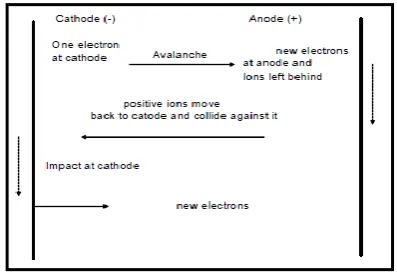
It is clear that the number of electrons and positive ions increase exponentially with the length of the discharge. Such a discharge is called an avalanche. A typical avalanche is shown in Figure 2.7. The mass of a hydrogen positive ion is 1860 that of an electron. It therefore accelerates much slower than the electron. The fast moving high (high mobility) electrons are at the tip of the avalanche with the heavy positive ions (low mobility) moving slowly towards the negative electrode. The discharges as described in this section are non-self-sustaining, for example they continuously require initiating electrons and as soon as the initiating electrons cease to appear, the process stop. Such avalanches alone cannot lead to flashover, but require a positive feed-back process to develop into a flashover. Townsend showed that secondary processes, such as ion impact at the cathode or photo-ionisation, provide such feed-back [13].
Distance
Figure 2.8: Streamer formation [10]
The self-sustained gas discharge(streamer discharge)showed that, if the length of the avalanche becomes large, the negative and positive charges in the avalanche distort the field to such an extent that new avalanches from ahead of the original avalanche, eventually bridging the gap. As shown in Figure 2.8, the fields, caused by the space charge, strengthen the applied field in the regions ahead and towards the tail of the original streamer. The ionization coefficient α is a function of the field strength (E) and it is therefore increased in these regions, to such an extent that new avalanches are triggered by photons that emerge from the original avalanche. This explanation was stated by [12], [13].
2.4 50% Breakdown Voltage of Air
A study on U50 has been carried out by [14], [15], [16]. The experiments have been
13
Figure 2.9: U50 (kV) for rod-plane electrode [16]
Further tests on U50 have been carried out by [17], [18], [19]. Standard lightning
impulse of 1.2/50 is used in this study, along with sphere-sphere electrode configuration with variable gap length. By applying the up-and-down method to get 50% breakdown value, the results from this study were obtained (see Figure 2.10).
Figure 2.10: U50 (kV) for sphere-sphere electrode [18]
Referring to Figure 2.9 and Figure 2.10, it is clear the U50 values increase
with increase the gap length. In both electrode configurations, the U50 curves increase
linearly with the proportion gap length. Therefore, from this study the result shows a linear relationship between gap length and breakdown voltage.
U50
[image:25.595.217.420.429.626.2]2.5 Analysis Electric Field from Previous Work
Studies on electric field have been carried out by [20]. This paper describes sparkover characteristics of CF3I-Co2, gas mixture, with focus on 30%-70% mixture.
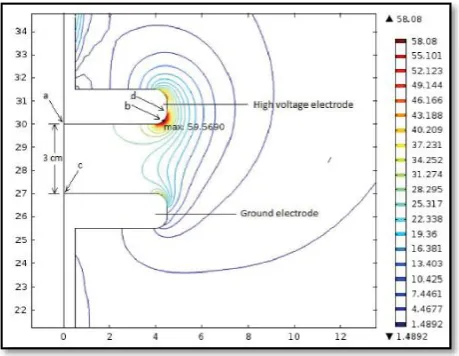
Standard lightning impulse of 1.2/50 is used in this study. By using three difference electrode configurations with variable gap lengths, the results from this study were obtained (see Figure 2.11 and Figure 2.12).
As a clearly shown in Figure 2.11, the maximum electric field, Emax occurs at
the very edge of the high voltage plane electrode at gap length 3 cm. Figure 2.12 shows that the Emax occurs at the tip of R12 and sphere high voltage electrode at gap
length 4 cm and 1 cm, respectively. Whereby red lines shows the maximum electric field and the blue lines shows the minimum electric field.
[image:26.595.204.434.463.641.2]From Figure 2.11 and Figure 2.12, the maximum electric field is focused on a small surface at high voltage electrode. This is the most likely location where the pre-discharges will occur, followed by air breakdown. This study shows that, a small surface on the electrode lead to the occurrence of maximum electric field values. This results is the same as reported by [15], [18], [21].
15
(a)
[image:27.595.206.433.67.489.2](b)
Figure 2.12: Lines of electric field with equal magnitudes with maximum electric field region at the tip of, (a) rod-plane configuration and (b) sphere gap configuration
(kV/cm) [20]
Table 2.1: Field utilization factor for each electrode configuration with V=1 kV [20]
[image:27.595.122.542.621.684.2]determind by the shape and the arrangement of electrode. So, the electric field utilization factor of the similar electrode arrangements should be almost same. The value of each factor (ɳ) is 1 in the uniform field and 0 < ɳ< 1in the non-uniform field [22]. Referring to the table 2.1, the results of field utilization factor for each electrode configuration with V= 1 kV has been carried out by [20]. It is found that higher gap length provides higher U50 and Emax for a given electrode configuration, although the
rise in U50 is more obvious in sphere-sphere configuration, due to more uniform
field.
Further tests on electric field have been carried out by [17]. This paper describes measurement of air breakdown voltage and electric field using standard sphere gap. The experiment is conducted at the normal temperature and pressure. Finite element method is used for finding the electric field between standard sphere electrodes. The electric field distribution for sphere gap arrangements is also calculated with the help of COMSOL. By using sphere gap electrode with standard diameter of 25 cm and variable gap length, the results from this study were obtained (see Figure 2.13). Figure 2.13 shows that the maximum electric field decreases with the increase in the gap distance. In the beginning there is sharp drop in the maximum electric field but it gradually saturates with increase in the gap distance. It found that, from this study that higher gap distance provides higher Emax for a sphere-sphere
electrode configuration. This result is the same as described by [18].
17
2.6 Lightning Impulse Voltage
As mentioned that lightning impulse also known as the fast-front overvoltages (FFO).This is due to very fast rise-time occurring on the waveform shape. The electrical strength of high voltage apparatus against external overvoltage that can appear in power supply system due to lightning strokes is tested with lightning impulse voltage. One differentiates thereby between full and chopped lightning impulse voltage [2]. A standard full lightning impulse voltage rises to its peak value in less than a few microseconds and falls, appreciably slower, ultimately back to zero (Figure 2.14a). The rising part of the impulse voltage is referred to as the front, the maximum as the peak and the decreasing part as the tail. Chopping of a lightning impulse voltage in the test field is done by a chopping gap, whereby one differentiates between chopping on the tail (Figure 2.14b), at the peak and on the front (Figure 2.14c). The standard chopped lightning impulse voltage has a time to chopping between 2 µs (chopping at the peak) and 5 µs (chopping on the tail) (Figure 2.14b). The voltage collapse on the tail shall take place appreciably faster than the voltage rise on the front. Due to such rapid voltage collapse, the test object is subjected to an enormously high stress. Special requirements may be placed on the form of chopped impulse voltages for individual high voltage apparatus. Lightning impulse voltage chopped on the front have times to chopping between 2 µs and low down to 0.5 µs. At short times to chopping, the waveform at the front between 0.3 on the peak voltage and the chopping instant is nearly. If variations from linearity are found within ±5 % of the front time[23].
(a)
(b)
(c)
Figure 2.14: (a) Full lightning impulse voltage, (b) lightning impulse voltage chopped on the tail, (c) lightning impulse voltage chopped on the front [2]
The various lightning impulse voltage are identified in the test specifications by the following time parameters [2]:
i. Front time T1 and To half value T2 for full lightning impulse voltages
ii. Lightning impulse voltage chopped on the front between 0.5 µs to 2 µs iii. Lightning impulse voltage chopped on the tail between 2 µs to 5 µs
For charactherising a full impulse voltage, numerical values of front times and times to half value in microseconds are introduced as symbols. The standard 1.2/50 lightning impulse voltage has accordingly a front time T1 = 1.2 µs and a tail
time T2 = 50 µs. kV
kV
t
19
2.6.1 Tolerance
While generating impulse voltages, deviations from the impulse parameter of the test standards laid down for high voltage apparatus are permissible. The tolerances for lightning impulse voltages amount shown in table 2.2.
Table 2.2: Tolerances of lightning impulse [2]
Lightning Impulse Front Time (T1) Tail Time (T2)
Tolerances ±30% ±20%
Standard Time (µs) 1.2 50
Voltage 0.90Vpeak 0.5Vpeak
The reason for the large amount of tolerances on the time parameters lies in the varying degrees of interaction of the test objects with the generator circuit, due to which the waveform and thus, the time parameter of the generated lightning impulse voltage are affected to a greater or smaller extent. The elements of the lightning impulse voltage generator with which the waveform is obtained need not be changed each time the load presented by the test object is marginally altered. No tolerances are fixed for the time to chopping Tc[24].
2.7 Capacitive Voltage Divider
Figure 2.15: Capacitive Divider
Capacitive divider formula:
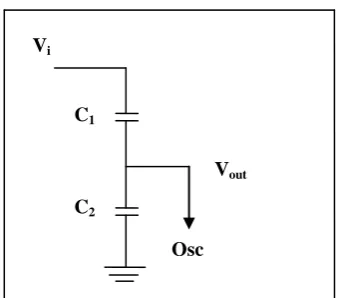
Figure 2.15 shows the capacitive divider that is connected in series. Whereby the capacitor with the smaller capacitance will have the greater voltage, and conversely, the capacitor with the smaller greater capacitance will have the smaller voltage [25]
2.8 Electric Field
An electric field is generated by electrically charged and time-varying magnetic field. The electric field describes force experienced by a motionless positively charged to negatively charge. The electric field direction is always direct away from positive source charges and toward negative source charges such as figure 2.16. Surrounding any object with charge, or collection of objects with charge, is an electric field. Any charge placed in an electric field will experience an electrical force.
Vi
C1
C2
21
(a).Positive Charge (b) Negative Charge
(c).Positive and Negative Charge (d) Positive and PositivCharge
Figure 2.16: Direction of an electric field[22]
Some fieldsare uniform (parallel, equally spaced fields lines) such as the field on the left formed by a sheet of negative charge. Nonuniform fields are stronger where the field lines are closer together, such as the field on the right produced by a sphere of negative charge [26].
2.8.1 Uniform and Non Uniform Electric Field
Figure 2.17: Magnitud and direction same at all point[26]
A uniform electric field is one whose magnitude and direction is same at all points in space and it will exert same force of a charge regardless of the position of charge in space such as figure 2.17. It is represented by parallel and evenly spaced lines. For example we find uniform electric field between parallel plates of a capacitor. The equipotential surfaces(dotted lines) drawn normal to the field lines are also equidistance from each other.
ii. Non uniform electric field
23
Figure 2.18: Different movement of magnitude and direction[27]
2.9 Equipotential Lines
Figure 2.19: Equipotential lines and electric field (E) [28]
2.10 Conclusion
In this chapter, a review on the air breakdown under lightning impulse has been presented.From the reading of previous work, explanation is the lightning threat and air breakdown in gases, from the study can determine the factors causing air breakdown in gases. Besides, it can know the characteristics of the damage occurred in the gas as Townsend and Streamer. Besides, by refer from variable sources such journals, books, websites and articles, the data and information can be collected. The research and deep study all related journal, book, manual guide, blog and another reference helped a lot in understanding this project and also as a guide along this project.
In addition, the study on lightning impulse voltage has been carried out, explaining that the waveforms according to IEC international standard for the 1.2 / 50 lightning impulse waveform. Study on standard lightning impulse waveform is important to know correct circuit used during the test run. Study on electric field is also important to know the characteristics that exist on electric field.
Equipotential Lines
REFERENCE
[1] M.E. E1-Hawary, Introduction to Electrical Power System. Institute of Electrical Engineering; 2008.
[2] BSI Standards Publication. High Voltage Test Techniques, Part 1: General Definitions and Test Requirements. IEC 60060-1:2010.
[3] JP Holtzhausen. WL Vosloo. High Voltage Engineering. Practice and Theory. 2013. 47-84.
[4] David Selby. (2008). Lightning Bolts Hitting Atlanta Skyscrapers. http://commons.wikimedia.org/wiki/File:Atlanta_Lightning_Strike_edit1.jpg. access date: 28th December 2014.
[5] Holle R, Lopez R, Vavrek R, Howard K. Educating Individuals about Lightning. Paper Presented at America Meteorological Society &th Symposium on
Lightning, January 11-16 1998. Phoenix. AZ
[6] Craig Sr. When Lightning Strikes. Pathophysiology and Treatment of Lightning Injuries. Postgrad Med. 1986, 79(4):109-112, 121-124.
[7] Uman m. All about Lightning. New York, NY Dover Publications; 1986.
[8] Crowe. R. W, Bragg. J. K and Thomas, Space Charge Formation and the Townsend Mechanism of Spark Breakdown in Gases, General Electric Research
Laboratory, Schenectady, New York; 10/1954.
[9] Y. Nishikori, S. Kojima, and T. Kouno, A study of the field utilization factor and
the maximum electric field at spark over of the standard sphere gaps, Translated from
[10] Perry Paisley Goh. (2011). Gas/Vacuum Insulation and Breakdown. http://highvoltageisoco.blogspot.com/2011_03_01_archive.html. access date: 28th December 2014.
[11] Stefan Lorin1, Erik Grusell1, Nina Tilly1, Joakim Medin2, Peter Kimstrand1 and Bengt Glimelius1, Reference Dosimetry in a Scanned Pulsed Proton Beam Using Ionisation Chambers and a Faraday cup, Phys.Med. Biol, 2008.
[12] N St J Braithwaite, Introduction to Gas Discharges. The Open Univercity, Oxford Research Unit, Foxcombe Hall, Boars Hill; 2000
[13] S. Ray. An Introduction to High Voltage Engineering. Prentice Hall India; 2004. [14] P. N. Mavroidis, P. N. Mikropoulos, C. A. Stassinopoulos, A. Dodos and P.
Zannias, Discharge Characteristics in Short Rod-Plane Gaps with Dielectric-Covered Rod under Lightning Impulse Voltage. High Voltage Laboratory, School
of Electrical and Computer Engineering Faculty of Engineering, Aristotle University of Thessaloniki, 54124 Thessaloniki Greece; 2008.
[15] J. S. Jorstad. Effect of Barriers in Air Insulated Rod-Plane. Norwegian University of Science and Technology Department of Electric Power Engineering; June 2012.
[16] N. L. Allen and M. Boutlendj. Dielectric Breakdown in Nonuniform Field Air Gaps. Department of Electronic and Electrical Engineering, The University of Leeds, UK; April 1993.
[17] Paraselli Bheema Sankar. Measurement of Air Breakdown Voltage and Electric Field using Standard Sphere Gap Method. Department of Electrical Engineering
National Institute of Technology, Rourkela, Rourkela-769008, India; June 2011. [18] A. Srikant and Shekhar Chandra Pradhan. Simulation of Air Breakdown
Mechanism using different Electrodes. National Institute of Technology, Rourkela Odisha; 2011.
69
[20] Muhammad Saufi Kamarudin. Experimental Investigation of CF3i-CO2 Gas
Mixtures on The Breakdown Characteristics in Uniform and Non-Uniform Field
Cinfigurations. School of Engineering Cardiff University; June 2013.
[21] Su-Youl Woo, Dong-Hoon Jeong, Kyoung-Bo Seo and Jin-Ho Kim. A Study on Dielectric Strength and Insulation Property of SF6/N2 Mixtures for GIS.
Journal of international Council on Electrical Engineering Vol. 2, No. 1, pp. 104~109, 2012.
[22] Ozcan Kalenderli etal, “Computing the Corona Onset and the Utilization Factor of Rod-Plane Electrode by using Charge Simulation Method”, Trans. of IEEE,
2001.
[23] I. Cotton. An Introduction to High Voltage Testing. MSc. Lecture Note, The University of Manchester; 2006
[24] Md Nor Ramdon, HV Generation and Testing 1.0 UTHM Slides High Voltage Engineering (MEK 10303)
[25] M. Denicolai. Tesla Transformer for Exprimentation and Research. Report TKK- SJT-52, High Voltage Institute. Helsinki University of Technology; 2001. [26] Zbigniew Oziewicz. Electric field and magnetic field in a moving reference
system. Universidad Nacional Aut´Onoma De M´Exico; December 2006.
[27] Njatc, Electrical Field Reference Handbook, 25 April 2008.
[28] G.A.G. Bennet, Edward Arnold, Electricity and Modern Physics (2nd Edition), (UK), 1974,
[29] A. kara, O. Kalenderli, K. Mardikyan. Effect of Dielectric Barriers to the Electric Field of Rod-Plane Air Gap. Istanbul Technical University, Electrical
and Electronic Engineering Faculty, Istanbul, Turkey; 2006
[30] M. S Kamarudin, A. Haddad and S. J. Macgregor, “Experimental Investigation of CF3I-CO2 Gas mixtures under Lightning Impulse”, 20th International
![Figure 2.2: Lightning generation mechanism[4]](https://thumb-us.123doks.com/thumbv2/123dok_us/8766009.896463/19.595.130.511.603.707/figure-lightning-generation-mechanism.webp)
![Figure 2.4: A lightning surge is unbound charge flowing into the ground [4]](https://thumb-us.123doks.com/thumbv2/123dok_us/8766009.896463/20.595.137.499.402.529/figure-lightning-surge-unbound-charge-flowing-ground.webp)
![Figure 2.8: Streamer formation [10]](https://thumb-us.123doks.com/thumbv2/123dok_us/8766009.896463/24.595.228.409.66.225/figure-streamer-formation.webp)
![Figure 2.10: U 50 (kV) for sphere-sphere electrode [18]](https://thumb-us.123doks.com/thumbv2/123dok_us/8766009.896463/25.595.229.409.67.265/figure-u-kv-for-sphere-sphere-electrode.webp)
![Table 2.1: Field utilization factor for each electrode configuration with V=1 kV [20]](https://thumb-us.123doks.com/thumbv2/123dok_us/8766009.896463/27.595.206.433.67.489/table-field-utilization-factor-electrode-configuration-v-kv.webp)
![Figure 2.17: Magnitud and direction same at all point[26]](https://thumb-us.123doks.com/thumbv2/123dok_us/8766009.896463/34.595.143.498.70.233/figure-magnitud-direction-point.webp)
![Figure 2.18: Different movement of magnitude and direction[27]](https://thumb-us.123doks.com/thumbv2/123dok_us/8766009.896463/35.595.205.433.66.404/figure-different-movement-magnitude-direction.webp)
