Journal of Chemical and Pharmaceutical Research, 2015, 7(6):465-469
Research Article
CODEN(USA) : JCPRC5
ISSN : 0975-7384
Research on improving the environment of tunnel using
mine geothermal effect
Yongliang Zhang
1, Di Wu
2* and Zhi Xue Zheng
21School of Automotive and Transportation, Qingdao Technological University, Shandong, Qingdao, China 2
Faculty of Resources and Safety Engineering, China University of Mining and Technology (Beijing), Beijing, China _____________________________________________________________________________________________
ABSTRACT
In order to rational use geothermal effects, analyzed seepage from rock fracture and stress relationship,built model
of heat and moisture exchange between inlet airflow and low temperature rock layer, Based on Jiudian Gold original main inlet air system, designed the upper abandoned roadway as mine inlet air cooling space, measured pre-cooling effect on the spot, results show that: using mine shallow geothermal effect can regulate the inlet air temperature effectively, improve working environment.
Key words: geothermal energy; mine; heat and moisture exchange; model
_____________________________________________________________________________________________
INTRODUCTION
As our human society is approaching to the 21 century, the critical problem for economic development and national survival is the supply and demand situation of energy and its rational utilization. It is significant to exploit and utilize the geothermal energy in order to construct resource-saving and environment-friendly society, safeguard national energy safety, improve our existing energy structure, and promote national saving strategic target into realization. Nowadays, our use scale of geothermal energy is in the leading position in the world, and we have already formed geothermal technical team. As it is known to all, geothermal energy has gained environmental and economic benefits instead of coal. Comparing with the foreign countries with advanced technology, however, there is still some difference between our geothermal technique and theirs. What is more, in our own country the developments on geothermal in different areas are unbalance. Therefore, it becomes a top priority to rapid increase de scientific and technical level in geothermal energy development and utilization.
Analysis of Seepage From Rock Fracture and Stress Relationship
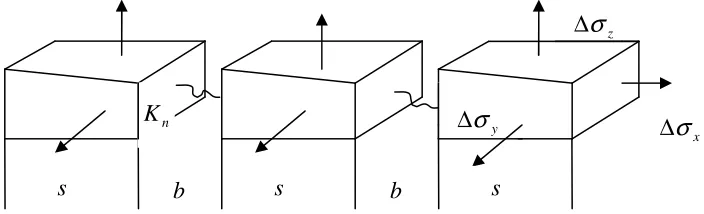
Recently, from the angle of experiment and numerical simulation, plenty of researches and studies are done for permeability attributes of fracture rock and relationship with ground stress. The result shows relationship between dense layers in different direction of crack permeability and present direction of stress, and sensitivity features of fracture permeability stress. It also initially creates the coupling relationship between the three-dimensional rock and unidirectional flow of rock fracture [1-5]. For example, create a seepage model from hot rock fracture, according to the rock character of Qingdao Jiudian Gold Mine, to take a further understand of water flow regulation form this rock fracture gap.
Fig. 1 Coupling Models of Three-dimensional Fracture Rock and Stress zx yz xy z y x
n
l
σ
m
σ
n
σ
lm
τ
mn
τ
nl
τ
σ
=
∆
+
∆
+
∆
+
∆
+
∆
+
∆
∆
2 2 22
2
2
(1) On the surface of fracture, when the direct stress is
∆
σ
n, the opening displacement of fracture∆
u
fisn n f
K
u
=
∆
σ
∆
(2)The displacement of rocks
∆
u
xwith stress∆
σ
n,∆
σ
y,∆
σ
zis(
)
[
x y z]
x
E
sl
u
=
∆
σ
−
ν
∆
σ
+
∆
σ
∆
(3)Combining those three formulas above, the action of permeability coefficient and seepage quantity with three dimensional stress of three-dimensional fracture is
(
)
[
]
31
∆
+
∆
−
∆
−
∆
+
=
x y zn n o z
Eb
sl
bK
K
K
σ
σ
ν
σ
σ
(4)(
)
[
]
41
∆
+
∆
−
∆
−
∆
+
=
x y zn n o z
Eb
sl
bK
Q
Q
σ
σ
ν
σ
σ
(5)According to the deduced model, it shows that there is a direct relationship between seepage performance of fracture rock and direct stress and shear stress.
Model of Heat and Moisture Exchange Temperature of wall rock of roadway
To compute the temperature of heat transfer of airflow in the roadway, we need discuss the heat conduction of wall rock, so the wall rock’s temperature must be confirmed first. For the heat conduction of wall rock is a very complex process, the issue must be simplified. The paper makes a hypothesis as follows: the wall rock is homogeneous and the same attribute of all directions; the heat conduction of wall rock is the infinite and long cylindrical conduction, that is, not add the gradient of axial temperature.
The differential equation of heat conduction of wall rock was established with the hypothesis:
∂
∂
+
∂
∂
=
∂
∂
r
t
r
r
t
a
r
t
1
2 2 (6)Where t is the temperature of wall rock, ℃; τ is the ventilated time, s; a is the temperature conduction
coefficient,m2/s; r is the radius of roadway, m.
Solving the thermal problem of wall rock should meet the following boundary condition:
[ ]
f w d(
w f)
r r
d
d
l
t
t
r
t
q
=
−
+
⋅
⋅
−
∂
∂
=
=β
α
λ
0 (7)Where q is the heat flux density, J/(m2﹒s); λis the conduction coefficient of wall rock, J/(m﹒s﹒k); r0 is the
equivalent radius of the roadway, m; αis convective heat transfer coefficient, J/(m2﹒s﹒k); tf is the average
temperature of airflow, ; l℃ w is the latent heat of vaporization of water, J/kg; βd is the moisture transfer coefficient
z
σ
∆
xσ
∆
yσ
∆
nK
by computing the moisture, kg/(m2﹒s); dw is the moisture of segmental boundary layer of roadway’s wet wall,
kg/kg; df is the average moisture of airflow, kg/kg; the method of confirming the parameterβd and dw is put in the
literature [8-9]. The surface of wall rock is wet in practice, and usually we use the f to stand for the wet degree of roadway’s surface to reflect the water evaporation ratio between partially wet roadway wall and totally wet roadway wall for the same air flow length [9]. As for the totally dry wall, f is 0, and for the totally wet wall, f is 1, so the range if f is from 0 to 1. According to the definition of moisture ratio, f can be computed with the following expression:
(
)
(
w f)
f f m pf
d
d
L
r
d
d
q
C
f
−
⋅
⋅
⋅
−
⋅
⋅
=
α
π
01 2
2
(8)
Where Cpf is Constant pressure specific heat, J/(kg·℃); qm is mass flow rate of airflow, kg/s; df1 is inlet moisture of
airflow, kg/kg; df2 is outlet moisture of airflow, kg/kg; L is the length of roadway, m.
Partial wet temperature of rock wall tw can be confirmed by the following formula:
(
)
d www
f
t
f
t
t
=
1
−
⋅
+
⋅
(9)Where tw is the temperature of the wall rock, ℃; td is the temperature of dry rock wall, ℃; tww is the temperature of
completely wet rock wall, ℃.
Linking rock wall’s boundary condition and initial condition and getting the formula (6)~(9) together, the formula of rock wall’s temperature of roadway will be set up.
The Temperature and Humidity’s Balanced Equation for Air Flow Running along the Roadway
The heat and humidity exchange between inlet airflow and rock wall is the process that is complex and unsteady heat and mass transfer, in which temperature and humidity change with the time [10-11]. So, simplifying it is necessary for easy analysis. This paper makes the following hypothesis:
• Airflow temperature and humidity don’t vary with the time, namely the inlet airflow temperature is the average temperature of summer.
• The rock wall is composed of dry wall and wet wall.
• The heat and moisture exchange of rock wall and airflow, not considering the influence of the local heat source.
The heat exchange’s formula of airflow and dry wall rock is established by Newton’s cooling equation and energy conservation equation:
u
r
L
(
t
nt
d)
r
L
(
t
dt
f)
r
K
q
=
λ
⋅
τ⋅
π
0⋅
⋅
−
=
π
0⋅
⋅
α
⋅
−
0
2
2
(10)The humidity of mine’s outlet airflow df2 can be described:
)
exp(
)
(
12
m d f
w w f
q
L
U
f
d
d
d
d
=
−
−
−
⋅
β
⋅
⋅
(11)
where tn is the original rock temperature, ℃; U is the Circumference of roadway, m; Kuτ is the unsteadily total heat
transfer coefficient’s Dimensionless Parameters, the specific method of defining Kuτ is given by the literature [8].
When humidity is 1, the rock wall is completely wet, the heat exchange capacity of convective mass transfer of wet roadway’s boundary is equivalent to the heat capacity of roadway’s wet wall transferred by the rock wall heat conduct:
0
)
(
)
(
)
(
r
t
t
K
t
t
d
d
l
u n wwf ww f
w f w
−
⋅
=
−
⋅
+
−
⋅
⋅
⋅
β
ρ
α
λ
τ (12)where β is the humidity exchange coefficient by the water-vapor concentration which is between the air and water surface, m/s; ρf is the density of airflow, kg/m3; ρf is defined by the method of Linear regression, and the specific
method will be seen in the literature.
inlet airflow is equivalent to the sum of transfer heat and airflow’s energy loss during the process of the rock wall and the airflow’s heat and mass transfer:
)
(
)
(
2
)
(
)
(
2 1 0
1 2 1
2
Z
Z
g
q
t
t
L
r
d
d
l
q
t
t
q
C
m f w w
f f w m f f m pf
−
⋅
⋅
+
−
⋅
⋅
⋅
=
−
⋅
⋅
+
−
⋅
⋅
α
π
(13)where αw is the heat transfer coefficient of Heat & Mass Transfer for the convection of wet roadway wall, and
J/(m2·s·℃); Z1 and Z2 are the heights of inlet and outlet of roadway and the height is relative to the datum plane, m;
g is the gravity, m/s2.
In light of mass conservation law, the inlet mass varied ratio is equivalent to airflow with the water-vapor’s increments in the process of mass transfer between the airflow and roadway rock wall:
) 0
1
2
)
2
(
(
f f w w fm
d
d
r
L
c
c
q
⋅
−
=
β
⋅
π
⋅
⋅
−
(14)where βw is the convective heat & mass transfer coefficient of wet roadway wall, m/s; cw is the humidity of wet rock
wall, kg/m3; cf is the water-vapor molecule concentration of airflow, kg/m3. αw and βw is specifically confirmed in
the literature8.
Field Testing Testing Object
Based on the system of original main airflow of Jiudian Gold Mine, two routes were designed by using the upper waste roadway as the terrain pre-cooling route of mine inlet airflow. It is used to pre-cool the airflow into mine; meanwhile, testing the distribution of original rock temperature and the pre-cooling effect of heat and moisture of inlet airflow. The ventilated pre-cooling route has been presented in Fig. 2.
Fig.2 Assistant ventilation route of pre-cooling inlet airflow
Testing Results
Experimental tests showed that: the effect of utilizing cryogenic effect of superficial layer roadway above elevation of -155m to pre-cooling inlet airflow is obvious to practical situation of Jiudian Gold Mine. Below the elevation of -155m, the temperature of inlet airflow gradually increases along with the depth, and to some extent, the effect of pre-cooling inlet airflow is weakened. Below the elevation of -100m, the effect of rock seepage and underground water on the relative humidity of airflow gradually increases.
CONCLUSION
one of the main issues which restrict mine safety production. The paper has established the mathematical model of heat and moisture exchange between the inlet airflow underground mine and rock wall concerning the specific circumstances of Qingdao Jiudian Gold Mine in Shandong. The numerical simulation of inlet airflow pre-cooling underground mine and applied practice research were also carried out. The results of this research provided the basis for making full use of the resource which is located in waste roadway and low temperature of shallow rock stratum.
Acknowledgments
This research was financially supported by the National Science Foundation funded project (51204100), China Postdoctoral Science Foundation Special funded project (2014T70658), China Postdoctoral Science Foundation funded project (2013M541934), University Science and Technology Development Program of Shandong Province (J14LH03), The science and technology development plan project of Shandong province (2014GSF116020), Qingdao Science and Technology Project (14-2-4-95-jch).
REFERENCES
[1] Abdulrazag YZ,Shedid AS. Journal of Petroleum Science and Engineering,2004,42(2):171-182.
[2] Caja MA,Permanyer A,Marfil R,et a1. Journal of Geochemical Exploration,2006,89(13):27-32.
[3] Hideaki Y, Polak H,Yasuhiro Mitani,et a1. Earth and Planetary Science Letters,2006,244(1-2):186-200.
[4] Ren C J,Huang T. Engineering Journal of Wuhan University:Engineering Edition,2004,37(2):8-12(in
Chinese).
[5] Zheng G. Joumal of Engineering Geology,2004,12(1):30-33 (in Chinese).
[6] Liu Xiang-jun,Luo Ping-ya. Rock mechanics and petroleum engineering [M]. Beijing: Petroleum Industrial Press.
2004.10.104-106.
[7] Zhang Jin-cai, Zhang Yu-zhuo. Geotechnical Engineering. 1998.3.2(20).19-22.
[8] Hideaki Yasuhara,hmir Polak,Yasuhiro Mitani,et a1. Earth and Planetary SCience Letters,2006,244(12):
186-200.
[9] Dong Xue-Sheng. Hydraulic Rock Mechanics. China Water Conservancy and Hydropower Press: 2004.185-190. [10] Zeng L B,H YG,Wang z G,et a1. Earth Sdence_-Journal of Cllina University of Geosciences,2007,32(2):
194-200(in Chinese).