CONSTRUCITON PROJECTS
AAWAG MOHSEN MOHAMMED
ENHANCING SKILL WORKER REQUIREMENTS IN IMPROVING IMPLEMENTATION OF IBS IN CONSTRUCTION PROJECTS
AAWAG MOHSEN MOHAMMED
A Thesis submitted in partial
fulfilment of the requirement for the award of the Degree of Master in Construction TechnologyManagement
Faculty of Technology Management and Business University Tun Hussein Onn Malaysia
DEDICATION
ACKNOWLEDGEMENTS
All praise is due to Allah Almighty the creator of this universe, I am also grateful to him for giving me a good heal, strength, power and inspiration (Alhamdulillah).
This thesis owes its existence to the help, support and inspiration of several people. First and foremost, I would like to express my sincere appreciation and
gratitude to my supervisor, Associate Professor Dr. Narimah Kasimfor her guidance
during my research. Her support and inspiring suggestions have been precious for the development of this thesis content. I would like again to thank her for providing me this great chance to work with her and I feel honored and lucky to have the opportunity to do so. Under her supervision, my research knowledge and self-confidence have increased. I have become more outspoken and brave in giving my opinion as well as sharing ideas with others. My deep and sincere appreciation also to all lecturers at Department of Construction Management, Faculty of Technology Management and Business, UTHM, for their support and trust in me to complete my Master of Science in Construction Technology Management.
ABSTRACT
ABSTRAK
TABLE OF CONTENTS
TITLE i
DECLARATION ii
ACKNOWLEDGEMENTS iii
ABSTRACT iv
ABSTRAK v
TABLE OF CONTENTS vi
LIST OF TABLES vii
LIST OF FIGURES viii
LIST OF ABBREVIATION ix
LIST OF APPENDICES x
CHAPTER 1 INTRODUCTION 1
1.1 Background of Research 1
1.2 Problem Statement 3
1.3 Research Questions 4
1.4 Research Aim and Objectives 5
1.5 Significant of Research 5
1.6 Scope of Research 6
1.7 Research Methodology 6
1.8 Thesis Outline 8
1.9 Summary 9
CHAPTER 2 LITERATURE REVIEW 10
2.1 Introduction 10
2.2 Construction Industry Overview 11
2.2.2 Lack of Manpower 14 2.3 Industrialised Building System (IBS)
Implementation in Malaysian
Construction Industry 16
2.3.1 History of IBS in Malaysia 17
2.3.2 IBS Definition 19
2.4 Classification of IBS 20
2.4.1 Precast Concrete System 21
2.4.2 Steel Form Work System 21
2.4.3 Steel-frame Building and Roof Trusses 22
2.4.4 Prefabricated Timber Framing System 23
2.4.5 Block Work System 24
2.5 Essential Characteristics of IBS 25
2.5.1 Closed System 25
2.5.2 Opening Building System (OBS) 26
2.5.3 Modular Coordination 26
2.5.4 Standardisation and Tolerances 27
2.5.5 Mass Production 27
2.5.6 Good Organisation 28
2.5.7 Transportation 29
2.5.8 Specialisation 30
2.6 Summary 30
CHAPTER 3 RESEARCH METHODODLOGY 31
3.1 Introduction 31
3.2 Research Design 31
3.2.1 Quantitative Research 32
3.3 Questionnaire Design 33
3.3.1 Population and Sampling 34
3.3.2 Pilot Test 35
3.4 Data Collection 35
3.4.1 Literature Review 37
3.4.2 Questionnaire Survey 37
3.5 Data Analysis 38
4.1 Introduction 40
4.2 Pilot Test 40
4.3 Response Rate 41
4.4 Data Analysis Method 42
4.5 Reliability 42
4.6 Data Editing and Coding 43
4.7 Demographic Profile 44
4.7.1 Position 44
4.7.2 Type of Projects Have been Done 45
4.7.3 Experience in Construction Industry 46
4.7.4 Projects have been Built / Experienced
By using IBS 48
4.7.5 Based on Experience How Durable
IBS in Construction Industry 49
4.8 Influencing Factors for Enhancing Skills
Worker Requirements 51
4.8.1. Discussion of Findings 53
4.9 Recommend Ways for Enhancing Skill Worker
Requirements 54
4.9.1 Discussion of Findings 56
4.10 Summary 57
CHAPTER 5 CONCLUSION AND RECOMMENDATIONS 58
5.1 Introduction 58
5.2 Summary 58
5.2.1 Objective 1: To identify the influencing factors for enhancing skill worker
requirements in improving implementation
of IBS in construction projects 59
5.2.2 Objective 2: To recommend ways for enhancing skill worker requirements in improving implementation of IBS in
5.3 Contribution to Knowledge 60
5.4 Limitation of Research 61
5.5 Recommendations 61
5.6 Closure 61
REFERENCES 63 APPENDICES 70 APPENDIX A QUESTIONNAIRE 71
LIST OF TABLES
4.1 Pilot Testing Result 41
4.2 Response Rate 42
4.3 Testing Reliability Result 43
4.4 Position 44
4.5 Types of Projects Have Been Done 45
4.6 Experience in Construction Industry 47
4.7 Projects Have Been Built / Experienced by Using IBS 48
4.8 Based on your Experience How Durable Using IBS for the
Projects in Construction Industry 50
4.9 Descriptive Statistics of Influencing Factors for Enhancing
Skills Worker Requirements 51
4.10 Descriptive Statistics of Recommend Ways for Enhancing
LIST OF FIGURES
1.1 The Review of Research Method, Activities and Output 7
2.1 Industrialised Building System (Sufian 2009) 16
2.2 Typical Project Using Steel Framing System (Sufian, 2009) 22
2.3 Typical Project Using Timber Forming System (Sufian, 2009) 23
2.4 Typical Project Using Block Work System (Sufian, 2009) 24
3.1 Research Process 36
4.1 Position 45
4.2 Types of Projects Have Been Done 46
4.3 Experience in Construction Industry 47
4.4 Projects Have Been Built / Experienced by Using IBS 49
4.5 Based on your Experience How Durable Using IBS for the
LIST OF ABBREVIATION
IBS Industrialised Building System
IT Information Technology
BRT Business Round Table
CIMP Construction Industry Master Plan Malaysia
US United States
CIDB Construction Industry Development Board
NHP National Housing Policy
GBI Green Building Index
LIST OF APPENDICES
Appendix A Questionnaire 71
CHAPTER 1
INTRODUCTION
This chapter briefly outlines the discussion on the research background and the research statement problems. It also states the aim of the research, research questions and objectives. In addition, significance of research, scope of research and brief methodology considered is also discussed. Lastly, it describes the structure of the thesis.
1.1 Background of Research
Industrialised Building System (IBS) has been introduced to cope with a growing demand of affordable housing, solving issues associated with foreign labours and improving image, quality and productivity of construction industry. The limited take up on IBS have triggered many research initiatives attempting to scrutinised the barriers and seek the way forward. For contractors, the demand to use IBS is less attractive due to cost and risk issues, lack of professional trained in IBS, limited information technology (IT) adoption and lack of guidance (Pan et al., 2008; Blismas, 2007). Nawi
Lack of expertise can cause of time and cost overrun in the projects that IBS has been applied without appropriate study during the planning phase. IBS is costly for construction companies compared to conventional construction methods. This result is the same with Rahman & Omar (2006) and Bing (2001) mentioned that higher cost was the main obstacle of using IBS for construction companies. Higher cost mostly resulted from lack of expertise, lack of technologies, lack of standards and government incentives as well as limited suppliers. Another common barrier is design alteration during or after construction. Design changes are always costly even in the conventional method, but it depends on in which phase of project change occurs. In the IBS method, because components are produced in factories in large amounts, therefore, any design alternations would be extremely costly. Then applying IBS needs the careful design process and several controlling processes before the construction phase to ensure there is no mistake and minimize the chance of any changes after the design phase (Gibb, 2001).
Skills worker in building and construction need to be implemented in terms of knowledge of materials, methods, and the tools involved in the construction or repair of houses, buildings, or other structures such as highways and roads. It is the construction worker who is basically responsible for special hospital structures, building shopping malls and many other commercial as well as residential buildings. There are a range of careers that a person can choose from with respect to the construction business. These construction professionals include electricians, carpenters. Workers must be able to keep up with the physical demands of the job, which can be very rigorous. As they often work in teams, teamwork and skills are also important. Self-motivation can be important for construction workers who are self-employed or who must market their services. A desire and ability to work hard is also imperative for construction workers.
rather than total cost, have also contributed to degraded skill levels in workers. Currently, there is an extraordinary struggle for a very ordinary workforce. In South Africa, the skills shortage has been acknowledged by Government and industry (Singh, 2007). The skills deficit appears to be on a path where demand will continue to outstrip supply as a result of the substantial growth in infrastructure investment. The step change in announced private sector projects in 2005 and 2006 resulted in additional skills requirements, the precise nature of which was beyond the scope of the study. Government-initiated projects also suggest a significant number of small (by value) municipal, provincial and national projects that will require more skills spread over several projects rather than a concentration of skills in fewer large projects.
1.2 Problem Statement
In line with the 2006 – 2015, by 2015 the percentage of IBS used in construction projects should be above 80%. Furthermore, Malaysia will push the nation out of the middle income trap and create high income society towards developed nation status by the year 2020 (Hill et al., 2013). Construction industry practitioners seem reluctant to use IBS as their construction method. Their reluctance to use the system is surprising its benefits have been pointed out by researchers. Warszawski (1999) highlighted that by adopting IBS, some saving in manual labour on-site can be achieved, increasing construction speed and providing higher construction quality.
mechanised approach in IBS. Therefore, extra cost was needed to train existing semi-skilled labour to be highly semi-skilled labour.
Improving skills worker requirements in enhancing implementation of IBS in construction projects is an essential to overcome issues that occur nowadays in construction projects field that cause delay in projects delivery, drawbacks, effective high cost as well as quality. Many construction industries lack of skilled and professional workers to handle effectively and successfully the progress of construction projects, so it is important to study and find out the challenges in improving skills worker requirements in order to improve implementation of IBS in construction projects. The limited take up on IBS have triggered many research initiatives attempting to scrutinised the barriers and seek the way forward. For contractors, the demand to use IBS is less attractive due to cost and risk issues, lack of professional trained in IBS, limited information technology (IT) adoption and lack of guidance (Pan et al., 2008; Blismas, 2007). Therefore, this research seek to investigate skills worker requirements in improving implementation of IBS in construction projects.
1.3 Research Questions
It is essential to develop research questions in order to help on focus the area of research. Following are some research questions that arise when conducting the research:
(i) What are the influencing factors for enhancing skill worker requirements in improving implementation of IBS in construction projects?
The aim of this research is to enhance skills worker requirements in improving implementation of IBS in construction projects. Therefore, in order to achieve the above aim, the following objectives have been identified:
(i) To identify the influencing factors for enhancing skill worker requirements in improving implementation of IBS in construction projects.
(ii) To recommend ways for enhancing skill worker requirements in improving implementation of IBS in construction projects.
1.5 Significance of Research
Currently the main challenges in construction projects are lack of innovation, soft-skills, motivation, poor knowledge, technology skills as well as lack of training. Familiarity with IBS concept and its benefits is vital to its success because IBS requires different approach in construction industry. The barriers of IBS implementation in construction projects can be summarised and categorized in several themes, which are standardisation, and quality issues, issues in consumer perception, issues in professional perception, technology, training and education, finance and costing, incentive and communication issues as well.
as a guideline or benchmark for the construction industry concerning the current usage of IBS implementation and challenges in construction projects. The study would also help the practitioners to enhance ways of IBS usage in construction projects. Lastly, the findings of this research can be helpful to contribute to parties of construction industry focusing on the enhancing of skills worker requirements for implementation of IBS in construction industry.
1.6 Scope of Research
The scope of this research is focused on enhancing of skill worker requirements and recommend ways in improving implementation of IBS in construction projects. The research focuses on contractor G7 which includes project engineer, manager, site supervisor and engineers; towards acquiring the utilisation of IBS in construction projects in Johor Bahru, Johor, Malaysia. The transformation of the whole industry depends on the readiness of contractors as project implemented to use IBS. G7 contractors employ many professional such as huge number of workforce, sub-contractors and specialists in their projects. G7 sub-contractors dominate the IBS market as they have better capability to invest in mass production with the updated and advanced technology. Large number of contractor involve in IBS is G7 (Kamar and Hamid, 2011).
1.7 Research Methodology
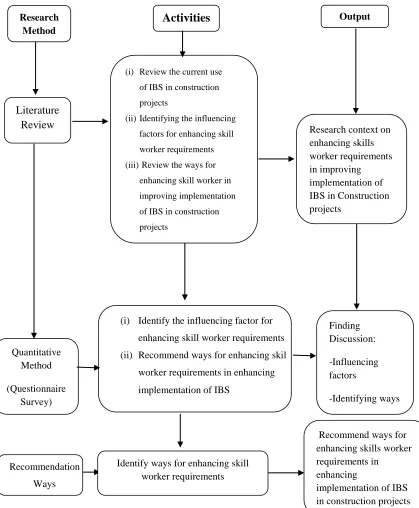
outputs of related activities are shown in Figure 1.1.
[image:21.612.113.532.149.657.2]
Figure 1.1: Review of Research Method, Activities and Output
Recommend ways for enhancing skills worker requirements in enhancing
implementation of IBS in construction projects (i) Identify the influencing factor for
enhancing skill worker requirements
(ii) Recommend ways for enhancing skill
worker requirements in enhancing
implementation of IBS
Output Recommendation Ways Quantitative Method (Questionnaire Survey)
Identify ways for enhancing skill worker requirements Finding Discussion: -Influencing factors -Identifying ways (i) Review the current use
of IBS in construction
projects
(ii)Identifying the influencing
factors for enhancing skill
worker requirements
(iii) Review the ways for
enhancing skill worker in
improving implementation
of IBS in construction
projects
Literature
Review Research context on
enhancing skills worker requirements in improving implementation of IBS in Construction projects
Research Method
1.8 Thesis Outline
The thesis consists of five (5) main chapters. The chapters’ organisations are as follows:
(i) Chapter 1: Introduction
This chapter consists of introduction to research, background of research, problem statement, research questions, research objectives, scope of research, significance of research and research methodology.
(ii) Chapter 2: Literature Review
This chapter discusses on improving worker skills requirements in enhancing implementation of IBS in construction industry including its definition, features, types, barriers, history as well as challenges in implementing IBS in construction industry.
(iii) Chapter 3: Research Methodology
This chapter discusses on research approaches and strategies, and research procedures used as well as the process of both data collection and analysis of research were developed.
(iv) Chapter 4: Data Analysis and Findings
This chapter explains data analysis from questionnaire survey and further discusses in detail and findings highlighted accordingly.
(v) Chapter 5: Conclusion and Recommendations
CHAPTER 2
LITERATURE REVIEW
2.1 Introduction
Skills shortages within the construction industry are not a new phenomenon with the industry seeing a recurrent problem over the last thirty years due to the cyclical nature of the industry (Oyegoke et al., 2009). With the anticipated growth of the industry between 2013 and 2015 (CIOB, 2013), and with the importance of new specialist markets such as the low carbon economy, there are major concerns for the future prosperity of the industry and its capacity for growth should the skills crisis continue. With previous research consistently highlighting the importance of the UK skills agenda and the importance of more modern, competitive and efficient industry.
Actually there are various definitions of the Industrialized Building System (IBS) in Malaysia. This indicated that no agreed definition of the IBS since there have few type of definition from different author (Mohamad Rofzdi, 2009). IBS can be considering as the building built by using pre-fabricated components. The component was systematically manufactured either by using machine or other forms of mechanical equipment. The component was manufacturing off site and delivered to construction sites for assembly and erection (Rahman and Omar, 2006). Chung and Kadir (2007) has defined that the IBS is a mass production of building components either in factory or at site. It depends on the specification of the standard shape and dimension to transport to the site to be re-arranged according to certain standard to form a building. Construction Industry Development (2003) defined IBS as a construction technique included components which are manufactured in a controlled environment either on or off site, transported, positioned and set up into a structure with minimal additional site works.
There was no commonly accepted or agreed definition of IBS. Several authors have defined IBS as process or a technique. Blimas et al. (2006) and Pan et al. (2008) defined that IBS is often referred by literatures as off –site construction, off-site production, industrialised and automated construction.Warszawski (1999) explained in detail that an industrialised process is and investment in equipment, facilities, and technology with the objective of maximising production output, minimising labour resource, and improving quality while a building system is defined as a set of interconnected element joint together to enable the designated performance of a building. Lessing et al. (2005) explained IBS as “an integrated manufacturing and
construction process with well-planned organization for efficient management, preparation and control over resources used, activities and results supported by the used
of highly developed components”. Rahman et al. (2006) defined IBS as “a construction
definitions of IBS mentioned the prefabricated, off-site production and mass production of building components as a main characteristic of IBS. The scope of IBS focuses the construction of building rather than civil structure or engineering projects. For the purpose of this research, IBS is best defined according to CIDB Malaysia (2001) as “construction system in which components are manufactured in a factory, on or off site, positioned and assembled into a structure with minimal additional in situ activities.
The uses of IBS as a method of construction in Malaysia is evolving. Many private companies in Malaysia have teamed up with foreign expert to offer solutions to their IBS project (Eastern Pretech, BPB Malaysian Gypsum, Lafarge and Duralite) (CIDB, 2003). Many had acquired enough knowledge through technology transfer to build up own capacity in IBS technologies (PKNS Engineering, Setia Precast and Global Globe). In fact, Malaysian was also keen on developing own IBS technologies (Zenbes, CSR, IJM Formwork, Pryda, Baktian and HC Precast). The local IBS manufacturers were mushrooming, although yet to operate in full capacity. The current IBS systems used in Malaysia housing projects are large panel systems, steel frame, precast frame and formwork system. The IBS system is largely used for private residential projects in Shah Alam, Wangsa Maju and Pandan (Sarja, 1998), Dua Residency, KL, Taman Mount Austin and Tongkang Pecah, Johor (CIDB, 2006).
2.2.1 Obstacles to Construction Growth
continual funding or extra capital investment compared to the conventional labor-intensive method.
2.2.2 Lack of Manpower
Construction industry has a major role on generating wealth trough a constant growth in GDP’s contribution and influenced in the development of social and economic infrastructures and buildings, but its total energy and resource consumption and carbon emission raise a growing awareness regarding this industry. The issues of sustainability also have been strongly highlighted in the Construction Industry Master Plan (2005 2015) as a significant importance for the Malaysian construction industry. In this regards, the Malaysian Green Building Index (GBI) has been developed recently in order to promote sustainability in built environment. On the other hands, the industry is under a constant pressure to deliver and to tackle issues on performance, safety, shortage of labour, environment and sustainability, dependency on Malaysian construction industry has been urged to use innovative construction technique and to shift from traditional practice to Industrialized Building System (IBS) construction. Unfortunately, against all attempts the level of IBS usage in construction was only 15% in 2003 (CIDB, 2003b) and reached 10% in 2006 which is less than one third of total completed construction project using at least one IBS products (CIDB, 2007). While, unique characteristics of IBS in terms of cost and time certainty, attaining better construction quality and productivity, reducing risk related to occupational safety and health, alleviating issue on skilled workers and dependency on manual foreign labour and achieving ultimate goal of reducing overall cost of construction suggest its contribution in the sustainability challenge facing the construction industry. Thus, the main objectives of the study are determining main issues in green and sustainable construction through IBS and then investigating the role and contribution of IBS in green and sustainable construction in order to identify potential solution for IBS to achieve its prospective in the area of green construction and sustainability (Fauzi, 2009).
awareness, these local authorities tend to misinterpret IBS current building guidelines adding to further delays in approval (Kamar et al., 2009). The skill level of IBS workers is more demanding compared to the conventional construction methods. Under this system, the demand for on-site manual labourers, particularly carpenters, bar benders and concreters becomes less. The system demands more machine-oriented skills, both on sites and in factories. Thus, this leads to a transformation requiring the restructuring of human resource in an organization in terms of training and education. Malaysia still lacks skilled workers generally. As such, more intensive training programmes are needed in the specialized IBS skills like system integrating or assembling. However, this need requires more time and investment (Thanoon et al., 2003a; Rahman and Omar, 2006). In an IBS project, the role of the contractor is shifted from that of a builder to that of an assembler on site (Shaari and Elias, 2003). This requires contractors to be equipped technologically with IBS knowledge and skill. The needs are made more imperative if the contractors were to promote their IBS products and compete in the industry. From July to September 2002, the situation was suddenly worsened when many trained foreign workers were forced to leave the country after a wide spread crackdown on illegal foreign workers (Thanoon et al., 2003a). The “new batches” of foreign workers did not possess the required skill in IBS and had to be retrained (Thanoon et al., 2003a).
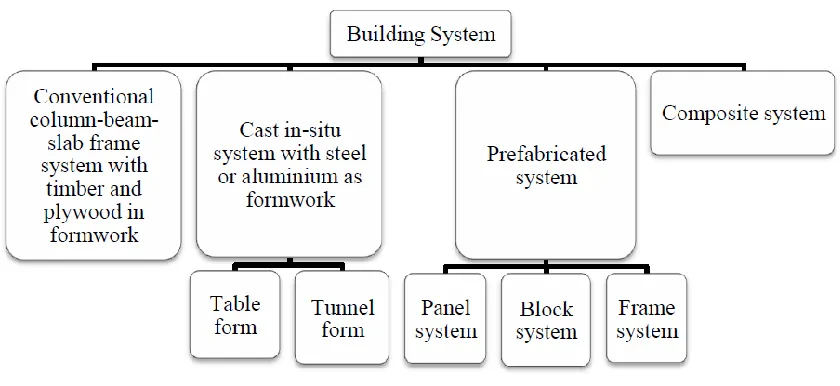
Warszawski (1999) classified the building system into a few types which depend on the particular interest of their users and producers. His classification uses construction technology as a basis for classifying different building systems. In this manner, four major groups can be distinguished such as system using timber, steel, cast
Figure 2.1: Industrialised Building System (Sufian 2009)
2.3 IBS Implementation in the Malaysian Construction Industry
Over the past decade, the level of IBS usage in Malaysia is still very low even though its implementation has started since early 1960’s. Construction industry practitioners seem reluctant to use IBS as their construction method. Their reluctance to use the system is suprising its benefits have been pointed out by researchers. Warszawski (1999) highlighted that by adopting IBS, some saving in manual labour on-site can be achieved, increasing construction speed and providing higher construction quality. Thanoon et al.
Malaysia and his study has analyzed ways to improve the implementation of IBS in terms of the current policy and guideline available to implement the usage of IBS in the local construction industry.
Implementation stage carries largest scale of project life cycle including variety of physical work such as design, fabrication work at factory, logistics task (e.g transportation, supply chain management, vendor), installation and erection work at site, and commissioning. In other words, there are several activities of implementation which can be categorized as upstream activities and downstream activities. Upstream activities can be list as design, planning, and production works. On the other hand, procurement system, supply chain, transportation system, legislation and regulation can be classified as downstream activities in implementing IBS. Different activities of a project can proceed subsequently with different speeds in design and consequent stages, but all must come together in testing and commission stage for the finish building.
2.3.1 History of IBS in Malaysia
The initiative to use and introduce IBS in Malaysia started off back in the early sixty, when the Minister of Housing and Local Government visited some European countries and evaluated their buildings systems performance. Din (1984) reported that, it was then that the two pilot projects using IBS concept was carried out in 1964 where the first pilot project was 7 blocks of 17 story flats and 4 blocks of 4 story flats which comprise of 3000 units of low cost flats and 40 units of shop lots in Kuala Lumpur. The project implemented large panel system using the Danish System with IBS concept of construction.
based on cost productivity and quality factor, the overall performance of IBS is more competitive than the conventional method.
Since 1980’s there are intensive marketing strategy launched by the Malaysian government to introduce modular coordination, Trikha (1999) reported that its acceptance has received poor response for the building industry. As a result, an event partial introduction of IBS such as lintels and staircase has not been possible.
Previously in the 7th Malaysian plan, the country intended to construct about 800,000 units of houses for its population using the IBS construction. Indeed, 585,000 units were planned for the low and low medium cost hosues. However, the achievements are disappointing with only 20 percent completed houses reported due to use of conventional construction method. According to Ismail (2001), although the government introduced numerous incentives and promotions to encourage housing developers to invest in such housing category, the response is not so positive. Under the 7the Malaysian Plan, the enforcement of Modular Coordination through the Construction Industry Standard 1 and 2 only applies to the low cost housing projects initiated by the Ministry of Housing and Local Government Malaysia (CIDB, 2003a). The enforcement by the local authorities did not apply to all the parties involved in construction contribute to the failure of the implementation in Malaysia. Furthermore, the incentives that promised to be given to developers by the government does not clearly stated in the law of Malaysia. This nonconformance leads to the use of conventional method which is less risky to the developers.
construction firm acts as system integrators and catalyst for transforming new technologies into marketable products. These play an important role modifying and developing new technologies that impact as feedback loop to producers in the upstream. The forces for technology for adaptation are strongest among materials, component manufacturers and high quality equipment for production purposes. Property developers and government policy makers also feed the stream for innovation by funding in research and development activities.
IBS has been introduced in Malaysia since early 1960s when Ministry of Housing and Local Government of Malaysia visited several European countries and evaluate their housing development program (Thanoon et al., 2003). After their successful visit in 1964, the government had started first project on IBS, just a year later aims to speed up the delivery time and built affordable and quality houses. This project was awarded to JV Gammon & Larsen and Nielsen using Danish System of large panel pre-cast concrete wall and plank slabs. The project was completed within 27 months from 1966 to 1968 including the time taken in the construction of the RM 2.5 million
casting yard at Jalan Damansara (CIDB, 2006; CIDB, 2003; and Thanoon et al., 2003).
A similar system was constructed almost at the same time at Edmonton, North London and about 20,000 BRECAST dwellings were constructed throughout UK from 1964 to 1974 (CIDB, 2006). Nonetheless, the building design was very basic and not considering the aspect of serviceability such as the local needs to have wet toilet and bathroom (Rahman and Omar, 2006).
2.3.2 IBS Definition
be defined as a concept of mass production of quality building by using new building systems and factory produced building components (Badir and Hashim, 2002). Earlier researchers like Parid (2003) defined IBS as a system which use industrialized production method either in the production of component or assembly of the building or both. Trikha (1999) defined IBS as a system in which concrete components are manufactured at site or in factory are assemblies to form the structure with minimum in situ construction. Esa and Nurudin (1998) in the first IBS colloquium in Malaysia, defined IBS as continuum beginning from utilizing craftsmen for every aspect of construction to a system that make use of manufacturing production in order to minimize resource wastage and enhance value end users. IBS was defined by Abdullah and Egbu (2009) as a method of construction developed due to human investment in innovation and on rethinking the best ways of construction work deliveries based on the level of industrialization. The level of industrialization in IBS can be classified as pre-building system, modern construction, advance automation and volumetric construction (Abdullah and Egbu, 2009). In his work on IBS risks, Hassim (2009) defined IBS as an organizational process-continuity of production implying a steady flow of demand, standardization, integration of the whole production process, a high degree of organization of work, mechanization to replace human labor.
2.4Classification of IBS
Precast Concrete System is defined as any precast components that are used in construction industry. This is included all types of precast concrete systems as defined and it include as follows:
(i) Precast concrete framing, panel and box systems (ii) Precast concrete wall system
(iii) Building with precast concrete slab
The precast concrete framed system is one of the most popular forms of industrialised building system. The precast concrete framed building consists of slab, beam and column component that are fabricated or manufactured off-site using machine and formwork. The advantage of the system is high degree of flexibility in term of larger clear distance between columns; as a result longer span gives bigger open space and greater freedom of areas.
Precast concrete wall system consist a structural framework of the building composed of pre-cast slab and load bearing wall. The load bearing walls and slabs are manufactured off-site in simple and uncomplicated with a lesser degree of flexibility whereas the removal of load bearing wall are restricted during the service life. With careful design and good coordination between erectors and designers, the erection process can be very fast with the number of wet trade in-site can be reduced significantly (Oyegoke et al., 2009).
2.4.2 Steel Formwork System
panel sizes and stiffened using built in stiffeners or tie rods to resist lateral concrete pressure during concreting. It offers faster speed of erection, comparatively lower cost and simplicity in equipment. It also provides good accuracy and smooth internal finishing that eliminate the need of plastering (Oyegoke et al., 2009).
2.4.3 Steel-framed Building and Roof Trusses
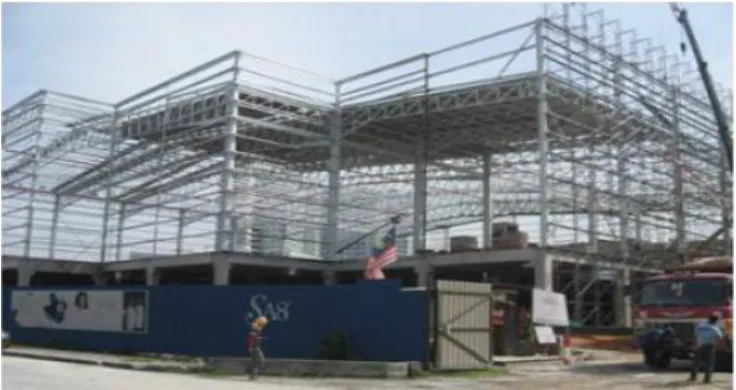
[image:36.612.152.520.431.626.2]According to Sufian (2009), steel is a strong and stiff material that suitable for the construction and reparative frame building with architectural detailing with high flexibility in providing long-spanning structure. It normally used in for multi-story frames for all and slander building such as high constructability and simplicity of construction as well as greater construction speed. Just recently, steel roof trusses showed their capability in housing industries whereby the cost became competitive as compared to timber roof trusses. An example, typical project using steel framing system as shown in Figure 2.2.
In the early 1970s, single story low cost terrace houses were mostly out of plain wooden framing and plank sitting on those three feet high plastered brickwork and taking advantages of the simple raft foundation due to the light weight super structure. The houses construction for the low cost development at rural area or remote town. Today, this type of construction has been classified as one of IBS. The prefabricated timber framing system is normally used in the conventional roof truss and timber frames as shown in Figure 2.3. The timber is pre-fabricated by joining the members of the truss by using steel plate. It is important that all members are treated with the anti-precast chemical. Then, the installation is done on site by connecting the prefabricated roof truss to the reinforcement of the roof beams (Oyegoke et al., 2009).
2.4.5 Block Work System
[image:38.612.80.552.360.623.2]Referring to Sufian (2009), this system depends on modular dimension at the design stage, which identical to lego blocks to some extent. Furthermore, it applies load bearing walls. By incorporating the columns and the beam as integral part of the walls for all house types. The elements of block work system include interlocking concrete masonry units and lightweight concrete blocks. The elements are fabricated and cured in the factory. The elements are normally used as bricks in structures and interlocking concrete block pavement. Depends on the design, the amount that can be saved on a wall can range from between 10 percent to 30 percent saving in wall construction, faster in project completion, no beam and column, less foundation construction. An example, typical project using block work system as shown in Figure 2.4.
REFERENCES
Abdul Rahman, H. & Hanid, M. (2009). A Literature Review of the Advantages and Barriers to the Implementation of Industrialised Building System (IBS) In Construction Industry. Malaysian Construction Research Journal, 4(1), 10-14. Abdullah, M. R. & Egbu, C. O. (2009). Industrialised building system in Malaysia:
issues for research in a changing financial and property market. In Proceedings of the BUHU 9th International Post Graduate Research Conference (Vol. 1, pp. 15-25). University of Salford.
Abidin, A. R. B. Z. (2007). Simulation of industrialised building system formation Affect Employees’ Well‐being? Industrial Relations: A Journal of Economy and Society, 47(3), 355-389.
Ahamad, M. S. S. and Hanafi, M. H. (2011). Quantitative analysis on the level of IBS acceptance in the Malaysian construction industry. Journal of Engineering Science and Technology, 6(2), 179-190.
Ahamad, M. S. S. and Hanafi, M. H. (2011). Quantitative analysis on the level of IBS acceptance in the Malaysian construction industry. Journal of Engineering Science and Technology, 6(2), 179-190.
Al-Aghbari, M. (2005). Factors affecting construction speed of industrialized building system in Malaysia (Doctoral dissertation, Universiti Putra Malaysia).
Ali, M. C., Zin, R. M., Hamid, Z. A. and Ayub, A. R. (2010). Quality cost in the construction industry–preliminary findings in Malaysia. Journal of Design and Built Environment, 29-43.
Ali, M. C., Zin, R. M., Hamid, Z. A. and Ayub, A. R. (2010). Quality cost in the construction industry–preliminary findings in Malaysia. Journal of Design and Built Environment, 29-43.
Azman, M. N. A., Ahamad, M. S. S. And Hilmi, N. D. (2012). The Perspective View of Malaysian Industrialized Building System (IBS) under IBS Precast Manufacturing. The 4th international engineering conference towards engineering of 21st century, (pp. 78-96).
Badir, Y. F., Kadir, M. A. & Hashim, A. H. (2002). Industrialized building systems construction in Malaysia. Journal of Architectural Engineering, 8(1), 19-23. Bakhtyar, B., Zaharim, A., Sopian, K. & Moghimi, S. (2013). Housing for Poor People:
A Review on Low Cost Housing Process in Malaysia. WSEAS Transactions on Environment and Development, 9(2).
Bamberger, M. (2012). Introduction to mixed methods in impact evaluation. Impact Evaluation Notes, 3, 1-38.
Bendat, J. S. and Piersol, A. G. (2011). Random data: analysis and measurement procedures (Vol. 729). John Wiley and Sons.
Brown, G. D., Gardner, J., Oswald, A. J. and Qian, J. (2008). Does Wage Rank Building maintenance: Malaysian Perspective. International Journal of Engineering Science and Advanced Technology, 2(6), 1684.
Chong, L. P. (2006). Implementation Strategy for Industrialised Building System. PhD thesis, Universiti Teknologi Malaysia.
Chung, L. P. & Kadir, A. M. (2007) Implementation Strategy for Industrialised Building Systems. PhD thesis, Universiti Teknologi Malaysia (UTM), Johor Bahru. Chung, L. P. (2006) Implementation Strategy for Industrialized Building System.
CIDB (2007). “Implementing IBS Roadmap: Mid-term review of IBS Roadmap 2003-2010”, Construction Industry Development Board (CIDB), Kuala Lumpur, 2007.
CIDB (2007). IBS Digest at Malbex in IBS Digest. Special Issues on 24th Malaysian International Building Exposition: (Malbex 2007).
CIDB (2011). The Current State of Industrialised Building System (IBS) Construction
Forward. Proceedings of 1st IBS Roundtable Workshop. CIDB. Combat
consistent housing shortage in developing countries: Towards an appropriate system for India. In World Congress on Housing. Available at: http://atiwb. gov. in U (Vol. 4).
Construction Industry Development Board (CIDB) (2003), IBS Roadmap 2003-2010, Construction Industry Development Board Malaysia (CIDB), Malaysia.
Construction Industry Development Board (CIDB) (2007). Construction Industry Master Plan 2006-2015 Kuala Lumpur: Construction Industry Development Board (CIDB), Kuala Lumpur.
Creswell. J. W. (2012). Educational Research: Planning, Conducting, and econometric methods for transportation data analysis. CRC press.
Esa, H. & Nuruddin, M. M. (1998). Policy on Industrialised Building System–Report on Colloquim on Industrialised Construction System. Kuala Lumpur. Evaluating Quantitative and Qualitative Research: Fourth Edition, Boston: Pearson Education.
Field, A. (2009). Discovering statistics using SPSS. Sage publications. for housing construction (Doctoral dissertation, Universiti Teknologi Malaysia). Grace, D. (2014). Intersectionality-informed Mixed Method Research: A Primer. Health
Sociology Review, 19(4), 478-490.
Hamid, Z., Kamar, K. A. M., Zain, M., Ghani, K. & Rahim, A. H. A. (2008). Industrialized Building System (IBS) in Malaysia: the current state and R&D initiatives. Malaysia Construction Research Journal, 2(1), 1-13.
Hamzah, N. H., Nafi, M. N. A., & Yacob, J. (2010). A Study on the Acceptance of IBS in Construction Industry in Kelantan: Application of Logistic Regression Analysis.
Hassim, S., Jaafar, M. S. & Sazalli, S. A. (2009). The contractor perception towers Industrialised Building System risk in construction projects in Malaysia. American Journal of Applied Sciences, 6(5), 937.
Howell, G. & Ballard, G. (1998). Implementing lean construction: understanding and action. In Proc. 6 th Ann. Conf. Intl. Group for Lean Construction. Implementation for Malaysian construction industry(Doctoral dissertation, Universiti Teknologi Malaysia).
Jaafar, M., Abdul Aziz, A. R., Ramayah, T. And Saad, B. (2007). Integrating information technology in the construction industry: Technology readiness assessment of Malaysian contractors. International Journal of Project Management, 25(2), 115-120.
Kamar, A. M., Hamid, Z. A., Azman, N. A. & Ahamad, M. S. S. (2011). Industrialized Building System (IBS): Revisiting Issues of Definition and Classification. International Journal of Emerging Sciences, 1(2), 120-132.
Kamar, K. A. M., Alshawi, M. & Hamid, Z. (2009, January). Industrialised building system: the critical success factors. In 9th International Postgraduate Research Conference (IPGRC), University of Salford, Salford (pp. 29-30).
Kamarul A. M. K., Zuhairi A. H. M. Z. M. Z., Ahmad H. A. R. & Mohd K. G. (2010). MBAM Online News “Skilled Manpower Shortage Need Urgent Attention” by Siti Sakinah Abdul Latiff on 4 August 2010, www.MBAM.org.my.
Engineering Science and Advanced Technology, 2(6), 1684.
Kline, R. B. (2011). Principles and practice of structural equation modeling. Guilford Press.
Koch, G., Kunze, C. And Seidl, J. (2005). Loam Construction - From a niche product to an industrial building system. In The World Sustainable Building Conference.
Lim, P. C. & Kadir, A. M. (2006). Implementation Strategy for Industrialised Building System, Master Theses. Universiti Tenknologi Malayasia (UTHM), Skudai. Lou, E. C. W. & Kamar, K. A. M. (2012). Industrialized Building Systems: Strategic
outlook for manufactured construction in Malaysia. Journal of Architectural Engineering, 18(2), 69-74.
Majid, T. A., Azman, M. N. A., Zakaria, S. A. S., Yahya, A. S., Zaini, S. S., Ahamad, M. S. S. and Hanafi, M. H. (2011). Quantitative analysis on the level of IBS acceptance in the Malaysian construction industry. Journal of Engineering Science and Technology, 6(2), 179-190.
Masod, W. M. S. (2007). Declaration of thesis/undergraduate project paper and copyright.Meinshausen, N., and Bühlmann, P. (2006). High-dimensional graphs and variable selection with the lasso. The Annals of Statistics, 1436-1462. Masod, W. M. S. (2007). Declaration of thesis/undergraduate project paper and
MIGHT (2004). Industrialized Building System (IBS): greater efficiency for greater capacity. FUSION (Malaysian Industry-Government Group for High Technology); Issues 8 Oct 2004.
Mohamed N. A. A., Taksiah A. M. & Mohd S. S. A. (2012). Drivers and Barriers to Industrialised Building System (IBS) Roadmaps in Malaysia, Malaysian Construction Research Journal, ISSN 1985 -3807, Vol. 9 (1).
Nelwamondo, F. V. and Marwala, T. (2008). Key issues on computational Intelligence techniques for missing data imputation-a review. In Proceedings of World Multi Conference on Systemics, Cybernetics and Informatics (Vol. 4, pp. 35-36).
Nelwamondo, F. V. and Marwala, T. (2008). Key issues on computational Onyeizu, E. N., Hassan, A. and Bakar, A., (2011). The Utilisation of Industrialised Building System in Design Innovation in Construction Industry. Applied Sciences, 15(2), 205-213.
Parid. W. (1997). Global trends in research. Development and Construction Proceeding of the International Conference on Industrialized Building System (IBS 2003): Construction Industry Development Board (CIDB) Malaysia Kuala Lumpur, 1997.
Rahman, A., Baharuddin, A., & Omar, W. (2006). Issues and Challenges in the implementation of Industrialised Building Systems in Malaysia.
Rashid, K. A. (2009). Industrialised Building Systems: the JKR perspectives. Malaysia Construction Research Journal, 4(1), 1-9.
Roy, A. U. K., Ahadzi, M. and Saha, S. (2007). Mass-industrialized housing to combat consistent housing shortage in developing countries: Towards an appropriate system for India. In World Congress on Housing. Available at: http://atiwb. gov. in U (Vol. 4).
Roy, A. U. K., Ahadzi, M. and Saha, S. (2007). Mass-industrialized housing to Shaari, S. N. & Elias I. (2003) Promoting the Use of Industrialized Building System and Modular Coordination in the Malaysian Construction Industry. Bulletin Ingenieur, page 7-9.
Tabachnick, B. G. & Fidell, L. S. (2007). Using Multivariate Statistics Fifth Edition. Boston: Allynand Bacon.
Conference on Industrialised Building Systems, Vol.10, pg. 11.
The Malaysian Insider online (2010). “Foreign Workers Levy Hike in 2011” 20th May 2010 by Asrul Hadi Abdullah Sani, logged on www.malaysianinsider.com. Trikha. D. N. (1999). Industrialized buildi`ng systems. Prospects in Malaysia
Proceedings World Engineering Congress: Malaysia, 1999.
Waleed, A. M. T., Lee, W. P., Kadir, M. R. A., Jaafar, M. S. & Salit, M. S. (2003). The Essential Characteristics of IBS. In International Conference on IBS, Malaysia. Wong, P.M. (2011). Workers Shortage Could Hit ETP Plan. The Star Online 16 march
2011. Available on www.thestar.my, 2011.
Yunus, R. (2012). Decision making guidelines for sustainable construction of industrialised building systems. Construction Innovation: Information, Process, Management, 12(4), 447-463.
Zaini, O. (2000). Malaysian Construction Industry. Challenges and Demand. Malaysian Structural Steel Association Convention, Kuala Lumpur.
Zakaria, M.Y. (2006) “Challenges in Providing Local Skilled Construction Workers” Universiti Teknologi Malaysia.
ZAWAWI, M. B. (2009). Effectiveness of industrialised building system (IBS) implementation for Malaysian construction industry (Doctoral dissertation, Universiti Teknologi Malaysia).