Journal of Chemical and Pharmaceutical Research, 2014, 6(6):693-697
Research Article
CODEN(USA) : JCPRC5
ISSN : 0975-7384
Internal and external value evaluation of E-business strategy in
enterprise
Li Zhou
School of Management, Minzu University of China, Beijing, China
_____________________________________________________________________________________________
ABSTRACT
E-business software solutions allow the integration of intra and inter firm business processes; it involves business processes spanning the entire value chain: electronic purchasing and supply chain management, processing orders electronically, handling customer service, and cooperating with business partners.According to the empirical analysis, we can get that there exist a long-term equilibrium relationship between E-business application and small business sales volume, and E-business is the reason to business sales volume increase.
Key words: E-commerce, Software, Enterprises Strategy, Analytic Hierarchy Process (AHP)
_____________________________________________________________________________________________
INTRODUCTION
E-business provides a new sales channel that can not consider business time and location, also online shopping will reduce the cost compared with traditional business. With the development of information technology, E-business becomes the core competition of Small and medium enterprises in recent years [1]. Electronic business is an internet business, may be defined as the application of information and communication technologies in support of all the activities of business. E-commerce focuses on the use of ICT to enable the external activities and relationships of the business with individuals, groups and other businesses. E-business also promotes the development in small and medium enterprise, as SMEs didn’t have the scale competition advantage, E-business will become the core competition that can help SMEs get several advantages as lowest cost, differentiated services, and more convenient and efficient service [2]. According to the China statistical data the E-commerce market overall trade scale is 8.1 trillion RMB ($1.3 trillion) in 2012, up 27.9%. E-commerce has a huge potential in the retail market, also more small and medium enterprises begin to build their own online sales website.
The legal definition of “SMEs” varies by country and by industry, SMEs means a small business that having fewer than 500 employees for manufacturing businesses and less than $7 million in annual receipts for most non manufacturing businesses. Hans Jansson (2012) pointed that the small business has several advantages as low cost and can be started on a part-time basis, small business is also well suited to internet marketing because it can easily serve specialized niches, independence is another advantage of owning a small business, as E-business can further strengthen the advantages of small business, so that it would be important for SMEs to adopt E-business strategy [3].
out there are several constraints for SMEs to adopt E-commerce such as lack expertise in digital marketing and sales, insufficient resources required for ideal levels of investment and other creative cost and risk [5]. Elie Elia and Louis-A (2007) presented empirical data from an electronic survey conducted among 96 manufacturing SMEs to investigate e-commerce initiatives and their related benefits [6]. The research findings point to four main profiles of manufacturing SMEs with different e-commerce focuses.
As the E-business is becoming more and more important to small and medium sized enterprises (SMEs), many researchers focused on the marketing strategy of E-commerce and give out some suggestions in using e-business technology. Patrizia Fariselli (1999) explored three issues as globalisation; SMEs and e-commerce, then pointed that there are important synergies between e-commerce (virtual) networks and (real) production networks [7]. A. J. Davies, A. J. Garcia-Sierra (1999) pointed out that electronic commerce has been accepted as a bona fide business practice in the commercial world, and monitored and researched the usage patterns and find out the effect of these technologies not only on the smaller companies independently, but also on their customers, suppliers and collaborators [8]. Erik Wierstra, Gabriele Kulenkampff (2001) assessed the impacts of basic elements of business strategies on the relative competitive position of selected types of ISPs, and find out that the incumbent telcos have a relatively strong starting point in the ISP market, while small regional ISPs have a weak starting point [9].
In recent years, e-commerce technology used more widely in SMEs. David A. Johnston, Lorna Wright (2004) pointed out that over 60% of Small and Medium Enterprises (SMEs) in the USA and Canada have adopted some form of business process through a computer mediated network, such as the Internet [10]. Also, there are many researchers use enterprise models and empirical study to measure the impact of e-business to small business in emerging economics [11]. As the E-commerce developed fast in China, using E-commerce becomes more and more important to small and medium enterprise (SMEs). The small business has several advantages as low cost and can be started on a part-time basis, and E-business technology can strengthen these advantages. In this paper, we try to analyze how E-commerce application will affect the business performance in emerging countries as China and then give out some suggestions.
EXPERIMENTAL SECTION
2.1 Data collection and evaluation index
In order to analyze how the application of E-business effect on the business performance, we use STATA 12.0 software and make a statistical analysis of E-business application index (EB) and sales volume (SV) in SMEs from Beijing .The E-business application index is very comprehensive, so that we use analytic hierarchy process (AHP) in order to construct this index. After the measurement and selection, we constructed the evaluation index of e-commerce development level in SMEs. This evaluation system mainly includes three class as e-commerce transactions Index, Informatization development Index and human capital Index. This E-business application index can be used to analyze the level of E-business application in SMEs, the content of these three indicators as shown below.
a) E-commerce transactions Index (X1): Share of e-commerce transactions, that is, the ratio of e-commerce
transactions to the total turnover.
b) Informatization development Index(X2): mainly include the informatization investment ratio, the average daily
efficiency of computer and the average hits ratio of enterprise website. The informatization investment ratio means the proportion of informatization investment to total investment.
c) Human capital Index(X3): staff ratio of the electronic commerce enterprise and the popularity of the Internet level.
The E-business application index can be calculated by using linear weighted method. According to the index system, we used comprehensive evaluation method to measure the E-business application index (EAI), the calculation formula is:
ij m
i n
j ij ij
W
W
P
EAI
×
=
∑ ∑
=1 =1
(1)
100
max ×
= ij ij ij
x x
P (2)
So that we can get the E-business application index based on this method. The data of sales volume is collected from Beijing statistic year book and Caixin database, period from 2001 to 2011. We also undertake log processing to data, noted as LnEB and LnSV.
2.2 ADF unit root test
The unit root test was first put forward by David Dickey & Wayne Fuller, so it is also called DF test. DF test is a basic method in stationarity test, if we have a model as:
t t
t
Y
Y
=
ρ
−1+
µ
(3)DF test is the significance test to the coefficient. If ρ<1, when T→∞, ρT→0, that means the impulse will be reduced
when the time is increased. However, if ρ≥1, the impulse will not be reduced with the time, so that this time-series data
is not stable. The basic DF test model can be written as:
(
)
t tt
t
Y
Y
=
β
1+
β
2+
1
+
δ
−1+
µ
(4)If we add the lagged variable of ∆Υt in formula 10, then it will be called the augmented Dickey-Fuller test, so that ADF
test model can be written as:
t m
i i t i t
t
t
Y
Y
Y
=
β
+
β
+
δ
+
α
∆
+
ε
∆
∑
= − −
1 1
2
1 (5)
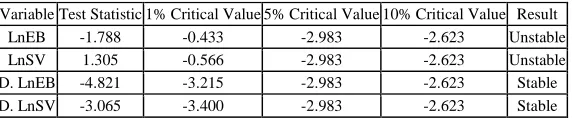
[image:3.595.165.451.426.485.2]Data stable is the premise of establishing VAR model, an augmented Dickey–Fuller test (ADF) is a test for a unit root in a time series sample. We use ADF unit root test to inspect LnEB and LnSV, the result as is shown in table 1. Through the test results we can see that LnEB and LnSV are non-stationary,then we test on d.LnEB and d.LnSV and demonstrate that d.LnEB and d.LnSV are stable, so we can build the VAR model and use granger test and cointegration test.
Table 1: Augmented Dickey–Fuller test (ADF)
Variable Test Statistic 1% Critical Value 5% Critical Value 10% Critical Value Result LnEB -1.788 -0.433 -2.983 -2.623 Unstable LnSV 1.305 -0.566 -2.983 -2.623 Unstable D. LnEB -4.821 -3.215 -2.983 -2.623 Stable D. LnSV -3.065 -3.400 -2.983 -2.623 Stable
2.3 VAR model
Vector auto regression (VAR) is a statistical model used to capture the linear interdependencies among multiple time series. An estimated VAR model can be used for forecasting, and the quality of the forecasts can be judged.VAR model is the simultaneous form of autoregressive model, A VAR (p) model of a time series y (t) has the form:
( )t p t p t
t
A
y
A
y
y
A
0 ( )=
1 (−1)+
⋅
⋅⋅
+
(− )+
ε
(6)
In this paper, I use AIC, SC criterion to identify the lag length. From the result, we can get that the minimum AIC is in lag 2, so I choose lag 2 as the lag length. Then, we bulid the VAR model of LnEB and LnSV as:
2 1
2
1
0
.
128
0
.
451
0
.
329
229
.
0
59
.
2
S
V
=
+
LnEB
t−+
LnEB
t−+
LnSV
t−+
LnSV
t−Ln
(7)
According to this formula, we can get that the application of E-business will promote sales volume increase. LnEB at lag 1 period increased one percentage can drive LnSV increased by 0.22 percentages, so the effect of E-business to SMEs’ business performance is obvious.
Table 2: Granger causality test
Equation Excluded chi2 df Prob > chi2 LnEB LnSV 2.5005 2 0.286 LnSV LnEB 17.214 2 0.000
[image:4.595.167.443.349.693.2]At the same time, we take Johnson co-integration test to analyze the long-term relations between E-business application and sales volume increase, the results is shown in table 3 Co integration is a statistical property of time series variables. Two or more time series are co integrated if they share a common stochastic drift, if two or more series are individually integrated but some linear combination of them has a lower order of integration, then the series are said to be co integrated.
Table 3: Johnson Co-integration test
Rank Parms LL Characteristic Value Statistic 5% Significant level 0 6 25.653892 8.1213* 15.41 1 9 29.678554 0.63438 0.0720 3.76
According to the results, there exist at least one direct co-integration relationship between E-business application and sales volume, which means that there exist a long-term equilibrium relationship between E-business application and small business sales volume.
2.4 Impulse-response analysis and variance decomposition
[image:4.595.168.443.377.548.2]According to the results above, we can get that there exist a long-term equilibrium relationship between E-business application and small business sales volume, and E-business is the reason to business sales volume increase, also the VAR model is stable. In order to analyze the VAR model, I use Impulse-response function and cholesky variance decomposition, the results is shown in figure 1 and figure 2.
Figure 1. Impulse-response analysis
Figure 2. Cholesky variance decomposition
The cholesky variance decomposition also shows the same result, the contribution degree of LnSV to LnSV is gradually reduced and the contribution degree of LnEB to LnSV is gradually increased. From figure 2, we find the contribution degree of LnSV to LnSV at t=1 period is almost 100%, and then reduced gradually from setp 2, finally reduced to 67.2% in t=8 period. At the same time, the contribution degree of LnEB to LnSV is 25% at t=1 period, then increased and become stable from step 2, the contribution degree in t=8 period is 62%.This means that E-business application has a important contribution degree to sales volume increase, and can be used to explain the business performance in SMEs by using E-business technology.
DISCUSSION
However, there are still some inhibitors of using e-commerce in SMEs, such as: The high cost of implementation
Lack of organizational readiness with many SMEs having limited existing IT resources There are still some complex technologies like EDI which could require new skills Difficult to achieve timely network update
The different perception between webpage description and the reality of goods Security, including confidentiality and fraud
Thus, a range of issues may affect SMEs decisions to invest in e-business and to take advantage of future opportunities. These inhibitors of using e-commerce in SMEs still need to analyze and research. With the change of market environment, enterprises have realized the importance of customer resource. E-CRM is a new management mechanism that aims to improve the relationship between enterprises and customers, it provides comprehensive, personalized customer information to sales and service personnel, it also strengthen the tracking service, information analysis capabilities, enabling them to build and maintain the” one-to-one relationship" between customers and enterprise. With the extensive application of management information system, small business will face more customer data, using a reasonable CRM strategy and information technology will help SMEs establish a long-term customer relationship and improve the business performance.
CONCLUSION
In this paper, we first introduce the ECRM and E-business strategy in enterprise, and use VAR model to analyze how E-commerce affect the business performance in emerging countries as China. The result shows that E-business application can improve the sales performance of small business obviously, there exist a long-term equilibrium relationship between E-business application and small business sales volume. E-business would be the most important factors for SMEs to success. The advantage of using E-business in SMEs basically has the following aspects: First, electronic commerce has been the market development tools, the network marketing activities of enterprises can improve marketing efficiency and reduce the cost of sales. For example, internet advertising can increase the sales about 10 times compared with the traditional advertising, but the cost is only 1/10 of traditional advertising; Second, the electronic commerce can reduce procurement costs because the enterprise can seek the most preferential prices in the global market suppliers, and reduce the loss of intermediate links due to inaccurate information; Third, Electronic commerce as a marketing platform, the network transaction does not need an intermediary party, and can improve efficiency. By using the network information technology, customers’ order can be received directly through the network, so that the products do not need to be stored to the warehouse but can be shipped directly to the customers. In addition, relying on the Internet technology like MSN, and other business real-time software dialog, it can strengthen the communication.
REFERENCES
[1] JG Cegarra-Navarroa ; DJ Jiménezb ; EÁM Conesac,International Journal of Information Management,
2007,27,173–186
[2] S Drew,European Management Journal, 2003,21 ,79–88
[3] T Kontinen ; A Ojala1,International Business Review, 2011,20, 440–453 [4] ME Jennex ; D Amoroso,Electronic Commerce Research, 2004,4, 263-286 [5] CA Fader ,International Journal on Digital Libraries , 2002, 3, 279-283
[6] E Elia, LA Lefebvre,Information Systems and e-Business Management, 2007,5, 1-23 [7] P Fariselli ; C Oughton ; C Picory ; R Sugden,Small Business Economics, 1999,12, 261-275 [8] AJ Davies , AJ Garcia-Sierra,BT Technology Journal, 1999,17, 97-111
[9] E Wierstra ; G Kulenkampff ; H Schaffers,Netnomics, 2001,3,35-65