
International Journal of Emerging Technology and Advanced Engineering
Website: www.ijetae.com (ISSN 2250-2459, ISO 9001:2008 Certified Journal, Volume 3, Issue 4, April 2013)
139
Web Mining Using Cloud Computing
Kaikala Anjani Sravanthi
1, Yalamarthi Madhavi Lata
21Koneru Laxmaiah University,B.Tech (IV/IV),ECM, Vaddeswaram, Vijayawada 2Koneru Laxmaiah University, Associative professor, Vaddeswaram, Vijayawada
Abstract— In this paper I present the technology of cloud computing using web mining .Web mining include how to extract the useful information from the web and gain knowledge using data mining techniques. Here so many online resources are available i.e. web content mining and access through the web servers. Web mining techniques and applications are much needed in cloud computing .The implementation of these techniques through cloud computing will allow users to retrieve relevant and meaningful data from virtually integrated data warehouse which reduces cost and infrastructure.
Keywords— Data mining, Web Mining, Data Warehouse, Knowledge Discovery, Cloud Mining, Web Content Mining, Web Structure Mining, Web Usage Mining
I. INTRODUCTION
The Internet is becoming an increasingly vital tool in our everyday life, both professional and personal, as its users are becoming more numerous. It is not surprising that business is increasingly conducted over the Internet. Perhaps one of the most revolutionary concepts of recent years is Cloud Computing. The expansion of the World Wide Web (Web for short) has resulted in a large amount of data that is now in general freely available for user access. The different types of data have to be managed and organized in such a way that they can be accessed by different users efficiently. Therefore, the application of data mining techniques on the Web is now the focus of an increasing number of researchers. Several data mining methods are used to discover the hidden information in the Web. However, Web mining does not only mean applying data mining techniques to the data stored in the Web. The algorithms have to be modified such that they better suit the demands of the Web [1].
The Cloud, as it is often referred to, involves using computing resources – hardware and software – that are delivered as a service over the Internet (shown as a cloud in most IT diagrams).
Many companies are choosing as an alternative to building their own IT infrastructure to host databases or software, having a third party to host them on its large servers, so the company would have access to its data and software over the Internet.
The use of cloud computing is gaining popularity due to its mobility, huge availability and low cost .On the other hand it brings more threats to the security of the company‘s data and information .At an equally significant extent in recent years, data mining techniques have evolved and became more used, discovering knowledge in databases becoming increasingly vital in various fields: medicine, business, science and technology, spatial data. [2] [3]
A. History of Web Mining
Web mining techniques are the result of long process of research and product development. This evolution began when business data was first stored on computers & internet, continued with improvements in data access and more recently real-time technologies that users in the WWW (World Wide Web) allow us to navigate through our data.
Data gathered from surveys, or input from several independent or networked locations via Computer & tapes are define Data collection. Use the data storage typically refers to software and related activities, the retrieving, or stored in a database or other data source acting on.
In the evolution from business data to business information each new step has built upon the previous one. For example, the ability to store large databases is critical to web mining. From the user point of view, the five step listed in Table I were revolutionary because they allowed new business question to be answered accurately and quickly.
International Journal of Emerging Technology and Advanced Engineering
Website: www.ijetae.com (ISSN 2250-2459, ISO 9001:2008 Certified Journal, Volume 3, Issue 4, April 2013)
140
Today, the maturity of these techniques, coupled with high performance relational database engines and broad data integration efforts, make these technologies practical for current data warehouse environments. [4]
II. ASPECTS OF CLOUD COMPUTING
Cloud computing represents both the software and the hardware delivered as services over the Internet. Cloud Computing is a new concept that defines the use of computing as a utility, that has recently attracted significant attention.
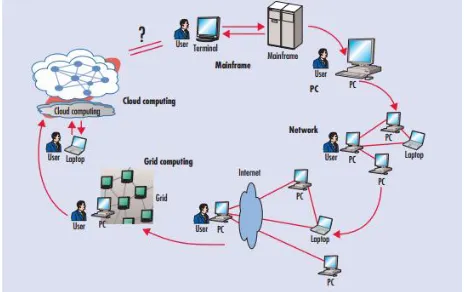
In Figure 1 below it is illustrated the computing paradigm shift on the last half century through six distinct phases: [1]
• Phase 1: people used terminals to connect to powerful mainframes shared by many users.
• Phase 2: stand-alone personal computers became powerful enough to satisfy users‘ daily work.
• Phase 3: computer networks allowed multiple computers to connect to each other.
• Phase 4: local networks could connect to other local networks to establish a more global network.
• Phase 5: the electronic grid facilitated shared computing power and storage resources.
[image:2.612.312.567.353.725.2]• Phase 6: Cloud Computing allows the exploitation of all available resources on the Internet in a scalable and simple way.
Figure 1. Computing paradigm shift of the last half century [1]
As it is defined by the National Institute of Standards and Technology, ―Cloud computing is a model for enabling ubiquitous, convenient, on-demand network access to a shared pool of configurable computing resources (e.g., networks, servers, storage, applications, and services) that can be rapidly provisioned and released with minimal management effort or service provider interaction.
This cloud model is composed of five essential characteristics, three service models, and four deployment models.‖ [5]
III. ASPECTS OF DATA MINING
Data mining represents finding useful patterns or trends through large amount of data.
Data mining is defined as a ‖Type of database analysis that attempts to discover useful patterns or relationships in a group of data .The analysis uses advanced statistical methods, such as cluster analysis , and sometimes employs artificial intelligence or neutral network techniques . A major goal of data mining is to discover previously unknown relationships among the data, especially when the data come from different databases.‖[6]
The most important data mining techniques and their description are presented in table I below:
TABLE I
DATA MINING TECHNIQUES [7]
Cloud Name Key Feature
Clustering Useful for exploring data and
finding natural groupings. Members of a cluster are more like each other than they are like members of a different cluster. Common examples include finding new customer segments and life sciences discovery.
Classification Most commonly used
technique for predicting a specific outcome such as response/no-response,
high/medium/low value
customer, likely to buy/not buy.
Association Find rules associated with
frequently co-occurring
items, using for market
basket analysis, cross-sell, and root cause analysis. Useful for product bundling, in-store placement, and defect analysis.
Regression Technique for predicting a
continuous numerical
[image:2.612.58.290.458.604.2]International Journal of Emerging Technology and Advanced Engineering
Website: www.ijetae.com (ISSN 2250-2459, ISO 9001:2008 Certified Journal, Volume 3, Issue 4, April 2013)
141
Attribute Importance Ranks attributes according to
strength of relationship with target attribute. Use cases include finding factors most associated with customers who respond to an offer, factors most associated with healthy patients.
Anomaly Detection Identifies unusual or
suspicious cases based on deviation from the norm. Common examples include health care fraud, expense
report fraud, and tax
compliance.
Feature Extraction Produces new attributes as
linear combination of existing attributes. Applicable for text data, latent semantic analysis,
data compression, data
decomposition and
projection, and pattern
recognition.
A. Drawbacks in the Existing Approaches
1.The response time perceived by the user is too long. 2.The explosive growth of the Web has imposed a
heavy demand on networking
3.Resources and Web servers.
4.Hence, an obvious solution in order to improve the quality of Web services would be the increase of bandwidth, but such a choice involves increasing economic cost.
5.Web caching scheme has three significant drawbacks:
If the proxy is not properly updated, a user might receive stale data, and, as the number of users grows, origin servers typically become bottlenecks.
6.The several factors diminish the ideal effectiveness of Web caching. The obvious factors are the limited system resources of cache servers (i.e., memory space, disk storage, I/O bandwidth, processing power, and networking resources). However, even if the cache space is unlimited, there are significant problems that cannot be avoided by such as approach. Specifically, large caches are not a solution because, the problem of updating such a huge collection of Web objects is unmanageable.
7.Main drawback of systems which have enhanced
prefetching policies is that some pre-fetched objects may not be eventually requested by the users. In such a case, the prefetching scheme increases the network traffic as well as the Web servers‘ load. [8]
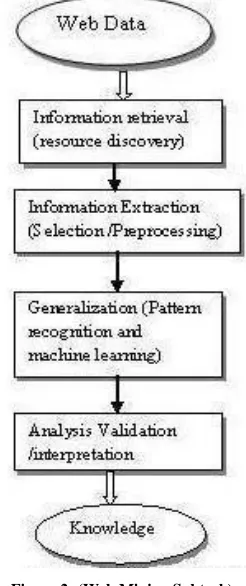
Figure 2: (Web Mining Subtask)
Based on the aforesaid four subtasks (Figure. 2), web mining can be viewed as the use of data mining techniques to automatically retrieve, extract and evaluate information for knowledge discovery from web documents and services. Here, evaluation includes both ―generalization‖ and ―analysis.
B. Web Mining Categories
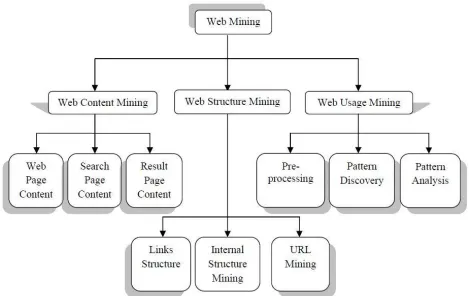
Web mining can be categorized in to three area of interest based on which part of the web to mine:
a) Web Content Mining b) Web Structure Mining c) Web Usage Mining
i. Web Content Mining
[image:3.612.383.506.142.435.2]International Journal of Emerging Technology and Advanced Engineering
Website: www.ijetae.com (ISSN 2250-2459, ISO 9001:2008 Certified Journal, Volume 3, Issue 4, April 2013)
142
ii. Web Structure Mining
We can define web structure mining in terms of graph. The web pages are representing as nodes and Hyperlinks represent as edges. Basically it‘s shown the relationship between user & web. The motive of web structure mining is generating structured summaries about information on web pages/webs. It is shown the link one web page to another web page.
iii. Web Usage Mining
It is discovery of meaningful pattern from data generated by client server transaction on one or more web localities. A web is a collection of inter related files on one or more web servers. It is automatically generated the data stored in server access logs, refers logs, agent logs, client sides cookies, user profile, meta data, page attribute, page content & site structure.[3] Web mining usage aims at utilize data mining techniques to discover the usage patterns from web based application.
It is technique to predict user behaviour when it is interact with the web. [9] Web usage mining is categories in three phases:-
• Pre-processing • Pattern Discovery • Pattern Analysis
Pre-processing- According to client, server and proxy server it is first approach to retrieves the raw data from web resources and processed the data .it is automatically transformed the original raw data.
Pattern Discovery- According the data pre-processing discovered the knowledge and implements the techniques to discover the knowledge like as machine learning and data mining procedures are carried out at this stage.
Pattern Analysis- pattern analysis is the process after pattern discovery. Its check the pattern is correct on the web and how to implement on web to extract the information on your web search / extract knowledge from the web.
[image:4.612.80.549.375.671.2]International Journal of Emerging Technology and Advanced Engineering
Website: www.ijetae.com (ISSN 2250-2459, ISO 9001:2008 Certified Journal, Volume 3, Issue 4, April 2013)
143
[image:5.612.41.563.166.355.2]C. Web Mining v/s Data Mining
Table II
(Web Mining v/s Data Mining) [10]
Comparison Web Mining Data Mining
Scale In this the search processing is not a big, 10 million job in web server database
In this the search processing is large, a 1 million jobs in data base
Access Web Mining is access data publicly. In this not hide the data which is access in web database. But take permission to web log master and access the data.
Data Mining is access data privately and only authorize user access data in the database.
Structure In Web mining get the information from
structured, unstructured and semi
structured from web pages. web mining
fetch the information from wide
database
In Data mining get the information from explicit structure. Data mining is not
fetch the information from wide
database compares to web mining database.
IV. WEB MINING THROUGH CLOUD COMPUTING
Cloud Computing is clearly one of today's most seductive technology areas due at least in part to its cost efficiency and flexibility. However, despite increased activity and interest, there are significant, persistent concerns about cloud computing that are impeding momentum and will eventually compromise the vision of cloud computing as a new IT procurement model [11]. The term ‗cloud‘ is a symbol for the Internet, an abstraction of the Internet‘s underlying infrastructure, used to mark the point at which responsibility moves from the user to an external provider.
Basically Cloud Mining is new approach to faced search interface for your data. SaS (Software-as-a-Service) is used for reducing the cost of web mining and try to provide security that become with cloud mining technique. Now a day we are ready to modify the framework of web mining for demand cloud computing. [12] In terms of ―mining‖ clouds, the Hadoop and Map Reduce communities who have developed a powerful framework for doing predictive analytics against complex distributed information sources.
V. RELATED WORK
Many researchers have looked for way of represent the web mining and future of web mining. Some of these are said that cloud mining is the future of web mining. As we know, Etzioni is the first person who coined the term Web Mining. This paper describes the web mining subtask and process through cloud computing [13].
D. Sravan Kumar and B. Naveena Devi [14] described the web mining classification like Content mining, Structure mining & Usage mining. In this paper they also describe the process of web usage mining.
VI. CONCLUSION
We provide a survey about the research in the area of Web mining‘s today structure and tomorrow view. We point some confusion between data mining and web mining. Web data is growing at a significant rate. Web Mining is fertile area of research. Many Successful applications exist. We also suggest the subtask of web mining & future of web mining. Now we also work for the process mining and try to combine usage mining with structure mining. We also go for the mining from cloud. Whenever we work on mining over cloud computing that time we hesitate for the cost but that come very less by cloud mining. So, we can say that cloud mining can be seen as future of web mining.
REFERENCES
[1] Jeffrey Voas and Jia Zhang, ―Cloud Computing: New Wine or
Just a New Bottle.‖ IEEE Internet Computing Magazine,2009. http://www.cmlab.csie.ntu.edu.tw/~jimmychad/CN2011/Reading s/CloudComputingNewWine.pdf.
[2] Virgilio Almeida, Azer Bestavros, Mark Crovella, and Adriana de
International Journal of Emerging Technology and Advanced Engineering
Website: www.ijetae.com (ISSN 2250-2459, ISO 9001:2008 Certified Journal, Volume 3, Issue 4, April 2013)
144
[3] Chen, M. S, Han, J. and Yu, P. S. ―Data Mining: An overview from a database perspective‖, IEEE transaction on knowledge and data engineering, Vol. 08, No. 6, pp: 866-883, 1996.
[4] Raymond Kosala, Hendrik Blockeel,‖ Web Mining Research: A
Survey‖, In ACM SIGKDD, July 2000.
[5] Peter Mell, and Timothy Grance, ―The NIST Definition of Cloud
Computing‖, The National Institute of Standards and
Technology, USA, 2011,
Link:http://csrc.nist.gov/publications/nistpubs/800-145/SP800-145.pdf.
[6] Merriam-Webster Dictionary, ―Definition of data mining‖,
Link:http://www.merriamwebster.com/dictionary/data%20 mining
[7] ORACLE, ―Oracle Data Mining Mining Techniques and
Algorithms‖,
Link:http://www.oracle.com/technetwork/database/options/advan ced-analytics/odm/odm-techniques-algorithms-097163.html.
[8] Faten Khalil, Jiuyong Li and Hua Wang ―A Framework of
Combining Markov Model with Association Rules for Predicting Web Page Accesses‖ ,Proc. Fifth Australasian Data Mining Conference (AusDM2006), CRPIT Volume 61,177-184.
[9] Wu, K.L. Yu, P. S. Ballman, A. ―A Web usage mining and
analysis tool―, IBM Systems Journal, 2010.
[10] Michael Jennings,‖ What are the major comparisons or
differences between Web mining and data mining?‖ Information Management Online, June 25, 2002.
[11] Deyi Li, Kaichang Di, Deren Li and Xuemei Shi, ―Mining
association rules with linguistic cloud models‖, Research and Development in Knowledge Discovery and Data Mining ,Lecture Notes in Computer Science, 1998.
[12] Ajay Ohri ―Data mining through Cloud Computing‖.
http://knol.google.com/k/data-mining-through-cloud-computing# See on Dec. 2010.
[13] Etzioni, O. ―The World Wide Web: Quagmire or gold mine‖,
Communication of the ACM, Vol. 39, No. 11, pp. 65-68, 1996.
[14] Sravan Kumar, D. and Naveena Devi, B. ―Learner‘s Centric
Approach for Web Mining‖ et al. (IJCSIT) International Journal of Computer Science and Information Technologies, Vol. 1(2), 2010.
Address for correspondence
Kaikala Anjani Sravanthi, B. Tech (IV/IV), K L University, Vaddeswaram, Vijayawada.
![Table II (Web Mining v/s Data Mining) [10]](https://thumb-us.123doks.com/thumbv2/123dok_us/8730458.886658/5.612.41.563.166.355/table-ii-web-mining-v-s-data-mining.webp)
