www.arpnjournals.com
RESOURCE ALLOCATION FOR DOWNLINK COORDINATED MULTIPOINT
(CoMP) IN LTE-ADVANCED
Norshidah Katiran1, Norsheila Fisal2, Aimi Syamimi Abdul Ghaffar3, Siti Marwangi Mohamad Maharum2,
Faiz Asraf Saparudin3
1Faculty of Electrical and Electronic Engineering, Universiti Tun Hussein Onn Malaysia, Malaysia 2
UTM-MIMOS Center of Excellence, Universiti Teknologi Malaysia, Malaysia 3Faculty of Engineering Technology, Universiti Tun Hussein Onn Malaysia, Malaysia
E-Mail: [email protected]
ABSTRACT
Coordinated multipoint (CoMP) in LTE-Advanced is considered as a promising way to enhance spectrum efficiency in interference-limited wireless network through base station (BS) cooperation. However, resource allocation is one of the key challenges faced by CoMP network because resource allocation strategy of one cell affects the other cells’ performance. Moreover, due to the scarcity of wireless network resources such as bandwidth and power, efficient resource allocation strategy is always desirable. In this paper, a low-complexity resource allocation strategy in CoMP that aims to achieve high network throughput is presented. The resource allocation strategy consists of three modules which are performed sequentially; user allocation module, subcarrier allocation module and power allocation module. Our simulation study shows that the proposed strategy gives significant performance gain in CoMP LTE-Advanced network.
Key words: CoMP Resource allocation Low-complexity
INTRODUCTION
Recently, CoMP technology has been proposed in Third Generation Partnership Project (3GPP) LTE-Advanced as a promising way to boost the system spectrum efficiency and the cell-edge performance. Downlink CoMP implies dynamic coordination among multiple geographically separated transmission points or base stations (BSs) (“3GPP TS 36.189 V.11.1.0 (2011-12) 3GPP Technical Specification Group Radio Access Network; Coordinated Multipoint operation for LTE Physical Layer Aspects (Release 11),” n.d.).The backhaul link allows the exchange of information which is used to coordinate the BS transmissions such that interference generated to neighboring cells is minimized. In other word, the backhaul link is used for radio resource management (RRM) purposes including ICIC (“3GPP TS 36.420 V.10.0.1 (2011-03); 3GPP Technical Specification Group Radio Access Network; EUTRAN; X2 General Aspects and Principles (Release 10),” n.d.).
NETWORK MODEL
The CoMP LTE-Advanced network model consisting of cells with number of users in cell is considered. Total users in the network is denoted as . Each OFDMA BSs in the network has subcarriers. Each BS in the network is equipped with antennas and each user device has antennas. Therefore, in the downlink, the cooperative BSs and the paired users can form a ∗ , ∗ , virtual MIMO system. This framework is depicted in Figure 1, where three BSs coordinate to create a multi-point transmission to the users. CoMP minimizes interference among the users in the network which are close to the multiple BSs and therefore experience an interference-limited environment. The interference is
reduced due to coordination between the interfering BSs and the serving BS.
Cell 3
Cell 2
Cell 1
Central Scheduler Cell in CoMP cluster
Cell from other cluster
Figure 1: Downlink CoMP LTE-Advanced network model
RELATED WORKS
Resource allocation in CoMP LTE-Advanced has been actively investigated in the downlink transmission to maximize total network throughput. Low complexity algorithms usually aim to determine an efficient subchannel allocation and power allocation solutions, sequentially. The solution described in (Fraimis, Papoutsis, & Kotsopoulos, 2010) searches the subchannel that is infrequently reused by adjacent BSs. A subchannel is allocated to the cell-edge user with the best channel condition on that subchannel. Then, this subchannel and this user are eliminated from the procedure and equal power is allocated to the cell-edge group users. The authors, however, neglected to indicate how the power is to be distributed to the cell-centric and cell-edge groups.
In (Lu, Daiming, Tao, & Jie, 2010), prioritization was enforced using weighted sum throughput maximization. A distributed iterative algorithm was used to tackle the user scheduling and power control problem. The approach exploits the interaction among the transmit power of different BSs and signal-to-interference plus noise ratio (SINR) of all scheduled user. However, the authors ignored to show how the weights are to be assigned to the users in a real system. In (Yiwei, Eryk, Xiaojing, & Markus, 2013), prioritization of getting system resources was enforced using similar approach as in (Lu et al., 2010). The weighting factor balanced the physical resource block (PRB) allocation between cell-edge and cell-centric users of the network. The graph-based framework together with fine-scale PRB assignment algorithms was proposed to manage inter-cell interference (ICI) in a centralized manner. The power allocation is performed independently in each cell to maximize performance of its own cell-edge users.
In theory, downlink capacity scales linearly with the number of transmit and receive antennas. In practice, the number of transmit antenna at a BS is always limited. Thus, the BS needs to select a restricted number of users to serve in each multi-user multiple-input multiple-output (MU-MIMO) transmission. A user selection strategy must be judiciously devised, because the users are coupled and their achievable rates depend on the orthogonality of their instantaneous channel states. To search for the optimal user subset using brute-force approach is computationally exhaustive due to the massive number of possible user subset combinations. In order to reduce the computational complexity, various suboptimal user selection algorithms have been considered. Orthogonality based user selection (Chen, Lv, Jiang, & Wang, 2010; Gupta, Chaturvedi, & Member, 2014) have been shown to well approximate the optimal capacity at low computational complexity. The BS chooses the first user with the highest channel quality. Then, the next user that provides the best potential performance when grouped with those selected ones is selected. The procedure repeats until users are selected. Other suboptimal user selection algorithms were studied in (Cho, Kang, & Kim, 2012; Gupta et al., 2014; Kudo, Takatori, Murakami, & Mizoguchi, 2011; Seki, Takyu, & Umeda, 2010; Xie & Zhang, 2014).
PROBLEM FORMULATION
The total number of transmit antennas at cooperative BSs is given by equation (1) and the total
number of receive antennas at active users is given by equation (2):
,
(1)
,
∈
(2)
The cooperative BSs and active users form a virtual MIMO system, where . A total system bandwidth of Hertz is divided into subcarriers. Letting Ω be the set of subcarriers allocated to user , , the allocated power of user on subcarrier , the total allocated power of user over the set of subcarriers Ω, and !"#$ the maximum BS transmission power. Furthermore, %, 1 if subcarrier is allocated to user in cell , i.e., ∈ Ω. Otherwise, %, 0.The achievable throughput of user in bits per second (bps) is defined as follows:
(
%,, log,-1 .
,, /,,
0 ,
1 2
!
0
∈34
(3)
Note that in equation (3), the impact of interference received from other cell has been ignored to reduce computational complexity. The resource allocation problem is formulated to maximize the total network achievable throughput which is expressed as:
567 (
∈
(4)
s.t.
0 8 ,,
9∈34
8 !"#$
∈
(5)
This resource allocation problem does not have a close-form solution because of the interaction between channel matrices of different users. Exhaustive search method can be used to solve the aforementioned resource allocation problem. However, when the number of users is large, it has prohibitive computational complexity. A large search space is required with the total search space is given by:
:
;
<=
(6)
PROPOSED RESOURCE ALLOCATION STRATEGY
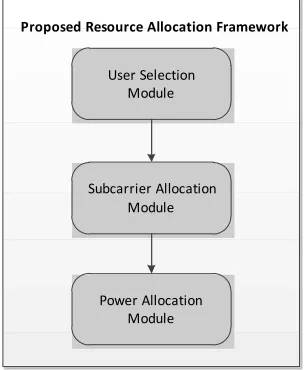
The main goal of the proposed resource allocation strategy is to achieve the network throughput as high as possible by selecting appropriate set of users with low computational complexity. Generally, the strategy consists of three modules; user selection module, subcarrier allocation module and power allocation module. The framework of the proposed strategy is illustrated in Figure 2.
Proposed Resource Allocation Framework
Subcarrier Allocation Module
Subcarrier Allocation Module
Power Allocation Module
Power Allocation Module
User Selection Module
[image:3.612.123.277.173.358.2]User Selection Module
Figure 2:Proposed resource allocation framework for CoMP LTE-Advanced
User Selection Module
The user selection module selects appropriate set of users to achieve high system throughput with low complexity. A selected user set, > ?∈ @1, A: ,, C 0 is defined as a set of selected users with nonzero allocated power. The total transmit power out of the BS is constrained
by !"#$. Consider D, is the th user’s channel matrix
on subcarrier from all BSs in the CoMP network:
D, ED, D,, … … D,
G (7)
where D
,
is the
, , channel matrix from BS to user . The development of user selection module in the proposed strategy is based on the squared Frobenius norm of the user’s channel matrix (Katiran et al., 2012). The squared Frobenius norm of a user channel on subcarrier, of a particular subchannel is interpreted as a total gain of the channel (Yong, S. C., Jaekwon, K., Won, Y. Y. and Chung, 2010), that is:
HD,HI
,
JD,DK,L . JD,,D,K,L . ⋯ . JD,
D
,
K L
(8)
where D,DK, or similarly D,DK,are the eigenvalues of the Hermitian symmetric matrix. Then, the squared Frobenius norms of all active users’ channels on subcarrier are ranked in descending order, such that:
ND,NI,C ND,,NI,C NDO,NI,C ⋯ C ND,NI,
(9)
The user selection module selects the top users to be the candidates in the admissible user set, > such that
.
Subcarrier Allocation Module
The subcarrier allocation module adopts equal subcarrier allocation. This means that each user gets the same number of subcarriers, 0PQregardless of the channel condition or individual demand. Therefore no prioritization is enforced in the subcarrier allocation module, hence provides some notion of fairness. A subset of subcarriers is allocated to each user based on block type method. This type is often used in environment of low mobility and stable channel condition (Yong, S. C., Jaekwon, K., Won, Y. Y. and Chung, 2010). The advantage of using a block type of resource allocation is it reduces the signaling overhead in terms of feedback and control signaling since each subset of subcarriers is constructed within the coherence bandwidth. The subcarrier allocation module finds the pair of user and subcarrier that yields the higher channel gain and completes the subcarrier assignment. Then, the user and his/her allocated subcarrier are excluded from the procedure. Finally, the procedure is repeated until all users in the selected user set, > are assigned the appropriate subcarriers.
Power Allocation Module
The power allocation scheme adopted in the proposed resource allocation strategy is based on water-filling (WF) algorithm. WF has been widely applied in the area of power allocation in wireless networks due to its optimality performance (Dongyan, Zesong, Shuo, & Jingming, 2010; Fengya, Yu, Bin, Pin, & Xiang, 2012; Hojoong & Byeong, 2009; Qilin, Minturn, & Yaoqing, 2012; Yi & Krishnamachari, 2012). The algorithm allocates more power to subcarriers with higher SNR to maximize the network throughput. It can be formulated as the following optimization problem:
max (
∈
(10)
subject to
,,
9∈34
8 !"#$
∈
(11)
∗,, U 1 V WXD1
,
X,Y
Z
[ 1 V W
1
XD,
X,, \]
1 V W
1
XD,
X, 0
0, ^_`abc\da
e
(12)
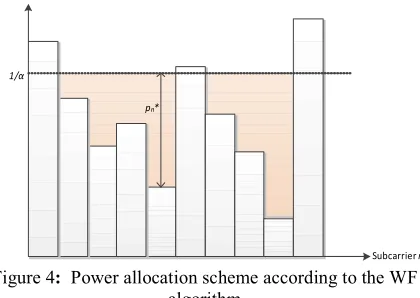
where V is the Lagrange multiplier that is chosen to fulfill the power constraint in equation (11). Based on this algorithm, a subcarrier with larger SNR is allocated more power. Figure 4 illustrates a graphical description of the optimal power allocation solution in equation (12). The noise-to-signal ratio (NSR), given in a function of the subcarrier index , can be considered as the bottom of a water tank with an irregular shape. If each subcarrier is poured with units of water in the tank, the depth of the water at subcarrier corresponds to the power allocated to that subcarrier, while 1 V⁄ is the height of the water level. It is interesting to note that no power must be allocated to subcarriers with the bottom tank above the given water level. This implies that a poor channel must not be used for transmitting data.
1/α No/|Hn|2
[image:4.612.69.290.63.167.2]Subcarrier n pn*
Figure 4: Power allocation scheme according to the WF algorithm
SIMULATION RESULTS AND DISCUSSION
[image:4.612.80.290.352.501.2]In our simulation study, the number of users distributed in each cell in the CoMP network is varied between 2 and 14. There are four transmitting antennas at each BS, while each user device is equipped with two antennas. A user measures the link quality from all BSs in the network and sends the measurement report to the central scheduler. Through selective combining (SC) technique, only one BS is selected by the central scheduler to serve the user. The SC combiner chooses only the BS with the highest signal-to-noise ratio (SNR). Then, the central unit signals the corresponding user data to the selected BS for transmission. All users will be served by one BS only in order to relax the stringent requirements on backhaul network. The number of subcarriers allocated for each user, 0PQ is set to 12. The CoMP network model parameters are provided in Table 1.
Table 1: CoMP network model parameter setting
Parameter Assumption
Distance-dependent g System bandwidth, Subcarrier spacing Total subcarriers, Shadow fading Inter-site distance
Base station power, !"#$ No. of BS antenna No. of user device antenna
g 128.1 . 37.6 logno
5 MHz 15 kHz
300 8 dB 500 m 43 dBm
4 2
[image:4.612.315.546.455.612.2]The performance of the proposed low-complexity resource allocation strategy for CoMP LTE-Advanced network is evaluated. The results are compared with orthogonal based (OPO) user selection algorithm (Chen et al., 2010). The algorithm uses the distance metric between subspaces spanned by the vectors of users’ channels. The distance is defined as the Frobenius norm of the difference value between orthogonal projection operators of subspaces. Figure 6 shows the network sum-rate results of the proposed strategy and OPO. It can be observed from Figure 6 that the proposed strategy outperforms OPO with network sum-rate enhancements range between 21% and 36% achieved with different cell loading compared to OPO. This explains that the proposed strategy is more efficient than OPO in selecting user because the user selection criteria used is based on the maximization of the channel gain. By contrast, the user selection criteria used in OPO is based on the orthogonality of users’ channels.
Figure 6: Network sum-rate results
Numerical results of the average transmit power per BS is depicted in Figure 7. Observation from Figure 7 shows that lower transmission power is required in the proposed strategy compared to OPO with reduction between 19% and 24% in relative to the cell loading. This indicates that the user selection criterion adopted in the proposed work able to reduce the network transmission power in comparison to OPO algorithm.
0 10 20 30 40
2 4 6 8 10 12 14
N
e
tw
o
rk
S
u
m
-R
a
te
i
n
M
b
p
s
Cell Loading
Figure 7: Average transmit power results
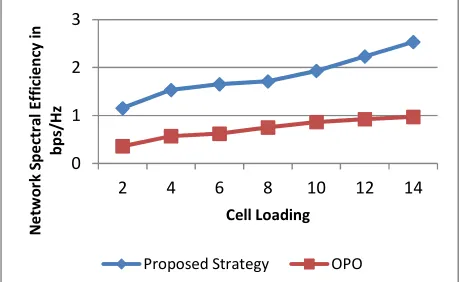
[image:5.612.68.300.348.489.2]Figure 8 presents the numerical result of network spectral efficiency. It can be observed from Figure 8 that the proposed resource allocation strategy gives better spectral efficiency performance compared to OPO. With different cell loading, an average of 60% increment in spectral efficiency is obtained. This explains that by selecting user based on the highest channel gain, higher spectrum utilization is achieved.
Figure 8: Network spectral efficiency results
CONCLUSION
In this paper, the low-complexity resource allocation strategy for CoMP LTE-Advanced network is presented. The proposed strategy consists of three modules; user selection module, subcarrier allocation module and power allocation module which are performed sequentially. The strategy exploits frequency and spatial diversities offered by the time-varying wireless channels to accomplish network performance gain. Simulation study shows that the proposed strategy enhances network sum-rate up to 36%, while reduces the average BS transmit power down to 24% compared to OPO strategy.
ACKNOWLEDGEMENT
The authors would like to thank to Office for Research, Innovation, Commercialization and Consultancy Management (ORICC) of Universiti Tun Hussein Onn Malaysia for their fundings.
REFERENCES
3GPP TS 36.189 V.11.1.0 (2011-12) 3GPP Technical Specification Group Radio Access Network; Coordinated Multipoint operation for LTE Physical Layer Aspects (Release 11). (n.d.).
3GPP TS 36.420 V.10.0.1 (2011-03); 3GPP Technical Specification Group Radio Access Network; EUTRAN; X2 General Aspects and Principles (Release 10). (n.d.).
Chen, C., Lv, C., Jiang, Y., & Wang, T. (2010). A Scheduling Technique for the Downlink of Multiuser MIMO Channels. 2010 International Conference on
Computational Intelligence and Software Engineering, 1–5.
doi:10.1109/WICOM.2010.5600619
Cho, C., Kang, J. W., & Kim, S.-H. (2012). Opportunistic maximum rate user selection with low complexity in MIMO interference channel. 2012 IEEE 23rd International Symposium on Personal, Indoor and Mobile Radio
Communications - (PIMRC), 732–637.
doi:10.1109/PIMRC.2012.6362881
Dongyan, Z., Zesong, F., Shuo, L., & Jingming, K. (2010). Improved Iterative Water-Filling Algorithm in MU-MIMO System. IET 3rd International Conference on Wireless,
Mobile and Multimedia Networks.
Fengya, L., Yu, Y., Bin, W., Pin, H. H., & Xiang, L. (2012). Power Allocation based on Fast Water-filling for Energy Efficient OFDM and MIMO Transmission. In IEEE Global
Communications Conference (GLOBECOM).
Fraimis, I. G., Papoutsis, V. D., & Kotsopoulos, S. A. (2010). A Decentralized Subchannel Allocation Scheme with Inter-cell Interference Coordination (ICIC) for Multi-Cell OFDMA Systems. In IEEE Global Communications
Conference, Exhibition and Industry Forum (GLOBECOM).
Gupta, G., Chaturvedi, A. K., & Member, S. (2014). User Selection in MIMO Interfering Broadcast Channels. IEEE
Transactions on Communications, 62(5), 1568–1576.
Hojoong, K., & Byeong, G. L. (2009). Cooperative Power Allocation for Broadcast/Multicast Services in Cellular OFDM Systems. IEEE Transactions on Communications.
Katiran, N., Fisal, N., Yusof, S. K. S., Abdul Ghaffar, A. S., Mohamad Maharum, S. M., & Asraf Saparudin, F. (2012). Joint Power Allocation Strategy in CoMP ( JP ) Transmission. In IEEE Symposium on Wireless Technology
and Applications.
Kudo, R., Takatori, Y., Murakami, T., & Mizoguchi, M. (2011). User Selection for Multiuser MIMO Systems Based on Block Diagonalization in Wide-Range SNR Environment. 2011 IEEE International Conference on
Communications (ICC), 1–5. doi:10.1109/icc.2011.5963515
Lu, L., Daiming, Q., Tao, J., & Jie, D. (2010). Coordinated User Scheduling and Power Control for Weighted Sum Throughput Maximization of Multicell Network. In IEEE
0 0.05 0.1 0.15 0.2 0.25
2 4 6 8 10 12 14
A
v
e
ra
g
e
T
ra
n
sm
it
P
o
w
e
r
in
W
a
tt
s
Cell Loading
Proposed Strategy OPO
0 1 2 3
2 4 6 8 10 12 14
N
e
tw
o
rk
S
p
e
ct
ra
l
E
ff
ic
ie
n
cy
i
n
b
p
s/
H
z
Cell Loading
Global Communications Conference, Exhibition and
Industry Forum (GLOBECOM).
Qilin, Q., Minturn, A., & Yaoqing, Y. (2012). An Efficient Water-filling Algorithm for Power Allocation in OFDM-based Cognitive Radio Systems. In International
Conference on Systems and Informatics.
Seki, Y., Takyu, O., & Umeda, Y. (2010). Performance evaluation of user selection based on average SNR in base station cooperation multi-user MIMO. 2010 IEEE Radio
and Wireless Symposium (RWS), 685–688.
doi:10.1109/RWS.2010.5434247
Xie, X., & Zhang, X. (2014). Scalable user selection for MU-MIMO networks. IEEE INFOCOM 2014 - IEEE
Conference on Computer Communications, 808–816.
doi:10.1109/INFOCOM.2014.6848008
Yi, G., & Krishnamachari, B. (2012). Online Learning Algorithms for Stochastic Water-Filling. In Information
Theory and Applications Workshop.
Yiwei, Y., Eryk, D., Xiaojing, H., & Markus, M. (2013). Downlink Resource Allocation for Next Generation Wireless Networks with Inter-cell Interference. IEEE
Transactions on Wireless Communications, 12(4), 1783–
1793.
Yong, S. C., Jaekwon, K., Won, Y. Y. and Chung, G. K. (2010). MIMO-OFDM Wireless Communications with