International Journal of Emerging Technology and Advanced Engineering
Website: www.ijetae.com (ISSN 2250-2459, ISO 9001:2008 Certified Journal, Volume 9, Issue 1, January 2019)
40
Analysis of Software Development Processes in A Healthcare
Facility
Onyekwere Eucharia
1, Ogwueleka Francisca Nonyelum
21,2
Computer Science Department, Nigerian Defence Academy Kaduna, Nigeria
Abstract - The advent of technology has facilitated the advancement and improvement of healthcare. Health informatics has made it possible for individuals to seek for medical care through various means and ways. The process of making this possible depends on the development of an efficient and effective software to run the healthcare facility. The health care facility is in categories based on the level of care it renders and comprises of multiple aspects such as the patient, doctors and other health workers. Developing a software for health care requires consideration of many factors such as the model of the Systems Development Life Cycle to be adopted in building the software, software risk management standards and the requirements of the facility. This study focused on the analysis of these processes using a privately-owned secondary healthcare facility as a case study. Personal and Telephone interviews were conducted in order to collect data from the software developers and information technologist. Questionnaires were administered on the patients and staff to assess the extent to which the software has been integrated into the work culture of the health facility and its effectiveness. The study was able to analyze the processes used in the development of a secondary Health Care Facility in Kaduna State, Nigeria, based on the results of the questionnaire administered and interviews carried out. Data obtained was analyzed using Statistical Package for Social Sciences version 25 and results shows that 84.4% of the medical staff can easily have access to patients records for retrieval in all the relevant departments but there are no room for adding new features to the software as more requirements are elicited. A healthcare facility is a critical area as such, Risk Management Standards based on international best practice should employed in the development of a software to serve this purpose.
Keywords - Healthcare facility, SDLC, Health informatics, Kaduna State, Risk management Standard, Hospital Management System.
I. INTRODUCTION
Technological innovations have led to breakthroughs in various fields such as Engineering, Energy and Aero Space. As such, the healthcare sector should not be left out in the global trend of technological advances in making life easier and more convenient. Healthcare has evolved from the processes of knowledge acquisition through to the use of equipment and modes of rendering care.
Information technology has facilitated the advancement and improvement in quality patient care all over the world. Patients seek medical care through telemedicine and electronic health records; which is an integral part of health informatics that has made it possible and more convenient for patients to access their medical records anywhere in the world.
Healthcare informatics is a multidisciplinary field, comprising of medical informatics, nursing informatics and biomedical informatics. Health informatics is an aspect of information management that is related to health (AHIMA, 2014). Hospital equipment such as digital thermometers, x-ray machines, ultra sound scanners, magnetic resonance imaging machines, computerized tomographic machines and a host of others has made medical diagnoses much easier and effective. Hence, software in any medical facility must be able to accommodate all these facets of the healthcare industry, with the sole aim of meeting the patient’s needs and improving the productivity of the health workers.
Software meant for any healthcare facility should be able to satisfy the patient’s needs and at the same time create a cohesive work system of all the different fields and departments thereby improving the productivity of the health workers. According to the National Academy of Sciences, in its publication titled “A framework for a Systems Approach to Health Care Delivery” (2001) stated that, “the health care is divided into four nested levels: the individual patient; the care team, which includes the professional care providers (clinicians, pharmacists and others); the organization (hospital, clinic) and; the political and economic environment”.
International Journal of Emerging Technology and Advanced Engineering
Website: www.ijetae.com (ISSN 2250-2459, ISO 9001:2008 Certified Journal, Volume 9, Issue 1, January 2019)
41
Each phase in-turn comprises of series of steps that gives an output. Several SDLC models can be modelled during the development of a software, each having its own unique way of ensuring success and efficiency in meeting client’s needs.A. Background of the Study
Developing a medical software is paramount in all health care facility globally as quality improvement is high on the agenda of several countries all over the world. According to Curry et al (2006), there is a great interest in problems concerning efficient and effective delivery of safe health care. The large number of countries that have budgeted so much money evidences this fact. Healthcare facility is a location or place where health care is provided (MedlinePlus, 2018). A healthcare facility could be a primary, secondary (specialized) or a tertiary health institution. Most primary healthcare facility are smaller in size and are privately owned such as clinics and Doctors’ offices, although, there are primary health care centers that are owned by government, that provide preventive measures from common health diseases particularly in children. The tertiary health care facilities are much larger comprising of so many departments and units with various large and sophisticated equipment, in that the process of developing a software for such a facility can be complex and would require a lot of integration.
The process of developing a software for a healthcare facility is not in any way different from the oldest and extensively used methods of software development and acquisition. The SDLC comprises of various models that can be applied in developing a software project for the hospital. This study looked at two models that can assist in attaining the deliverables, considering the four levels of health care system and the type of healthcare facility in question.
The Dialogue Specialist hospital used as a reference point is in the suburb of Kaduna State of Nigeria, within the central part of the state capital. It is a privately owned and modern health care facility well furnished with modern diagnostic machines. The hospital is also equipped with thirty-bed space for admission and observation of patients. The hospital has facility to cater for patients with different kinds of specialist conditions and diseases pertaining to different parts of the body. The different units/departments that are operational are Obstetrics and Gynecology (O&G), Ear, Nose and Throat (ENT) clinic; Surgery department, Family medicine and Pediatric clinic. This hospital has sixty-seven staff in all, including the 9 permanent and 5 visiting doctors and, 14 nurses.
Other staff include medical laboratory scientists, Information Technologist, accountants and other Staff needed to run the facility. They admit an average of sixty patients in a month. They also provide outpatient diagnostic services, family planning and immunization services to children below the age of five.
B. Statement of the Problem
[image:2.612.341.549.529.650.2]The Hospital Management System is multifaceted in that, at the core of every health care facility is the patient, then moving down to other aspects are the Doctors, and Nurses. You also have, laboratory scientists, Radiographers and other health workers as well as diagnostic equipment used by the doctors in actualizing the goal of providing adequate health care. In addition, the Pharmacy department provides drugs and the accounting section is responsible for the overall finances of the hospital. The different facets of the health care facility are shown in Figure 1. In this part of the world, registering a patient at the point of entry in any hospital can be very clumsy due to the manual system of registration. Trying to retrieve these records when the need arises especially when the patient comes for follow-up is another big problem and can be a herculean task. On the other hand, the health care team, which is the rudimentary building block of any health microsystem, has trouble trying to link patients’ record. The use of software, therefore, has become paramount and differentiator for health care seekers as well as health care providers and medical device producers. Medical device software is safety critical and so when developing a medical software, risk management standards must be maintained. This study, therefore, tries to identify the hindrances and peculiarities associated in the software development processes in a health care facility.
International Journal of Emerging Technology and Advanced Engineering
Website: www.ijetae.com (ISSN 2250-2459, ISO 9001:2008 Certified Journal, Volume 9, Issue 1, January 2019)
42
C. Aim and Objectives of the StudyThe aim of this study is to analyze the processes involved in the development of a software for a healthcare facility. It also seeks to identify the readiness and willingness of private hospital owners to identify with a medical software in managing its healthcare facility.
The objectives are:
i. To collect data using the questionnaire and interview methods of data collection and stratified sampling technique.
ii. To analyse the data collected using Statistical Package for Social Sciences version 25 and discussing the analysis using pie charts and bar charts.
iii. To evaluate the results analysed to draw conclusion and make recommendations as deem fit.
D. Significance of the Study
The findings of this study will reveal the processes involved in developing a software for a healthcare facility with emphasis on various models of the Systems Development Life Cycle. This study will identify which of the models will be most appropriate and effective in developing a software for managing a healthcare facility.
E. Scope of the Study
This study focused on the analysis of the SDLC models and eliciting the model that will best be suited in the development of a system for a health care facility. The different facets of a health care facility were also illustrated. A specialized private hospital, known as Dialogue Specialist hospital, which is a secondary health care facility, situated in Kaduna metropolis, was used as a case study from which data was collected.
F. Limitations of the Study
This study is limited to two of the SDLC models; the Waterfall model, which was modelled by the developers in the hospital, used as case study in this research, and the Agile model, which would have been more appropriate that can be used in the development of the software for a healthcare facility. The reference point used as a case study is limited to a privately-owned healthcare facility located in Kaduna State of Nigeria. According to the Ministry of Health in Kaduna State, there are 1011 primary health care centers, 29 secondary health facilities and 6 tertiary health facility. None of the tertiary and primary health facilities uses a software to run its activities, while 4 out of the 29 secondary health care facilities uses a software to run its business.
Hence, this hospital was sampled based on purposeful sampling technique due to its central location, number of patients they attend to and the number of staff they have. It is also well organized with ultra-modern equipment.
G. Research Questions
The research questions used are:
i. What are the processes involved in the development of the medical software?
ii. What is the impact of the software on the productivity of the health care institution?
iii. Is there a software risk management standard in the country? If there is, does the software conform to the standard?
iv. Does the software contribute to the ease and quality of patient care?
H. Organization of Paper
This paper is organized into five chapters. Chapter 1 introduces the study, giving an overview of the subject matter. The statement of the problem aims and objectives, the significance and scope of the study, limitations of the study and research questions were stated. Chapter 2 covers the literature review, which has to do with related work that has previously been carried out by other researchers. It also provides relevant information about the topic in question for better understanding. Chapter 3 gives an insight into the selected methodology that was used in the study. While chapter four presents the data analysis and discussions of the findings. Finally, chapter five summarizes and concludes the study.
J. Definition of Terms
Biomedical informatics (BMI) – Is an interdisciplinary field that studies the effective use of biomedical data, information and knowledge for scientific inquiry, problem solving, and decision making in order to improve health. Digital thermometers – Are portable temperature sensing devices that have permanent probes and a digital display.
Electronic Health Records – Electronic record of health-related information of an individual that can be created, gathered, managed, and consulted by authorized clinicians and staff within one health care organization.
Health care facility – Places that provide health care. They include hospitals, clinics, outpatient care centers and specialized care centers.
International Journal of Emerging Technology and Advanced Engineering
Website: www.ijetae.com (ISSN 2250-2459, ISO 9001:2008 Certified Journal, Volume 9, Issue 1, January 2019)
43
Magnetic resonance imaging – A medical imaging technique used in radiology to form pictures of the anatomy and the physiological processes of the body in both health and disease.Medical informatics – Is the intersection of information science, computer science, and health care.
Multifaceted – Having many different aspects or features. Nursing informatics – A specialty that integrates nursing science with multiple information management and analytical sciences to identify, define, manage and communicate data, information, knowledge, and wisdom in nursing practice.
Telemedicine – Remote diagnosis and treatment of patients by means of telecommunications technology.
II. LITERATURE REVIEW
A. Introduction
The varieties of health care facilities that are currently in existence is quite encompassing, ranging from small to moderately simple clinics to elaborate multifaceted and expensive research and teaching hospitals. According to Carr (2017), large health centers comprise of several subsidiary and specialized health care types that are of interdependent facilities. These facilities communicate with clients, donors, vendors and staff about the organization and the kind of medical care they render. The best health care facility software should be a set of solutions that will assist in creating a combined work system of all the medical subdivisions, making room for comparisons of medical examination and treatment. When developing a system for a health care facility, there are potential users that need to be considered. These are the staff, patients and the hospital authorities. Ferlie and Shortell (2001) described the health care system as comprising of four nested levels namely; the individual patient, secondly, the care team comprising of the professional health workers (doctors, nurses, laboratory scientists and pharmacists) and family members. Thirdly, the organization that is concerned with management and administrative processes. Lastly, the political and economic environment. Developing a health care model is a multidisciplinary approach that involves the health care professionals, systems analysts and programmers thereby necessitating the application of various techniques such as the SDLC models of systems development.
B. Classification of Health care Facilities
There is an increasing number of health care types because of a drift towards specialization.
The divisions of the healthcare facility into specialized areas and different levels of care facility is because of transition from hospital based curative care to outpatient care and implementation of preventive measures.
i) Primary Health Care Facilities: These are the first level facilities that are easily accessible to health seekers. A typical example are clinics that run for just a few hours in a day. According to Ministry of Health, in Nigeria, government usually owns the primary health care centers, which provides preventive health care to its clients. Another type of primary healthcare facility is community healthcare center, which provides initial baseline maternity, accident and emergency care to patients for few hours not exceeding 48 hours prior to discharge or transfer to a larger facility. Community health centers are located mainly in rural areas and small communities. There also privately-owned clinics that fall into this group.
ii) Specialized Hospitals: These hospitals render service to definite groups of health care seekers. They accept referrals from primary healthcare facilities, providing specialist care to specific health concerns. Our reference point in this study which is a privately-owned secondary health care facility known as Dialogue Hospital belong to this group. iii) Tertiary Health Care Institution: Tertiary Health care institutions are very large and complex healthcare facilities, providing a vast range of services ranging from education, curative measures and research. They serve as referral centers where difficult and complex health conditions are treated. It comprises of various units and departments that are independent of themselves.
C. Processes Involved in the Development of a Software for a Health Care Facility
To develop a robust system for any hospital, it is paramount to understand the dynamics and organization of the health care system. The basic requirement for the development of a healthcare facility must firstly, be able to deal with the hospital management system. Secondly, it must always provide correct and appropriate information. Thirdly, the hospital automation system should be flexible and liable to improvement. Fourthly, the user interface should be such that it will be enlightening, easy and convenient to use.
International Journal of Emerging Technology and Advanced Engineering
Website: www.ijetae.com (ISSN 2250-2459, ISO 9001:2008 Certified Journal, Volume 9, Issue 1, January 2019)
44
i) The Individual Patient: Coddington et al (2001) stated that, any health care establishment that fails to accord the patient its rightful place at the core of its integration efforts is bound to fail. As Ferlie and Shortell (2002) rightly put it, the requirements and desires of the individual patient should be a determining element in patient-centered health care facility. In order to render efficient health care services to its clients, hospitals need to set up systems that can process calls from prospective patients and provide information about the timings of its appointments as well as other activities and services rendered. Health information management should be made an integral part of the system. This will help speed-up patient’s registration process, avoid duplication of client data, secure the storage for easy retrieval and prevent loss of patient’s record. [image:5.612.66.264.520.679.2]ii) The Health Care Team: According to Ferlie and Shortell (2001), the care team is the second level of the health care system, comprising of the doctors, nurses, pharmacists, laboratory scientists, patient’s relatives and other health care workers. The rudimentary building block of any health micro-system is the care team. The needs of the healthcare team should be put into consideration since they are the major users of the system. Doctors need to devote more time caring for the patient rather than documentation as such all the patient data needs to be in one place so that he can have easy access to the patient’s medical history as well as his test results in order to facilitate accurate diagnosis and make proper prescription. With proper integration of the patient’s medical records, the medical scientists can easily access the recommended laboratory test and enter the results as soon as it is ready. More so, the nurse can look at the treatment schedule and effect it.
Figure 2: The four nested levels of the health care system
iii) The Organization: The organization is the third level of the health care system which is responsible for the decision-making processes, and includes; operational and information systems, financial, administrative and clinical processes (Ferlie and Shortell, 2001). It is the responsibility of the management to ensure profitability of the health care facility and one of the numerous challenges that health care organizations are facing today is the issue of cost. Consequently, management must decide and make appropriate plans to get an efficient and effective working system at a minimum cost.
iv) The Political and Economic Environment: This final and fourth level of the health care system is responsible for regulating the financial and managerial decisions in the health establishment. The political arena affects the limpidity of the care system by setting requirements for employment and safety of patients and other aspects of the quality of care. If there is political instability in the organization, it will have an adverse effect on the regulatory processes and decision-making processes in the facility.
D. Regulatory Issues
Software in most cases are developed according to the needs of the client, while medical device software should be manufactured according to the safety of patients. That is, medical software should be developed according to the software risk management standards for health. For instance, in Nigeria all measuring equipment must conform to the standards organization of Nigeria (SON), which is a member of International Organization for Standardization (ISO). The main function of SON amongst others is to ensure reference standards for calibration and verification of measures and measuring instrument, as well as certification of quality and environmental systems.
E. Patient Data Security
The electronic mode of storing patient’s data can adversely affect the privacy of patients if there is no data security (Haak et al. 2003). Consequently, software developers must safeguard the privacy of patient information.
F. The Systems Development
International Journal of Emerging Technology and Advanced Engineering
Website: www.ijetae.com (ISSN 2250-2459, ISO 9001:2008 Certified Journal, Volume 9, Issue 1, January 2019)
45
In developing a software for any health care facility, there are some basic requirements developers must consider irrespective of the kind of healthcare facility, be it a primary, secondary or a tertiary healthcare institution. The medical software should be such that employees will be able to cope with the management system of the hospital. Secondly, as part of systems security, access should be role-based for every employee according to responsibilities and the hospital authority must have control over the access roles with maximum level security of patient’s personal data. Thirdly, the user interface must not just be flexible and smart; it should also be informative, appropriate and easy to use.It is equally important that, the SDLC model so selected be able to elicit the organization, establishment, management and control of the development activities in relation to health care. Prabu et al (2015) stated that, software developers should adhere strictly to guidelines provided by regulatory bodies in the development of software for medical facilities. Another very important factor is risk assessment, which is a fundamental activity in the formation of medical devices. The process of development is a design for the whole software development. The agile development model, which is an approach to software development whereby the requirements and solutions progress through collective effort of local interactions and cross-functional teams, and the waterfall model which is the oldest model in Software development life cycle.
[image:6.612.340.546.133.232.2]i) The Waterfall model: This is the initial viewpoint used for software development. Shelly et al (2012), describe this approach as the traditional model that consist of five phases, while Powell (2016) illustrates it as a six-phase model. Shelly et al (2012) described each phase as a “deliverable” or output that flows into the succeeding phase. This model described the software development process as a “linear sequential flow” meaning that the next phase begins only after the completion of the previous phase, while the output of the previous phase becomes the input of the next phase and as such do not overlap. Figure 3 shows the different stages of software development using the Waterfall model.
Figure 3: The Waterfall model (Powell, 2016)
Advantages:It is simple, easy to comprehend and apply. It is simple to manage because of its rigidity as each phase has specific deliverable.
Disadvantages: Functioning software is not fashioned out until late during the life cycle, it is very challenging to go back and alter anything once the application is in the testing phase and risk and uncertainty is very high (TRY QA, 2018). There is no customer involvement during the process of development and in the event of any failure, you must start from documentation to the coding, which can be very costly.
Applicability: The waterfall model is better used in situations where the user requirements are well documented, clean and clear without ambiguity, where enough resources with necessary skill are easily available and the project is short. This approach will not flow in a health care facility due to moderate to high risk of changing requirements; moreover, it is not a good model for complex and object-oriented projects. It is also a poor model for continuing projects.
International Journal of Emerging Technology and Advanced Engineering
Website: www.ijetae.com (ISSN 2250-2459, ISO 9001:2008 Certified Journal, Volume 9, Issue 1, January 2019)
46
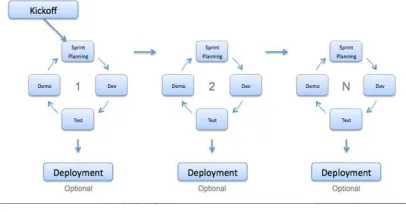
Features of each build is cumulative, while the final build binds all the features needed by the client. Figure 4 illustrates the Agile method with three incremental stages starting from kick-off up to any required number of incremental. [image:7.612.67.270.264.370.2]The idea behind this model began early in the development of software and became widespread because of its flexibility. Scrum, Rational Unified Process, Extreme programming and Dynamic Systems Development Method (DSDM) are some of the most widely used Agile methods.
Figure 4: The Agile model (TRY QA, 2018)
Agile Strategic Idea: The initial step in the process of software development is, gathering of requirements. Since this process cannot be completely attained from the beginning, the agile method made it possible by ensuring regular customer collaboration and interaction, incorporating self-organisation and drive in its processes. The Agile methods is also focused on rapid response to change and constant development, in addition to its ability in producing a working demo, which serves as a good way of communicating with the customer and understanding their requirements rather than relying on documentation alone.
Disadvantages of Agile Methods: There is great demand on both the developers and the customer, requiring a lot of time and commitment. The demo software reduces the need for documentation that are necessary in the development process making it less predictable hence probability of project falling off track.
Applicability: According to Prabu et al (2015), the Agile model has an extensive usage in the development of medical device software. Software developers can adopt the Agile methodology if it yields the necessary output for the health care facility. According to Martin et al (2013), Stephenson, MacDermid and Ward implemented Agile model for the development of controlled systems. This model was initially called “Agile Health method” since it can be applied into care and life-threatening projects.
Most often, the Agile methodology is compared to the waterfall model, but the Agile method is seen as been better in that, it uses an incremental style where a sample demo is considered with the client and, in order to maintain quality of product in the whole development phase.
III. SYSTEM ANALYSIS,METHODOLOGY AND DESIGN
A. Introduction
This chapter is centred on the research strategy, methods of data collection, sampling technique, ethical considerations and limitations of the study, as well as type of data analysis.
B. Research Strategy
This research is a survey type of study, which is concerned with the description and effects of the existing system in the hospital. That is, if the software in existence conforms with development processes as well as with the healthcare facility and risk management standards. Moreover, if it serves the purpose for which it is meant.
C. Tools and Methods of Data Collection
Primary data was collected using the questionnaire and interview methods. Personal interview method was used on the information technologist of the hospital while telephone interview was employed while collecting data from the software developers.
D. Sampling Selection
A purposive sampling technique was used in selecting the hospital for data collection, out of the four hospitals that are using a software in Kaduna based on convenience. Stratified sampling technique was used in administering questionnaire to the respondents due to non-homogeneity of respondents in order to get representative data. Hence, they were grouped into four, comprising of the information technologist, the software developer, staff and patients.
E. Ethical Considerations and Limitations of Study
The hospital administration and the respondents were assured that this exercise was purely an academic study and will not, in any way be used for purposes other than that which it is intended. Participants are to remain anonymous as names and identification marks on the questionnaire are not required.
International Journal of Emerging Technology and Advanced Engineering
Website: www.ijetae.com (ISSN 2250-2459, ISO 9001:2008 Certified Journal, Volume 9, Issue 1, January 2019)
47
F. Data AnalysisQuestionnaire was administered to 150 patients out of which 129 were answered and returned. And, 45 out of the 50 questionnaires issued to the Staff were answered and returned. The data collected was analysed using Statistical Package for Social Sciences.
The following personal interview questions were asked:
i. What type of software are you using - customised or off-the-shelf?
ii. Is the system audited regularly?
iii. Does the system have a mobile application?
iv. Can the management find out which medical services generates revenue, and which should be closely monitored?
The following Telephone interview questions were asked:
i. Does the hospital Software comply with the quality and risk management standard?
ii. Who and who has access to Patient’s data?
iii. How conversant are the medical and other staff with the software?
iv. How are updates made, is it on request or there are scheduled updates?
v. Which of the software models did you adopt in the development of the software?
G. Results of Analysis
It was gathered that the software currently in use is a customised solution that was implemented four months ago. Although, they started with an off-the-shelf at the inception of the business five years ago before migrating to the present software. Moreover, the present software is audited every three weeks as they have a retainership contract with the consultants.
Staff can access the software and run reports on medical services rendered to patients. Management can evaluate doctors work as well as have knowledge about which of the medical services generates more revenue.
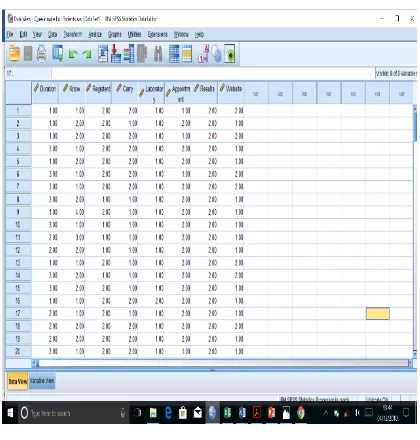
[image:8.612.339.549.155.375.2]On the other hand, the software does not comply with any form of risk management standard and there is no external backup of data. Additionally, the waterfall approach was adopted in developing the software. The software is updated when necessary and the staff are trained at regular schedules. Table I shows the data view of data collated from questionnaire administered to the patients.
Table I:
Data View of Questionnaire Administered to Patients.
IV. DATA ANALYSIS AND RESULTS
A. Introduction
This chapter is concerned with analysis of the data collected from the questionnaire using the statistical package for social sciences version 25. Stratified sampling technique was used due to non-homogeneity of the respondents. Fifty questionnaires were issued to the staff, out of which 45 were returned, while 150 questionnaires were administered to the patients and 129 answered questionnaires were returned.
B. Discussions
International Journal of Emerging Technology and Advanced Engineering
Website: www.ijetae.com (ISSN 2250-2459, ISO 9001:2008 Certified Journal, Volume 9, Issue 1, January 2019)
[image:9.612.322.566.140.303.2]48
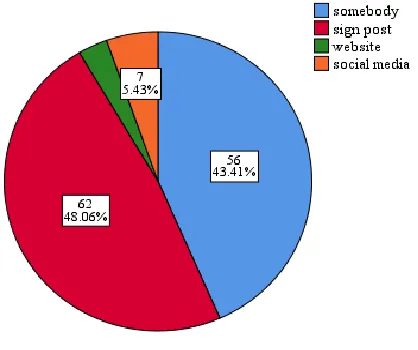
Figure 6 is a pie chart showing the portion sizes of how the patients got to know about the existence of the hospital according to the percentages. From the chart, it could be seen that majority (43.4%) knew about the hospital through someone, while 48.1% knew through signpost. However, 4% and 7% knew through website and social media respectively. This goes to show either ignorance of the existence of the software in the hospital by patients or the hospital website is not active due to some technological constraints.Table II answers the question of how they were registered whether manually or digitally using a computer system. From this table, it could be attested that they were registered using a digital system and they are registered within a record time of about 10 minutes.
Table II:
How were you registered?
Frequency Percen
t
Valid
Percen
t
Cumulativ
e Percent
Vali
d
manuall
y
24 18.6 18.6 18.6
compute
r
105 81.4 81.4 100.0
Total 129 100.0 100.0
Table III reveals that 33.3 percent of the Patients carry their case note from one point to the other, while a majority of 65.9% do not have to transport their case note themselves.
Table III:
Do you Carry file to the doctor?
Frequenc
y
Percen
t
Valid
Perce
nt
Cumulati
ve
Percent
Valid Yes 43 33.3 33.6 33.6
No 85 65.9 66.4 100.0
Tota
l
128 99.2 100.0
Missin
g
Syst
em
1 .8
Total 129 100.0
If there was adequate and proper integration of the system, the patients need not carry their folder say from the doctors consulting room to the Nurses station or laboratory for recommended tests. The patient will only need to go to the respective department or unit and give his name and identification number for other health workers to access his record.
[image:9.612.64.273.440.615.2]International Journal of Emerging Technology and Advanced Engineering
Website: www.ijetae.com (ISSN 2250-2459, ISO 9001:2008 Certified Journal, Volume 9, Issue 1, January 2019)
49
Figure 7 is a pie chart depicting the length of time it takes for a patient to be registered. It could be seen that 73.3% of the staff agree that the patients are registered in less than 10 minutes, indicating that the software can easily be logged into and that, the hospital staff has been trained to use it.Table V. Reveals that 84.4% of the staff can easily access patients record for retrieval especially when they come for follow-up. This is one of the greatest challenges of hospitals that are not information technology compliant.
Table V:
Can you easily access Patient's records for retrieval?
Frequency Percent Valid Percent
Cumulative Percent
Valid Yes 38 84.4 84.4 84.4
No 7 15.6 15.6 100.0
Tota l
45 100.0 100.0
Out of the 50 questionnaires administered to the hospital staff, 38 agree that they can easily access patients record for retrieval, while less than 10 said that they cannot easily access patients record for retrieval. The staff that cannot access these records might be those that do not necessarily have any business with the patients records.
In all hospital setting, the first point of contact for any intending patient is the reception/registration unit. After registration, he/she then goes to the Doctors office for consultation. Thereafter, he/she is then referred to the Nurses for administration of treatment and subsequent documentation of services rendered. If all these group of staff mentioned here do not have access to the database, they will not be able to give medical protocol and add to the information about the patient that already exists.
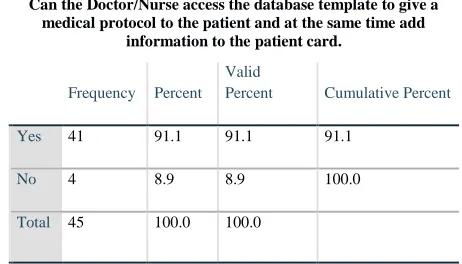
Table VI displays that the Staff that can log onto the data base, make modifications and update patients’ records is of greater percentage (91.1%) than those that cannot access it. This confirms the confidentiality and security of patient’s data to a certain extent.
Table VI:
Can the Doctor/Nurse access the database template to give a medical protocol to the patient and at the same time add
information to the patient card.
Frequency Percent Valid
Percent Cumulative Percent
V a l i d
Yes 41 91.1 91.1 91.1
No 4 8.9 8.9 100.0
Total 45 100.0 100.0
Table IV:
Is the hospital website informative?
Frequen
cy
Percen
t
Valid
Percen
t
Cumulati
ve
Percent
Valid Yes 74 57.4 57.8 57.8
No 54 41.9 42.2 100.0
Total 128 99.2 100.0
Missin
g
System 1 .8
[image:10.612.327.558.533.665.2]International Journal of Emerging Technology and Advanced Engineering
Website: www.ijetae.com (ISSN 2250-2459, ISO 9001:2008 Certified Journal, Volume 9, Issue 1, January 2019)
[image:11.612.56.282.176.357.2]50
Figure 8 is a bar chart that represents the number of staff who agree that reports can be generated from the system upon request by the patient.Table VII reveals that the clinic has a mobile application that is restricted to just a few of the staff.
Table VII:
Does the clinic have mobile management application
Frequen cy
Percen t
Valid Percent
Cumulati ve Percent
Valid Yes 31 68.9 70.5 70.5
No 13 28.9 29.5 100.0
Total 44 97.8 100.0
Missin g
Syste m
1 2.2
Total 45 100.0
V. CONCLUSION AND RECOMMENDATIONS
A. Introduction
This chapter summarizes this research and gives conclusion of the overall study. Recommendations and suggestions for further studies was also buttressed in this chapter.
B. Summary
This research has extensively dwelt on a health care facility and what it takes to make a health care information system more workable and efficient. This research also covered the different types of a health care, which comprises of primary, secondary and tertiary health care facilities. The process of developing a software for a healthcare facility considering its sensitive nature while laying emphasis on the quality, risk management standard and the SDLC. A secondary health care facility was used as a case study in which convenience and stratified sampling techniques were applied in selecting the hospital and sample population respectively. Findings reveal that, the development process has gone a long way in easing off the registration process of patients but much still needs to be desired.
C. Conclusion
In developing a software for a health care facility, there are considerations that are paramount. Firstly, the type of healthcare facility involved whether primary, secondary or tertiary health care institution. Secondly, the approach must be one that will serve the purpose of the institution. Thirdly, the risk management plan based on the services the hospital provides and standards approved by regulatory bodies should be considered. Finally, Privacy and security of electronic patient record is of paramount importance and should be safe guarded. Hence, protection of confidentiality and integrity of patient information must be guaranteed by software systems.
The study was able to analyze the processes used in the development of a secondary Health Care Facility in Kaduna State, Nigeria, based on the results of the questionnaire administered and interview carried out.
D. Recommendations
This study proposes that, in order to develop a software for any healthcare facility, in-depth analysis of the facility concerned should be carried out in order to elicit the requirements and carry out the appropriate design to suit the purpose of the health care institution. Secondly, while designing the software, risk management Standards based on International Standard Organization should be taken into consideration.
REFERENCES
[1] AHIMA Work Group, 2014, Defining the Basics of Health Informatics for HIM Professionals Journal of AHIMA 85, Vol., No.9 pp 60-66.
International Journal of Emerging Technology and Advanced Engineering
Website: www.ijetae.com (ISSN 2250-2459, ISO 9001:2008 Certified Journal, Volume 9, Issue 1, January 2019)
51
[3] Brian F., Klaas-Jan S., Ryan O., and Donald O’Brien, (2013),Scaling Agile Methods to Regulated Environments: An Industry Case Study, ICSE 2013, San Francisco, CA, USA Software Engineering in Practice, IEEE 2013, pp 22-25.
[4] Carr R.F., (2017), https://www.wbdg.org/building-types/health-care-facilities retrieved 22nd october 2018
[5] Coddington D.C., Ackerman A.K., and Moore K.D., (2001), Integrated Health care Systems: Major Issues and Lessons Learned. Healthcare leadership & Management Report. 2001a; No. 9, pp 1-9. [6] Dennis A., Wixom B. H., and Roth R.M., (2012), System Analysis
and Design, 5th Ed USA: John Wiley and Sons, Inc. . pp 13, 59.
[7] Martin M., Oisín C., Fergal M., Richardson I. and Xiaofeng W. An Agile V-Model for Medical Device Software Development to Overcome the Challenges with Plan-Driven Software Development Lifecycles. Software Engineering in Healthcare Workshop of ICSE 2013May, San Francisco CA, USA, pp 20-21
[8] Prabu M., Narasinham D. and Michaelraj T.F., (2015), A Developers Perspective: An Analysis of Process Involved in Software Development of Health Care Industries International Journal of Engineering and Technology (IJET), Vol.7, No 2, pp 7-8.
[9] Reid P.P., W., Compton W.D., Grossman J.H. and Fanijang G., (2005) Building a Better Delivery System: A New Engineering/Health Care Partnership, Washington, D.C. National Academy of Sciences. pp.19-23.
[10] Robert F.C (2017) Types of Health Care Facilities Retrieved from https://www.wbdg.org/building-types/health-care-facilities [11] Shelly G.B., and Rosenblatt H.J. (2012), System Analysis and
Design, 9th Ed., Boston, USA: Course Technology, Cengage
Learning. pp. 23-25.
[12] Shroff V., Reid L., Hashmi S., Mulligan G., Sheehy D., Xiang K., and Richardson I. (2011), Development of a Software quality plan for hospitals Retrieved from https://www.researchgate.net/publication/48991631