Conference proceedings 2010
SPARC,
Title
Conference proceedings 2010
Authors
SPARC,
Type
Conference or Workshop Item
URL
This version is available at: http://usir.salford.ac.uk/16822/
Published Date
2010
USIR is a digital collection of the research output of the University of Salford. Where copyright
permits, full text material held in the repository is made freely available online and can be read,
downloaded and copied for noncommercial private study or research purposes. Please check the
manuscript for any further copyright restrictions.
Proceedings of the
Salford Postgraduate Annual
Research Conference
(SPARC)
2010
Proceedings of the Salford Postgraduate Annual Research Conference (SPARC) 2010
© 2011 University of Salford. All rights reserved. ISBN: 978-1-4477-8072-4
Published by
The University of Salford Salford
Greater Manchester M5 4WT
Preface
Postgraduate research is the dynamo that drives innovative new work at good universities, and we are particularly proud of the work of our postgraduate students. SPARC brings together the best of this research across key fields that well express our university’s strong themes of enquiry. The annual SPARC conference provides a dynamic forum for research students and supervisors to present and discuss new knowledge, fostering connections across disciplines that will open up areas for the future.
Professor Martin Hall
Vice-Chancellor, University of Salford
Welcome to the 2010 proceedings of the Salford Postgraduate Annual Research Conference (SPARC). This selection of papers provides an excellent indication of the scope and scale of the two day interdisciplinary conference, and testifies to the quality and intellectual rigour of the research projects showcased there.
One of the defining characteristics of SPARC is its openness to all disciplines and research topics. This enables the participants to set the priorities of the conference, and allows for natural themes to emerge. This broad-ranging selection of thirty papers spans a wealth of disciplines – from life sciences, management, finance, computing, education, and the built environment through to sociology, art and literature studies. This publication offers a snapshot of that range: alongside Salford’s researchers, there are contributions from postgraduates at the Universities of Liverpool John Moores, Exeter, Bolton University, Cardiff University, Suffolk and Limerick Institute of Technology in Ireland.
As well as facilitating conversations between disciplines, SPARC offers space for informal and academic networking between researchers from different universities, with presenters drawn from different regions of the UK and internationally. Providing an environment for cross - institutional engagement is just one of the ways in which the annual conference supports researcher development. It is an opportunity to develop individual research projects, giving presenters the chance to test out ideas on new audiences, receive valuable feedback from the academic community, make their work known and consequently raise their research profile. At the same time, the conference is also about professional development – allowing early career academics to develop all important conference presentation skills, to practise the art of translating complex research ideas into a clear and concise format, and to communicate those ideas to audiences outside of their immediate specialism. This has valuable implications in terms of employability, encouraging the development of the kind of transferable skills that researchers are increasingly expected to demonstrate.
access ethos of the unrestricted sharing of knowledge is very much in keeping with the spirit of the conference.
If you would like to find out more information about the annual conference and details other support for early career researchers offered by Salford’s Graduate Studies team, please visit our website at http://www.pg.salford.ac.uk
Dr Victoria Sheppard Dr Sonja Tomaskovic
Contents
Evaluation of Car-following Models Using Field Data
Hamid A.E. Al-Jameel ……… 8
Estimation of critical occupancy values for UK motorways from traffic loop detectors
Jalal Al-Obaedi and Saad Yousif ……… 22
The Effects of Residential Location on Total Person Trip Rates
Firas Asad ……… 34
Factors affecting the excellence of service quality at Syrian Public Banks
Dima Al-Sayeed Assad……… 50
Little Dorrit’s Rigaud: Stock Melodramatic Villain or Clinical Portrait of Psychopathy?
Abby Bentham……….... 68
Unravelling ecological genetics in the face of environmental change: the case of the common toad (Bufo bufo)
Robert Coles……… 76
Evaluation of Training Programmes Provided for the Academic Staff of Libyan Universities
Majda Elferjani and Les Rudock……… 88
The Methodology of Identifying of the Factors of Organisational Conflict in the Libyan Cement Industry
Munira Elmagri and David Eaton……… 100
Preliminary assessment of the food control systems in Libya
Nagat A Elmsallati……… 116
An examination the impact the Nature and Particularities of Banking Services Industry on the Use of Performance Measurements: Libyan Evidence
Gumma Fakhri, Karim Menacere and Roger Pegum……… 124
Identification of Wheel-Rail Contact Condition Using Multi-Kalman Filtering Approach
Imtiaz Hussain and T. X. Mei………. 144
A novel single step process for making CuInSe2 absorbing layers for solar cell applications
Attitudes of staff members towards the embracing of Electronic Learning at the Libyan Higher education
Abdulbasit S. Khashkhush ………. 170
Detection of Echinococcus granulosus in farm dogs in South Powys, Wales using coproELISA and coproPCR
Wai-San Li, Belgees Boufana, Helen Bradshaw, Arjen Brouwer,
David Godfrey and Philip Craig……… 184
Investigating the Emerging Issues that Affect the Online Consumers
Vincent Lui and Mathew Shafaghi……… 196
Bloodless Minutes of Global-local Fear: Identity in the Novel Senza sangue, the Film Vier Minuten and the Music Video The Fear
Mattia Marino……….. 210
Coping or exiting BMES response to discrimination in construction
Paul Missa and Vian Ahmed………. 222
Structural impact study of “ideal” 3D aluminium foam
Sathish Kiran Nammi, Peter Myler and Gerard Edwards……… 238 An Application of the Activity-Based Costing for the Management of Project
Overheads to Increase Profit during the Construction Stage
Nyoman M. Jaya, Chaminda P. Pathirage and Monty Sutrisna………... 248 Exploring the link between organizational learning and sustainable construction
project
Alex Opoku and Chris Fortune………. 268
Mapping minimal music through the lens of postmodernity
Alexis Paterson………... 284
Risk assessment in natural hazard areas for the resettlement programmes
Panitp Piyatadsananon, Dilanthi Amaratunga and Kaushal Keraminiyage…………... 298 Web 2.0: the use of online Social Networking Sites (SNSs) for marketing
Higher Education (HE)
Arash Raeisi………... 312
Implementing the Process of Knowledge Sharing within Small Construction Consultancy Companies in Ireland
Rita Scully and Farzad Khosrowshahi………. 330
The Efficiency of Libyan Commercial Banks in the Context of Libyan WTO Accession
An ethnographic study of the culture in a Diagnostic Imaging Department (DID) – some personal reflections
Ruth M Strudwick, Stuart Mackay and Stephen Hicks………. 360
The antecedents for knowledge sharing behaviour among Malaysian undergraduate Students
Nor Intan Saniah Sulaiman……… 372
Auxetic Materials and Engineering Applications
Muhammet Uzun………. 396
Growing Ethnopolitical Conflict and the Challenge of ‘One Nigeria’: Politics of State Building in a Multiethnic Society, 1960-2010
Ali Simon Bagaji Yusufu………. 412
Value Destruction from Spin-offs
Evaluation of Car-following Models Using Field Data
Hamid A.E. Al-Jameel, University of Salford
Abstract
Traffic congestion problems have been recognised as a serious problem in all large urban areas. It can
significantly reduce urban mobility. Therefore, it has become a major concern to the transportation and
business communities and to the public in general. Different techniques have been proposed to alleviate
this problem. One of these techniques is a traffic simulation. It has been used effectively as it can
represent real life, to some extent, and apply different strategies without the need to make physical
changes. Car-following models represent the basic unit that governs the longitudinal movement for each
traffic simulation model. The efficiency of a traffic simulation model mainly depends on its core units:
car-following and lane changing.
In this study, three car-following models (namely, CARSIM, WEAVSIM and PARAMICS) were tested.
The first two of these models were rebuilt using Visual Compact FORTRAN Version-6.5. The models
were tested using three different sets of data from single lane traffic. These sets of data have been
collected using two different methods of collecting data from three regions. In addition, different traffic
conditions have been included in this data such as high speed, low speed and “stop and go conditions”.
The results indicated that CARSIM gave the most accurate representation of real life situations.
Therefore, the assumptions of this model were adopted in a newly developed model to represent traffic
behaviour in weaving sections to evaluate the factors affecting the weaving capacity.
Keywords:
Traffic micro-simulation, car-following model, CARSIM and WEAVSIM
1. Introduction
Traffic congestion problems have been recognised as a serious problem in all large urban areas. It can
significantly reduce urban mobility. Therefore, it has become a major concern to the transportation and
business communities and to the public in general. Different techniques have been proposed to alleviate
represent real life, to some extent, and applies different strategies without the need to make physical
change on site before implementing such strategies. Car-following model represents the basic unit that
governs the longitudinal movement for each traffic simulation model. The efficiency of any traffic
simulation model relies mainly on the accuracy of its car-following and lane changing assumptions
(Panwia and Dia, 2005).
In this study, the algorithms of three car-following models are explained briefly and the results of testing
these models using different sets of data are also illustrated.
2. Car-following models
Several car-following models have been proposed to govern the longitudinal movement of vehicles in a
traffic stream as shown in Figure 1. Pipes (1967) suggested that the follower normallymaintained safe
time headway of 1.02s from its leader. This value was extracted from a recommendation in the California
Vehicle Code (Choudhury, 2007). These models were then followed by various models with different
theoretical backgrounds and assumptions.
In general, car-following models can be classified into three groups; sensitivity-stimulus, safety or
non-collision criteria and psychophysical models (Olstem and Tapania, 2004).
Firstly, sensitivity-stimulus models, these models were introduced by GM Research Laboratories and
represent the basis for most models to date. The Gazis-Herman-Rothery (GHR) model represents this
group. This model was tested under three sets of data with different parameters (linear and non-linear).
Different thresholds have been suggested to indicate the following behaviour from free-following
(Al-Jameel, 2009). However, this model is still unable to mimic most traffic conditions. In addition, there is
no obvious connection between the model parameters and driver`s characteristics as reported by
Gipps (1980).
Secondly, safety or non-collision criteria models assume that a driver maintains a safe distance between
him/her and the leader to prevent a collision at any time of movement (Brackstone and McDonald, 1999).
CARSIM and WEAVSIM are examples for this group.
Thirdly, psychophysical models assume that a driver will respond (acceleration or deceleration) after a
certain threshold. This threshold can be represented by a relative speed or a distance (Brackstone and
Headway
Gap
Figure 1 Longitudinal (headway) space between leading and following vehicles.
The algorithms of CARSIM, WEAVSIM and PARAMICS are briefly explained in the following
sub-sections.
2.1. CARSIM model
CARSIM (CAR-following SIMulation) is a freeway simulation program. This model has been developed according to some of the assumptions that have been introducedby Benekohal and Treiterer (1988). In the model, five situations were used to describe the degree of response (acceleration or deceleration). These situations are:
A. If there is no restriction from the preceding vehicle, the driver will drive to reach his / her desired speed or speed limit.
This speed represents the maximum speed that driver tries to reach it when there are no other constrains such as a vehicle ahead, speed limit, and bad weather conditions.
The non-collision criterion that prevents the following vehicle from colliding with the leader at any time
even if the latter brakes suddenly. The deceleration will be calculated according to Equation1.
POSL-(POSiF+SPF+0.5*`ACCs *Dt2) –L- BS>= max. of (SPF+ ACCs *Dt)RT or
(SPF+ ACCs *Dt)RT+ (SPF+ ACCs *Dt) 2/ (2MDF)-(SPL) 2/ (2MDL)...Equation 1.
Where:
POSL= the position of a leader vehicle
POSiF= the position of a follower vehicle at the beginning of the current scanning time.
ACCs= acceleration/ deceleration (m/sec2).
MDF or MDL= maximum deceleration for follower and leader, respectively (m/sec2).
RT= reaction time (sec).
Dt= scanning time (0.5 sec.).
BS= buffer space.
L=length of leading vehicle.
A. Vehicle mechanical ability conditions
As the vehicle generates in the system, the type of each vehicle is assigned also for each vehicle as
passenger car and heavy vehicle. Passenger car has more mobility in the movement and manoeuvre
because of it short and light mass. These differences in characteristics have been translated in the
amount of acceleration/ deceleration that can be achieved by each type of vehicles. Therefore,
different values of acceleration/ deceleration have been assigned to represent the characteristics of
movement for passenger and heavies as reported by ITE (1999).
B. Moving from stationary conditions
When vehicle stops in the platoon conditions and then tries to move due to the movement of leading
vehicle, its acceleration in this case depending mainly on the type of vehicle. Therefore, the amount of
delay that is taken by each vehicle to start movement is called start-up delay. Yousif (1993) has
reported that 1 second is suitable for driver with shorter reaction time and 2 second is suitable for the
rest vehicles. Therefore, the same values have been adopted in this study.
The headway of vehicles in the slow speed or stationary conditions should always be more than the
buffer space. This buffer space has different values ranging from 3 m to 1.8 m (Benekohal, 1986 and
Yousif, 1993). In this study, it was used as 1.5 m.
Basically, the acceleration from each situation is calculated and the minimum one will govern the
situation. For example, if the acceleration resulting from reaching a desired speed is higher than the
acceleration resulting from the mechanical ability of vehicle, then the later acceleration will govern the
situation.
Aycin and Benekohal (2001) examined five car-following models, NETSIM, INTRAS, FRESIMS,
CARSIM and INTELSIM, in terms of the stability, performances and characteristics of car-following
approximately the same headway which equals to the reaction times. In addition, they also reported
that INTRAS and FRESIM representing unrealistic acceleration variations and high maximum
decelerations. Then, they concluded that CARSIM represents greater headway than NETSIM and
provide more realistic results. Finally, they argued that INTELSIM can provide similar speed and
headway to those of drivers.
2.2 WEAVSIM Model
The car-following incorporated in this model is based on a combination of two conditions (Zarean, 1987
and Iqbal, 1994):
The following vehicles always seek a desired headway which will be a function of vehicle speed, relative
speed and vehicle’s type.
A collision criterion will be applied to avoid a collision.
By using these two conditions, each speed and location of any vehicle will be determined. Thus, three
conditions are used in this model (Zarean, 1987 and Iqbal, 1994):
As the leader has come to a complete stop the following vehicle should also come to stop while keeping
space headway of at least equal to the length of the leader plus a safety distance (S.D).
POSL-POSfF >= L+ BS...Equation 2. POSfF = POSiF + SPF 2/2* ACCs ….…….……...…...….Equation 3.
By substituting in Equation 4 then:
ACCs = - SPF 2/ (2(POSL – POSfF -L- BS))..…..………...…Equation 4.
Where;
POSfF = position of the following vehicle at the end of current scanning time interval.
When the updated speed of the leader is greater than zero but less than the current speed of the follower
the follower should decelerate to avoid a collision. The safe space headway is calculated as following:
POSL-POSF >=L+ BS + RT * SPF 2/2*MED- SPL 2/2*MED …...Equation 5.
The basic concept here is that a follower maintains headway equal to the length of vehicle plus buffer
spacing. In order to determine the deceleration the updated position of the follower must be substituted
As the updated speed of the leader is greater than the current speed of the follower, the space headway for this case can be expressed as:
POSL-POSfF >=L+ BS + RT * SPL ………...….……...…Equation 6.
2.3 PARAMICS Model
PARAMICS is traffic simulation software that is widely used to design and analyse different highway facilities such as intersection, merging section and roundabouts. A brief description
of car-following model in terms of acceleration and deceleration was discussed in Panwia and Dia (2005).
Figure 2 Car-following phase-space diagram (Panwai and Dia, 2005).
Five situations were investigated at which there were different responses of the following vehicles which
were noted according to different thresholds. Figure 2 indicates the location of vehicles depending on
the relative speed and relative headway. After identifying the vehicles’ situation in Figure 2, the correct
3. Rebuilding The Models
Visual Compact FORTRAN has been used to rebuild CARSIM and WEAVSIM depending on the
algorithms of these models as discussed in section 2. In each model, a warm-up and cool-off sections
have been used to reduce the error from unstable conditions in the start and end of the sections. A
warm-up time is also used to reduce the instability that may occur in the start time of the program.
4. Statistical Tests
To assess the difference between the simulation outputs with the field data, two measures are used: the
Root Mean Square Error (RMSE) and Error Metric (EM) (Panwai and Dia, 2005). These parameters can
be determined as shown in Equation 9 & 10.
...Equation 8.
...Equation 9.
Where;
Ds = simulated distance (m).
Df = observed distance (m).
The EM is used by Panwai and Dia (2005) as a measure of precision between the simulated and field.
However, this measure is inadequate as noted during this study because it is affected by the number of
points which are considered in the comparison of simulated data and field data. Consequently, the values
of RMSE were adopted in this study rather than the EM. As the value of RMSE increases, the difference
between the field and simulated data increases, too.
5. Data sets
5.1. First Set of Data
This data was collected by the Robert Bosch GmbH Research Group under stop-and-go traffic conditions
on a single lane in Stuttgart, Germany during an afternoon peak. It was gathered by using an
instrumented vehicle to record the relative speed and space headway. Moreover, this data has been used
to test four car-following models: AIMSUN (v4.15), VISSIM (v3.70) {Wiedemann 74& 99} and
PARAMICS (v4.1) (Panwia and Dia, 2005). This data consists of two vehicles: the leader and follower.
This set of data provides a comparison of the distance between the leader and follower as shown in
Figure 3.
This set of data is characterised by:
• A range of speed between 0 and 60 kph.
• Three stop situations.
• Test duration of 300 seconds.
Figure 3 Field data via simulated data (CARSIM, WEAVSIM and PARAMICS).
Figure 3 represents the field data from Germany and the results from the three simulation models. The
field data ranges from free-flowing conditions in the first part of curve (up to 30 sec.) to a slow speed
condition at the end of test. Through the slow speed conditions, the leader came to a complete stop at
PARAMICS was tested by Panwia and Dia (2005) with this set of data. The results, as shown in Figure 3
indicate a significant difference between PARAMICS and field data. The first variation is within the
free-flow region up to 30 seconds. This shows bad handling of the model under free–flow conditions.
The second variation is within the slow speed and stop/go conditions. Again, the behaviour of the model
tends to give a shorter headway than what the real data suggests. Therefore, in free-following the model
seeks larger headway than real data and vice versa.
Then, WEAVSIM is compared with field data as shown in Figure 3. This model can represent the
free-following case better than PARAMICS. The main difference between the model and PARMICS is that
WEAVSIM adopts a shorter headway than the latter. However, there is a difference between the model
and the field data as shown in Figure 3. Another factor, which determines the behaviour of this model in
such a case, is the reaction time. In the case of increasing this factor, the curve seems to give better
resultsbut this leads to more discrepancies in the slow speed region.
On the other hand, the RMSE for PARAMICS is 10.43 m whereas it is 7.5 m for WEAVSIM. So the
latter is better than PARAMICS in the amount of error between field and simulated data.
A third model, CARSIM represents the driver behaviour more accurate than other models as shown in
Figure 3. This model is similar to WEAVSIM but it is better than the latter in different experimental
situations. Moreover, the value of RMSE for CARSIM is less than WEAVSIM`s model (RMSE=7.0 m).
5.2 Second Set of Data
Two experiments were conducted to gather two sets of data by using an instrumented vehicle (Sauer et al., 2004). Data has been collected by the following vehicle in this test and the previous one. This data represents two vehicles: leader and follower.
The characteristics of this set of data are:
• A range of speed between 27 and 108 kph
• The duration of the test is 162 sec.
Figure 4 Field data via simulated data (CARSIM and WEAVSIM).
Figure 4 illustrates the comparison between field data and simulated data, CARSIM and WEAVSIM.
In this set of data, both CARSIM and WEAVSIM gave reasonably similar results. However, the value
of RMSE of CARSIM of 0.63 m/sec is less than that of WEAVSIM (1.0 m/sec). Therefore, CARSIM
is considered better than WEAVSIM in such situation.
5.3. Third Set of Data
A new method of collecting data was adopted in this set of data from the USA. In this method, hidden
video cameras, they were covered by other things, were used to monitor the behaviour of drivers to avoid
the effect of influencing the drivers who were used as part of the experiment. In this method of
collecting data, valuable information was obtained because the instrumented test vehicle is the lead
vehicle. The driver of the lead vehicle can be any normal driver who can drive legally.
The specifications of this set of data are:
• A range of speed between 14 and 43 kph.
• The space distance between vehicles ranging from 3 to 15m.
Figure 5 Test vehicle apparatus and connectivity diagram (Kim, 2005).
In this case, the following vehicle was the monitored vehicle and the driver of this vehicle was not made
aware that he/she was monitored by others. Figure 5 indicates the components of the monitored system
in the leading vehicle.
Figure 6 shows the results of the two models compared with the field data. The most important point here
is that this data represents slow speed conditions. Thus, the CARSIM model here gave better results than
WEAVSIM. In addition, the value of RMSE for CARSIM is 1.4m while thatfor WEAVSIM is 2.7m.
Therefore, CARSIM is preferred for this test.
Table 1 Results of simulated models with field data.
No. Of
Tests
Test one (First set) Test two (Second set) Test three(Third set)
CARSIM WEAVSIM PARAMICS CARSIM WEAVSIM CARSIM WEAVSIM
RMSE 7.0m 7.5m 10.43m 0.62m 1.0m 1.4m 2.7m
The results of the RMSE for the three tests are summarised in Table 1. Firstly, the maximum value of
RMSE among other models for the test one is belong to PARAMICS. This means that PARAMICS is the
worst one because as the value of RMSE increases, its difference with field data increases, too.
Moreover, the first test is better than other tests because the second set of data includes different of traffic
conditions ranging from free following to stop-and-go conditions. Therefore, CARSIM is the best one
among the other models under study because it has the lowest value of RMSE in this test and also in the
second and third test as shown in Table1.
6. Conclusions and Recommendations
In this study, two car-following models have been developed using Visual Compact FORTRAN (version
6.5) based on algorithms of CARSIM and WEAVSIM to produce a simulation model. This simulation
model is able to mimic the reality using visual animation in representing the movements of vehicles,
spacing between vehicles, speeds of vehicles and other characteristics. These two models with package of
PARAAMICS have been tested with three sets of data. The main conclusions of these tests are:
PARAMICS gives the worst representation of the reality in terms of graphical and statistical test (i.e.,
RMSE =10.43m) among other models.
CARSIM model gives the best results among other models (RMSE = 7.0m).
Finally, the developed simulation model CARSIM could be used in representing the car-following model
better than WEAVSIM and PARAMICS. Therefore, the assumptions which CARSIM is based on could
be used in the newly developed model to evaluate the effect on capacity and delays of weaving sections
for more improvements for the developed model CARSIM to get a less difference than that in the current
study.
7. References
Al-Jameel, H.A. (2009) Examining and Improving the Limitations of the Gazis-Herman-Rothery
Car-following Model. SPARC 2009, University of Salford.
Aycin, M.F. and Benekohal, R.F. (2000) Analysis of Stability and Performance of Car Following
Models in Congested Traffic. Proceedings of the 79th Annual meeting of the Transportation Research Board, January, Washington DC, USA.
Benekohal, R.F., and Treiterer (1988) CARSIM: Car-following Model for Simulation of Traffic in
Normal and Stop –and –go Conditions. Transportation Research Record 1194, Washington, D.C.
Brackstone, M. and McDonald, M. (1999) Car-following: a historical review. Transportation Research Part F, Vol. 2, pp. 181-196.
Choudhury, C.F. (2007) Modelling Driving Decision with Latent Plans. Thesis (PhD), Massachusetts Institute of Technology, USA.
Gipps, P.G. (1981) A Behavioural Car-Following Model for Computer Simulation. Transportation Research Part B,Vol.15, pp.105-111.
Iqbal, M.S. (1994) Analytical and Simulation Model of Weaving Area Operations Under Non-Freeway
Conditions. Dissertation (PhD), New Jersey Institute of Technology, USA.
Kim, T. (2005) Analysis of Variability Car-following Behaviour over Long-term Driving Manoeuvres .
Thesis (PhD), University of Maryland.
Olstam, J.J. and Tapani, A. (2004) Comparison of Car-following Models. Swedish National road and Transport Research Institute.
Panwai, S. and Dia, H. (2005) Comparative Evaluation of Microscopic Car-Following Behaviour. IEEE Transactions on Intelligent Transportation Systems, Vol. 6, No. 3, pp. 314-325.
Pipes, L. A. (1967) Car Following Models and the Fundamental Diagram of Road Traffic.
Transportation Research, Vol.1, pp.21-29.
Yousif, S.Y. (1993) Effect of Lane Changing on Traffic Operation for Dual Carriageway Roads with
Road Works. Thesis (PhD), University of Cardiff, Wales, United Kingdom.
Zarean, M. (1987) Development of a Simulation Model for Freeway Weaving Sections. Dissertation
Estimation of critical occupancy values for UK motorways from traffic loop detectors
Jalal Al-Obaedi & Saad Yousif, University of Salford
Abstract
Occupancy is the percent of time a traffic loop detector embedded in the road pavement is occupied by
vehicles. This term is usually used as a substitution for the traffic density which is not feasible to obtain
from detectors. One of the recent applications for the traffic occupancy is in calculating the timing for
traffic signals on motorway entrances (Ramp Metering, RM). Most of the existing algorithms for RM
assume that these devices will not operate until the traffic occupancy upstream or downstream from the
merge area exceeds a specific value called “critical occupancy”. This paper focuses on estimating the
critical occupancy using Motorway Incident Detection and Automatic Signalling (MIDAS) data. The data
is taken from loop detectors located on three motorway sites in the UK. The results are compared with
corresponding values as adopted by the Highways Agency for these sites to operate the ramp metering.
The results show that the values which are currently used to operate the ramp metering devices in these
sites are higher than those obtained from analysing the data. This will cause delays in the operation of the
RM until the starting of traffic congestion which ultimately causes reduction in motorway capacity.
Keywords: Occupancy, loop detectors, ramp metering
1.Introduction and background
Occupancy is the percent of time a traffic loop detector embedded in the road pavement is occupied by
vehicles. Unlike the well known traffic density, occupancy can easily be measured from traffic loop
detectors that are located regularly around a motorway’s junction. Hall et. al (1986) concluded that time
occupancy can describe traffic conditions (congested, uncongested or transitional) in the same way as
traffic density could do. Figure 1 explains the flow-occupancy relationship using data taken from an
upstream detector from the M6 J23 Motorway site. The figure explains how this relationship is similar
to that for flow-density. The relationship between traffic density and occupancy based on data from 5
detectors on the M6 J23 is presented in Figure 2. The density is estimated by dividing the motorway flow
Figure (1) Flow-occupancy relationship bases on data from the M6 J23
Figure (2) Occupancy-density relationship based on data from the M6 J23
The term “Critical occupancy” is extensively used to define the limit between normal and congested
traffic situations. In almost, critical occupancy corresponds with the motorway capacity
Smaragdis et al. (2004). Previous research suggests a range of values for critical occupancy. For
example, Hall et al. (1986) based on data from Queen Elizabeth Way in Ontario found that critical
occupancy lies between 19 and 21%. The Minnesota Department of Transportation used a value of 18%
to separate congested and uncongested flow. Sarintorn (2007) concluded that critical occupancy for the
Pacific Motorway in Australia ranged from 17-20%. Zhang and Levinson (2010) used time occupancy to
occupancy is less than 20%, traffic is regarded as not congested, when occupancy lies between 20 and
25% the traffic is regarded to be in the transitional phase while the traffic regarded to be in the congestion
phase if the occupancy exceeds 25%.
2.Application of occupancy in ramp metering
Recently, traffic signal devices (ramp metering) have been installed on motorway entrances on a part-time
basis to regulate the entering traffic in an attempt to reduce congestion. Previously, these devices worked
on a fixed time plan where the traffic signal operated for specific periods with a set time. Now, most of
existing methods for ramp metering are reactive. This means that the timing of the traffic signal changes
based on the traffic conditions. In the later extension of ramp metering, time occupancy is applied in
different ways. These are to judge the need to trigger the ramp metering devices, to calculate the
required timing for traffic signal and finally to switch off the traffic signals after operating.
Currently, ALINEA (Papageorgiou et al., 1991, 1997) and Demand-Capacity algorithms (Masher et al.,
1975) are the most applicable algorithms for ramp metering in the world. Both methods use occupancy in
updating the traffic signal timing. ALINEA calculates the metering rate from equation 1 while
Demand-Capacity uses equation 2.
... (1)
....(2)
Where:
r is the metering rate (veh/hr),
r(c-1) metering rate during the last time interval (veh/hr),
KR is the regulator parameter (veh/hr),
Occd is the desired occupancy and usually equal to critical occupancy (Occcr),
Occ(c-1) is the actual occupancy during the last time interval,
Cap is the capacity of the downstream merge section, and
flowin is the upstream motorway flow.
It is worth mentioning that using inaccurate values for critical occupancy can lead to the improper
applications for ramp metering and that will affect the ability of these devices in the alleviation of traffic
congestion. In addition, using values lower than the actual to trigger the traffic signals will cause further
delays for merging traffic.
The contribution this paper is to estimate the critical values for critical occupancy using data from loop
detectors and to compare these values with such values currently used on ramp metering on the studied
motorways of the UK.
3.Methodology
In this paper, Motorway Incident Detection and Automatic Signalling (MIDAS) data from upstream and
downstream loop detectors from 4 motorway sites is used. These sites are M56 J2 (two lanes), M60 J2
(three lanes), M6 J23 (three lanes) and M6 J20 (four lanes). The data provided is taken over one minute
for speed, flow and occupancy.
Two methods are used to estimate the critical occupancy. The first method is suggested by
Hall et al. (1986) for finding the average occupancy for each given flow. Obviously, there are two values
of occupancy for each value of flow (i.e. in normal and congested traffic). The method requires an
assumed trial value for critical occupancy. The purpose of that is not to average occupancies from normal
conditions with those from congested conditions. After doing some trials for critical occupancy, all
values then should be compared graphically. The critical occupancy value is then selected based on the
point which gives the maximum flow at normal traffic condition. To apply this method the occupancy are
averaged for each flows within interval of +100 veh/hr. A simple computer program is written to speed
up the computational process. This method also requires the removal of the transition points from
congested to normal conditions from consideration.
The second method is to inspect the raw data for values of occupancy which separate then normal and
congested situations. This method is known as “time series inspection method”. The method is
this approach in estimating the critical occupancy. According to this method, critical occupancy will be
the transition value from normal to congested situations.
The results from these three methods are compared in this paper by existing values which are currently in
use to trigger the ramp metering in some of the above referred sites.
4. Results and discussions
Before applying the average occupancy approach for each corresponding flow, the data is filtered to
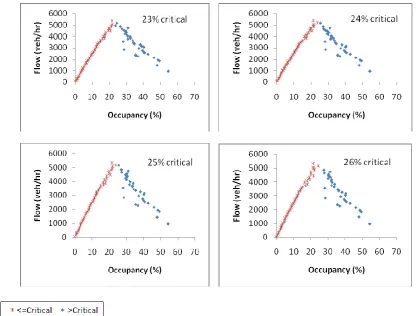
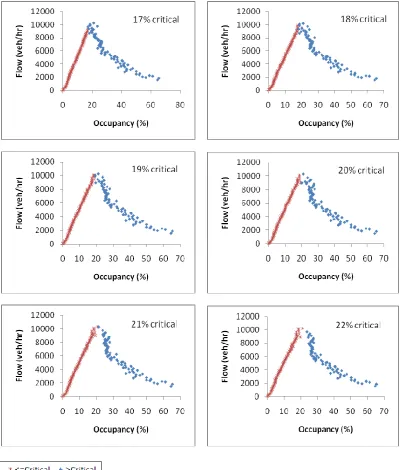
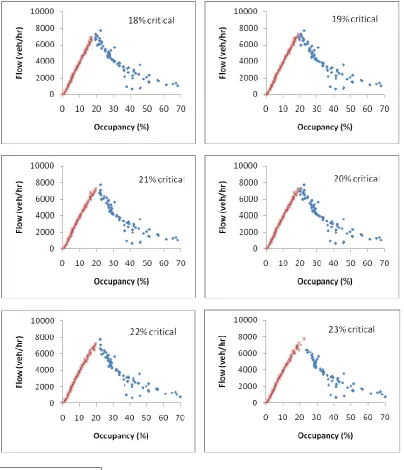
remove the transition cases from congested to normal traffic situations. Figures 3, 4, 5 and 6 show the
possible shapes for flow-occupancy relationships for different trials of critical occupancy values using the
approach of average occupancy at each specific flow for the M56 J2, M6 J23, M6 J20 and M60 J2,
respectively. For the M56 J2, Figure 3 shows that the critical occupancy value lies between 25 and 26%.
Lower values are not considered because these lower values give flows for congested regime that are
equal or higher to those in a normal regime.
In the same way, and based on Figures 4-6, values of 23%, 22% and 20-21% are suggested for the M6
J23, M6 J20 and M60 J2, respectively:
[image:28.595.67.484.153.469.2]
[image:29.595.69.471.155.625.2]
[image:30.595.69.473.155.625.2]
[image:31.595.73.472.157.643.2]
Figure 7 gives examples about critical occupancy values based on the time series inspection approach. It
should be noted that only congested situations caused by merge traffic are considered (i.e. congested
situations due to further downstream bottlenecks are not considered). While the results obtained from the
first method (average occupancy) gave limited variation in critical occupancy between sites, the variation is
more announced using the time series inspection method. This variation is also described in the work by
Hall et al. (1986).
Figure (7) Critical occupancy values using time series inspection method
Table 1 compares the critical occupancy values obtained from the average occupancy approach with such
critical values that are currently in use to trigger the ramp metering devices on the selected motorway
sites. The value that is used to trigger the ramp metering in M56 J2 was not given due to a lack of data.
The table shows that for the M6 J23 and M6 J20 sites, the values which are currently used to operate the
[image:32.595.67.461.275.615.2]cause delays in the operation of the RM after the traffic congestion has started and that ultimately causes
reduction in motorway throughput. For the M60 J2, the value used is much close to the estimated value.
Table 1 Estimated and Values in use for critical occupancy
Site M6 J23 M6 J20 M60 J2
Estimated critical occupancy (%)
23 22 20-21
Value in use in RM (%) 28 25.5 19
5. Summary
This paper focuses on the estimation of critical occupancy using data taken from loop detectors. The data
from four motorways junctions which are served by ramp metering devices in the UK are used. These
motorways are M56 J2, M60 J2, M6 J23 and M6 J20. Two methods are used to find the critical
occupancy. The first method is by finding the average occupancy for each corresponding flow. The
second method is to follow-up the transitions from normal to congested situations. It is found that the
variation between the results between the selected sites is more pronounced using the second method.
The results are compared with corresponding values as adopted by the Highways Agency for these sites
to operate the ramp metering. As a part of M60 J2, the results show that the values which are currently
used to operate the ramp metering devices in these sites are higher than those obtained from analysing the
data. This will cause delays in the operation of the RM until the starting of traffic congestion which
ultimately causes reduction in motorway capacity.
6. References
Hall, F. L., Allen, B. L. and Gunter, M. A., (1986). Epirical analyses of freeway flow-density
relatioships. Transportation Research A, Vol. 20A, No. 3 p.p. 197-210.
Masher D.P., Ross D.W., Wong P.J., Tuan P.L., Zeidler H.M., and Petracek S., (1975), Guidelines for
Design and Operation of Ramp Control Systems", Stanford Research Institute, Menid Park, CA.
Papageorgiou, M., Haj-Salem, H. and Blosseville, J-M. (1991). "ALINEA: a local feedback control law
for on-ramp metering." Transportation Research Record, Volume (1320), p.p. 58-64.
Papageorgiou, M., Haj-Salem, and F. Middleham, (1997), ALINEA local ramp metering: Summary of
field results. In Transportation Research Record 1603, TRB, National Research Council, Washington
D.C., 1997, pp. 90-98.
Sarintorn, W. (2007) Development and comparative evaluation of ramp metering algorithms using
microscopic traffic simulation. Journal of Transportation, Volume (7), Issue 5, p.p. 51-62.
Smaragdis, E., Papageorgiou, M. and Kosmatopoulos, E. (2004) A flow-maximizing adaptive local ramp
metering strategy, Transportation Research Part B: Methodological, Volume (38), Issue 3, p.p. 251-270
Zhang, L. and Levinson, D. (2010) Ramp metering and freeway bottleneck capacity Transportation
The Effects of Residential Location on Total Person Trip Rates:
An Empirical Study
Firas Asad,School of Computing, Science and Engineering, University of Salford
1. Introduction
Developing a robust trip generation model, for predicting the number of vehicular/person trips generated
by a residential development, is still a vital task for both transportation planners and engineers. There are
two key reasons for this; one of them is because trip generation is the first model in the travel forecasting
process for the vast majority of orthodox urban transportation modelling systems (UTMSs). The second
reason is because local planning agencies need the predicted number of trips that are likely to be
generated from a proposed development to quantify the anticipated impacts of such development on the
transport system infrastructure and performance.
Consequently, many researchers have been studying the factors that possibly affect the total number of
the generated trips (trip ends). Site location as one of the residential land use descriptive characteristics, is
one of the relevant factors to be studied. The objective of this paper is to investigate whether the location
of a residential site affects its trip-making pattern and hence its traffic impacts as an attempt to attach a
spatial dimension of study to the land use-trip generation relationship.
The Trip Rate Information Computer System (Trics-ver.2009a), being one of the UK and Ireland’s
industry standard trip generation database, is interrogated in this study. It is used to derive the likely mean
person and vehicle trip ends for residential sites with six different location types and for, where possible,
six modes of travel. The statistical methodology ANOVA (Analysis of Variance) using SPSS (ver.17,
2008) software is employed to examine whether there are any statistically significant differences among
the trip rates means of Trics main location groups for each travel mode separately.
2. Trics Database
Trics was founded and is owned by the Trics Consortium, which consists of 6 county councils (West
Sussex, East Sussex, Surrey, Kent, Dorset, and Hampshire). It is the national standard for trip generation
analysis, containing about 6,000 directional transport surveys at more than 100 types of land uses in the
At the start of the trip rate calculation process, after selecting the proper land use category and
subcategory, Trics asks the user, through a number of windows with user-friendly interface, to provide
the system with a series of initial, main, secondary, and optional parameters. By specifying these
parameters users can create their representative sample of sites. In the initial parameters window, the user
is required to choose between vehicle-based and modal trip rate calculation options. In the
multi-modal option, trip rates and/or the total number of arrival, departure and total trips (both direction) can be
computed for travel modes other than total vehicles like, for instance, pedestrians, cyclists, PTUs, and
total people.
In the next stage, the main parameter window, the primary trip rate parameter like number of dwellings,
total bedrooms or site area should be firstly chosen followed by the desired week days and finally the
main and secondary site location types. After that, in the secondary stage, desired sites and survey days
should be determined. Finally, further fine-tuning for the sites may be done by optional parameters
including population, car ownership and access to a travel plan.
Trics, in line with the planning policy statement 6 (PPS6, 2005), assigns main and, where applicable,
sub-location definitions as a descriptive characteristic for each development site. The main location
categories are basically as a proxy measure of how far is the site from the central core area of the
town/city. The availability of public amenities is also a major determinant in location definition. In Trics
2009(a), being interrogated in this study, there are six main location categories; Town centre TC, Edge of
town centre ETC, Neighbourhood centre NC (Local centre), Suburban area SA (Out of centre), Edge of
town ET, and Free standing FS (Out of town). For more information and definitions, interested readers
are referred to the Trics 2009(a) online help. Taking into account the basic requirement for a statistically
adequate sample size, only the main six location types are considered in this analysis. On the other hand,
the total vehicle counts in addition to five of the multi-modal trip rate counts are included in the statistical
analysis. These five multi-modal counts are: total people, pedestrians, vehicle occupancy, PTUs, and
motor cars.
There are 13 residential land use subcategories (sub land uses) in Trics (2009a); only seven of them were
chosen to be interrogated in this study. These seven are; Houses Privately Owned (HPO), Houses for Rent
(HFR), Flats Privately Owned (FPO), Flats for Rent (FFR), Mixed Private Housing (MPH), Mixed
A full definition of these residential developments is available in the Trics 2009 Online Help File. Other
subcategories were excluded either for lack of an adequate number of sites (in this study a threshold of
more than 3 sites is adopted), or because of the inconsistency in the trip generation calculation parameter.
For all the seven selected subcategories, the number of dwelling units is adopted as a unit of analysis in
calculating the vehicle and person weekday trip rates. The Guidance on Transport Assessment (2007)
reports that for residential developments the peak periods predominantly occur on weekdays, hence
surveys selected in this study were based on a 12hr. (7.00-19.00) weekday analysis period.
In line with Trics recommendations (Trics Basic Tutorial, 2005), only the most recent surveys were
chosen to avoid any possible bias towards the multiple survey sites. Furthermore, in order to keep the
subcategory datasets as eligible as possible for statistical analysis, no further filtering has been applied by
Trics optional parameters. In Table 1, each cell shows the available number of multi-modal counts sites in
Trics 2009(a) for each specific residential land use and location type. Unfortunately, this pilot survey
evidently reveals that most of these cells are ineligible for statistical analysis according to this study
threshold (more than 3 sites).
Table 1: Trics 2009(a) multi-modal counts sites cross classified by both residential land use and location
types
Land use / Location Types Town
centre
Edge of
town
centre
Neighbour
hood
centre
Suburban
area
Edge of
town Free Standing
A. Houses privately owned 0* 6 2* 30 28 0*
B. Houses for rent 0* 2* 0* 5 1* 0*
C. Flats privately owned 3* 10 0* 10 0* 0*
D. Flats for rent 0* 7 0* 9 4 0*
K. Mixed private housing 1* 2* 1* 13 3* 1*
L. Mixed non private housing 0* 2* 0* 1 0* 0*
M. Mixed private/non private
housing
0* 0* 0* 8 6 0*
*
Not sufficient for statistical analysis.
To avoid this, a proposed regrouping of the seven Trics 2009(a) residential subcategories, produced by
Asad and Henson (2010) has been adopted. Based on a statistically grounded methodology and the
category analysis method concepts, Asad and Henson (2010) showed that these seven residential
As a consequence, a new grouping consisting of two main housing subcategories has been produced,
namely; Houses-like travel behaviour (HLTB) and Flats-like travel behaviour (FLTB). The first housing
subcategory, HLTB, contains four of the seven original Trics residential subcategories; Houses-privately
owned, Houses for rent, Mixed non-private housing, and Mixed private/non-private housing. In contrast,
Flats-like TB housing group contains the remaining three; Flats privately owned, Flats for rent, and
Mixed private housing.
3. Site Location
The Trics good practice guide (2009, p.4) pointed out that site location type is one of the vital data fields
when seeking site selection compatibility. Six main location categories are listed in Trics 2009a, and all
of them, where possible, are considered here. The guide further stated that development sites located in a
town centre will experience a modal split different from another site in rural areas when there is a
considerable variation in the acceptable level of local public transport accessibility.
Many researchers have highlighted the issue of how the travel behaviour of a specific land use may be
affected by its location type. Hurst (1970) stated that land use location, relative to the central business
district (CBD/Non CBD), is a principal variable in the functional relationship between a non-residential
land use and urban travel volume. Baumgaertner (1985) for example, found that trip generation rates for
movie theatre in urban areas are quite different from those in suburbs. Three modes of travel were
included in the study; passenger vehicles, pedestrian and rail/bus.
Szplett and Kieck (1995), depending on household travel surveys from two cities, demonstrated that
household location with respect to the city centre has a clear impact on the number of generated vehicle
trips. In addition, they revealed that downtown residents generate vehicle trips more than those living in
suburban environments. Boarnet, et al. (2003) in their statistical research found out that non-work trip
frequency, in the developed ordered probit model, significantly depends on a set of sociodemographic and
land use variables. Residence location relative to the CBD was found to be one of them. Rhee (2003)
emphasised that in constructing the cross classification table in the category analysis method, households
are categorised according to a set of attributes such that trip production characteristics within each
category are similar. Household location is one of these attributes employed for stratification.
Three recent relevant studies have been found during reviewing previous studies. O’Cinneide and Grealy
(2008) studied the likely primary factors that would quantify the traffic volume generated from residential
compared with Trics equivalent rates. It was revealed that development location mainly influences the
morning peak traffic generation frequency, type of occupant, and car ownership level. Three location
types were included; inner city, suburbs, and rural areas. The study claimed that car trip rates for inner
city/town development are, in general, lower than those rates in suburbs or rural areas. However, no
statistical evidence was employed to show how significant is the location effect on the residential traffic
generation.
Maclaine (2007) based on Trics 2007(a) site characteristics and count data and the correlation statistical
technique results, showed that no significant correlation was found between the multi-modal count data
and the Trics 2007 optional parameter; location. Therefore, the study stressed that refining the sample
according to the main location parameter is not recommended. It is worthwhile noting that the Pearson
correlation coefficient (r) was used as a parametric test, although no statistical evidence was presented to
show both the normality of the correlated variables and their variance homogeneity. Furthermore, the
Pearson correlation coefficient was computed for two variables; one is continuous (trip rate) while the
other is categorical (location). Nevertheless, the study failed to submit an illustrative example to
demonstrate how that was done.
Broadstock (2008, 2009), using Trics 2004(b) as the main database, researched the possible effect of land
zone placement, in line with spatial planning policy, on passenger car trip making behaviour in residential
areas. Depending on a semi-parametric regression technique and bootstrap algorithm, the study concluded
that geographical features such as land zone placement marginally determine residential car trip
generation rates. Broadstock (2009, p.19) claimed that “there are no individually significant land zone
variables, yet they represent a statistically relevant feature of the final preferred model”. Hence, no
powerful proof has been produced on the proposed functional relationship between land zone placement
and travel behaviour.
Two key points should be highlighted in both of Broadstock’s studies; the first is the data constraint in
Trics during the selected period of study (1987-2002) (Broadstock, 2008, p.145). The second is the use of
a semi-parametric technique instead of a robust parametric one due to the issues of small sample size and
variance heterogeneity (Broadstock, 2008, p.2). Finally, the study has failed to properly distinguish
between the 14 Trics 2004(a) residential sub land uses when analyzing land zone impacts on travel
behaviour. In particular, the study considered all the 14 sub land uses as one single residential group
4. Study Methodology
For obvious statistical reasons it is highly recommended when studying the probable effect of a specific
factor (independent) on the behaviour of a certain variable (dependent) to exclude the possible effects of
other factors that may influence the dependent variable behaviour. For applying this scenario here, it is
supposed to isolate the impacts of other socio-economic and development type factors when studying the
effects of housing development location type on its trip making patterns.
However, the Trics 2009(a) database in its current depth and breadth of records makes it statistically
impractical to filter data like that. According to the vast majority of trip generation literature, the type of
development has a significant effect on the trips generated, consequently, only this factor is considered in
this study. Furthermore, the scientifically grounded new housing groupings suggested by Asad and
Henson (2010) for Trics 2009(a) residential land uses is adopted; Houses-like TB and Flats-like TB.
It is useful to recall that the effect of the six housing location types on the number of trips generated was
examined separately for each of the two new housing groupings. As mentioned previously, six types of
travel modes have been adopted; total vehicles, motor cars, PTUs, pedestrian, vehicle occupancy, and
total people. Total vehicle counts were extracted from the vehicle trip rate option in the Trics 2009(a) trip
rate calculation initial parameter window. In contrast, the other travel modes count data were calculated
using the multi-modal trip rate option. For each mode of travel mentioned above, the statistical procedure
one-way ANOVA has been employed to test whether there is a significant difference between the trip rate
means (dependent variable) of the six selected location types. This is done for each housing group
separately.
Using SPSS (ver.17) the Least Significant Difference (LSD) method is employed to investigate the
potential differences between sample group means (with a null hypothesis Ho : there is no significant
difference) at 5% level of significance (LOS). Moreover, using the ANOVA post – hoc analysis
technique, multiple comparisons could be performed to discover which specific group mean (mean of a
specific trip rate location category) may significantly differ from others and by how much (George and
Mallery, 2009).
Being one of the robust parametric statistical tests, ANOVA depends on restrictive main conditions, like
normality and variance homogeneity. The data in the groups being tested should be independent and
drawn from a population that is normally distributed and these groups should have variances not
substantially different from each other (Keller, 2005). Based on Shapiro-Wilk (S-W) and
Kolmogorov-Smirnov (K-S) normality tests embedded in SPSS, it has been found that some of location groups have
This problem has been solved by applying a logarithmic transformation of type (y = ln(x)) for these
groups’ observations. This mathematical solution has been suggested and supported by many researchers
(for example see Bland and Altman (1996) and Osborne (2002)). On the other hand, Levene’s test is used
to examine whether the between-groups variances are substantially heterogeneous (Heteroskedasticity).
Hayter (2007) emphasised that both of these conditions could be considered satisfied unless they have
been violated remarkably, i.e., either the data are obviously not normally distributed or there is a
significant difference between the variances of the levels (location categories) of the factor (trip rate)
being analysed.
5. Data Analysis Results and Discussion
The limited count data for modes of travel at some location categories is the reason behind excluding
some statistics from the analysis. For instance, there is no data for HLTB housing in town centres,
whereas, both neighbourhood centre and free standing locations were mostly excluded for the shortage of
a statistically efficient sample size. The trip rate figures are the total (arrivals and departures) 12hr.
(7:00-19:00) expected trips per each dwelling unit. In the following subsections the analysis results of the effect
of site location on trip making pattern will be shown and discussed for each type of traffic counts. The
level of significance (LOS) is 0.05 (5%) for all the inferential statistical analysis unless stated otherwise.
a. Total vehicles
This count includes all vehicles entering and exiting a site at any access point excluding cyclists. For
HLTB housing, Table 2 shows the SPSS normality tests output for the total vehicles trip rate (VehTR)
dependent variable. It is clear that approximately all the location groups have data that are normally
distributed at 5% LOS according to Shapiro-Wilk test. Although, ET location group are significantly
different from normality using S-W test, however, it does not show significant deviation from normality
at 0.10 LOS using K-S test (Sig.= 0.02). As a result, no more concerns were devoted to the normality
assumption of the ANOVA model and therefore a logarithmic transformation was not adopted in this
Table 2. Tests of Normality results for HLTB housing.
Location Type
Sig. (P-value)
Kolmogorov-Smirnova
Shapiro-Wilk
VehTR Edge of Town Centre ETC .103 .166
2Neighbourhood Centre NC (PPS Local Centre)
.200* .444
Suburban Area ( PPS Out of Centre) .200* .633
Edge of Town .022 .002
Free Standing (PPS Out of Town) .299
a. Lilliefors Significance Correction
Table 3 shows the output results of the Levene’s test for the homogeneity of variances
(Homoskedasticity). The statistics do not prove any distinct variation (P-value = 0.237).
Table 3. Test of Homogeneity of Variances
Levene Statistic df1 df2 Sig.(P-value)
1.394 4 249 .237
The results of the ANOVA model are found to be significant with P-value (Sig.) equal to 0.008. This
means there is at least one location group with trip rate mean significantly deviate from others. Post-hoc
tests using the LSD method may now be carried out. Table 4 presents the HLTB housing group multiple
comparisons. The statistical analysis results (see table 4) reveal that edge of town ET trip rate is
significantly larger than vehicle trip rate in both edge of town centre ETC and neighbourhood centre NC
[image:42.595.64.480.176.404.2]Table 4. Multiple Comparisons results using LSD method.
(I) LocCode (J) LocCode Mean Difference (I-J) Std. Error
Sig.(P-value)
Edge of Town Centre Neighbourhood Centre -.129508 .487426 .791
Suburban Area -.675883 .445967 .131
Edge of Town -1.055186* .432593 .015
Free Standing -.582964 .870230 .504
Neighbourhood Centre Edge of Town Centre .129508 .487426 .791
Suburban Area -.546375 .316059 .085
Edge of Town -.925678* .296890 .002
Free Standing -.453456 .811361 .577
Suburban Area Edge of Town Centre .675883 .445967 .131
Neighbourhood Centre .546375 .316059 .085
Edge of Town -.379303 .222365 .089
Free Standing .092919 .787152 .906
Edge of Town Edge of Town Centre 1.055186* .432593 .015
Neighbourhood Centre .925678* .296890 .002
Suburban Area .379303 .222365 .089
Free Standing .472222 .779653 .545
Free Standing Edge of Town Centre .582964 .870230 .504
Neighbourhood Centre .453456 .811361 .577
Suburban Area -.092919 .787152 .906
Edge of Town -.472222 .779653 .545
*. The mean difference is significant at the 0.05 level.
Table 4 presents the full SPSS output for this case. However, to avoid excessive length, SPSS results for
the remaining comparisons will be limited to summary results rather than full tabulations.
For FLTB, Similarly, ANOVA primary conditions (normality and homoskedasticity) should be at first
satisfied before performing the multiple comparisons. Natural log transformation was done for data since
there was significant deviation from the normality for some of them. The post-hoc tests results show that
town centre TC trip rate is substantially lower than other locations’ rates. Furthermore, no significant
distinctions in trip rates are noticed between edge of town ET, suburban area SA, and neighbourhood
centre NC locations. However, it seems that people in ET locations use vehicles more than those living
near TC. Fig. 1 shows that, in general, there is an increase in the total generated vehicles with the increase