International Journal of Emerging Technology and Advanced Engineering
Website: www.ijetae.com (ISSN 2250-2459,ISO 9001:2008 Certified Journal, Volume 5, Issue 3, March 2015)
514
A Fuzzy Logic based Electronic Load Controller for Three
Phase Alternator
Anurag Yadav
1, S.N. Singh
2, Appurva Appan
31,3Masters of Technology, Alternate Hydro Energy Centre, Indian Institute of Technology Roorkee, Roorkee, 247667,
Uttarakhand, India
2
Senior Scientific Officer, Alternate Hydro Energy Centre, Indian Institute of Technology Roorkee, Roorkee, 247667, Uttarakhand, India
Abstract—The present work deals with the use of Fuzzy logic for the implementation of ELC (Electronic Load Controller for three phase alternator). The proposed design of the controller regulates both voltage and frequency of an alternator working in isolated/stand-alone mode. The ELC circuitry designed here is a combination of three phase diode bridge rectifier, IGBT based chopper and a resistive ballast/dump load for dump power consumption whenever there is a mismatch between the generated power and consumer demand. The fuzzy logic based controller is the heart of ELC as it controls the amount of power dumped by varying the duty cycle of the pulses generated based on PWM scheme which are being fed to the IGBT (Insulated Gate Bipolar Junction Transistor) based chopper switch. The proposed ELC model for an alternator has been simulated in MATLAB-SIMULINK environment and is being analysed for both steady-state and transient performance.
Keywords—Alternator, Chopper, ELC, Fuzzy logic, PWM, IGBT.
I. INTRODUCTION
In the present era, electricity has become inevitable for the survival and for the reasons best known to all. Dwindling fossil fuels have posed a formidable challenge before the researchers to meet the growing energy requirements. The major setbacks of the fossil fuels are their rising prices, inability in meeting peak demands, limited stocks, not being environment friendly etc. Fast growing economy and expansion of the energy provisions for the exploding population demands an increment in the share of energy production from renewable energy sources in the overall energy mix [1]. Simultaneously, there is a need to export the power to the remote areas, rural electrification etc. Micro-hydro generation system is quite captivating alternative for remote, hilly areas where there is facile availability of water resources. Power plant operation in such areas demands less operation and maintenance costs, robust construction, exemption from the requirement of state of the art expertise etc. [2].
Alternators/Synchronous generators appear to be an apt candidate due to its advantages viz. less maintenance, robust construction, inherent short-circuit and overloading protection, better frequency and voltage regulation, dual-mode flow of power i.e. it can both import and export power depending upon the type of excitation. In isolated/stand-alone mode there are frequent and large perturbations in the voltage and frequency which are required to be controlled in order to prevent the damage to the load as well as to the machine. Conventional hydraulic governor system is quite big in size, sophisticated and is a costly affair. Moreover, efficiency considerations also make it impractical to be used in micro-hydro governing system [3]-[4]. Aforesaid arguments in collusion demands for an efficient, cheap and dynamic governing system for control of voltage and frequency [5]. In the proposed scheme, ELC is being paralleled with the consumer load across the alternator terminals. ELC circuitry is composed of three-phase diode bridge rectifier, IGBT based chopper switch and a ballast load [1]. The fuzzy logic is implemented for the PWM generation scheme for the pulses that are fed to the chopper switch for controlling the dump power. Pulses are of varying duty cycle in accordance with the consumer load variations. The idea of ELC is to maintain constant load on the alternator. Thus, in the scheme alternator always runs at rated conditions in the steady-state. The ELC is being analysed for three phase balanced resistive load across the alternator terminals [6].
[image:1.612.363.530.589.691.2]II. ALTERNATOR MODEL WITH ELC
International Journal of Emerging Technology and Advanced Engineering
Website: www.ijetae.com (ISSN 2250-2459,ISO 9001:2008 Certified Journal, Volume 5, Issue 3, March 2015)
515
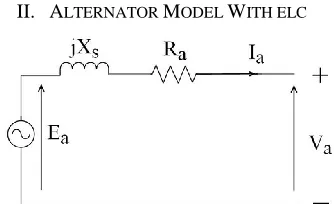
The per phase equivalent circuit of the stator of a typical three phase alternator/synchronous generator is shown in Fig. 1. The various parameters of the equivalent circuit are defined as:
Ea = Excitation Voltage
Xs = Synchronous Reactance per phase Va = Terminal Voltage
Ia = Armature Current
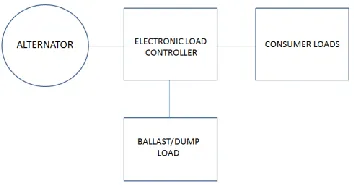
[image:2.612.347.553.145.216.2]The ELC senses the difference between the reference voltage and the actual/operating voltage. The difference in the two voltages is due to the load variations across the alternator terminals. It transfers the difference between the rated power and the consumer demand to the dump/ballast load for dissipation due to which the load on the machine always remains constant and thus the speed/frequency of the generator remains constant[7]-[8]. The scheme of ELC is depicted in Fig. 2.
Fig. 2: Schematic diagram of ELC
III. CONTROL STRATEGY OF ELC
Electronic Load Controller (ELC) helps in maintaining rated load on the generator irrespective of the variations in the consumer load. The heart of its working is the PWM generation scheme shown in Fig. 3 which generates the pulses by comparing the output of the fuzzy logic controller with a sawtooth carrier wave [9]. Here carrier frequency is taken to be 1000Hz. The pulses so generated are of variable duty cycle in accordance with the magnitude of error signal which acts as one of the inputs to the fuzzy logic controller, other being its continuous time derivative. The duty cycle of the pulses changes as the load changes, thus the scheme is also known as the pulse width modulated scheme for switching the IGBT based chopper switch which finally controls the dump power consumption [10].
Fig. 3: PWM based pulse generation scheme for firing the IGBT
IV. FUZZY LOGIC BASED CONTROL
[image:2.612.80.257.344.441.2]International Journal of Emerging Technology and Advanced Engineering
Website: www.ijetae.com (ISSN 2250-2459,ISO 9001:2008 Certified Journal, Volume 5, Issue 3, March 2015)
[image:3.612.57.285.129.307.2]516
Table I
Rule base for Fuzzy Logic Controller
Here NL means „negative large‟, NM means „negative medium, NS means „negative small, Z means „zero‟, PS means „positive small‟, PM means „positive medium‟, PL means „positive large‟, error is the difference between the reference voltage and actual/operating voltage, derror is the continuous-time derivative of error. Fig. 4-Fig. 6 show the membership functions for the input and output variables.
[image:3.612.322.576.139.207.2]Fig. 4: Membership functions for input variable ‘error’
[image:3.612.316.583.243.413.2]Fig. 5: Membership functions for input variable ‘derror’
Fig. 6: Membership functions for output variable ‘control’
V. MATLAB-SIMULINK MODEL DESCRIPTION
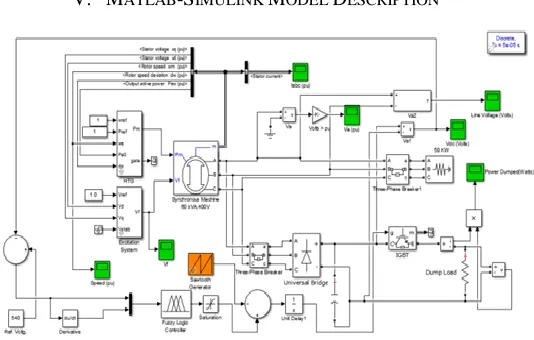
Fig. 7: MATLAB-SIMULINK model of ELC for alternator
[image:3.612.41.300.400.477.2]International Journal of Emerging Technology and Advanced Engineering
Website: www.ijetae.com (ISSN 2250-2459,ISO 9001:2008 Certified Journal, Volume 5, Issue 3, March 2015)
517
Where,
Vdc = Rectifier output voltage VLL = Line-line Voltage of alternator Rd = Dump load resistance
Pd = Dump Power C = Filter capacitor f = Line frequency R.F = Ripple factor Rs = Snubber resistance Cs = Snubber Capacitance Ts = Sampling time
Pn = Nominal power of the converter Vn = Nominal line-line AC voltage
The parameters of the control circuit play a vital role for the dumping of power effectively and efficiently, so these are designed taking into consideration their tolerance levels.
VI. RESULTS AND DISCUSSION
A. Transient Analysis
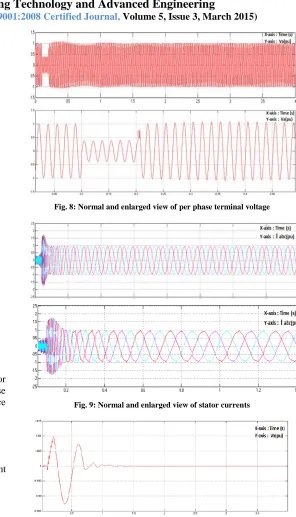
[image:4.612.54.537.98.583.2]The waveforms of various parameters under transient conditions are shown in Fig. 8 to Fig. 11.
Fig. 8: Normal and enlarged view of per phase terminal voltage
Fig. 9: Normal and enlarged view of stator currents
[image:4.612.282.578.108.625.2]International Journal of Emerging Technology and Advanced Engineering
Website: www.ijetae.com (ISSN 2250-2459,ISO 9001:2008 Certified Journal, Volume 5, Issue 3, March 2015)
518
Fig. 11: Variation in power dumped during transient analysis
As the sudden load of 50kW is switched on at 0.1 second, there is a sudden drop in the voltage as shown in Fig. 8. However, there is a sudden rise in the stator currents, depicted in Fig.9. The abrupt rise in the current is likely to happen due to sudden application of such a large load which accounts to almost 84% of the rated capacity of the alternator. The speed also drops suddenly below 0.99pu as shown in Fig. 10. There is also a transient at 0.1 second in the power dumped which finally settles down to a steady-state value of 10kW as shown in Fig. 11. However, there is a slight departure of stator currents from purely sinusoidal nature. The various operating parameters settle down to normal values in about a second which prove the efficient and effective action of fuzzy logic controller.
B. Steady-state Analysis
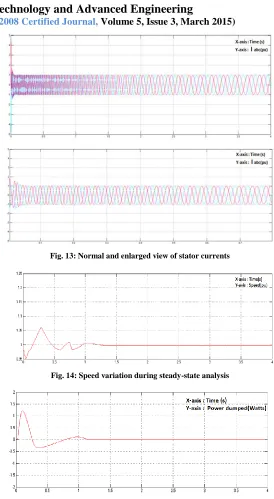
The variation of various parameters under steady-state is depicted by the waveforms shown in Fig. 12 to Fig. 15. The explanation of waveforms under steady-state has been done in this section to appreciate the performance of fuzzy logic based controller.
[image:5.612.304.578.103.602.2]Fig. 12: Normal and enlarged view of per phase terminal voltage
[image:5.612.47.294.490.676.2]Fig. 13: Normal and enlarged view of stator currents
Fig. 14: Speed variation during steady-state analysis
Fig. 15 Variation in power dumped during steady-state analysis
International Journal of Emerging Technology and Advanced Engineering
Website: www.ijetae.com (ISSN 2250-2459,ISO 9001:2008 Certified Journal, Volume 5, Issue 3, March 2015)
519
As the generator is loaded up to its rated capacity, there is an initial transient in the power dumped which reduces to zero after sometime as shown in the Fig. 15. The speed contains lesser number of transients as compared with the case of transient analysis. The settling time for transients is also less for all the operating parameters as compared with the case of transient analysis.
VII. CONCLUSION
The fuzzy logic based electronic load controller has been developed in MATLAB-SIMULINK and is simulated for three phase alternator. It is evident from the waveforms that fuzzy logic based controller gives very good performance under transient as well as steady-state conditions. The perturbation in the operating parameters is within permissible limits. There are less overshoots and transients in the operating parameters and system gets restored to its normal operating condition in a very short duration. In a nutshell it can be said that fuzzy logic based electronic load controller is a strong candidate for governing the alternators. The future scope is directed towards the analysis of the developed controller for inductive dump load, controller design can be improved by using neuro-fuzzy technique. STATCOM can also be integrated with ELC for reduction in the harmonic content of the rectified voltage for better regulation. The design can be practically developed and validated for the results in the laboratory.
REFERENCES
[1] Das Dibyendu, M.Tech dissertation Work On, “Steady-State analysis of Electronic Load Controller for Three Phase Alternator” , Alternate Hydro Energy Centre, Indian Institute of Technology Roorkee, 2011. [2] Appurva Appan, et al, “A Novel MATLAB GUI Comparitive Technique to Evaluate Generated Frequency and Saturated Magnetizing Reactance of a Three phase SEIG”, Vol. 5, Issue: 2, pp 233-239, Feb. 2015.
[3] Singh B., et al, “Analysis and design of ELC for SEIG”, IEEE Transactions on energy conversion, Vol. 21, No. 21, pp 285-293, March 2006.
[4] Singh B., et al, “Neural-Network based integrated ELC for isolated asynchronous generator in small hydropower generation”, IEEE Transactions on Industrial Electronics, Vol. 58, Issue: 9, pp 4264-4274, 2011.
[5] Ramirez J.M, et al, “An electronic load controller for self-excited induction generator”, IEEE Transactions on energy conversion, Vol. 22, No. 2, pp 1-8, 2007.
[6] Yellaiah. Ponnam, et al, “Electronic load controller for SEIG using fuzzy logic”, IOSR Journal of Electrical and Electronics Engineering, Vol. 5, Issue 3, pp 49-54, 2013.
[7] Murthy S.S., et al, “A novel digital control technique for ELC for SEIG based micro hydel power generation”, IEEE International Conference on Power Electronics, drives and energy systems, pp 1-5, 12-15 dec, 2006.
[8] Rajagopal V., et al, “Electronic load controller for isolated asynchronous generator in pico hydropower generation”, Conference paper, Department of Electrical Engineering, Indian Institute of Technology Roorkee, 2010.
[9] Garg Anjali, et al, “A fuzzy logic based ELC for self-excited induction generator”, Journal of Alternate Energy Sources and Technologies, Vol. 2, No.2, 2011.
[10] Kathirvel C., et al, “Fuzzy logic based voltage and frequency of a SEIG for micro-hydro turbines for rural applications”, Journal of Theoretical and Applied Information Technology, Vol.54, No. 1, 2013.
[11] Dhanalaxmi R, et al, “ANFIS based neuro-fuzzy controller in LFC of wind-micro hydro-diesel hybrid power system, International Journal of Computer Applications, Vol. 42-No. 6, March 2012.
BIOGRAPHIES
Anurag Yadav was born in Meerut, Uttar Pradesh, India, in 1989. He received his B.Tech degree in Electrical and Electronics Engineering from Gautam Buddh Technical University, Lucknow, India, in 2012. His areas of interest include Electrical Machines, Power Electronics, Power Systems, Distributed Generation and Renewable Energy Development Technology. He is currently pursuing Masters of Technology in Alternate Hydro Energy Systems at Indian Institute of Technology (IIT) Roorkee.
International Journal of Emerging Technology and Advanced Engineering
Website: www.ijetae.com (ISSN 2250-2459,ISO 9001:2008 Certified Journal, Volume 5, Issue 3, March 2015)