International Journal of Emerging Technology and Advanced Engineering
Website: www.ijetae.com (ISSN 2250-2459,ISO 9001:2008 Certified Journal, Volume 5, Issue 3, March 2015)
425
Notes on Fuzzy Graph
K. Arjunan
1, C. Subramani
21
Department of Mathematics, H.H.The Rajahs College, Pudukkottai – 622001, Tamilnadu, India.
2
Department of Mathematics, G.T.N Arts College, G.T.N.nagar, Dindigul-624005, Tamilnadu, India.
Abstract--In this paper, we study some of theproperties of fuzzy graph and prove some results on these. Fuzzy graph is the generalization of the ordinary graph and here fuzzy graph is a simple fuzzy graph. So we introduce a new structure of a fuzzy graph.
2010Mathematics subject classification: 03E72, 03F55, 05C72
Keywords-- Fuzzy subset, Fuzzy relation, Strong fuzzy relation, Fuzzy graph, Fuzzy loop, Fuzzy pseudo graph, Fuzzy spanning subgraph, Fuzzy induced subgraph, Fuzzy underling graph, Level set, Degree of fuzzy vertex, order of the fuzzy graph, size of the fuzzy graph, Fuzzy regular graph, Fuzzy strong graph, Fuzzy complete graph.
I. INTRODUCTION
In 1965, Zadeh [3] introduced the notion of fuzzy set as a method of presenting uncertainty. Since complete information in science and technology is not always available. Thus we need mathematical models to handle various types of systems containing elements of uncertainty. After that Rosenfeld[1] introduced fuzzy graphs. Yeh and Bang[6] also introduced fuzzy graphs independently. Fuzzy graphs are useful to represent relationships which deal with uncertainty and it differs greatly from classical graph. It has numerous applications to problems in computer science, electrical engineering system analysis, operations research, economics, networking routing, transportation, etc. Nagoor Gani.A [4, 5] introduced a fuzzy graph and regular fuzzy graph. In this paper we introduce the new structure of a fuzzy graph.
Preliminaries:
1.1 Definition: Let X be any nonempty set. A mapping M: X
[0,1] is called a fuzzy subset of X.1.2 Example: A fuzzy subset A = { (a, 0.3), (b, 0.4), (c, 0.6) } of a set X = { a, b, c }.
1.3Definition: Let A and B be any two fuzzy subset of X. We define the following relations and operations:
(i) AB iff A(x)≤ B(x) for all x in X. (ii) A = B iff A(x) = B(x) for all x in X.
(iii) AB iff (AB)(x) = min { A(x), B(x) } for all x in X.
(iv) AB iff (AB)(x) = max {A(x), B(x)} for all x in X.
(v) AC = 1 A = { ( x, 1 A(x) ) / xX }.
1.4 Definition: Let M be a fuzzy subset in a set S, the strongest fuzzy relation on S, that is a fuzzy relation V with respect to M given by V(x,y) = min { M(x),
M(y) } for all x and y in S.
1.5 Definition: Let V be any nonempty set, E be any set and f: E
VV be any function. Then A is a fuzzy subset of V, S is a fuzzy relation on V with respect to A and B is a fuzzy subset of E such thatB(e)
1
e f ( x,y)
S(x, y)
.
Then the ordered triple F = ( A, B, f ) is called a fuzzy graph, where the elements of A are called fuzzy points or fuzzy vertices and the elements of B are called fuzzy lines or fuzzy edges of the fuzzy graph F. If f(e) = (x, y), then the fuzzy points ( x, A(x) ), ( y, A(y) ) are called fuzzy adjacent points and fuzzy points (x, A(x) ), fuzzy line (e, B(e) ) are called incident with each other. If two district fuzzy lines (e1, B(e1) ) and (e2, B(e2) ) are incident with a common fuzzy point, then they are called fuzzy adjacent lines.
1.6 Definition: A fuzzy line joining a fuzzy point to itself is called a fuzzy loop.
1.7 Definition: Let F = (A, B, f) be a fuzzy graph. If more than one fuzzy line joining two fuzzy vertices is allowed, then the fuzzy graph F is called a fuzzy pseudo graph.
1.8 Definition: F = (A, B, f) is called a fuzzy simple graph if it has neither fuzzy multiple lines nor fuzzy loops.
International Journal of Emerging Technology and Advanced Engineering
Website: www.ijetae.com (ISSN 2250-2459,ISO 9001:2008 Certified Journal, Volume 5, Issue 3, March 2015)
426
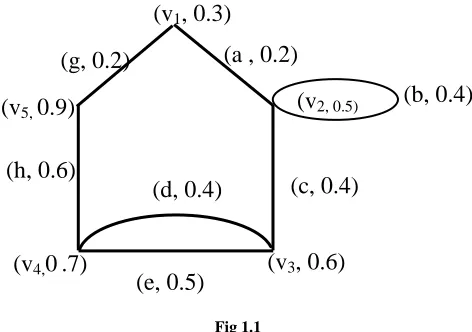
A fuzzy relation S ={((v1, v1), 0.3), ((v1, v2), 0.3), ((v1, v3), 0.3), ((v1, v4), 0.3), ((v1, v5), 0.3), ((v2, v1), 0.3), ((v2, v2), 0.5), ((v2, v3), 0.5), ((v2, v4), 0.5), ( (v2, v5), 0.5), ( (v3, v1), 0.3), ( (v3, v2), 0.5), ( (v3, v3), 0.6), ( (v3, v4), 0.6), ((v3, v5), 0.6), ((v4, v1), 0.3), ((v4, v2), 0.5), ((v4, v3), 0.6), ((v4, v4), 0.7), ((v4, v5), 0.7), ((v5, v1), 0.3), ((v5, v2), 0.5), ((v5, v3), 0.6), ((v5, v4), 0.7), ((v5, v5), 0.9)} on V with respect to A and a fuzzy subset B = {(a, 0.2), (b, 0.4), (c, 0.4), (d, 0.4), (e, 0.5), (h, 0.6), (g, 0.2) } of E.Fig 1.1
In figure 1.1, (i) (v1, 0.3) is a fuzzy point. (ii) (a, 0.2) is a fuzzy edge. (iii) (v1, 0.3) and (v2, 0.5) are fuzzy adjacent points. (iv) (a, 0.2) join with (v1, 0.3) and (v2, 0.5) and therefore it is incident with (v1, 0.3) and (v2, 0.5). (v) (a, 0.2) and (g, 0.2) are fuzzy adjacent lines. (vi) (b, 0.4) is a fuzzy loop. (vii) (d, 0.4) and (e, 0.5) are fuzzy multiple edges. (viii) It is not a fuzzy simple graph. (ix) It is a fuzzy pseudo graph.
1.10 Definition: The fuzzy graph H = (C, D, f) is called a fuzzy subgraph of F = (A, B, f) if C A and D B.
1.11 Definition: The fuzzy subgraph H = (C, D, f) is said to be a fuzzy spanning subgraph of F = (A, B, f) if C = A.
1.12 Definition: The fuzzy subgraph H = (C, D, f) is said to be a fuzzy induced sub graph of F = (A, B, f) if H is the maximal fuzzy subgraph of F with fuzzy point set C.
1.13 Definition: Let F = (A, B, f) be a fuzzy graph with respect to the sets V and E.
Let C be a fuzzy subset of V, the fuzzy subset D of E is defined as D(e) = C(u)C(v)B(e), where f(e)= (u, v) for all e in E. Then H= (C, D, f) is called fuzzy partial subgraph of F.
1.14 Definition: Let F = (A, B, f) be a fuzzy graph. Let (x, A(x) )
A. The fuzzy sub graph of F obtained by removing the fuzzy point (x, A(x) ) and all the fuzzy lines incident with (x, A(x) ) is called the fuzzy subgraph obtained by the removal of the fuzzy point (x, A(x) ) and is denoted F(x, A(x) ). Thus if F (x, A(x) ) = (C, D, f) then C = A { (x, A(x) ) } and D = { e, B(e) / (e, B(e) )
B and (x, A(x) ) is not incident with (e, B(e) ) }. Clearly F (x, A(x) ) is fuzzy induced subgraph of F. Let (e, B(e) )
B then F (e, B(e) ) = (A, D, f) is called fuzzy sub graph of F obtained by the removal of the fuzzy line (e, B(e) ), where D = B{(e, B(e) ) }. Clearly F (e, B(e) ) is an fuzzy spanning sub graph of F which contains all the lines of F except (e, B(e) ).1.15 Definition: By deleting from a fuzzy graph F all fuzzy loops and in each collection of fuzzy multiple edges all fuzzy edge but one fuzzy edge in the collection we obtain a fuzzy simple spanning
subgraph F, called fuzzy underling simple graph of F.
[image:2.612.61.297.262.428.2]1.16 Example:
Fig. 1.2 A fuzzy pseudo graph F = (A, B, f)
(v
2, 0.5)(b, 0.4)
(v
3, 0.6)
(v
4,0
.7)
(v
5,0.9)
(v
1, 0.3)
(h, 0.6)
(d, 0.4)
(e, 0.5)
International Journal of Emerging Technology and Advanced Engineering
Website: www.ijetae.com (ISSN 2250-2459,ISO 9001:2008 Certified Journal, Volume 5, Issue 3, March 2015)
[image:3.612.79.535.127.677.2]427
Fig. 1.3 A fuzzy subgraph of F
Fig 1.4 A fuzzy spaning subgraph of F
Fig. 1.5 Afuzzy subgraph Induced by P = {v1, v3, v4,v5}
Fig 1.6 A partial fuzzy subgraph induced by C
[image:3.612.77.293.144.631.2]Where C(v1) = 1, C(v3) = 0.6, C(v4) = 0.8, C(v5) = 0.6.
Fig 1.7 F (v2 , 0.7)
[image:3.612.340.526.333.665.2]International Journal of Emerging Technology and Advanced Engineering
Website: www.ijetae.com (ISSN 2250-2459,ISO 9001:2008 Certified Journal, Volume 5, Issue 3, March 2015)
428
Fig 1.9 Underlingfuzzy simple graph of F.
1.17 Definition: Let A be a fuzzy subset of X then the level subset or
– cut of A isA
= {x
A / A(x)
}, where
[0,1].1.18 Theorem: Let F = (A, B, F) be a fuzzy graph with respect to the set V and E.
Let ,
[0,1] and
. Then (A
,B
, f) is a subgraph of (A
,B
,f).Proof: It is trivial.
1.19 Theorem: Let F = (A, B, f) be a fuzzy graph with respect to the set V and E, the level subsets
A
,
B
of A and B subset of V and E respectively. ThenF = (A, B, f) is a subgraph of G = (V, E, f). Proof: It is trivial.
1.20 Theorem: Let H = (C, D, f) be a fuzzy subgraph of F = (A, B, f) and
[0,1]. Then Hα=(Cα,Dα, f) is a subgraph of Fα= (Aα, Bα, f).
Proof: Let H = (C, D, f) be a fuzzy subgraph of F = (A, B, f) and
[0,1]. Suppose u
Cα
C(u)
A(u) C(u)
A(u)
u
AαCα Aα. Let e
Dα
D(e)
B(e) D(e)
B(e)
Dα Bα. Therefore Hα is a fuzzy subgraph of Fα.
1.21 Definition: Let A be a fuzzy subset of X. Then the strong level subset or strong -cut of A is A+= { x
A / A(x) >
}, where
[0,1].1.22 Theorem: Let F = (A, B, F) be a fuzzy graph with respect to the set V and E. Let ,
[0,1] and
. Then (A+, B+, f) is a subgraph of (A+, B+, f).Proof: It is trivial.
1.23 Theorem: Let F = (A, B, f) be a fuzzy subgraph with respect to the set Vand E, the level subsets A+, B+ of A and B subset of V and E respectively. Then F+ = (A+, B+, f) is a subgraph of G = (V, E, f).
Proof: It is trivial.
1.24 Theorem: Let H = (C, D, f) be a fuzzy subgraph of F = (A, B, f) and
[0,1]. Then H+ = (C+, D+, f) is a subgraph of F+ = (A+, B+, f).Proof: Let H = (C, D, f) be a fuzzy subgraph of F = (A, B, f) and
[0,1]. Suppose uC+
C(u) >
A(u) C(u) >
A(u) >
uA+. Therefore C+ A+ . Let eD+
D(e) >
B(e) D(e) >
B(e) > . Therefore D+ B+ . Hence H+ is a fuzzy subgraph of Fα+ .1.25 Theorem: Let F = (A, B, f) be a fuzzy subgraph with respect to the set V and E, let , [0,1] and Fα and Fβ be two subgraphs of G. Then (i) Fα Fβ is a subgraph of G. (ii) Fα Fβ is a subgraph of G. Proof: Since Aα and Aβ are subset of V. Clearly Fα
Fβ is a subgraph of G. Also Fα Fβ is a subgraph of G.
1.26 Definition: Let F = (A, B, f) be a fuzzy graph. Then the degree of a fuzzy vertex is difined by d(v) = ∑ +2 ∑ .
1.27 Definition: The minimum degree of the fuzzy graph F = (A, B, f) is δ(F) = { d(v) / vV } and the maximum degree of F is (F) = {d(v) / vV }. 1.28 Definition: Let F = (A, B, f) be a fuzzy graph. Then the order of fuzzy graph F is defined to be o(F) =
v V
A(V)
.1.29 Definition: Let F = (A, B, f) be a fuzzy graph. Then the size of the fuzzy graph F is defined to be S(F) =
e f 1(x,y)
B(e)
[image:4.612.80.277.125.292.2]International Journal of Emerging Technology and Advanced Engineering
Website: www.ijetae.com (ISSN 2250-2459,ISO 9001:2008 Certified Journal, Volume 5, Issue 3, March 2015)
429
[image:5.612.312.548.114.726.2]1.30 Example:
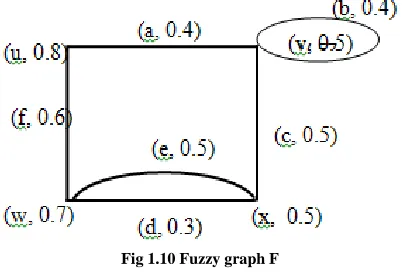
Fig 1.10 Fuzzy graph F
Here d(u) = 1, d(v) = 1.7, d(w) = 1.4, d(x) = 1.3, (F) = 1, (F) = 1.7, o(F) = 2.5, S(F) = 2.7
1.31 Remark: 0 (F) (F).
1.32 Remark: Degree of membership value of fuzzy vertices v need not be equal to the sum of the membership values of all edges incident with fuzzy vertex v.
1.33 Theorem: The sum of the degree of all fuzzy vertices in a fuzzy graph is equal to twice the sum of the membership value of all fuzzy edges. i.e.,
v V
d(v)
2S(F)
.Proof: Let F = (A, B, f) be a fuzzy graph with respect to the set V and E. Since degree of a fuzzy vertex denote sum of the membership values of all fuzzy edges incident on it. Each fuzzy edge of F is incident with two fuzzy vertices. Hence membership value of each fuzzy edge contributes two to the sum of degrees of fuzzy vertices. Hence the sum of the degree of all fuzzy vertices in a fuzzy graph is equal to twice the sum of the membership value of all fuzzy edges. i.e.,
v V
d(v)
2S(F)
.1.34 Theorem: Let F be any fuzzy graph and P be the
number of fuzzy vertices. Then (F)
2S(F)
P
(F).
Proof: Suppose F = (A, B, f) any fuzzy graph with P –vertices. If every fuzzy vertex has degree then
v V v V
d(v)
P
. If every fuzzy vertex hasdegree then
v V v V
d(v)
P
.But ∑ ∑ ∑
P 2S(F) P. Hence (F)
2S(F)
P
(F).1.35 Theorem: Let F = (A, B, f) be a fuzzy graph with number of fuzzy vertices n, all of whose fuzzy vertices have degree s or t. If F has p-fuzzy vertices of degree s and np fuzzy vertices of degree t then
S(F) =
2
)
(
s
t
nt
p
.
Proof: Let V1 be the set of all fuzzy vertices with degree s. Let V2 be the set of all fuzzy vertices with degree t. Then
v V
d(v)
=1
v V
d(v)
+2
v V
d(v)
which implies that 2S(F) = ps + (n-p)t which implies
that S(F) =
2
)
(
s
t
nt
p
.
II. REGULAR FUZZY GRAPH
2.1 Definition: A fuzzy graph F = (A, B, f) is called fuzzy regular graph if d(v) = k for all v in V. 2.2. Remark: F is a fuzzy k-regular graph if and only if = = k.
2.3 Example:
Fig 2.1
Here d(v1) = 1.2 ,d(v2) = 1.2, d(v3) = 1.2, δ=1.2,
Δ = 1.2. Clearly it is a fuzzy 1.2-regular graph.
2.4 Definition: A fuzzy graph F = (A, B, f) is called a fuzzy complete graph if every pair of distinct fuzzy vertices are fuzzy adjacent and B(e) =
1
e f ( x,y)
S(x, y)
for
[image:5.612.80.286.156.292.2]International Journal of Emerging Technology and Advanced Engineering
Website: www.ijetae.com (ISSN 2250-2459,ISO 9001:2008 Certified Journal, Volume 5, Issue 3, March 2015)
430
2.5 Definition: A fuzzy graph F = (A, B, f) is a fuzzy strong graph if B(e) =
1
e f ( x,y)
S(x, y)
for all e in E.
[image:6.612.73.285.157.434.2]2.6 Example:
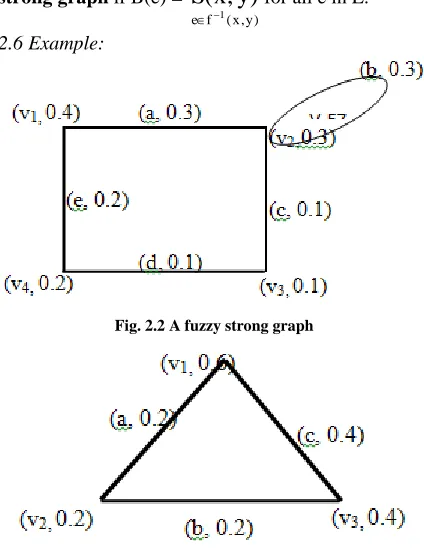
Fig. 2.2A fuzzy strong graph
Fig. 2.3 A fuzzy complete graph
2.7 Remark: Every fuzzy complete graph is a fuzzy strong graph. A fuzzy strong graph need not be fuzzy complete graph from the fig. 2.2 .
2.8 Theorem: If F is a fuzzy k-regular graph with
p-fuzzy vertices. Then
2
)
(
F
pk
S
.Proof: Given that the fuzzy graph is a fuzzy k-regular graph, so d(v) = k for all v in V. Here there are p-fuzzy vertices, so
v V v V
d(v)
k
= pk whichimplies that
2
)
(
F
pk
S
.2.9 Remark: In a crisp graph theory any complete graph is regular. But in this fuzzy graph, every fuzzy complete graph need not be fuzzy regular graph. In fig. 2.3, it is a fuzzy complete graph but not a fuzzy regular graph since d(v1) = 0.6, d(v2) = 0.6, d(v3) = 0.4 .
2.10 Theorem: Let F = (A, B, f) be fuzzy complete graph and A is constant function. Then F is a fuzzy regular graph.
Proof: Since A is a constant function, so A(v) = k (say) for all v in V and F is a fuzzy complete graph,
so B(e) =
1
e f ( x,y)
S(x, y)
for all x and y in V and xy.
Therefore membership value of all fuzzy edges are k. Hence d(v) = (p 1) k for all v in V.
2.11 Remark: Let F = (A, B, f ) be fuzzy complete graph with p-fuzzy vertices and A(v) = k for all v in V. Then F is a fuzzy (p-1)k-regular graph.
2.12 Theorem: If F = (A, B, f) is fuzzy complete graph with p-fuzzy verties and A is constant function then sum of the membership values of all fuzzy edges
is A(v) for all v in V. i.e., S(F) = pC2 A(v), for all v in V.
Proof: Suppose F is a fuzzy complete graph and A is a constant function.
Let A(v) = k for all v in V and d(v) = (p-1) k for all v
in V. Then
V v V
v
k
p
v
d
(
)
(
1
)
which impliesthat 2S(F) = p(p 1) k. Hence S(F) = k. i.e., S(F) = pC2 A(v) for all v in V.
2.13 Definition: Let F = (A, B, f) be a fuzzy graph. The total degree of fuzzy vertex v is defined by dT(v) =
1 1
i i i
i i
e f (u ,v) e f (v,v)
B(e ) 2
B(e ) A(v)
=d(v) + A(v) for all v in V.
2.14 Definition: A fuzzy graph F is fuzzy k-totally regular graph if each vertex of F has the same total degree k.
2.15 Example:
International Journal of Emerging Technology and Advanced Engineering
Website: www.ijetae.com (ISSN 2250-2459,ISO 9001:2008 Certified Journal, Volume 5, Issue 3, March 2015)
431
Here dT(v1) = 1.8, dT(v2) = 1.8, dT(v3) = 1.8, it is fuzzy 1.8-totally regular graph2.16 Example: Fig 2.1 it is a fuzzy regular graph, but it is not a fuzzy totally regular graph since dT(v1) = 1.8, dT(v2) = 2 and dT(v1) dT(v2).
2.17 Example: Fig 2.4, it is a fuzzy totally regular graph but it is not a fuzzy regular graph since d(v1) = 1.1, d(v3) = 1.2 and d(v1) d(v3).
[image:7.612.76.278.256.404.2]2.18 Example:
Fig 2.5 Here d(vi) = 1.2 for all i, dT(vi) = 2 for all i. It is
both fuzzy regular graph and fuzzy totally regular graph.
2.19 Example:
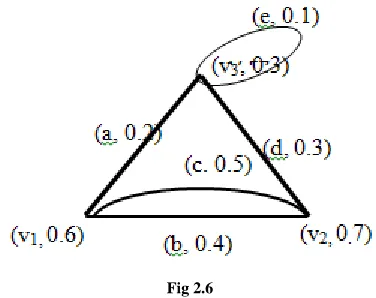
Fig 2.6
Here d(v1) = 1.1 d(v2) = 1.2 d(v3) = .7, dT(v1) = 1.7 dT(v2) = 1.9 dT(v3) = 1, it is neither fuzzy regular graph nor fuzzy totally regular graph.
2.20 Theorem: Let F = (A, B, f) be fuzzy complete graph and A is constant function. Then F is a fuzzy totally regular graph.
Proof: By theorem 2.10, clearly F is fuzzy regular graph. i.e., d(v) = (p1)k for all v in V. Also given A is constant function. i.e., A(v) = k for all v in V. Then dT(v) = d(v) + A(v) = (p1)k + k = pk – k +k = pk for all v in V. Hence F is fuzzy totally regular graph.
2.21 Remark: Let F be a fuzzy complete graph with p-fuzzy vertices and A(v) = k for all v in V. Then F is a fuzzy pk-totally regular graph.
2.22 Theorem: Let F = (A, B, f) be a fuzzy regular graph. Then H = (C, B, f) is a fuzzy totally regular
graph if C(vi) = n
i 1
V
A(vi) for all vi in V.
Proof: Assume that F = (A, B, f) is a fuzzy k- regular
graph. i.e., d(vi) = k for all vi in V. Given C(vi) = n
i 1
V
A(vi) for all vi in V. Then C(vi) = k1 (say) for all vi in V and dT(H)(vi)= d(vi) + C(vi) = k + k1 for all vi in V. Hence H is fuzzy totally regular graph.
2.23 Theorem: Let F = (A, B, f) be a fuzzy graph and A is a constant function ( ie. A(v) = c (say) for all vV ). Then F is fuzzy k-regular graph if and only if F is fuzzy (k+c)-totally regular graph.
Proof: Assume that F is a fuzzy k-regular graph and A(v) = c for all v in V, so d(v) = k for all v in V. Then dT(v) = d(v) + A(v) = k + c for all v in V. Hence F is fuzzy (k+c)-totally regular graph. conversely, Assume that F is fuzzy (k+c)-totally regular graph. ie., dT(v) = k+c for all v in V which implies that d(v)+A(v) = k+c for all v in V implies that A(v) = c for all v in V implies that d(v)+c = k+c for all v in V. Therefore d(v) = k for all v in V. Hence F is fuzzy k-regular graph.
2.24 Theorem: If F = (A, B, f) is both fuzzy regular graph and fuzzy totally regular graph then A is a constant function.
Proof : Assume that F is a both fuzzy regular graph and fuzzy totally regular graph.
Suppose that A is not constant function. Then A(u) A(v) for some u, v in V. Since F is a fuzzy k-regular graph. Then d(u) = d(v) = k. Then dT(u) dT(v) which is a contradiction to our assumption. Hence A is a constant function.
[image:7.612.85.273.459.608.2]International Journal of Emerging Technology and Advanced Engineering
Website: www.ijetae.com (ISSN 2250-2459,ISO 9001:2008 Certified Journal, Volume 5, Issue 3, March 2015)
[image:8.612.82.280.141.268.2]432
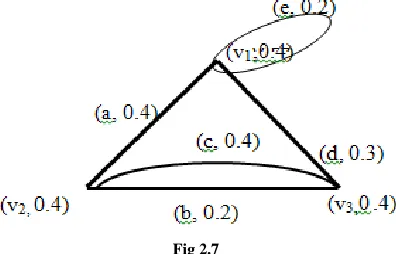
Fig 2.7
Here A(vi) = 0.4 for all i , d(v1) = 1.1, d(v2) = 1, d(v3) = 0.9, dT(v1) = 1.5, dT(v2) = 1.4, dT(v3) = 1.3. Hence F is neither fuzzy regular graph nor fuzzy totally regular graph.
2.26 Theorem: If F = (A, B, f) is a fuzzy c-totally regular graph with p-fuzzy vertices. Then
2
)
(
)
(
F
pc
o
F
S
.Proof: Assume that F is a fuzzy c-totally regular graph with p-fuzzy vertices.
Then dT(v) = c for all v in V implies that d(v)+ A(v) = c for all v in V which implies that
d(v)
A(v)
cfor all v in V which implies that 2S(F) + o(F) = pc. Hence2 ) ( )
(F pc o F
S
2.27 Theorem: If F = (A, B, f) is both fuzzy k-regular graph and fuzzy c-totally regular graph with p-fuzzy vertices. Then o(F) = p(ck).
Proof: Assume that F is fuzzy k-regular graph with p-fuzzy vertices. Then 2S(F) = pk By theorem 2.26, 2S(F) + o(F) = pc implies that o(F) = p(ck).
REFERENCES
[1] A. Rosenfeld, Fuzzy graph, in: L.A.Zadeh, K.S.Fu, M.Shimura (Eds.), Fuzzy sets and their applications to cognitive and decision process, Academic Press, New York, 1975, pp. 77 -95.
[2] J.N. Mardeson and C.S. Peng, Operation on Fuzzy graph, Information science, 19(1994), 159- 170.
[3] L. A. Zadeh,Fuzzy sets, Information and Control, 8 (1965) 338-353.
[4] Nagoor Gani, A. and Basheer Ahamed.M., Order and Size in Fuzzy Graphs, Bulletin of Pure and Applied Sciences, Vol 22E (No.1) 2003, 145-148.
[5] Nagoor Gani.A and Radha.K., On Regular Fuzzy Graphs, Journal of Physical sciences, Vol. 12, 2008, 33-40. [6] R.T Yeh, S.Y. Bang, Fuzzy relations fuzzy graphs and their