On the Boundary Layer Flow over a Moving Surface in a
Fluid with Temperature-Dependent Viscosity
E. W. Mureithi1, J. J. Mwaonanji1, O. D. Makinde2
1
Department of Mathematics, University of Dar es Salaam, Dar es Salaam, Tanzania
2
Cape Peninsula University of Technology, Bellville, South Africa Email: [email protected]
Received March 25, 2013; revised April 28, 2013; accepted May 6, 2013
Copyright © 2013 E. W. Mureithi et al. This is an open access article distributed under the Creative Commons Attribution License, which permits unrestricted use, distribution, and reproduction in any medium, provided the original work is properly cited.
ABSTRACT
This paper examines a boundary layer flow over a continuously moving heated flat surface with velocity U
x in a streaming flow with velocity U
x and with temperature dependent viscosity,
T . The momentum and the en- ergy equations are coupled through the viscous dissipation term. The coupled boundary layer equations are transformed into a self-similar form using an appropriate similarity variable. An efficient numerical technique is used to solve the self-similar boundary layer equations. It is shown that at low enough values for the velocity ratio , an increase in viscous dissipation enhances greatly the local heat transfer leading to temperature overshoots adjacent to the wall. The viscosity variation parameter is shown to have significant effects on the temperature dependent viscosity and the veloc-ity and temperature distribution within the boundary layer.Keywords: Flat Moving Surface; Temperature Dependent Viscosity; Self-Similar Equations; Viscous Dissipation
1. Introduction
Studies on heat and mass transfer in boundary layers over continuously moving or stretching surfaces have been in- creasing due to their wide variety of applications in manufacturing processes such as glass-fibre production, metal extrusion, materials-handling conveyors and paper production.
One of the earliest studies on boundary-layer flow past moving surfaces was initiated by Sakiadis [1], who in- vestigated momentum transfer for a flow over a con- tinuously moving plate in quiescent fluid. The results of Sakiadis were later verified experimentally by Tsou et al. [2]. Over recent years studies of boundary layer past mo- ving or stretching surfaces in otherwise quiescent fluids included the work of Ali [3] who investigated similarity solutions for a thermal boundary layer over a power-law stretching surface with suction or injection; Elbashbeshy [4] who studied heat transfer over a stretching surface with suction or injection; Magyari and Keller [5] who studied similarity solutions for boundary layer flow over an exponentially stretching surface and Mureithi [6] who examined linear stability properties of a boundary layer flow over a moving surface in a streaming flow.
Studies on free-stream effects on boundary-layer flows
over moving or stretching surfaces included the work of Abdelhafez [7] and Chappidi and Gunnerson [8] who independently considered flows over moving surfaces in which both the surface and the free stream moved in the same direction. In their studies, they formulated two sets of boundary value problems for the cases U U and UU. Afzal [9] formulated a single set of equations
using as reference velocity a composite velocity given by
U U U. Later Lin and Huang [10] used Afzal’s
formulation to study momentum and heat transfer for a flow over a surface moving parallel or reversely to the free stream with temperature dependent viscosity. A study by Afzal [11] investigated momentum transfer on a power law stretching surface with free-stream pressure gradient.
The current study investigates a boundary layer flow over a moving surface in a streaming flow with a tem- perature dependent dynamic viscosity, . The Ling and Dybbs [12] model for is used in this study.
T
T 2. Problem Formulation
An incompressible flow past an infinite surface con- tinuously moving with velocity U in a streaming flow
with velocity and with temperature dependent vis- cosity , is investigated. The fluid is of density
U
T ,
thermal conductivity and specific heat capacity cp
(at constant pressure). The boundary layer equations are
2 2 2 0 d , d p p u v x y Uu u u
u v U T
x y x y y
T
T T T u
u v
x y c y c y
(1)
The boundary conditions for this flow are
, 0 , , 0 0, , 0 ,
, , , .
u x U x v x T x T
u x U x T x T
(2)
for a flow over an impermeable surface v x
, 0 0. The following temperature dependent viscosity model due to Ling and Dybbs [12] is used here:
1 T T T where is a constant, is the constant reference
viscosity in the absence of heating. The case 0
corresponds to the constant viscosity situation.
3. Self-Similar Boundary Layer Equations
The basic flow is rendered in non-dimensional form through setting
1 2 , , , , w xu x y Uf T x y T T T
yRe x ,
where U x
UU is the reference velocity (Afzalet al. [9]),
x y,
f
is the boundary-layer similarity vari- able and and
are the scaled free-stream velocity and temperature, respectively. The parameterx
Re is the local Reynolds number defined as
x
Ux Re
.
In non-dimensional form, the Lings-Dybbs model be- comes
1 1
where is the dimensionless dynamic viscosity
and is the variable viscosity parameter. The case is equivalent to the case
T T
0
0 corre-sponding to constant viscosity.
[image:2.595.306.540.377.533.2]From the equation of continuity we have
Figure 1. Schematic diagram for the problem.
1 2
d
, 1 1 ,
d 2 x
U x
v x y f f
U x
Re
U
where the parameter reduces to the pressure gradient parameter 0 d if 0. d U x U
U x
We assume power-law variations in the free-stream velocity and wall velocity of the form
so that.
0 ,
n
e U U x UU xn
0
n n
e
U U x U x U U x Ax
and 0n. The dimensionless similarity boundary- layer equations take the form
2 2
11 ,
2 1
n f
f n f ff
(3)
2
2 2 1 1 1 . 2 1 n Ecxn f f
Pr (4)
with boundary conditions
0 0,
0 1 ,
0 1,, 0 as ,
f f f (5) where
2, p, e
p
c U
U
Pr Ec
U U c T T
. 1
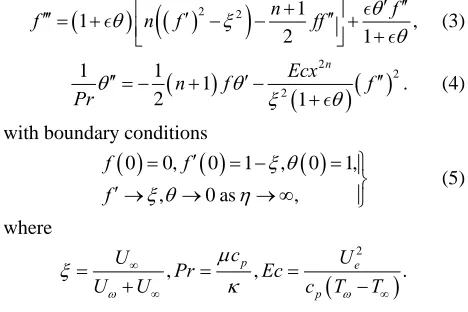
The parameter is the Prandtl number and is the Eckert number. The flow is self-similar if one of the following is satisfied:
Pr Ec
1. n = 0 for any Ec.
2. Ec = 0 for any n (negligible viscous dissipation).
remarks
We have assumed that both the wall and the free stream move in the same direction so that 0 . The case when 0 is corresponds to a wall moving in an otherwise quiescent fluid
U0
, 10
corresponds to flow over a stationary wall
U
and 1 2 is equivalent to U U so that the wall and the free-stream move with the same speed. When 0 1 2, the wall moves faster that the free-stream while the case when 1 2 1 corresponds to the free-stream moving faster than the wall.
represented using the local skin friction factor, Cf, and
the local Nusselt number, Nux, respectively defined as
1 2 1 2
2 0
, 0
1
f x x x
f
C Re Nu Re
.
4. Numerical Solution and Discussion of
Results
The coupled self-similar boundary layer Equations (3) and (4) together with the boundary conditions (5) are solved numerically using a shooting method coupled with the fourth-order Runge-Kutta scheme.
The results presented here are for the cases when . Self-similar solutions were obtained for two cases. Case one is the flow viscous dissipation and
. Case two corresponds to the case with
0.72
Pr
0
n n0 but
without viscous dissipation effects.
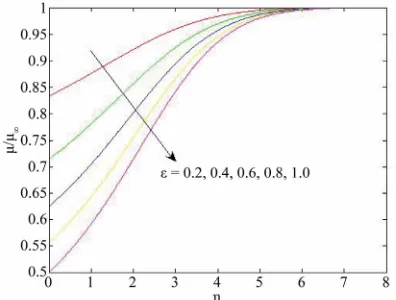
Figures 2 and 3 show that the effect of varying the fluid viscosity variation parameter on the temperature- dependent dynamic viscosity,
and the stream-
wise velocity f
, within the boundary layer. At any location within the boundary layer decreases with increase in the viscosity parameter, . The boun- dary layer thickness is found to decrease with increase in . The parameter is a measure of fluid viscosity vari- ation.
The effect of varying viscous dissipation parameter, , and the velocity ratio
[image:3.595.316.531.85.250.2] [image:3.595.316.529.304.472.2]Ec on the temperature distri- bution in the boundary layer is shown in Figures 4 and 5.
Figure 4 shows that for 0.1
Ec
, increasing results in temperature over-shoot near the wall, with peaks in creasing with increase in . Figure 5 illustrates the effect of varying the velocity ratio on the temperature distribution. For the case when , the results show that the temperature peaks are realized for
Ec
0.5
Ec
0.3
[image:3.595.310.538.517.694.2]and the peaks amplitudes increase with decrease in .
Figure 2. Effects of viscosity variation parameter on the dynamic viscosity for
0, 0.8, 0.5, 0.2,0.4,0.6,0.8,1. n Ec
Figure 3. Effects of viscosity variation parameter on velo- city profiles for
0.0, 0.8, 0.5, 0.2,0.4,0.6,0.8,1
n Ec .
Figure 4. Effects of varying Ec 0.1,
n E
on temperature distribu- tion for 0.0,0.1, c0.1,0.3,0.5.
Figure 5. Effects of viscosity variation on the temperature distribution profiles for
0.0, 0.1, 0.1,0.2,0.3, 0.5
[image:3.595.74.272.544.694.2]The skin-friction is presented as a function of in
Figures 6 and 7. These figures show the effect of varying
on the local skin friction coefficient for the case when
0.5 1 and 0 0.5. For the case when
0.5 1, the local skin friction coefficient is positive and hence the fluid exerts a dragging force on the wall. For this case, increasing results in increase in the skin friction coefficient. For the case when
0 0.5, the local skin friction coefficient is negative, which is an indication that the wall drags the fluid. Also, increasing
results in a decrease in the skin friction.
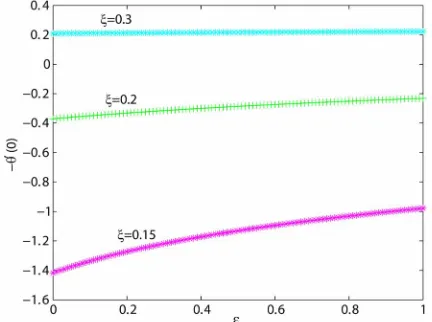
In Figure 8, the effect of varying on local Nusselt number is shown as a function of for the cases when0.5 1. The results show that the heat transfer coefficient decreases with increase in and increases with increase in .
[image:4.595.316.532.307.468.2]The results shown in Figure 9 are interesting. It is shown that for 0 0.3, the local Nusselt number is
Figure 6. The skin friction coefficient against for the case when n0.0,Ec0.5,0.6,0.7,0.8,0.9.
Figure 7. The skin friction coefficient against for the case when n0,Ec0.5,0.15,0.2,0.3.
Figure 8. The heat transfer coefficient against for the case when
0, 0.5, 0.6,0.7,0.8,0.9
[image:4.595.59.286.313.487.2]n Ec .
Figure 9. The heat transfer coefficient against for the case when
0, 0.5, 0.15,0.2,0.25,0.3
n Ec .
negative, changing sign to positive for 0.3. This explains the results observed in Figure 7 where tem- perature over-shoot were observed adjacent to the wall. These results show that for low enough values for , the heat transfer from wall to the fluid is greatly en- hanced resulting in temperature over-shoots adjacent to the wall.
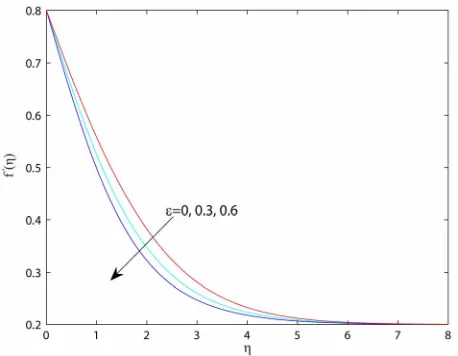
The effect of varying on the velocity and tempera- ture distribution within the boundary layer is presented in
Figures 10 and 11 for the case when wall is moving faster than the free-stream. The results show that velocity boundary layer thickness decreases with increase and that the temperature peaks decrease with increase in . This shows that the increasing results in a decrease in heat transfer from the wall to the fluid.
5. Conclusions
[image:4.595.57.292.526.705.2]Figure 10. Effects of varying on the velocity distribution
[image:5.595.58.288.305.487.2]f for n0.0,0.2,Ec0.5 and 0,0.3,0.6.
Figure 11. Effects of varying on the temperature distri- bution
for n = 0.0, ξ = 0.2, Ec = 0.5 and = 0, 0.3, 0.6.
for a flow over a continuously moving heated surface in a fluid with temperature dependent viscosity. The self- similar equations were solved numerically and the results are presented in graphs.
In this study the effects of varying the viscosity vari- ation and the velocity ratio are investigated for the case when the surface moves in the same direction as the free-stream.
For low enough values for the velocity ratio ξ, the lo- cal heat transfer is found to be negative, indicating the heat transfer from the wall to the fluid is greatly en- hanced near the wall as the Eckert number increases. This is seen in the temperature distribution profiles where temperature peaks are observed adjacent to the wall. For the case when the wall moves faster than the fluid, the skin friction coefficient is negative, indicating that
wall drags the fluid. The reverse occurs for the case when
0.5 1 where the skin friction is positive and hence the free-stream exerts a dragging force on the boundary layer.
REFERENCES
[1] B. C. Sakiadis, “Boundary Layer Behavior on Continuous Solid Surfaces: II Boundary Layer on a Continuous Flat Surface,” American Institute of Chemical Engineers Jou- rnal, Vol. 7, No. 2, 1961, pp. 221-225.
doi:10.1002/aic.690070211
[2] F. Tsou, E. M. Sparrow and J. R. Goldstein, “Flow and Heat Transfer in the Boundary Layer on a Continuous Moving Surface,” International Journal of Heat and Mass Transfer, Vol. 10, No. 2, 1967, pp. 219-235. doi:10.1016/0017-9310(67)90100-7
[3] M. E. Ali, “On the Thermal Boundary Layer on a Power- Law Stretched Surface with Suction or Injection,” Inter- national Journal of Heat and Fluid Flow, Vol. 16, No. 4, 1995, pp. 280-290.doi:10.1016/0142-727X(95)00001-7 [4] E. M. Elbashbeshy, “Heat Transfer over a Stretching Sur-
face with Variable Surface Heat Flux,” Journal of Physics D: Applied Physics, Vol. 31, No. 16, 1998, pp. 1951- 1954.doi:10.1088/0022-3727/31/16/002
[5] E. Magyari and B. Keller, “Heat and Mass Transfer in the Boundary Layer on an Exponentially Stretching Conti- nuous Surface,” Journal of Physics D: Applied Physics, Vol. 32, No. 5, 1999, pp. 577-585.
doi:10.1088/0022-3727/32/5/012
[6] E. W. Mureithi, “Stability Properties of a Boundary Layer Flow Past a Continuously Moving Wall in a Streaming Flow,” International Journal of Fluid Mechanics Re-search, Vol. 33, No. 5, 2006, pp. 430-444.
doi:10.1615/InterJFluidMechRes.v33.i5.40
[7] T. A. Abdelhafez, “Skin Friction and Heat Transfer on a Continuous Flat Surface Moving in a Parallel Free Stream,” International Journal of Heat and Mass Trans- fer, Vol. 28, No. 6, 1985, pp. 1234-1237.
doi:10.1016/0017-9310(85)90132-2
[8] P. R. Chappidi and F. S. Gunnerson, “Analysis of Heat and Momentum Transport along a Moving Surface,” In-ternational Journal of Heat and Mass Transfer, Vol. 32, No. 7, 1989, pp. 1383-1386.
doi:10.1016/0017-9310(89)90039-2
[9] N. Afzal, A. Badaruddin and A. A. Elgarvi, “Momentum and Heat Transport on a Continuous Flat Surface Moving in a Parallel Stream,” International Journal of Heat and Mass Transfer, Vol. 36, No. 13, 1993, pp. 3399-3403. doi:10.1016/0017-9310(93)90022-X
[10] H. T. Lin and S. F. Huang, “Flow and Heat Transfer of Plane Surface Moving in Parallel and Reversely to the Free Stream,” International Journal of Heat and Mass Transfer, Vol. 37, No. 2, 1994, pp. 333-336.
doi:10.1016/0017-9310(94)90104-X
Journal of Engineering Science, Vol. 41, No. 11, 2003, pp. 1197-1207.doi:10.1016/S0020-7225(03)00002-8 [12] J. X. Lings and A. Dybbs, “Forced Convection over a Flat