© Strojniški vestnik 47(2001 DB,455-461 ISSN 0 0 3 9 -2 4 8 0
UDK 5 3 B .2
Izvirni znanstveni članek C1.01D
©Journal of Mechanical Engineering 4702001 D8.455-4B1 ISSN 0 0 3 S -2 4 B 0
UDC 5 3 6 .2 Original scientific paper 01 .01D
MODELING OF VOID FRACTION AND LIQUID TEMPERATURE
PROFILE EVOLUTION IN VERTICAL SUBCOOLED NUCLEATE
BOILING FLOW
Ivo K ljen ak Reactor Engineering Division
Jo zef Stefan Institute Jam ova 39 Ljubljana, Slovenia
E-mail: [email protected]
ABSTRACT
A three-dimensional bubble-tracking model, which simulates subcooled nucleate boiling in a heated vertical cylindrical tube, is presented. The behavior o f the liquid-vapor system results from motion, interaction and heat transfer mechanisms prescribed mostly at the level o f individually-tracked vapor bubbles. The model takes into account bubble nucleation and liquid heating caused by wall heat flux, bubble sliding on the tube wall, bubble departure from the tube wall, bubble condensation in the low-temperature tube core region, bubble interaction through wake drift, bubble collisions and coalescence, bubble radial migration towards the tube core region, and turbulent dispersion in the liquid phase. Simulated void fraction and liquid temperature radial profiles on different axial locations o f a heated channel are compared with experimental results from other authors
INTRODUCTION
Void fraction and liquid temperature behaviors in subcooled regions o f forced convective nucleate boiling flows in vertical channels may be modeled using various approaches with different time and length scales. One-dimensional models (which also include some two-fluid models) with various degrees o f empiricism may predict fairly well void fraction and liquid temperature, averaged over the flow cross-section. These kinds o f models are used in so-called thermal-hydraulic codes to simulate transients in nuclear power plants (for example, as carried out by Parzer et al., 1995). However, these models cannot predict the evolution o f void fraction and liquid temperature radial profiles along heated channels. Also, the development o f second-order accurate schemes for two-fluid models, which limit numerical diffusion, is at present mostly confined to adiabatic flows (Tiselj & Petelin, 1998). On the other hand, "sophisticated" models based on local instantaneous
description o f the flow (such as proposed by Juric & Tryggvason, 1998) are still computationally too demanding to be applied to boiling systems which may have a complex interface structure due to the presence o f up to several thousand hubbies. Intermediate-level models include multidimensional two-fluid models (for instance, as proposed by Kurul & Podowski, 1991 ) and so-called bubble-tracking models (Mortensen & Trapp, 1992, Kljenak & Mavko, 1999), in which vapor is distributed in liquid in the form o f individually tracked bubbles.
In the present work, a three-dimensional bubble-tracking model is presented: the model already presented in earlier works (Kljenak & Mavko, 1997, Kljenak, 1998, Kljenak, 1999, Kljenak & Mavko, 1999) was further developed. The model enables the modeling of the axial evolution o f void fraction and liquid temperature profiles when a vapor-liquid flow in a vertical cylindrical tube is heated with a known heat flux. The overall behavior o f the vapor-liquid system results from motion, interaction and boiling mechanisms prescribed mostly at the level o f individual bubbles. Empiricism concerning the structure o f the gas-liquid interface is thus included at a "more fundamental" level than in one-dimensional models or multi dimensional two-fluid models. The model takes into account the following heat transfer phenomena: heating of the liquid, bubble nucleation on the tube wall and bubble condensation in the low- temperature tube core region. Differences in bubble velocities, due to wake drift and liquid velocity gradient, cause bubbles to collide and eventually merge into larger bubbles. Bubble interaction may be disrupted by turbulent dispersion in the liquid phase.
PHYSICAL MODEL
Bubble Axial Motion and Interaction
Bubbles are modeled as rigid ellipsoids which move upwards in a vertical channel with their symmetry axis always vertical. Larger, spherical cap bubbles, may be created by coalescence and expansion o f smaller bubbles.
Bubble instantaneous axial velocity is calculated as the sum of local liquid velocity and bubble relative velocity, which is obtained from a correlation by Peebles and Garber (1953, as cited by Wallis, 1969). The local instantaneous liquid velocity is equal to the sum o f a hypothetical undisturbed liquid velocity (a l/7th power law was assumed) and an eventual increase due to wake drift caused by nearby bubbles. Bubble axial motion was thus simplified, which was necessary because o f the long computation times due to the large number o f bubbles which are present in boiling systems. The liquid velocity gradient causes bubbles located at different radial coordinates to move with different velocities. The liquid velocity behind bubble i, which is increased due to wake drift, is calculated as:
2(z, -z )
tv, (z, r,t) = tv,,*, (z, r, t) +
2f / 3
(W bi(t)-w ,00( z ,,r ,,/) ) (1)
where C, is an empirical exponent, set equal to 3.0.
A necessary condition for a trailing bubble to be influenced by a leading bubble through wake drift is that bubbles overlap in the lateral direction by more than a certain critical fraction, called minimum relative overlapping (a similar approach was also proposed by Mortensen & Trapp, 1992). Bubbles which do overlap and collide axially for whatever reason may remain sticking for some time, move along together with the upper bubble's velocity and eventually merge or separate. If bubbles do not overlap more than the critical fraction, the motion o f the trailing bubble is not affected by the leading bubble and bubbles behave as if they would not overlap at all. This rule was prescribed to approximate the influence o f bubble agitation which occurs in real bubbly flow and allows bubbles to overtake one another. The drawback o f this approach is that bubbles may temporarily spatially overlap, which is not physically realistic.
Bubble Lateral Migration
Bubble distribution over the tube cross-section supposedly results from the interaction o f different phenomena, such as liquid turbulence, transverse lift force and bubble interaction. As most o f the experimental and theoretical work on void fraction distribution in bubbly flow deals with adiabatic air- water flow (for instance, as reported by Liu, 1993, Žun et al., 1993, or Ohnuki & Akimoto, 1998), state-of-the-art findings were not applied to the present model. Rather, a simple approach was adopted, based on experimental observations of nucleate boiling by various authors (for instance, by Bibeau & Salcudean, 1994): after detaching from the tube wall, bubbles tend to migrate towards the low-temperature tube core region (if their motion is not restricted by other bubbles), where they eventually condense.
In earlier work (Kljenak & Mavko, 1997; Kljenak, 1998), the process o f bubble detachment from the tube wall was considered together with the process o f bubble lateral migration. To achieve bubble detachment from the wall without excessive migration towards the tube core region, the probability o f lateral migration was prescribed as proportional to the liquid velocity gradient. In the present work, the process o f bubble lateral
migration is considered as being distinct from the process of bubble detachment. When bubbles migrate radially, the lift force, which is related to the liquid velocity gradient, represents a restraining force. The probability o f lateral migration p m, which should thus increase with decreasing velocity gradient, is calculated as:
Pm 1 0 ~ k m dwi dy
1/2
(2)
where k,n is an empirical coefficient. Bubble lateral migration is attempted every time a bubble moves a distance equal to its maximum vertical chord length in the axial direction. The migration is simulated as a radial movement consisting of individual steps o f a quarter o f the bubble width.
Turbulent Dispersion
The relative motion between bubbles is mainly influenced by the eddy motion o f the length scale o f bubble size (Prince and Blanch, 1990). Approaches which consider the structure o f the liquid turbulence, for instance based on discrete vortex simulation (Sene et al., 1994, Yang & Thomas, 1994), are at present too complex to be applied on the scale o f bubbly flow over an entire tube, with several thousand bubbles present. A much more simple approach was thus adopted in the present model: turbulent dispersion in the liquid phase, which may affect wake drift or sticking bubbles which have just collided, is modeled as a succession o f random events with a prescribed probability o f outcome. Each event has two possible outcomes: turbulent dispersion either does or does not occur. A larger probability of dispersion simulates a higher turbulence intensity.
In the proposed model, disruption o f wake drift is related to the turbulence length scale: wake drift behind a bubble may be sporadically interrupted and eventually resumed later, after the bubble has traveled a distance equal to D/20 in the axial direction (see Zun et al., 1993). However, disturbance of sticking bubbles is connected to the event o f bubble axial collision: after a collision, the outcome o f turbulent dispersion simulation determines whether bubbles will remain sticking until eventual merging or separation, or will not influence each other. This approach is based on the observed behavior of bubbles within clusters in the experiments o f Mao & Core (1993) and Stewart (1995).
Despite contrary experimental evidence (for example, as reported by Serizawa et al., 1975), intensities o f turbulent dispersion were assumed constant over the tube cross-section to keep the model relatively simple. Also, breakup of bubbles was not considered at present. The main difficulty with assumptions concerning interaction between bubbles resides in the lack of quantitative experimental evidence on the behavior o f bubbles within clusters in turbulent bubbly flow.
Bubble Coalescence
After axial collision, bubbles which overlap more than the minimum relative overlapping either remain sticking together or do not affect each other, depending on the outcome o f turbulent dispersion simulation (which is carried out immediately after each collision). Bubbles merge after sticking together for a certain time interval (so-called "rest time"). Coalescence of bubbles occurs instantly only if an edge o f the leading bubble is close to the tube wall whereas the trailing bubble is farther away, as the impact between bubbles is presumably stronger due to larger velocity differences. Bubble lateral collisions do not result in coalescence, as it was assumed that the impact of
iMigfiflMDKl s tra n 4 5 6
the collision is not strong enough to lead to rupture o f the vapor-liquid interface.
Liquid Temperature
The temperature o f the tube wall is determined from a correlation by Shah (1977, as cited by Kandlikar, 1998) :
q " = \I30(m °hlg ) - ° S h ,( T w - Ts ) f (3)
where the single-phase heat transfer coefficient ht is calculated from the Dittus-Boelter correlation (Collier, 1981), and hig indicates the difference between vapor and liquid specific enthalpies at saturation conditions.
The liquid temperature T is assumed to obey the following law (Sekoguchi et al., 1981):
T - T
±w ±
T - Tw c y_
R
~ i l ! m
(4)
where the factor m was set equal to 4.0. The liquid temperature profile at different axial locations along the observed tube region is obtained from steady-state values o f the thermodynamic equilibrium quality, with the local void fraction profile taken into account.
Heat Flux Partitioning
An approach based on the model proposed by Zeitoun & Shoukri (1997) is used to determine respective parts o f the wall heat flux consumed for bubble nucleation on tube walls and heating o f the liquid. The wall heat flux is given as :
q "= C ,h i(T w- < T , > ) + q " p +q"g ($)
The first term on the r.h.s. o f eq. (5) represents heat transfer due to single-phase forced convection. Although the factor Cj accounts for the portion o f the heating surface not covered by bubbles, its value was assumed to be 1.0, as in the work of Zeitoun & Shoukri (1997). The single-phase heat transfer coefficient h( is again calculated from the Dittus-Boelter correlation (Collier, 1981). The term q"p denotes the energy transfer to the liquid due to the agitation o f the thermal boundary layer caused by bubble growth - collapse cycle, which is also referred as the "pumping" component. The term q"g denotes the heat flux consumed for bubble nucleation. The ratio between the pumping and nucleation components is called the pumping factor e and is calculated according to the principles stated by Zeitoun & Shoukri (1997) as :
£ ( TW- < T , >
f a 2b p vhlg l 2
where the thermal boundary layer thickness 8 is calculated from:
g _ ^i(Tw < 7} >)
9" (7)
Bubble Nucleation
Bubbles are nucleated with a constant frequency at fixed nucleation sites, which are randomly distributed over the wall surface, and than grow instantly to so-called departure size, which is constant at each nucleation site. The nucleation site density, which varies along the flow, is determined from a balance between vapor generation rate through nucleation, bubble departure sizes and nucleation frequencies. The bubble departure diameter is assumed to obey a Gaussian distribution. The frequency o f bubble nucleation at individual sites is assumed constant and calculated from the following correlation by Zuber (1963, from Collier, 1981):
f = 0.59
1 dd
° g ( P l - P g )
Pi
(8)
Bubble Sliding and Detachment
After nucleation, bubbles first slide on the tube wall and than tend to detach and migrate towards the tube core region if their motion is not restricted by other bubbles. According to Van Helden et al. (1995), bubbles on the tube wall are subjected to the lift force, surface tension force, corrected buoyancy force, expansion force, drag force, and temperature drop force. In their experiments on subcooled nucleate boiling at low pressure, which were performed in a vertical annulus, Bibeau & Salcudean (1994) observed that the bubble sliding distance on the heated surface decreases with increasing void fraction. In the present work, it was assumed that the decrease o f the sliding distance is related to the decrease o f the distance between nucleation sites: the proliferation of bubble nucleation sites increases the disturbance o f the liquid layer near the wall, thus creating more favorable conditions for bubble detachment.
Bubble detachment from the heated wall is modeled probabilistically, the probability o f detachment being either constant or increasing linearly with decreasing average distance between nucleation sites. Bubble detachment is attempted every time a bubble moves a distance equal to its maximum vertical chord length in the axial direction. The detachment is simulated as a radial movement towards the tube center-line o f a quarter of the bubble width.
Bubble Condensation
Bubbles which move laterally into the low-temperature tube core region collapse. The mechanisms governing bubble condensation in real flow are complex and depend on various parameters (Zeitoun et al., 1995). In the present model, it was assumed that bubbles condense if the difference between the liquid temperature corresponding to the bubble center and the saturation temperature exceeds a certain value ATco„d, which was adjusted to obtain a reasonable agreement between simulation and experimental results.
NUMERICAL MODEL
Bubble Axial and Lateral Motion
Bubble axial motion was simulated with a simple discrete time-step method, neglecting inertial effects:
Zj (t + A t) = z, ( 0 + wbi (/) • At (9)
As bubbles in the proposed model undergo significant accelerations only briefly before axial collision with a leading bubble or after radial migration towards the tube center-line, the added mass effect was not taken into account. After each axial displacement during a time step, bubbles which overlapped more than the minimum relative overlapping and whose interaction was not prevented by turbulent dispersion were adjusted if they overlapped in the axial direction. Adjustments started at the tube entrance, and upper bubbles were adjusted with respect to lower bubbles.
Bubbles' cross-sectional coordinates assumed discrete values which correspond to points located on concentric circles centered on the tube axis (Fig. 1). The distance between neighboring points must be o f the order o f a fraction o f the smallest bubbles' width. Bubble lateral movements were modeled as instantaneous jumps to other points which occur between successive time steps.
Volume Fraction and Energy Coupling
The vertical tube was divided in the axial direction into control volumes. The length o f a control volume was o f the same order o f magnitude as the tube diameter. The total simulation time was divided into averaging time intervals during which passages o f bubbles through the upper boundaries o f control volumes were recorded. At the end o f each interval, the liquid velocity profile in each volume was corrected to satisfy the condition (Kowe et al., 1988):
Ac i l = J w/oo (1 - a )d A c + Cm wbl \ adAc (10)
A A
where a denotes the time-averaged local void fraction obtained from recordings o f bubble passages at the control volume upper boundary and integrals were calculated over the tube cross- section. The coefficient o f added mass C„ was set equal to 0.5. In the same way, the liquid temperature profile was set so that the thermodynamic equilibrium quality at the control volume upper boundary assumed the steady-state value. These liquid velocity and temperature profiles were then used in the calculations during the next averaging time interval. Within each control volume, liquid velocities and temperatures were calculated by linear interpolation between values which correspond to the control volume lower and upper boundaries.
Figure 1. Schematic representation of bubble centers' discrete cross-sectional coordinates.
Bubble Coalescence, Nucleation and Condensation
Mergers between bubbles, bubble condensations and bubble nucleations were modeled as instantaneous events which occur between time steps. After each averaging time interval, the part of the heat flux which is consumed for bubble nucleation was determined again for each control volume, as described earlier. Nucleation sites on the tube wall were than generated randomly and used during the next averaging time interval. The number of nucleation sites was determined from bubble departure diameters and corresponding nucleation frequencies.
RESULTS AND DISCUSSION
Experimental Conditions
There is very little published experimental data on the evolution o f local parameters in forced convective boiling in vertical cylindrical tubes. Some results on subcooled and low quality boiling flow are reported by Sekoguchi et al. (1980, 1981). Two experimental runs (referred as "1" and "2" in the present work) were selected to assess the capability o f the present model to simulate subcooled nucleate boiling. Experimental conditions for both runs are presented in Table 1.
Simulation Results
The flow was simulated over distances z/D equal to 35 (run 1) and 30 (run 2). Bubbles were generated randomly at the beginning o f the considered tube region to help obtaining a void fraction profile similar to the experimental one.
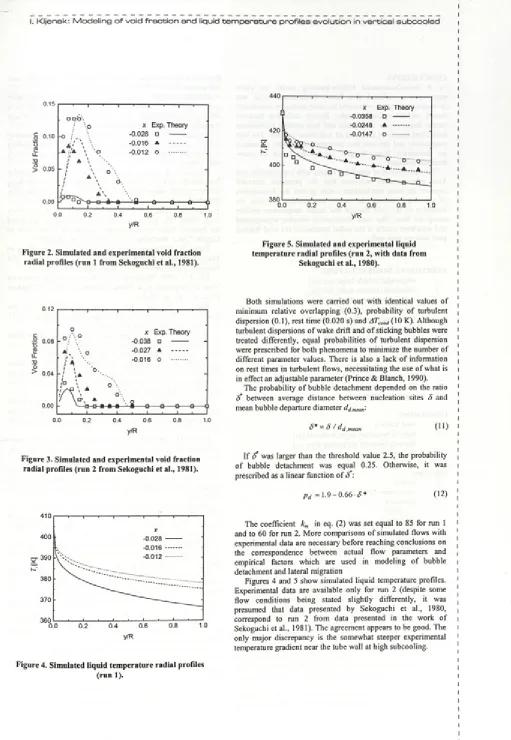
Figures 2 and 3 depict experimental and simulated time- averaged void fraction radial profiles at different axial locations along the flow. The proposed model simulates quite well the gradual increase o f the void fraction peak and the widening of the layer near the wall, in which bubbles are present. The main discrepancy is that the void fraction peak moves too quickly away from the tube wall, especially in run 1 (Fig. 2). As the simulated process is a complex phenomenon, caused by interacting and mutually competing processes o f wake drift, differing bubble velocities due to liquid velocity gradient, bubble lateral motion, bubble collisions and coalescence, turbulent dispersion, bubble nucleation, bubble sliding on tube walls and bubble condensation, the overall agreement between simulations and experiments indicates that the basic mechanisms which govern void fraction profile development in subcooled nucleate boiling have been adequately taken into account.
One o f the most influential parameters in bubbly flow is allegedly bubble size which was not measured and therefore had to be assumed. In run 1, bubble departure diameters were assumed to obey a Gaussian distribution between values 0.4 mm and 2.0 mm, whereas in run 2, the limiting values were 0.4 and 1.0 mm. Both ranges are roughly in accordance with experimental results from Bibeau & Salcudean (1994). Bubbles already present at the initial axial location were supposed to assume the maximum departure size.
Table 1. Experimental conditions of Sekoguchi et al. (1981).
Run D
[mm]
P [atm]
<l"
[kW/rn2] [kg/m2-s]
1 15.78 2 189.6 695
Figure 2. Simulated and experimental void fraction radial profiles (run 1 from Sekoguchi et al., 1981).
y/ R
Figure 3. Simulated and experimental void fraction radial profiles (run 2 from Sekoguchi et al., 1981).
Figure 4. Simulated liquid temperature radial profiles (run 1).
y/ R
Figure S. Simulated and experimental liquid temperature radial profiles (run 2, with data from
Sekoguchi et al., 1980).
Both simulations were carried out with identical values of minimum relative overlapping (0.3), probability of turbulent dispersion (0.1), rest time (0.020 s) and ATcmd( 10 K). Although turbulent dispersions o f wake drift and o f sticking bubbles were treated differently, equal probabilities o f turbulent dispersion were prescribed for both phenomena to minimize the number of different parameter values. There is also a lack o f information on rest times in turbulent flows, necessitating the use o f what is in effect an adjustable parameter (Prince & Blanch, 1990).
The probability o f bubble detachment depended on the ratio <5* between average distance between nucleation sites 8 and mean bubble departure diameter cldme„„\
8 * = 8 / d ll mean ( 1 1 )
If 8 “ was larger than the threshold value 2.5, the probability o f bubble detachment was equal 0.25. Otherwise, it was prescribed as a linear function o f 8’:
p d = 1.9-0.66 <5* (12)
The coefficient km in eq. (2) was set equal to 85 for run 1 and to 60 for run 2. More comparisons o f simulated flows with experimental data are necessary before reaching conclusions on the correspondence between actual flow parameters and empirical factors which are used in modeling o f bubble detachment and lateral migration
CONCLUSIONS
A three-dimensional bubble-tracking model, in which empiricism is included at a "more fundamental" level, was developed to simulate subcooled nucleate boiling in a uniformly heated vertical cylindrical tube. Bubble collective behavior results from motion, interaction and heat transfer mechanisms prescribed mostly at the level o f individual bubbles. The wall temperature and the heat flux consumed for bubble nucleation are determined from "integral" approaches based on cross- sectional averages.
The comparison o f simulated results with experimental data from other authors indicates that the proposed approach captures the basic mechanisms which govern the development o f subcooled boiling: the model successfully simulates the evolution o f the void fraction and liquid temperature profiles along the flow. The main discrepancy between experimental and simulated results is the radial location o f the void fraction peak near the tube wall.
ADDITIONAL NOMENCLATURE a ellipsoidal bubble large axis [m] b ellipsoidal bubble small axis [m] d bubble equivalent diameter [m] h specific enthalpy [J/kg]
heat transfer coefficient [W/m2 K]
j volumetric flux [m/s]
l bubble vertical chord length [m] m° mass flux [kg/m2 s]
P probability [-] r radial coordinate [m]
X thermodynamic equilibrium quality [-] y distance from tube wall [m]
z axial coordinate [m]
Greek Letters a void fraction
8 thermal boundary layer thickness [m] distance between nucleation sites [m] E "pumping" factor
Subscripts b bubble c tube center-line d departure i i-th bubble P "pumping"
O ther Symbols
< > average over tube cross-section
REFERENCES
Bibeau, E.L. & Salcudean, M., 1994, "Subcooled Void Growth Mechanisms and Prediction at Low Pressure and Low Velocity Int.J. Multiphase Flow, Voi. 20, pp. 837-863.
Collier, J.G., 1981, Convective Boiling and Condensation, McGraw-Hill.
Jurič, D. & Tryggvason, G., 1998, "Computation o f Boiling F lo w s,''/« /./ Multiphase Flow, Voi. 24, pp. 387-410.
Kandlikar, S.G., 1998, "Heat Transfer Characteristics in Partial Boiling, Fully Developed Boiling, and Significant Void Flow Regions o f Subcooled Flow Boiling," J. Heat Transfer, Voi. 120, pp. 395-401.
Kljenak, I., 1998, "Prediction o f Void Fraction Profile Evolution in Subcooled and Saturated Nucleate Boiling with a
Lagrangian Simulation o f Bubbly Flow, " Proc. 3rd Int. Conf Multiphase Flow ICMF'98, Lyon, France.
Kljenak, I., 1999, "Modeling o f Interfacial Area Transport and Variation in Subcooled Nucleate Boiling Based on a Bubble-Tracking Model," Proc. 3rd ASME/JSME Joint Fluids Engineering Conference, San Francisco, CA.
Kljenak, I. & Mavko, B., 1997, "Lagrangian Simulation of Bubbly to Slug Flow Transition in Saturated Nucleate Boiling in a Vertical Tube," Proc. 5th Int. Conf. Nucl. Engng. ICONE5, Nice, France.
Kljenak, I. & Mavko, B., 1999, "Simulation o f Subcooled Nucleate Boiling in a Vertical Tube With a Bubble-Tracking Model," Proceedings o f the ASME Heat Transfer Division HTD-Vol. 364-2, pp. 61-68.
Kowe, R., Hunt, J.C.R., Hunt., A., Couet, B. & Bradbury, L.J.S., 1988, "The Effects o f Bubbles on the Volume Fluxes and the Pressure Gradients in Unsteady and Non-Uniform Flow of Liquids," Int.J. Multiphase Flow, Voi. 14, pp. 587-606.
Kurul, N. & Podowski, M.Z., 1991, "On the Modeling of Multidimensional Effects in Boiling Channels," Proc. 27th National Heat Transfer Conf, Minneapolis, USA.
Liu, T.J., 1993, "Bubble Size and Entrance Length Effects on Void development in a Vertical Channel," Int.J. Multiphase F lo w ,Vol. 19, pp. 99-113.
Mao, Z. & Core, K.L., 1993, "Visualization of the Coalescence Process in Dispersed Multi-Phase Systems," ASME FED Vol. 165, Gas-Liquid Flows, pp. 3-11.
Mortensen, G.A. & Trapp, J.A., 1992, "Two-Phase Flow Modeling with Discrete Particles," ASME HTD Eoi.220, Two- Phase Flow in Energy Exchange Systems, pp. 73-85.
Ohnuki, A. & Akimoto, H., 1998, "Prediction o f Phase Distribution Under Bubbly Flow in a Large Vertical Pipe by Multidimensional Two-Fluid Model," Proc. 3rd Int. Conf Multiphase Flow ICMF'98, Lyon, France.
Parzer, I., Petelin, S. & Mavko, B., 1995, "Feed-and-Bleed Procedure Mitigating the Consequences o f a Steam Generator Tube Rupture Accident," Nuclear Engng. Design, Voi. 154, pp. 51-59.
Prince, M.J. & Blanch, H.W., 1990, "Bubble Coalescence and Break-Up in Air-Sparged Bubble Columns," AIChE./., Voi. 36, pp. 1485-1499.
Sekoguchi, K., Tanaka, O., Esaki, S. & Imasaka, T., 1980, "Prediction o f Void Fraction in Subcooled and Low Quality Boiling Regions," Bull. Japan Society Mech. Eng., Voi. 23, pp.
1475-1482.
Sekoguchi, K., Tanaka, O., Esaki, S., Katsuki, N. & Nakasatomi, M., 1981, "Prediction Method o f Flow Patterns in Subcooled and Low Quality Boiling Regions," Bull. Japan Society Mech. Eng., Voi. 24, pp. 834-841.
Sene, K.J., Hunt, J.C.R. & Thomas, N.H., 1994, "The Role o f Coherent Structures in Bubble Transport by Turbulent Shear Flows," J. Fluid Mechanics, Voi. 259, pp. 219-240.
Serizawa, A., Kataoka, I. & Michiyoshi, I., 1975, "Turbulence Structure o f Air-Water Bubbly Flow - II. Local Properties," Int.J. Multiphase Flow, Voi. 2, pp. 235-246.
Stewart, C.W., 1995, "Bubble Interaction in Low-Viscosity Liquids," Int.J.Multiphase Flow, Voi. 21, pp. 1037-1046.
Tiselj, I. & Petelin, S., 1998, "First and Second-Order Accurate Schemes for Two-Fluid Models," J. Fluids Engineering, Voi. 120, pp. 363-368.
Van Helden, W.G.J., Van der Geld, C.W.M. & Boot, P.G., 1995, "Forces on bubbles growing and detaching in flow along a vertical flow," Int.J. Heat Mass Transfer, Voi. 38, pp. 2075- 2088.
Yang, X. & Thomas, N.M., 1994, "Simulation o f Particle and Bubble Dispersion in Turbulent Free Shear Flows," ASME FED Voi. 185, Numerical Methods in Multiphase Flows, pp. 259-268.
Zeitoun, O., Shoukri, M. & Chatoorgoon, V., 1995, "Interfacial Heat Transfer Between Steam Bubbles and Subcooled Water in Vertical Upward Flow," J. Heat Transfer, Vol. 117, pp. 402-407.
Zeitoun, O. & Shoukri, M., 1997, "Axial Void Fraction Profile in Low Pressure Subcooled Flow Boiling," Int.J. Heat Mass Transfer, Voi. 40, pp. 869-879.
Žun, I., Kljenak, I. & Može, S., 1993, "Space-Time Evolution o f the Nonhomogeneous Bubble Distribution in Upward Flow", Int.J. Multiphase Flow, Voi. 19, pp. 151-172.
j -—f ft ‘X ''ii'