Using Genetic Algorithms for Solving the
Comparison-Based Identification Problem of Multifactor
Estimation Model
Andraws Swidan1, Shmatkov Sergey2, Bulavin Dmitry2
1Computer Engineering Department, University of Jordan, Amman, Jordan; 2Computer Science Department, Kharkov National
Uni-versity, Kharkov, Ukraine.
Email: [email protected], [email protected], [email protected]
Received April 23rd, 2013; revised May 25th, 2013; accepted June 2nd, 2013
Copyright © 2013 Andraws Swidan et al. This is an open access article distributed under the Creative Commons Attribution License, which permits unrestricted use, distribution, and reproduction in any medium, provided the original work is properly cited.
ABSTRACT
In this paper, the statement and the methods for solving the comparison-based structure-parametric identification prob- lem of multifactor estimation model are addressed. A new method that combines heuristics methods with genetic algo- rithms is proposed to solve the problem. In order to overcome some disadvantages of using the classical utility functions, the use of nonlinear Kolmogorov-Gabor polynomial, which contains in its composition the first as well as higher char- acteristics degrees and all their possible combinations is proposed in this paper. The use of nonlinear methods for iden- tification of the multifactor estimation model showed that the use of this new technique, using as a utility function the nonlinear Kolmogorov-Gabor polynomial and the use of genetic algorithms to calculate the weights, gives a consider- able saving in time and accuracy performance. This method is also simpler and more evident for the decision maker (DM) than other methods.
Keywords: Genetic Algorithm; Comparatory Identification; Fitness-Function; Chromosome; Crossover; Mutation
1. Introduction
Identification of the object mathematical model is to de- termine its parameters based on experimental investiga- tion of the object. Identification is the most time-con- suming and very important operation in the synthesis model.
The classical problem of identification is to determine the mathematical model y = F(x) of the object which consists of determining the transformation rules of the input x into output y or more precisely the form and pa- rameters of operator F. Such identification is called di- rect because it is based on direct quantitative measure- ment of input and output signals of the object. However, in some cases, there is a need to identify an object, when the researcher has no direct access to information about the output signal. The objects considered in this paper, are assumed to be of this type.
In different situations, estimates given by the person to one or other properties of an object are subjective and cannot be directly measured by any physical devices. In such cases, the classical methods of the direct identifica- tion are not applicable. Alternative methods are indirect
identification. The most convenient and widely used among these methods is the comparison-based identifica- tion [1].
2. Statement of the Problem
Suppose we have a set of alternatives (solutions) X = {xj},
1,
j m, each of which is characterized by a set of indi-vidual criteria (characteristics) ki, i1,n. The values of
individual criteria are clearly defined. Based on the analysis of this information a person shall select the most preferred solution from the set of solutions X, for example l
( )
i j
k x
x , i.e. he sets strict order relation on the set of alternatives X:
1 2 m x х x .
It means that, according to the utility theory [2], which postulates the existence of scalar quantify the preference of any alternative xjX we can write:
l
j ;P x P x j l; j1,m, (1) where P x( )j —individual scalar evaluation of the use-
On the basis of this information it is necessary to syn-thesize the mathematical model of individual choice of the decision maker, i.e, a model of generalized utility formation P x( )i .
Currently, the most widely used two forms of utility functions are: the additive:
1 1 λ n i i iP x k x
(2)and multiplicative:
2 1 λ n i i iP x k x
(3)where λi isomorphism coefficients indicating dimension,
significance, possible values range, partial criteria that lead to the isomorphism type. i
k
The most informative situation is one in which the co- efficients of isomorphism are given numerically. Since λi
is a constant, then (3) can be rewritten as follows:
1 1 λ n n k i i iP x k x
i (4)Analysis of (4) shows that the multiplicative estima-tion does not take into account the “weights” of partial criteria, since the product
i is a constant scalingmultiplication factor and does not affect the relationship of different solutions x X . Therefore, additive utility function is more universal and widely used.
Equation (2) makes sense only if i takes into ac- count the importance of individual criteria and are at the same time isomorphism coefficients. Most often, defin- ing such coefficients is a big problem, so it was decided to represent the additive utility function in the form:
1 n н i i iP x a k x
(5)where i—dimensionless relative weight coefficients
that satisfy the following restrictions:
a
0ai1, , (6)
1 1 n i i a
and is normalized, i.e. transformed to the iso- morphic type partial criteria.
( ) н
i k x
The normalization is performed by the following for- mula:
WB W
i i
н
i
i i
k x k
k x
k k
(7)
where k xi
—value of the private criteria; iB, iW—the best and worst value (accordingly) of the private cri- teria that is among the domain of admissible values.
k k
In such a way the problem of utility function synthesis reduces to the parametric identification of the relative
importance coefficients. Expert evaluation methods or comparison-based identification methods are used for this purpose [3].
An additive utility function disadvantage is that it does not consider the possible nonlinear dependence of the utility function on the individual criteria absolute values
and their mutual influence.
i k
Great theoretical and practical interest is the solution of the general structure-parametric identification problem of the individual evaluation model under less restrictive assumptions about the structure of the model.
For this purpose the Kolmogorov-Gabor polynomial is suggested as a possible structure class.
0 1
1 1 1
*
n
н
i i i
m n n
н н
r i g
r n j g
P x a a k x
a k x k x
1, ; 1, , 1,
i n g n r n m, (8) and genetic algorithms as a method for solving the gen- eral structure-parametric identification problem.
This approach allows us to describe any nonlinear de- pendence and does not impose any apriority restrictions on the additive or multiplicative utility functions, since polynomial (8) contains in its composition the first as well as higher degrees of characteristics and all their possible combinations. i
k x
3. Optimal Complexity Model Definition
The aim of the solution the comparatory structure-para- metric identification problem is to synthesize an optimal complexity model, which provides the minimum error of approximation criteria of experimental data output mo- del.minimum, and then begins to decline due to the inclusion of “harmful” random components. Model, which gives a minimum test sequence approximation error, was named as the optimal complexity model [3].
This raises the problem of choosing criteria of accu- racy evaluation of the mathematical model. In the case of the classical identification the most commonly used cri- teria is the least squares, for the implementation of which numerical input and output experimental data is neces- sary. In the case of identification of multifactor estima- tion model, as noted above, quantitative information about the output effects is not available. In this regard, a number of specific problems, considered below, came to the surface.
4. Solving the Comparatory Identification
Problem by the Genetic Algorithms
Method
In the above formulation, the comparatory structure-para- metric identification problem can be solved by different methods and algorithms. But common to all of them is the need to implement a sequence of procedures:
generation of the model structure;
defining the quantitative values of its parameters; assessing the quality of the model.
Various combinations of algorithms, of different pre- cision, complexity, versatility, for the first and second stages are possible. To obtain perfectness and versatility evaluation criteria in the field of the methods application there is a need for their investigation. With the help of computer experiments genetic programming algorithms were synthesized and investigated.
Genetic Algorithms (GAs) are based on the mecha- nisms of natural selection and implement a scheme of “survival of the fittest” among the considered structures, shaping and changing the search algorithm based on modeling the evolution of search. In each generation a new set of artificial sequences is created using part of the old set and the addition of new parts with “good proper- ties” [5-9].
GA starts with a random set of solutions called popu- lation. Each element of the population is called a chro- mosome and represents a solution to the problem. The chromosomes evolve over multiple iterations, bearing the name of generations. In the process of iteration chromo- some is estimated using the fitness-function [6,7,10].
In solving the problem of structure-parametric identi- fication on the first step a population of chromosomes, describing the structure of the model is created. This is done by selecting a class of admissible structures. Kol- mogorov-Gabor polynomial, taking out the free term and limiting it to only linear and quadratic terms (squares and pair wise combinations of variables), was chosen as this
class. Then the polynomial will be written as follows:
2
2
1 1 1
П n *
C
n n
i i j i l i r
i j l
a k x a k x a k x k x
1, ; 1, , .
l n r n lr (9) It means that for n partial criteria the complete poly- nomial will have
2
2 n
N n C (10) terms, where is the number of combinations and is equal to:
2 n C
2 !
2!( 2)! 2( 2)!
n
n n
C
n n
!
1
(11)
Consequently, each chromosome of the population must contain N bits.
The validity of imposing such limitations on the com- plexity of the polynomial is based on the fact that after the normalization by formula (7) all partial characteris- tics have values 0 н
i k
. Squaring these numbers or the multiplication of any two of them lead to a rapid de- crease in the values. In addition, each term of the poly- nomial is multiplied by a coefficient ai1
(because ).
1
1
N
i i
a
Based on the fact that the calculation of utility function
P X and weights i with accuracy higher than two
decimals is impractical, it can be concluded that it is im- practical as well to include terms higher than the second order.
a
After the generation of the chromosomes population, which describes the model structure, in the second stage, for each of them, a parametric identification is provided by one of the following possible methods:
Method of determining the Chebyshev point on the polyhedron described by the system of inequalities
l
jP X P X , j l [5]; The genetic algorithms method.
The first of these methods is described in [2,5] and will not be considered. The implementation of the ge- netic algorithm is as follows. For each chromosome of the population, which characterizes a model structure, we determine the number M of coefficients i equal to
the number of units in the chromosome. By definition, the coefficients must satisfy the following conditions:
a
0ai1, (12)
1
1
M
i i
a
and is expressed to two decimal places. Hence the num- ber of bits that must contain the chromosome of each coefficient is equal to [8,10]:
1 2
2mj *10 mj
j j
b a
2 1
where [ai, bi]—interval range of i, pointed in (12), and
resultant chromosome of all the coefficients ai, a
1,
i M
is
*
B L M (14). For each chromosome of the structure population we form population of chromosomes coefficients ai and
solve the problem of the genetic selection of these coef- ficients values that maximize the match function. As a match function the number of satisfied inequalities of (9) can be taken. If necessary it can be divided into training and testing sets.
On the established populations an iterative procedure of genetic selection on the first and second populations to achieve the best value of the match function is imple- mented.
Example: Let us assume a situation where a decision maker has to choose the best option among five alterna- tives of computer systems with four partial criteria: processor frequency, memory size, hard disk capacity and price.
The decision maker represents the situation by con- structing Table 1.
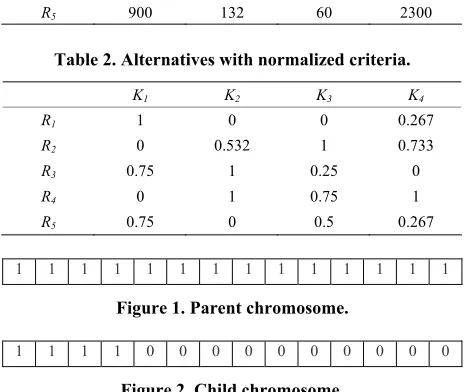
After that the maximum and minimum values of each criterion are defined and the quantitative normalized par- tial criteria are calculated by formula 7.
[image:4.595.307.539.101.177.2]As a result of the above mentioned operations we get Table 2 which represents the set of the alternatives with their normalized partial criteria.
Next, the DM selects the best, in his opinion, alterna- tive. Let us assume that the DM chooses the fourth alter- native. Next step is to calculate the additive utility func- tion. First the weight coefficients are calculated and then inserted in the linear Kolmogorov-Gabor polynomial. Thus the additive utility function is expressed as:
2
0.61 0.39
адд
P k k4
5
(15) We start the procedure of genetic algorithms.
Let there be two chromosomes: a parent that contains the complete Kolmogorov-Gabor polynomial (Figure 1), and a child that contains only the components of the first term (Figure 2).
Child chromosome will be for us the resultant, which is the shortest polynomial satisfying the condition
4 1,?4 2 4 3 4
R R R R R R R R (16) This condition (16) will be the criterion on which we will carry out the selection.
Next, using the above mentioned method of genetic algorithms to solve the comparison-based structural-para- metric identification we get variant of a child chromo- some that meets criterion (16).
The next step is to choose an optimal length utility function represented as the Kolmogorov-Gabor polyno- mial. That is, the shortest polynomial that satisfies (16)
Table 1. The set of alternatives with their partialcriteria.
K1 K2 K3 K4
R1 1000 1000 40 2300
R2 600 198 80 1600
R3 900 256 50 2700
R4 600 256 70 1200
[image:4.595.307.540.162.358.2]R5 900 132 60 2300
Table 2. Alternatives with normalized criteria.
K1 K2 K3 K4
R1 1 0 0 0.267
R2 0 0.532 1 0.733
R3 0.75 1 0.25 0
R4 0 1 0.75 1
R5 0.75 0 0.5 0.267
1 1 1 1 1 1 1 1 1 1 1 1 1 1
Figure 1. Parent chromosome.
1 1 1 1 0 0 0 0 0 0 0 0 0 0
Figure 2. Child chromosome.
and at the same time has the maximum utility function. To do this, we introduce one more condition:
gen add
P P
, max (17).
Thus, after finding the optimal length Kolmogorov- Gabor polynomial satisfying (16), we check that poly- nomial. For the chosen alternative substituting partial criteria we obtain the following lengths:
2
gen 0.429 2 0.571 4
P k k2 (18).
Hence the utility functions of the different alternatives are: R4 = 1; R3 = 0.429; R2 = 0.4277; R5 = 0.04; R1 =
0.04.
The utility function of alternative R4 is maximum, and
other alternatives are worse and thus the problem is cor-rectly solved.
5. Conclusion
The use of nonlinear methods for the identification of the multifactor estimation model showed that the use of a new technique, using as a utility function the nonlinear Kolmogorov-Gabor polynomial and the use of the ge- netic algorithms to calculate the weights gives a consid- erable saving in time and accuracy performance. It is as well simpler and more evident for the decision maker than other methods.
REFERENCES
tification of Linear Multifactor Estimation Models Para- meters,” Radioelektronika i Informatika, Vol. 2, No. 3, 1998, pp. 41-43.
[2] A. O. Ovezgeldyev, E. G. Petrov and K. E. Petrov, “Syn- thesis and Identification of Multifactor Estimation and Optimization Models,” Naukova Dumka,Kiev, 2002, 161 p.
[3] G. K. Voronovsky, К. V. Machotilo, S. N. Petroshev and S. А. Sergeev, “Genetic Algorithms, Artificial Neural Networks and Virtual Reality Problems,” Osnova, Khar- kov, 1997, 112 p.
[4] V. М. Kureychik, “Genetic Algorithms. State. Problems,”
Teoriya i Systemy Upravleniya, No. 1, 1999, pp. 144-160. [5] E. G. Petrov and Д. А. Булавин, “Application of Cheby-
shev’s Dot and Genetic Algoritms’ Methods for Deter- mination the Structure of Multifactor Estimation Model,” Problemy Bioniki, No. 58, 2003, pp. 36-44.
[6] E. G. Petrov and Д. А. Булавин, “Application of Genetic Algoritms’ Method for Solving the Multifactor Estima- tion Model Comparatory Identification Problem,” Radio-
elektronika i Informatika, No. 1, 2003, pp. 89-93.
[7] J. Zhang, H. Chung and W. L. Lo, “Clustering-Based Adaptive Crossover and Mutation Probabilities for Gene- tic Algorithms,” IEEE Transactions on Evolutionary Com- putation, Vol. 11, No. 3, 2007, pp. 326-335.
doi10.1109/TEVC.2006.880727
[8] L. M. Schmitt, “Theory of Genetic Algorithms II: Models for Genetic Operators over the String-Tensor Representa- tion of Populations and Convergence to Global Optima for Arbitrary Fitness Function under Scaling,” Theoreti- cal Computer Science, Vol. 310, No. 1, 2004, pp. 181- 231. doi10.1016/S0304-3975(03)00393-1
[9] D. Goldberg, “Genetic Algorithms in Search, Optimiza- tion and Machine Learning,” Addison-Wesley Profes- sional, Reading, 1989.