Handoff Latency Minimization by using Access Point by
GPS using Selective scanning
Debabrata sarddar
(Asst. Proff.) Department of C.S.E.University of Kalyani
Dipsikha Ganguly
Department of E.T.C.E. B.P.Poddar I.M.T.,WBUTSoumya Das
Department of E.T.C.E Bengal Institute of tec.WBUTSuman Kumar Sikdar Sougata Chakraborty
Kunal Hui
M. Tech in C.S.E M.Tech in C.S.E. M. Tech in C.S.EJadavpur University
Shabnam Bandyopadhyay Kalyan Kumar Das Sujoy Palit
Department of C.S.E Department of C.S.E Department of C.S.EJadavpur University Jadavpur University W.B.U.T
ABSTRACT
Due to rapid growth in IEEE 802.11 based Wireless Local Area Networks (WLAN), handoff has become a burning issue. A mobile node (MN) requires handoff when it travels out of the coverage area of its current access point (AP) and tries to associate with another AP. But handoff delays provide a serious barrier for such services to be made available to mobile platforms. Different works have been done to reduce the handoff delay.In this paper, we have also a proposed a method to reduce handoff latency for IEEE 802.11 wireless networks with map based on GPS. IEEE 802.11 uses 11 possible channels of 14 of which only the channels 1, 6 and 11 do not mutually overlap. Using these channels and 8 others by selective scanning here we have reduced the handoff off delay and later the authentication as well as re-association delay.
Keywords
Next Generation Wireless Systems (NGWS), Handoff, BS (Base Station), MN (Mobile Node), RSS (Received signal strength), IEEE802.11, CI ratio.
1.
INTRODUCTION
Handoff or handover is an essential criterion in mobile communication system especially in urban areas, owing to the limited coverage area of Access Points (AP). Whenever a Mobile station moves from a current AP to a new AP it requires handoff. For successful implementation of seamless Voice over IP communications, the handoff latency should not exceed 50ms.
But measurements indicate MAC layer handoff latencies in the range of 400ms which is completely unacceptable and thus must be reduced for wireless networking to fulfill its potential.
With the advent of real time applications, the latency and packet loss caused by mobility became an important issue in Mobile Networks. The most relevant topic of discussion is to reduce the IEEE 802.11 link-layer handoff latency. IEEE 802.11 MAC specification [1] defines two operation modes: ad hoc and infrastructure mode. In the ad hoc mode, two or more stations (STAs) recognize each other through beacons
and hence establish a peer-to-peer relationship. In infrastructure mode, an AP provides network connectivity to its associated STAs to form a Basic Service Set (BSS). Multiple APs form an Extended Service Set (ESS) that constructs the same wireless networks.
Figure 1
Channel distribution
Figure.2
It should be noted that due to overlapping of frequencies there can be significant interference between adjacent APs. Thus, in a well configured network, most of the APs will operate on the non-overlapping channels numbered 1, 6 and 11.
Handoff
When a MS moves out of reach of its current AP, it must be reconnected to a new AP to continue its operation. The search for a new AP and subsequent registration without any loss known as handover and the time needed to complete a handover process is known as handoff latency.
Three strategies have been proposed to detect the need for hand off [2]
1)Mobile-controlled-handoff (MCHO):The mobile station(MS) continuously monitors the signals of the surrounding base stations(BS)and initiates the hand off process when some handoff criteria are met.
2) Network-controlled-handoff (NCHO): The surrounding BSs measure the signal from the MS and the network initiates the handoff process when some handoff criteria are met.
3) Mobile-assisted-handoff (MAHO): The network asks the MS to measure the signal from the surrounding Base Stations. The network makes the handoff decision based on reports from the MS.
Now Handoff is of two types:
Hard & soft handoff: Originally hard handoff was used where a station must break connection with the old AP before joining the new AP thus resulting in large handoff delays. However, in soft handoff the old connection is maintained until a new one is established thus significantly reducing packet loss as shown in figure [3]:
Figure 3
In NGWS (next generation wireless system), two types of
handoff scenarios arise: horizontal handoff, vertical handoff [3] [4].
Horizontal Handoff: When the handover occurs between two BSs of the same system it is termed as horizontal handoff. It can be further classified into two:
Link layer handoff: Horizontal handoff between two BSs that are under the same foreign agent (FA).
[image:2.595.314.541.101.548.2] Intra system handoff: Horizontal handoff between two BSs that belong to two different FAs and both FAs belong to the same gateway foreign agent (GFA) and hence to the same system. Vertical Handoff: When the handoff occurs between two BSs that belong to two different GFAs and hence to two different systems it is termed as vertical handoff as shown in figure 3.
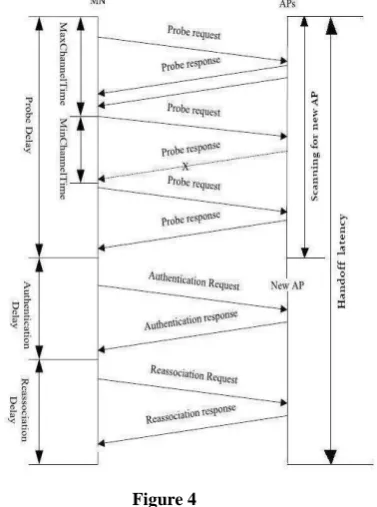
The handoff procedure is done in three logical phases where all communication between the mobile station undergoing handoff and the APs concerned is controlled by the use of IEEE802.11 management frames as shown below in [fig4].
Figure 4
Scanning: When a mobile station is moving away from its current AP, it initiates the handoff process when the received signal strength and the signal-to-noise-ratio have decreased significantly. The STA now begins MAC layer scanning to find new APs. It can either opt for a passive scan (where it listens for beacon frames periodically sent out by APs) or chose a faster active scanning mechanism wherein it regularly sends out probe request frames and waits for responses for TMIN (min Channel Time) and continues scanning until TMAX
(max Channel Time) if at least one response has been heard within TMIN.
Thus, n*TMIN ≤ time to scan n channels ≤ n*TMAX. The
information gathered is then processed so that the STA can decide which AP to join next. The total time required until this point constitutes 90% of the handoff delay.
[image:2.595.346.535.304.558.2] [image:2.595.60.292.597.744.2]Authentication: Authentication is necessary to associate the link with the new AP. Authentication must either immediately proceed to association or must immediately follow a channel scan cycle. In pre-authentication schemes, the MS authenticates with the new AP immediately after the scan cycle finishes. IEEE 802.11 defines two subtypes of authentication service: „Open System‟ which is a null authentication algorithm and „Shared Key‟ which is a four-way authentication mechanism. If Inter Access Point Protocol (IAPP) is used, only null authentication frames need to be exchanged in the re-authentication phase. Exchanging null authentication frames takes about 1-2 ms.
Re-Association: Re-association is a process for transferring associations from old AP to new one. Once the STA has been authenticated with the new AP, re-association can be started. Previous works has shown re-association delay to be around 1-2 ms. The range of scanning delay is given by:-
N × Tmin _ Tscan _ N × Tmax
Where N is the total number of channels according to the spectrum released by a country, Tmin is Min Channel Time, Tscan is the total measured scanning delay, and Tmax is Max Channel Time. Here we focus on reducing the scanning delay by minimizing the total number of scans performed.
Handoff in NGWS
Fig.5 shows a typical handoff scenario in NGWS. The integrated architecture in Fig.1 consists of two different wireless systems, System A and System B, they are integrated through Internet backbone [1].In practical scenario the integrated architecture may consists of many different wireless systems. In NGWS there are two types of handoff: horizontal handoff and vertical handoff [3], [4].
Horizontal handoff: Handoff between two BSs within a same system. Horizontal handoff is of two types.
1) Link-layer handoff: Horizontal handoff between two BSs, under same foreign agent (FA), e.g. the handoff of a MT from BS10 to BS11 in Fig. 5.
2) Intra-system handoff: Horizontal handoff between two BSs that belong to two different FAs and both FAs belongs to the same system and hence to same gateway foreign agent (GFA), e.g. handoff of MT from BS11 to BS12 in Fig. 5.
Vertical handoff (Inter-System Handoff): Handoff between two BSs, belong to two different systems and two different GFAS, e.g. the handoff of the MT from BS12 to BS20 in Fig. 5.
Figure 5
Seamless handoff management is still an open research issue because of the following heterogeneities :
1) Next Generation Wireless Systems integrate Bluetooth, GPRS, IEEE 802.11 based WLANs, WiMAX, UMTS. All these systems have different cell sizes of radii ranging from few meters to few kilometers and may have overlapping or partially overlapping coverage areas.
2) Different network architectures have different transport, routing and mobility management protocols.
3) They are optimized for specific service demands like Bluetooth provides very small coberage area for personal use, IEEE 802.11 based WLANs for local area internet connectivity, limited obility, VoIP calls, UMTS provides full mobility, Teleservices, SMS, MMS, Packet data, E-mail, VoIP, Internet, WiMAX provides very limited mobility, P2P, Point-to-Multipint, Interent connection, VoIP etc.
In this paper, we present a handoff mechanism to support vertical handoff in NGWS by considering the speed of the mobile node, Relative singnal strength (RSS), signalling dealy information and threshold distance from the cell boundary. Our proposal helps to take the right decision when to initiate the handoff registration or HMIP registration. False handoff initiation can lead to handoff failure and even call termination. We have organized the rest part of this paper as follows. Sec 2 describes the related works, Sec 3 describes our proposed approach. The simulation results are given in Sec 4 and finally concluding remarks are presented in Sec5.
2. RELATED WORK
A number of different schemes have been proposed to reduce handoff latency in IEEE 802.11 wireless LANs. IEEE 802.11b based wireless and mobile networks [5], also called Wi-Fi commercially, are experiencing a very fast growth upsurge and are being widely deployed for providing variety of services as it is cheap, and allows anytime, anywhere access to network data.
The new age applications require a seamless handover while the small coverage of individual APs has increased the number of handoffs taking place. Thus reducing the handoff latency has become a burning issue and much work has been done to achieve this. See [6] for an overall review of popular methods suggested.
Shin et al in [7] have introduced a selective scanning algorithm with the help of channel masking technique coupled with a caching mechanism to significantly reduce the handoff delay. However, it still scans excess APs even after the new AP may have already been found and thus leaves room for further improvements.
Handoff, an inherent problem with wireless networks, particularly real time applications, has not been well addressed in IEEE 802.11, which takes a hard handoff approach [8].
In [9] a pre-authentication mechanism is introduced to facilitate seamless handover. [10] is a novel approach towards reducing handover latency in AP dense networks.
In [11] the authors have introduced a novel caching process using neighbour graphs by pre-scanning neighbour APs to collect their respective channel information. The concept of neighbour graphs can be utilized in different ways and have become very popular in this field.
In [12] a cross layer handoff management protocol scheme has been proposed. They tried to enhance the handoff performance by analyzing the speed of the mobile node, handoff signaling delay, relative signal strength of old and new base station and their relation with handoff failure probability.
A novel mobility management system is proposed in [13] for vertical handoff between WWAN and WLAN. The system integrates a connection manager (CM) that intelligently detects the changes in wireless network and a virtual connectivity manager (VCM) mantains connectivity using end-to-end priciple.
Authors of [14] propose solutions towards enabling and supporting all types of mobility in heterogeneous networks. The proposed approach does not support real time applications by the network mobility functionality. This keeps the application unaware of network mobility and works as a back up for real time applications.
Handoff using received signal strength (RSS) of BS has been proposed also to reduce handoff latency in NGWS.
In [15], the authors proposed a handoff algorithm in which the received pilot signal strength is typically averaged to diminish the undesirable effect of the fast fading component. Unfortunately, the averaging process can substantially alter the characteristics of path loss and shadowing components, causing increased handoff delay.
In [16], a handoff algorithm using multi-level thresholds is proposed. The performance results obtained, shows that an 8-level threshold algorithm operates better than a single threshold algorithm in terms of forced termination and call blocking probabilities.
In [17] signal to interference ratio between old base-station and neighboring base-stations are calculated to make the handoff initiation decision for next generation wireless system or 4G networks.
In [18], a handoff algorithm using multi-level thresholds is proposed. The performance results obtained, shows that an 8-level threshold algorithm operates better than a single threshold algorithm in terms of forced termination and call blocking probabilities.
In [19] selective scanning and pre-authentication is used to reduce the handoff latency.
3. PROPOSED WORK
In our proposed work we have modified the process of selective scanning described in [19].We have described the process of choosing the channels according to its probability of the response of AP and then the pre-authentication is done and the re-association after two successive authentication and sorting those.
The maximum range up to which the signal can be transmitted is determined by the height of the antenna and the power of the signal is inversely proportional to the square of the distance from the AP. Coverage area of each AP to be concentrated within a hexagon of certain edge length which is best approximation for uneven distribution. Same channel can be reused in a cell by another cell as long as they are far apart and doesn‟t interfere. And for scanning minimum co channel interference is minimum considered. IEEE uses only 11 channels out of 14 channels. 1, 6, 11 are expected to have greater CI ratio than the others. Here we have also considered to scan the non-overlapping channels first and then the overlapping ones but selectively. Next generation wireless systems follow Frequency Division Multiple Access (FDMA) or Time Division Multiple Access (TDMA) for multiple access of a single channel frequency band. In TDMA, here a single channel is used by several users, with AP assigning time slots for different users, and each user is served in a round-robin method. In FDMA, the allocated frequency band for one channel is subdivided into many sub-bands and each sub-band is allocated by the AP to each user. Thus, in FDMA, it may be seen that a particular sub-band is allocated to a user which falls between the interference zones of channels within the same AP. Thus, protocols using FDMA techniques have a certain probability that during handoff, even when the channel is free, the user is allocated such a sub-band within the above mentioned region. Thus, it will encounter a very low CI ratio and for that selective channel technique have been proposed. Here we have also taken some assumption or process
1. Selective channel scanning
2. Pre authentication during scanning and also the 3. The re-association takes place during the
authentication.
A. Selective channel scanning
presently operating, but also the channels used by the those APs.
But here we have taken that in selective scanning first the non overlapping channels will be scanned. I.e. first 1, 6 and 11 will be scanned. Then from the rest 11 channels only 8 are selected by taking the probability of APs would respond to the probe request and the highest 8 channels will be selected for scanning. Thus the scanning time will be reduced to a huge amount. So here we select the potential APs to which the call may be handed off and scan only the channels associated with those APs. The most potential AP is the one with minimum distance between it and the MN when handoff criterions are met. Selective channel probing brilliantly reduces the handoff delay by a massive percentage when compared with selective scanning or basic active scanning. The expected scanning delay using selective scanning is
t = N‟× τ + α,
where„t‟ is the scanning delay, N‟ is the number of channels scanned, „τ‟ is the round trip time and α is the message processing time. „τ‟ is the summation of the time taken for the Probe Request to be sent to the selected AP‟s and for the Probe Response to be received, which, in our case, is nothing but the Min Channel Time, which has been estimated to be around 3-7 ms.
B. Pre authentication
To reduce the message processing delay, authentication is done during scanning phase. By this method, the authentication delay vanishes and the message processing delay, α, is composed only of the re-association time. Thus the parameter „α‟ is reduced by at least half of its initial value and hence the net time delay,„t‟, as proposed in [3], is greatly reduced. This can be implemented as proposed in [8] and [9].
C. Here re-association takes place during the authentication. The connection will be established one by one when the authentication of one is done without completing the whole process. For this the delay will be less. So, first after authentication of two will be sorted accordingly and then the connection will be established. For that the delay for the re-association will also get reduced.
Thus, the authentication time, and re association delay which was very minute in proportion as compared to scanning phase delay of previous methods, would now command a greater percent of time delay, because, in our case, the scanning phase delay has been much reduced. However, by the process of pre-authentication, even this delay is nullified. So our method reduces the net handoff latency by a great extent as compared to the previous proposed methods. The experimental results are given in the forthcoming section. It gives a brief overview of the simulation process and the results obtained conform to our theory.We have used GPS for power saving with minimum power loss.
4. SIMULATION RESULTS
For the simulation part, we have used a 2D-plane with APs on centre of hexagons packed together. The heights of each antenna were considered to be the same and the topology distribution was also considered to be similar. Hexagons have been for specifying the range of the APs as hexagons can fit side by side like honey combs and is mainly used by all research workers for this category of simulations. The
frequency was allocated as per the protocols that are generally followed in frequency allocation in IEEE 802.11 standards. Calls originate on a memory less basis, that is, they follow Poisson distribution function and use the channel within the AP on whose range the call is created. The channel allocated to it is determined by the AP. The channel allocation is considered to be static and FDMA was used for multiple accesses. The CI ratio was calculated for each channel within each AP which is an important parameter for our method. Moreover, separate CI ratios were calculated for all the sub bands when a single channel was used by multiple users. The sub bands‟ CI ratio takes into account the CI ratio of the channel on which the multiple access is carried on. Now, we considered various instances of time where there is a case where a randomly generated MN has a need for handoff. The different parameters, like the number of existing MNs in the two APs, the CI ratios, the co-ordinates of the APs and MN etc. at that instance of time were taken into consideration. Then we applied our method, that is, the MN first looks for the potential AP and then first scans the channels 1, 6 and 11 if present. If this fails, it will start scanning the other channels. We also neglect the authentication delay as pre-authentication was done during the scan phase. We considered the round trip time to be 3 ms and the message processing time which comprises of only the re-association time was neglected to carry out our calculations.
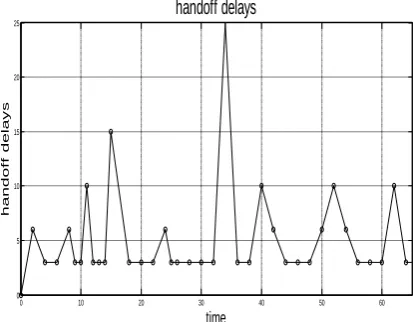
We made a sample run of our simulation and calculated the time required for handoff at regular intervals of
time. We calculated 100 such instances and calculated the total time required for the handoff to take place. From a particular sample run we got the average time delay for all 100 instances as 6.1129 ms. The graph of this simulation is plotted in Figure 4, which shows the various handoff delay times in the „Y‟ axis in milliseconds, for each instance, which is shown in the „X‟ axis. The variation of results obtained from other simulation was negligible. So we can consider that our method reduces the net handoff delay to a minimum of around 6 ms in the best case which is much lower than the previous results.
0 10 20 30 40 50 60
0 5 10 15 20 25
time
han
dof
f
dela
y
s
[image:5.595.338.545.498.659.2]handoff delays
Figure 4. Graph showing the handoff delays at
5. CONCLUSION
In this paper, we have discussed the selective scanning which reduces the scanning time delay and then pre-authentication reduces the authentication delay and establishing connection after two successive authentications also reduces the handoff delay. We have used pre-authentication in which the STA authenticates the new AP just after the scanning phase, thus abolishing the authentication delay.
Our discussion is based on IEEE 802.11b standard, even though the proposed set-up is also valid for IEEE 802.11g with minor adjustments.
Although the proposed work has been presented considering honeycomb structures yet our algorithm would work in a similar manner for other cell structures and neighbor AP locations. Minor changes would be introduced depending on the network topology. Here we have used GPS instead of neighbourgraph just not to having the power loss.
6. REFERENCES
[1] Hye-Soo Kim, Sang Hee Park, Chun-Su Park, Jae Won Kim and Sung-Jea Ko. “Selective Channel Scanning for Fast Handoff in Wireless LAN using Neighbor Graph”, July 2004.
[2] Hongqiang Zhai, Xiang Chen, and Yuguang Fang. “How well can the IEEE 802.11 wireless lan support quality of service?” IEEE Transactions on Wireless Communications, 4(6):3084-3094, December 2005. [3] Yi-Bing Lin Imrich Chalmatc, “Wireless and Mobile
Network Architectures,” pp. 17.
[4] AKYILDIZ, I. F., XIE, J., and MOHANTY, S., "A survey on mobility management in next generation all-IP based wireless systems," IEEE Wireless Communications, vol. 11, no. 4, pp. 16-28, 2004. [5] STEMM, M. and KATZ, R. H., "Vertical handoffs in
wireless overlay networks," ACM/Springer Journal of Mobile Networks and Applications(MONET), vol. 3, no. 4, pp. 335-350, 1998.
[6] Jaeyoung Choi Student Member, IEEE, Taekyoung Kwon & Yanghee Choi, Senior Member IEEE, Sangheon Pack Member, , IEEE,Fast Handoff Support in IEEE 802.11 Wireless Networks.
[7] Arunesh Mishra, Minho Shin & William Arbaugh, An Empirical Analysis of the IEEE 802.11 MAC Layer Handoff Process. [Anshuman Singh Rawat & Henning Schulzrinne Reducing MAC Layer Handoff Latency in IEEE 802.11 Wireless LANs.
[8] Sangho Shin, Andrea G. Forte, Context Caching using Neighbor Graphs for Fast Handoffs in a Wireless Network. Chien-Chao Tseng, K-H Chi, M-D Hsieh & H-H Chang,
[9] Location-based Fast Handoff for 802.11 Networks. IEEE COMMUNICATIONS LETTERS, VOL9, NO 4 April 2005.
[10]S. Park and Y. Choi Pre-authenticated fast handoff in a public wireless LAN based on IEEE802.1x mode IFIP TC6 Personal Wireless Communications. Singapore, October 2002.
[11]Jin Teng, Changqing Xu, Weijia Jia, Dong Xuan, D-scan: Enabling Fast and Smooth Handoffs in AP-dense802.11 Wireless Networks.
[12]S.Mohanty and I.F. Akyildiz,‟A Cross-Layer(Layer 2+3) Handoff Management Protocol for Next-Generation Wireless Systems‟,IEEE Transactions On Mobile Computing,Vol-5,No-10 OCT 2006.
[13]Q. Zhang, C. Guo, Z. Guo and W. Zhu, Wireless and Networking Group, Microsoft Research Asia,” Efficient Mobility Management for Vertical Handoff between WWAN and WLAN‟‟ IEEE,communications Magazine,2003.
[14]I.F. Akyildiz, J. Xie, and S. Mohanty, “A Survey on Mobility Management in Next Generation All-IP Based Wireless Systems,” IEEE Wireless Comm., vol. 11, no. 4, pp. 16-28, Aug. 2004.
[15]I.F. Akyildiz, S. Mohanty, and J. Xie, “A Ubiquitous Mobile Communication Architecture for Next Generation Heterogeneous Wireless Systems,” IEEE Radio Comm. Magazine, vol. 43, no. 6, pp. S29-S36, June 2005.
[16]Brannstorm, R. Kodikara, E.R. Ahlund, C. Zaslavsky, A Mobility Management for multiple diverse applications in heterogeneous wireless networks, Consumer Communications and Networking Conference, 2006. CCNC 2006. 3rd IEEE.
[17]K. Ayyappan and P. Dananjayan, RSS Measurement for Vertical Hnadoff in Heterogeneous Network, Journal of Theoritical and Applied Information Technology, pp.989-984, 2008.
[18]Leu, A. E, Mark, B. L., "Local Averaging for Fast Handoffs in Cellular Networks" IEEE Transactions On Wireless Communications, Vol. 6, No.3, March 2007, pp. 866 - 874.
[19]Minimization of Handoff Latency Using AP with GPS based method. Debabrata sardar,subhojeet chatterjee,utpal biswas,M.k.Naskar.
[20]Y. Kim, K. Lee and Y. Chin, “Analysis of Multi-level Threshold Handoff Algorithm”, Global Telecommunications Conference (GLOBECOM’96), vol. 2, 1996, pp. 1141-1145.
[21] S. BEN OUBIRA, M. FRIKHA, S. TABBANE,”Handoff Management In 4G Networks”, IWCMC ‟09, June 21-24, 2009, Leipzig, Germany.ACM 978-1-60558-569-7/09/06.
[22]Y. Kim, K. Lee and Y. Chin, “Analysis of Multi-level Threshold Handoff Algorithm”, Global Telecommunications Conference (GLOBECOM’96), vol. 2, 1996, pp. 1141-1145.
[23] D. P. Agarwal and Q. A. Zeng,‟ Introduction to Mobile and Wireless Systems‟, chapter 3
7. AUTHORS PROFILE
Debabrata Sarddar (Asst. Professor in Kalyani University) is currently pursuing his PhD at Jadavpur University. He completed his M.Tech in Computer Science & Engineering from DAVV, Indore in 2006, and his B.Tech in Computer Science & Engineering from Regional Engineering College, Durgapur in 2001. His research interest includes wireless and mobile communication. Email: [email protected] Dipsikha Ganguly, currently pursuing B.Tech in Electronics & Communication engineering at B.P.Poddar Institute of Management & Technology under West Bengal University of Technology. Her research interest includes wireless communication & satellite communication. Email: [email protected]
communication engg. at Bengal Institute of Technology under West Bengal University of Technology. His research interest includes mobile communication & satellite communication Suman Kumar Sikdar completed his B.Tech in CSE from Murshidabad College of Engineering & Technology and M.Tech in Computer Science & Engineering from Jadavpur University in 2011. His research interest includes wireless sensor networks and wireless communication systems. Email: [email protected]
Sougata Chakraborty is presently an employee of IBM (Kolkata). He has completed his B.Tech in IT from Murshidabad College of Engineering and Technology and M.Tech in Computer Science & Engineering from Jadavpur University in 2011. His research interest includes wireless sensor networks and wireless communication systems. Email: [email protected]
Kunal Hui is presently an employee of Cognizant (Kolkata). He has completed his B.Tech in Computer Science & Engineering from Murshidabad College of Engineering and Technology (2004-2008) and M.Tech in Computer Science & Engineering from Haldia Institute of Technology (2009-2011). His research interest includes wireless sensor
networks and wireless communication systems. Email: [email protected]
Shabnam Bandyopadhyay is presently an employee of Cognizant (Kolkata). She has completed her B.Tech in Electronics and Communication Engineering from Meghnad Saha Institute of Technology and pursuing M.Tech degree in Computer Science & Engineering at Jadavpur University Her research interest includes wireless sensor networks and wireless communication systems. Email: [email protected]
Kalyan Kumar Das completed his BE degree in Computer Science and Engineering from REC (NIT), Durgapur in 2002 and M.Tech. in Computer Technology from Jadavpur University in 2011. His research interest includes wireless sensor networks and wireless communication systems. Email: [email protected]