Improving Distributed Intelligence in
Complex Innovation Systems
Kuhlmann, Stefan and Boekholt, Patries and Georghiou,
Luke and Guy, Ken and Heraud, Jean-Alain and Laredo,
Philippe and Lemola, Tarmo and Loveridge, Denis and
Luukkonen, Terttu and Moniz, António and Polt, Wolfgang
and Rip, Arie and Sanz-Menendez, Luis and Smits, Ruud
ISI, Fraunhofer Geselschaft, UNL-FCT, BETA, CSIC-IESA, Madrid,
Universiteit Twente, PREST, ARCS, TNO-STB, École des Mines de
Paris-CSI
June 1999
in Complex Innovation Systems
Final report of the Advanced Science & Technology Policy Planning Network (ASTPP)
A Thematic Network of the European Targeted Socio-Economic Research Programme (TSER); Contract No. SOE1-CT96-1013
Stefan Kuhlmann Patries Boekholt Luke Georghiou Ken Guy Jean-Alain Héraud Philippe Laredo Tarmo Lemola Denis Loveridge Terttu Luukkonen Wolfgang Polt Arie Rip Luis Sanz-Menendez Ruud Smits
Dr.rer.pol. Stefan Kuhlmann Fraunhofer Institute
Systems and Innovation Research Breslauer Str. 48
D - 76139 Karlsruhe
Complex Innovation Systems
Executive Summary
It is the year 2005 and the Managing Director of Biomat has a problem. Her spin-off firm builds replacement human organs using metagenic technology, but after two years of success Biomat is at a crossroads. Should it stick to metagenics, which is costly and prone to production problems, or should it use the latest ultragenic approaches - still unproven but likely to yield great cost reductions?
She switched on her videophone and traced the local head of RIB, the Regional In-novation Bureau of ENDBITS, the European Network of Distributed Bureaux of Intelligence for Technology Strategies. RIB helped her to prepare a videonote on technology options. It ran a standard search on the European Foresight Bank, an electronic tool which logged all of the world's foresight outputs and used AI algo-rithms to cluster the results and build scenarios. Recent expert assessments all looked good for ultragenics, but RIB advised her not to rely solely upon foresight results – however positive. Social and regulatory problems were also possible, and the Bureau had heard of some problems in Austria.
RIB used the Technology Assessment directory to identify the main Austrian experts in the field and confirmed that ultragenics had been subject to ethical challenges from a local religious foundation. RIB then called for more information and scanned the recordings of the Consensus Conference. Relief! The objections were based on a misunderstanding of the procedures for ultragenics (which unlike earlier approaches did not depend upon foetal cells) and the citizens’ jury had come out in favour of the technology.
Biomat was ready to launch its ultragenics research programme, but was worried about the cost. RIB pointed out that all three of the European Research Framework Programme agencies offered support, but noted that recent evaluations praised the Prague office for its fast turnaround of proposals and claims.
“Thanks RIB” said the Biomat MD. “Life without ENDBITS just wouldn’t be the same.”
Traditionally, policymakers and strategists dealing with technology and innovation have used a number of "intelligence" tools and techniques to provide them with the data they need to formulate appropriate policies and strategies. In the public sector, for example, innovation policy formulation has been improved in recent years via the use of Technology Foresight, Technology Assessment and Policy Evaluation exercises. All have yielded valuable information which has helped policymakers make wise technology choices and fine-tune courses of action.
In future, however, more will be needed. The complexity of the modern world and the crucial role innovation plays within modern economies and social structures make it imperative that intelligence tools are improved and access to the results of intelligence exercises carried out across the globe is enhanced.
In this report we review the use of a number of intelligence tools in innovation poli-cymaking before going on to examine how they could be used in different combina-tions to enhance strategic intelligence inputs into policymaking. Critically, we also examine the need for a system of "Distributed Intelligence" which could provide policymakers with access to strategic intelligence outputs produced in different lo-cations for different reasons. Specifically, we use a number of stylised "fictions" such as the Biomat example to explore the design requirements of a "system archi-tecture" for distributed intelligence.
Contents
1. Introduction: Improved Strategic Intelligence for Policy Formulation
in Complex Innovation Systems 5
Preamble... 5
1.1 Complex Innovation Systems and the Need for Improved Strategic Intelligence... 7
1.2 Innovation Policy in Multi-Actor/Multi-Level Arenas... 11
1.3 User Needs for Distributed Intelligence ... 14
1.4 Basic Elements of Improved Strategic Intelligence... 17
1.5 Résumé: General Requirements for Distributed Intelligence ... 19
2. Basic Concepts of Technology Foresight, Innovation Policy Evaluation, Technology Assessment and Seeds of Combined Approaches ... 23
2.1 Science and Technology Foresight ... 24
2.2 Innovation Policy Evaluation... 31
2.3 Technology Assessment ... 41
2.4 Seeds of Combination... 45
2.4.1 Elements of Integration in the Context of Different National Cultures of Innovation Policymaking ... 46
2.4.2 Examples of the Potential for Integration in Various Institutional Contexts ... 49
2.4.3 Linkages across Geographical Borders... 54
2.4.4 Conclusions on Inter-linkages between the Three Forms of Enhanced Intelligence Tools ... 57
3. Requirements for Distributed Intelligence 59 3.1 Evolving Policy Configurations and Distributed Intelligence ... 60
3.2 Stylized Fictions ... 65
3.2.1 Fiction 1: An SME Considering a Strategic Technological Move ... 65
3.2.2 Fiction 2 : A Region Considering its New "Education, Research and Innovation" Contracts with the Nation and the EU... 68
3.2.3 Fiction 3: Developing a New EU Technology Programme ... 71
3.3 Which "Infrastructure" for "DI Architectures"? - Design Requirements... 76
4. Enhancing Distributed Intelligence for Innovation Policymaking
on the European level... 81
1.
Introduction: Improved Strategic Intelligence for
Policy Formulation in Complex Innovation Systems
Preamble
HAMLET.
... Thus conscience does make cowards of us all, And thus the native hue of resolution
Is sicklied o'er with the pale cast of thought, And enterprises of great pitch and moment With this regard their currents turn awry And lose the name of action ...
William Shakespeare, Hamlet, Act III, Scene 1
Hamlet's concern may well apply to this report. The authors' academic "conscience" may have made "cowards" of them, and "the pale cast of their thought" may have obstructed an "enterprise of great pitch and moment". The authors, nevertheless, are confident that the open-minded reader will recognize that there is some "name of action" inherent to the ideas put forward by this report.
The report has been produced by members of the Advanced Science and Technology Policy Planning Network1 – a network set up as part of the Targeted
Socio-Economic Research Programme of the European Union. Details of the network, its task and workshops conducted can be found in Appendix 1.
The aim of the report is to explore and suggest ways in which innovation policy and innovation policymaking can be improved. Innovation policy is here defined as the entire scope of related public measures of science, research, technology policy, overlapping also with industrial, environmental, labour and social policies.
1 Members of the Network were: Stefan Kuhlmann (Network Co-ordinator), Fraunhofer Institute
for Systems and Innovation Research (ISI), Karlsruhe, Germany; Ken GuyandPatries Boekholt,
Technopolis Ltd., Brighton, Great Britain; Jean-Alain Héraud, Bureau d’économie théorique et
appliquée (BETA), Univ. Louis Pasteur, Strasbourg, France; Yannis Katsoulacos, Center for
E-conomic Research and Environmental Strategy (CERES), Athens, Greece; Philippe Laredo,
Centre de Sociologie de l’Innovation (CSI), Ecole des Mines, Paris, France, and Bas de Laat
(meanwhile Technopolis); Tarmo LemolaandTerttu Luukkonen, Group for Technology Studies,
The policy challenge confronting society is to evolve policies capable of effectively nurturing innovation within modern economies and social structures – a task made intrinsically difficult by the complexity of innovation systems and their dynamics. One way of enhancing policymaking is to improve the Strategic Intelligence (SI)
upon which policy choices and decisions are based. In the past this intelligence was generated via tools such as Evaluation (EV), Technology Foresight (TF) and Tech-nology Assessment (TA). Improving the way these tools are used is one way of
im-proving strategic intelligence and hence policymaking.
In this report we argue that there is now a need to go further. In particular, we sug-gest two key developments, namely
• the development of Enhanced Tools (ET), i.e. SI tools which can be used in
dif-ferent combinations to enhance strategic intelligence inputs into policymaking
• the exploitation of Distributed Intelligence (DI), i.e. access to, and exploitation
of, SI produced in different locations for different reasons
Furthermore, in order to produce Improved Strategic Intelligence, there is a need to
develop the institutional infrastructures which will allow both the use of enhanced tool combinations and facilitate the combination of multiple intelligence inputs from an accessible distributed intelligence architecture.
In developing our ideas about Distributed and Improved Strategic Intelligence we might have "overshot the mark" – if the horizon is defined by innovation policy-planning and -making concepts still normally in use. Also, one might accuse us of presenting ideas of a far too theoretical and generalistic nature, not immediately applicable to the real world of innovation policymaking. Well, such critics may be right, though it is only broad-minded thinking that helps to overcome the "path de-pendencies" of conventional taken-for-granted practices. Moreover, we shall present a couple of examples providing at least some empirical evidence of the emergence of Distributed and Improved Strategic Intelligence.
1.1
Complex Innovation Systems and the Need for Improved
Strategic Intelligence
Science, technology and innovation have long been recognised as important drivers of economic development. Indeed, some would argue that they now occupy a posi-tion of critical centrality in modern economic and social structures. As such, poli-cymakers have become increasingly interested in the development of policies to ensure that science, technology and innovation continue to underpin economic de-velopment.
Other factors have also fuelled an interest in innovation policies. Science and tech-nology are neither costless nor necessarily benign activities, and society has a right to become involved in determining the level of resources devoted to them. Society also has a role to play in shaping and determining the directions in which scientific developments are allowed to evolve. The need for societal choice and control thus implies the need for science, technology and innovation policies.
Specifying these policies is not easy, however. Analysts in the field have abandoned simplistic models of how innovation and innovation processes work. It is increas-ingly recognised that the dynamics of so-called "innovation systems"2 are complex and difficult to understand, and that scientific and technological communities, not to mention the "users" of their products, face a number of challenges, both now and in the future3:
(1) The nature of technological innovation processes is changing. The production
of highly sophisticated products makes increased demands on the science base, necessitating inter- and trans-disciplinary research and the fusion of heteroge-neous technological trajectories.4 New patterns of communication and interac-tion are emerging which researchers, innovators and policymakers have to rec-ognise and comprehend;
2 Or (national) "systems of innovation"; see Freeman, C. (1987): Technology Policy and Economic Performance: Lessons from Japan, London (Pinter); Lundvall, B.-Å. (1992) (ed.): National Sys-tems of Innovation: Towards a Theory of Innovation and Interactive Learning, London (Pinter); Nelson, R. R. (ed.) (1993): National Innovation Systems: A Comparative Analysis, Oxford/New York (Oxford University Press); Edquist, Ch. (1997) (ed.): Systems of Innovation. Technologies, Institutions and Organizations, London/Washington (Pinter).
3 See also Lundvall, B.-Å. / Borrás, S. (1998): The globalising learning economy: Implications for innovation policy, Luxembourg (Office for Official Publications of the European Communities) (Targeted Socio-Economic Research).
(2) The "soft side of innovation"5 is also of growing importance. Non-technical
factors such as design, human resource management, business re-engineering, consumer behaviour and "man-machine interaction" are critical to the success of innovation-processes. As a consequence, the learning ability of all actors in the innovation process is challenged and it becomes more appropriate to speak about a "learning economy" than a "knowledge-based economy"6.
(3) These first two points are specific manifestations of what Gibbons et al7 call
the transition from mode-1 science to mode-2 science. Mode-1 refers to
tradi-tional science-driven modes of knowledge production. Mode-2 refers to knowledge production processes stimulated and influenced far more by de-mand, in which many actors other than scientists also have important and rec-ognised roles to play.
(4) The pressure on the science and technology (S&T) and the innovation system to function more effectively is complemented by similar pressures to function more efficiently, largely driven by the growing costs of S&T. This will require
a muchbetter understanding of the research system itself8. In this respect, SI
(e.g. S&T policy evaluations) can help sharpen insights into the internal dy-namics of S&T and their role in innovation systems.
(5) Within more demand-oriented national and regional innovation systems, sci-entists are under increasing pressure to produce results in terms of concrete
solutions for societal problems and contributions to the competitiveness of the national economies. This necessitates effective links between the supply and demand sides of knowledge production, which in turn increases the demand for Strategic Intelligence.
(6) European innovation policymakers have to co-ordinate or orchestrate their interventions with an increasing range and number of actors in mind (e.g.
European authorities; various national government departments and regional agencies in an expanding number of member states; industrial enterprises and associations; trade unions and organised social movements etc.). Furthermore, the accession of new Eastern European member states will undoubtedly in-crease the importance of this aspect.
5 See e.g. Den Hertog, P. / Bilderbeek, R. / Maltha, S. (1997): Intangibles. The soft side of innova-tion. In: Futures, Vol. 29, No.1, 33-45.
6 This is recommended "since the high pace of change means that specialised knowledge becomes much more of a short-lived resource and that it is rather the capability to learn and adapt to new conditions that increasingly determines the performance of individuals, firms, regions and coun-tries" (Lundvall/Borrás 1998, 31).
7 Michael Gibbons et al. (1994) The new production of knowledge: the dynamics of science and research in contemporary societies. London: Sage Publications.
(7) The growing cost of S&T is also likely to accelerate the increasing interna-tional division of labour in the European S&T system, a development which
will increase both the pressure and the need for a highly strategic, though not necessarily a centralised, European S&T policy.
(8) Since the 1980s, the adaptability of the innovation systems to changing
mar-kets has been perceived with increasing clarity as a critical factor in the inter-national competitiveness of the participating economic actors9. In the transi-tion to the 21st century the natransi-tional (and regional) innovatransi-tion systems are ex-periencing revolutionary shockwaves: the increasing pull of "globalising" eco-nomic relationships has mixed up ingrained regional or national divisions of labour between industrial enterprises, educational and research institutions, as well as administration and politics, and devalued many of their traditional strengths. Up to now, however, globalisation has not led to conformity of the national innovation systems, which would result in their abolition. Rather, the various innovation cultures react in quite different ways, which in some cases leads to crises, in others to stability, and in some reveals unsuspected, novel chances in the transformed global context – a challenge to public innovation policies.
(9) Finally, Europe has to overcome the so-called European Paradox – the
rela-tively weak ability of Europe to capitalise upon a compararela-tively strong scien-tific position in terms of industrial innovation.
Policy-formulation in these circumstances is not straightforward. There is increasing pressure on policymakers to:
• increase efficiency and effectiveness in the governance of science and
technol-ogy;
• make difficult choices in the allocation of scarce resources for the funding of
science and technology;
• help preside over the establishment of an international division of labour in sci-ence and technology acceptable to all actors involved;
• integrate "classical" innovation policy initiatives with broader socio-economic targets, such as reducing unemployment, fostering the social inclusion of less favoured societal groups and regions, as claimed in particular by the 5th Frame-work Programme of the European Commission;
• acknowledge, comprehend and master the increasing complexity of innovation
systems (more actors, more aspects, more levels etc.);
• adapt to changes in the focus of innovation policies between international
(growing), national (declining) and regional (growing) levels.
Over the last two decades, considerable efforts have been made to improve inputs into the design of effective science, technology and innovation policies. In
lar, formalised methodologies have been introduced and developed which attempt to analyse past behaviour (EV)10, review technological options for the future (TF)11, and assess the implications of adopting particular options (TA)12.
Achievements in these areas have been impressive. As a complement of EV, TF and TA, other intelligence tools such as comparative studies of the national, regional or sectoral "technological competitiveness", benchmarking methodologies etc. were developed and used. Policymakers at regional, national and international levels have all benefited from involvement in these processes and exploited their results in the formulation of new policies. Increasingly, however, it has become obvious to both policymakers and the analysts involved in the development and use of SI tools that there is scope for improvement. In particular, there is a need to improve existing SI tools and use them in more flexible and intelligent ways, combining them in indi-vidual exercises to satisfy the multiple needs of innovation policymakers. These are the concepts we try to capture in this report via the use of the term Enhanced Tools (ET).
There is a further need, however, to exploit potential SI synergies within what we call a system of Distributed Intelligence. Currently policymakers in different parts
of the world independently call for localised SI activities to be customised to their own particular needs. In this report, however, we argue that the results of many of these exercises have a didactic value in other contexts. We also argue that the com-petence, which exists within the SI community as a whole, can also be exploited more broadly by policymakers in localised settings.
If the use of Enhanced Tools is combined with the effective exploitation of Distrib-uted Intelligence, we believe the result will be Improved Strategic Intelligence.
Before considering these issues further in Chapters 2 and 3, however, further dis-cussion is needed of the context within which infrastructural changes will be
10 See e.g. the survey of various European national systems of evaluation by Georghiou, L. (1995): Research evaluation in European National Science and Technology Systems. In: Research evaluation, Vol. 5, No. 1, 3-10; Papaconstantinou, G. / Polt, W. (1997): Policy Evaluation in In-novation and Technology: An Overview. In: OECD (ed.): Policy Evaluation in InIn-novation and Technology. Towards Best Practices, Paris (OECD); Callon M. / P. Laredo / Mustar, P. (1997): The Strategic Management of Research and Technology, Paris (Economica International). 11 For various approaches and ways of implementation of technology foresight see Martin, B.
(1995): Foresight in Science and Technology. In: Technology Analysis & Strategic Management vol. 7, no. 2, 140; Cameron, H. / Loveridge, D. / Cabrera, J. / Castanier, L. / Presmanes, B. / Vas-quez, L. / van der Meulen, B. (1996): Technology Foresight - Perspectives for European and In-ternational Co-operation, Manchester (PREST: Mimeo); Grupp, H. (1998) (ed.): Technological Forecasting & Social Change; Special Issue on Recent National Foresight Activities, Vol. 57. 12 See e.g. Rip, A./ Misa, Th.J. / Schot, J. (eds.) (1995): Managing Technology in Society. The
needed. In particular, fuller coverage is needed of the complexity of modern-day innovation policymaking in multi-actor/multi-level arenas.
1.2
Innovation Policy in Multi-Actor/Multi-Level Arenas
This section provides a set of assumptions, based on our analysis of the functioning of advanced SI in complex innovation systems.
First of all, our analysis is based on a twofold basic assumption: Innovation
policy-making - using SI - is pursued by political-administrative institutions and actors (e.g. ministries for S&T), by research organisations and by R&D-based companies,
seeking to learn in order to improve their institutional performance and the
precon-ditions for institutional survival or even growth (functional assumption) and to
con-tribute to socio-economic modernisation (normative assumption). In doing so S&T
and political actors find themselves confronted with
• given general issues of innovation policymaking (public and private policy),
moulded by the emerging and constantly changing role of S&T and innovation in economy and society (as sketched in section 1.1 above),
• given arenas and configurations with other actors in terms of resources
(finan-cial, knowledge), and of regulations and institutions (political, economic), partly determining and partly facilitating their actions.
Arenas and Actor Configurations
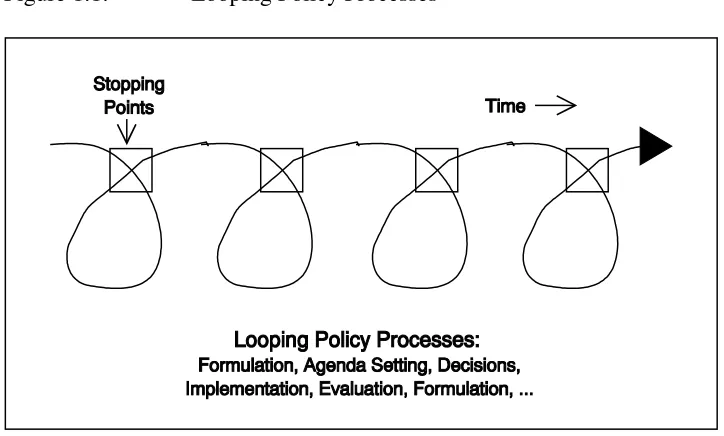
Assumption 1: A linear model of policymaking as a consequential process (typical
steps: formulation, agenda setting, decisions, implementation, evaluation, formula-tion ...)13 is no longer appropriate, at least not in the field of S&T policies. Here, all typical steps are more or less interacting, thereby describing "loops"14: Ideally,
looping policy processes provide "stopping points" where policy-shaping activities
converge in a way that effective acting is feasible (see figure 1.1).
Entry options for SI could be found at (1) such stopping points, (2) ad hoc opportu-nities, or (3) if it has been institutionalised as a steady monitoring process. The emergence of SI knowledge as a policy resource on the one hand and structural and institutional preconditions of using SI activities on the other influence and transform
13 See e.g. Brewer, G.D./de Leon, P. (1983): The Foundation of Policy Analysis, Homewood, Ill., 17-21
each other. Often it is external pressure on policy actors and the related arenas that gives the impulse for the production and application of advanced SI.
Figure 1.1: Looping Policy Processes
Assumption 2: Innovation policy is rather (and increasingly) a matter of networking
between heterogeneous (organised) actors instead of top-down decisionmaking and implementation. Policy decisions frequently are negotiated in multi-level/multi-actor arenas and related actor networks15; given power structures and the shape of
arenas, nevertheless, may vary considerably between member states (or regions) or corporations (see figure 1.2). "Successful" policymaking normally means compro-mising through alignment and "re-framing"16 of stakeholders’ perspectives.
Assumption 3: Negotiating actors pursue different - partly contradicting - interests,
represent different stakeholders perspectives, construct different perceptions of
"re-ality"17, refer to diverging institutional "frames". Different actors having different responsibilities (policymakers define programmes, allocate budgets; researchers define themes, purchase equipment; industry looks for competitive advantages ...) perceive different "stopping points".
15 See e.g. Marin, B./ Mayntz, R. (1991): Policy Networks. Empirical Evidence and Theoretical Considerations. Frankfurt/Main und Boulder/Colorado (Campus; Westview Press).
16 See Schön, D. / Rein, M. (1994): Frame Reflection. Toward the Resolution of Intractable Policy Controversies, New York (BasicBooks). The conditions under which this works with innovation policymaking are discussed by Kuhlmann, S. (1998): Politikmoderation. Evaluationsverfahren in der Forschungs- und Technologiepolitik, Baden-Baden (Nomos); Laat, B. de (1996): Scripts for the future. Technology foresight, strategic evaluation and socio-technical networks: the confron-tation of script-based scenarios, Amsterdam (PhD thesis).
Figure 1.2: Actors in Innovation Policy Arenas and Strategic Intelligence
Assumption 4: Contesting and negotiating actors use money, power and information
as their main media. Various actors have different shares of these resources at their disposal. SI tools (policy evaluation; technology foresight; technology assessment)
use in particular "information" and knowledge as negotiation medium18. Possible
variables of arena configurations are the size of arena, related policy issues (e.g.
distribution of resources; industrial; ethical/cultural), hampering or fostering insti-tutional environments, the degree of self-organisation and of power of actors, or established routines and traditions, and the stability of configurations. Within differ-ent "configurations" SI activities may fulfil certain functions including
• analyses of changing innovation processes, the dynamics of changing research systems, changing functions of public policies;
18 A related concept of policy analysis is provided by Kuhlmann, S. (1998): "Politikmoderation". Evaluationsverfahren in der Forschungs- und Technologiepolitik, Baden-Baden (Nomos).
National research ministry
Other national ministries
Regional
govern-ments National
parlia-ment
EU Com-mission
Multi-national companies
SME asso-ciations
Industrial asso-ciations
Universi-ties National research centers
Research councils Contract
research institutes
Consumer groups
• the identification of diverging "frames" of actors' perceptions;
• a more "objective" formulation of diverging perceptions of (even contentious) subjects, offering appropriate indicators and information-processing mecha-nisms;
• the organisation of mediation processes and "discourses" between contesting actors (or between representations of their views).
Assumption 5: Is there anything specific about SI for innovation policy? Yes,
re-search and innovation are open-ended activities, throwing up novelties. Thus, the results of R&D evaluation and the efforts on TF and TA cannot produce automati-cally clear-cut alternatives for policymakers' decisions (for example, because of life
cycle of research issues, research groups and institutes). This is particularly, and sometimes dramatically, visible vis-à-vis the consequences of scientific or techno-logical breakthroughs.
How can the implications of these assumptions be taken up in innovation policy-making? Putting it abstractly, alignment and consensus production is a precondition
for successful policymaking. Innovation policy decisions are taking place in
multi-level/multi-actor arenas and related actor networks and thus no actor can easily make his/her own interests/objective/actions prior to those of the others. In addition, TF, EV and TA rely on the input of experts and existing organisations and are in-creasingly considered as tools to create alignment between actors (cf. foresight tri-angle in which foresight methods are positioned between the three poles of exper-tise, creativity and interaction).
Does the alignment process foster or prevent "revolutionary" decisions?
Govern-ments and others now and then try to force such decisions: examples are the Task Forces of the EU, the Technological Centres of Excellence ("Technologische Top Instituten”) in the Netherlands19, and probably also the UK White Paper. These are breakthrough policies that initialise new patterns, activities, aggregations within the innovation system, changing existing institutes or setting priorities and posteriori-ties20. There is a paradox: the legitimisation of these breakthroughs partly comes from the outcomes of evaluations of the performance of institutes or analyses of national systems of innovation. Strategic Intelligence may, however, create also broader "roadmaps" orienting actors towards a more conscious decisionmaking ex-ceeding "conservative" alignments.
19 When initiating the idea of TTI the Ministry of Economic Affairs in the Netherlands deliberately tried to circumvent existing actors, esp. the traditional scientific organisations and give industry a large say in the selection and management of the TTIs. However, at the time the idea had to be made concrete more and more the TTI idea changed from a new (brick-) institute to a (network) institute combining groups from universities, TNO and industry. It is remarkable that eventually the Royal Academy played a key role in the selection of the institutes.
1.3
User Needs for Distributed Intelligence
Summing up the assumptions sketched above, a basic presumption of this report is that the functional acts of policymaking and decisionmaking are improved via ac-cess to "relevant information" or "strategic intelligence". This is linked to the pre-sumption is that "societal policy aggregation and formulation" (i.e. the total set of policymaking activities which take place at many organisational levels within com-plex societal structures) is enhanced if this "Strategic Intelligence" is "distributed" around these societal structures in such a way that it can be easily accessed and used by all or most interested parties – which includes public sector policymakers, pri-vate sector decisionmakers and all those affected by the resultant policies and deci-sions made by these actors. This latter presumption, however, is one that can only be examined via a closer look at user needs for strategic and distributed intelligence. Within complex social structures, the range of potential users of "Distributed Intel-ligence" is as vast as the variety of needs this intelligence is meant to satisfy. These needs also change over time. Within public policymaking circles, for example, pol-icy has evolved from "science polpol-icy" to "science and technology polpol-icy" and lat-terly to "innovation policy", with a corresponding shift in policy emphasis from "science push" to "market pull" and latterly to a realisation that "variable geometry" policy mixes are needed to "manage" complex "innovation systems". Accordingly, the information and intelligence needs of policymakers located within these innova-tion systems have evolved apace. Nowadays innovainnova-tion systems are conceived as complex social interactions between multiple actors, with single policy interven-tions having multiple causes and an equally diverse set of consequences.
In such situations, choosing appropriate policy interventions is problematic and de-pendent on a substantial degree of understanding of both likely causes and conse-quences. Policy actors thus have an urgent need for "intelligence" which is timely, comprehensible, relevant to their needs and of sufficient quantity and quality to temper their decisions with a healthy dose of rationality.
Since the intelligence needs of different actors are highly specific and "localised", it is tempting to conclude that these needs can only be satisfied via highly customised intelligence gathering and problem-solving exercises – all differing radically from one organisational and spatial setting to another. It is this reasoning which has led in the past to the commissioning in different settings of many highly focused and indi-vidualistic intelligence gathering exercises, with the choice between evaluation (EV), Technology Foresight (TF) and Technology Assessment (TA) studies depend-ent upon customer preferences vis-à-vis a desire either to review past actions, re-spond to current events or to assess future options.
This practice of commissioning highly individualistic exercises has been reinforced in the past by the influence of "disciplinary" and "cultural" factors. There has, for example, been a tendency over the last twenty years or so for EV, TF and TA to be conceived of as independent "disciplines" or "schools", with fairly well-defined spheres of interest and operation. Although some conceptual links do exist between these schools, in practice their intellectual development has tended to be along sepa-rate tracks.
There has also been a tendency for the practices associated with the conduct of EV, TA and TF to be culturally differentiated. It is possible, for example, to identify a very Dutch brand of TA, and EV orientations which differ radically as one moves from Northern to Southern Europe, with heavy emphasis in the North on "objectiv-ity" and the production of written evaluation "outputs", and a greater emphasis in the South on "process" aspects which encourage beneficial interchanges between evaluators and the evaluated.
ask for evaluations to be conducted via internationally oriented "evaluation mis-sions", i.e. evaluation exercises which tap into international sources of evaluation and technological expertise rather than purely local sources. Provided by organisa-tions prepared to operate globally and to draw on a vast, international pool of ex-pertise, evaluation missions offer government agencies the chance to sample and explore evaluation methods and approaches not always available locally.
Strongly embedded within the concept of distributed intelligence is the notion that "localised" user needs for strategic intelligence can be best met via the adoption of global best practice intelligence gathering methodologies21. Part of the rationale for the ASTPP workshops was a recognition that too rigid a conceptual compartmen-talisation of EV, TA and TF was inappropriate in this day and age, primarily be-cause such a static construction would fail to meet the evolving needs of European policymakers. These needs will also be ill met if "local" EV, TA and TF practitio-ners fail to realise that "local" approaches may no longer be appropriate and that there is a need for best practice approaches to spread from one country to another via mechanisms such as evaluation missions.
Also implicit in the concept of distributed intelligence is the notion that the results of specific localised exercises can be, and are increasingly recognised to be, perti-nent to policy formulation elsewhere in the world. This is particularly so for evalua-tion and foresight exercises. Although not central to the needs of "local" policy-makers, the results of similar exercises in different parts of the world comprise a valuable contextual backdrop against which the results of customised intelligence exercises can be compared. These are precisely the user needs that can be satisfied via the elaboration of a system architecture for distributed intelligence within Euro-pean and global innovation systems.
For many policy actors within innovation systems, the need to access comparative
contextual data produced via the strategic intelligence exercises of others is
be-coming a necessity rather than a luxury. The complex dynamics of innovation sys-tems in part demand a pooling and sharing of such data in order to avoid expensive
duplication of effort. The same complexity also means that there are few tried and tested policy formulae that can be adopted and applied, with many policy initiatives constituting risky experiments unless guided by intelligence reports concerning the fate of similar initiatives in other parts of the world. Current user needs for strategic intelligence may still have a strong local focus, but there is little doubt that the need for access to a system of distributed intelligence is increasing.
1.4
Basic Elements of Improved Strategic Intelligence
In the preceding sections we have tried to demonstrate that a growing need exists for strategic intelligence to underpin policymaking in the area of science, technology and innova-tion. We have also indicated that it is not necessary to start from scratch when attempting to meet these needs. In the past a whole array of instru-ments have been developed to pro-vide strategic intelligence. Among the best known are the three strategic intelligence tools discussed in detail in this report: evaluation, foresight and technology assessment. The use of these tools, however, could be im-proved considerably, as could access to the results of exercises which em-ploy them.
Basically there are two parallel and complementary routes which can be
taken to improve the quality, efficiency and efficacy of strategic intelligence.
The first involves improvements in the use and deployment of existing instruments and tools. A great deal could be gained via the further development of these
instru-ments and via their use in interesting new combinations, either with each other, e.g. combined evaluation and foresight exercises feeding into strategy development, or, alternatively, via comparison of the results of the parallel use of the same instru-ments at different levels (e.g. national vs. international) or in different places (na-tional vs. na(na-tional).
That there is potential for further developing these instruments is perhaps
demon-strated by the extent of developments to date. TF and TA, for example, have changed considerably over the last three decades, with forecasting (prediction) being supplanted by foresight (scenario construction)22, and TA metamorphosing from an "early warning system" into a policy instrument capable not only of identifying pos-sible positive and negative effects, but also capable of helping actors in innovation
22 See Irvine, J. / Martin, B. (1989): Research Foresight: priority-setting in Science, Pinter Publish-ers, London and New York.
Box 1.1: Examples of infrastructures for distributed intelligence: Technology Arsenal
management
processes to develop insights into the conditions necessary for the successful pro-duction of socially desirable goods and services23.
A relatively new trend has been the development of tools which not only provide useful strategic intelligence, but which also enhance innovation processes them-selves by allowing the actors involved to interact in different ways. IT-supported group decision rooms24, consensus development conferences, and platform and scenario workshops are all examples of these new tools. In fact, the existence of this new trend emphasises the shift from analytical to more process-oriented instru-ments, a shift which takes into account the growing complexity of innovation sys-tems and the need for assistance in strategy development to go beyond the provision of empirical data on the development of new technologies.
The second route to improved strategic intelligence leads us to the critical con-cept of Distributed Intelligence (DI).
Underpinning this concept is the no-tion that policymakers - and other ac-tors involved in innovation processes – only use or have access to a small pro-portion of the strategic intelligence of potential relevance to their needs, or to the tools and resources needed to pro-vide relevant strategic information. These intelligence tools, resources and outputs exist within a wide variety of institutional settings and at many or-ganisational levels, but are scattered all over the globe. Consequently they are difficult to access and use. Rectifying this situation will thus require major efforts to develop interfaces stimulat-ing the accessibility of already existstimulat-ing information, and to convince potential users of the need to adopt a broader perspective in their search for relevant
23 For an analysis of this change in relation to the shift in innovation policies from supply-oriented towards user-oriented approaches see Smits R. / Leyten, J. / den Hertog, P. (1995): Technology Assessment and technology policy in Europe: new concepts, new goals, new infrastructures. In: Policy Sciences (28), 272-299.
24 For the potential role of ICT supported group decision systems in user-oriented decisionmaking on technology see for instance Bongers, F. / Smits, R. / Geurts, J. (1999): Technology and soci-ety: GSS-supported participatory policy analysis accepted for publication by the International Journal of Technology Management; Breiner, S. (1997): Die Sitzung der Zukunft, Heidelberg (Physica/Springer).
Box 1.2: Examples of infrastructures for dis-tributed intelligence - Filiere policy in the
Alsace
intelligence expertise and outputs.
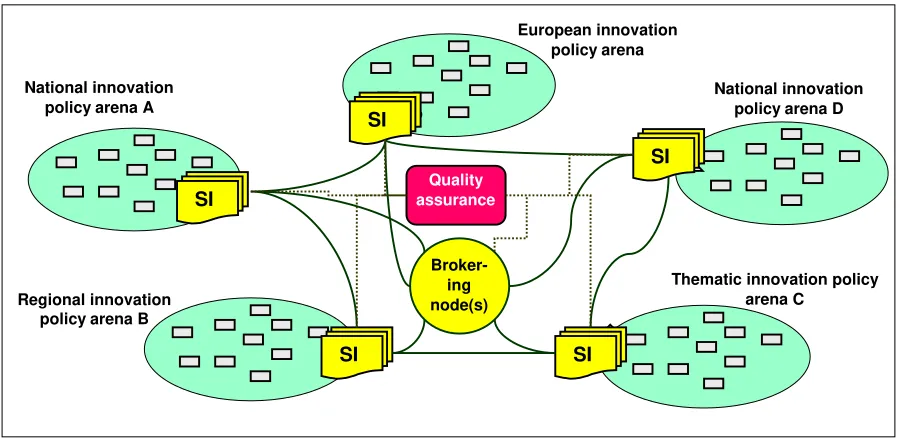
Consequently, the architecture and infrastructures of Distributed Intelligence must allow access, and create inter-operability across locations and types of intelligence,
including a distribution of responsibilities with horizontal as well as vertical
con-nections, not (exclusively) hierarchical, thus also limiting the public cost of DI and strengthening the "robustness" of its infrastructure.
Furthermore, the robustness presupposes provisions for quality assurance, thus
un-derpinning the trust in DI based debates and decisionmaking.
Having introduced two routes to stimulate and improve strategic intelligence, the next step is to consider their operationalisation and implementation. In particular, what kind of infrastructural requirements arise and have to be met in order to facili-tate the use of new combinations of strategic intelligence instruments and improved utilisation of a system of distributed intelligence.
1.5
Résumé: General Requirements for
Distributed Intelligence
Summing up and in order to justify the direction we take in this report, we have to stipulate a number of general principles of Distributed Intelligence for complex in-novation systems.
General requirements of Strategic Intelligence are:
• Organize mediation processes and “discourses“ between contesting actors in re-lated policy arena
• Inject policy evaluation, foresight and TA results, also analyses of changing in-novation processes, the dynamics of changing research systems, changing func-tions of public policies
• Realize thereby the multiplicity of actor's values and interests
• Facilitate a more “objective” formulation of diverging perceptions by offering appropriate indicators, analyses and information-processing mechanisms
• Create forums for interaction, negotiation and the preparation of decisions
• Respond to the political quest for democracy vis-à-vis technological choices
• Create an architecture of "infrastructures" for Distributed Intelligence – but no one unique "system"!
• Link – via SI infrastructure – the existing regional, national, sectoral etc SI fa-cilities, horizontally and vertically
• Build brokering "nodes" managing and maintaining the infrastructure
• Establish a "enabling structure" allowing free access to all SI exercises under-taken under public auspices. Thereby the "pedigree" of information transferred through the infrastructure must be traceable
• Offer a "directory" facilitating direct connections between relevant actors • Define clear rules to access the infrastructure
• Make the infrastructure robust, able to survive; guarantee adequate resources
General requirements for related quality assurance mechanisms are:
• Facilitate repeated and "fresh" exercises (e.g. EV, TF, TA) and new combina-tions of actors and levels
• Enhance and ensure professional quality of SI and DI production, including reg-istration and accreditation of professional practitioners, and mechanisms to stimulate renewal
2.
Basic Concepts of Technology Foresight, Innovation
Policy Evaluation, Technology Assessment and Seeds
of Combined Approaches
Roughly, one can describe the basic concepts of Technology Foresight, S&T Policy Evaluation, and Technology Assessment in the following way:
• "Technology foresight is the systematic attempt to look into the longer-term fu-ture of science, technology, the economy and society, with the aim of identifying the areas of strategic research and the emerging of generic technologies likely to yield the greatest economic and social benefits"25.
• Practices of S&T policy evaluation are wide-ranging, and their functions vary significantly (1) from the provision of legitimation for the distribution of public money and the demonstration of adequate and effective use of the funding by measuring the scientific/technological quality or the (potential) socio-economic impacts, via (2) targeting and "controlling" in the sense of improved management and "fine tuning" of S&T policy programmes, to (3) an attempt to improve trans-parency in the rules of the game and the profusion of research funding and subsi-dies, and to enhance the information basis for shaping S&T policies, in the sense of a government-led "mediation" between diverging and competing interests of various players within the S&T system26.
• Technology assessment: In very general terms, TA can be described as the an-ticipation of impacts and feedback in order to reduce the human and social costs of learning how to handle technology in society by trial and error. Behind this definition, a broad array of national traditions in TA is hidden27.
On the following pages we summarise the experiences gained so far of the perform-ance of TF, EV and TA in decisionmaking processes of S&T policies. Since the understanding of the three analytical tools varies considerably, not only from coun-try to councoun-try, but also from one institution to another, any attempt at a systematic description of existing definitions and practices would far exceed the scope of the present report. We concentrated our efforts therefore on basic experiences across
25 Martin, B. (1995): Foresight in Science and Technology. In: Technology Analysis & Strategic Management vol. 7, no. 2, 140.
26 See e.g. Kuhlmann, S. (1997): Evaluation as a Medium of Science & Technology Policy: Recent Developments in Germany and Beyond. In: OECD (ed.): Policy Evaluation in Innovation and Technology, Towards Best Practices. Paris, 443-460.
countries and institutions, while illustrating the given variety of practices and con-texts through a number of cases.
The chapter will finally lead to the identification of some seeds of combination of TF, EV and TA in decisionmaking processes of S&T policies, providing starting platforms for advanced concepts of "Distributed Intelligence".
2.1
Science and Technology Foresight
Science and Technology Foresight exercises are becoming increasingly attractive for governments, national research agencies and businesses in their efforts at coping with increasing complexity of new technologies and decision environments, in an increased techno-economic competition world-wide28.
TF could be presented as a new type of technology policy tool ... if it were really an innovation. In exact terms, the newness is not the tool, but the fact that TF is done explicitly and involves more people. The techniques existed and policymakers only decided to (re-)use them in a situation of great needs: faced with the necessity of making choices while confronted by increasing competition in the globalized world of the nineties, and then starting to think in terms of division of labour for science and technology. On the private level, during the entire post-war period, large firms and other organisations have never ceased to use TF as an element of their strategic management process. Now policymakers and experts of various institutions are in-creasingly involved in a new type of policymaking mechanism and negotiation pro-cess, supposed to facilitate the creation of consensus and commitment among them on a large scale.
The actual uses made of TF exercises have not yet been studied and evaluated suffi-ciently. This is one of the areas for future research in the field. Still, first hand expe-riences of the exercises indicate many positive effects and in some cases even en-thusiasm from those participating in the process. Nevertheless, there is a need for thorough cost-benefit analyses because TF exercises are expensive and, especially if large-scale consultative processes are being used, cumbersome procedures. Fur-thermore, in some cases, national TF programmes have been performed without enough consideration of the uses of the results and the necessary follow-up actions. The problem at hand is that, as a cognitive creation, TF cannot be considered as a final aim or output (in contrast to scientific discovery, for instance) and supposes political continuity, plus commitment to implement the results in some sense. The majority of experts consider TF essentially as a collective and consultative pro-cess, with the process itself being equally or even more important than the outcome.
National TF programmes are ways of obtaining opinions, conflicting or otherwise, about future developments, most of which are already established. TF in this sense is an essential contributor to the creation, either collectively or individually, of models of the future. Models of the future are important because they are capable of creating synthesis, they are disruptive and interfere with current modes of thought, thus forming and shifting values.
Many experts are convinced (but this is not a general opinion) that gains could be obtained if TF exercises were carried out at the European level. In particular, smaller countries might profit from joint efforts at the European level, since the use of large expert panels such as in the Delphi exercises is a costly and cumbersome tool. However, even for the larger countries, the national level may not be the most relevant context. Countries or "intermediate level" actors such as regions, which have not yet conducted national (regional) TF exercises, could benefit from learning the techniques in joint efforts. Care should, however, be taken not to ignore national differences and other differences of context. This requirement would make Euro-pean level exercises very complicated. Still, such exercises would probably be fruit-ful provided the European level is intelligently articulated with the lower levels and, in particular, if such exercises enrol the experience of the European TF "champi-ons".
Examples of S&T foresight experiences:
(1) The UK Foresight Programme. The UK Foresight Programme provides a rare example of TF becoming deeply embedded and institutionalised within the national innovation system rather than operating only at a higher strat-egy-making level. The Programme began in 1993, having been announced as the centrepiece of a Government White Paper on Science, Engineering and Technology, which itself was seeking to greatly improve the connections be-tween the national science base and its users, notably in industry. From the outset the TF Programme (as it was initially known) combined this objective with that of informing priorities for public spending on science and, implic-itly, promoting a "TF culture" more broadly.
organisa-tions may be better placed to anticipate the acorganisa-tions of their customers, suppli-ers and othsuppli-ers, such as regulators, who may influence the environment in which they operate29. Efforts were made at this stage to broaden the base of
participation beyond that of regular advisers to government.
In the main stage of the TF activity, panels identified key issues and trends, developed scenarios for their sectors and consulted widely, by means of a Delphi survey, regional workshops and contact with other parties. The proc-ess culminated in the production of a report by each panel and a Synthesis Report by the Steering Committee. The latter prioritised the recommendations of the sectoral panels in a matrix which plotted attractiveness of the potential economic and social benefits against the feasibility of the science and tech-nology involved, with the ability of the UK to achieve the result a key consid-eration in both cases.
After the reports were published, the Programme entered its second phase in which the main objective was to disseminate and act upon the results through media, workshops, professional and trade associations, among others. Some 600 events were held and 130,000 reports disseminated. The panels were re-tained to drive this process, though with some adjustment in terms of refer-ence and membership. The most direct follow-up was a new funding initiative, the TF Challenge fund, which supported 24 academic-industrial projects re-lated to TF priorities with ECU 50 million of public funds and ECU 93 mil-lion of private sector contributions. Existing budgets for science were also influenced, though it is much harder to establish attribution here. An official estimate gave 54% of Research Council spending as being aligned with TF priorities, of which ECU 450 million was for new initiatives. Other govern-ment departgovern-ments carried forward areas relating to their own remits, for ex-ample transport and environment.
In 1997/98 the third phase of the Programme gave top priority to the wider engagement of business, with the top priority being to increase business par-ticipation beyond R&D divisions to reach those involved in corporate strat-egy, marketing and finance. This was one reason why the term technology was dropped from the title. Other activities at this phase included efforts to improve co-ordination across government departments and to begin prepa-ration of a new cycle of TF activity. Both the Steering Committee and the Panels were reconstituted as networks of implementing organisations. With the wide range of linkages across the whole of science and innovation policy the Foresight Programme can be said to have been re-invented as a brand and binding agent for innovation policy in the UK.
In evaluating the successes and problems of the Programme, on the positive side there was a clear success in attracting widespread support in industry
and much of the science base. While the priorities which emerged were rather broad, they have been generally accepted. There is a recognition that these are priorities for follow-up action, not an attempt to second-guess scientific creativity. The networking activities have universally been seen as beneficial and become more prominent as an objective over time.
Problems encountered included a rather rushed time scale for Phase 1 which inhibited the development of mature recommendations and the ability to take full advantage of the methodologies. While the panels mostly worked well, barriers of communication emerged between members and the rest of the community and between the panels themselves. This has led to the conclusion that the next cycle should have a more cross-sectoral approach and more permeable structures. In terms of participation, there was a step change up-wards in the numbers involved, but these still were all in the expert commu-nity and did not include the wider public. Excessive focus on technology as a driver led to over-emphasis on technical fix solutions relative to regulatory or social change.
At the time of writing, proposals for a new cycle of TF activity from 1999 in-volve several changes and developments, partly to capitalise upon experience and partly to avoid a repetition of the previous findings. As well as the more open structures mentioned above, it is proposed that there should be a mix-ture of sectoral panels as before, and thematic panels on cross-cutting topics such as the ageing population, future cities, crime control and social cohe-sion. A further innovation is the establishment of a "knowledge pool", a pro-fessionally managed electronic library which draws together contributions from the community and provides a common resource. The devolved nature of the new cycle does not include any centralised surveys, Delphi or otherwise, though individual panels may pursue these.
should deploy "distorting mirrors" facilitating the creation of new combina-tions of knowledge and experience embodied in heads or technologies.
There is no general TF model in industry. SMEs perform TF, if at all, implic-itly, i.e. without formal procedures and explicit investments; many large cor-porations, on the other hand, organise TF efforts rather explicitly! One should differentiate the functions of industry-internal vs. public TF initiatives: Industrial TF initiatives are done for survival and growth, while public ac-tivities initiated by governments can help to create awareness, to provide le-gitimisation for company-internally "revolutionary" discourses and for pri-oritising of investments. Large corporations use public TF exercises as just another information source, while SMEs tend to take advantages from it (if at all) embedded in broader public support initiatives.
(3) Regional foresight initiatives: The Bordeaux Case. The example of Del-phi Technopolis in the Bordeaux region shows possibilities, but also difficul-ties of the use of TF exercises at the regional level30. As in the case of the
na-tional Delphi, where experts expressed a certain resistance to dealing with the originally Japanese list of topics (the French national experience used the Japanese Delphi as a model), the regional experts did not very easily ac-cepted the national survey, because of the high proportion of topics they felt irrelevant for their own (or the regional) context - although they had the pos-sibility to add their own topics to the questionnaire. The experts' critique has also been formulated in a slightly different way: "In designing the regional Delphi, why have you not taken into account the existing local networks in-stead of imposing such an external (understand: irrelevant) view?" Every TF experience, by definition, builds a new network of communication and aims at creating novel networks of actors, around new projects and new combina-tions of existing competencies. And, by definition, it hurts existing networks. These organised local groups will probably be involved in the subsequent phases, for the choice and the implementation of any regional strategy of de-velopment, but we consider it here as an advantage to start the process with a more neutral view, coming from a higher (national) or external (foreign) level.
The second sort of problem we want to underline in the Delphi Technopolis experience is related to the legitimacy and/or credibility of the operator. Shortly before the end of the project, the science park organisation Bordeaux-Technopolis decided to link the regional Delphi with the freshly issued results of the other large national technology survey, managed by the Ministry of In-dustry and focusing on "critical technologies" for the French productive
tem. Among the reasons, we can stress the general characteristics of the lat-ter national survey: medium-lat-term TF in a demand-oriented approach. But the decisive argument for adding that national survey to the regionalised TF ex-perience was the fact that the Ministry of Industry had more credibility (commitment to re-frame the ministry's subsidies system along the critical technologies' grid given by the survey) than the less powerful Ministry of Higher Education and Research responsible for the national Delphi.
Another limitation of the Delphi project is linked to the relatively weak insti-tutional status of the operator, Bordeaux Technopolis, among the actors of the regional scene. The follow-up of the project has been taken over by the association of the four main actors (the Regional Council and the three local administrations of ANVAR, DRRT, DRIRE, respectively for the National Agency for Technological Diffusion and the Ministries of Research and of In-dustry). Nevertheless, the catalytic function of the science park organisation must be recognised: without its initiative, the joint initiative of the four main actors in the science and technology regional scene would not have been set for such a global TF procedure.
One of the general methodological conclusions that have been drawn by the actors of that regional experience is the importance of the context. The ac-ceptability of the whole set of items to be examined in such a survey is one component of the context: the regional experts can be discouraged if too many of the items are felt irrelevant to be - or only badly known. In terms of information diffusion, and concerning the " raising awareness " function that any form of TF procedure involves, it means that a sort of optimal trade-off must be reached between bringing too little and too much novelty to the ex-perts, when translating the TF experience from the upper level to the lower one. The second contextual aspect deals with the credibility / legitimacy of the institution performing (directly or indirectly) the experience: it proved to be crucial to link TF with power and commitment to act.
Summary and conclusions
(1) TF has standard methods, used for decades in public as well as private contexts.
They are still improving, and the evolution lies also in the art of combining them adequately: Delphi, workshops, specific surveys, seminars, etc. But the newness is more in the fact that policymakers have recently decided to use these explicit meth-ods of TF more systematically (instead of opaque bureaucratic decision processes). With explicit professional methods of TF, more people are involved: scientists, managers, consultancy firms, social partners, etc. In this respect, more distributed intelligence is enforced. Through their participation, all these various actors get
Large explicit procedures are costly, but they improve the quality of the decision process also in another sense: allowing the reaction of various categories of "ex-perts", they add dimensions of TA and EV to the "pure" TF exercise.
The possible action of the EU in this domain is to diffuse information on the best national practices and be a model by actively practising TF exercises.
(2) TF approaches are known and used by large private and public organisations. Private corporations often develop in-house TF exercises, as part of their strategic management process. They also participate in the large public exercises and/or they can use public TF results in their information/decision system.
The more challenging point is the participation of SMEs, since most of them have
not the critical mass, the time or the competence to feed in or use TF information. Thinking of the ways to involve these actors in existing TF programmes or to adapt the tool for them is an important task to deal with. Our first ideas on that point are: 0 large diffusion of the results and interpretations of existing national/international
TF experiences;
1 developing regional TF because they are closer to the needs and competencies of the SMEs;
2 involving consultancy firms and public agencies that play an important role in the environment of SMEs as strategic information transmitters and processors. Here, the role of the EU could be to support such actions through information diffu-sion and co-financing regional projects.
(3) Distributed intelligence is an overarching concept of policymaking or manage-ment. In the case of TF, it means involving a large scope of actors and levels: public and private organisations, large and small units, national and regional institutions, experts and citizens, bureaucracy and politics, etc.
As an overarching political system the EU could play a specific role as a model-creating initiator, starting with the implementation of "distributed" (in the geo-graphical sense) intelligence. Developing a European TF programme is one possi-ble option. One can discuss its cost/advantage ratio for the European Commission's
policymaking, its political desirability etc., but since TF is often more useful as a collective learning process than for its final output, any common European TF ini-tiative would have a positive impact on European integration. By developing spe-cific TF tools, the EU plays the role of a demonstration centre and a catalyst of communication within Europe.
(4) It is well known that big S&T breakthroughs have often not been forecast by a majority of experts. Some of them were nevertheless anticipated by individual thinkers. This is a classical problem of TF and other methods of "prospection": how to detect feeble signals or the minority views that could be revealed as the very pre-cursors of the future? The paradoxical nature of TF tools is that they aim at two
conflicting goals: building consensus and preserving variety of visions. The specific
ma-jority views (risk-taking is not the philosophy of administration - private or public). Distributed intelligence means here: combining views of heterogeneous relative weights.
This is a crucial issue for the EU because of, both: the size and complexity of its institutions that make administrative procedures particularly cumbersome - the per-manent (welcome) insistence on the need to preserve variety within Europe adding to the necessity to keep variety of visions for all the various national contexts. (5) The EU already has its own TF functionality, scattered in various locations. Some aspects are dealt with in an institution like the Institute for Prospective Tech-nology Studies (IPTS), others are processed through the activity of several Director-ate Generals, etc. Here, the challenge is to circulate that "distributed" information available in European institutions in order to build real "intelligence". How to make
the activity of all the functional structures dealing with future trends in science, technology and innovation more transparent to each other and to external observers? Certainly, the use of advanced information and communication technologies is an
opportunity to be seized.
2.2
Innovation Policy Evaluation
In European countries, an "evaluation culture" in S&T and innovation policies has evolved. In most countries there is quite a well developed system of ex ante EV of project proposals. Other forms of S&T policy EV, not yet quite as common, but increasingly used during the last two decades include
0 ex post EV of research programmes and other policy initiatives,
1 EV of R&D centres and universities, 2 EV of R&D funding agencies.
In all these cases, EV plays a different role in decisionmaking. It is directly and in-strumentally linked to decisions in ex ante EV of proposals. The role of EV varies from case to case and includes, among other things, the following functions:
(1) EV may provide legitimisation for the allocation of public money to R&D.
(2) EV may enhance an adequate and effective use of funding by measuring the scientific/technological quality or the (potential) socio-economic impact.
(3) EV may improve programme management and "fine tune" S&T policy
pro-grammes.
(4) EV may provide new ideas or legitimate already circulating ideas about
changes in R&D centres and funding agencies, thus enhancing the fulfilling of