How to cite this paper: Yao, Q.K., Zhang, B., Luo, Y.W. and Huang, H. (2014) No-Cloning Theorem, Leibniz’s Principle, and the Notion of Uniqueness. Open Access Library Journal, 1: e981. http://dx.doi.org/10.4236/oalib.1100981
No-Cloning Theorem, Leibniz’s Principle,
and the Notion of Uniqueness
Qiankai Yao1,2, Bin Zhang2, Yanwei Luo1, Hui Huang1
1College of Science, Henan University of Technology, Zhengzhou, China
2International Joint Research Laboratory for Quantum Functional Materials of Henan, School of Physics and
Engineering, Zhengzhou University, Zhengzhou, China Email: [email protected]
Received 8 July 2014; revised 28 August 2014; accepted 30 September 2014 Copyright © 2014 by authors and OALib.
This work is licensed under the Creative Commons Attribution International License (CC BY).
http://creativecommons.org/licenses/by/4.0/
Abstract
The impossibility of cloning an unknown quantum state is one of the basic rules governing quan-tum physics. This statement, known as the “no-cloning theorem”, prohibits perfect cloning, but doesn’t oppose approximate copying. In this paper, we will prove that, due to the uncontrollable quantum fluctuations, no perfect cloning can be achieved. Such a situation allows us to treat the no-cloning theorem as an equivalent one to Leibniz’s principle, and further unify them under the notion of uniqueness; that is, any physical entities (whether macroscopic or microscopic objects) in nature would have its individuality. Moreover, we also demonstrate the universality of unique scheme by showing that, any process of trying to construct one exactly symmetrical or asymme-trical body of a physical object is forbidden. On the whole, nature doesn’t allow the existence of completely identical, symmetrical or asymmetrical things and this conclusion is valid for all phys-ical domains.
Keywords
No-Cloning Theorem, Leibniz’s Principle, Uniqueness
Subject Areas: Quantum Mechanics, Theoretical Physics
1. Introduction
superposi-OALibJ | DOI:10.4236/oalib.1100981 2 October 2014 | Volume 1 | e981 tion must be the superposition of the outputs c = ↑ ↑ + ↓ ↓a b . But he wants
(
)(
)
s s = a ↑ + ↓b a↑ + ↓b , two copies of the original; that is not the state c he gets [3]. Another version of the no-cloning theorem [4]-[6] states that any attempt at learning something regarding the input state of the copying device will necessarily induce some disturbance in the output state. This principle presents a very interesting variation of the so-called “uncertainty principle” since it applies to an individual system.
Importantly, the inadmissibility of creating two same quantum states has quickly led to a discussion on the in-dividuality of quantum states. A central role in the discussion is undoubtedly played by the question of the va-lidity of Leibniz’s principle in quantum physics [7] [8]. Leibniz’s principle provides a relation between the discernibility of things and their identities. According to the principle, it is not possible for two things to be in-discernible. The validity of Leibniz’s principle is traditionally debated in the philosophical and logical literature [9]. But here, our basic motivation is to reveal the physical meaning of Leibniz’s principle, by taking into ac-count its equivalence to the no-cloning theorem.
In the following, we first prove that, as a strict principle, the no-cloning theorem prohibits any perfect cloning of quantum states, no matter the orthogonal or non-orthogonal. Secondly, we illustrate that, Leibniz’s principle has an equivalent meaning to the no-cloning theorem, which thus can be stated by a unified scheme that any physical object in nature would have its individuality. Meanwhile, we also turn to the specific subject of our pa-per: the physical validity of Leibniz’s principle is also reflected in a broader proposition: nature doesn’t allow the existence of completely identical, symmetrical or asymmetrical things.
2. Possibility of Perfect Cloning
According to the no-cloning theorem, perfect cloning means both of the output and its source should share ex-actly the same properties. So that, if writing an ideal copying process as [10] [11]
s t ψ s c
ψ χ ψ ψ
Ξ → Ξ (1)
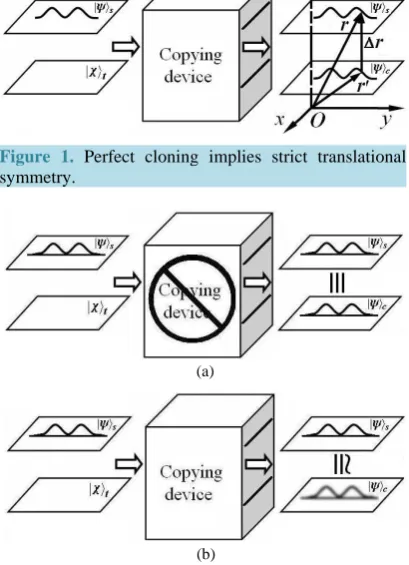
It would require (seeFigure 1)
( )
,(
,)
( )
,c c s
t t t
ψ r′ ≡ ψ r− ∆r ≡ ψ r (2)
where Ξ denotes the state of copying device (ancilla), ψ s the original one would like to copy (source),
and χ t the blank state to which ψ s shall be copied (target).
Notice that, the traditional no-cloning theorem stated perfect cloning is possible only when the copied are or-thogonal [1] [12]. However, a different result excludes this possibility, since it would lead to superluminal communication [13]. Another version emphasizes any attempt to learn something about the input will necessar-ily induce some disturbance [4] [6]. These results inspired us to examine the uncertainty effect on cloning process, that is, in order to ensure the coexistence of physical principles, Equation (1) must be rejected [3] [14].
To see why, we imagine there is a long life quantum state ψ s with a zero energy uncertainty
~ 0
s t
E t ∆ →∞
∆ ∆ → , to be copied to target in a finite interval of time τ
(
< ∞)
. When the original enters, one copying state ψ c comes out, whose finite time uncertainty τ will determine an energy disturbance of beingallowed to close but not equal to zero, ∆Ec ~τ τ<∞ ~ 0. These uncertainty relations clearly suggest that the
output c
ψ can only be approximate rather than identical to s
ψ , if not (i.e.
c s
ψ ≡ ψ ), then give 0
c s
E E
∆ = ∆ → , being a false result. Hereby, we stress that, due to the uncertainties caused by uncontrollable quantum fluctuations, only approximate cloning is permitted (seeFigure 2). That is to say, any perfect cloning of quantum states (no matter the orthogonal or non-orthogonal) will be prohibited, or that, any quantum backup will show some deviation from the original. This scheme different from the traditional view on quantum cloning, can work as a basic rule, and therefore place a strict limitation on the cloning fidelity [3] [15].
3. The Notion of Uniqueness
OALibJ | DOI:10.4236/oalib.1100981 3 October 2014 | Volume 1 | e981
Figure 1. Perfect cloning implies strict translational symmetry.
Figure 2. There is no perfect quantum copier. (a) No copier can copy a quantum state perfectly; (b) Only ap-proximate cloning is possible.
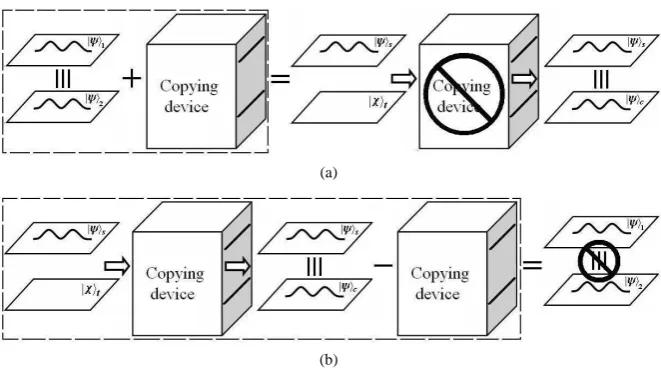
no connection with cloning scheme, however, this is not the case, since it can lead to an equivalent statement (here called no-existing statement): there exist no quantum states exactly alike [16]. Their equivalence can be proved by showing that if either is false, so is the other. Specifically, if the no-existing statement were violated, i.e. exist ψ 1 ≡ψ 2, one could treat the two identical states as a source and a target respectively, and let them pass through a racing copier, whose total effect is to perform a perfect copying (seeFigure 3(a)). In turn, con-clusion remains the same (seeFigure 3(b)). Importantly, these two statements can be unified under the unique notion, that is, any quantum state would be unique. The argument undoubtedly implies that, any physical object of being composed of numerous quantum states will also possess its individuality. So that, if describing a physi-cal object simply as
( )
i,t ψ1( )
1,t ψ2( )
2,t ψi( )
i,tΨ r = r ⊗ r ⊗ ⊗ r ⊗ (3)
there is not other one Ψ′ ′
( )
ri,t equal to it, suggesting no equality of Ψ′ ′( )
ri,t ≡ Ψ( )
ri,t tenable. This is very what Leibniz’s principle want to express [9] [17] [18].The wide impact of the unique notion can be reflected by the study on symmetrical aspect. Such consideration for cloning scheme reads that, it is impossible to construct a device which can produce one partner of an original object (including orthogonal state)
( )
i,s
t
Ψ r , and ensure them have strict symmetry (such as space-time re-versal or matter-antimatter symmetry), namely
( )
, ˆ( )
,i′t c F i t s
Ψ r ≡ Ψ r (4)
ˆ
F denotes a designated symmetrical transform. Especially, one neither creates two systems being mirror im-ages of each other or evolving along reciprocal paths strictly, nor makes them share exactly the opposite proper-ties. If this is false, one can take the output as an input and perform the same operation again, so that
( )
ˆ( )
ˆ2( )
( )
, , , ,
i′′t c F i′t c F i t s i t s
Ψ r ≡ Ψ r ≡ Ψ r ≡ Ψ r (5)
(a)
OALibJ | DOI:10.4236/oalib.1100981 4 October 2014 | Volume 1 | e981 (a)
[image:4.595.148.479.81.268.2](b)
Figure 3. If either no-existing or no-cloning statement is false, so is the other.
whose only effect is to realize a perfect copying, requiring the no-cloning theorem to also be false.
From the relevant discussion it follows that, there aren’t two things perfectly symmetrical or asymmetrical, and the same must also be said of other things, no one can cultivate two leaves with exact mirror symmetry, or develop a picture strictly negative to the other. This immediately leads to a general conclusion, that is, nature doesn’t allow the existence of completely identical, symmetrical or asymmetrical physical objects.
4. Summary
In short, we have shown that, for being incompatible with uncertainty principle, any attempt to perfectly clone any quantum state (rather than only the nonorthogonal in the usual view) is completely ruled out by quantum mechanics. Such the cloning property is closely associated with the individualities of physical entities [16], and thus displays its equivalence to Leibniz’s principle. The equivalence of no-cloning theorem and Leibniz’s prin-ciple can help us to achieve a unified proposition: the fundamental characteristic of nature is that it doesn’t allow any physical objects to share exactly the same, symmetrical or asymmetrical properties. The argument will play a crucial role in understanding the physical world.
References
[1] Wootters, W.K. and Zurek, W.H. (1982) A Single Quantum Cannot Be Cloned. Nature, 299, 802-803. http://dx.doi.org/10.1038/299802a0
[2] Dieks, D. (1982) Communication by EPR Devices. Physics Letters A, 92, 271-272. http://dx.doi.org/10.1016/0375-9601(82)90084-6
[3] Linares, A.L., Simon, C., Howell, J.C. and Bouwmeester, D. (2002) Experimental Quantum Cloning of Single Photons. Science, 296, 712-714. http://dx.doi.org/10.1126/science.1068972
[4] Bennett, C.H., Brassard, G. and Mermin, N.D. (1992) Quantum Cryptography without Bell’s Theorem. Physical Re-view Letters, 68, 557-560. http://dx.doi.org/10.1103/PhysRevLett.68.557
[5] Mor, T. (1998) No Cloning of Orthogonal States in Composite Systems. Physical Review Letters, 80, 3137-3140. http://dx.doi.org/10.1103/PhysRevLett.80.3137
[6] Fuchs, C.A. and Peres, A. (1996) Quantum-State Disturbance versus Information Gain: Uncertainty Relations for Quantum Information. Physical Review A, 53, 2038-2045. http://dx.doi.org/10.1103/PhysRevA.53.2038
[7] Cortes, A. (1976) Leibniz’s Principle of the Identity of Indiscernibles: A False Principle. Philosophy of Science, 43, 491-505. http://dx.doi.org/10.1086/288707
[8] Barnette, L. (1978) Does Quantum Mechanics Disprove the Principle of the Identity of Indiscernibles. Philosophy of Science, 45, 466-470. http://dx.doi.org/10.1086/288822
OALibJ | DOI:10.4236/oalib.1100981 5 October 2014 | Volume 1 | e981 [10] Daffertshofer, A., Plastino, A.R. and Plastino, A. (2002) Classical No-Cloning Theorem. Physical Review Letters, 88,
210601-210604. http://dx.doi.org/10.1103/PhysRevLett.88.210601
[11] Ramanathan, R. (2012) Complementarity of Quantum Correlations. Thesis for the Doctor Degree, National University of Singapore, Singapore.
[12] Wootters, W.K. and Zurek, W.H. (2009) The No-Cloning Theorem. Physics Today, 2, 76-77. http://dx.doi.org/10.1063/1.3086114
[13] Herbert, N. (1982) Superluminal Communication Based upon a New Kind of Quantum Measurement. Foundations of Physics, 12, 1171-1179. http://dx.doi.org/10.1007/BF00729622
[14] Scarani, V., Iblisdir, S., Gisin, N. and Acin, A. (2005) Quantum Cloning. Reviews of Modern Physics, 77, 1225-1256. http://dx.doi.org/10.1103/RevModPhys.77.1225
[15] Cerf, N.J., Lévy, C.N. and Assche, G.V. (2001) Quantum Distribution of Gaussian Keys Using Squeezed States. Phys-ical Review A, 63, Article ID: 052311. http://dx.doi.org/10.1103/PhysRevA.63.052311
[16] Muller, F.A. and Seevinck, M.P. (2009) Discerning Elementary Particles. Philosophy of Science, 76, 179-200. http://dx.doi.org/10.1086/647486
[17] Teller, P. (1983) Quantum Physics, the Identity of Indiscernibles, and Some Unanswered Questions. Philosophy of Science, 50, 309-319. http://dx.doi.org/10.1086/289112