University of Huddersfield Repository
Cheng, Siu Yee, Bamford, David, Dehe, Benjamin and Papalexi, Marina
Healthcare ‘Single Point of Access’ and the application of Lean
Original Citation
Cheng, Siu Yee, Bamford, David, Dehe, Benjamin and Papalexi, Marina (2014) Healthcare ‘Single Point of Access’ and the application of Lean. In: European Operations Management Association (EurOMA) conference, 2025 June 2014, Palermo, Italy.
This version is available at http://eprints.hud.ac.uk/id/eprint/21024/
The University Repository is a digital collection of the research output of the University, available on Open Access. Copyright and Moral Rights for the items on this site are retained by the individual author and/or other copyright owners. Users may access full items free of charge; copies of full text items generally can be reproduced, displayed or performed and given to third parties in any format or medium for personal research or study, educational or notforprofit purposes without prior permission or charge, provided:
• The authors, title and full bibliographic details is credited in any copy; • A hyperlink and/or URL is included for the original metadata page; and • The content is not changed in any way.
For more information, including our policy and submission procedure, please contact the Repository Team at: [email protected].
1
+HDOWKFDUHµ6LQJOH3RLQWRI$FFHVV¶DQGWKHDSSOLFDWLRQ
of Lean
Siu Yee Cheng ([email protected]) University of Huddersfield
David Bamford University of Huddersfield
Benjamin Dehe University of Huddersfield
Marina Papalexi University of Huddersfield
Abstract
This paper disseminates findings from a Lean healthcare project in a UK National Health Service (NHS) Single Point of Access; a new healthcare case study setting. Action research was applied and Lean tools used to establish current state processes, customer values and develop improvement opportunities. It was found that interface issues between primary and secondary healthcare organisations were the root cause of wastes and service failXUH 8VLQJ /DUVVRQ DQG %RZHQ¶V VHUYLFH GHVLJQ framework the case study setting was identified as a reciprocal service function. Therefore, recognising the customer/supplier relationship can lead to more effective and sustainable service improvement.
2 I ntroduction
This paper outlines the use of Lean methods within a specific healthcare environment ± Single Point of Access (SPA). It describes the relevance of Lean application to this type of healthcare service setting, and how recognising the type of relationship and the QDWXUHRILQWHUDFWLRQEHWZHHQWKHVHUYLFH¶VFXVWRPHUVXSSOLHUFDQOHDGWRPRUHHIIHFWLYH and sustainable service improvement solutions.
Literature review
Lean in healthcare
/HDQLVRIWHQGHVFULEHGDVLQFUHDVLQJHIILFLHQF\WKURXJKWKHUHPRYDORIµZDVWH¶LHQRQ-value adding activities, thus only delivering what is valuable to the customer (Radnor and Burgess, 2013). The application of Lean in manufacturing has received much attention with many documented examples of when it has been successful in improving productivity (Young and McClean, 2009; Brandao, 2009). However, over the last decade, the application of Lean has expanded to other industries and public sector services, e.g. The UK National Health Service (NHS), (Holden, 2011; Meredith et al., 2011; Dickson et al., 2009; Herring, 2009). With the NHS facing the challenge of GHOLYHULQJ ELOOLRQLQSURGXFWLYLW\VDYLQJVE\.LQJ¶V)XQG11), the NHS will be required to do more whilst using fewer or similar level of resources, so the use of Lean in healthcare has never been more relevant.
Healthcare organisations across the world are reporting successful application of Lean thinking with examples from US hospitals (Savary and Crawford-Mason, 2006), Australia (Bem-Tovim et al., 2007) and the UK (Jones and Mitchell, 2006, Fillingham, 2007). Lean is being increasingly applied in both acute (Radnor et al. 2006; Joosten et al. 2009) and community settings (Grove et al. 2010a, 2010b). The application of Lean is associated with improving clinical processes by increasing quality, safety and efficiency (Fillingham, 2007; Silvester et al., 2004; Radnor and Boaden, 2008; Breyfogle and Salveker, 2004). +ROGHQ¶V (2011) review of Lean applications in Accident and Emergency (A&E) departments showed that Lean can reduce waiting times, length of stay, and the proportion of patients leaving without being seen. Lummus et al. (2006) applied Lean WRROVLQDSK\VLFLDQ¶VFOLQLFWRVLJQLILFDQWO\LPSURYH the patient flow and administrative processes. Similar results have been reported by Kelly et al. (2007), where an emergency department was analysed and redesigned using Lean principles. Gubb (2009) noted that the Flinders Medical Centre was able to achieve a 15-20 percent work increase with fewer safety incidents, whilst on the same budget and using the same infrastructure, staff and technology. Another example is the Virginia Mason Medical Centre who was able to create enough capacity through waste reduction to eliminate the need to purchase additional multi-million dollar facilities (Womack et al., 2005). Furthermore, other research showcased reduced lead-time (Al-Araidah et al., 2010), reduced clinical errors (Raab et al., 2006), as well as enhanced patient and staff satisfaction (Dickson et al., 2009).
Improving access to healthcare services
3
There is little academic literature which examines whether these SPA have been effective in improving access but sources from the grey literature appears supportive and advocate the use of SPAs in healthcare. Partnership for Access to Health (PATH) (2009) reported that SPA is a key theme of good practice that would improve access for patients with multiple and complex needs. Goodard (2008) described how research carried out by Greater London Authority, found that a major barrier faced by General Practitioners (GPs) and other referrers in directing patients to local mental health services was lack of knowledge of what was available and perception that mental health conditions were too specialised and complex to be dealt with in primary care. As such, a SPA staffed by individuals with specialist clinical knowledge in their respective field and full information about the range of local health service provisions was a key recommendation from the reporW,QUHFHQW\HDUVWKHUHLVJURZLQJFRQVHQVXVWKDWµIURQW-ORDGLQJ¶WKHSDWLHQWSDWKZD\ZLWKH[SHUWVWDIIZRXOGPD[LPLVHWKHOLNHOLKRRGRISDWLHQWV being directed to the most suitable care pathway, and ultimately lead to faster access to the right care and reduce the need for multiple assessments (Naylor and Bell, 2010).
Despite the support for SPAs there were concerns from referrers, specifically GPs XVLQJ D PHQWDO KHDOWK 63$ ZKR IHOW WKDW WKH 63$ ZDV D ERXQGDU\ WKDW µLPSHGHG WKH establishment of professiRQDO UHODWLRQVKLSV DQG WUDQVIHU RI NQRZOHGJH¶ DQG UHGXFHG their accountability to their patients (Raine et al, 2005). Nevertheless, the study did acknowledge that the concept of SPA would eliminate a number of process inefficiencies (eliminate multiple forms and client records, reduce number of access points), and other literature described other benefits such as; i) better response times for assessment and treatment; ii) eliminate referral and assessment duplications; iii) standardise information and work processes; and iv) increased service quality and efficiency (Department of Health, 2010; Gallimore et al., 2009).
Therefore, this research sought to investigate how Lean can be applied to a Mental Health Service SPA ± an unfamiliar clinical decision making healthcare function, and in what ways it could improve access to services. It was also noted that Lean application within a mental health service environment was lacking in the literature with only two papers identified (LaGanga, 2011 and Radnor, 2011). The literature also revealed biasness towards case studies using departments with clearly defined process flows such as surgical, laboratory and A&E settings. This study differs in that the focus is a clinical decision-making service function with ambiguous processes and as such, the findings could provide evidence of Lean implementation within a new context.
Based on the findings from the extant literature, the following Research Question (RQ) was developed:
RQ1: How can Lean thinking be used to improve access to secondary mental health services?
M ethod
4
A series of facilitated workshops with frontline SPA workers and stakeholders were held and engaged participants in Lean thinking. The workshops had multiple purposes; 1) introduce and train the workforce in the use of various Lean tools, 2) information gathering to establish the current state at each SPA site and identify operational issues, and 3) serve as an in-house forum for knowledge exchange and internal benchmarking. The rationale for engaging with frontline staff being that these individuals had the relevant background and/or experiences to provide the appropriate data required to establish the current state and identify problems (Jankowicz, 2005). Furthermore, Stuart et al. (2002) argue that direct involvement with people to understand their everyday life analytically was important in case-based research.
Other stakeholders such as the receiving service teams and referrers were also engaged to explore their perceptions and experiences with SPA. Subsequent analysis of current state processes and investigation of operational problems through Root Cause Analysis helped to triangulate the source of the problems. This additional information was obtained through a mixture of interviews, questionnaire surveys, secondary quantitative data (obtained from the Trust's in-house performance and information function) and observation. The extant literature provided evidence that researchers in Lean healthcare incorporated a mixture of quantitative and qualitative components in their studies (Wojtys et al., 2009; Radnor, 2011; Schwarz et al., 2011; Esain et al., 2012; Morrow et al., 2012), which reinforced the appropriateness of this approach.
Findings
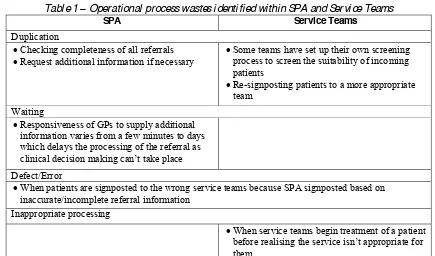
[image:5.595.79.514.483.739.2]The application of Lean thinking within the study allowed the researcher to establish the current state operational processes within each of the SPA teams and identified operational issues. The main complaints from referrers and service teams were associated SPA signposting patients to the wrong service team for treatment. Moreover, linkage diagrams revealed a high number of process wastes occurring within SPA and at the Service Teams which are summarised in Table 1.
Table 1 ± Operational process wastes identified within SPA and Service Teams
SPA Service Teams
Duplication
x Checking completeness of all referrals
x Request additional information if necessary
x Some teams have set up their own screening
process to screen the suitability of incoming patients
x Re-signposting patients to a more appropriate
team Waiting
x Responsiveness of GPs to supply additional
information varies from a few minutes to days which delays the processing of the referral as
FOLQLFDOGHFLVLRQPDNLQJFDQ¶WWDNHSODFH
Defect/Error
x When patients are signposted to the wrong service teams because SPA signposted based on
inaccurate/incomplete referral information Inappropriate processing
x When service teams begin treatment of a patient
EHIRUHUHDOLVLQJWKHVHUYLFHLVQ¶WDSSURSULDWHIRU
5 Tracing root cause of operational problems
Analysis revealed the root cause of SPA defects i.e. patients receiving unsuitable services for their needs; stemmed from the quality and completeness of the referral information supplied to the SPA clinician by the referrer. The incumbent procedure for submitting a referral to SPA was through the use of a paper referral form for non- urgent cases and telephone for urgent cases. However, due to the breadth of mental health conditions and the qualitative nature of information needed for a diagnosis, a 5 page referral form was used to capture information aimed at covering all possible permutations of mental health conditions.
In-house performance data indicated that on average, 70% of referrals received by SPA originated from GPs in primary care. SPA teams were unclear on the reasons why GPs were not consistently completing the referral form so the researcher extended the Root Cause Analysis beyond the boundary of the Trust and engaged with GPs.
GP engagement and defining customer values
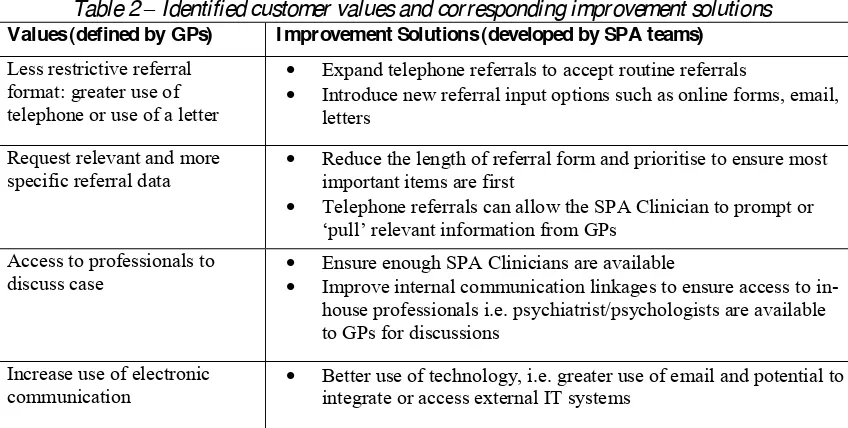
The researcher engaged with GPs through direct semi-structured interviews and electronic questionnaires, to enquire on their experiences on making a referral into SPA. Their responses were analysed thematically and the results shown in Table 2 as µcustomer values¶. In terms of why insufficient referral information was not being supplied, GPs perceived the referral form as being too long which often asked for µGHPRJUDSKLFVZKLFKLVDOUHDG\RQ6\VWHP>,76\VWHPXVHGE\*3V@¶DQGµVRPHRI WKHER[HVDUHQ¶WDSSOLFDEOHWRWKHSDWLHQWEXWLI,GRQ¶WILOOLWLQWKHUHIHUUDOJHWVUHMHFWHG¶ /LPLWHGWLPHZDVDQRWKHUUHDVRQJLYHQZLWKRQH*3H[SODLQLQJµ:HVSHQGPLQXWHV ZLWKDSDWLHQWDQGWKHQZHKDYHWRZULWHXSWKHVHVVLRQ>«@DSDJHUHIHUUDORQWRSRI WKDWGRHVQ¶WKHOS¶DQGDQRWKHUVWDWLQJµLWWDNHVPHKDOIDQKRXUWRILOOLQWKHIRUP± LW¶V WRRORQJ
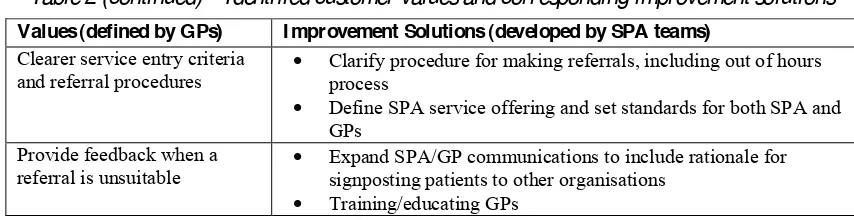
[image:6.595.87.511.542.756.2]Overall, many of the process wastes and complaints about SPA stemmed from this interface between SPA and the referrer, i.e. the supply of patient and clinical information. Subsequently, a series of improvement solutions were generated (shown in Table 2), which focused on improving the dialogue and information flow between primary care (the referrer) and secondary care clinicians (SPA), and to satisfy customer values.
Table 2 ± Identified customer values and corresponding improvement solutions
Values (defined by GPs) I mprovement Solutions (developed by SPA teams) Less restrictive referral
format: greater use of telephone or use of a letter
x Expand telephone referrals to accept routine referrals
x Introduce new referral input options such as online forms, email, letters
Request relevant and more
specific referral data x Reduce the length of referral form and prioritise to ensure most important items are first
x Telephone referrals can allow the SPA Clinician to prompt or
µSXOO¶UHOHYDQWLQIRUPDWLRQIURP*3V
Access to professionals to
discuss case xx Ensure enough SPA Clinicians are available Improve internal communication linkages to ensure access to in-house professionals i.e. psychiatrist/psychologists are available to GPs for discussions
Increase use of electronic
6
Table 2 (continued) ± Identified customer values and corresponding improvement solutions
Discussion
Although the study identified operational process variations and used Lean thinking to mitigate these, it was noted that there are already many examples of the methods on how to reduce process variations in healthcare services and its associated benefits in the extant literature. Discussions will therefore focus on how customer values were identified and defined to influence the creation of service improvement opportunities.
P1: Shared Values should be used to guide Lean application when there are multiple customers
Much of the extant literature has stressed the importance of identifying the right customer to define values, with Womack and Jones (1996), describing failure to do so would result in the wrong product or service being delivered in a highly efficient way. However, in healthcare the environment is complex and there can be multiple µFXVWRPHUV¶Young et al., 2004; Burgess and Radnor, 2013) so identifying the customer and therefore defining values can be difficult. Nevertheless, The 10 year NHS Plan outlined by the Department of Health (2000) emphasises placing the patient at the centre of care and so value should stem from them. Young and McClean (2008) describe three types of value that exist in healthcare. In this study, the values which ZHUH LGHQWLILHG FDQ EH FRQVLGHUHG µ&OLQLFDO 9DOXHV¶- focussed on achieving the best outcome for the patient; signposting them to the right service team for treatment. Despite not specifying the patient as the customer, these Clinical Values are likely to be shared by both clinicians and the patients. Therefore, when the customer is not clear, common values shared by the multiple customers can be used to guide Lean application.
P2: Using Lean to understand the type of process variations will determine the service redesign strategy
P3: Reciprocal service design should be applied to improve access to health care services
The root cause for patients beings signposted to the wrong service team was traced back to the way referrals information is supplied to SPA. With the procedure for making referrals centred around a referral form, the variations in the quality of the referral information supplied can be considered DQµ$UWLILFLDO¶YDULDWLRQDVGHVFULEHGE\-RRVWHQ et al (2009), because the inconsistency is a result of the way the system has been designed. Artificial variations can have a greater impact on health outcomes than natural ones (McManus et al., 2003; Joosten et al., 2009), and is reinforced by the fact that inaccurate SPA signposting of patients led to increased waiting time for patients to receive the correct treatment. Ultimately, ensuring the patient is signposted to the right service team first time is dependent on the quality and completeness of referral information.
Values (defined by GPs) I mprovement Solutions (developed by SPA teams) Clearer service entry criteria
and referral procedures x Clarify procedure for making referrals, including out of hours process
x Define SPA service offering and set standards for both SPA and GPs
Provide feedback when a
referral is unsuitable x Expand SPA/GP communications to include rationale for signposting patients to other organisations
[image:7.595.82.509.93.203.2]7
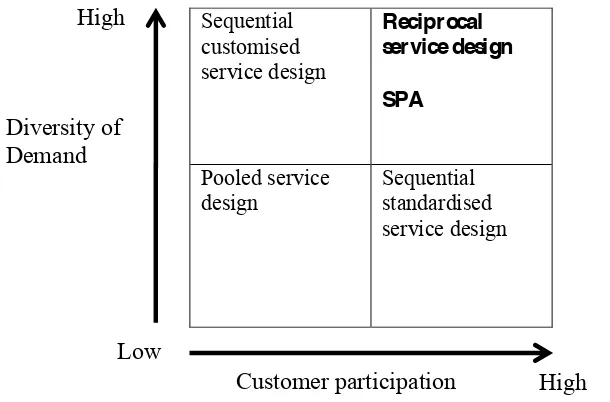
The root cause analysis led the researcher to investigate the interaction between the GPs and SPA. In doing so it was realised that the GPs are actively involved in the service production process ± they supply SPA with information, and in order to do so they are required to interact with the service provider. These observations appear to KDYH SDUDOOHOV ZLWK /DUVVRQ DQG %RZHQ¶V PDWUL[ RI VHUYLFH LQWHUGHSHQGHQFH illustrated in Figure 1. In the context of this model, GPs are considered the customers who carry out a high degree of participation because they supply SPA (the service) with something needed by the service to allow them to add value, i.e. use the referral information to inform their clinical decision making to signpost the patient to the most appropriate treatment team. Furthermore, high degrees of both natural and artificial variations as described by Joosten et al (2009) exist in the SPA operational process:
x Natural variability arising from each patients needs are unique which means each referral information will also be unique
x Artificial variability arising from inconsistent quality of referral information GPs input on the referral form.
[image:8.595.112.417.395.596.2]This high degree of variability would correspond to high diversity of demand from the customer; meaning that on Larsson anG %RZHQ¶V PRGHO WKH 63$ FDVH VWXG\ would be situated in the reciprocal service design quadrant. Reciprocal service design implying that SPA service improvement should involve direct engagement and involvement with the customer - GPs.
Figure 1: Typology of service interdependence patterns. Adapted from Larsson and Bowen (1989)
The reciprocal service production can also be considered as a form of µFR-SURGXFWLRQ¶RI value as described by Grönroos and Voima (2012). The GP and SPA interface can be defined as a Joint Sphere where the value is created through direct interaction whereby ERWK WKH FXVWRPHU¶V DQG VHUYLFH¶V UHVRXUFHV WLPH SHUVRQQHO NQRZOHGJH WHFKQRORJ\ etc) are engaged in a merged dialogue process; the GP and SPA Clinician create value through exchanging referral information and clinical expertise in order to signpost the patient to the most appropriate mental health service team for treatment. Subsequently, the SPA service improvement efforts focussed on improving the interface between SPA Clinician and the GPs and the way referral information is supplied, based on the values
Sequential customised service design
Reciprocal service design
SPA
Pooled service design
Sequential standardised service design
Low
High High
Diversity of Demand
8
defined through the thematic analysis of the GP feedback. In doing so, it is expected that many of the process wastes identified would be eliminated.
Conclusion
The study has demonstrated that by using Lean thinking, health care teams can employ various Lean tools and techniques to establish current state operational processes. From this, variations and wastes can be identified and use of root cause analysis and linkage diagram allowed the source of these to be triangulated. A series of improvement solutions were generated which focused on improving the information flow between primary and secondary care clinicians. The greater availability of information could subsequently improve the clinical decision making process of the SPA clinician. If the improvements were applied, it is anticipated that accuracy of signposting patients to the most suitable service team would increase, which will reduce delays to treatment and eliminate duplicate assessments. Furthermore, relationships between primary care GPs and SPA clinicians would benefit through greater knowledge transfer between health care organisations.
The study also applied service design frameworks and contributes to the knowledge base by serving as a practical example of a health reciprocal service function and SURYLGHV HYLGHQFH RI WKH UHOHYDQFH RI WKH /DUVVRQ DQG %RZHQ¶V IUDPHZRUN ,W also highlighted interface issues that exist between primary and secondary health care organisation, and demonstrated how Lean tools need to be applied beyond the boundary of a firm in order to seek out the true causes of waste to inform improvement efforts. In doing so, the researcher was able to develop a redesigned service proposition which would satisfy customer values, allow the service team to manage and reduce natural variations, and potentially eliminate a number of process wastes.
Acknowledgements
This research was an Economic and Social Research Council (ESRC) funded project (ES/K000667/1).
References
Al-Araidah, O., Momani, A., Khasawneh, M. & Momani, M. (2010), ³Lead-time reduction utilizing lean tools applied to healthcare: the inpatient pharmacy at a local KRVSLWDO´, Journal for Healthcare Quality, Vol. 32, pp.59±66.
%DPIRUG ' &KDW]LDVODQ ( ³+HDOWKFDUH FDSDFLW\ PHDVXUHPHQW´International Journal of Productivity and Performance Management, Vol.58, pp.748-766.
Bamford, D., Thornton, H. & Bamford, J. (2009), ³Health-care logistics redesign´Operational Research Society, Vol. 22, pp.140-152.
Bem-Tovim, D., Bassham, J., Bolch, D., Martin, M.A., Dougherty, M. & 6]ZDUFERUG0³/HDQ WKLQNLQJ DFURVV D KRVSLWDO UHGHVLJQLQJ FDUH DW WKH )OLQGHUV 0HGLFDO &HQWUH´Australian Health Review, Vol.31, pp.10-15.
%UDQGDRGH6RX]D/³7UHQGVDQGDSSURDFKHVLQOHDQKHDOWKFDUH´Leadership in Health Services, Vol.22, pp.121-39.
Breyfogle, F. & Salveker, A. (2004), Lean Six Sigma in Sickness and in Health, Smarter Solutions, Austin, TX.
Burgess, N. & Radnor, Z. (2013), ³(YDOXDWLQJ/HDQLQKHDOWKFDUH´International Journal of Health Care Quality Assurance, Vol.26, No.3, pp.220-235.
Department of Health (2000), The NHS Plan: a plan for investment, a plan for reform, available from http://webarchive.nationalarchives.gov.uk/+/www.dh.gov.uk/en/publicationsandstatistics/publications/ publicationspolicyandguidance/dh_4002960 [Accessed 28/03/2014]
9
Dickson, E.W., Anguelov, Z., Vetterick, D., Eller, A. & 6LQJK6³8VHRI/HDQLQWKH(PHUJHQF\ 'HSDUWPHQW$&DVH6HULHVRI+RVSLWDOV´Annals of Emergency Medicine, Vol.54, pp.504-510.
(ULNVVRQ+%HUJEUDQW,0%HUUXP, 0|UFN%³5HGXFLQJTXHXHVGHPDQGDQGFDSDFLW\ YDULDWLRQV´International Journal of Health Care Quality Assurance, Vol.24, pp.592-600.
Esain, A.E., Williams, S.J., Gakhal, S., Caley, L. & Cook, M.W. (2012), ³Healthcare quality improvement - policy implications and practicalities´ International Journal of Health Care Quality Assurance, Vol.25, pp.565-581.
)LOOLQJKDP ' ³Can Lean save lives?´, Leadership in Health Services, Vol. 20, No.4, pp.231-241.
Gallimore, A., Hay, L. & Mackie, P. (2009), What can service providers do to improve access to services for people with multiple and complex needs?, PATH, Edinburgh..
Goodard, M.K. (2008),Quality in and Equality of Access to Healthcare Services in England, available from http://www.york.ac.uk/inst/che/publications/index.htm [accessed on 20/12/13]
Gr|QURRV & 9RLPD 3 ³&ULWLFDO VHUYLFH ORJLF PDNLQJ VHQVH RI YDOXH FUHDWLRQ DQG FR -creation´Journal of the Academy of Marketing Science, Vol.41, No. 2, pp.133-150.
Grove, A.L., Meredith, J.O., Macintyre, M., Angelis, J. & Neailey, K. D³&KDOOHQJHVIDFHGE\D8.
health visiting service during lHDQLPSOHPHQWDWLRQ´Leadership in Health Services, Vol.23, pp.204-218.
Grove, A.L., Meredith, J.O., Macintyre, M., Angelis, J. & Neailey, K. E³/HDQLPSOHPHQWDWLRQLQ SULPDU\ FDUH KHDOWK YLVLWLQJ VHUYLFHV LQ 1DWLRQDO +HDOWK 6HUYLFH 8.´Quality and Safety in Health Care, Vol.19, pp.1-5.
*XEE - ³+DYH WDUJHWV GRQH PRUH KDUP WKDQ JRRG LQ WKH (QJOLVK 1+6"´British Medical Journal, Vol. 338, pp.442-443.
+HUULQJ/³/HDQH[SHULHQFHLQSULPDU\FDUH´Quality in Primary Care, Vol.17, pp.271-275.
+ROGHQ 5 ³/HDQ WKLQNLQJ HPHUJHQF\ GHSDUWPHQWV D FULWLFDO UHYLHZ´Annals of Emergency Medicine, Vol.57, pp.265-278.
Institute of Medicine (2001), Crossing the Quality Chasm: A New Health System for the 21st Century, National Academy Press, Washington DC.
Jankowicz, A. (2005), Business Research Projects, London, Thomson.
Jones, D. & Mitchell, A. (2006), Lean Thinking for the NHS, NHS Confederation, London.
Joosten T., Bongers I. & Janssen R. ³$SSOLFDWLRQ RI OHDQ WKLQNLQJ WR KHDOWK FDUH LVVXHV DQG REVHUYDWLRQV´International Journal of Quality Health Care, Vol.21, pp.341-347.
Kelly, A., Bryant, M., Cox, L. & Jolley, D. (2007) ³Improving emergency department efficiency by patient streaming to outcomes-EDVHGWHDPV´, Australian Health Review, Vol.31, No.1, pp.16-21.
.LQJ¶V )XQG (2011), How is the NHS Performing? Quarterly Monitoring Report, available from www.kingsfund.org.uk/ [accessed 20/12/2013]
LaGanga, L.R. (2011), ³Lean service operations: Reflections and new directions for capacity expansion in outpatient clinics´Journal of Operations Management, Vol.29, pp.422-433.
/DUVVRQ5 %RZHQ'(³2UJDQLVDWLRQDQG&XVWRPHU0DQDJLQJGHVLJQDQGFRRUGLQDWLRQRI VHUYLFHV´Academy of Management Review, Vol.14, pp.213-233.
Lummus, R.R., Vokurka, R.J. & 5RGHJKLHUR % ³Improving quality through value stream mapping: a case study of a pK\VLFLDQV FOLQLF´, Total Quality Management & Business Excellence, Vol.17, No. 8, pp.1063-1975.
McManus, M.L., Long, M.C., Cooper, A., Mandell, J., Berwick, D.M., Pagano, M., Litvak, E. (2003),
³Variability in Surgical Caseload and Access to Intensive Care Services´, Anesthesiology, Vol.98, No.6, pp.1491-1496.
0HUHGLWK -2 *URYH $/ :DOOH\ 3 <RXQJ ) 0DFLQW\UH 0% ³$UH ZH RSHUDWLQJ HIIHFWLYHO\" $ OHDQ DQDO\VLV RI RSHUDWLQJ WKHDWUH FKDQJHRYHUV´Journal of Operations Management Research, Vol.4, pp.89±98.
Morrow, E., Robert, G., Maben, J. & Griffiths, P. (2012), ³Implementing large-scale quality by improvement: Lessons from the productive ward: Releasing time to care!´International Journal of Health Care Quality Assurance, Vol.25, pp.237-253.
Naylor, C. & Bell, A. (2010), Mental health and the productivity challenge - Improving quality and value for money7KH.LQJ¶V)XQG/RQGRQ
PATH (2009) What can service providers do to improve access to services for people with multiple and complex needs?, available from www.pathproject.scot.nhs.uk [accessed 20/12/2013]
10
Radnor, Z. (2011), ³Implementing Lean in Health Care: Making the link between the approach, readiness and sustainability´International Journal of Industrial Engineering and Management, Vol.2, pp.1-12. Radnor, Z. & %RDGHQ5³(GLWRULDO/HDQLQWKH SXEOLFVHUYLFHVSDQDFHDRUSDUDGR["´Public
Money and Management, Vol.28 No.1, pp.3-6.
5DGQRU= %XUJHVV1³(YDOXDWLQJ/HDQLQKHDOWKFDUH´International Journal of Healthcare Quality Assurance, Vol.26, pp.220-235.
Radnor, Z., Walley, P., Stephens A. & Bucci, G. ³(YDOXDWLRQ RI WKH OHDQ DSSURDFK WR EXVLQHVV PDQDJHPHQW DQG LWV XVH LQ WKH SXEOLF VHFWRU VXPPDU\ UHSRUW´Research Findings No.20/2006, Scottish Executive, Office of Chief Researcher, Edinburgh.
5DLQH 5 &DUWHU 6 6HQVN\ 7 %ODFN 1 ³5HIHUUDO LQWR D void: Opinions of general
SUDFWLWLRQHUVDQGRWKHUVRQVLQJOHSRLQWRIDFFHVVWRPHQWDOKHDOWKFDUH´Journal of the Royal Society of Medicine, Vol.98, pp.153±157.
Savary, L. and Crawford-Mason, C. (2006), The Nun and the Bureaucrat: How they Found an Unlikely
&XUHIRU$PHULFD¶V6LFN+RVSLWDOV, CC-M Productions, Washington, DC.
Schwarz, P., Pannes, K.D., Nathan, M., Reimer, H.J., Kleespies, A., Kuhn, N., Rupp, A. & Zügel, N.P. (2011), ³Lean processes for optimizing OR capacity utilization: prospective analysis before and after implementation of value stream mapping (VSM)´ Langenbecks Archives of Surgery, Vol.396, pp.1047-1053.
Silvester, K., Lendon, R., Bevan, H., Steyn, R. & Walley, P. ³5HGXFLQJ ZDLWLQJ WLPHV LQ WKH 1+6LVODFNRIFDSDFLW\WKHSUREOHP"´Clinician in Management, Vol.12 No.3, pp.105-111.
Stuart, I., McCutcheon, D., Handfield, R., Mclachlin, R. & Samson, D. (2002), ³Effective case research in operations management: A process perspective´Journal of Operations Management, Vol.20, pp.419-433.
Wojtys, E.M., Schley, L., Overgaard, K.A. & Agbabian, J. (2009 ³Applying Lean Techniques to Improve the Patient Scheduling Process´Journal for Healthcare Quality, Vol.31, pp.10-16.
Womack, J.P. & Jones, D.T. (1996), Lean Thinking, Simon & Schuster, New York, NY.
Womack J., Byrne, A.P., Flume, O.J., Caplan, G.S., & Toussaint, J. (2005), Going lean in healthcare. Institute for healthcare improvement, Cambridge.
Young, T., Brailsford, C.C., Davies, R., Harper, P. & Klein, J.H. (2004), ³8VLQJLQGXVWULDOSURFHVVHVWR LPSURYHSDWLHQWFDUH´British Medical Journal, Vol. 328, pp.162-164
Young, T.P., & McClean, S.I. (2008), ³A critical look at Lean Thinking in healthcare´ BMJ Quality and Safety in Health Care, Vol.17, pp.382-386.
Young, T. & 0F&OHDQ 6 ³6RPH FKDOOHQJHV IDFLQJ OHDQ WKLQNLQJ LQ KHDOWKFDUH´International Journal of Quality in Health Care, Vol.5, pp.309-310.