University of Huddersfield Repository
Bamford, David, Cheng, Siu Yee, Dehe, Benjamin, Duggan, Mary and Papalexi, Marina
Lean Thinking: Theory, Application and Dissemination
Original Citation
Bamford, David, Cheng, Siu Yee, Dehe, Benjamin, Duggan, Mary and Papalexi, Marina (2014)
Lean Thinking: Theory, Application and Dissemination. University of Huddersfield, Huddersfield.
ISBN 9781862181250
This version is available at http://eprints.hud.ac.uk/id/eprint/21645/
The University Repository is a digital collection of the research output of the
University, available on Open Access. Copyright and Moral Rights for the items
on this site are retained by the individual author and/or other copyright owners.
Users may access full items free of charge; copies of full text items generally
can be reproduced, displayed or performed and given to third parties in any
format or medium for personal research or study, educational or notforprofit
purposes without prior permission or charge, provided:
•
The authors, title and full bibliographic details is credited in any copy;
•
A hyperlink and/or URL is included for the original metadata page; and
•
The content is not changed in any way.
For more information, including our policy and submission procedure, please
contact the Repository Team at: [email protected].
Lean Thinking:
Theory, Application
and Dissemination
Lean Thinking: Theory, Application and Dissemination is published by the University of Huddersfield, Queensgate, Huddersfield, HD1 3DH.
For more information about this and other works from the Operations Management Group at the Business School, University of Huddersfield, visit our website:
www.hud.ac.uk/research/researchcentres/boscat/
This publication is copyright under the Copyright, Designs and Patents Act 1988. All rights reserved. No parts of this publication may be reproduced, stored in a retrieval system, or transmitted, in any form or by any means, electronic, mechanical, photocopying, recording or otherwise, except as permitted by the UK Copyright, Designs and Patents Act 1988, without the prior permission of the publisher.
This publication is designed to provide accurate and authoritative information in regard to the subject matter covered. It is given on the understanding that the publisher is not engaged in rendering professional services. If professional advice or other expert assistance is required, the services of a competent professional should be sought.
ISBN: 978-1-86218-125-0
Foreword
Faced with the prospect of needing to make over 4% real time efficiency savings, the National Health Service is facing its greatest challenge since it was founded in 1947. There is the challenge of demographic changes which will see an increase in children, as well as a huge increase in people over the age of sixty five over the next ten years. Many of these people will have long term conditions and a large number will have problems with memory. These issues will place a huge burden on existing public services - most notably, on health and social care.
At a time when there isn’t any new investment available to us, we are responsible for responding to that challenge and to do that we need to do things differently. The first part is to work more closely with service users and carers in their local community to transform the offer of service. Crucial to that is placing people in the centre and giving them greater control of their care. To do this we need to appreciate how, where and why services are delivered. In particular, we need to understand the processes that underpin our current healthcare delivery models. We can then eliminate waste and repetition - often described as Lean systems thinking.
Throughout 2013 and 2014 we have been working in partnership with the University of Huddersfield Business School, on projects that will transform our service offer through: improved access, improved thinking on efficiency and most importantly, on improving the lives of those who use our services. In doing so, we have utilised the latest research and thinking to help us meet the challenges that we face. This textbook summaries the lessons learned.
Steven Michael, OBE
Chief Executive Officer
Contents
Executive Summary ...……… 7
Introduction …..….……… 15
Chapter 1: Lean Thinking Theory ……….... 17
1 Lean in the NHS ... 19
1.1 What is Lean? ... 19
1.2 Benefits of applying Lean ... 20
1.3 Why is Lean used in the NHS? ... 22
1.4 How is Lean applied in the NHS? ... 22
1.5 Comparison with other countries ... 25
1.6 Levels of Lean implementation in healthcare organisations ... 27
Chapter 2: Lean Thinking Applied ... 29
2 Lean in Service Transformation ... 31
2.1 Improving access to healthcare ... 31
2.2 Reducing variations in the clinical decision making process ... 38
3 Strategic Applications of Lean ... 44
3.1 Redesigning healthcare logistics ... 44
3.2 Aligning the strategic needs of healthcare commissioners and providers ... 47
3.3 Reducing the cycle time of healthcare infrastructure projects ... 48
4 Challenges to Lean in Healthcare ... 52
4.1 What can be done to overcome challenges? ... 55
Chapter 3: Lean Thinking Dissemination .. 57
5 The Importance of Dissemination ... 59
4
5.2 Use and expand your existing network of
contacts ………. 60
5.3 Using social media ... 61
5.4 Host or attend industry seminar events ………...………….. 63
5.5 Use multimedia differently ... 65
5.6 Apply for awards ... 65
Concluding Remarks .……….… 67
Glossary of Terms ………..………….……… 68
Additional Resources ………….…...………. 72
References ………....……… 73
Figures
1 Lean Maturity Model ………. 27 2 Realisations from Value Stream Mapping
and subsequent Lean approaches ……… 33 3 Root cause analysis for incorrectly
signposting service users ……… 36 4 SPA Clinician referral signposting
decision making process ………. 42 Tables
1 The seven service and healthcare wastes 23 2 Lean tools typically used by USA and UK
healthcare organisations ………. 26 3 Wastes identified in the SPA referral
process ………... 34 4 Results of the House of Quality to identify
preferred redesign option ……… 37 Boxes
1 The seven types of waste ……… 19 2 The five principles of Lean ………... 20 3
Examples of Benefits of Lean in
Healthcare ………. 21 4 Engaging with the workforce ……….. 32 5 A Gap in the Service Offering? ………….. 39 6 The SPA MCDA Model ……… 42 7 Case Study - @UoHLeanHealth ………… 62 8 Case Study - Challenges to Healthcare
Executive Summary
This book was written and compiled by the University of Huddersfield to share the learnings and
experiences of seven years of Knowledge Transfer Partnership (KTP) and Economic and Social Research Council (ESRC) funded projects with the National Health Service (NHS). The focus of these projects was the implementation of Lean thinking and optimising strategic decision making processes. Each of these projects led to major local improvements and this book explains how they were achieved and compiles the lessons learnt. The book is split into three chapters; Lean Thinking Theory, Lean Thinking Applied and Lean Thinking Dissemination.
Lean Thinking Theory
An introduction to basic Lean theory and concepts is given, before outlining the benefits of applying Lean in healthcare and concluding with an international benchmarking of Lean healthcare schemes. Originally developed by Toyota, Lean is an improvement philosophy which aims to continuously increase the efficiency and effectiveness of a system by driving out waste. In manufacturing, Lean has been successful in improving productivity and achieving cost savings. In healthcare, Lean has improved patient flow, shortened turnaround times, reduced waiting times and improved quality of care.
Why is Lean used in the NHS?
8
manages its resources. As such, the application of Lean thinking during this tumultuous period is very relevant.
Comparison with other countries
There are similarities and differences in the way that Lean is practiced in the UK and USA:
Similar Lean tools are used at the beginning of Lean intervention. These were Standardisation, Value Stream Mapping (VSM) and PDSA cycles.
In the UK, Lean is used to improve flow which was associated with improving the patient experience.
In the USA, more prominence is placed on the delivery of higher quality healthcare services.
There are more examples of Lean in USA healthcare organisations than the UK.
Levels of Lean implementation in healthcare organisations
Lean Thinking Applied
This chapter provides examples on how Lean thinking can be practically applied. It describes the Lean approaches used in a service improvement project, as well as several case studies demonstrating the use of Lean at a strategic level.
Improving access to healthcare
The Problem: There were significant variations within the four autonomous Single Point of Access teams (SPA) at South West Yorkshire Partnership NHS Trust. It led to differences in operational processes, inconsistent levels of service quality and performance. In particular, there were complaints from the service teams of services users being incorrectly signposted.
Aims & Objectives: Use Lean tools and techniques to: 1) establish a baseline of current SPA provisions across the Trust; and 2) develop improvement opportunities by identifying waste and constructing ways to remove/reduce their impacts
Findings: The project revealed significant process and resource variations between the four SPA teams. The root cause of a number of wastes stemmed from the way referral information was provided to the SPA Clinician. It was realised that the ability of the SPA Clinician to signpost referrals accurately was dependent on the quality and completeness of the referral information supplied.
Solution: Replace the incumbent paper referral form with a telephone based and electronic referral process. It would allow the SPA clinicians to ‘pull’ relevant referral information to inform their clinical decision making and ensure referral information was complete.
Outcome and benefits:
Reduce signposting errors
Eliminate waiting for additional referral information from referrers
Remove duplication from converting paper referrals into electronic format
10
making
Improve relationship between primary and secondary care clinicians
Redesigning healthcare logistics
The Problem: The transport system at NHS Bradford and
Airedale was fragmented and separated into patient and non-patient services. However, services were shifting from acute settings and into the community which placed a greater demand and need for the provision of different transport models in the district.
Aims & Objectives: The project looked at both patient transport, services and resource logistics provisions in the Bradford area. It involved an assessment of existing transport provisions, application of Lean thinking theories to rationalise the Trust’s logistical assets, and offered recommendations for redesign.
Findings: The Trust uncovered the use of numerous
disjointed transport providers. There was also significant duplication, especially in the movement of specimens and notes throughout the system.
Solution: Development and roll out of an Integrated Transport Unit in collaboration with other trusts and the local authority. This centralised and coordinated patient transport.
Outcome and benefits:
The Trust was able to save in excess of £280,000 per year
More efficient use of staff time (by reducing time spent on organising transport)
More appropriate in-house vehicle fleet usage which contributed to improved ambulance response times
Reducing the cycle time of healthcare infrastructure projects
The Problem: NHS Bradford and Airedale was in the
process of assessing and developing new healthcare facilities. It was recognised that there was a lack of mechanisms, systems and procedures for overseeing the development process and ensuring the new facilities were suitable.
Aims & Objectives: Lean construction concepts and decision making models were applied during the planning, design and management cycle of new healthcare infrastructure development projects.
Findings: Major bottlenecks during the Planning and Design phases were the strategic decision making for: the estates rationalisation, the site selection, the service portfolio selection and the design decisions process. Without these sets of decisions, proceeding planning and design activities were stalled, thus hindering the overall infrastructure development cycle.
Solution: Development of a bespoke Lean Methodology
composed of MCDA models to optimise the site selection process; Performance measurement frameworks to drive innovation and continuous improvement, as well as to inform strategic decision making. Furthermore, the use of Quality Function Deployment (QFD) was used to manage the Design phase in order to amalgamate the service users’ and infrastructure requirements to generate design solutions that were fit for purpose.
Outcome and benefits:
The Trust was able to reduce the infrastructure development cycle time by 18% and reduce costs by 7.35%.
Challenges to Healthcare
12
The organisational culture wasn’t ready for change
Difficulties in maintaining strategic buy-in and project momentum
Availability and quality of data Unclear Lean programme/project plan To manage some of these challenges, practitioner reflections suggested spending more time in the initial stages of the project to plan, clarify expectations and secure buy in from relevant individuals/parties. Redefining ‘failure’ as an ‘opportunity to improve and learn’, and celebrating success would help to increase personal resilience.
Lean Thinking Dissemination
The dissemination of knowledge and learning from Lean projects is an important yet under practiced activity. Whilst individual projects create local benefits, effective dissemination offers the opportunity for a project to have a far greater impact; expanding beyond colleagues and peers, to potentially influence policy makers and the wider health community. Based on experiences from the ESRC Lean in Healthcare project, there are a number of tools and methods that can be used for dissemination:
Create a dedicated project website
A project website can be used as a central source of information that is freely and permanently available. Establishing a website for a project is useful for sharing greater quantities and more detailed information and resources in a readily available and cost effective manner.
Use and expand your existing network of contacts
know is an effective way to grow your own network of contacts. It can also maintain project momentum and ensure strategic buy-in.
Use social media
Social Media can be used to communicate work, and find out about the work of others.
Feedback/responses are instantaneous and due to its web-based nature, geographical limitations no longer hinder discussions and knowledge exchange.
Host or attend industry seminar events
These events can be particularly effective in engaging practitioners and reach a wider network of NHS Trusts and healthcare organisations. Answering ‘call for speakers’ for external seminar/conferences can gain access to new communities and individuals.
Use multimedia differently
Using more interactive methods for dissemination can appeal to a wider audience and facilitate greater engagement. Examples are audio Podcasts, Video casts and the use of ‘Prezi’ instead of a standard PowerPoint presentation.
Apply for awards
Introduction
This publication was compiled from the findings and methodologies developed during seven years of Knowledge Transfer Partnership (KTP) collaborations and Economic and Social Research Council (ESRC) funded projects with the National Health Service (NHS). During this period, substantial experience in implementing Lean thinking and optimising strategic decision making processes were gained. Each of these NHS KTPs has achieved very clear results and led to major local improvements.
At the core of all these projects was the application of Lean thinking. This book will share how Lean can be applied to achieve major cost savings, increase efficiency and productivity and improve strategic decision making, as well as share the best practice that arose from the three KTP and ESRC projects.
Who should read this?
This publication will be helpful for:
Chief Executives of PCTs, NHS Trusts, DoH and other NHS organisations
Directors: including those with responsibility for operations, strategy, performance, improvement and human resources
NHS improvement leaders
Service managers with responsibility for change in public, private and third sector healthcare organisations
Presentation style
The book is divided into three chapters: 1. Lean thinking theory 2. Lean thinking applied 3. Lean thinking dissemination
Each chapter begins with an overview of its contents. Case studies are presented in white boxes, whilst definitions are can be found in grey tabs along the top or bottom of a page. Each chapter concludes with a set of questions for the reader to consider and reflect upon.
Chapter 1
Lean Thinking
Theory
1 Lean in the NHS
1.1 What is Lean?
Lean can be defined as an improvement philosophy which aims to continuously increase the efficiency and effectiveness of a system by driving out waste (Womack et al., 2005). In doing so, organisations can achieve competitive advantage by reducing the production cost of their goods/services without compromising the quality of their products. The origin of Lean is widely accepted to be from the manufacturing sector developed in the 1950s by Toyota under its production system (Toyota Production System) and the application of Just-in-Time (JIT) and Theory of Constraints (TOC) (Ohno, 1988; Taguchi, 2005; Goldratt, 2004).
There are seven types of waste that Lean organisations strive to eliminate or reduce their impacts (Ohno, 1988). Understanding the types of waste and where they are arising allows an
organisation to investigate them in order to develop mitigating solutions. In order to do this Womack and
Jones (1997, p.12) identified five principles of Lean implementation.
Box 1: The seven types of waste
1. Transportation 2. Inventory
3. Unnecessary motion
Box 2: The five principles of Lean
1. Specify value according to the needs of the customer
2. Identify the value streams to realise the final product
3. Create continuous flows on critical activities
4. Apply pull systems over these flows 5. Implement continuous improvement to
strive for perfection
To achieve these principles, there are numerous tools and techniques from the Lean toolkit that can be applied. Amongst the most popular are work Standardisation, Value Stream Mapping, Kaizen, 5S, A3 report, Kanban, PDSA cycles, Benchmarking, Brainstorming, and ABC analysis (Papalexi et al., 2013a). However an important aspect of Lean implementation is engagement with staff from the bottom up, as well as top level commitment and strong leadership (Institute for Healthcare
Improvement, 2005; NHS Improvement, 2010). Lean requires top level management to empower and allow their staff to use their everyday experiences and expertise to identify problems, develop their own solutions and ultimately, to deliver change directly from the frontline (Waring & Bishop, 2010).
1.2 Benefits of applying Lean
The application of Lean in manufacturing has received much attention with many documented examples of when it has been successful in improving productivity and achieve cost savings (Young and McClean, 2008; Brandao de Souza, 2009). The last decade has seen the application of Lean expand beyond the
Box 3: Examples of Benefits of Lean in Healthcare
NHS Doncaster, redesigned its Transient Ischemic Attack pathway by introducing a rapid one-stop access clinic. The result was a 96% reduction in waiting time for a care (Tuck, 2009).
The Histopathology team at Calderdale and Huddersfield NHS Trust, reduced their turnaround times by 43% (Raja et al., 2008).
Virginia Mason Medical Centre, created additional capacity through waste reduction to eliminate the need to purchase
additional multi-million dollar additional (Womack et al., 2005).
Denver Health Medical Centre saved approximately $2.8 million, without reducing staffing or patient care (Shanley, 2007; Nuzum et al., 2007).
ThedaCare in Wisconsin, was able to achieve $10 million in cost-savings due to its Lean programmes (Matzek, 2006).
1.3 Why is Lean used in the NHS?
With the NHS facing the challenge of delivering £20 billion in productivity savings by 2014/15 (King’s Fund, 2011), the NHS will be required to do more whilst using fewer or similar level of resources. Furthermore, following the outcomes of the Mid-Staffordshire inquiry and the Francis Report, there are pressures to increase patient safety and place patients at the centre of their care (Mid Staffordshire NHS Foundation Trust Public Inquiry, 2013). As such, the application of Lean thinking during this tumultuous period in the NHS would be highly relevant and support several objectives healthcare organisations are trying to achieve.
In the UK, health care has a long history with service improvement (Department of Health, 2000; NHS Institute, 2008). Improvement methods in the late 1990s focused on the identification and resolution of problems in the existing workforce (Bevan et al., 2003). Public sector organisations typically focused on using business process improvement methodologies, particularly Lean and Six Sigma (Radnor and Boaden, 2008). The latter are favored by healthcare services, with Lean being increasingly applied with the aim of improving quality of care, safety, eliminate delays and reduce length of stay without using additional resources (Westwood et al., 2006; Silvester et al., 2004; Breyfogle and Salveker, 2004).
1.4 How is Lean applied in the NHS?
its adaptability to fit a particular setting. Lean is environmentally dependent and can generate benefits only when appropriately applied. It has been
demonstrated that Lean is not directly applicable to every process, but instead needs to be transformed and tailored to fit a particular environment (Bamford, 2011). Therefore, being able to mould Lean to fit a specific healthcare context is essential in achieving the desired outcome. Some work has already been done on this with the NHS Institute for Improvement and Innovation (NHS Institute, 2007) adapting the Lean wastes in the context of the healthcare sector as shown in Table 1 (Radnor, 2011).
Typical Wastes in Services
Examples of Healthcare Wastes
Transportation Customers delayed by waiting for service, delivery, queuing, waiting for response, not arriving as promised.
Staff walking to the other end of a ward to pick up notes/ equipment
Central equipment stores instead of items located where they are needed Inventory/ Duplication
Having to re-enter data, repeat details on forms, copying information, answering the same query multiple times.
Unused, surplus stock in storerooms
Patients waiting to be discharged
Waiting lists Motion
Unnecessary movement: Queuing several times, lack of one-stop, poor ergonomics in the service encounter.
Looking for paperwork, e.g. drug sheets not in the correct place
Storing equipment at opposite ends of the room
[image:26.298.57.263.157.365.2] Not having basic equipment available in every examination room Table 1: The seven service and healthcare wastes. Adapted
24
Typical Wastes in Services
Examples of Healthcare Wastes Waiting (Delays)
Unclear Communication and wastes from seeking clarification; confusion over product or service use, wasting time finding a location that may result in misuse or duplication.
Waiting for patients, theatre staff, doctors, results, prescriptions and medicines to arrive for
process/procedures to begin.
Over-production
Incorrect Inventory: Out-of-stock, unable to get exactly what was required, supply of substitute products or services.
Requesting unnecessary tests
Retaining investigation slots/beds 'just in case'
Over or inappropriate processing
Lost opportunity to retain or win customers, failure to establish rapport, ignoring customers, unfriendliness and rudeness.
Duplication of information, such as asking for patients’ details several times
Repeated clerking of patients
Defects
Errorsin the service transaction, defects in the product/service bundle, lost or damaged goods.
Corrections due to:
Readmission due to failed discharge, adverse drug reactions
Repeating tests due to incorrect information
[image:27.298.22.231.24.329.2]1.5 Comparison with other countries
Despite Lean thinking in healthcare being a recent phenomenon compared to its application in the industrial sector (Fillingham, 2007; Institute for Healthcare Improvement, 2005), there are numerous examples of Lean interventions in hospital settings within the UK and the USA. There are also differences in the way that Lean has been put into practice within the two countries which we could learn from. Research suggests that Lean implementation is not consistent between the two geographical areas (Papalexi et al., 2013b). The USA for instance, appears to have more experience than the UK. Brandao de Souza (2009) showed that more interventions have occurred in the USA (57%), compared with 29% in the UK but growing at a fast pace. The majority of UK Lean healthcare schemes were applied to clinical processes (73%), with the remaining 27% applied to support processes. In the USA, more emphasis was placed on improving support services with clinical processes accounting for 60%. This would suggest that UK health
organisations have a stronger interest in improving the patient experience from their first contact with the healthcare system, whilst in the USA more
prominence was given on the delivery of higher quality healthcare services.
There were similarities in the tools that were being used at the beginning of a Lean intervention and these were:
Process standardisation
Value Stream Mapping (VSM)
26
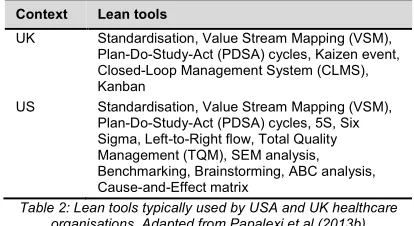
Additional tools were used by both countries and this is when differences could be observed (see Table 2).
Context Lean tools
UK Standardisation, Value Stream Mapping (VSM), Plan-Do-Study-Act (PDSA) cycles, Kaizen event, Closed-Loop Management System (CLMS), Kanban
[image:29.298.21.228.63.176.2]US Standardisation, Value Stream Mapping (VSM), Plan-Do-Study-Act (PDSA) cycles, 5S, Six Sigma, Left-to-Right flow, Total Quality Management (TQM), SEM analysis, Benchmarking, Brainstorming, ABC analysis, Cause-and-Effect matrix
Table 2: Lean tools typically used by USA and UK healthcare organisations. Adapted from Papalexi et al (2013b)
1.6 Levels of Lean implementation in
healthcare organisations
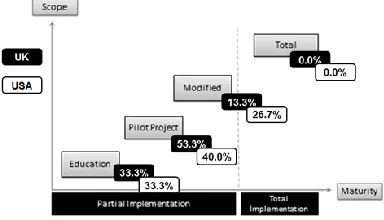
[image:30.298.78.270.149.259.2]There are four levels which can be used to describe an organisation’s degree of Lean implementation; Education, Pilot Project, Modified and Total. Research carried out by Papalexi et al (2013) classified the levels of US and UK Lean healthcare schemes using Safeyni’s (1991) Lean Maturity Model. The results were as follows:
Figure 1: Lean Maturity Model. Adapted from Safayeni et al., (1991) and modified by Papalexi et al., (2013b)
28
Lean Maturity Levels
Education Level
An intervention with the primary aim of finding a quick solution to a problem without understanding its root causes.
Pilot Level
These schemes show a deeper knowledge of the root cause of problems.
Modified Level
Interventions have successfully changed the operations of the organisation.
Total Implementation
Suggests that a world-class level has been reached.
Nevertheless, no case study was found where a healthcare organisation fell into the Total Implementation category, which highlighted the relative infancy of Lean application in the healthcare industry. However, the Royal Bolton NHS Foundation Trust in the UK is considered the closest healthcare organisation to achieving Total Implementation level (Radnor, 2010).
Reflection Questions
Q: What types of waste can you find in your processes?
Q: What Lean characteristics does your organisation show?
Q: What is your organisation doing to measure the effectiveness of your Lean schemes? Q: How mature is your organisation in Lean
implementation?
Chapter 2
Lean Thinking
Applied
The NHS is undergoing significant change and transformation as it strives to make productivity savings whilst simultaneously improving levels of patient safety and quality of care. The previous chapter gave an introduction and overview of Lean concepts and this chapter will demonstrate how Lean thinking can be practically applied. It will describe the Lean approaches used in a service improvement project which was part of a NHS Trust wide transformation programme, as well as several case studies demonstrating the use of Lean on a strategic level.
What is SPA?
SPA is a gateway for patients into health services. A clinical decision making function that signposts referral to the best service team for
2 Lean in Service
Transformation
A healthcare Transformation programme can cover an organisation with thousands of staff members, hundreds of premises, and tens of different kinds of services. All of these are reviewed simultaneously – not necessarily in the same pace and order. Throughout 2013, South West Yorkshire Partnership NHS Trust (SWYPFT) embarked on a Transformation programme in response to the UK healthcare productivity challenges. Within the Transformation programme was a series of service improvement projects which focussed on specific aspects of the care pathway and which used Lean thinking to redesign services. One such project was a review of the service access provisions across the Trust; namely, the four Single Point of Access teams (SPA). The project presented here is the ESRC funded Lean in Healthcare project (ES/K000667/1).
2.1 Improving access to healthcare
The organisational structure of the Trust has meant that service delivery was
32
the Trust. The project used Lean tools and techniques to:
1. Establish a baseline of current SPA provisions across the Trust.
2. Develop improvement opportunities by identifying waste and constructing ways to remove/reduce their impacts.
The work was not done in isolation by the project manager. As is typical with Lean, a bottom up approach was used with direct engagement with frontline SPA staff and other relevant stakeholders when appropriate.
Box 4: Engaging with the workforce
A series of workforce engagement events were held throughout the project and these took the form of facilitated workshops. The workshops had several purposes:
1. Introduce frontline workers in the use of different Lean tools and techniques as the project progressed
2. Establish and reinforce the sense of ownership and inclusion
3. Information and data collection
Lean tools used
[image:36.298.76.273.170.311.2]Each of the SPA teams had been developed differently in terms of their service scope, technological and staff resources, and operational procedures. In order to capture their differences, frontline workers from each team were directly engaged to understand these variations, and to collect relevant information and data. Value Stream Mapping (VSM) was used to capture the current state of each SPA team, highlight wastes and allow comparison to identify the variations between the teams. This led to the following realisations which also informed the next set of Lean approaches to use (as shown in Figure 2).
Figure 2: Realisations from Value Stream Mapping and subsequent Lean approaches
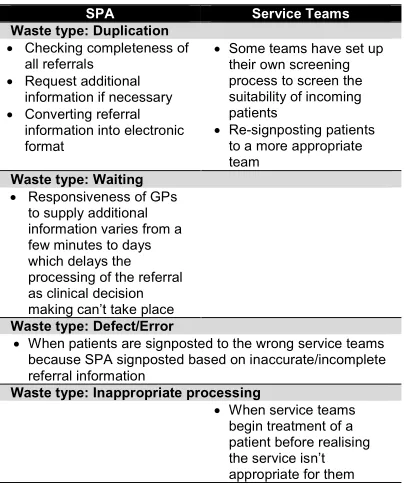
A number of operational wastes within SPA and also in
downstream service teams (see Table 3)
Root cause analysis
Multiple value streams resulting in unclear service offering and confusion over the role and purpose of SPA
Define customer
values
Inconsistent processes and
34
SPA Service Teams
Waste type: Duplication
Checking completeness of all referrals
Request additional information if necessary
Converting referral information into electronic format
Some teams have set up their own screening process to screen the suitability of incoming patients
Re-signposting patients to a more appropriate team
Waste type: Waiting
Responsiveness of GPs to supply additional information varies from a few minutes to days which delays the processing of the referral as clinical decision making can’t take place
Waste type: Defect/Error
When patients are signposted to the wrong service teams because SPA signposted based on inaccurate/incomplete referral information
Waste type: Inappropriate processing
[image:37.298.25.228.37.287.2] When service teams begin treatment of a patient before realising the service isn’t appropriate for them
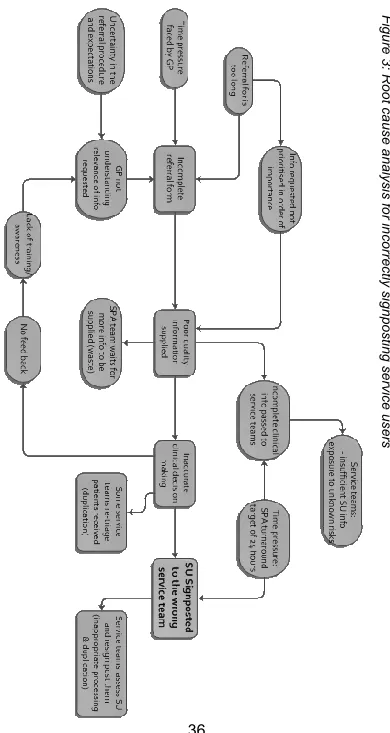
By using Root Cause Analysis and through the use of a Linkage diagram (Figure 3), the origins of the following wastes were traced back to the way referral information was being supplied to the SPAs:
Inaccurate signposting causing downstream duplication (assessments and re-signposting).
Missing or poor quality referral information.
Waiting for additional referral information.
Duplication: converting paper referral information into electronic format.
36
F
igu
re
3
:
Roo
t ca
us
e a
na
lysi
s f
o
r in
co
rre
ctly si
gn
po
sti
ng
se
rvice
us
er
[image:39.298.34.229.25.392.2]The House of Quality (HoQ) framework (typically associated with Quality Function Deployment, QFD), was used to assess the SPA redesign options to identify which would best satisfy the needs of the customer. The results of the HOQ are shown in Table 4. It determined that Option 4 or 5 would best satisfy the GP values. There was only a 1 point difference between these two solutions with Option 5 -
Combination of telephone & electronic referral system, scoring the highest and therefore the preferred option.
Redesign Options Score HoQ Ranking
1. Do nothing but roll out planned
RiO IT document scanning 30 5 2. Referral form submitted via
email 44 4
3. Online referral form integrated
into RiO IT system 48 3
4. All referrals taken by
telephone 60 2
5. Combination: Telephone &
[image:40.298.77.269.133.265.2]electronic submission 61 1
Table 4: Results of the House of Quality to identify preferred redesign option
Outcomes
38
links between primary and secondary care clinicians. Both GPs and SPA Clinicians considered telephone conversations to be valuable in creating richer clinical discussions and improved information exchange – particularly in conveying urgency, as well as serving as a knowledge transfer mechanism, i.e. instant feedback and education when referrals aren’t suitable for services.
In addition, the following process wastes would be mitigated:
Reduce signposting errors, i.e. improved quality of referral information to facilitate SPA clinical decision making.
Eliminate waiting for additional referral information from referrers. This can range from a few minutes up to several days.
Reduce number of inappropriate referrals made to SPA which was around 5%.
Reduce GP waiting times for advice/consultation from service teams/specialists.
Remove duplication from converting paper referrals into electronic format. Typing up a referral form into the IT system takes approximately 20 minutes per referral. This equates to around 3,950 hours per year.
2.2 Reducing variations in the clinical
decision making process
duplicate assessments further down the care pathway. Interviews with frontline workers revealed that the signposting decision was relatively subjective and at the discretion of individual SPA clinicians. Additional interviews and engagement with service teams revealed tensions between SPA and several teams which centred on the incorrect signposting of service users. This led to negative perceptions of the SPA teams within the organisation, yet highlighted the fact that the causes of the SPA signposting errors were not fully understood. Anecdotal evidence suggested insufficient training amongst SPA staff, weak management, not interpreting referral
information effectively and by far the most compelling reason, gaps in the Trust’s service offering.
Box 5: A Gap in the Service Offering?
Interviews with SPA workers and representatives from service teams revealed interface issues and tension between SPA and several service teams. These service teams claimed that they were sent a high number of service users whose needs were probably best suited in an alternate service. The impacts of SPA inaccurately signposting referrals were the creation of a number of problems:
Unnecessary multiple assessments for service user
Re-directing service user to more suitable service
Service user delayed in receiving treatment
Potential of exposing staff to high risk individuals
40
It was thought that there was an ambiguous group of service user whose needs were too severe to be treated by IAPT, yet not severe enough to dealt with by CMHT resulting in service users being ‘bounced’ between these two teams. It was believed that there was a gap in the Trust’s service offering between the IAPT and CMHT services which was causing the majority of the signposting inaccuracies in SPA.
Analysis of data suggested that the signposting error rate ranged from 17% to 55%. The investigation also revealed that the majority of signposting errors were in fact between SPA and three different service teams; IAPT, CMHT and Adult Psychological Therapies (APT). This was extremely useful because it disproved the managers’ original perception that there was a gap in the Trust’s service offerings between IAPT and CMHT. This avoided the creation and introduction of a potentially unnecessary service. The analysis of the data helped people to get an accurate picture of what was really happening and to understand where the problems were arising in order to work towards a proper solution. In this instance, the data implied difficulties in how SPA distinguished between referrals suited to IAPT, CMHT and APT. As such, the root cause of the signposting problems appeared to be inconsistency in the clinical decision making process. Therefore, the process through which the SPA clinician formulated their signposting decision was investigated to further understand the problem.
What is MCDA?
Multiple Criteria Decision Analysis (MCDA), is a method and framework to cope with the multiple aspects of a situation. It allows the aggregation and weighting of both qualitative and quantitative data to optimise decision making. SPA Clinical Decision Making Process
As revealed in the Box 5 case study, the SPA signposting problems appeared to stem from
inconsistencies in the clinical decision making process which required further investigation. Interviews with SPA Clinicians found that they considered a number of factors during their clinical decision making process. Three of these were qualitative factors such as the Sainsbury risk assessment tool, patient history and the current risk level of the patient. These were combined with the results of two quantitative surveys (PHQ-9 and GAD7). Nevertheless, the clinical decision ultimately rested solely on the expert opinion of the individual SPA clinician (Dehe, 2013). Further investigation revealed that variations existed between individual clinicians due to their levels of experience, risk perception, training and knowledge of available services; all of which could affect their clinical decision-making process. With such high degrees of variations, the application of Multiple Criteria Decision Analysis (MCDA) was considered ideal.
How could MCDA be applied?
1. Develop a common model with input from the four SPA teams to gain consensus on which criteria should be taken into account. 2. Develop and assign a
weighting to each criteria. 3. Pilot the model using
historical patient case data and adapt to improve the accuracy of the model. 4. Refine the MDCA model as
42
The use of MCDA is useful to support a more consistent approach to clinical decision making. An MCDA model can offer a powerful, structured framework to support the information exchange between clinicians by integrating qualitative and quantitative data within the same model in a systematic and consistent manner. It can help consolidate the information asymmetries between clinicians and has the necessary validity to be applied to the SPA process.
Box 6: The SPA MCDA Model
[image:45.298.28.220.145.339.2]A bespoke MCDA model was developed based on the results of in-depth interviews with SPA Clinicians. The decision making process and the criteria the SPA Clinician typically considered are summarised below:
Figure 4: SPA Clinician referral signposting decision making process. Adapted from Dehe (2013).
The decision making process was based on information supplied to the SPA Clinician on the referral form.
The information is a mixture of qualitative and quantitative factors which the clinician used in conjunction with their knowledge and experience to assess and determine the most appropriate service team to signpost the referral. The resulting signposting decision was therefore heavily subjective and at the discretion of individual clinicians based on individual levels of experience and expertise.
The MCDA model offered a methodology and framework to cope with the multiple aspects behind the signposting decision. In doing so, it can rationalise, standardise and bring consistency to the decision making process. MCDA works by allocating a weight to each criterion depending on its importance in informing decision making and the results aggregated to generate a score. The score can be used to distinguish which service team would be the optimal choice for a specific referral. The purpose of the SPA MCDA was to offer clarity to the SPA Clinician in distinguishing which service users would be best suited to IAPT, APT and CMHT.
It was recognised that the distinguishing factor between these teams was the level of risk. As has been demonstrated earlier, assessing risk of a referral is a key component of the SPA clinical decision making process and risk perception can vary between individual clinicians due to its qualitative nature. Developing a bespoke MCDA model for SPA could potentially quantify ‘risk’, to support/reinforce their decision making and help bring consistency in how risk is perceived between clinicians.
44
3 Strategic Applications of
Lean
The following sets of projects illustrate how Lean can be applied on a more strategic level to influence and improve the decision making process – in particular, the development of future healthcare resources and cultivating closer partnership working. It highlights how the implementation and dissemination of appropriate models can support complex and transparent decision making to resolve some of the issues that the NHS faces. The three projects presented are KTP collaborations with NHS Bradford and Airedale (KTP 1717, 7352, 7698).
3.1 Redesigning healthcare logistics
The project looked at both patient transport and logistics provisions that moved services and resources around the Bradford area. It involved an assessment of existing provisions, application of Lean thinking theories to rationalise the Trust’s logistical assets, and offered recommendations for redesign. The presence of a robust transport system has been found to improve access to healthcare services, yet it is often a forgotten element. This was supported by frequent comments arising from public consultations that transport is key to being able to access health services. The Department of Health social exclusion unit estimated that 1.4 million people per year missed/turned down or choose not to seek healthcare appointments because of transport issues
system could make a strategic contribution, allowing more patients to access healthcare services. The NHS approach to transport service provision was traditionally separated into patient and non-patient services. These were focused on individual efficiencies rather than overall system effectiveness. Because transport provisions were fragmented, there was lack of understanding of the different aspects and their associated costs. As more services shifted from acute settings and into the community, greater demand was being placed on transport provisions and the need for a more integrated approach between care providers in the district.
Patients notes have to follow the patient throughout their care pathway so when a patient is treated in the community, their notes from the acute services need to be there too. In addition, it was found that pathology services were only provided in the acute setting; therefore, all specimens taken in primary care have to be routed to secondary (acute) care for testing. These samples can be taken 24 hours a day and have a ‘shelf life’. This places a huge demand and pressure on the transport infrastructure (Bamford et al., 2009). The Trust uncovered the use of a number of transport providers for this service who all worked in isolation of one another. Transport-related logistics service expenditure across the Trust was estimated be in excess of £400,000 per annum – much of which was spent in an ad hoc manner (for example, of medical supplies, devices, aids and adaptations, and so on) which was not centrally coordinated and not managed in terms of efficiency or effectiveness.
The project brought together the various transport and service providers, who were able to uncover
46
specimens and patient notes throughout the system. This enabled a new model to be developed that would reduce the duplication and ultimately reduce costs to each organisation. Due to the complexity of the associated logistics, an integrated service improvement approach was used that involved four healthcare organisations – the Primary Care Trust, Acute Trusts and the Ambulance Trust.
Outcomes:
The outputs of the project saw the creation and roll out of an Integrated Transport Unit (ITU) in
collaboration with other trusts and the local authority. This resulted in a patient transport unit which co-ordinated and centralised some of the decision making. The approach not only radically improved the situation but also reduced a host of non-value-added activities. Examples included reducing spend on ad hoc and non-contracted taxi journeys, more efficient use of staff time (by reducing time spent on organising transport), better and more appropriate in-house vehicle fleet usage, and consolidating van runs. In doing so, this project was successful in terms of achieving both process improvement and efficiency through optimisation which were quantifiable and actually evidence based. By redesigning and optimising NHS Bradford and Airedale’s transport system and logistical assets management, the Trust was able to save in excess of £280,000 per year. A number of other indirect benefits were also realised (Bamford, 2013) such as:
Reduction in DNAs - people were less likely to waste an appointment if they can get there or if it is easier for them.
Contribute to reduce health inequalities and work towards health prevention - if people could access service better, then they could receive both early intervention and preventative care.
3.2 Aligning the strategic needs of
healthcare commissioners and
providers
This project focussed on how to inform strategic decision making by using classic management theory and evidence based. It involved the use of
performance appraisals and the balance scorecard frameworks to convert data sets into information in a business context, whilst integrating the fundamental purpose and aim of the Trusts; to provide appropriate patient services. It was about looking after the health of the local population.
The implementation of the Balanced Scorecard (BSC) enabled NHS Bradford and Airedale to align its strategies from its different units, and have a more robust and comprehensive approach to strategy deployment. It has helped the Trust to improve the effectiveness of its strategic decision making. It also established the use of formal decision making methods within healthcare at a time when it wasn’t practised as regularly as perhaps it is today. The introduction of the BSC and other strategic tools significantly improved the strategy alignment between the different units, as well as between the
48
3.3 Reducing the cycle time of
healthcare infrastructure projects
In this project, Lean construction concepts and decision making models were applied during the planning, design and management cycle of healthcare infrastructure projects. The Trust was in the process of assessing and developing new healthcare facilities that would satisfy current and future service demands. Existing premises were considered not fit for purpose to fulfil the Trust’s strategic aims and objectives. Furthermore, it was recognised that there was a lack of mechanisms, systems and procedures for overseeing the development and delivery of new healthcare premises and ensuring that they were suitable.
The Infrastructure Development Cycle
The infrastructure development cycle describes the major steps and milestones common to all new premises development projects. The four phases are:
1. Planning – alignment with operations strategy and shaping of the network and future development.
2. Design – recognisingthe design processes/needs of both infrastructure and the services.
Synchronising the two sets of design needs is essential to maximising fitness for purpose.
3. Construction – typically outsourced to contractors to deliver the physical product, and associated with funding and handover processes.
Evaluating and optimising the decision making process of new healthcare centres
In the Planning phase, estates rationalisation and site selection were identified as real issues and
bottlenecks within the infrastructure development process. The problem appeared to be balancing and satisfying the needs of various stakeholder groups; in particular, the local populations who had a high interest and genuine concern over the location of their future healthcare centre, with the local political issues and strategic direction of the Trust. However, it was recognised that without a decision on the location of the new premises, the ability to carry out other planning and design activities were hindered. It also ultimately resulted in a longer infrastructure development cycle time (up to 15 years), and developments which might not necessarily be fit for purpose.
With decision making within the planning and design stages understood to be the process bottleneck, any effort to improve the overall development should be focussed on alleviating these constraints. As such, the following tools and techniques were applied:
i) MCDA to optimise the site selection process. ii) A performance framework to support the
innovation and continuous improvement. iii) QFD to optimise the design decisions. They formed the bespoke Lean methodology deployed to support the new infrastructure development processes.
50
involved looking at a number of criteria and associated sub-criteria. The criteria included:
Environment and safety
Population profile
Total cost
Accessibility
Risks
Design The weighting for each criterion was informed by outputs from the public and stakeholder consultation events. This allowed the creation of a model that applied evidential reasoning to identify an optimum site location. The MCDA was not restricted for use in site selection, but could be used to inform other strategic decisions. By using MCDA, it was
established that the cycle time for the Planning phase could be reduced from 50 months to 36 months – a 28% cycle time reduction.
Using the voice of the customer to drive infrastructure design
The QFD models facilitated information sharing, controlled processes and ensured transparent decision-making based on Lean thinking principles (waste elimination, focus on value added activities and setting-up for continuous improvement). In implementing the QFD framework, a number of benefits could be achieved, most notably:
A 15% reduction in design iterations.
10% improvement in the speed of the Design phase.
Reducing the Design phase from 27 months to 22 months.
52
4 Challenges to Lean in
Healthcare
Although the Lean projects presented in this chapter have illustrated numerous benefits, the route through which they were achieved was not without challenges. Research has shown that 70% of change projects fail to achieve their main objectives, whilst 90-95% of Lean initiatives fail (Bamford et al, 2003). With this in mind, this next section offers practitioner reflections and lessons learnt from a service transformation project, as well as some tips on how to become more resilient for future Lean projects.
The organisational culture isn’t ready for change
An important aspect of Lean implementation is a change in the organisational culture; moving away from traditional top down management to a bottom up approach and entrusting and empowering the workforce to deliver change. However, there are some who have experienced uncertainty and fear amongst the workforce which resulted in resistance and unwillingness to engage and support Lean schemes.
If things go wrong, remember:
You did your best so this will make accepting failure easier
Learn from it – take time to reflect; after all, you have gained an experience!
The idea didn’t fail, its execution did. Redevelop and improve it so next time it will be more successful
Create a culture of accepting honest failure by sharing your learnings
It was thought that lack of communication, transparency and low visibility/absence from senior management confounded the problem. It is therefore important to realise that Lean cannot simply focus on improving the operational process, but must also include organisational change management. Maintaining strategic buy-in and momentum
As a Trust undergoes a period of quite intense change, it can be particularly challenging to maintain focus and momentum. Particularly when new ideas are being generated but not enough time is spent on developing them and seeing them through to the end. Changes in leadership and changes in who holds ownership of the programme can present an
additional challenge. This reinforces the importance of assigning clearly defined roles and responsibilities in these types of projects for the purpose of managing expectations. Furthermore, the role of leadership is pivotal in driving a project forward; dictating the pace of change to ensure that it isn’t too slow so the workforce loses interest, nor too fast to avoid good ideas being applied badly.
Availability of data
54
Unclear Lean programme/project plan
An absent or poorly established programme management structure and plan can result in project delays. For example, if there are queries which require strategic input/guidance but the absence of a clear structure and hierarchy makes obtaining answers difficult. Nevertheless, it reinforces the importance of having clearly defined roles and responsibilities for all individuals involved right from the start.
Practitioner Reflections
When we went in to work with different staff groups doing process mapping and having discussions around improvements, there was singularly little resistance to change and lots of eagerness to do things better and more effectively. I think it is really important to trust the front line staff. They are very creative people, open to new ideas and often they are constantly on the lookout for better ways to do things. But, they need to be given permission to make the changes they need to make. I think this is where Lean can really support us because this is one of the fundamental principles of Lean; the people who are delivering the services, are the people who know what the problems are and who are best placed to work out the solutions to those problems.
4.1 What can be done to overcome
challenges?
Here are some top tips for personal resilience: It is not a ‘failure’ but an ‘opportunity to improve
and learn’.
Remember the good experiences: Get inspired by best practices and your achievements! Celebrate successful stories.
Remember the positives: actively collect compliments – keep emails and letters of thanks from patients.
Practitioner Reflections
Spend time at the beginning being really careful about how you set things up. Make sure that you understand the scope of what you are trying to do and that everybody else who is involved understands and agrees the scope.
Make sure you are really clear about precisely what you are going to deliver, the different roles involved, the different responsibilities involved. Make sure that everybody agrees and understands them and are comfortable with them.
The more time you spend on that, the less hassle you will have later on in the project!
56
Reflection Questions
Q: What are you doing or what more could do to ensure your Lean schemes engages from the
bottom up?
Q: How engaged are your senior management team in your Lean initiative? Q: Q: What are you doing or what more could do to prepare your organisation for the upcoming
change?
Chapter 3
Lean Thinking
Dissemination
5 The Importance of
Dissemination
Although the idea of Lean applied within NHS processes is not new (Bamford et al., 2011; Boaden et al., 2008), the dissemination and further
implementation of the knowledge and learnings gained from previous Lean projects is an equally important activity that could be better practiced. Disseminating best practice and accumulated knowledge presents an opportunity for other organisations to challenge their status-quo, and encourage them to revise their existing processes, and work towards rationalising and optimising resources by using Lean thinking. If done effectively, its impact could potentially expand beyond inspiring colleagues and industry peers, to directly influencing policy makers through engaging with the wider health community.
There are a variety of proven tools and methods that can be used to disseminate work to the wider health community and these can be applied both internally and externally and some of these are presented in this chapter.
5.1 Create a dedicated project website
60
SharePoint
There will be instances when information needs to be shared or communicated to a restricted audience, i.e. only to in-house/project staff. Using an internal virtual shared document storage area such as a ‘SharePoint’, in parallel to the website can facilitate this, as well as create transparency and sense of inclusion in a Lean project.
Furthermore, a website can host a variety of multimedia platforms that can make disseminating your work more interesting and engaging, e.g. Discussion boards, electronic surveys, podcasts, downloadable materials.
Ultimately, a project website can be used as a central source of information that is freely and permanently available to all those who wish to access it.
5.2 Use and expand
your existing
network of
contacts
What is Social Media?
Social media is, “a set of technologies and channels targeted at forming and enabling a potentially massive community of participants to productively collaborate” (Bradley, 2010,
identified as challenges to Lean in healthcare projects in Chapter 2.
The external impact of increasing the visibility of a Lean project is its expansion beyond the confines of the host Trust to neighbouring Trusts and eventually further afield, and potentially policy and national strategy development level. There is also the potential of it reaching the realms of other institutions, e.g. Universities; nurturing partnerships working or improved links with these institutes for access to research and knowledge exchange. The development of these networks doesn’t necessarily rest solely on the networking capabilities of a sole individual, but the effective use of other readily available tools can make network development much easier. One such example is social media.
5.3 Using social media
Advancement and availability of technology have allowed individuals and organisations to use more innovative methods to communicate and collaborate with each other, and one such example is Social Media (Williams et al., 2012). It
62
knowledge and higher revenue” (Henneman, 2010, p. 4), so it can be relevant in sharing learnings from Lean projects.
Box 7: Case Study - @UoHLeanHealth
A Twitter feed was set up during the ‘Improving Access to Healthcare’ Lean project. Its purpose was to:
Provide real time information on latest project activities and development
Generate discussions and seek
advice/guidance/opinions around Lean thinking from others
Follow latest thinking and topics around aspects of Lean healthcare
Access individuals who in normal circumstances may be difficult to contact
Academic researchers have been using social media to communicate their work, finding out about others work, or for developing and sustaining networks (Rowlands et al., 2011). Feedback/responses are instantaneous and due to its web-based nature, geographical limitations no longer hinder discussions and knowledge exchange.
There are numerous types of social media platforms such as Blogs, Twitter, LinkedIn, YouTube, Facebook, Pinterest and Instagram; each appealing to different demographics and with a different tone. For example, LinkedIn targets the professional workforce to share industry specific news and to allow the user to connect to other similar individuals (LinkedIn, 2014). Therefore, it is important to have a clear
understanding of the audience you intend to share with and the ‘tone’ and image you would like to project, as this would dictate which social media platform to use.
5.4 Host or attend industry seminar
events
Organising a bespoke seminar event is an ideal way to share work and knowledge directly with a specific audience. It can be particularly effective in engaging practitioners to allow dissemination to a wider network of other NHS Trusts and healthcare organisations. Not only would a seminar help to expand your own network of contacts, but it will also allow attendees to develop their own networks and share their
64
External organisations often organise their own seminar/conference events and typically place a ‘call for speakers’. These are ideal opportunities to proactively share a Lean project to relevant individuals involved in local/regional healthcare community. Higher education institutes may be keen to develop links with local industries so being available to share experiences of the practical realities of the application of theory would be of great interest to them. Other healthcare knowledge sharing networks include NHS National Institute of Health Research (NIHR), regional Collaboration for Leadership in Applied Health Research and Care (CLAHRC), Academic Health Science Networks (AHSN).
Box 8: Case Study - Challenges to Healthcare Transformation Seminar
The University of Huddersfield held a bespoke seminar event targeting healthcare practitioners. The event was open to all healthcare professionals and healthcare researchers. Delegates came from several NHS trusts, councils and third sector health service providers from across Yorkshire and as far as Greece.
5.5 Use multimedia differently
Whilst traditional dissemination mediums can be heavily text based, i.e. articles, websites, blogs; this may not appeal to everyone nor hold their attention. Using other methods that contain an element of interaction and that differ from the norm, can be more appealing and facilitate greater engagement. Examples are audio Podcasts, Video casts and the use of ‘Prezi’ instead of a standard PowerPoint presentation. Prezi differ in that it can contain greater amounts of information in different media formats (embedded videos, audios) yet allows the user to explore the information themselves; at their own pace, in the order they want and level of detail they need. The zooming feature of Prezi can make exploration more visually appealing and engaging, rather than clicking through a traditional slide deck.
5.6 Apply for awards
Finally, consciously celebrate success and
Box 9: Case Study - BOSCAT research group
66
projects by applying for industry and/or in-house awards. Even if the application is unsuccessful, at least it would have reached the attention of those assessing it. Nevertheless, if the project wins than your efforts and achievements will be recognised, and your learnings shared.
Reflection Questions
Q: What Lean projects have you done that you could share with others? Remember, they don’t have to have gone to plan and don’t just share
the results, share your experience. Q: What have you done to share your Lean
thinking projects?
Concluding Remarks
As this book has showcased, Lean is highly relevant and applicable to the NHS and can support and underpin the significant changes that are taking place. The case studies have shown that the correct adaptation and application of Lean can help healt