2017 2nd International Conference on Computer, Mechatronics and Electronic Engineering (CMEE 2017) ISBN: 978-1-60595-532-2
Visual Inspection Method of Ceramic Bottle Surface Defects
Based on Niblack Optimization
Li-yuan LI
1, Xue-wu ZHANG
1,*, Wen-tao LI
1, Xiao-qi SHAO
1,
Yan XIANG
2and Jin-bao SHENG
21
College of Internet of Things Engineering, Hohai University Changzhou, China
2
Nanjing Hydraulic Research Institute, China
*Corresponding author
Keywords: Machine vision, Defect detection, Image segmentation, Support vector machine.
Abstract. In order to improve the efficiency and accuracy of the defect detection of ceramic bottle production line, a method of visual inspection of ceramic bottle surface defects based on threshold segmentation Niblack optimization algorithm is been proposed. The CLAHE interpolation image enhancement algorithm is used to improve the image contrast, and then the local threshold is obtained by calculating the local mean and standard deviation in the domain window to realize the segmentation of the defective region. Then the minimum gray value difference is introduced and whether there are defects in images are determined to the center pixel gray value range. The characteristics of the defect target are extracted, and the defect classifier is used to classify the defects according to the principle of support vector machine. The experimental results show that the optimization algorithm can realize the effective segmentation of the defect area and reduce the false detection rate by reducing the influence of background noise on the segmentation results with an accuracy rate of 90.8%.
Introduction
In the firing process of ceramic products, the defects on the surface of ceramic bottle can lead to stress concentration easily and cause damage. At present, domestic and foreign researchers have made some progress in the detection of ceramic surface defects [1, 2, 3, 4]. Guo Meng et al. [1] combined Kirsch and Canny operator to achieve the edge detection of the defect. Li Qingli et al. [2] proposed a feature color extraction method based on gray relational analysis to realize the detection of ceramic defects. Yasantha C. Samarawickrama etc [3] compared the differences of the white pixels in the edge detection images and the filled image are calculated respectively in the blocks and the reference blocks. Atul N. Shire etc [4] turned the image into a black-and-white image first, and then used the second-order edge detection to connect the edge point of the image to detect defects.
In order to improve the development of automatic detection of surface defects of ceramic vials, this paper presents a Niblack binarization optimization algorithm based on machine vision and localized threshold segmentation to realize the effective segmentation of defective surface of ceramic. In this paper, the images of six kinds of defect, such as pits, cracks, scratches, spots, pinholes and bubbles are added and segmented, and the shape, grayscale and texture feature vectors are extracted as the input vector of support vector machine (SVM) to identify different types of defects.
System Structure
includes a conveyor belt, a photoelectric switch, an entrance flap, a CMOS camera, a rotary table and a sorting device.
Figure 1. System structure.
Image Processing
CLAHE Interpolation Image Enhancement
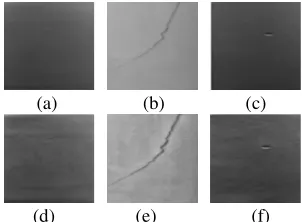
Since the defective portion information is less obvious due to the reflective of ceramic surface, image enhancement is performed before the defect detection is performed. The image is processed by the contrast-limited adaptive histogram equalization (CLAHE) interpolation algorithm proposed by Zuiderveld Karel. The experimental results are shown in Fig. 2. Fig. 2 (a) (b) (c) shows the original images of ceramic bottle with no defective surface, crack surface and pit surface. Fig. 2 (d) (e) (f) shows the images that have been processed by CLAHE interpolation image enhancement. It is showed in the experimental results that the defect feature is more obvious and with higher contrast after image enhancement, which is helpful for image segmentation and feature extraction.
(a) (b) (c)
(d) (e) (f)
Figure 2. The enhancement effect of ceramic bottle with no defective surface, crack surface and pit surface (a)(b)(c)original images; (d)(e)(f)CLAHE interpolation enhancement image.
Improved Algorithm of Niblack Image Segmentation
The traditional Niblack binarization algorithm defines a neighborhood window first and then calculate the local threshold by moving the neighborhood window on the gray scale. The local threshold T can be obtained by calculating the local mean m and standard deviation s of the neighborhood window. The local threshold is calculated as shown in Eq. 1 [5],
2 i
2 2
i
p 1
T m k s m k (p m) m k ( m ).
NP NP
= + × = + ×
∑
− = + ×∑
− (1) [image:2.612.230.381.420.531.2]pixel gray value f(x, y) > T. And the gray value is set to 0 and defined as a dark spot when the center pixel gray value f(x, y) ≤T.
In order to avoid the effect of noise on image segmentation, the Niblack binarization algorithm is improved, and the concept of minimum gray scale difference Abs is introduced. In the neighborhood window with size M×N, it is assumed that f(x, y) is the gray value of the central pixel and m(x, y) and d(x, y) represent for the local mean and the standard deviation in the neighborhood window respectively, and StdScale is the standard deviation coefficients in the input [0, 1].Then the variable V(x, y) can be defined by the Eq. 2,
v(x, y)=max(StdScale d(x, y), Abs).× (2) The standard deviation d(x, y) measures the noise in the figure and StdScale reflects the sensitivity of the algorithm to noise. So we can get Eq. 3 and Eq. 4 from Eq. 2 and the original Niblack binarization algorithm,
f (x, y)>m(x, y)+v(x, y). (3)
f (x, y)<m(x, y) v(x, y).− (4)
m(x, y) v(x, y)− ≤f (x, y)≤m(x, y)+v(x, y). (5) We can get the conclusions that the center pixel which satisfying Eq. 3 or Eq. 4 is considered to be in the defect existence region. And the center pixel which satisfies the Eq. 3 is a bright spot and which satisfies the Eq. 4 is a dark spot. The center pixel which satisfying the Eq. 5 is considered to be in the smooth region.
Defect Feature Extraction and Classification Recognition
This paper extracts 22 characteristic descriptors of the image including 11 regional shape features
[6], such as the area, circumference, rectangle, compactness and Hu moment combination Φ1~Φ7,
and 7 grayscale feature [7], such as the maximum, minimum, contrast, gray mean, gray variance, entropy and the nonhomporal coefficient of the image, and four texture features [8], such as the contrast, the angular second moment, the inverse moment [9], and the correlation.
SVM algorithm play an important role in solving small samples, non-linear and high-dimensional problems[10].The 22 characteristic vectors are the input of the SVM, which outputs the results of the classification recognition.
Experiment and Analysis
According to multiple parameters set the experimental results, we set the size of the neighborhood window M×N as 11×11, the minimum gray value difference as 10, and the standard deviation coefficientStdScale as 0.2.
(a) Original image(b) Optimization algorithm(c) Otsu (d) Iterative optimal threshold (e) Sobel (f) Roberts
Figure 3. Segmentation results of different algorithm.
The improved algorithm is used to segment the image with different types of defects. The experimental results are shown in Fig. 4. In Fig. 4, (a) to (d) are the original defect images of different defect types. (e) to (h) are images that are enhanced by CLAHE algorithm. (i) to (l) are the images that are processed by the image segmentation algorithm proposed by the paper. The experimental results show that the improved algorithm has a good effect in segmenting many different types of defects, and the defect features are obvious.
(a) (b) (c) (d)
(e) (f) (g) (h)
[image:4.612.193.420.230.399.2](i) (j) (k) (l)
Figure 4. Detection results of different types of defects.
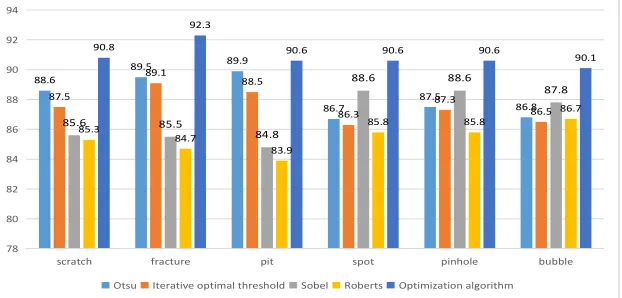
We use Halcon platform to complete the classification process. The experiment under 22 feature dimensions selected a total of 862 defect pictures, and 40% of the defective pictures are set as training samples, and all the pictures are set as test samples. The Niblack improvement algorithm, Otsu, the optimal threshold method, Sobel and Roberts algorithm are used to segment six kinds of defective images including scrambling, fractures, pits, spots, pinholes and bubbles. The defective images after segmented are the input of SVM for classification and recognition. The classification accuracy of different algorithms is shown in Fig. 5. It is showed in the experimental results that images processed by the Niblack improvement segmentation algorithm has higher accuracy of 90.8% than other algorithms in SVM with the definite selected defect feature and classification recognition algorithm. To some extent, it can satisfy the needs of industrial production and improve the quality of production.
88.6
89.5 89.9
86.7
87.5
86.8 87.5
89.1
88.5
86.3
87.3
86.5
85.6 85.5
84.8
88.6 88.6
87.8
85.3
84.7
83.9
85.8 85.8
86.7 90.8
92.3
90.6 90.6 90.6
90.1
78 80 82 84 86 88 90 92 94
[image:4.612.152.463.574.723.2]Summary
Aiming at improving the efficiency and accuracy of the defect detection of ceramic bottle production, an automatic method for identifying and classifying the defects on the surface of ceramic bottles is proposed. This method improves the traditional Niblack binarization image segmentation algorithm, and combines the support vector machine classification to complete the identification and classification of the defects on the surface of ceramic bottles. The experimental results show that the proposed method can reduce the interference of background noise in the image effectively, the classification accuracy of SVM is 90.8%, which can meet the efficiency and accuracy of detection on the production line.
Acknowledgement
This paper is supported by the Fundamental Research Funds for the Central Universities (2015B25214, Y716019, Y716015, Y716011, 51679151), National Natural Science Foundation of China (61671202, 61573128, 61273170), National Key Research Program of China (2016YFC0401606, 2016YFC0401605).
Reference
[1] Guo Meng, Hu Liao-lin, Zhao Jiang-tao. Preparation Detection of Ceramic Bowl Based on Kirsch and Canny Operator [J/OL]. Acta Optica Sinica, 2016, 36 (09): 27-33.
[2] Li Qingli, Wang Yongqiang, Zhang Fan. Study on visual inspection algorithm of ceramic tile surface defects [J]. China Ceramics, 2015, 51 (03): 44-47.
[3] Yasantha C. Samarawickrama, Chamira D. Wickramasinghe, "Matlab based automated surface defect detection system for ceremic tiles using image processing", Technology and Management (NCTM) National Conference on, pp. 34-39, 2017.
[4] Shire, Atul N., M. M. Khanapurkar, and R. S. Mundewadikar. "Plain Ceramic Tiles Surface Defect Detection Using Image Processing." Fourth International Conference on Emerging Trends in Engineering & Technology IEEE Computer Society, 2011: 215-220.
[5] Khurshid K, Faure C. Comparison of Niblack inspired binarization methods for ancient documents: Document Recognition and Retrieval Xvi, Drr 2009, Document Recognition and Retrieval Conference, 2009 [C].
[6] Singh J P. Designing an FPGA Synthesizable Computer Vision Algotithm to Detect the Greening of Potatoes [J] .arXiv preprint arXiv: 1403.1974, 2014.
[7] Steinbrucker F, Kerl C, Cremers D. Large-scale multi-resolution surface reconstruction from RGBR: Proceedings of the IEEE International Conference on Computer Vision, 2013 [C].
[8] Bao Hua, MA Bailong, Jiao Liheng. Analysis of Gray-degree Co-occurrence Matrix of Image Texture [J].Journal of Electronics, 2006, 34 (1): 155-158.
[9] Liu Li, Gang Kuangyao.A review of image texture feature extraction methods [J].Journal of Image and Graphics, 2009, 14 (4): 622-635.
[10] Cortes C, Vapnik V. Support vector machine [J]. Machine learning, 1995, 20 (3): 273-297.