University of Huddersfield Repository
Ahmed, Nisreen and Teviotdale, Wilma
Formative Assessment in Higher Education
Original Citation
Ahmed, Nisreen and Teviotdale, Wilma (2008) Formative Assessment in Higher Education. In:
BMAF Annual Conference 2008 The Learning and Teaching Agenda in the UK: National
Perspectives but Common Concerns?, 29th – 30th April 2008, Edinburgh, UK. (Unpublished)
This version is available at http://eprints.hud.ac.uk/id/eprint/9540/
The University Repository is a digital collection of the research output of the
University, available on Open Access. Copyright and Moral Rights for the items
on this site are retained by the individual author and/or other copyright owners.
Users may access full items free of charge; copies of full text items generally
can be reproduced, displayed or performed and given to third parties in any
format or medium for personal research or study, educational or notforprofit
purposes without prior permission or charge, provided:
•
The authors, title and full bibliographic details is credited in any copy;
•
A hyperlink and/or URL is included for the original metadata page; and
•
The content is not changed in any way.
For more information, including our policy and submission procedure, please
contact the Repository Team at: [email protected].
Formative Assessment in Higher Education
Presented to HEA BMAF conference, Edinburgh, April 2008
Nisreen Ahmed & Wilma Teviotdale, University of Huddersfield.
Abstract.
Assessment is a key driver in higher education. As summative assessment is high stakes students tend to focus on this aspect and, with various other constraints, overlook the
importance of formative assessment. Research evidence has shown that formative assessment does improve learning. Research has carried out in this area which has taken place at school, colleges and higher education level. This paper outlines an on-going three year TQEF project undertaken at the University of Huddersfield’s Business School. The project aims to provide a more co-ordinated, and effective approach to formative assessment, placing this at the centre of quality enhancement in the curriculum, thus prompting learning,
enhancing retention, progression and encouraging students to excel in their learning. The project’s main focus is on first year undergraduate students. To support the project a survey of current first year undergraduates was undertaken followed by qualitative research to explore in more detail students experiences of formative assessment.
Introduction
Traditionally within the educational sector, assessment is viewed as an essential feature in the teaching and learning process. Assessment is a vital to a number of parties, not only to the educational institution itself but also to stakeholders, professional bodies and most
importantly to students. There is little doubt that assessment is a key driver and students place high value on marks or grades they receive. Brown (2001) states “assessment defines what students regard as important. What is then the difference between summative and formative assessment? In simple terms summative assessment, often referred to as ‘assessment of learning’, is regarded as high stakes and tends to come at the end of a course of study or programme where judgements are made on the student performances, for certification purposes. Whereas formative assessment is often referred to as ‘assessment for learning’, which is low stakes and occurs during the learning process where students have the opportunity to receive feedback on their performance and to help them improve on their learning. York (2003) states that the concept behind “formative assessment is to contribute to student learning through the provision of information about performance”.
Research highlights that formative assessment does improve learning. Black and William (1998) conducted a meta-analysis on formative assessment research across the schools, colleges and higher education sectors and concluded that ‘formative assessment does improve student learning’.
Features of Formative assessment
It has been highlighted that there is no common understanding of the term formative
assessment, (Wiliam & Black,(1996). However, there are a number of interpretations of the term. Black & Wiliam (1998) describe formative assessment as “encompassing all those activities undertaken by teachers, and/or by their students, which provide information to be used as feedback to modify the teaching and learning activities in which they are engaged”. Sadler (1998) explains that “formative assessment refers to assessment that is specially intended to generate feedback on performance to improve and accelerate learning”. Cowie and Bell (1999) define formative assessment as “the process used by teachers to recognize, and respond to student learning in order to enhance that learning, during learning”.
Taking into consideration these various interpretations what is apparent is that the concept of feedback is imperative to formative assessment. Black and Wiliam (1998) identify feedback as central to formative assessment and define it as “Any information that is provided to the performer of any action about their performance”. Ramprasad (1983) defined feedback as “information about the existing ‘gap’ between actual level and the reference level of performance, stressing that information was only ‘feedback’ if used to alter the gap”. Biggs (1998) argues that the “effectiveness of formative assessment is dependent upon the students accurate perception of the gap, as well as their motivation to address it”.
Black and Wiliam (1998) conducted a meta-analysis of over 250 studies and stated that “feedback produced significant benefits in learning and achievement across all content areas, knowledge and skill types and levels of education”.
The work of Sadler (1989) is highly influential and has been used by other writers to underpin their research in this area. Sadler identified three conditions necessary for students to benefit from feedback in academic tasks. He argued that students must know:
1. “what good performance is (i.e. the student must possess a concept of the goal or standards being aimed for);
2. how current performance relates to good performance ( for this, the student must be able to compare current and good performance);
3. how to act to close the gap between current and good performance”. Sadler (1989)
It appears that just providing students with feedback on their performance is not enough and that steps have to put in place where the student have the opportunity to actively engage with the feedback. (Rust 2002) states “…just giving feedback to students without requiring them to actively engage with it is likely to have limited effect”.
Nicol et al (2006) discuss formative assessment and self-regulated learning and propose a model and seven good principles of feedback. The principles are as follows:
1. helps clarify what good performance is (goals, criteria, expected standards); 2. facilitates the development of self-assessment (reflection) in learning; 3. delivers high quality information to students about their learning; 4. encourages teacher and peer dialogue around learning;
5. encourages positive motivational beliefs and self-esteem;
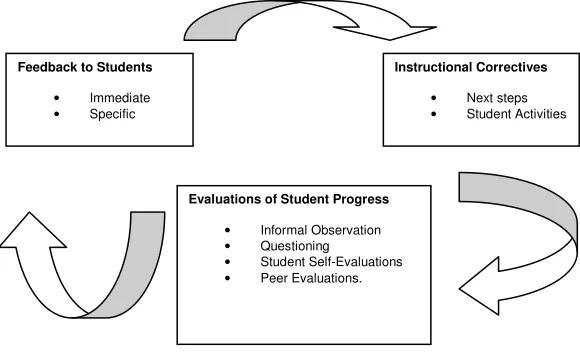
McMillan (2007) argues that “the aim of formative assessment is to improve student motivation and learning. For this aim to be achievable, teachers must construct a cycle of a continuing process of learning that involves their evaluations of student work and behaviour, feedback to students, and instructional correctives”. (See figure1)
Figure 1 McMillan 2007, (p.3)
It has been expressed that the same assessment can be used for both formative and summative purposes therefore “an assessment is formative to the extent that information from the
assessment is fed back within the system and actually used to improve the performance, of the system in some way (i.e., that the assessment forms the direction of the improvement)” (McMillan, 2007). Other researchers have commented that the difference between formative and summative assessment is the purpose and effect, not timing (Sadler 1989). When
considering the terms formative and summative assessment Wiliam & Black (1996) state that “from the earliest use of these terms, it was stressed that the terms applied not to the
assessment themselves, but to the function they served”.
Formative assessment ‘purists’ argue that the purpose of formative assessment is to provide students with opportunities to complete activities during the learning process to help them improve their learning without providing marks/grades. However, some argue the point how are students able to make judgements as to what is a good or a poor piece of work without any actual guidance on what that piece of work is worth (Race 2007).
Taras (2001) illustrates in her study how student self-assessment which uses tutor feedback in summative, graded student work can keep a strong formative element.
It would seem that tutors cannot assume that students will understand what to do with the feedback that is given to them therefore it is important that tutors should help students engage with feedback. Students need to understand what tutors want from them therefore students need to understand assessment criteria. Another point to take in to account is that students should have the ability to self assess their learning:
Feedback to Students
• Immediate • Specific
Instructional Correctives
• Next steps • Student Activities
Evaluations of Student Progress
• Informal Observation
• Questioning
“The indispensable conditions for improvement are that the student comes to hold a concept of quality roughly similar to that held by the teacher, is able to monitor continuously the quality of what is being produced during the act of production itself, and has a repertoire of alternative moves or strategies from which to draw at any given point. In other words, students have to be able to judge the quality of what they are producing and be able to regulate what they are doing during the doing of it”.
(Sadler 1989).
Irons (2008) emphasises that formative feedback can take various forms and the most appropriate form taken depends on the circumstances of what is being taught. Irons (2008) illustrates typical feedback approaches such as “annotated scripts (coursework &
examinations), feedback sheets, marking grids, model answers, statement banks, demonstrations, peer feedback, tutorials and various e-assessment mechanisms”.
Curriculum development is a crucial aspect when thinking about formative assessment. Staff workload and other problematic considerations such as timeliness need to be taken into consideration and balanced with strategies which will produce feedback for the students and get the students involved in being able to be independent learners and making judgements about their learning for example the use of peer, self-assessment and the use of ICT.
The work of Ramprasad, Sadler and Black & Wiliam is well quoted and influential. They emphasise the importance of feedback and getting students actively involved with feedback. Students need to be aware that feedback comes in various forms and that feedback does not automatically mean tutor written feedback. It is reasonable to believe that students will compare themselves with each other. By introducing peer assessment this would legitimise what students do informally. Peer assessment would mean students giving feedback to each other and in order form them to make judgements; students will have to have an
understanding of assessment criteria. Another way students can make judgments about their own learning and have an understanding of assessment criteria is through self-assessment. By using peer and self assessment the onus of assessment is on the students. Boud et al (1999) state that such peer processes can help students develop their judgment skills which in turn students can use to produce and regulate their own work.
“Nothing affects students more than assessment, yet they often claim that they are in the dark as to what goes on in the minds of their assessors and examiners. Involving students in peer-and self-assessment can let them in to the assessment culture they must survive”. (Race, (2007)
Another useful and powerful tool that has been advocated in helping students to clarify goals and standards is by way of using ‘exemplars’. Orsmond et al, (2002) state that “the use of exemplars can help students demonstrate greater understanding of both marking criteria and subject standards; the use can help students learning so that higher quality outcomes are produced and the use of exemplars forms a focus for meaningful formative feedback”.
The methods of self and peer assessment are not easy to master. However, by embedding these methods as part of the teaching and learning process, and hence part of the student’s higher education experience, would help them in becoming independent learners and reflective practitioners. Further, they would be able to apply such skills in the world of employment.
Extensive research has taken place in the area of peer and self-assessment which shows its benefits. (e.g. Boud, (1991); Boud,(1995); Dochy et al., (1999); Orsmond et al
(1997);Orsmond et al (2000); Orsmond et al (2004). Dochy et al (1999) state from their study that:
“Overall, it can be concluded that research reports positive findings concerning the use of assessment in educational practice. Students who engage in
self-assessment tend to score most highly on tests. Self-self-assessment, used in most cases to promote the learning of skills and abilities, leads to more reflection on one’s own work, a higher standard of outcomes, responsibility for one’s own learning and increasing understanding of problem-solving. The accuracy of the self-assessment improves over time. This accuracy is enhanced when teachers give feedback on students self assessment”.
New technologies are developing all the time and education has been affected by these. HEFCE encourage the use of e-learning (ICT) to make higher education accessible and flexible. HEFCE (2005), in their 10 year e-learning strategy assert that “we aim to support the HE sector as it moves towards embedding e-learning appropriately, using technology to transform higher education into a more student-focused and flexible system, as part of lifelong learning for all who can benefit”. ICT can be used as a tool for promoting learning, as for example using MCQs and computer-assisted assessment help with the changing higher education environment such as growing student number, reduced resources, and time
Methodology
This TQEF sponsored project is work-in-progress, having started in December 2006 with an end date of July 2009.
The data collection for the purposes of this project uses a combination of quantitative and qualitative methods. Questionnaires are used and followed up by semi-structured interviews to obtain a better understanding of how the formative assessments have worked.
As previously mentioned recent research in the area of formative assessment suggests that it is not the assessment method (activity) that makes it formative but the function and purpose it serves. Some of the key factors relating to formative assessment are that students are provided with the opportunity to complete activities, make mistakes and receive feedback to help improve their learning. It will also help students to be able to make judgments about their learning which in turn should help with their motivation and confidence.
The aim of the project is to have more co-ordinated and effective approaches to formative assessment. An initial pilot study was undertaken to obtain information as to what formative assessment was already happening within the Business School and to ascertain the attitudes and understanding of both staff and students (2006/07 cohort) to formative assessment in order to frame further research. This process was conducted using structured interviews with staff and holding semi-structured group interviews with students. The following are examples of some of the findings from this process:
• Staff are supportive of formative assessment and there are a variety of practices in
use. However, the lack of student engagement and use of effective formative assessment emphasizes staff concerns about additional workload.
• There was little use of ICT to support formative assessment. Assessment tools on
Blackboard were rarely used.
• Most staff had not considered the use of formative assessment as a means of
reflecting on how to improve the modules’ teaching & learning approaches.
• Students did not understand what formative assessment was and that it is ‘assessment
for learning’ as opposed to ‘assessment of learning’. They were reluctant to engage in work which did not contribute to the module mark/grade.
• Students were more likely to engage if issues of timing of formative assessment were
taken into account by staff.
Discussions were held with the module leaders to consider the concepts highlighted by recent research within the field of formative assessment and further for the six module leaders to decide which of these activities were to be used for formative assessment purposes during the academic year 2007/08. The module leader made the final decision as to which activity to use and when during the 24 week teaching period the formative assessment would take place. The sample size constitutes of the following number of students. Management and Cost Accounting, 77, Introduction to Business, 85, Management Skills & Personal Development, 181, Introduction to Sports Promotion & Marketing, 23, EU Law, 121 and Legal Environment of Business and Employment, 77.
The table below illustrates the modules chosen, from which Business School department, and the formative assessment (s) to be tried out. The students taking the Accountancy module are also taking the Legal Environment of Business and Employment module.
Department Module Formative Assessment (to be tested).
Law EU Law • MCQs on Blackboard.
• Self assessment- using a checklist
grid. Showing students part of the assessment criteria their
courseworks will be marked against (relating to the EU coursework).
• Use of exemplars (in relation to self
assessment checklist grid). A sample of a previous coursework will be provided as an exemplar to illustrate to students what is poor/good/excellent work to help them to make judgements about their own work and self assess.
Law Legal Environment of Business and Employment
• Group attempt at a mock
coursework Accountancy Management and Cost
Accounting
• Essay writing exercise
• MCQs on Blackboard.
Business Studies
Introduction to Business • “What is business?” group activity
• MCQs on Blackboard. • Peer (& Tutor) assessment of
presentations
Management Management Skills &
Personal Development. •
Short report-tutor feedback
• Presentation-peer assessed
• Portfolios-tutor feedback • Mini report-tutor feedback
Marketing Introduction to Sports
Promotion & Marketing. •
Presentation (peer and tutor feedback)
• Mock Exam
At the start of the academic year in September 2007 a short talk was given to the students on each of the six modules about the TQEF formative assessment project which included what formative assessment was and how it can help students to improve their learning.
As feedback is a key feature of formative assessment, to ascertain students views at the start of the academic year students they were given a short questionnaire on aspects of feedback and what they felt was most important to them.
Results from Student Questionnaires (how students rate various types of feedback). (Please see Appendix 1 for the questions asked on feedback).
The key below shows the number of students on each module and the number of students who completed the questionnaire relating to aspects of feedback.
KEY.
A. Management & Cost Accounting. The number of students on the module 77; 67 completed the questionnaire
B. Introduction to Business. The number of students on the module 85; 41 completed the questionnaire.
C. Management Skills & Personal Development. The number of students on the module 181; 90 completed the questionnaire.
D. Introduction to Sports Promotion & Marketing Module. The number of students on the module 23; 9 completed the questionnaire.
E. EU Law. The number of students on the module 121; 34 completed the questionnaire.
F. Legal Environment of Business & Employment
As these students were the same students taking the Accountancy module, they were not asked to complete the same questionnaire again.
1. Aspects of feedback
The following tables show which aspects of feedback the students on the different modules focused on. The percentage highlighted in blue shows the aspect which students regard the most important. The figures in the tables below show that across all modules students predominately focus on both positive and negative aspects of feedback.
A B
Response % Response %
Positive 4.5 Positive 7.3 Negative 22.4 Negative 14.6
Both 73.1 Both 75.6
No response by respondent
No response by
respondent
C D
Response % Response %
Positive 7.8 Positive 0 Negative 14.4 Negative 0
Both 76.7 Both 100
No response by respondent
1.1 No response by
respondent 0
E
Response %
Positive 0 Negative 14.7 Both 85.3 No response
by respondent 0
2. Discussing feedback with tutors.
The following tables show the number of students who have met their tutor to discuss
feedback. The highlighted blue sections below show that across all modules, students tend not to meet their tutors to discuss feedback
A. B.
Response % Response %
Yes 26.9 Yes 4.9
No 73.1 No 90.2
No response by respondent
0 No response
by respondent 4.9
C D
Response % Response %
Yes 17.7 Yes 22.2
No 77.8 No 77.8
No response by respondent
4.4 No response by respondent
0
E
Response %
Yes 47.1 No 52.9 No response
3. Using feedback for future work
The following tables show the number of students who use feedback for future work. The results show that students tend to ‘mostly’ use feedback they receive for future work.
A B
Response % Response %
Always 26.9 Always 9.8 Mostly 40.3 Mostly 29.3 Sometimes 19.4 Sometimes 29.3
I try 10.4 I try 24.4
Never 1.5 Never 2.4
No response by respondent
1.5 No response by respondent
4.9
C D
Response % Response %
Always 20.0 Always 33.3 Mostly 33.3 Mostly 33.3 Sometimes 22.2 Sometimes 11.1
I try 24.4 I try 22.2
Never 0 Never 0
No response by respondent
0 No response
by respondent 0
E
Response %
Always 29.4 Mostly 52.9 Sometimes 2.9 I try 14.7 Never 0 No response by respondent
4. How would you rate the following types of feedback?
The tables below show that regardless of the subject being studied all students tend to think along the same lines as to which aspects of feedback they think is important to them. Across the modules the aspect that students seem to rate highly is ‘how to correct their mistakes’ and ‘ways they could improve’. However, compared to the other modules the students on the Introduction to Sports Promotion & Marketing Module seem to predominantly rate all of the different aspect of feedback high, however the number of students on this module are far smaller than any other module.
A.
Question 4 Not at all Important % Not Important % Neutral % Important % Very Important % No response by respondent %
.1 0 7.5 22.4 20.9 49.3 0 .2 1.5 0 7.5 22.4 65.7 3.0 .3 1.5 0 6.0 19.4 73.1 0 .4 0 0 20.9 47.8 31.3 0 .5 1.5 1.5 23.9 40.3 32.8 0 .6 1.5 4.5 9.0 23.9 61.2 0 .7 1.5 0 25.4 44.8 28.4 0 .8 1.5 3.0 6.0 13.4 76.1 0 .9 1.5 6.0 22.4 41.8 28.4 0 .10 3.0 7.5 17.9 49.3 22.4 0
B.
Question 4 Not at all Important % Not Important % Neutral % Important % Very Important % No response by respondent %
C.
Question 4 Not at all Important % Not Important % Neutral % Important % Very Important % No response by respondent %
.1 1.1 1.1 17.8 32.2 46.7 1.1 .2 1.1 2.2 2.2 22.2 72.2 0 .3 1.1 1.1 5.6 36.7 55.6 0 .4 0 1.1 20.0 44.4 34.4 0 .5 0 4.4 27.8 35.6 32.2 0 .6 1.1 5.6 16.7 44.4 3.2 0 .7 0 3.3 33.3 37.8 24.4 1.1 .8 0 1.1 10.0 21.1 67.8 0 .9 1.1 4.4 24.4 34.4 35.6 0 .10 2.2 4.4 23.3 44.4 25.6 0
D.
Question 4 Not at all Important % Not Important % Neutral % Important % Very Important % No response by respondent %
.1 0 0 22.2 44.4 33.3 0
.2 0 0 11.1 0 88.9 0
.3 0 0 11.1 0 88.9 0
.4 0 0 0 33.3 66.7 0
.5 0 0 11.1 22.2 66.7 0 .6 0 11.1 11.1 33.3 44.4 0 .7 0 0 22.2 33.3 44.4 0
.8 0 0 0 22.2 77.8 0
.9 0 0 22.2 22.2 55.6 0 .10 0 11.1 22.2 22.2 44.4 0
E.
Question 4 Not at all Important % Not Important % Neutral % Important % Very Important % No response by respondent %
Module specific questionnaires have been devised to ascertain the students’ views with regard to the different formative assessment that have/ will be taking place. This data is in the process of being collected.
Semi-structured group interviews were also used to ascertain in-depth information from students. The Management & Cost Accounting and The Legal Environment of Business and Employment, interviews took place on 3rd December 2007 and the Introduction to Business module, its interview took place on 5t February 2008.
The following are some interim findings from this process:
Interim findings
Management & Cost Accounting.
• Essay writing- Good idea but there was a timing issue as there was a large class.
Students felt that it would have been better if they could have handed in their written essay to the tutor for him to provide written feedback and the opportunity to discuss their feedback individually. They did not get the opportunity to use the feedback from doing that formative assessment in that module.
• Students found the Blackboard quizzes useful as it helped their understanding of what
they were learning in class. They preferred the quizzes that provided feedback and a mark compared to the one that only provided a mark and engagement with the latter was significantly lower.
The Legal Environment of Business and Employment.
• Students found the formative assessment very useful.
• Students found discussing the assessment guidelines with the tutor helped students to understand what the assessment guidelines mean and what is required of them. Then they applied the criteria to a problem question by working in groups to structure a model answer. The students received feedback within the session.
• It was useful that the tutor linked the formative assessment to a future piece of work which the students had to complete.
• The assessment guidelines were placed on Blackboard however the students commented that they did not understand the written guidelines. However when discussed with the tutor they had a better understanding of what the guidelines were requiring of them.
Introduction to Business.
• Students found the formatives assessments useful and fun.
• The peer and tutor assessment of presentation was the formative assessment that the
students found the most useful as it give the students an opportunity to discuss assessment criteria and being able to provide feedback to their peers, receive tutor feedback and a clear link was shown to them as regards future work.
• Students commented that formative assessment activities should be short and in class
time so as to receive rapid feedback.
• Tutors should state the usefulness of the formative assessment activity for future work
Other matters by Business Studies students.
• Students commented that not everyone is going to engage in formative assessment as in the first year of an undergraduate degree all that is required is a pass mark of 40%.
• Some students felt that the first year of an undergraduate is mostly going over materials that students have covered at A-level Business Studies. However students who ad not completed an A-level in Business Studies did not have this opinion.
• Formative assessment should be timed appropriately so as not to clash with
summative assessments as students tend to give preference to summative assessments.
• Some members of staff have found it difficult to find time within their teaching
programme to fit in formative assessments.
Conclusion.
The findings so far highlight that students see the importance of formative assessment, however there is a lack of engagement. Also students regard tutor feedback as being of more importance than peer feedback and can overlook the fact that by providing feedback to peers, they need to have an understanding of assessment criteria to be able to make such judgements. By involving students in peer and self assessment activities, and with encouragement and guidance, students can make judgements about their learning. With regard to tutors,
Biggs, J. (1998). "Assessment and classroom learning: A role for summative assessment?" Assessment in Education 5: 103-110.
Black, P. and D. Wiliam (1998). "Assessment and classroom learning." Assessment in Education 5(1): 7 - 68.
Boud, D. (1991). Implementing Student Self-assessment, Campbelltown, Higher Education Research and Development Society of Australasia.
Boud, D. (1995). Enhancing Learning Through Self Assessment, London, Kogan Page.
Boud, D., R. Cohen, et al. (1999). "Peer learning and assessment." Assessment and Evaluation in Higher Education 24(4): 413-426.
Brown, G. (2001). Assessment: a guide for lecturers, LTSN Generic Centre.
Bull, J. and C. McKenna (2004). Blueprint for Computer-Assisted Assessment, Routledge.
Council, H. E. F. (2005). HEFCE strategy for e-learning: 1-17.
Cowie, B. and B. Bell (1999). "A model for formative assessment in science education." Assessment in Education 6(1): 101-116.
Dochy, F., M. Seger, et al. (1999). "The use of self-, peer and co-assessment in higher education." Studies in Higher Education 24(3): 331-350.
Irons, A. (2008). Enhancing Learning Through Formative Assessment and Feedback, Routledge.
McMillan, J. H., Ed. (2007). Formative Classroom Assessment-Theory into Practice, Teachers College Press.
Nichol, D. (2007). "E-assessment by design: using multiple-choice tests to good effect." Journal of Further and Higher Education 31(1): 53-64.
Nichol, D. and J. Milliagn (2006). Rethinking technology-supported assessment in terms of the seven principles of good feedback. Innovative Assessment in Higher Education, by C.Bryan and C.Clegg, Taylor and Francis Group Ltd.
Nicol, D. and D. Macfarlane-Dick (2006). "Formative Assessment and self-regulated learning: a model and seven principles of good feedback practice." Studies in Higher Education 31(No.2): 199-218.
Orsmond, P., S. Merry, et al. (1997). "A Study in Self-assessment: tutor and student's perceptions of performance criteria." Assessment & Evaluation in Higher Education 22(4): 357-368.
Orsmond, P., S. Merry, et al. (2000). "The Use of Student Derived Marking Criteria in Peer and Self-assessment." Assessment & Evaluation in Higher Education 25(1): 23-38.
Orsmond, P., S. Merry, et al. (2002). "The Use of formative feedback when using student derived marking criteria in peer and self-assessment." Assessment & Evaluation in Higher Education 27(4): 309-323.
Race, P. (2007). The Lecturer's Toolkit: A practical guide to assessment, learning and teaching, Routledge.
Ramprasad, A. (1983). "On the definition of feedback." Behavioral Science 28: 4-13.
Rust, C. (2002). "The impact of assessment on student learning: How can the research literature practically help to inform the development of departmental assessment strategies and learner-centred assessment practices?" Active learning in Higher Education 3: 145-158.
Sadler, D. (1998). "Formative assessment: revisiting the territory." Assessment in Education 5(1): 77-84.
Sadler, D. R. (1989). "Formative assessment and the design of instructional systems." Instructional Science 18: 119-144.
Taras, M. (2001). "The use of tutor feed back and student self-assessment in summative assessment tasks: towards transparency for students and for tutors." Assessment & Evaluation in Higher Education 26(No. 6): 605-614.
Wiliam, D. and P. Black (1996). "Meanings and consequences: a basis for distinguishing formative and summative functions of assessment?" British Educational Research Journal 22(5): 537-548.
Yorke, M. (2003). "Formative Assessment in Higher Education: Moves towards theory and the enhancement of pedagogic practice." Higher Education Research &
Appendix 1
Questions relating to the aspects of feedback.
The students were asked the following questions:
1. Which of the following aspects of feedback do you focus on?
□
Positive□
Negative□
Both2. Have you ever met your tutor to discuss feedback?
□
Yes□
No3. Do you use the feedback for future work?
□
Always□
Mostly□
Sometimes□
I try□
Never4. How would you rate the following types of feedback? 4.1 Feedback that tells you the grade
4.2 Comments that tell you the ways you could improve 4.3 Comments that explain your mistakes
4.4 Comments that focus on your critical analysis. 4.5 Comments that focus on your arguments.
4.6 Comments that tell you what you have done badly. 4.7 Comments that focus on the subject matter.
4.8 Comments that tell you how to correct your mistakes 4.9 Comments that focuses on the tutors overall impression. 4.10 Generic feedback on content and style.
(The possible responses available for question 4 were: