Abdullah, Zaleha (2011) Collision of two communities:
Developing higher education student teachers’ creativity
in design through a social networking collaboration with
professional designers. PhD thesis, University of
Nottingham.
Access from the University of Nottingham repository:
http://eprints.nottingham.ac.uk/12238/1/THESIS_FINAL_Zaleha_Abdullah.pdf Copyright and reuse:
The Nottingham ePrints service makes this work by researchers of the University of Nottingham available open access under the following conditions.
· Copyright and all moral rights to the version of the paper presented here belong to the individual author(s) and/or other copyright owners.
· To the extent reasonable and practicable the material made available in Nottingham ePrints has been checked for eligibility before being made available.
· Copies of full items can be used for personal research or study, educational, or not-for-profit purposes without prior permission or charge provided that the authors, title and full bibliographic details are credited, a hyperlink and/or URL is given for the original metadata page and the content is not changed in any way.
· Quotations or similar reproductions must be sufficiently acknowledged.
Please see our full end user licence at:
http://eprints.nottingham.ac.uk/end_user_agreement.pdf
A note on versions:
The version presented here may differ from the published version or from the version of record. If you wish to cite this item you are advised to consult the publisher’s version. Please see the repository url above for details on accessing the published version and note that access may require a subscription.
The University of Nottingham
School of Education
Collision of two communities: Developing higher
education student teacher
through a social networking collaboration with
professional designers
by
Zaleha Abdullah
BA Art and Design (Graphic advertising)
MA Design (Visual communication)
Thesis submitted to the University of Nottingham for the
degree of Doctor of Philosophy
Abstract
This study examines the activity of an online community in developing design creativity. This involved undergraduate Malaysian university students and their tutor from the School of Education, and professional designers in a private online community using the social network site - Facebook - to improve interface design (websites or interactive courseware). Two research processes adapted from different communities - the creative industries and the higher education communities - were applied in the collaboration. Each community embraces distinctive methods, objectives, instruments, rules and roles in producing design. Contradictions and tensions resulting from incorporating these two communities were analysed. In addition, the effect of social interactions on
investigated.
A qualitative approach was utilized and data consisted of online semi-structured questionnaires, face-to-face interviews, field documentation on Facebook, and Facebook chat. The process of analysis is divided into two parts: initial analysis and substantive analysis of four case studies. Thematic (Braun and Clarke, 2006) and comprehensive data treatment (Silverman, 2010) approaches were used to analyse the initial data. Activity systems analysis (Engeström, 1999) was employed in the substantive analysis to explore the contradictions within the collaboration.
The results indicate that contradictions occurred due to the new practice introduced by the community of practitioners (the designers). The collision of new practice positioned students in a disequilibrium stage but managed
to also s and promote awareness of the
importance of producing purposeful design. However it also revealed the importance of both cognitive and emotional support during the process as the harsh nature of the feedback from designers could potentially hinder creativity.
The findings of this study contribute to our understanding that the social-cultural process of creativity can be nurtured within higher education through the use of social network sites such as Facebook. It concludes that more research exploring online social interactions between a learning community and a community of practitioners is required in order to better understand the benefits it has to offer for creativity development.
Acknowledgements
First and foremost, I would like to express my greatest gratitude to my main supervisor Associate Professor, Gordon Joyes for the continuous support of my Ph.D study and research, for his patience, earnest guidance, insightful feedback, motivation and immense knowledge. My sincere thanks also go to my former co-supervisor Dr. Rolf Wiesemes for his emotional support and constructive feedback; and to my co-supervisor Dr. Charles Crook for his critical and insightful comments.
I would like to give my sincere appreciation to all my designer friends, tutors and students involved in this study for their support to my research, without them this endeavour would have not been possible. I gratefully acknowledge the funding sources that made my Ph.D. work possible: Universiti Teknologi Malaysia (UTM). Thank you.
Lastly, and most importantly, with a genuine and grateful heart, I would like to thank my loving, supportive, and patient husband, Zulfikar Mohamad who was there throughout my Ph.D journey; and to my mother, Sa adiah Buang for her prayers and love. Not forgotten, warm appreciation to my wonderful researcher friends who I now count as peers and life friends; to dear Hadijah Jaffri and wonderful people in the C floor of Jubilee Campus: Paola Signorini, Mariza Mandez, Faizah Idrus, and LeRoy Hill thank you for your peer reviewing, advice, constant care, warm encouragement, full support and endless love all through my studies. I thank you all for making this thesis possible!
List of Abbreviations
CASA4SBL Cognitive apprenticeship and social apprenticeship for studio-based learning
CoP Community of practice
LPP Legitimate peripheral participation MKO(s) More knowledgeable other(s) ZPD Zone of proximal development
List of Tables
Table 2.1 T 20
Table 3.1 Differences between traditional apprenticeships and cognitive apprenticeships
62
Table 3.2 A summary of roles of cognitive mentors and students and target outcomes for the six teaching methods of cognitive apprenticeship
66
Table 3.3 The eight step model 90
Table 4.1 Course structure for courseware and web-based multimedia design with implementation of CASA4SBL pedagogic model
104
Table 4.2 Student participants 130
Table 4.3 Summary of initial and substantive analyses 135
Table 4.4 Phases of thematic analysis 136
Table 4.5 Four selected groups for case studies 138 Table 4.6 Compatibilities between activity systems analysis and
case study research
139
Table 4.7 The use of activity systems analysis and case studies in this research
139
Table 5.1 Codes and indication from field documentation on Facebook
152
Table 5.2 Categorising codes from field documentation on Facebook into three styles of feedback
156
Table 5.4 Percentage of style of feedback delivered in each case study and in total
197
List of Figures
Figure 2.1 Interface design 17
Figure 2.2 The iterative process of user interface design 19 Figure 2.3 The three components of creativity 21
Figure 2.4 Model of the design process 27
Figure 2.5 Design thinking strategies 29
Figure 2.6 K 39
Figure 2.7 Crit session 40
Figure 2.8 Process of mediation in the ZPD 48 Figure 3.1 The traditional and cognitive apprenticeship 63 Figure 3.2 Cognitive apprenticeship characteristics 64 Figure 3.3 I
systems
74
Figure 3.4 Pedagogical model of cognitive apprenticeship and social apprenticeship for studio-based learning (CASA4SBL)
83
Figure 3.5 First generation of Activity Theory 88 Figure 3.6 Second generation of Activity Theory 89 Figure 3.7 Third generation of Activity Theory 91 Figure 3.8 Integrating CASA4SBL and Activity Theory in the study 97 Figure 3.9 Using the second generation of activity system
analysis to capture activities within the CASA4SBL
98
Figure 3.10 Using the third generation of activity system analysis to identify contradictions
99
Figure 4.1 Research design phases and instruments 102
Figure 4.2 Register on Facebook 108
Figure 4.3 DC group on Facebook 109
Figure 4.4 Interface designs in a photo format (jpeg) were posted in DC group on Facebook
Figure 4.5 Design interactions on Facebook 111 Figure 4.6 Database for the online semi-structured interview 114 Figure 4.7.1 Chat - users can chat with their Facebook friends 121 Figure 4.7.2 Messages and Inbox - users can send messages
(similar to email inbox) to any number of friends at a time
121
Figure 4.7.3 Network and groups - users are allowed to join different networks and groups within Facebook
122
Figure 4.7.4 Notifications - users are notified with status updates and incoming messages from friends and groups
123
Figure 4.7.5 Wall - users are allowed to post messages, photos, web links, videos, and questions on Facebook wall for other group members to see
124
Figure 4.7.6 Photos - users can upload albums of photos, tag friends on photos and also leave comment on photos
124
Figure 4.7.7 Discussions - users can post any topic for discussions on Facebook
125
Figure 4.8 Privacy settings in Facebook 126
Figure 4.9 Certificate of appreciation 133
Figure 5.1 Analysis phases 151
Figure 5.2 Difference between the learning environments for the old and new courses
193
Figure 5.3 Contradictions in the Facebook-based course activity system
196
Figure 5.4 Designs produced by group 4 201
Figure 5.5 The impact of contradictions on case study A 203 Figure 5.6 The impact of contradictions on case study B 204 Figure 5.7 The impact of contradictions on case study C 205 Figure 5.8 The impact of contradictions on case study D 205 Figure 5.9 Reconciling contradictions in case study A 208 Figure 5.10 Reconciling contradictions in case study B 208 Figure 5.11 Reconciling contradictions in case study C 209 Figure 5.12 Reconciling contradictions in case study D 209 Figure 5.13 Factors that contributed to the development of 213
creativity for case study A
Figure 5.14 Factors that contributed to the development of creativity for case study B
214
Figure 5.15 Factors that contributed to the development of creativity for case study C
215
Figure 5.16 Factors that contributed to the development of creativity for case study D
215
Figure 5.17 “ evelopment of an
effective website or courseware for case study A
218
Figure 5.18 “
effective website or courseware for case study B
218
Figure 5.19 “
effective website or courseware for case study C
219
Figure 5.20 “
effective website or courseware for case study D
220
Figure 6.1 Gap in feedback practice 230
Figure 6.2 Transformation in design learning 239
i
Table of Contents
Abstract Acknowledgements List of Abbreviations List of Tables List of FiguresChapter One: Introduction... 1
(1.0) Chapter overview ... 1
(1.1) My background and its influence on this study ... 1
(1.2) The importance of the educational multimedia programme for M ... 4
(1.2.1) The problem with developing technology-based learning applications in the educational multimedia programme ... 6
(1.3) The purpose of the study ... 11
(1.4) An overview of the chapters included in this thesis ... 13
Chapter Two: Literature on design learning ... 16
(2.0) Chapter Overview ... 16
(2.1) Introduction of design ... 16
(2.1.1) Interface design in education ... 17
(2.2) Design as a mix of creative individuals, processes and products ... 20
(2.2.1) Creative individuals: the individual and the social ... 20
(2.2.2) Creative process: design as problem solving ... 27
(2.2.3) Creative product: novelty and appropriateness ... 31
(2.3) The design practice: designers in action ... 33
(2.4) Applying studio-based learning in the development of interface design ... 37
(2.4.1) Emphasising mediation (meaning-making) in studio-based learning ... 45
(2.4.2) Related studies to studio-based learning ... 49
ii Chapter Three: A theoretical framework for the enquiry into
design learning ... 57
(3.0) Chapter overview ... 57
(3.1) Apprenticeship in educational practice ... 58
(3.1.1) The limitations of apprenticeship ... 59
(3.2) From traditional to cognitive apprenticeships ... 60
(3.2.1) Legitimate peripheral participation in cognitive apprenticeship ... 68
(3.2.2) Cognitive and social apprenticeships ... 71
(3.2.3) Integrating cognitive and social apprenticeship in a web-based setting and face-to-face ... 75
(3.2.4) A conceptual framework for development of the CASA4SBL pedagogical model ... 82
(3.3) Activity Theory as an analytical tool ... 86
(3.3.1) What is Activity Theory? ... 87
(3.3.2) Activity Theory and contradictions ... 93
(3.3.3) The relationship between two concepts: the CASA4SBL pedagogical model and Activity Theory ... 96
(3.4) Summary ... 100
Chapter Four: Research Design ... 101
(4.0) Chapter overview ... 101
(4.1) Research design phases and instruments ... 101
(4.2) The courseware and web-based multimedia design course structure ... 104
(4.3) Triangulation of instrumentation and data sources ... 112
(4.3.1) Online semi-structured questionnaire ... 113
(4.3.2) Face-to-face semi-structured interview ... 116
(4.3.2.1) One-to-one interviews ... 117
(4.3.2.2) Group interviews ... 117
(4.3.3) Field documentation on Facebook ... 119
(4.3.3.1) Privacy implications on Facebook ... 125
(4.3.4) Facebook chat ... 127
(4.4) Participants ... 127
iii
(4.4.2) Student participants ... 129
(4.4.3) Designer participants ... 130
(4.4.4) Tutor participants... 131
(4.5) The research ethics procedures ... 131
(4.6) Data analysis methods ... 133
(4.6.1) Initial analysis ... 136
(4.6.2) Substantive analysis ... 137
(4.6.3) Activity theory compatibility with case studies ... 138
(4.7) Defining the research ... 140
(4.8) The rationale for choosing qualitative case study research ... 141
(4.9) Researcher trustworthiness ... 143
(4.10) Limitations of the methodology ... 145
(4.11) Summary ... 148
Chapter Five: Analysis of data ... 149
(5.0) Chapter overview ... 149
(5.1) Analysis phases ... 150
(5.1.1) Initial analysis ... 151
(5.1.1.1) Key theme 1: style of feedback ... 152
Sub-theme 1.1: Feedback for reflection ... 157
Sub-theme 1.2: Feedback for confrontation ... 159
Sub-theme 1.3: Feedback for empathy ... 163
(5.1.1.2) Key theme 2: Collisions of feedback practice between two communities ... 164
Sub-theme 2.1: Collision of feedback for confrontation ... 164
Sub-theme 2.2: Collision of feedback timing ... 176
Sub-theme 2.3: Collision in th feedback as authoritative source ... 177
(5.1.1.3) Key theme 3: impact of feedback ... 178
Sub-theme 3.1: Disequilibrium ... 180
Sub-theme 3.2: Reconciling disequilibrium ... 182
Sub-theme 3.3: Transformation ... 185
(5.1.2) Substantive analysis of case studies ... 186
(5.1.2.1) Activity system components and analysis ... 188
iv
(5.1.2.3) Activity system analysis for research question 2: ... 194
(5.1.2.4) Activity system analysis for research question 2.1: ... 197
(5.1.2.5) Activity system analysis for research question 2.2: ... 205
(5.1.2.6) Activity system analysis for research question 3: ... 209
(5.1.2.7) Activity system analysis for research question 3.1: ... 215
(5.2) Summary ... 220
Chapter Six: Discussion of findings ... 222
(6.0) Chapter overview ... 222
(6.1) Social creativity: extending beyond the boundaries of semester-based classes ... 222
(6.2) The collision of two communities: feedback practice, timing, and qualification... 224
(6.3) The double-edged sword of disequilibrium: ... 231
(6.4) Reconciling disequilibrium: ... 235
(6.5) Factors that influence the development of design creativity ... 237
(6.6) Transformation and improvement of design... 238
(6.7) Summary ... 241
Chapter Seven: Conclusion and Recommendations ... 243
(7.0) Chapter overview ... 243
(7.1) Summary of findings ... 243
(7.1.1) Development of design creativity in a social context with confrontational dialogue and studio-based assessment approach ... 245
(7.1.2) The crucial role of cognitive and emotional support ... 248
(7.1.3) F experiences... 251
(7.2) The significance of this research ... 255
(7.3) Research limitations ... 256
(7.4) Recommendations for future research ... 258
(7.5) Recommendations for practice ... 259
‘ ... 261
‘ of engagement ... 263
(7.5.3) Recommendations for sustaining collaborations with the community of practitioners ... 264
v
(7.6) Conclusion ... 265
Bibliography ... 268
Appendices ... 308 Appendix A: Malaysian universities offering undergraduate programmes
in educational technology ... 309
A B D P ... 313 Appendix C: Online semi-structured questionnaire ... 317 Appendix D: Information sheet for prospective participants, consent
form and ethics approval ... 320 Appendix E: Example of the process of coding data ... 328 Appendix F: Graphs indicating the style of feedback delivered by
participants regarding different design submissions ... 331 Appendix G: Percentage of style of feedback delivered to each group in
the study ... 347 A H E
participants on Facebook ... 350 Appendix I: Marking criteria ... 362
1
Chapter One: Introduction
(1.0) Chapter overview
In this introductory chapter I discuss the influential aspects that have motivated me to conduct this exploration into the development of s design creativity through social interaction. I initially describe my background and its influence on my study. I also clarify the need for an educational multimedia design curriculum within initial teacher education in Malaysia and the challenges around developing student creativity within the courseware and web-based design courses within this curriculum.
(1.1) My background and its influence on this study
I entered Malaysian higher education in 2004 as a tutor with experience in different fields. I had previously worked as a graphic designer in Malaysian advertising agencies for several years before joining the School of Education. I had a bachelor's degree in art and design (graphic advertising
T
reason for my shift in profession was mainly because I had to move from the capital city of Kuala Lumpur to a region in the south of Malaysia, Johor Bahru. There was only a relatively small number of advertising agencies to be found in Johor Bahru and as the opportunity for employment was very limited, I decided to apply for a job at one of Malaysia established universities: Universiti Teknologi Malaysia (UTM) as a tutor. I was fortunate that the Department of Educational Multimedia in the School of Education was hiring staff with a background in industry. There are staff members with a range of different experience and skills backgrounds in the
2 department, such as IT programmers, graphic designers and broadcasters. The department requires the involvement of those with areas of expertise other than just education to help develop their postgraduate and undergraduate programmes in educational multimedia. The programmes cover the theory and practice of learning and teaching using tools that allow the integration of multimedia components, e.g., text, audio, video, graphics and animation.
Mohamad Bilal Ali (2008), the head of the Educational Multimedia Department, verified that every semester approximately 300 students from the following programmes register for the educational multimedia courses:
Bachelor of Science and Computer with Education (Chemistry); Bachelor of Science and Computer with Education (Mathematics); Bachelor of Science and Computer with Education (Physics); Bachelor of Science with Education (Sport Science);
Bachelor of Science with Education (TESL);
Bachelor of Science with Education (Islamic Study); Bachelor of Science with Education (Science).
These students are from different states in Malaysia and from diverse educational backgrounds. Similar groups of students can be found in other faculties of education in different universities in Malaysia who also take the same educational multimedia courses (see Appendix A). Students in each programme are expected to attend a total of 123 credit hours of lectures in classroom and computer labs; achieve minimum cumulative grade point average score (CGPA) of 2.00; pass teaching practice conducted at schools (equivalent to 8 credit hours/at least 12 weeks) at Year 3; and complete the
3 undergraduate project at Year 4. All final year students at Year 4 have to conduct a project either in the form of research, software development or technological design.
Among the educational multimedia courses offered to these students are information technology in education; teaching methods in software development; audio and video technology; courseware and web based multimedia design; and programming languages. The educational multimedia courses were introduced with the aim to produce teachers who are able to integrate technology into education as well as to take part and advise in the development of future software for use in schools. The intention was to overcome the problems associated with overreliance on third parties (private developers) to produce educational multimedia applications, e.g., video, website and courseware: detail explanations on this are given in section 1.2 and 1.2.1.
I was assigned to teach the courseware and web-based multimedia design course to undergraduate teachers from the following programmes described earlier. Students undertaking this course are expected to use their creativity to develop multimedia applications for teaching and learning in the form of a website or courseware. I was, however, concerned
to develop such
educational multimedia applications, particularly in organising screen design, e.g., coordinating colour, text and graphics. I sought to change the stud of the importance of screen design and this is how I began my journey as a researcher. As part of the process of adapting to the
4 practice of education, I wondered what the outcome would be if these education students were to experience feedback on their designs from practitioners in the creative industries. I decided to explore this approach and it became the context for my doctoral research.
(1.2) The importance of the educational multimedia
programme for Malaysia
s
teacher education
The Government of Malaysia has been proactive in integrating the use of information and communication technology (ICT) within the educational system (Foong-Mae, 2002). The Ministry of Education in Malaysia (MOE, 2008) sees ICT as a tool to improve learning, enrich courses, develop self-reliance. Tinio (2003) defines ICT as an umbrella term that includes all communication and application technologies such as computers, the internet, radio, television and the telephone. Of course, computers and the internet have received the most attention over the last twenty years compared to any other technologies in the development of teaching and learning (Tinio, 2003). Koller et al. (2008) use the terminology of technology-based learning to signify the use of computer and internet technologies in learning.
Technology-based learning (TBL) constitutes learning via electronic technology, including the Internet, intranets, satellite broadcasts, audio and video conferencing, bulletin boards, chat rooms, webcasts, and CD-ROM. TBL also encompasses related terms, such as
online learning and web-based learning that only include learning that occurs via the Internet, and computer-based learning that is restricted to learning through the use of computers. E-learning is synonymous with TBL and has largely replaced it in scholarship and industry as the term of choice. (Koller, et al., 2008, p. iii)
5 In meeting the expectations of the Malaysian Government, technology-based learning with multimedia components specifically interactive courseware and websites has been used as tools in classrooms to support teaching and learning; however, most of the technology-based learning applications have not achieved expected levels of success. Kamaruddin (2010) states that the Malaysia Ministry of Education identified a low uptake of technology-based learning in schools. According to researchers (Kamariah, 2006; Kamaruddin, 2010; MDC, 2005; MOE, 2004; Neo, 2005) this moderate level of success was caused by poor interfaces design. In addition, technology-based learning developers in Malaysia currently do not have enough experts specialised in both pedagogy and design. In attempting to solve the problem, they have either tried to make their team members multitask, or outsourced the work to third parties. Kamaruddin (2010) also notes that there were miscommunications between courseware developers and content experts. Content experts (usually teachers) mistakenly assume that interface designers in the development team already know the fundamental pedagogical concepts involved in producing technology-based learning applications. These conflicts resulted in the development of teacher-centred instructional software based on printed textbooks and content delivery approaches in schools (Muda and Mohamed, 2006).
Aware of these constraints, the Ministry of Higher Education in Malaysia introduced educational multimedia curriculum programmes that aim to produce teachers who are able to develop technology-based learning applications and integrate technology into education. These
technology-6 literate teachers are recognised as teacher- (CEMCA, 2003). Student teachers are trained to apply cognitive learning theory, motivation, colour principles, communication, usability, multimedia learning principles and instructional design to technology-based learning applications. As of 2011, nine out of twenty public universities in Malaysia offer educational multimedia programmes for student teachers. A list of these universities can be found in Appendix A.
(1.2.1) The problem with developing technology-based learning applications in the educational multimedia programme
Technology-based learning has the potential to provide a highly positive learning experience. Nonetheless, it also has the potential to achieve exactly the opposite. Kreijns and Kirschner (2001) explain that the difference between these two extremes relies partly on the quality of the instructional design. Instructional design refers to the production of highly effective, efficient and engaging instruction for learning experiences. According to Kreijns and Kirschner (2001), the challenge of developing effective technology-based learning involves design choices, e.g., layout, quality of information, images and colour, and it needs to address actual user needs. In addition, the development of technology-based learning certainly depends on many subtle interface cues, both psychological and physiological. This is why the production of technology-based learning in creative industries is mostly managed by a team of people with different roles and expertise (Lara and Pérez-Luque, 1996); for instance graphic designers, user-interaction designers, programmers, web developers and information architects. The Department for Culture, Media and Sport
7 (DCMS, 1998, p. 3) in the United Kingdom defines creative industries as ...those industries which have their origin in individual creativity, skill and talent which have a potential for job and wealth creation through the generation and exploitation of intellectual property.
Based on my experience as a tutor, it was not an easy task to train student teachers to design effective technology-based learning applications due to the reasons described above; designing a technology-based learning application requires skills ranging from design to implementation. Thus, different kinds of understanding (from pedagogy to user interface) need to be applied in this field. Student teachers taking educational multimedia programmes are trained to master these skills; however they find it difficult to shift their thinking particularly into developing a screen design. The term screen design is often used interchangeably with Graphical User Interface (GUI) design (Zhang, 1996), or interface design (Chang et al., 2001). According to Haag and Snetsigner (1993), screen design plays a crucial role in the delivery of information to the learner. It functions as a bridge connecting the interface appearance to experience (Wilding, 1998). In other words, learners are guided on how to interact and navigate, and what to expect from a technology-based learning application through its screen design. Screen design acts as an overview or a table of contents. Researchers (Milheim and Lavix, 1992; Sponder and Hilgenfeld, 1994) state that screen design has the potential to hold , promotes engagement and facilitates deep processing of important information.
8 Designing for the interface involves problem-solving and creativity. Researchers (Cross, 1997; Gero, 2000; Hsiao and Chou, 2004) recognise design as a creative activity because the exploration of design solutions requires creative skills. A number of design studies have emphasised the importance of developing and advancing creativity in collaboration (Detienne, 2006; Resnick et al., 2005; Warr and O'Neill, 2005). Hence, the collaborative approach has been widely used in encouraging learners to work collectively in the design process. Smith and MacGregor (1992) provide an explanation of collaborative learning:
Collaborative learning covers a broad territory of approaches with wide variability in the amount of in-class or out-of-class time built around group work. Collaborative activities can range from classroom discussions interspersed with short lectures, through entire class periods, to study on research teams that last a whole term or year. The goals and processes of collaborative activities also vary widely. Some faculty members design small group work around specific sequential steps, or tightly structured tasks. Others prefer a more spontaneous agenda developing out of student interests or
I
is to create a clearly delineated product; in others, the task is not to produce a product, but rather to participate in a process, an exercise
meaning-making. (Smith and MacGregor, 1992, p. 5)
There is no doubt that collaborative activities present opportunities for reflection and interpretation, but these activities certainly do not guarantee design competence or the development of creativity for that
matter. I in
developing screen designs. The course on courseware and web-based multimedia design (UTM, 2008) in the Universiti Teknologi Malaysia (UTM) is structured for students to attend lectures, engage in group work,
9 discussions and lab sessions. The delivery during lectures and lab sessions is mainly formal and teacher-led. Students listen to the tutor and take notes. Students then have to work in a group to develop technology-based learning applications and engage in group discussion outside of class time.
The u e-learning tool is used and
to distribute lecture notes and class schedules. During my personal teaching experience conducting the course, I had difficulties in delivering regular feedback to a large class of more than 60 students. It was difficult to identify students who required more support. A similar problem was also faced by other tutors who conducted the same course. Students eventually had no choice but to discuss issues among themselves when developing the interface design.
Sas (2006) proposes that design teaching should involve good coaching, reflection on experience, access to communities of practice and efficient communication. The dynamic teaching described by Sas (2006) is well established in cognitive apprenticeship (Collins et al., 1989): a trade apprenticeship that has been successfully applied in developing higher order thinking skills, shaping effective learning interactions and enhancing teaching (Cash et al., 1996; Glazer, 2004; Jarvela, 1995; Snyder et al., 2000). Cognitive apprenticeship as described by Collins et al. (1989) evokes the traditional apprenticeship model but with an integration of elements of schooling such as courses and curriculum. Dennen (2004) explains how, in cognitive apprenticeships, novices learn to solve problems and handle complex tasks with help from the expert. The expert provides assistance through a process of modelling (showing), coaching (explaining),
10 scaffolding (supporting) and fading (slowly removing scaffolding as students develop competence). Students are also encouraged to engage with authentic activities in a context of (Lave and
Wenger, 1991; Wenger, 1998). Communities of practice (CoP) according to Wenger (1998) represent a group of people who are active practitioners sharing a common interest in a particular domain area.
It is important to note that this study attempts to highlight two communities: (1) a community of practitioners from the creative industries involving designers who place a major focus on sharing experiences and insights in the context of professional practice (Lave and Wenger, 1991; McConnell, 2006), while (2) a learning community from the higher education/learning institutions refers to learners and tutors who share ownership in defining and addressing learning problems together (Rogoff et al., 1996; Wells et al., 1990).
Kirk and Kennedy (2001) recognise three critical roles of graphic designers in the design and development of educational multimedia. They aim to help students develop: (i) a visual concept, i.e., a well-organised screen design that can stimulate and attract the specific target audience; (ii) effective visual communication, i.e., layout design with clear text composition and immediately recognisable visual representation; and (iii) conceptual ideas, i.e., practical ideas that help solve design problems. Learning collaboratively to develop interface design with the designers is considered an important skill for student teachers to acquire, but it remains under-promoted.
11 The incorporation of cognitive apprenticeships and a community of practitioners in design learning may offer effective methods to promote expert problem solving and reasoning activities. This study explores how these powerful instructional methodologies have the potential to facilitate
ity in interface design. I touch on this
in more depth in Chapters Two and Three of the thesis.
(1.3) The purpose of the study
I am interested in exploring the ways the learning of design can be improved through an approach that provides feedback from practitioners in the creative industries. My concern is not to place students in the workplace environment but instead incorporate workplace experiences into the I also search for an understanding of how notions of design can be affected and the issues that are related to the application of this approach. It is hoped that this can put educational multimedia teachers/researchers in a better position to work more
I that
appropriate learning instruction or programmes which truly relate to learners can be developed which support individuals from specific educational backgrounds such as student teachers.
In seeking answers, I refer further to apprenticeship theories which specifically focus on social interactions. Such socially-situated learning allows students to interact with one another by verbally sharing skills and knowledge. I decided to investigate whether the positive gains produced
12 through social interactions between two communities (a learning community and a community of practitioners) could help develop design creativity.
Little research has been conducted in the Malaysian context to investigate the use of apprenticeship theories such as cognitive apprenticeship on the development of Malaysian
“ M
learning using collaborative technology settings are even fewer. There are a number of studies from other countries on the incorporation of cognitive apprenticeships for design learning; however, very few studies were explicitly carried out using collaborative technologies (Dickey, 2008), and none to date have initiated collaboration between student teachers and practitioners from the creative industries. I will discuss this further in section 3.2.3.
Theoretically, I intend to focus primarily on two key areas: (a) apprenticeship theories; and (b) the process of critical reflection. The first key area sketches the importance of various apprenticeship models, encompassing traditional, cognitive and social apprenticeships. The second key area elucidates the process of critical reflection used by the community of designers; and the learning community in the architecture and design schools.
Methodologically, a qualitative case study is used to gain greater understanding of and more comprehensive insights into the issues. The research design involves the combination of recorded interactions,
13 interviews and interface design outcomes. Chapter Four details these. Three main methods of analysis - thematic, comprehensive data treatment, and activity system analysis - are applied to make sense of the data (see Chapter Five for a detailed account of the data analysis methods.)
Philosophically, the study adopts constructivist and social constructivist perspectives that regard design learning as a dynamic process of construction. Learners are active participants who learn to create meanings and solve design problems by retrieving previous knowledge and experiencing social interactions with others. V (1978) notions of
mediation and zone of proximal development (ZPD) are central to social constructivist theories and are applied in this study to help students develop as independent yet collaborative learners. P (1964) concept
of equilibrium and disequilibrium is also referred to, to explain
adaptation process to new practice. To sum up, students are exposed to the social construction of thinking influenced by social situations. This provides a different perspective than that of conventional design instruction in Malaysian higher education and it is hoped that this study can focus attention on the integration of social learning into routine design instruction in Malaysia.
(1.4) An overview of the chapters included in this thesis
This thesis has seven chapters. The first has briefly described the influences that prompted the research into exploring more effective approaches to support the teaching of interface design for Malaysian student teachers. Chapter Two is a literature review that explores the literature underpinning
14 the context of this study: design and creativity. Here I describe the nature of design practice in creative industries and the pedagogical approach of studio-based learning, a well-known reflective approach that has been successfully used to teach design courses. I also discuss in depth the importance of involving professional designers in the design learning process. Chapter Three explores theoretical conceptions of apprenticeship learning, from traditional apprenticeships to cognitive and social apprenticeships. With reference to apprenticeship learning (cognitive and social) and the studio-based approach, I propose a pedagogical model
called -based
learning (CASA4SBL) for this study that uses the social network site - Facebook as a tool for collaboration. In addition, I introduce Activity Theory as a framework for analysis to help identify contradictions and holistically learning experiences. Chapter Four refines the research questions and provides an outline of the methodology. I present the data analysis in Chapter Five by incorporating two sections: initial analysis (thematic and comprehensive data treatment) and substantive analysis of four case studies (activity system). The initial and substantive analyses assist to answer the research questions posed in this study which are: (1) What is the nature of the learning experience and how does this
promote understanding of the creative design of websites or courseware?
(2) What are the contradictions caused by this new pedagogic approach? (2.1) How did the students respond to the contradictions?
15 (3) What are the factors within the learning experience that contributed to
the development of design creativity?
(3.1) How did the factors support students to develop an understanding of effective website or courseware design? In Chapter Six, I discuss the results of the analysis, focusing on the relationship between contradictions and the development of design creativity; I also examine the utility of Activity Theory as a tool for analysis
within t F
connecting two different communities: a learning community (tutor and students) and a community of practitioners (designers). The conclusion is presented in Chapter Seven, where I restate my research questions, and highlight the key findings, contributions and implications of this research. Recommendations and suggestions for future research are also made in this final chapter.
16
Chapter Two: Literature on design learning
(2.0) Chapter Overview
I begin Chapter Two by considering the link between design and creativity. I discuss the requirements of producing a creative outcome (interface design) which involves creative individuals, process and product. I also discuss the nature of design practice in the creative industries and the ways designers use critical reflection as part of routine interactions. The link between d ractice and the approach used in studio-based learning is made. The pedagogical approach of studio-studio-based learning is described, and I examine its implications for Four related studies that have implemented studio-based learning are discussed to understand its potential in developing design creativity.
(2.1) Introduction of design
Design is a sector classified as coming under the creative industries (O'Connor, 2010). The Department for Culture, Media and Sport (DCMS) in the United Kingdom defines creative industries as ...those industries which have their origin in individual creativity, skill and talent which have a potential for job and wealth creation through the generation and exploitation of intellectual property (1998, p. 3).
Creative individuals (trained in the arts) in the design sector are responsible for making things better for people (Seymour, 2008). They have to deal with ill-structured and open-ended problems in order to produce novel and practical designs (Hoadley and Cox, 2009). In terms of methodology, Eder
17 (1999) describes design as the process of producing a simple or more complex product (an artefact) for an intended purpose. The production of a design as an artefact or product requires thinking processes which comprise various design activities across many professional fields (Lawson and Dorst, 2009).
Humans are surrounded by designed artefacts; for instance, the book that we read, the car that we drive, the clothes that we wear, the piece of furniture on which we are sitting and the building that surrounds us. These artefacts have been designed to fulfil the requirements of humans as users themselves. Design is indeed a discipline that explores the conversation between products, people and contexts (UPA, 2005).
Design is therefore defined as the translation of ideas into something functional and precise for individuals within a certain context. In this thesis, I focus on the design of a product for teaching and learning, or, to be more specific, the production of the interface design of an educational website or courseware.
(2.1.1) Interface design in education
Interface design is the part of the computer or electronic device that can be seen and interacted with (Hackos and Redish, 1998; Stone et al., 2005). It functions as a bridge connecting the interface
experience (Wilding, 1998). According to Mayer (2003), a well-designed interface of an educational website or courseware can enhance learning experiences. It adds to the satisfaction of the students and increases
18 motivation and engagement. Figure 2.1 depicts an example of the interface design of a website (on the right) and human interaction with the computer interface (on the left).
Figure 2.1: Interface design (DavisDesignPartners, 1999; Smith, 2009)
The development of an interface design is distinguished at two levels: the conceptual and the physical. Garrett (2003) defines conceptual design as the usability of a design solution, referring to making a product such as a website easier to access or use. He also explains that physical design is a more refined level that defines the aesthetic or visual appearance of a product. Both levels, conceptual and physical, are key determinants of the success or failure of the product.
Interface design has a commercial value and is judged by what it does, how it works, what it looks like, who it is for and how it fits together (Barlex, 2007). Designing an interface, particularly for teaching and learning, requires implementation of pedagogical approaches (Guralnick, 2006; Precel et al., 2009). Laurillard (2002) emphasises three aspects that must be considered when developing technology-based learning applications. These are: the user interface, the design of learning activities, and assessment of whether learning objectives have been met. This means that
19 designers will have to seek suitable learning principles, apply the principles in the interface and investigate their effectiveness.
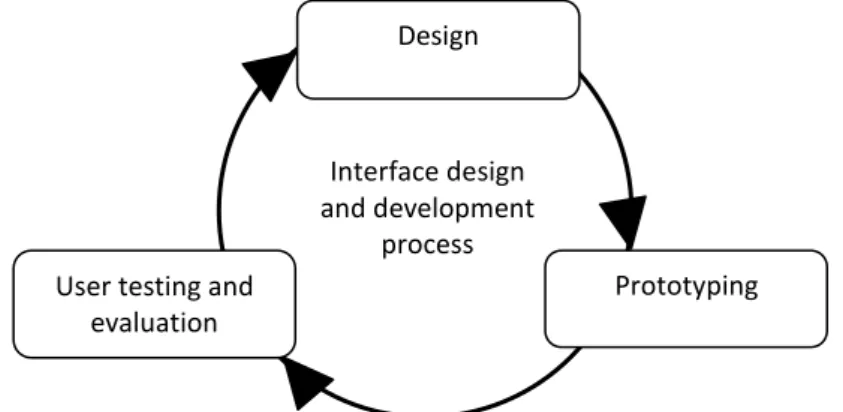
Greenberg (1996) suggests that it is necessary for users to be involved in the process of developing interface design (see figure 2.2). In doing this, designers are able to gain a richer understanding of user requirements. It is proposed that this process should be highly iterative in order to gain user feedback and approval. In this way, as stated by Hoadley and Cox (2009), users are involved as co-constructors of the design process.
Figure 2.2: The iterative process of user interface design (adapted from Greenberg, 1996)
U
producing an interface design that is useful and usable (O'Neill, 2000). The difficulties of implementing this method however involve identifying and recruiting appropriate users (Kyng, 1994; Norris and Wilson, 1999) U
involvement in the design process can also be expensive. I discuss the process of design further in section 2.2.2
Design
Prototyping User testing and
evaluation
Interface design and development
20
(2.2) Design as a mix of creative individuals, processes and
products
The literature reveals that creativity may be usefully looked at in three ways: the person, the process and the product (Gardner, 1983; Tardif and Sternberg, 1988).
(2.2.1) Creative individuals: the individual and the social
A creative person is normally defined as someone who comes up with a novel and useful idea. He or she considers many ideas and different kinds of ideas, and can even change or transform ideas. According to Torrance (1988), a creative person possesses skills of fluency, flexibility, elaboration and originality (see table 2.1).
T T (adapted from Torrance, 1988)
Fluency (Quantity of ideas) How many ideas can you come up with? Flexibility (Variety of ideas) How many different ideas can you come up
with?
Elaborateness Can you explain or detail your ideas? Originality (Uniqueness) Can you come up with an idea that no one
else has?
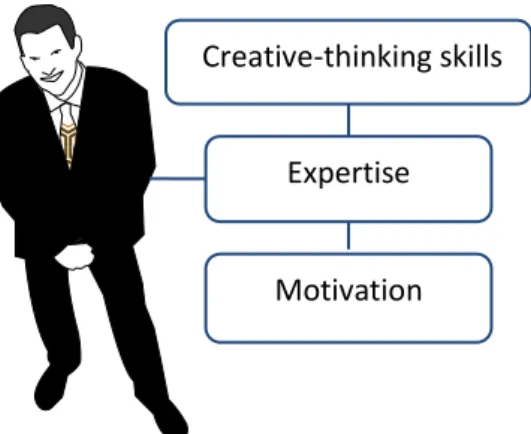
Jackson and Shaw (2006) add the following features in describing a creative individual: being imaginative; generating new ideas; thinking differently by looking beyond the obvious; exploring, experimenting and taking risks; and possessing skills in critical thinking and synthesis. All of the creativity traits in an individual can be categorised into three key components as proposed by Amabile (1998), which comprise creative-thinking skills, expertise, and motivation (see figure 2.3).
21
Figure 2.3: The three components of creativity A own illustration)
Amabile (1998) describes the creative individual as a person who can think creatively (see Jackson and Shaw, 2006; Torrance, 1988). They are experts in a certain domain of work and trained with specific knowledge and technical abilities. It is generally acknowledged that individuals are creative within particular domains (Csikszentmihalyi, 1988; Feldman, 1974; Feldman, 1994; Gardner, 1983; Sawyer et al., 2003). For instance, someone may be creative in the arts, but they may lack creativity in biology (Gardner, 1983). John-Steiner (1985) explains that creativity requires fluency in language, symbols and the tools of a domain. Without fluency, creativity is hard to achieve. The creative individual is also motivated by their interests, passions and determination. Researchers (Amabile, 1996; Hennessey, 1995) claim that intrinsic motivation has a strong link with creative achievements. Intrinsic motivation is the tendency to engage in tasks because the individual finds them interesting, challenging, involving and satisfying. Extrinsic motivation, on the other hand, is the tendency to engage in tasks because of task-unrelated factors such as the promise of rewards and punishments, directives from superiors, surveillance and
Expertise
Motivation Creative-thinking skills
22 competition with peers (Deci and Ryan, 1995). Csikszentmihalyi (1990) describes intrinsic motivation as an advantageous experience or flow . Flow is the mental state of operation in which individuals are fully immersed in what they are doing (Csikszentmihalyi, 1990).
Although many researchers have focused on intrinsic motivation in enhancing creativity (Amabile, 1996; Csikszentmihalyi, 1990; Hennessey, 1995), having both intrinsic and extrinsic motivation can sometimes be useful. Extrinsic rewards can increase the chance that individuals will be motivated in accomplishing their goals (Paulus and Nijstad, 2003). For instance, a person will work harder to seek creative solutions when offered rewards. Researchers (Eisenberger et al., 1999; Eisenberger and Rhoades, 2001) have found evidence that extrinsic rewards increase creativity and trigger an -determination.
Aside from rewards, pressure can be another effective extrinsic motivator to some people when it is properly harnessed. It drives people to do things that they otherwise would not do. In order to avoid shame and guilt, pressure in some instances can motivate a person to make a greater effort (Kandel and Lazear, 1992). Pressure is a type of motivation known as introjected regulation (Deci and Ryan, 1995). Deci and Ryan (2000) describe introjected regulation as motivation with an element of control over people. People feel motivated to perform in order to avoid guilt or anxiety, or to maintain ego. Deci and Ryan continue by explaining that introjected regulation can shift into integrated regulation where a person can become fully engaged with his or her beliefs and work. According to
23 Brophy and Wentzel (2004), integrated regulation is not the same as intrinsic motivation; a person performs a task because of self-determination instead of enjoyment or interest. Brophy and Wentzel (2004, p. 206) acknowledge that Deci and Ryan have disclosed the key to understanding motivational dynamics is not an intrinsic vs. extrinsic motivation dichotomy, but the degree to which the person perceives rewards or other extrinsic features of the situation as informational versus controlling . Informational rewards refers to individuals finding the task as challenging and interesting, while controlling rewards demote individuals perceiving the task as pressuring or forcing (Brophy, 2010). This also means that extrinsic features of motivation can either enhance or hinder creativity depending on an (Parnell et al., 2007).
An individual with creative thinking, expertise and motivation can certainly contribute to the production of creative outcomes. Nevertheless, designers in the creative industries generally work in teams. Team work is important in coping with time constraints (deadlines) and high-level requirements from customers (Badke-Schaub and Frankenberger, 1999). The multiple perspectives and alternatives offered by group members lead to more innovative (De Dreu and West, 2001) and higher quality outcomes (Nemeth et al., 2001). Furthermore designing a complex and quality interface requires many different design skills (Shank, 2005). Shank (2005, p. 11) lists the skills involved in interface design:
We needed instructional design skills to determine the goal of instruction and select instructional strategies and multimedia elements, writing skills to write content, information architecture skills to structure the content so it was easily to follow and access,
24 graphic design skills to develop clear and attractive navigation and explanatory graphics, multimedia skills to work with instructional designers to create interactive elements, usability research skills to frustrate learners, and infrastructure skills to make sure it would
N quire one or more people for each of these functions, but most require some elements of all of them.
In relation to design skills, many creativity researchers have now recognised the importance of social interactions, mentoring and collaboration in creative work (Amabile, 1983; Candy and Edmonds, 2002; Csikzentmihalyi, 1999; Fischer, 2000; Klemmer et al., 2002). Warr and
O N (2005) see design as a social activity. Design is a socially-generated
creative outcome (Watson, 2007) and can be productively achieved through a process of social construction (Detienne, 2006). Even if a design is produced by a single individual that does not mean its essence is individual. The individual designer would still have to deal with a number of other people such as clients, users, legislators, consultants, suppliers and manufacturers in production (Lawson, 2004).
W O N (2005) propose that creativity in design should be
understood as social creativity. Social creativity is defined as a socio-cultural process (Csíkszentmihályi, 1996) in which novel and appropriate products are developed (NACCCE, 1999). It is perceived as a generic skill that can be fostered through interactions between people and in interactions with tools and artefacts (Bereiter, 2002). An objective of social creativity is to create, accumulate, share knowledge and enable innovation (Fischer, 2005). Social creativity is not a luxury but a necessity to address
25 design problems (Fischer, 2004). Fischer (2004) suggests that design problems are better addressed, framed and solved by communities rather than individuals. Creativity in design is not perceived as a personal judgement but is judged by social groups (Csikszentmihalyi and Wolfe, 2000).
The study of social creativity was extensively promoted V
Moran and John-Steiner (2003) identify that Vygotsky produced a number of papers related to creativity studies which were not published during his lifetime: for instance, The Psychology of Art (Vygotsky, 1925/1971); On the Problem of the Psychology of the A Creative Work (Vygotsky, 1932); Imagination and Creativity in Childhood (Vygotsky, 1933/2004); Imagination and Creativity in the Adolescent (Vygotsky, 1931/1998); and Imagination and Its Development in Childhood (Vygotsky, 1932/1987). Vygotsky was more interested in the origins and interrelationship of functions, in contrast to researchers who conceived of creativity as a set of traits of specific individuals that could be measured in tests and cross-sectional experiments (Guilford, 1970; Runco, 1999; Torrance, 1988). Arguably, Vygotsky did not emphasise separation but rather connection.
Vygotsky recognised the , and
also acknowledged the critical role of social interactions in the development of creativity (Gibbons and Grey, 2004; Vygotsky, 1978; Wertsch, 1985). Through V
who manage to utilise higher mental functions in getting others to acknowledge their creative ideas (Moran and John-Steiner, 2003). Diaz et al. (1990) describe higher mental function as a complex thinking process
26 derived from social interactions. Within the thinking process, individuals internalise social interactions and continually develop their understanding (Moran and John-Steiner, 2003) towards producing creative outcomes that can gain recognition from others. This also means that individuals have to adapt to reality if they wish to develop creativity (Rieber and Carton, 1988). As a result the involvement of the social community in nurturing creativity should be taken seriously, particularly in the domain of design: a domain that requires making things functional and precise for individuals within a certain context.
Although researchers (Amabile, 1983; Candy and Edmonds, 2002; Csikzentmihalyi, 1999; Klemmer, et al., 2002) have recognised the importance of social interactions, mentoring and collaboration in creative work, there is also another important aspect to look at in developing creativity in a social context: group development. Paulus and Nijstad (2003) states that for social collaboration to have effects on creativity, careful attention to the development of the group is required because the experience of being in a group with members who have different backgrounds and perspectives can often be difficult. A clearer understanding of group interaction needs to be developed (Hand et al., 1997) to reduce the potential sense of insecurity, embarrassment and conflict: these are seen as some of the negative psychological effects that can occur when a group is not carefully managed (Turner and Horvitz, 2001).
27 I further discuss the benefits and disadvantages of conflicts and disagreement in section 2.4. Next, the process of creativity is examined.
(2.2.2) Creative process: design as problem solving
Creativity may be considered as the process of getting ideas, testing them and communicating the results. Design of any type is mostly seen as a problem-solving process that leads to the transformation of a product or service (Heskett, 2002). Lawson and Dorst (2009) explain that designers have to formulate solutions through analysing a design problem. From many solutions, designers will have to decide on the one that is most appropriate. This model of solving design problems is commonly used by every designer, and is illustrated in figure 2.4.
Figure 2.4: Model of the design process (Lawson and Dorst, 2009, p.33)
The process of design is nonetheless not as simple in reality as it is portrayed in figure 2.4. The evaluation process involving practitioner critical review is not mentioned explicitly in the model (Lawson and Dorst, 2009). Practitioner critical review is the part of the practice used to frame the problem as described by Schön (1983). A reflective practitioner is someone who does something and is automatically reflective (Schön, 1983). They constantly learn, evaluate and refine their practice, even after years of experience. Schön (1983, 1991) introduced the idea of
28 in-action (thinking while dealing with a problem), and reflection-on-action (looking back at what has already taken place) to describe the way practitioners work in practice. Killion and Todnem (1991) “
notions of reflection-on-action and reflection-in-action to include reflection-for-action (planning ahead for future actions). Schön recognised reflection-for-action but he did not consider it as a new reflective event, instead as imaginative perspectives. Reflection-for-action is an important mechanism that stimulates thinking and cognitive growth (Killion and Todnem, 1991) thus it is no less important than the other two types of reflection (on, and in action).
Practitioners in general reflect on their practice during and after engaging in action in order to creatively adapt their practice to new situations. They interpret and frame problems by referring to past experiences, knowledge, theories and practices. This is because their work constantly deals with complex situations. For example, as described by Stolterman (2008, p. 59) designers have to create something with a specific purpose, for a specific situation, for a specific client and user, with specific functions and characteristics, and done within a limited time and with limited resources . Roller (2009) explains that, in dealing with complex design situations, designers utilise design thinking: an analytical and contextual thinking intended to create great products and experiences for their customers (see Garrett, 2003; Roller, 2009). Analytical thinking relates to a step-by-step thinking process involving planning and developing a design (Roller, 2009). This is where designers focus on the functionality and appearance of a product or design. Contextual thinking conversely refers to capturing the
29 users experience of using a product or design (Roller, 2009). Designers have to make sure the experience of a product or design meets their
s. They have to deal with customers from
varying backgrounds; from sophisticated professionals to those with no design experience. Other than utilising analytical and contextual thinking, Sternberg and Lubart (1999) emphasise the importance of synthetic thinking in producing creative ideas or outcome. Synthetic thinking require
(Sternberg, 2009, p. 28). Synthetic thinking can be linked to what Lawson and Dorst (2009) refer to as situation-based and strategy-based thinking - I discuss this next.
Lawson and Dorst (2009) describe in more detail the way designers think when solving design problems. They identify three different approaches to design thinking strategies: convention-based, situation-based and strategy-based (see figure 2.5). These approaches can be employed separately or simultaneously depending on the design problem and the expertise of those involved in the design process.
Figure 2.5: Design thinking strategies (Lawson and Dorst, 2009, p.69) Situation Based Convention Based Strategy Based
30 Convention-based design thinking relies on standard rules of design such as rules of proportions. Rules of proportions refer to a framework for organising content, images and other graphical elements in a design layout. An over-reliance on this type of thinking can lead to the production of ordinary design ideas. It is normally used as a first step in becoming literate
in I I
to experts, novices usually consider convention-based design thinking as they follow strict rules to deal with design problems.
Situation-based design thinking solves design problems by considering the
most suitable and appr D
s and they begin to improvise and explore their
creativity further. For instance, instead of designing a building by following a rule-based structure, the designer applies unique characteristics to the building design, an example given by Lawson and Dorst (2009) is the Sydney Opera House; or instead of designing a website with a generic layout design, the designer applies appealing features such as page flipping, for example www.datafisher.com and www.blackcoffeeproject.com.
In strategy-based design thinking, designers formulate a solution by
added value for
customers and society. For example, designers may implement environmental awareness in their design after reflecting on climate change, for example eco-friendly buildings and furniture made from recycled
31 materials, or designers may produce a website with user-friendly facilities for users with vision or hearing impairments.
According to Lawson and Dorst (2009), these three modes of thinking lie behind the problem solving and decision making that takes place through design activities. The mode of thinking plays a crucial role in determining the quality of design products.
(2.2.3) Creative product: novelty and appropriateness
Creativity may also be seen as a product. It is the ability to bring something into existence. Looking back at earlier research on defining creativity, the term creativity often focuses on producing novel or original works. Boden (1998b) offers two explanations for novelty: psychological (P-creativity) and historical (H-creativity). P-creativity represents an idea which has been used by others but is new to the person who produces it, whereas H-creativity is an idea which has never been thought of in the history of mankind. Boden admits H-creativity is very hard to distinguish as most creative ideas are rather mundane. Boden (1998a) adds that creative products need to be not only novel but also valuable. Parallel to Boden, Sternberg (2007, p. 34) recognises the creative product as relatively novel, high in quality, and appropriate for the task at hand . Sternberg emphasises the dynamic interplay between the novelty and the usefulness of an idea or product. While novel refers to any new idea or product, creativity is a subset of novelty, covering ideas that are both novel and appropriate to the cultural context (Amabile, 1983; Csikszentmihalyi and Wolfe, 2000; Warr and O'Neill, 2005). Appropriateness is determined by
32 some form of public recognition, and varies from one domain to another (Warr and O'Neill, 2005). Whether an idea or product is creative or not does not depend only on its own qualities, but on the effect it has on others who are exposed to it. This led to a discussion concerning the interrelationships between innovation and renovation to emphasise the
ion of creative
ideas or product. Dillon (2000, p. 3)
the introduction of new ideas, methods and pro
I
another words, while innovation relates to production of new ideas, renovation focuses on the ongoing process of restoring or upgrading the existing ideas. Innovation allows for creative ideas or product to be recognised for its potential within a certain domain or field (Amabile et al., 1996). Renovation on the other hand ensures that the resulting ideas can
I and
renovation work as a value adding process leading to commercialisation of creativity; this should be emphasised especially in the production of ideas or product that require recognition from the public or users, e.g., interface design.
Regardless of the person, the process and the product, literature on creativity suggests that the definitions of the term vary considerably depending on the contexts in which the topic is discussed (EUA, 2007). In short, creativity has to be defined in its own context, and something can only be recognised as creative