2017 2nd International Conference on Software, Multimedia and Communication Engineering (SMCE 2017) ISBN: 978-1-60595-458-5
UAV Detection with S Transform of
t-student
Window
Dong WANG, Yi SU
*and Yi-chao ZHAO
School of Electronic Science and Engineering, National University of Defense Technology, Changsha 410073, China
*Corresponding author
Keywords: Micro-motion target, S Transform, Short-time fourier transform, Pseudo wigner-ville transform, T-student.
Abstract. So far, the detection of helicopters, especially micro helicopters, has been widely studied, while few works are available on detection of rotor unmanned aerial vehicle (UAV). Due to its low flight height, small RCS and the complicated urban environment, the traditional methods are unable to achieve effective detection of rotor UAV. In this paper, we present a novel S transform with improved window based on t-student to deal with this problem. The simulation and field experiments all show that the proposed S transform can suppress Gaussian noise effectively, and obtain the clear time-frequency distribution of the micro-motion target. Thus, the proposed S transform provides some references for detecting the micro-motion target with small RCS and small rotation amplitude such as the rotor UAV.
Introduction
As known, the UAV has been widely used in social life nowadays. The UAV is challenging the public safety because it could be transformed into offensive weapons. So it’s extremely urgent and important to detect and monitor the UAV. However, the conventional detection methods can’t effectively detect the UAV because of the complicated urban environment, its low flight height, small RCS, but great mobility. Time-frequency analysis method was introduced to detect the micro-motion target by V.C. Chen[1], which provides a new idea for the detection of rotor UAV. So far, there are few research on micro-motion targets such as rotor UAV. Most research on the detection of micro-motion targets aims at large helicopters, ballistic missiles[2,3,4], etc. Liu W Y[5] presents the auto term window method based on Wigner-Ville distribution(WVD), which effectively extracts the rotating structure of targets. But the cross-term is still disturbed. Li Jingqing[6] proposes the generalized S-Wigner distribution (GSWD) method to detect the ballistic targets. However, his method isn’t suitable for detecting rotor UAV because of the intense time-frequency resolution change of GSWD.
In order to solve the above problems and detect the rotor UAV more effectively, the S transform with t-student window is presented in this paper. The simulation and field experiments all show that our approach is effective to suppress Gaussian white noise and obtains clear time-frequency distribution of the echo of micro-motion targets. Our approach could be considered to detect micro-motion targets with small RCS and small rotation amplitude such as the rotor UAV.
Echo Signal Model of UAV
U
V W
O
Q
LOS
0
u v w, ,
u v, , 0 Radar coordinates
U V W, ,
( ) LOS angle
[image:2.595.157.433.78.233.2]0 f
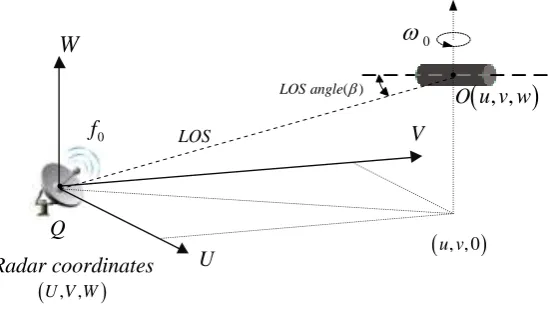
Figure 1. Geometry of radar and rotating target.
As shown in Figure 1, the cylinder replaces the rotor of the UAV to simplify the geometry. If the radar transmits single-frequency continuous wave, and the frequency is f0. The rotation angular
frequency of the cylinder is 0. The coordinate of the center point of the cylinder is
u v w, ,
. TheLOS angle is referred as the angle between LOS and the cylinder center line. The LOS angle of the cylinder changes as sinusoidal function approximately. So, according to GTD model, the scattering intensity of the rotor of UAV can be expressed as the following model[4]:
t 0
exp
Bsin 0t
(1) Where σ0, ρ, B and η are constants, and depend on the characteristics of scattering center.
Considering the anisotropy of scattering target, the echo signal of the rotor of UAV can be expressed as follows:
4 0 2 exp sin exp sin exp 2
0 0 0 0 0 0
1
L f r t
l
s t l l Bl t l j r l A l t l j f
c c
l
(2)Where L represents the number of scatter centers. σ0, ρ, B and η represent the scattering
characteristics of scattering center l. r0l is the initial distance from radar to scattering center .A0l is the rotation radius of scattering center l. l is the initial phase of scattering center l. c is the light velocity. Thus, the echo of the rotor of UAV is the multi-component amplitude modulation-frequency modulation (AM-FM) signal. The AM and FM of the each signal component is sinusoidal modulation, and the modulation frequency is the rotation frequency.
S Transform with the Improved Window
S transform[9,10] provides frequency-dependent resolutions and retains the absolute phase of time series component. Furthermore, it provides time-frequency representation of the signal so that the components of the signal can be isolated and processed independently in the time-frequency plane. The generalized S transform of continues time series h t
is [11]:
, ,
, ,
exp
2
S f p h t t f p j ft dt
(3) According to the convolution theory, the S transform can be written as a function of Fourier transform of time series, as follows:
Where H and W are the Fourier transform of f and t , respectively. Typically, Gaussian function is applied as the modulating window in the S transform. The Gaussian window in the frequency domain WGS is:
2 2 2
2 , , 2 exp GS GS GS f W f
(5)
Where GS is the adjustable parameter, which has been defined to tune the time and frequency resolutions of the S transform. From the above formula we clearly know that the Gaussian window has narrow width at the low frequency, which means S transform has high frequency resolution and low time frequency resolution at the same time. Because of the quick and intense variations of the Gaussian window over frequency, the S transform with Gaussian window is not appropriate in the detection of rotor UAV. Thus, a window with gradual changes over frequency may improve the S transform and make it suitable for the detection of rotor UAV.
T-student distribution[11] has more gradual changes over frequency in comparison with sharp changes of Gaussian window. Thus, we propose the t-student based window Wts over x with the freedom degree of v F x v
for the S transform as follows:
12 2 1 1 1 2 , , 1 ts v v
W x v p F x v
v x v
(6)
Where
is the Gamma function. In order to obtain a more uniform time and frequencyresolutions, we applied a window with t-student distribution over 2/ f with one degree of freedom
2
/ 1
F f . Furthermore, an adjustable parameter Pr is added to the proposed window to tune the
time and frequency resolutions of the S transform. The S transform with the improved windows is as follows:
Pr Pr 2 2
Pr
1
, , exp 2
1
W f H f j d
f
(7) The amplitude of the proposed window scales with the square root of frequency unlike other windows previously used in the S transform in which the amplitude is scaled linearly with frequency. The width of the all windows scales with the inverse of their amplitude. Variation of the proposed window with the square root of frequency instead of linear scaling provides more uniform spectral field because of more gradual changes in the window.Simulation and Experiment
In this section, the S transform with the proposed window is compared with other conventional time-frequency distribution methods such as STFT and PWVD. The simulation setup is as shown in Figure 1, we set: f0=18GHz, PRF=50kHz, and SNR=20dB, 0=200. In general, we set L=2. For
the scattering center l, 0l=0.01, 0l
A =0.05m,
u v w, ,
=(10,40,0).(a) (b)
(c) (d)
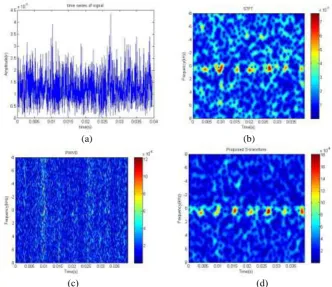
Figure 2. (a) The amplitude of the return wave(b) STFT(c) PWVD(d) The proposed S transform.
From the simulation results, we clearly know that the Gaussian noise has a serious impact on STFT distribution. PWVD distribution is disturbed by the noise and self-cross terms. So we can’t recognize the micro-motion curve from STFT and PWVD. However, S transform with the improved window performs a better ability to suppress Gaussian noise and has no self-cross terms. We can recognize the micro-motion curve and get the target information more clearly.
[image:4.595.126.465.72.373.2]To verify the performance of the S transform with the improved window further, we perform a field test of a plastic fan in the anechoic chamber. The experiment setup is shown in Figure 3, two standard horn antennas 1 and 2 are used as the transmitting and receiving antennas respectively. The distance of two antennas is 0.3 meter and they are all aimed at the plastic fan. The plastic fan is placed 1 meter away from two antennas, and they are at the same horizontal height. The blades plane of fan is facing the horn antennas with tilt angle of about 30 degrees. The transmission signal is the single-frequency signal and the frequency is 16GHz.The sampling frequency is 38kHz.
[image:4.595.195.401.582.733.2](a) (b)
(c) (d)
Figure 4. (a) The amplitude of the return wave (b) STFT (c) PWVD(d) The proposed S-transform.
Figure 4 shows the comparison results of applying the STFT, PWVD and S transform with the improved window. The comparison results show that the echo of the plastic fan doesn’t behave as the sinusoidal frequency modulation signal, and it behaves like the periodical discrete ridges. The reason is that the phase of the echo changes as the sinusoidal frequency modulation signal with a small amplitude, but the amplitude of the echo changes as the sine-like modulation with great amplitude. So the time-frequency distribution of the echo appears like the discrete and concentrated ridges. Just as the simulation shows, the STFT or PWVD distribution still could not achieve a satisfactory performance in the field experiment. In contrast, S transform with the improved window performs a certain ability to suppress Gaussian noise compared with the STFT distribution and has no cross-terms compared with PWVD. Furthermore, we can estimate the rotational frequency and other parameters of the plastic fan from the S transform distribution of the echo in the field experiment. There is a good correlation between the simulation and experiment results.
Summary
[image:5.595.129.462.71.358.2]Acknowledgements
This work was jointly supported by the National Science Foundation of China under Grant (61372160), Besides, the authors are grateful to Song Xiaoji for supporting in experiments. Thanks for the helpful discussions to Chen Qiao and Lu Jianrong.
References
[1] Victor C. Chen, F Li, SS Ho, H Wechsler, Micro-doppler effect in radar phenomenon, model, and simulation study, IEEE transactions on aerospace and electronic systems, vol.42, no.1, pp.2-21, Jan. 2006.
[2] Thayapran T, Abrol S, Riseborough E, Analysis of radar micro-doppler signatures from experimental helicopter and human data, IET Radar, Sonar and Navigation, vol.1, no.4, pp.289-299, 2007.
[3] Marple S L, Large dynamic range time-frequency signal to helicopter Doppler radar data[C], Proceedings of International Conference on Information Sciences Signal Processing and their Applications, 2001,1:260-263.
[4] Chen Xingyong, Li Xiang, Guo Guirong, Identification of air-target based on the micro-motion radar signatures of blades, Systems Engineering and Electronics, vol.28,no.3, pp.372-375, Mar.2006.
[5] Liu W Y. Auto term window method and its parameter selection, Elsevier Measurement, vol.46, no.9, pp.3113-3118, 2013.
[6] Li Jingqing, Feng Cunqian, He Sisan, Tang Dongli, Micro-motion feature extraction algorithm of ballistic target based on GSWD-Viterbi[J], Journal of projectiles, rockets, missiles and guidance, vol.35, no.6, pp.95-97, Dec.2015.
[7] Li Kangle, Research on feature extraction and parameters estimation for radar targets with micro-motions[D], Changsha, Graduate School of National University of Defense Technology, pp.17-51, May, 2010.
[8] Sun Zhenzhen, Cheng Zengping, Zhuang Zhaowen, Guo Guirong, A parametric model for high-frequency complex 2-D radar scattering[J], Journal of National University of Defense Technology, vol.23, no.4, pp.113-119, 2001.
[9] Stankovic L, Djurovic I, Thayaparan T, Micro-doppler-based target detection and feature extraction in indoor and outdoor environments[J], Journal of the Franklin Institue, vol.1, no.3, pp.1-23, 2008.
[10] R.G. Stockwell, L. Mansinha, R.P. Lowe, Localization of the Complex Spectrum: the S transform, IEEE Transactions on Signal Processing, vol.44, no.4, pp.998-1001, Apr, 1996.