2017 2nd International Conference on Artificial Intelligence: Techniques and Applications (AITA 2017) ISBN: 978-1-60595-491-2
Oceanographic Big Data Text Categorization Algorithm
Based on Improved Mutual Information
Bei LIU, Bo YIN, Zhi-qiang WEI and Yong-quan YANG
*College of Information Science & Engineering, Ocean University of China, Qingdao, China
*Corresponding author
Keywords: Oceanographic big data, Text categorization, Mutual Information, TF-IDF.
Abstract. Research on automatic text categorization of the oceanographic big data, has always been the core work of establishing a oceanographic information database based on oceanographic big data information platform. However, in face of extreme complex Internet data and the professional needs of the oceanographic field, the categorization accuracy of the traditional tf-idf algorithm is difficult to meet the demands. Based on traditional tf-idf algorithm and mutual information algorithm, I propose improved tf-idf-miow algorithm in order to meet the demands of text categorization of the oceanographic big data. Optimize the mutual information algorithm, calculate the correlation coefficient between the characteristic word and the oceanographic field. In this way, I set the weight of oceanographic field: miow by this correlation coefficient, and bring miow into traditional tf-idf algorithm. The results of automatic text categorization experiments show that the recall rate of tf-idf-miow in oceanographic field is 10.33% higher than of traditional tf-idf algorithm, and the f1-score is improved by 6.92%.
Introduction
The oceanographic big data is designed to track the related website around the world, focus on online media, covering all of the oceanographic organizations, collecting a lot of news and information to establish a oceanographic information database. However, the information on the Internet is huge and complex, so automatic text categorization is the necessary means to establish the
oceanographic information database. Based on mutual information algorithm, this paper introduces
the weight of oceanographic field: miow (mutual information ocean weight), and bring it into traditional tf-idf algorithm, proposes the tf-idf-miow algorithm.
The Brief Introduction of Text Categorization
Text categorization[1] refers to use computer programs and related algorithms for allocating the target text to the category by comparing the contents of the target texts and training text. The training texts consisted of a given set of predefined categories and initial texts of each category. To enable the computer can correctly identify the text and calculate correlation coefficient, it is necessary to translate texts into computer-readable model. In the field of automatic text categorization and natural language processing, the vector space model (vsm) is a widely used and effective text representation model[2]. Vsm is an kind of algebraic model, first proposed In 1969. The basic idea of vsm is to segment the the text, regard the text as a collection of characteristic words that contained in the text. Text is represented by a vector so that the computer is capable of algebraic computation. Vsm represents each characteristic word as one dimension of the vector, with the weight of the word as the vector component, namely, vec(d)=(t1,w1;t2,w2,...,tn,wn)[3], ti is the No.i characteristic word of
document d, and wi is the weight of ti. The similarity between two documents can be measured by
∑
∑
∑
= = = = m 1 i m 1 i 2 bi 2 ai m 1 i bi ai b a w · w w · w ) d ,Sim(d . (1)
In the expression, da and db are two contrasted documents, m is the dimension of vector, wai(wbi) is
the No.i dimension of vector, that is, the weight of the No.i characteristic word. In the following experiment, vsm is used to represent the document, and the similarity between two documents is calculated with the cosine value.
TF-IDF Algorithm
The weight of characteristic word is a key factor in the similarity calculation, which is directly related to the accuracy of the similarity result between texts, thus affect the text categorization effect. Tf-idf[5] has been the most widely used weight representation algorithm in vsm, because of its relatively simple, high precision and recall rate. The equation of tf-idf is as follow[6]:
2 m 1 k d 2 d k, d 2 d t, d t, 0.01)) n n ( log · (tf 0.01) n n ( log · tf w
∑
= + += (2)
In the expression, wt,d is the weight of the characteristic word t in document d, tft,d is the number of
occurrences of t in document d, n is total number of documents, nd is the number of documents that
containing t, m is the number of non-repeating characteristic words contained in document d. The numerator part is a normalization factor, normalizing the weight calculation results to reduce the influence of excessive disparity on text length. If a characteristic word appears with a high frequency in a few documents, and rarely appears in other documents, it is considered that this word has a good categorization ability, that means it is suitable for categorization. Tf-idf algorithm can give high-weight to those characteristic words that have stronger ability to distinguish the content of document, and exclude the low distinguishing characteristic words that appears in multiple documents.
Improvement of Weight Calculation Based on Mutual Information
The Brief Introduction of Mutual Information
According to the principles disclosed in the information theory[7], mutual information(mi) is usually used to characterize the degree of association between two random events. In the field of text categorization, mi reflects the interdependence between the characteristic word t and ci category. Mi
calculation between t and ci is as follow[8]:
p(t) ) c | p(t log ) p(t)p(c ) c p(t, log mi i 2 i i 2 ) C
(t, i = = (3)
In the expression, mi(t,ci) is the value of mi between characteristic word t and ci category, p(t) is the
probability that characteristic word t appears in all documents, p(ci) is the probability that documents
in ci category appear in all documents, p(t,ci) is the probability that characteristic word t and
documents in ci category appear at the same time, p(t|ci) is the the probability that characteristic word
t appears in ci category. If the probability of the characteristic word t appears in ci category is larger
and the probability is smaller in the other categories, then mi(t,ci) is large. It is shown that the
correlation between characteristic word t and ci category is strong, namely, characteristic word t is
mi of characteristic word t is obtained by the sum of mi between characteristic word t and each category weighted by the probability of occurrence of each category:
p(t) ) c | p(t log · ) p(c mi · ) p(c mi i 2 m 1 i i ) C (t, m 1 i i
t
∑
i∑
= ==
= (4)
However, there are some shortcoming in the traditional mutual information algorithm. First, according the Eq.3, mi cannot reflect the difference in frequency of a characteristic word. For example, there are two characteristic words:t1, t2 with different frequency, when p(t1|ci)/p(t1) = p(t2|ci)/p(t2),
mi(t1,ci) = mi(t2,ci). But a higher frequency of a characteristic word means a stronger correlation.
Second, according the Eq.4, the global mi is usually used to represent the categorization ability of a characteristic word in the entire text set, while the ability to explore the correlation between a characteristic word and the particular category is insufficient.
Improved Oceanographic Word Weight Based on Mutual Information Algorithm
In the field of text categorization in the oceanographic big data, whether a characteristic word is related to oceanographic field is an important factor in the categorization process. However, traditional tf-idf algorithm considers that the more concentrated characteristic word have stronger categorization ability than the scattered words, while ignoring the correlation between characteristic words and the oceanographic category. If a characteristic word meaning related to the oceanographic field, this characteristic word have a greater contribution to the categorization of oceanographic field, and it should be given a higher weight. In this paper, I propose a weight parameter miow based on the
improved mutual information algorithm to explore the correlation between characteristic words and
the oceanographic field, and introduce miow into traditional tf-idf algorithm to modify the weight of characteristic words. First, according to the cited literature[9], the prior probabilities and posterior probabilities of the characteristic words are introduced to reflect the dispersion and concentration of the characteristic words. Second, in order to reflect the influence of word frequency on mutual
information algorithm, I introduce the frequency parameter into mutual information algorithm. The
improved mi between a characteristic word t and the ci category is expressed as:
1) p(t) ) c | p(t ( log · t) | p(c · ) c | p(t · n 1) (tf log mi i 2 i i C ) C (t, 10 ) C (t, i i i + +
= . (5)
In the expression, tf(t,ci) is the frequency of the characteristic word t in ci category, nCi is is the
number of documents in ci category, p(ci|t) is the probability of ci category when t appears.
Finally, the weighting coefficients are set up to highlight the characteristics of oceanographic field. The miow weight of characteristic word t is expressed as:
) c (t, m 2 i i i ) c (t, 1
t 1 α ·p(c ) ·mi 1 β ·p(c) ·mi i
miow
∑
=
− +
= (6)
In the expression, c1 is oceanographic category, c2-cm are categories outside the oceanographic
category, m is total number of categories, α and βi are weight adjustment factors of oceanographic
category and other categories. The tf-idf algorithm is improved into tf-idf-miow algorithm by introducing miow weight factor:
t d t, MIOW -d
t,
w
·
miow
Experiment Process and Result Analysis
Experimental Data Set and Experimental Environment
The data set used in this experiment comes from the text categorization corpus provided by the natural language processing group of Fudan University and the Sogou laboratory. There are a total of 15 categories including the oceanographic category, 1720 training documents and 1746 test documents. In the experiment process, the word segmentation is processed by the open source project IKAnalyizer, and the main part is implemented in java language.
Experimental Evaluation Criteria
K-nearest neighbor (knn) is one of the most common and efficient categorization algorithm, it is widely used in text categorization. In this paper, knn is selected as the document categorization standard, and the k value is selected as 150 after experiment. At the same time, the results of categorization were evaluated by the international standard: precision rate and recall rate. For a particular category, if it is assumed that there are a documents categorized in this category, this category contains b documents, and c documents categorized success in this category, The precision rate(p) is represented as a/c and recall rate(r) is represented as b/c. Precision rate and recall rate reflect two different aspects of categorization quality, and conflict with each other. So the f1-score is
usually used to evaluate the combination of them:
r p
r * p * 2 f1
+
= (8)
Analysis of Experimental Results
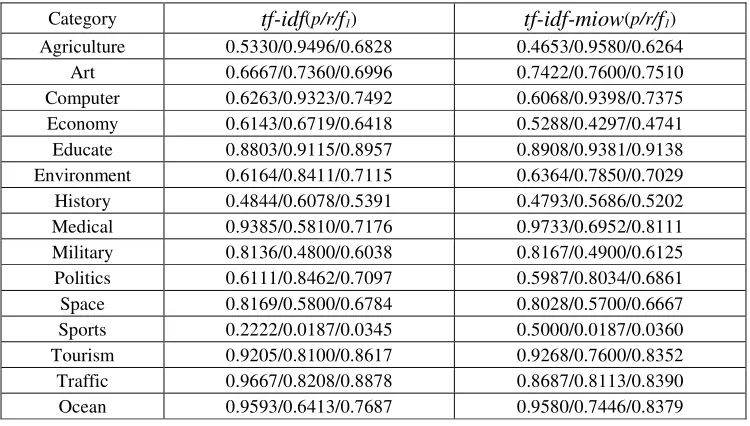
[image:4.612.119.494.459.672.2]Based on the selected training documents and test documents, the traditional tf-idf algorithm and the tf-idf-miow algorithm are used to calculate the weight of characteristic words respectively. Establishing the vector space model, categorizing the test documents based on the training documents. The experimental data comparisons of the two algorithms are listed in Table 1:
Table 1. The experimental data comparisons of the two algorithms. Category tf-idf(p/r/f1) tf-idf-miow(p/r/f1)
Agriculture 0.5330/0.9496/0.6828 0.4653/0.9580/0.6264
Art 0.6667/0.7360/0.6996 0.7422/0.7600/0.7510
Computer 0.6263/0.9323/0.7492 0.6068/0.9398/0.7375 Economy 0.6143/0.6719/0.6418 0.5288/0.4297/0.4741 Educate 0.8803/0.9115/0.8957 0.8908/0.9381/0.9138 Environment 0.6164/0.8411/0.7115 0.6364/0.7850/0.7029 History 0.4844/0.6078/0.5391 0.4793/0.5686/0.5202 Medical 0.9385/0.5810/0.7176 0.9733/0.6952/0.8111 Military 0.8136/0.4800/0.6038 0.8167/0.4900/0.6125 Politics 0.6111/0.8462/0.7097 0.5987/0.8034/0.6861
Space 0.8169/0.5800/0.6784 0.8028/0.5700/0.6667
Sports 0.2222/0.0187/0.0345 0.5000/0.0187/0.0360 Tourism 0.9205/0.8100/0.8617 0.9268/0.7600/0.8352 Traffic 0.9667/0.8208/0.8878 0.8687/0.8113/0.8390
Ocean 0.9593/0.6413/0.7687 0.9580/0.7446/0.8379
The analysis of the experimental results suggests that tf-idf-miow algorithm improved the categorization quality of oceanographic category, the recall rate has risen by 10.33%. The precision rate is less affected. While the f1-score is increased by 6.92%. It is also noted that tf-idf-miow has a
show that tf-idf-miow algorithm improves the text categorization quality in the oceanographic category compared with traditional tf-idf algorithm.
Summary
Embarking from the actual demands in oceanographic category, I proposed the improved tf-idf-miow
algorithm on the basis of traditional tf-idf algorithm. The tf-idf-miow algorithm adjusts the weight of the characteristic word by introducing the mutual information-related parameter, which embodies the oceanographic characteristics of characteristic words. Compared with the traditional tf-idf algorithm, tf-idf-miow greatly improves the categorization quality of oceanographic category. However, the
miow weights for characteristic words cause interference to the categorization of some
non-oceanographic categories, resulting in a slight decrease in them. It is the focus of the author’s next work to explore the more optimized characteristic weighting algorithm, to improve the categorization quality of oceanographic while reducing reducing interference with categorization of non-oceanographic categories.
Acknowledgment
This work is supported by The Aoshan Innovation Project in Science and Technology of Qingdao National Laboratory for Marine Science and Technology (No.2016ASKJ07).
Reference
[1] Tan X Q, Zhou T, Luo L. A text classification algorithm based on the average category similarity[J]. New Technology of Library and Information Service, 2014, 250(9): 66-73.
[2] Yang Y. An Evaluation of Statistical Approaches to Text Categorization[J]. Information Retrieval, 1999, 1(1-2):69-90.
[3] Ren Y P, Chen L C, Zhang Y J, Yuan Y. Research of term weighting algorithm combining semantics[J]. Computer Engineering and Design, 2010, 31(10):2381-2383.
[4] Zhang Y F, Peng S M, Lyu J. Improvement and Application of TFIDF Method Based on Text Classification[J]. Computer Engineering, 2006, 32(19):76-78.
[5] Salton G, Yu C T. On the Construction of Effective Vocabularies for Information Retrieval[M]// Operator algebras, unitary representations, enveloping algebras, and invariant theory: Birkh auser, 1974:48-60.
[6] Xiong Z Y, Li G, Chen X L, Chen W. Improvement and application to weighting terms based on text classification[J]. Computer Engineering and Applications, 2008, 44(5):187-189.
[7] Qiu P L. Information Theory and coding[M].Beijing: Higher Education Press, 2003.
[8] Guo F, Zhang X J, Ye J. Text Classification System Based on Feature Selection of Improvement Mutual Information[J]. Journal of Sichuan University of Science & Engineering (Natural Science Edition), 2008, 21(3):93-96.