Proceeding of National Conference of Electric and Electronic Engineering 2012
A Study on Multiple Fine Solid Lines by Flexographic
Printing in Printed Antennas for W I D (radio frequency
identification) Transponder: An Overview
M. I. ~ a k s u d ' ,
M.
usof' of',
M. Mahadi Abdul ~arnil'
'Faculty of Mechanical & Manufacturing, Department of Mechanical Engineering
' ~ o d e l l i n ~ and Simulation Research Laboratory, Faculty of Electrical & Electronic Engineering, Universiti Tun Hussein Onn Malaysia, Batu Pahat, Johor.
1. Introduction
Electronic devices manufactured by printing are likely to increase. The use of printing processes both as impact and non-impact (i.e. ink jet) variants for electronic products such as displays, back planes, memory, antennas, batteries and other devices due to the advances in material and fundamental research related to the printing processes and electronics design (Kleper,2004). A significant amount of research has been carried out on both impact and non-impact printing to fulfill the emerging demand of printing electronics. However, impact printing processes are much faster and capable of printing over large areas compared with non-impact printing (Kippan, 2001). In impact printing, screen printing has the advantages over the other type of printings due to its capabilities to deposit thick layers of ink over large areas (Blayor et al., 2005).
It is currently being used extensively and will continue playing a leading role in printing electronic products. However there are some disadvantages that include speed where a high resolution web based arrangement runs at only around 40mlmin. And although a web fed rotary type of screen printing can run at up to 150m/min, regrettably this system is only capable of lower resolution (Regney, 2004) and this limits the
Figure 1: Gravure printed images with jagged lines However, the flexographic printing process offers the possibility to print continuous fine solid lines (Yusof et al., 2006). While flexography is a simple process and the image carrier is cheaper compared with gravure, a
vast number of parameters affect this process which will ultimately affect the quality of the printed images. However, current research on printing plate technology (Yusof et al., 2005) and investigation into critical parameters such as anilox rollers, ink rheology etc (Yusof et a1.,2007) help to comprehend the impact and the affects of these and other parameters on the final printed images. Further research on the application of finite element analysis (FEA) including both linear and non-linear models provides complementary work to predict the printing plate deformation (Yusof et al., 2007) and in understanding the ink spreading mechanism (Yusof et al., 2007).
2. Flexography Printing
[image:2.541.297.499.412.679.2]Flexography is a simple process. It is one of the most basic forms of printing as it simply transfers the image with its image carrier or printing plate onto the substrate. The plate is inked using an anilox roller and the process is similar to a rubber-stamping process. The anilox picks up the inks with it cells from the ink bath and metered using a doctor blade. It then inks the relief image on the printing plate where finally it transfers the inked image onto the substrates. A simple schematic of the flexographic printing process can be seen figure 2.
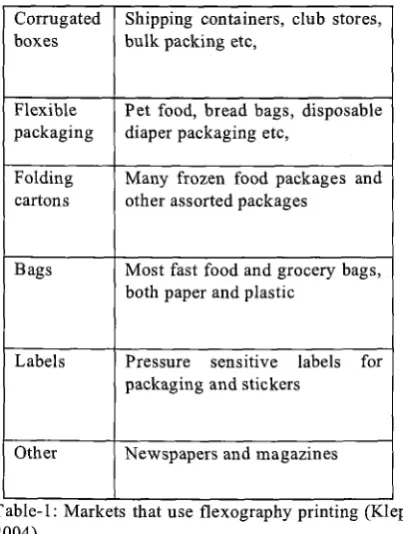
Figure 2: Schematic of Flexography printing process Nevertheless researches in the flexographic printing are continuously carried out where the process itself is constantly being developed and now have a capability that approaches those of the high-speed processes. It is used dominantly in packaging printing and mainly used for graphic purposes but has recently evolved to many other technique depending on the applications as seen in Table-1. And since it is widely used as packaging printer, it has a big advantage in printing RFID antenna and other applications onto the packaging label itself.
boxes bulk packing etc,
Flexible packaging
Most fast food and grocery bags, both paper and plastic
Pet food, bread bags, disposable diaper packaging etc,
Folding cartons
Many frozen food packages and other assorted packages
I
Other/
Newspapers and magazinesI
LabelsTable-1: Markets that use flexography printing (Kleper, 2004)
Pressure sensitive labels for packaging and stickers
2.1 Conductive Inks
Proceeding of National Conference of Electric and Electronic Engineering 2012
printing technologies there are a number of conductive inks currently being considered. Commonly used are inks with metallic particles such as silver, gold, nickel and platinum. Also there are polymeric, organic and inorganic conductive inks. In high volume printing, there is a requirement for rapid drying and the ability of the ink to adhere to the substrate (Jay, 2005) or previously printed layer where essential. The demand has lead to the development of conductive ink for various printing processes by many companies. A successful carbon black inks developed for this type of printing has been published by Yusof (Yusof et al. 2011). In non-impact printing method, ink jet or digital printing has been extensively explored recently to fulfil the demand (Yuka, 2005). It has been found that this could also lead to various electronic applications such as membrane switches, transistor and printing antennas for RFID. Particularly in the RFID field, this gives a wider range of antenna usage as a passive RFID with various wavelengths. However, cheaper and considerably faster printing method is still much needed and flexography is an attractive candidate for its low cost and high speed printing capabilities. It is one of the most basic forms of printing as it simply transfers the image with its image carrier or printing plate onto the substrate.
2.2 Rfid
-
Radio Frequency IdentificationRecently, it has been known that the popularization of technology for automatic identification (Auto-ID) in industry, trade and academic, become the focus of several researches. This interest meets the emerging demands in the automation process, which creates the need for more efficient applications to obtain and control information. The RFID technology (Radio Frequency Identification) is used for automated identification of objects. The superiority demonstrated by this technology in relation to other existing identification systems, presents two main characteristics: it has identification fields and it does not need a direct view to the object. The hardware of RFID consists of the following three items:
Tags (Transponders)
Readers (Electronic Interrogators) Middleware
Tags there are two types of tags, active or passive The word transponder is derived from transmitterlresponder and describes how a tag functions
-
the tag responds to a transmitted signal from the reader (http://www.rfidnazette.ora/-
RFID 101). Passive tags do not have their own power supply; communication with the reader is caused by minute electrical current or magnetic field induced by the antenna of the reader. The incoming radio frequency carries enough power for the tag to send a response back to the reader for verification and exchange of data.Passive tags can only transmit information over short distances, usually 10 feet or less. Passive tags are relatively inexpensive to manufacture and they are ideal for tracking low cost items. Another advantage of passive tags is their miniscule size – as of 2005, the smallest passive tag measures only 0.4mm x 0.4mm (www.wikipedia.org – RFID). Many anti-theft systems described in the introduction use passive tags and stationary interrogators.
Active tags have their own power supply and can transmit data over long ranges, typically over 100 over feet. The battery can last up to 10 years. They also possess larger storage capacities and can store information from the readers, effectively making them read and write enabled. The information is stored in a non-volatile memory. Usage and application of active tags are infinite such as container shipping tracking or the railroad tracking mentioned earlier. However, due to the embedded battery pack and larger memory, active tags are physically bigger and more expensive than passive tags.
Both types of tags contain a unique identifier called Electronic Product Code (EPC), which are pre programmed by the manufacturer to identify a particular item. This identifier can be picked up by the reader and makes simultaneous readings of many tag possible (Schaeffe, stefen et al., 2004).
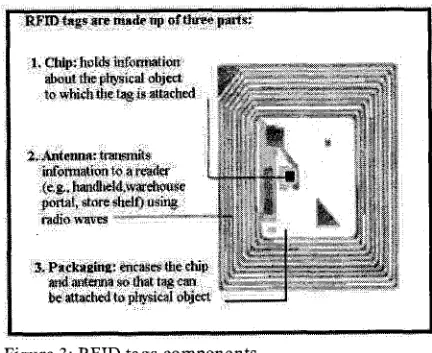
Readers - An electronic device that uses radio frequency to read or interrogate the tags. When an RFID reader and tag communicate, two things happen; they share energy in the form of radio frequency which allows the exchange of information.
1. CMp; bl& inSnmLia~t
ahurzhc *9id objqject
fa which rhe €ag i s attacheel
te,g.. hdld&,%m&orsr;c
p m k k rkm al&@ using
radio wives
-.--
3. Packaging: &nrm&e c h i ~
mnrrctatmmw Lhatfa&catr
[image:3.529.275.491.486.663.2]k mrrkod ti, pf@Gral obieft Figure 3: RFID tags components
2.3 Finite Element Analysis O n Multiple Solid Lines
element theory may be found in (1.M.Smith and D.V.Grifffits, 1998). FEA has received application in exploration of a range of mechanisms that are associated with printing processes by many researchers such as Bould (Bould, 2001), Hamblyn (Hamblyn, 2004), Megat Ahmad (Ahmad, 1996). Holmvall (M.Holmval1; and T.Uesaka, 2007) and Srinivas et a1 (Mirle and Zettlemoyer, 1988).
The recent development and demand for printed electronic devices, has heightened the need for further understanding of the solid line behaviour and a method of predicting the plate expansion under the printing nip. This research will explore the novel development of plate deformation on multiple solid lines under different engagement using FEA simulations. The methods used in predicting the barrelling of dot expansions under the printing presses in both two and three dimensions were successfully carried out by Bould (Bould, 2001) and Hamblyn (Hamblyn, 2005). In this research the first development will focus on a two dimensional linear model of multiple solid line. This assumes that the photopolymer plate, the double sided tape and the ink spreading mechanism are linear, however each will contribute differently to the overall result. In the second stage of model development in this chapter, the novel achievement of developing a model that includes materials' non- linearity will be explored and demonstrated. This includes carrying out a series of tests on the mechanical properties of the printing plate materials and comparing a series of material law evaluations. It is vital to identify the characteristic of the printing plate material and the material law to be assigned to it. This was completed successfully by carrying out a series of tests on the mechanical properties of the printing plate materials and conducting a series of material law evaluations.
3.
Discussion And Conclusion
Recently, it has been known that the popularization of technology for automatic identification (Auto-ID) in industry, trade and academic had become the focus of many researchers. The only problem with this of exceptionally cutting edge of researches are to minimize the cost of production and the cost of materials to reproduce the products with the cheapest means possible. Undeniably printing technologies which has taken new form of functions in terms of printing electronics moving from conventional practice of printing graphics offers the possibilities of fast and cheap reproducibility using reel to reel productions.
The main objective of this study will be to investigate the fundamental properties and principles of several types of printed antennas such as carbon black inks or
metallic particles filled inks i.e silver flake, argentums or the usage of organic inks.
From this investigation, the data acquired from the RFID readers will be utilized to evaluate the performance of the printed antennas with regards of read-range capabilities. Next, the study will persist on multiple solid lines using a Finite Element Analysis (FEA) which is novel to this work to comprehend the feasibility of printing closed articulated patterns to improve the read-range capabilities.
Finally, the result of finite elements could be compared against actual printed materials to determine the ink spreading mechanisms and how multiple solid lines differ against single solid lines. This study could provide the knowledge gaps in how close these articulated patterns of antennas could be printed to enhance the capability of RFID read-range.
References
[I] Kleper, M.L., Printed Electronics and the Automatic Identification of Objects. 2004:GATF Press. 63.
[2] Kippan, H., Handbook of Print Media. 2001, Berlin-Heidelberg: Soringer-Verlag
[2] Blayo A, Pineaux B. Printing Processes and their Potential in Printing RFID in Proceedings Smart Objects and Ambient Intelligence 2005, France [4] Rigney, J. Materials and Processes for High Speed Printing for Electronic Components. in
International Conference On Digital. Michigan, USA. 2004.
[5] D.Gamota, P.B., K.Kalayasundram, J.Zhang, Printed Organic and Molecular Electronics. Massachusets 2004,: Kluwer Academic Publishers. [6] M.S.Yusof, T.V.K., F.M. Jachim, T .C.Claypole, D.T.Gethin. Fine Line Printing for the
Reproduction of Electrical Devices by Flexography. in Technical Research Conference. 2006. Swansea University.
[7] M.S.Yusof, T.C.C., D.T.Gethin. Fine Line Printing by Flexography Printing. in ESPRC International Colloquium on Integrated Manufacture by Printing Greygynog, UK. 2006.
[8] M.S.Yusof, S.M.H., T.C.Claypole, D.T.Gethin. Investigation into Ultra Fine Solid Lines inFlexographic Printing. in Malaysian Research Group International Conference.Salford, UK.
Proceeding of National Conference of Electric and Electronic Engineering 2012
[9] M.S.Yusof, S.M.H., T.C.Claypole, D.T.Gethin. Measuring Solid Line Geometry on Flexographic Photopolymer Printing Plate. in International Conference on Print and Media Technology. Chemnitz, Germany, 2005.: Verlag fur Wissenschaft und Fochung, Berlin.
[lo] M.S.Yusof, A.M.A.Z., T.C.Claypole, D.T.Gethin. The Effects of Anilox Roller on Fine Line Printing in Flexographic Printing Process. in 2nd International Conference on Print and Media Technology. 2007. Chemnitz, Germany: Verlag fur Wissenschaft und Forschung, Berlin.
[l 11 M.S.Yusof, A.M.A.Z., T.C.Claypole, D.T.Gethin. The Effects of Printing Plate on the Reproduction of Fine Solid Line Printing in Flexography. in 2nd International Conference on Print and Media Technology. Chemnitz, Germany 2007.: Verlag fur Wissenschaft und Forschung, Berlin.
[12] M.S.Yusof, T.C.C., D.T.Gethin. Exploring Fine Line Reproduction in Flexography. in 2nd
International Colloquium on Integrated Manufacture by Printing,. Greygynog, UK. 2007.
[13] M.S.Yusof, T.V.K., T.C.Claypole, D.T.Gethin. An Investigation into Deformation of Photopolymer Plate During Printing Solid Line in Flexography. in 5th European Conference on Constitutive Models for Rubber.. Paris, France: 2007 Taylor & Francis. [14] M.S.Yusof, D.T.Gethin, Investigation of Carbon Black Ink on Fine Solid Line; In Flexography, Proceedings of 3rd WSEAS International Conferences on Nanotechnology, World Academic and Scientific Engineering Society, Cambridge University, UK 201 1.
[15] KLEPER, M. L. (2004) Printed Electronics and
the Automatic Identification of Objects. The Emerging and Developing Technologies Related to the Generation Beyond Print-on-Paper. GATF.
[17] W K A YOSHIOKA, P. D. C., GHASSAN E.JABBOUR (2005) Simple Modification of Sheet Resistivity of Conducting Polymeric Anodes via Combinatorial Ink-Jet Printing Techniques. Inter Wiley, 26 (4), pp. 23 8-246.
[18] 1.M.SMITH and D.V.GRIFFFITS (1998) Programming the Finite Element Method. In: Vol. Third Edition. Wiley.
[19] BOULD, D. C. (2001). An Investigation into Quality Improvements in Flexographic Printing. PhD. Univeristy of Wales Swansea.
[20] HAMBLYN, S. (2004). The Role of the Plate in the Ink Transfer Process in Flexographic Printing. PhD. University of Wales Swansea.
[21] AHMAD, M. M. H. B. M. (1996). Dot Analysis In Heat Set Web Offset Lithographic Printing. PhD. University of Wales Swansea.
[22] M.HOLMVALL; and T.UESAKA (2007) Nip Mechanics of Flexo Post-printing on Corrugated Board. Journal of Composite Materials, 541 (17), pp. 2129
-
2145.[23] MIRLE, S. K. and ZETTLEMOYER, A. C. (1988) Viscoelasticity Of Photopolymer Plates and Ink Hydrodynamics In Modelling Flexographic Printing. Math1 Comput. Modelling, 11, pp. 1162-1165.
[24] HAMBLYN, S. (2005) Numerical Modelling of Flexographic Halftone Dots. In: Welsh Center for Printing and Coating Summit Conference. swansea: University of Wales Swansea.
[25] http://www.rfidgazette.orR/
-
RFID 101[26] IBM Corporation 2004 ( Schaeffe, stefen et al., 2004)