Irrigation drainage reduction
In a large area on the West Side of California's SanJoaquin Valley, natural drainage
is
severely limited by impermeable soil layers. Irrigation drain water that per- colates through the upper layers of soil has traditionally been collected by underground drainage systems and discharged into Kesterson Reservoir or the San Joaquin River, The discovery of high levels of selenium in the drain water in 1984 resulted in the closure of Kesterson and plugging of the 80-mile-long San Luis Drain leading to it. Without a readily available, environmentally-safe alternative for drain water disposal, many growers on the West Side are farming land without drainage. Minimizing irrigation drainage and deep percolation isof
paramount importance.One approach to the problem is to improve the effi- ciency of irrigation systems in the region and thereby reduce the volume of water that needs to be removed. The following articles report on some ways University
of
California scientists are studying to achieve this goal: more efficient, better managed irrigation systems, reuse of irrigation drain water, and new irrigation techniques.
A
systems
Blaine R. Hanson
S u b s u r f a c e drainage problems in farm- ing areas historically have been dealt with by installing systems to collect and convey drainage water to a disposal site. While these systems remove drainage wa- ter as it is generated, no source reduction is considered. The saline and toxic nature of drainage water in the San Joaquin Val- ley, however, precludes this traditional disposal method.
The alternative is drainage reduction through irrigation and drainage water management, through a systems ap- proach that considers interactions be- tween yield, irrigation, and drainage. Components of this approach include irri- gation system design and operation, irri- gation scheduling, drain water reuse, drainage system design and management, leaching, and crop yield.
Irrigation systems
The performance of irrigation systems is determined by:
0 Application efficiency - ratio of the amount of water stored in the root zone to average amount of water applied.
The San Luis Drain at Kesterson Reservoir before it was closed.
approach to drainage reduction
0 Coefficient of uniformity/distribu- tion uniformity - measure of the uni- formity of water applied throughout a field.
0 Deep percolation ratio - the amount of applied water that infiltrates below the root zone; the leaching fraction.
UTailwater ratio - ratio of surface runoff to amount of applied water.
Adequate irrigation at the maximum application efficiency is the primary goal of irrigation system design and manage- ment. Adequate irrigation is normally the application of a desired amount of water to 80 percent of a field. The actual amount applied, however, depends on the system management. In the San Joaquin Valley, where subsurface saline and toxic drainage water has caused substantial ad- verse environmental effects, reduction of subsurface drainage should also be a ma- jor design and management objective.
Subsurface drainage comes from non- uniform water application and from over- irrigation. Keys to drainage reduction through irrigation water management are thus the uniformity of the applied wa-
ter and the average depth of water ap- plied. The higher the uniformity, the high- er the potential of the irrigation system for drainage reduction and for producing desired yields. If substantially more wa- ter is applied than needed for crop pro- duction (overirrigation), reducing the depth applied to that required will de- crease drainage. This required amount, however, depends on the uniformity; the higher the uniformity, the smaller the average depth needed. If a system is oper- ated as efficiently as possible for existing conditions, drainage reductions will occur only by deficit irrigation of the field. The higher the system uniformity, the smaller the deficit and the less the yield reduction. The relationship between uniformity, average depth applied, percent of area deficit-irrigated, and subsurface drainage
is shown in the cumulative distribution of water in figure 1. The cumulative distri- bution shows the are& of the field that re- ceives at least a given amount of water. For example, in figure la, 100 percent of the irrigated area received a t least 2
inches of water: the dashed line shows
a
E
>
1
8
that 80 percent of the field received at least 3 inches. The area under the solid slanted line is the average depth applied; the dashed line represents the amount of water needed to replenish soil moisture; and the area between the dashed line and the solid line is the amount of subsurface drainage. While data from sprinkler sys- tem evaluations were used for the rela- tionships in figure 1, approximately the same relationships would exist for other types of systems with similar water dis- tributions.
In figure la, the average depth applied is 3.8 inches, and the area deficit-irrigated is 20 percent. The amount of subsurface drainage, represented by the area above the dashed line (the soil moisture deficit) and below the solid line, is 21 percent of the applied water. In figure lb, the dashed line shows that 40 percent of the irrigated ar ea received a t least the desired 3
inches. Now the area deficit-irrigated is
60 percent, and the amount of subsurface drainage is 6 percent of the average depth of applied water (2.8 inches). The maxi- mum deficit is about 0.8 inch.
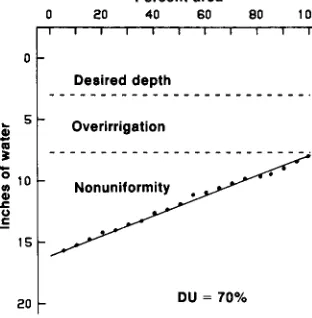
If the distribution uniformity (DU) is 40 percent, then for 80 percent of the irri- gated area to receive at least 3 inches, the average depth applied must be 5 inches, and the amount of subsurface drainage is nearly 42 percent of the average depth (fig. lc). Significant drainage reduction will occur only by substantial deficit irri- gation. The amount of subsurface drain- age will be reduced to 11 percent of the average depth by deficit-irrigating nearly 60 percent of the field (fig. Id). However, the maximum deficit is about 2.1 inches. If overirrigation is occurring, the cu- mulative distribution in figure 2 applies for a uniformity of 80 percent. Although only 3 inches are needed, the average depth applied is 12 inches, and the amount of subsurface drainage is 9 inches. Sub- stantial reductions in drainage will occur simply by decreasing the average depth applied.
Furrow irrigation
Uniformity of furrow systems depends on the time required for water to advance across the field (advance time) and the variability of the soil’s infiltration rate. Because of the advance time, differences in time for infiltration exist between the upper and lower ends of the field, causing nonuniformity in the depth of water infil- trated. These differences can be reduced by increasing the furrow inflow rate dur- ing the advance time, reducing the length
of run, and improving the grade of the field, all of which decrease the advance time.
Data from a furrow-irrigated field in the drainage-problem area revealed that reducing the length of run from 112 to 114
C E 8 -
10
Percent area Percent area
0 20 40 60 80 100 0 20 40 60 80 100
I I I I I I I I I I I I I I I I I I I I I I
- Applied water 0
DU = 70% 20% deficit 80% adequate
-
C E 8 -
10
I
- - -
- Desired depthDU = 70% 20% deficit 80% adequate
-
P 4 - c
: e -
x = 8 -
Percent area
0 20 40 60 80 100
1 1 1 1 1 1 1 1 1 1 1
0
a.-/
..
D
DU = 40% 60% deficit P 4
r
c
DU = 40% 20% deficit
I
r
B
DU = 70% 60% deficit
40% adequate
1 0
6
‘ I
“:i
1 0B
DU = 70% 60% deficit
40% adequate
Percent area
0 20 40 60 80 100
1 1 1 1 1 1 1 1 1 1 1
0
40% adequate l o t
80% adequate
Fig. 1. Cumulative distribution of water for sprinkler systems with distribution uniformities (DU) of 7 0 and 40 percent
Percent area
I I :4 6: I 8: I 1 p O
Desired depth
ii Overirrigation
DU = 70%
Fig. 2. Cumulative distribution under 70 percent uniformity, where overirrigation is occurring.
mile and reducing the set time increased the distribution uniformity from 80 to 89 percent and decreased subsurface drain- age by about 50 percent. Surface runoff, however, increased by nearly 75 percent. Interestingly, while increasing the furrow inflow rate from 35 to 55 gallons per min- ute (gpm) reduced the differences in the infiltration times along the length of run, the amount of infiltrated water remained the same for each inflow rate, a result verified by field data and apparently caused by an increase in the intake rate of the soil as the inflow rate increased.
While differences in infiltration time can be reduced, the maximum uniformity of a furrow irrigation system is limited by variability of the soil infiltration rate within a field. Several studies of infiltra-
tion variability revealed a field-wide dis- tribution uniformity of about 70 percent. This may represent an upper limit, since these fields were described as having a relatively uniform soil texture. Referring to figure la , for completely uniform infil- tration times, about 20 percent of the ap- plied water would be subsurface drainage for an adequate irrigation. The actual uni- formity of the system would be less than
70 percent, determined by the nonunifor- mity of the applied water from the soil variability in addition to the nonunifor- mity from differences in the infiltration times.
One option for reducing subsurface drainage caused by differences in infiltra- tion times is surge irrigation, which ap- plies the water in pulses instead of con- tinuously. (See related article.) Intermit- tent application appears to reduce the soil’s infiltration rate. Several evaluations
of surge irrigation on the West Side of the San Joaquin Valley have shown that it re- quires about 33 percent less water for ad- vance across the field compared with the traditional continuous inflow method. This difference indicates a potential for surge irrigation to reduce subsurface drainage for the first few irrigations of the season when infiltration rates are rel- atively high.
Level basin irrigation has successfully reduced subsurface drainage flows in the Wellton-Mohawk Valley of Arizona. In this irrigation method, water is applied at a high inflow rate to dead-level basins. No
[image:2.612.227.561.57.303.2] [image:2.612.226.382.344.503.2]California study of a level basin system on the West Side showed that, while it can reduce subsurface drainage at minimum labor and energy costs, the system design must be based on the infiltration rate of the preplant irrigation, field inflow rates
of 15 to 20 cubic feet per second, lengths of run no longer than 1/8 mile, and very precise land leveling if substantial drain- age reduction is to occur. Unfortunately, many water distribution systems along the West Side lack the needed flow rate. Another constraint is the natural land slope of the West Side, which would re- quire considerable cutting and filling, even for benched fields.
Sprinkler irrigation
Sprinkler system uniformity depends on hydraulic design, on system mainte- nance, and on distribution patterns over the area irrigated. The hydraulic design affects uniformity by creating pressure losses along mainlines and laterals be- cause of pipeline friction losses and eleva- tion differences. Poor system mainte- nance results in leakage, mixing of nozzle sizes, excessive nozzle and sprinkler head wear, and reduced pressure. The uniform- ity of applied water over the area depends on sprinkler spacings, system pressure, wind velocity, and sprinkler and nozzle type.
A maximum practical uniformity measured for hand-move sprinkler sys- tems used along the West Side is about 70
percent for low wind and adequate pres- sure. Under high winds and low pressures, uniformities of about 40 percent have been measured. A t best, periodic-move sprinkler systems would thus produce about 20 percent of the applied water as subsurface drainage unless deficit irriga- tion occurs (fig. la).
Sprinkler machines classified as con- tinuous-move, such as linear-move sys- tems, are assumed to have high uniform- ity compared with periodic-move systems, particularly under relatively high wind conditions. Some measured uni- formities of linear-move machines with spray nozzles on drop tubes have been be- tween 50 and 70 percent. Causes of nonun- iformity in these systems were inad- equate overlap of the wetted pattern of the spray nozzles and the start-stop se-
quence of the machines (although these machines are called continuous-move, movement actually occurs in a series of starts and stops controlled by a guide tower). The potential of these machines for drainage reduction would be similar to that of a hand-line with a uniformity of
70 percent, although high uniformity un- der windy and low-pressure conditions is more likely. The high application rates of
these systems, however, may cause sub- stantial surface runoff on West Side soils.
Furrow irrigation, the most widely used system in the San Joaquin Valley, is also a major source of drainage water. UC studies have shown that a 50 percent reduction in drainage can be realized if
the length of run and set time are reduced, even on well-operated systems.
Stationary or hand-move sprinkler systems can achieve 70 percent distribution uniformity if
properly designed and maintained, but efficiency drops sharply under high wind and low water pressure conditions. About 20 percent of the water applied may go into subsurface drainage.
Continuous- or linear-move sprinkler systems are generally believed to have higher distribution uniformity than stationary systems, but high application rates and design or maintenance defects can contribute substantially to surface runoff on West Side soils.
Drip/trickle irrigation
Uniformity of driphrickle irrigation systems depends on hydraulic design, manufacturing variation in emitters, and system maintenance. As with sprinkler systems, pipeline friction losses and ele- vation differences can affect system uni- formity, since the emitter discharge is proportional to the emitter pressure. However, variability in emitter dis- charges also can result from the manu- facturing process. This variability, mea- sured as the manufacturing coefficient of variation (CV), may be significant in de- termining system uniformity. A manufac- turing coefficient of variation of less than
5 percent is considered good.
Manufacturing coefficients of vari- ation for drip tape and tubing used in sub- surface drip/trickle irrigation systems generally range between 0.05 to 0.07, ac- cording to the Center for Irrigation Tech- nology. This corresponds to uniformities of 94 percent and 90 percent, respective- ly. The system uniformity is the nonuni- formity of the emitters added to the non- uniformity from hydraulic losses result- ing in the theoretical irrigation efficiencies in table 1 (from an engineer- ing journal). Thus, about 4 to 8 percent of the applied water would be subsurface drainage for a deficit irrigation of 20 per- cent.
Theoretically, drip/trickle irrigation systems are capable of high uniformities
TABLE 1. Dripltrickie system efficiencies
irrigation efficiency for
~ ~ ~ , C e ~ $ ! ~ ~ - o f coefficients of variation of: irriaated 0.04 0.08
5 10
20
93 86
94 89
96 92
and efficiencies, but evaluations of on- farm systems have found lower uniformi- ties. Of 57 drip irrigation systems tested by the mobile laboratory program in the San Joaquin Valley, 17 percent had uni- formities greater than 90 percent, 61 per- cent were between 70 and 90 percent, and 21 percent were less than 70 percent. Causes of the lower uniformities were
poor water quality and filtration with sub- sequent plugging, and excessive variabil- ity among emitters. Plugging of an initial- ly well-designed system probably would not increase subsurface drainage, unless operating time were increased in an at- tempt to compensate for the plugging, but it would increase the area deficit-irrigat- ed. Excessive emitter variability due to wear or poor manufacturing, however, may increase the subsurface drainage.
Other irrigation systems
Low energy precise application (LEPA) irrigation systems are used on the high plains of west Texas to reduce irriga- tion energy costs. These are center-pivot and linear-move sprinkler machines con- verted to drop tubes supplying water to individual furrows. Furrow dikes every 3
to 5 feet prevent surface runoff on sloping ground.
The uniformity of these systems has been measured at about 94 percent, due to hydraulic losses. Uniformity along the travel path, however, is influenced by the irregular movement of the machine, which determines the discharge time be- tween furrow dikes. Arizona researchers found that, for an 11-span linear-move machine, uniformity ranged from about
40 percent for a dike spacing of about 3
feet to 70 percent for a 10-foot spacing. Thus, for adequate irrigation with a 10-
Drip irrigation uses less water and is capable of high uniformity of application, but studies of on- farm systems have found large variations in efficiency stemming from poor water quality or filtration, and design defects that increase subsurface drainage.
foot spacing, about 20 percent of the ap- plied water would be subsurface drainage (fig. la).
Which is best?
It appears that greater drainage re- duction could be achieved with irrigation systems with a potential for high unifor- mities. Studies comparing different irri- gation systems, however, fail to com- pletely support this supposition. Many studies have compared well-designed, well-managed drip systems with poorly designed, poorly managed furrow sys- tems. Obviously, drip irrigation used less water than furrow irrigation. In addition, many of these comparisons were made on small plots, with performance character- istics probably considerably different from those of field-wide systems. A UC study comparing a furrow system with a linear-move sprinkler machine found the furrow system to have a higher applica- tion efficiency.
The irrigation system most likely to be used for drainage reduction will depend on the amount of reduction needed and the primary source of subsurface drain- age (overirrigation or nonuniform water application), the cost of drainage water disposal, the cost of increasing uniform- ity, and the effect of the system design and management on crop yield. For at least the near future, drainage reduction will result from upgrading existing sur-
face irrigation systems and using surge irrigation, since these measures are rela- tively inexpensive and can be implement- ed on existing systems.
Irrigation scheduling
Irrigation scheduling reduces subsur- face drainage if better timing lowers the number of irrigations and if better esti- mates of soil moisture depletion between irrigations decreases the average depth of water applied. Timing depends on crop evapotranspiration, available soil mois- ture, and allowable depletion. Evapotran- spiration can be estimated from Califor- nia Irrigation Management and Informa- tion System (CIMIS) weather station data and the appropriate crop coefficients. Some uncertainty may exist in estimating available soil moisture and allowable de- pletion. For cotton, however, a UC-devel- oped plant-based method of irrigation scheduling using a pressure chamber re- moves much of the guesswork in estimat- ing irrigation dates. At one location over- lying a high water table, scheduling with the pressure chamber eliminated one irri- gation.
[image:4.612.46.393.409.705.2]gations. In drainage problem areas, how- ever, the crop uses substantial amounts of saline groundwater, and soil moisture de- pletion between irrigations will be less than evapotranspiration. At the previous- ly mentioned site, average soil moisture depletion between irrigations was about
70 percent of the evapotranspiration. This depletion must be estimated directly us-
ing neutron probes, tensiometers, or other moisture-measuring devices, or by adjust- ing the evapotranspiration for the upward flow of groundwater.
Drain water use
Researchers have successfully used saline drainage water for crop production in studies by the University of California and the U.S. Salinity Laboratory. (See re- lated articles.) They used low-salinity wa- ter for crop establishment, and saline wa- ter thereafter. Crops in these studies were cotton, grain, sugarbeets, tomatoes, and melons. Results have shown that substan- tial amounts of saline water can be used with little yield reduction, and thus irri- gating with saline drain water is another option for drainage reduction. On-farm strategies for irrigating with such water include, after using low-salinity water for crop establishment, (1) using drainage water blended with low-salinity water for remaining irrigations, or (2) using undilut- ed drainage water for subsequent irriga- tions.
Some feel that the second strategy is the best, but the choice may be deter- mined by on-farm constraints. Irrigating with undiluted drainage water requires a
storage facility for accumulating enough for irrigation. No such facility may be needed for using diluted drain water, but a distribution system may be required to convey the drainage water continuously to the fields being irrigated. A constraint on irrigating with drainage water is the concentration of toxic materials in the water. Another would be sprinkler irriga-
60
50
@ 4 0
-
m e
t'p,,
t Z l 0
6 0
a g 2 0
L L
c -
E m
0 -
tion with drainage water; researchers a t the US Salinity Laboratory have found fo- liar absorption of salts to be a problem with some crops.
A third strategy for using drainage wa- ter in crop production is water table man- agement. Promoted in areas with no sa- linity problems, water table management entails controlling the water table depth to encourage maximum crop use of the shallow groundwater and reduce the irri- gation requirement.
In areas of shallow saline ground- water, water tables are usually controlled to minimize upward flow into the root zone. Recently, UC researchers have shown that shallow saline groundwater can contribute significantly to seasonal crop evapotranspiration, and that the depth of the maximum contribution de- pends on the groundwater salinity. For a saline groundwater with an electrical conductivity of about 10 mmhos per cm, a maximum contribution of about 30 per- cent occurs for a water table depth of about 5 feet (fig. 3). A main advantage of water table management is that the salin- ity distribution in the root zone, the result of irrigating with low-salinity irrigation water, would remain relatively un- changed. Research results have shown no adverse effect on crop yield from using saline groundwater.
Based on this approach, a manage- ment strategy may involve operating a subsurface drainage system only as need- ed to maintain a favorable salt balance in the root zone. During the remaining time, the drainage system would not be operat- ed, inducing maximum crop use of shal- low groundwater.
This strategy may require a different approach to the design of subsurface drainage systems. Laterals are normally installed in the direction of the land slope. Not operating the drainage system could cause water to accumulate in the lower end of fields and create excessively high
- EC = 5 mmhos/cm
_ _
EC = 20 mmhos/cm EC = 10 mmhos/cm -/--
- - --
-
_ _ - - _
_/-.
/ *
--
'.
',.
'\/ '
'.
-
/-
I I I I I I I
\ \
\
9,
m o 3 3 a4l
\
water tables. Under the water table man- agement approach, laterals would be in- stalled with little grade, across the land slope. A nonperforated mainline, with valves periodically spaced, would then al- low the drainage system to be shut down with little adverse effect a t the lower end of the field.
Leaching and drainage
Drainage reduction, as proposed here, would result in less irrigation water per- colating through the root zone, and an in- creased use of saline water for crop pro- duction. Both strategies would increase the potential for excessive salt accumula- tion in the root zone, which would harm crop yields. A salt balance favorable for profitable crop production must be main- tained by periodic adequate leaching of salts from the root zone.
[image:5.612.302.565.551.707.2]The question is, how much water is needed for leaching? Numerous studies have shown the leaching requirement to be related to irrigation water salinity, drainage water salinity, and crop yield. These studies generally assume that irri- gation water is the source of salt. For the low-salinity irrigation water used along the West Side of the San Joaquin Valley, the leaching requirement for no yield re- duction would be a very low percentage of the applied water, and substantial de- creases in the volume of subsurface drain- age could occur without any salinity ef- fects. This would be true for areas with no water tables. Where high water tables ex- ist, however, salt accumulation in the root zone is primarily from salt transport by upward-flowing groundwater, which can be substantial. Seasonal increases in root zone salinity of up to 25 percent of the initial salinity have been measured. The leaching requirement for areas with high water tables would thus be higher than for those with no drainage problems.
Figure 4, which shows the depth of wa- ter per unit depth of soil needed to reduce
-
Clay loam - - - Sandy loam- Peat
I I I I I I I t I I I I .
Fraction of initial salinity remaining
0 , 1 . 2 . 3 . 4 .5 . 6 . 7 . 8 . 9 1
Fig. 4. Depth of leaching water per unit depth of soil needed to reduce soil salinity by a desired percentage.
[image:5.612.43.290.559.712.2]the soil salinity by a desired percentage (developed by U.S. Salinity Laboratory personnel), might be used to estimate the amount of water needed for seasonal sa- linity control where saline high water ta- bles are present. For such areas, leaching would occur during the preplant irriga- tion. UC researchers have shown that, where preplant irrigations occurred, the spring soil salinity was the same for each year over a period of several years. Where no preplant leaching occurred, sa-
linity continued to increase over the time interval.
Since successful leaching requires good drainage, some method of drainage water disposal may be needed in the Val- ley. Evaporation ponds, either on-farm or regional, are now the only short-term dis- posal method. A UC study is being con- ducted to determine the appropriate com- promise between the size of an evaporation pond and the size of a tail- water recovery pond when upgrading a furrow system.
Conclusion
Water table levels are generally high- est in winter and spring, because of preir- rigations and rainfall, and lowest in late fall. Improved irrigation water manage- ment during the preirrigation and the first seasonal irrigation, such as upgrad- ing existing furrow systems or changing to surge irrigation, thus may substantially reduce subsurface drainage. For existing furrow irrigation systems operated as well as possible, a 50 percent reduction in drainage may occur if the length of run and set time are reduced, as indicated by an ongoing UC study. Further reductions may be achieved by converting to surge irrigation. In drainage problem areas, still more reductions might occur with improved irrigation scheduling, water ta- ble management, or irrigation with drain- age water.
In some areas, however, drainage re- duction requirements established by regu- latory agencies eventually may require irrigation systems with high uniformities, such as drip/trickle or low-energy pre- cise-application systems. The uniformity of these systems is independent of soil and climatic factors but depends on hydraulic design and system maintenance to ensure precise application of water.
Controversy exists over the upslope contribution to the drainage problem. Es- timates of upslope irrigation efficiencies show that the potential contribution may be substantial. Reducing this source of drainage water may be necessary for long-term drainage reduction.
Blaine R. Hanson is Extension Irrigation and Drain- age Specialist, Department of Land, Air, and Water Resources, University of California, Davis.
Saline drainage water reuse in
a
cotton rotation system
D. William Rains 0 Sham Goyal 0 Reina Weyrauch 0 Andre LSluchli