III. METHOD
This chapter describes the method that is used in conducting the data of the
research such as design, population and sample, research instruments, validity and
reliability of the instrument, research procedure, data analysis, and hypothesis
testing.
3.1. Design
This research was a quantitative in nature. The researcher used one group
pretest-posttest design (Hatch and Farhady, 1982: 20). One group pretest-pretest-posttest design
was a research design where one group of participants was pre-tested on the
dependent variable and then post-tested after the treatment condition has been
administered. The pre-test was conducted to measure students’ reading
comprehension achievement before treatment and the post-test was conducted to
find the students’ reading comprehension achievement after being taught using
Guessing Meaning from Context strategy. Then, the means score of both pre-test
and post-test was compared to find out the progress before and after the treatment.
The researcher used one class as the experimental class and as the try out class.
The researcher used simple random probability sampling to determine one
The research design is represented as follows:
T1 X T2
Where:
T1 : Pre-test
X1,X2,X3 : Treatments
T2 : Post-test
(Hatch and Farhady, 1982)
Pretests are administered before the treatments of teaching reading by using
recount text. Pretests are implemented in order to see the students’ reading skill.
Then, the researcher will give treatment that is teaching reading by using recount
text. After the researcher give the treatment and the last is post- test. Posttest will
administrate after treatments.
3.2. Subject
The subject of this research is the second grade students of SMPN 6 Metro. There
are sevent classes of the second grade students in 2014/2015 academic year. Each
class consists of about 30 students. The sample is one class as control class VIII
E. The researcher applies the class by using random sampling.
3.3. Variables
In order to assess the influence of the treatment in research, variables can be
defined as dependent and independent variables. Hatch and Farhady (1982: 15)
investigate and the dependent variable is the variable that the researcher observe
and measure to determine the improvement of the independent variable.
The research consists of the following variables:
1. Guessing Meaning from Context as independent variable (X)
2. Students’ Reading Skill as dependent variable (Y)
3.4. Research Instruments
The instrument of this research is reading test. The researcher administers a
pre-test, treatments, and post-test. Pre-test and post-test that the researcher administers
are the same test. Then, the data is analyzed from the result of those two activities
which can be clarified as follows:
1. Pretest
Pre-test is conducted in order to find out the students’ reading skill before the
treatments. The purpose of this test is to know where the students have the same
effect of reading recount text. The type of the test will be the multiple choice in
which the students is asked to choose one correct answer from the option a, b, c,
or d. In this pre-test the students will be given 30 items of reading comprehension
and it will be conducted within 60 minutes.
2. Treatments
Treatment is conducted in order to teach the students about Guessing Meaning
from Context strategies. The purpose of this treatment is how the students applied
text. In this treatment students will be taugh in 3 meetings, in each meeting
students will be taught about Guessing Meaning from Context strategies
(Definition, Restatement, Punctuation marks, Examples, Contras, Similarity,
Surrounding words, Pictures, Experience, Imagination). First meeting students
will be taught about definition, restatement, and punctuation marks. Second
meeting students will be taught about examples, contras, and similarity. Third
meeting students will be taught about surrounding words, pictures, experience,
and imagination. This treatment will be given in 40 minutes.
3. Test After Treatment
Test after treatment is three times test that will be given after treatment. The aim
of this tests is to find out whether students understand about the treatments. The
first test will be given after first treatment which disscussed about definition,
restatement, and punctuation marks. The second test will be given after second
treatment which disscused about examples, contras, and similarity. The third test
will be given after the third treatment which disscused about surrounding words,
pictures, experience, and imagination. This tests consists of 20 items of multiple
choices for 20 minutes.
4. Posttest
The aim of this test is to determine the effect of the treatments towards the
students’ reading comprehension after being given the treatments. This test
3.5. Data Collecting Technique
In collecting the data, the researcher uses the procedure that can be described as
follows:
1. Planning
The procedure of making planning of this research can be seen as follows:
a.Preparing the Try-out
In the first meeting, the researcher gave a test in experimental class. In try
out class, the researcher provided 40 items in 90 minutes. It was done in
order to know whether the test items were applicable or not, by finding out
the validity, reliability, level of difficulty, and discrimination power.
Split-half method was used to measure the reliability in which requires the
researcher to provide the items into two same groups, first half and second
half.
b.Preparing the Pre-Test
In the second meeting, the researcher administered the pre-test in
experimental class. This test was administered to find out the students’ basic
reading comprehension before treatment. It used an objective test in form of
multiple choices with 30 items in 60 minutes. 30 items were taken from the
result of try-out test.
c.Preparing the Treatments
After giving the pre-test for the students, the researcher conducted treatment
for six times by using Guessing Meaning from Context strategy. The
materials of this research were based on the School Based Curriculum 2006
in the process of teaching reading, which involved recount text inside.
Hopefully, those lesson plans in teaching reading process were able to
generate a good reading comprehension.
d.Preparing the Test After Treatment
The researcher administered the test after tratment in control class. This test
was administered three times after treatment to find out the students’ basic
reading skill after treatment. It used an objective test in form of multiple
choices with 20 items in 30 minutes. 30 items were taken from the result of
try-out test.
e.Preparing the Post-Test
In the last meeting, the post-test was distributed in the experimental class to
determine the result of students’ reading comprehension after being taught
by using Guessing Meaning from Context strategy. The researcher used an
objective test in form of multiple choice items in 60 minutes. It consisted of
30 items to find out whether there was a significant increase on the students’
reading comprehension achievement after the treatments.
2. Application
After making a plan, there are some steps that have been applied:
a.In the first meeting, try out is given.
The test papers are administered to the students and the students are asked to
do the test. And the last, they are asked to hand in their test. This test is in
the form of multiple choices that consist of 45 items and allocated within 90
b.In the second meeting, Pre-Test is given.
In this test, the researcher asks students to do multiple choices tests that
consist of 40 items of recount text in 60 minutes.
c.Conducting treatments
After giving the pre-test, the treatment is conducted in three meeting which
2 x 45 minutes. The students are given the different assignments for each
session and the materials which are about recount text.
d.Test After Treatment
Test after tratment in experimental class. This test was administered three
times after treatment. It used an objective test in form of multiple choices
with 20 items in 30 minutes. 30 items were taken from the result of try-out
test.
e.In the last meeting, Post-Test is given.
The post-test will be multiple choice which consists of 25 items of recount
text in 40 minutes.
3.6. Try Out of the Instruments
There are four criteria of good test namely, validity, reliability, level of difficulty,
and discrimination power.
3.6.1. Validity
Validity refers to the extent to which the test measures and to what is intended to
validity (Hatch and Farhady, 1982:250). A test can be considered to be valid if it
can precisely measure the quality of the test.
There are four kinds of validity those are:
1. Face validity, concerns with the lay out of the test
2. Content validity, depends on a careful analysis of the language being stated;
3. Construct validity, measures certain specific characteristic in accordance with a
theory of language learning;
4. Criterion-related validity, concerns with measuring the success in the future as
in replacement test.
According to the types of validity above, the researcher uses content and construct
validity. Both of them are explained as follows:
a. Content Validity
Content validity is intended to know wheter the test items are good reflection of
what will be covered or not. The test items which are adopted from the materials
that have been taught to the students should be contructed as contain a
representative sample of the course (Heaton, 1988). To get the content validity of
reading comprehension, the researcher tried to arrange the materials based on the
standard competence in syllabus for third grade of junior high school students. In
order to establish the content validity of measuring instrument, the researcher
The validity of instruments is referred to the contant and contructs validity in
which the question represents five sort reading skills, i.e. determining main idea,
finding the detail information, reference, inference, and vocabulary (Nuttal, 1985).
All test items which has good validity is used to collect the data for this research
and the bad one should be revised.
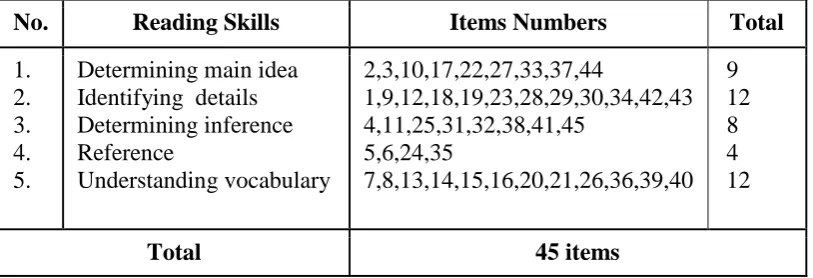
[image:9.595.114.521.279.418.2]The content of try out is presented in table of specification below:
Table 3.6. Reading Specification (Aspect of Reading)
From the table specification of try out above there are 45 items that divided into 5
objectives, they are identifying main idea 9 items, identifying details 12 items,
making inference 8 items, reference 4 items, and understanding vocabulary 12
items.
b. Construct Validity
Construct validity concerns whether the tests are true reflection in line with the
theory of what to know the language (Shohamy, 1985: 74). If a test has construct
validity it is capable of measuring certain specific characteristic in accordance
with a theory of language behaviour and learning. This type of validity assumes
the existence of certain learning process theories or contructs underlying the
acquisition of abilities and skills (Heaton, 1988: 161).
No. Reading Skills Items Numbers Total
1. 2. 3. 4. 5.
Determining main idea Identifying details Determining inference Reference Understanding vocabulary 2,3,10,17,22,27,33,37,44 1,9,12,18,19,23,28,29,30,34,42,43 4,11,25,31,32,38,41,45 5,6,24,35 7,8,13,14,15,16,20,21,26,36,39,40 9 12 8 4 12 12
3.6.2. Reliability
Reliability refers to the extend to which the test is consistent in its score and gives
us an indication of how accurate the test score are (Hatch and Farhady, 1982:
244). In other words, how far it can measure the subject at separated time, but it
shows the same result relatively (Setiyadi. 2006: 113). Reliability can be defined
as the extent to which a test produce consistent results when administered under
similar condition (Hatch and Farhady. 1982: 244). The test is determined by using
Pearson Product Moment which measures the correlation coefficient of the
reliability between odd and even number (reliability of half test) in the following
formula:
r
xy =√( )( )
Where:
rxy : coefficient of reliability between odd and even numbers items
x : odd number
y : even number
Σ
x2 : total score of add number itemsΣ
y2 : total score of even number itemsΣ
xy : total score of odd and even numberAfter getting the reliability of the half test, the researcher used “ Spearman
Bown’s Prophecy formula” (Hatch and Farhady, 1982: 247) to determine the
r
k =
Where :
rk : the reliability of the whole tests rxy : the reliability of half tests
The criteria of reliability as follows: 0.90 – 1.00 = high
0.50 – 0.89 = moderate 0.0 – 0.49 = low
(Hatch and Farhady, 1982:127)
3.6.3. Level of Difficulty
Level of difficulty relates to how easy or difficulty the item taken from the point
of view of the students who take the test. It is important since test items which are
too easy (that all students get right) can tell us nothing about differences within
the test population (Shohamy, 1985: 79).
Moreover, the difficulty level of an item shows how easy or difficult that
particular item does by the participants Heaton (1975:182). The students are
divided into two group that are upper and lower groups. The students’ scores of
try out are listed from the highest score and lowest score:
It is calculated by the following formula:
LD =
Where:
LD : level of difficulty
L : the number of lower group who answer correctly
N : the total number of students in upper and lower groups
The criteria are as follows:
<0.03 : difficult
0.03 – 0.07 : average
> 0.07 : easy
(Shohamy, 1985: 79)
3.6.4. Discrimination Power
Discrimination power is used to indicate how accurate the test items can really
differentiate between the successful (upper) and fail (lower) students who take the
test. The discrimination power (DP) is the proportion of the high group students
getting the items correct minus the proportion of the low-level students who get
the items correct. In calculating the discrimination power of each item the
following formula is used:
The discrimination power is calculated by this following formula:
DP = Correct Upper ― Correct Lower
⁄
Notes:
DP = Discrimination Power.
U = The number of upper group who answer correctly.
L
=
The number pf lower group who answer correctly.The criteria are:
DP : 0.00 - 0.19 = Poor
DP : 0.20 - 0.39 = Satisfactory
DP : 0.40 - 0.69 = Good
DP : 0.70 - 1.00 = Excelent
DP : - (Negative) = Bad items, should be omitted
(Heaton, 1975: 182)
3.7. Scoring System
The scoring system that Is used in this research is dividing the right answer by
total items timed 100. In scoring the students’ result of the pre-test and post-test,
the formula by Arikunto (1997: 212) is employed:
S =
x 100
Were :
S : score of the test
R : number of right answer
N : total number of items on test
3.8. Data Analysis
In order know the students’ progress in comprehending the text and the students’
score are computed by doing three activities:
1. Scoring the pretest and posttest
2. Tabulating the result of the test and calculating the mean of pretest and the
M =
Notes:
M = mean (average score)
Σx = the total students’ score
N = total number of students
(Hatch and Farhady: 1982)
1. Drawing conclusion from the tabulated results of the test given, that was by
statistically analyzing the data using statistical computerization i.e paired
T-Test of statistical Package for Social Science (SPSS) to test whether the
increase of students’ gain is significant or not, in which the significance is
determined by p < 0,05. It is used as the data from one sample. (Hatch and
Farhady, 1982: 117). In order to know whether the students get any progress,
the formula was as follows:
I = X
2– X
1Notes:
I = the increase of students’ reading comprehension achievement
X2 = the average score of post-test
X1 = the average score of pr-test
3.9. Hyphotesis Testing
The pre test and post test are compared in order to know the increase of students’
reading skill after treatments. The researcher used Repeated Measure T- test
towards the average score of pre test and post test. Morever, the result of t-test is
used to investigate the difference on reading comprehension ability before and
rejected. In this case, the researcher is significant level of 0.05 in which that the
probability of error in the hypothesis is only about 5%.
The hypothesis are drawn as follows:
H0 : There is no difference on students’ reading skill after gave treatments by
Guessing Meaning from Context strategy.
H1 : There is significance difference on students’ reading skill after gave
treatments by using Guessing Meaning from Context strategy.
(Hatch and Farhady, 1982: 111)
The criteria for accepting the hyphothesis are as follows:
1. H0 is accepted if the t-value is lower than T- ratio.