Matter from Toric Geometry and its Search at
the LHC
T.V. Obikhod
Institute for Nuclear Research, NAS of Ukraine 03680 Kiev, Ukraine
∗Corresponding Author: [email protected]
Copyright c⃝2013 Horizon Research Publishing All rights reserved.
Abstract
Toric geometry is applied for construction the enhanced gauge groups in F-theory compactified on elliptic Calabi-Yau fourfolds. The Hodge numbers calculated from the polyhedra for the chain H = SU (1), ... ,SU (5), SO(10),E6, E7determine the number of tensor multiplets, vector multiplets and hypermultiplets ofsoli-tonic states that appear from singularities of elliptic fibration. Due to duality between the compactification of
E8timesE8 heterotic string and the type IIA string compactification on a Calabi-Yau manifold there is a natural
sequence of E-group embeddings which gives the matter content of Minimal Supersymmetric Standard Model and the possibility of searching for supersymmetry at the LHC.
Keywords
Toric geometry, Calabi-Yau manifold, Singularities of elliptic fibration, Matter content1
Introduction
At high energy, the three gauge interactions which define the electromagnetic, weak, and strong interactions, are merged into one single interaction characterized by one larger gauge symmetry Grand Unified Theory, (GUT) [1] and thus one unified coupling constant. This gauge coupling unification works quite well in the Minimal Supersymmetric Standard Model (MSSM) motivating not only grand unification (or some superstring theories with similar properties) but also that supersymmetry emerges. Supersymmetry refers to possible relations between the spectrum and interactions of fermions (half-integer spin particles) and bosons (integer spin particles). It can be viewed as a space-time extension of the Poincare (Lorentz plus translational invariance) group, involving new anti-commuting dimensions. Under reasonable assumptions it is the unique extension of the usual Poincare and internal symmetries of field theory. Supersymmetry provides a possible route to unify gravity with the other interactions through superstring theory [2]. For a consistent formulation superstring theories require additional dimensions and there are actually a large number of string theories, many of which include underlying grand unification symmetries (GUT). One of the branches of string theory is F-theory [3] which allows string theorists to construct new realistic vacua - in the form of F-theory compactified on elliptically fibered Calabi-Yau fourfolds.
2
Reflexive Polyhedra as Geometric Realization of
Calabi-Yau Fourfolds
The elegant algorithm for obtaining the enhanced gauge groups in F-theory has been proposed by Candelas et al. [6, 7]. We consider F-theory of the form R3,1×X [8, 9], where X is a Calabi-Yau fourfold. We consider
superstring compactification on the Calabi-Yau fourfold X represented as the elliptic fibration over a complex threefold - the Hirzebruch surfaceFn,
ε
→ X↓
Fn
We also take X to be a local elliptic K3-fibration over
S of the form
Y → X
↓
S
where we model the local elliptically-fibered K3-surfaceY on a hypersurface in
C
3with an isolated ADE singularity. A great many Calabi-Yau manifolds are known in terms of toric data [10] and there is the correspondence, pointed out by Batyrev, between Calabi-Yau manifolds and reflexive polyhedra
△ [11]. To a Calabi-Yau manifold (of any dimension) defined as a hypersurface in a weighted projective space one can associate its Newton polyhedron, which we denote by △. The Newton polyhedron is often reflexive and when it is we may define the dual or polar polyhedron which we denote by ∇. Polyhedra △ and ∇ are reflexive, when fourfold X is simultaneouslyK3-fibration and can also be viewed as an elliptic fibration over the Hirzebruch surfaceF2k. By means of a computer program we have computed the dual polyhedra for the fourfolds
X18k+18(1,1,1,3k,6k+ 6,9k+ 9)(k=1,. . . , 6).
The following observations summarize the structure of the polyhedron▽:
1. Omitting the first two points and the last point of▽leaves us with the dual polyhedron3▽of theK3 surface
X12(1,1,4,6) ;
2. Omitting the first three points and the last two points of▽leaves us with the dual polyhedron2▽of the torus
X6(1,2,3) ;
3. The polyhedron3▽is divided into a ‘top’ and a ‘bottom’ by the polyhedron2▽and we may write 3▽=▽H
bot∪ ▽ k=1
top ,
where▽k=1
top depends only onk= 1 while ▽Hbotdepends only on the enhanced gauge group H.
Let us introduce special pointspt(1j)= ( 0, 0,−j, 2, 3) ,
pt(2j)= ( 0, 0,−j, 1, 2) ,
pt(3j)= ( 0, 0,−j, 1, 1) ,
pt(4j)= ( 0, 0,−j, 0, 1) ,
pt(5j)= ( 0, 0,−j, 0, 0) ,
pt(6j)= ( 0, 0,−j,−1, 0) ,
pt(7j)= ( 0, 0,−j, 0,−1) , wherej is a positive integer.
We consider now the possibility of adding to 2▽ combinations of the points pt(rj) in all possible ways such
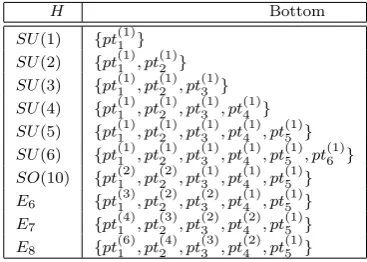
that the bottom corresponds to a reflexive polyhedron. Tables 1 and 2 show the allowed bottoms leading to enhanced gauge groupsH. Note that in each case the points of2▽are understood and pt(rj)implies the presence
ofpt(rj−1), . . . , pt(1)r .
Applying the analogous consideration to tops we obtain the following gauge content for fourfolds (1) :
H×SU(1) for k= 1, H×SO(8) for k= 2, H×E6 for k= 3,
H×E7 for k= 4,
H×E8 for k= 5,
H×E8 for k= 6.
The relations between the bottoms and the enhanced gauge groups are presented in Table 1.
3
Nesting of polyhedra
We consider now the possibility of adding combinations of the points in all possible ways such that the bottom corresponds to a reflexive polyhedron. All the groups do appear in Table 1 and, as a matter of consistency, we see the inclusions
Table 1. The bottoms and related enhanced gauge groups.
H Bottom
SU(1) {pt(1)1 } SU(2) {pt(1)1 , pt(1)2 } SU(3) {pt(1)1 , pt(1)2 , pt(1)3 } SU(4) {pt(1)1 , pt(1)2 , pt(1)3 , pt(1)4 } SU(5) {pt(1)1 , pt(1)2 , pt(1)3 , pt(1)4 , pt(1)5 } SU(6) {pt(1)1 , pt(1)2 , pt3(1), pt(1)4 , pt(1)5 , pt(1)6 } SO(10) {pt(2)1 , pt(2)2 , pt(1)3 , pt(1)4 , pt(1)5 } E6 {pt(3)1 , pt
(2) 2 , pt
(2) 3 , pt
(1) 4 , pt
(1) 5 } E7 {pt(4)1 , pt
(3) 2 , pt
(2) 3 , pt
(2) 4 , pt
(1) 5 } E8 {pt
(6) 1 , pt
(4) 2 , pt
(3) 3 , pt
(2) 4 , pt
(1) 5 }
as inclusions of the respective polyhedra. Thus we can see the duality between compactifications of the E8×E8
heterotic string and the type IIA string compactified on a Calabi-Yau manifold. The new contribution here is the observation that sequences of reflexive polyhedra associated to these spaces are nested in such a way as to reflect heterotic perturbative and non-perturbative processes. This qualitative observation is supported by quantitative agreement of the computed from the polyhedra Hodge numbers and the number of tensor, vector and hypermultiplets in the heterotic side. It leads also to the observation that the Dynkin diagrams for the groups may be read off from the polyhedra. Table 2 for the chains of fourfolds demonstrates the nesting of polyhedra.
Table 2. Matter content for the chain of enhanced gauge groups.
Group Matter content
SU(2) (6n+ 2)2 SU(3) (6n+ 18)3 SU(4) (n+ 2)6+(4n+ 16)4 SU(5) (3n+ 16)5+(2 +n)10 SO(10) (n+ 4)16+(n+ 6)10
E6 (n+ 6)27 E7 (n2 + 4)56
For the chain H =SU(1), . . . , SU(5), SO(10), E6, E7 we can determine the number of multiplets of solitonic
states that appear from singularities of elliptic fibration. Nesting of polyhedra is interpreted as phase transition. This phase transition can be interpreted as a group chain of spontaneous symmetry breaking
SO(10)→SU(5)→SU(3)×SU(2)×U(1) GroupSO(10) has groupSU(5) as its subgroup:
16 = 10 + 5 + 1.
Thus 16 multiplet of fermions consists of three SU(5) multiplets. Particle content of Minimal Supersymmetric Standard Model (MSSM) can be presented in terms ofSU(5) multiplets
3×(24 + 5H+ 5H+ 5M + 5M + 10M+ 10M),
where 5H and 5H are Higgs multiplets, 5M and 10M are multiplets of quark and lepton superpartners. The
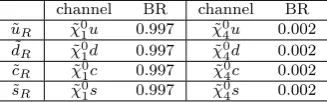
transition betweenSU(5) andSU(3)×SU(2)×U(1) can be realised with the help of partial widths of superpartners calculations. Using this restricted parameter set of MSSM model
M0= 800 GeV, M1/2= 650 GeV,
A0= 0 , tanβ= 10, sgn(µ) = +1.
[image:3.595.419.556.353.433.2]Table 3. Partial widths of superpartners
channel BR channel BR ˜
uR χ˜01u 0.997 χ˜04u 0.002
˜
dR χ˜01d 0.997 χ˜04d 0.002
˜
cR χ˜01c 0.997 χ˜04c 0.002
˜
sR χ˜01s 0.997 χ˜04s 0.002
Table 4. Partial widths of superpartners
channel BR channel BR
g b1b∗ 0.074 t1t∗ 0.425 b∗1b 0.074 t∗1t 0.425
4
Conclusions
Thus we see the duality between the compactifications of theE8×E8 heterotic string and the type IIA string
compactification on a Calabi-Yau manifold. The observations concerning this duality are the subject of the present article: we have a correspondence between reflexive polyhedra, △, and Calabi-Yau manifolds. Combining this with the correspondence between vector bundles and Calabi-Yau manifolds gives a correspondence between vector bundles and reflexive polyhedra△. It is known also that the moduli spaces of Calabi-Yau manifolds form a web in which continuous transitions between different Calabi-Yau manifolds (phases) occur [13]. Indeed it seems likely that all Calabi-Yau manifolds are connected by processes of this type [14]. In virtue of duality this web structure must exist also on the heterotic side, though the physical picture is different. Indeed, the space of heterotic vacua also forms a web in which different models are connected along branches parametrized by vacuum expectation values of scalars in vector and hypermultiplets. Subsequently, it was argued that the appearance of perturbative heterotic groups in the chains could be explained in the Calabi-Yau picture [6]. Indeed, there is a natural sequence of E-group embeddings which give the Standard Model gauge group and matter structure in an elegant manner:
E3×U(1)⊂E4⊂E5⊂E6⊂. . .
where E3 = SU(3)×SU(2) denotes the non-abelian gauge group of the Standard Model, E4 = SU(5) and
E5 =SO(10). Both gauge coupling unification as well as the matter content of the Standard Model hint at the
presence of a unified gauge group structure at high energies. From this perspective, we interpret the unification of the gauge couplings in the minimal supersymmetric extension of the Standard Model as evidence that instead of the infinitely complex variety of classical groups and matter which can appear in string theory, the list of relevant simple gauge groups is limited to the finite number of exceptional gauge groups and their subgroups. This provides an economical way to break the exceptional gauge group to gauge symmetries closer to the MSSM. One of the nicest qualities of supersymmetry is that so much is known about it already, despite the present lack of direct experimental evidence. The interactions of the Standard Model particles and their superpartners are fixed by supersymmetry, up to mass mixing effects due to supersymmetry breaking. Even the terms and stakes of many of the important outstanding questions, especially the paramount issue ”How is supersymmetry broken?”, are already rather clear. Analyses of LHC searches corresponding to ∼ 5 fb−1 at √s = 7 TeV have not found any superpartners, and have put strong lower bounds on the masses of squarks and gluinos in large classes of models. The most common templates used for reporting the results of experimental searches are the MSUGRA scenario with new parameters
m0, m1/2, A0,tanβ,Arg(µ). However, one should not lose sight of the fact that the only indispensable idea of
supersymmetry is simply that of a symmetry between fermions and bosons. If supersymmetry is experimentally verified, the discovery will not be an end, but rather a beginning in high energy physics. It seems likely to present us with questions and challenges that we can only guess at presently. The measurement of sparticle masses, production cross-sections, and decay modes will rule out some models for supersymmetry breaking and lend credence to others. We will be able to test the principle of R-parity conservation, the idea that supersymmetry has something to do with the dark matter, and possibly make connections to other aspects of cosmology including baryogenesis and inflation.
REFERENCES
[1] A.J. Buras et al. Aspects of the grand unification of strong, weak and electromagnetic interactions, Nucl. Phys., Vol. B135, 66–92, 1978.
[2] M. Kaku. Introduction to Superstring and M-Theory, New York, USA: Springer-Verlag, 1999, 593p.
[4] N. Arkani-Hamed, S. Dimopoulos and G. Dvali. The Hierarchy problem and new dimensions at a millimeter, Phys. Lett., Vol. B429, 263-272, 1998.
[5] C. Beasley, Jonathan J. Heckman and C. Vafa. GUTs and Exceptional Branes in F-theory - I , arXiv:0802.3391 [hep-th].
[6] P. Candelas and A. Font. Duality Between the Webs of Heterotic and Type II Vacua,arXiv: hep-th/9603170.
[7] E. Perevalov and H. Skarke. Enhanced Gauge Symmetry in Type II and F-Theory Compactifications: Dynkin Diagrams From Polyhedra, arXiv: hep-th/9704129.
[8] D. R. Morrison and C. Vafa. Compactifications of F-theory on Calabi-Yau threefolds (I), Nucl. Phys., Vol. B473, 74–92, 1996.
[9] D. R. Morrison and C. Vafa. Compactifications of F-theory on Calabi-Yau threefolds (II), Nucl. Phys., Vol. B476, 437-469, 1996.
[10] M. Kreuzer and H. Skarke. No Mirror Symmetry in Landau-Ginzburg Spectra!, Nucl. Phys., Vol. B388, 113–130, 1992.
[11] V. Batyrev. Variations of the mixed Hodge structure of affine hypersurfaces in algebraic tori, Duke Math. Journ., Vol. 69, 349–409, 1993.
[12] M. Muhlleitner, A. Djouadi and Y. Mambrini. SDECAY: a fortran code for the decays of the supersymmetric particles in the MSSM, Comput. Phys. Commun., Vol. 168, 46-70, 2005.
[13] M. Reid. The moduli space of 3-folds withK = 0 may nevertheless be irreducible, Math. Ann., Vol. 278, 329–334, 1987.