JULY-AUG, 2015, VOL-3/19 www.srjis.com Page 745 INFLUENCE OF TYPES OF SCHOOLS AND EFFORTFUL CONTROL ON
PROBLEM SOLVING ABILITY OF SCHOOL STUDENTS Sawinder Arora
Assistant Professor, G.N. College of Education (W), Kapurthala, Punjab, India
One of the indicators of intelligent behavior is the ability to solve problem. A student is expected to have adequate problem solving ability that will help them in solving academic and non-academic problems. Therefore, various efforts need to be done to improve problem solving ability in students. The present study was an effort to study the influence of types of institutions and effortful control on problem solving ability of
secondary school students. It was a survey work. The sample was selected from VIIIth, IXth
and Xth class students of government and private schools of Jalandhar and Kapurthala districts by using cluster random sampling technique. Tools used for data collection were Problem Solving Ability Test by Kaufman (1954) and King (1991), and Effortful Control Scale by Lonigan & Phillips (2001). The collected data were analysed and the results were interpreted.
A problem can be defined as a block or obstacle that one cannot overcome with exiting habits and practices. Woolfolk (2004) pointed out that problem is any situation in which you are trying to reach some goal and must find a means to do so. In day-to-day life we face many problems with no readymade solution. The aim of our schools is to make our students efficient in solving problems. National Curriculum Framework (2005) emphasised that the development of life skills such as critical thinking skills, interpersonal communication skills, negotiation/refusal skills, decision making/ problem-solving skills, and coping and self-management skills is very critical for dealing with the demands and challenges of everyday life. Kennedy (1980) argued that problem solving is related to individuals’ previous knowledge and experiences. So, learning problem solving skills in the schools can be beneficial in solving problems. However, government and private schools in India differ with respect to many factors like socio-economic background of students, qualification of teachers, salary structure of teacher, and medium of learning. Thus, the type of schools can have different influence on the problem solving ability of the students. It may be beneficial to study the influence of types of schools on the problem solving ability of the students. Moreover, the study also focused on investigating the relationship between effortful control and problem solving ability of student. As effortful control include attentional control processes, the inhibition of prepotent behaviors in response to instructions or social
Scholarly Research Journal's is licensed Based on a work at www.srjis.com
JULY-AUG, 2015, VOL-3/19 www.srjis.com Page 746 demands, and the capacity to perform an action when there is a strong tendency to avoid it (Rueda, 2015), studying problem solving ability in relation to effortful control of the students can be useful. Thus, it was thought to study the influence of types of schools and effortful control on problem solving ability of secondary school students
Objective
To study the influence of Type of School, Effortful Control and their interaction on
Problem Solving Ability of Secondary School Students
Methodology Sample
Cluster Random sampling technique was used to select the sample. The sample
comprised 244 students. Out of which, 125 were from government schools and 119
were from private schools. Also, class-wise 60 students were from class VIII, 125
students were from class IX, and 59 students were from class X.
Tools
For assessing the problem solving of secondary school students, the
Problem Solving Test consisting of 10 problems were used. Out of these 10
problems, two problems were taken from Kaufman (1954) and eight were
taken from paper and pencil test of problem solving ability developed by
King (1991). For each correct answer two marks were given.
For assessing effortful control of students, Punjabi translation of
Effortful Control Scale (ECS) developed by Lonigan and Phillips (2001) was
used. The ECS is a 24-item self-report questionnaire with a 5-point rating
scale, tapping Persistence/Low Distractibility and Impulsivity (12 items
each). The sum of score is the total effortful control score. Verstracten,
Vasey, Class, and Bijttebier (2009) supported the construct validity of
ECS and found it more appropriate for use in broader age ranges.
Procedure
Students selected in sample were made to sit comfortably in their classrooms of the
schools they belonged to. The Problem Solving Test and Effortful Control Scale were
administered on the students. After the completion of the test the investigator
collected the test booklets. The scoring was done as per the instructions given in the
JULY-AUG, 2015, VOL-3/19 www.srjis.com Page 747 Result and Interpretation
The objective was to study the influence of Type of School, Effortful Control and their
Interaction on Problem Solving Ability of Secondary School Students. There were two
types of schools (Government and Private) and there were three levels of effortful
control (Low, Intermediate and High). So, data were analysed with the help of 2 × 3
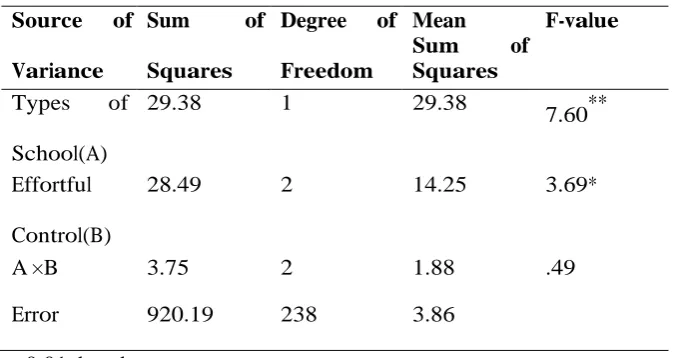
Analysis of variance. The results are given in table 1.
Table 2 Summary of 2 × 3 factorial design for problem solving ability
Source of
Variance
Sum of
Squares
Degree of
Freedom
Mean
Sum of
Squares
F-value
Types of
School(A)
29.38 1 29.38
7.60**
Effortful
Control(B)
28.49 2 14.25 3.69*
A ×B 3.75 2 1.88 .49
Error 920.19 238 3.86
significant at 0.01 level
significant at 0.05 level
As per the table 1, F-value for types of schools is 7.60, which is significant
at.01 level. It indicates that mean score of students belonging to Government
and Private schools differ significantly. In this context, the null Hypothesis,
namely, “There is no significant influence of Types of Schools on Problem
Solving Ability of secondary school students” is rejected. Further, the mean
score of problem solving ability of private school students (5.09) was
significantly higher than those of government school students (4.47). It may
therefore be said that the problem solving ability of private school students
was found to be better than government school students.
F-value for effortful control is 3.69, which is significant at .05 level. It indicates
that mean scores of students belonging to low, intermediate and high effortful
control groups differ significantly. In this context, null hypothesis, namely,
“There is no significant influence of Effortful Control on Problem Solving
Ability of secondary school students”, is rejected. In order to probe further the
Scheffe’s PostHoc analysis was done. The results are given in Contrast
[image:3.595.130.470.214.393.2]JULY-AUG, 2015, VOL-3/19 www.srjis.com Page 748 Table 2: Multiple comparisons and mean differences in problem solving ability by
effortful control
Comparison Mean Difference SE Scheffe 95%CI
Low vs. Average
-.73* .30 -1.48, .01
Average Vs. High .02 .31 -.74, .78
Low Vs. high -.71 .34 -1.54, .12
*
significant at0.05 level
The C o n t r a s t Tests Ta ble helps us to identify which main effects were
statically significant. Scheffe’s PostHoc analysis revealed that students with average
effortful control had significantly higher problem solving ability than students who
had lower effortful control. Influences at the other levels of effortful control were
not significant.
As per table 1, F-value for interaction between type of school and effortful
control is .49, which is not significant. It indicates that there was no
significant influence of the resultant of the interaction between types of
schools and effortful control on problem solving ability. In this context the null
hypothesis, namely, “There is no significant influence of Interaction between
Type of School and Effortful Control on Problem Solving Ability of secondary
school students”, is not rejected. It may, therefore be said that problem
solving ability was found to be independent of the interaction between type of
school and effortful control.
Discussion
It was found that problem solving ability of students of private school was better as
compared to government school students. The private s c h o o l students may have
b e t t e r environment for p robl em solving in their s c h o o l as compared to
government school students. The parents of private s c h o o l students are more
influential and better aware of importance of education than that of the parents of
government school students. The reasoning ability, mental ability and grasping power
o f the p r i v a t e s c h o o l students may be better than government school students.
These aspects are normally related with problem solving ability. It may be the reason
of present finding. Also it was found that students with average effortful control
JULY-AUG, 2015, VOL-3/19 www.srjis.com Page 749 control. Thus, teachers need to develop some strategies for helping students with
low effortful control to improve their effortful control.
References
ASLAN, E. A. (2002). Yaratıcı problem çözme. İçn. Örgütte kisisel gelişim [Creative problem solving. In personal development at organization] Esra A. Aslan (Ed.) Ankara: Nobel Yayınları.
Kaufman, G.L. (1954). The book of modern puzzles (2nd Ed.). New York: Dover Publication, Inc.
Kennedy, L. M. V. (1980). Educational psychology: In theory and practice. New York: Random House
King, A. (1991). Effects of training in strategic questioning on children's problem- solving performance. Journal of Educational Psychology, 83(3), 307-317
Lonigan, C.J., & Phillips, B.M. (2001). Temperamental influences on the development of anxiety disorders. In M.W. Vasey & M.R. Dadds (Eds.), The development psychopathology of anxiety (pp.60-91). New York: Oxford University Company.
National Council of Teachers of Mathematics (NCTM). (2000). Principles and standards for school mathematics. Reston, VA.
National Curriculum Framework. (2005). National curriculum framework. New Delhi: National Council of Educational Research and Training.
Verstracten, K., Vasey, M.W., claes, L., &Bijttebier, P. (2009). The assessment of effortful control in childhood: Questionnaires and the Test of Everyday Attention for children compared. Personality and Individual Differences, 48, 59-65. doi: 10.1016/i. Paid.2009.08.016.