402
ACTIVITY CLASSIFICATION FRAMEWORK BASED ON
PERSONALITY AND TIME SCALE
1SITI SUHANA ABDULLAH, 2MOHD ROSMADI MOKHTAR, 3MOHD JUZAIDDIN AB AZIZ Faculty of Information Science and Technology, The National University of Malaysia, Bangi, Malaysia
E-mail: [email protected], [email protected],[email protected]
ABSTRACT
A variety of activities input formally by a user such as data from a calendar application usage, contains cognitive information that can be predicted through an analysis of formal recorded activities. Although these data are static and rigid, they still contain information which facilitates in understanding activity tendencies for today’s computing requirement. This research aims to classify activity and develop an activity classification framework based on personality and time scale. The framework formation involves data collection, analysing and classifying activities based on total frequencies of the OCEAN personality model and the time scale identified. The testing phase involved 6 evaluators who evaluated and classified activities based on the OCEAN personality model framework and time scale. The OCEAN model contains various adjectives that have been categorized into five dimensions; namely Extraversion, Agreeableness, Conscientiousness, Neuroticism and Openness to Experience. These classifications are used and accepted in the field of psychology attributed to personality and character development. The average percentages evaluated by the evaluators are 26.7% (Extraversion), 1.6% (Neuroticism), 59.0% (Conscientiousness), 26.3% (Agreeableness) and 4.9% (Openness to Experience). The results show the capability of the framework classifying activity with the selection of the Conscientiousness dimension by 60% and Extraversion dimension by 40% as dominant dimensions. The results revealed that the activity classification framework based on personality and time scale is capable of classifying activity to the dominant personality dimension.
Keywords: Cognitive Science, OCEAN Model, Activity Classification, Personality Dominant, Calendar Data
1. INTRODUCTION
With the rapid development of smart applications for smartphones, a new way of analysing mobile phone usage is provided. The abundance of data in smartphones through application of apps contains cognitive information that can be analysed through formal record activities.
The information gathered or data collected have a big potential in understanding a user’s behaviour, preferences and also activities that can be predicted or classified through the formation of a framework or model. Through data analysis and framework formation, the activities can be classified into various perspectives such as a user’s personality or other area of interest for example personalization, localization, prediction model et cetera. These findings give a good understanding of the cognitive element of user usage for future application development that can help or hinder human benefits.
Every smartphone application contains valuable information regarding the user’s habits, preferences, behaviours and routines especially through structured apps which depend on the activities, pieces of information or data entered by the user. For example, calendar apps contain data, which in this study are known as activities that are recorded formally. Even though the data are stored in the smartphone, the data can be analysed, interpreted, and classified into different sets of information that can be used in understanding and helping the user himself. The information gathered can then be used by different apps or technology that can help the user, for example in the sense of decision making.
403 domain to be explored, particularly the cognitive psychology area of personality.
The problem statement for this study are the rigidness and static nature of the data stored in a calendar app and lack of research on the formation of a framework from the cognitive perspective. The objectives of this study are to identify a method of activity classification and to develop an activity classification framework based on personality and time scale. This study is limited to data recorded by the user through usage of a calendar application prototype developed for a certain period of time with assumptions which depend on the user lock-in activities and the activities are not considered to have occurred even though they have been recorded.
2. RELATED WORK
Nowadays there are plenty of calendar media whether in the form of paper such as wall calendars, desktop calendars, or planners or in the form of computers or smartphones equipped with calendar applications for personal or business use. Existing enterprise calendaring systems, for example, have suffered from problems such as rigidity, lack of transparency and poor integration with social networks.
Humans have been using the calendar as a cognitive artifact that has benefited mankind. A cogitative artifact is a physical object created by humans to assist, enhance and improve cognition [1]. The calendar is an example of a cognitive artifact. Other examples of cognitive artifacts are shopping lists, tying string on a finger as a reminder and also computers.
According to L.E. Doggett [2], a calendar is a system that arranges time units in order to calculate time duration. Conventionally, a day is the smallest time unit in calendaring and time measurement of hours and seconds is known as timekeeping. There are various calendars which have been created, whether based on astronomical observation, detailed calculation or others.
In terms of calendar research and development, there are lots of research findings in coordinating family calendar activities [3], calendar application for medication reminders for older people [4], calendar application for family member who have cognitive disabilities [5], calendar reminder applications that are based on user preferences [6], a recurrent tasks model developed by Yoshinari Nomura [7] and other calendar research that have contributed significantly to the research area.
However, it is to be borne in mind that events created in a calendar do not reflect the actual activities carried out by the user. The effectiveness of a calendar relies on real actions and updating by the user.
To further understand about the role of cognitive science in computer science, a background study was done by exploring what the cognitive science domains, areas and related research findings are.
The initial definition of cognitive science by William J. Rapaport [8] is the study of the mutual relationships between cognitive multidisciplinary studies. Here, cognitive means a state of mind, including symbols and ideas defined by the mind and processes such as reasoning, comprehension, memory, language comprehension, perception, visual and hearing impairment, learning, consciousness, emotions and so on. Dylan Evans [9] identified two key features that are shared by all forms of cognitive science, which are:
a. the computational theory of mind (CTM): the idea that the mind is a computer; and b. a design-based approach: the
methodological maxim that a good way to understand any natural mind is by designing artificial ones.
Thus, cognitive science is the study of the mind with interrelating disciplines of philosophy, psychology, computer science (especially artificial intelligence), neuroscience, linguistics and anthropology [10].
Various research have been done in cognitive science areas such as basic cognitive, Human Computer Interaction (HCI), assistive technologies, application development based on cognitive science et cetera.
According to Learning Rx, 2012 [11], basic cognitive research involves seven categories of cognitive skills in various capabilities. These abilities are important in analyzing the sound, image, memory, capabilities in relating information and concentration of the given task. Weakness or impairment in basic cognitive skills can complicate the life of the individual as humans use the brain to read, think, remember and process information received every day. Thus any weakness even if in only one basic cognitive ability will make life exhausting and difficult for the individual and family.
404 surveys conducted by Melissa Dawe [12], the family expects a simple and easy technology used primarily by long distance communication technology such as cell phones to be able to help the affected individual to live independently and to have the safety of the individual ensured.
Another device that has potential in helping the cognitively impaired individual is the personal digital assistant (PDA), especially for senior citizens dan persons with head injuries [13]. The reminders were sent through PDAs, such as for appointments and medication time which were entered previously by the medical staff.
Thomas T. Hewett et al [14] agrees with the initial definition of HCI as a discipline that focuses on the design, evaluation and implementation of a computerized interactive system for human use with a focus on the human environment. HCI also cuts across different disciplines with a different focus around the development of computers.
Assistive technologies have been the major research area in helping people, for example, persons with cognitive disabilities or families that have family members with cognitive disabilities, to ensure the sustainability and quality of life.
Another research area is cognitive architecture which was explained by Michael D Bryne [15] as a broad theory of human cognition based on a wide selection of human experimental data and implemented as a running computer simulation program. Cognitive architectures are distinct from engineering approaches to artificial intelligence, which strive to construct intelligent computer systems by any technology that best serves that purpose. Cognitive architectures are designed to simulate human intelligence in a human-like way.
For this research, we are focusing on cognitive information that is contained in a calendar application for smartphone usage. This formal recorded data analysis will then be analysed and explored more through cognitive psychology. The formation of the framework was based on personality scope which is one of topics which fall under cognitive psychology. Cognitive psychology is also one of the areas under cognitive science.
For the purpose of this study, we will focus on the personality perspective under the cognitive psychology area. The OCEAN model, also known as the Big Five personality framework [16] and [17] has received considerable support in psychology in the past through representing personality traits by using natural language adjectives and questionnaires in their research. This framework is a hierarchical model of personality traits that represent personality at the broadest level
of abstraction. The five dimensions are Extraversion (E), Agreeableness (A), Conscientiousness (C), Neuroticism (N) and Openness to Experience (O).
The Extraversion dimension has such traits as for example friendliness, social activeness and being energetic, cheerfulness, need for praise – enjoyment of attention et cetera. The Agreeableness dimension exhibits enjoyment of team participation, tolerance of others, being seen as kind and generous, trustworthiness and so on. The Conscientiousness dimension likes being organized (orderliness), is quality-conscious and detailed, uses a structured approach to work, is self-disciplined, et cetera. For the Neuroticism dimension the traits are proneness to anxiety under pressure, dislike for making big/important decisions, self-consciousness, anger issues and so on. The Openness to Experience dimension shows enjoyment of challenging the status quo, intellect, creative thinking and problem solving, love of the artistic, adventurousness, et cetera.
3. METHODOLOGY
The methodology used in this research involves three main phases, which are the research and literature study phase, the data collection phase which involves prototype development and data analysing, and the development and evaluation of activity classification framework phase.
The literature study phase is a fundamental phase in any research study that will collect information by exploring the breadth of the topic of interest and later on narrow down to the scope of the research. This research starts by identifying what is cognitive science in general, types of calendaring and later will identify the inter-related factors within the computer science domain which show potential for further research. The sources studied were from various media such as books, journals, the internet, articles, news, et cetera. The outputs of this phase are the research background, problem statement(s), research objectives, scope of the research, research interest and research methodology.
405 The datasets were analysed using basic analysis such as mean, mode and median of the data.
The development of the framework was based on the OCEAN model that focuses on five elements. The OCEAN model is also known as the Big Five personality framework. The five dimensions are Extraversion (E), Agreeableness (A), Conscientiousness (C), Neuroticism (N) and Openness to Experience (O). The research aims at identifying the dominant personality dimension of the model.
[image:4.595.83.293.362.474.2]The activity classification framework also looks into time scales which were identified as I for before 8 am, II for 8 am to 1 pm, III for 1 pm to 2 pm, IV for 2 pm to 5 pm and V for after 5 pm. The base template for activity classification framework based on personality and time scale before any classification of activity is shown as the table below.
Table 1: Activity Classification Framework Based On Personality And Time Scale
Dimension Time Scale Total
I II III IV V
Extraversion (E) Agreeableness (A) Conscientiousness (C)
Neuroticism (N) Openness to Experience (O)
Total
Each activity in each dataset was then classified as one of the activities of the main dimensions (whether E, A, C, N or O) into the dimension rows by crossing into the relevant time scale column (whether I, II, III, IV or V). As an example, a meeting which is scheduled/recorded at 3.00 pm is an activity that can be classified in the main Agreeableness dimension and recorded at time scale IV for Dataset 1. Therefore, we mark ‘1’ (known as frequency) at the Agreeableness dimension row and time scale IV column cell (crossed). The selection of the Agreeableness dimension as the main dimension was based on traits that fall under Agreeableness such as enjoyment of team participation, tolerance of others, et cetera. This process will be repeated for all activities recorded for the dataset. The frequencies were then counted for each row and column.
In order to test the usability of the activity classification framework based on the personality and time scale created, the framework was then evaluated by six evaluators from various backgrounds, and either education level or working
experiences by identifying the main dimension for each activity. The dimensions for each activity were keyed-in in relevant time scale columns which were identified beforehand. The frequencies for each dimension row and time scale column were counted respectively. By doing so, the dominant dimension can be identified by finding the highest frequency results by rows, and by cross tabbing the results to columns, we can identify what and when is the most dominant dimension for the day.
4. RESULTS
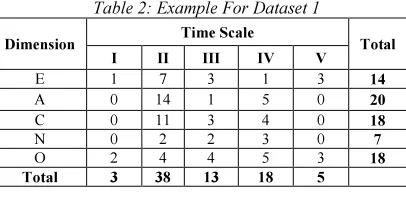
The activity classification framework was evaluated through the evaluation process which starts by identifying the main dimension for each and every activity, such as O, C, E, A or N, based on the five dimensions mentioned above. This was done by marking ‘1’ at respective cells by corresponding dimension and time scale for the activity. The frequencies of ‘1’ were counted by each row.
[image:4.595.303.506.408.508.2]Table II below shows an example of a classifying activity result for dataset 1:
Table 2: Example For Dataset 1
Dimension Time Scale Total
I II III IV V
E 1 7 3 1 3 14
A 0 14 1 5 0 20
C 0 11 3 4 0 18
N 0 2 2 3 0 7
O 2 4 4 5 3 18
Total 3 38 13 18 5
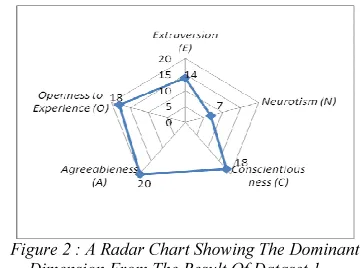
[image:4.595.303.512.600.729.2]As we can see here, based on the result above the dominant dimension of the activities for dataset 1 falls under the Agreeableness dimension (20 frequencies) and the most productive time is in time scale II which is between 8 am to 1 pm (14 frequencies).
[image:5.595.102.283.169.303.2]
406 Figure 1 and Figure 2 show the result for Dataset 1 in a more graphical presentation.
Figure 2 : A Radar Chart Showing The Dominant Dimension From The Result Of Dataset 1
The table below shows the average results from the evaluators for all datasets:
Table 3 : Average Results From Framework Evaluators
Dimens ion
Evaluators Avg
%
2 3 4 5 6
E 1.3 39.4 39.8 13.7 39.4 (26.7%) 133.6
A 0.0 0.0 0.0 8.0 0.0 8.0
(1.6%)
C 77.1 16.0 129.3 52.0 20.4 (59.0%) 294.8
N 19.0 17.3 43.7 17.4 33.9 131.3
(26.3%)
O 2.6 4.0 2.6 9.0 6.5 24.7
(4.9%)
The average percentages evaluated by the evaluators are 26.7% (Extraversion), 1.6% (Neuroticism), 59.0% (Conscientiousness), 26.3% (Agreeableness), 4.9% (Openness to Experience). The result shows the capability of the framework in classifying activity with the selection of Conscientiousness dimension by 60% and Extraversion dimension by 40% as the dominant dimension.
The results revealed that the activity classification framework based on personality and time scale is capable of classifying activity to the dominant personality dimension.
The framework can be used by identifying the dominant dimension in the personality domain that a person is in and the most productive period in terms of working perspective for a person. There are various potentials for the usage of this framework in the future which are mostly related to the cognitive element in human beings and computing.
5. CONCLUSIONS
The research in this paper has focused on the data analysis for calendar application usage by classifying activities to a personality and time scale framework. The results of the activity classification framework suggest a positive finding in classifying activity based on the personality model identified.
The information received by classifying the activity on the personality and time scale has vast potential in understanding human behaviour, performance and skill sets. For example, in the process of identifying a candidate for job promotion as a manager, the candidate should have minimum values of the Neuroticism dimension that shows that he or she are capable of making decisions without having an anxiety attack, depression or raising anger issues. The candidate should also have average results on the Agreeableness, Conscientiousness, and Extroversion dimensions and a plus point or high values for the Openness to Experience dimension.
This is just a small example of potential areas in the understanding of human complexity which always draws interest in the research study domain or cross domain. This study only reflects on personality which is a small area in the vast area of potential research environment. Therefore by understanding human behaviour, new technology, inventions, and tools in future can benefit, assist and support in decision making for human beings, especially for people in need.
REFRENCES:
[1] Wilson, R. A. and Keil, F.C, The MIT
Encyclopedia of the Cognitive Sciences
(MITECS), MIT Press, 2001.
[2] Doggett, L. E. (2013) Calendars. [Online].
Available :
http://astro.nmsu.edu/~lhuber/leaphist.hmtl [3] Carman, N., Brush, A. J. B. and Saul, G, “A
Digital Family Calendar in the Home:Lessons from Field Trials of LINC” in Proceedings of
Graphic Interface 2007.p.199.
[4] Robert, N., Jens, H., Jochen, F. and Boris, B, “Supporting Persons with Special Needs in Their Daily Life in a Smart Home” in
Proceedings of the Seventh International Conference on Intelligent Environments 2011.
p.370.
[5] Mike, W., Jeremy, B., Brian, R., Ronald, B. and Mike, M, “Collaborating to Remember: A Distributed Cognition Account of Families Coping with Memory Impairments” in
407
Human Factors in Computing Systems 2008.
p.825.
[6] Anil, S., Sushil, J. L., Sergiu, D., Linda, J. H. and Ramona, H, “User-context for Adaptive User Interfaces” in Proceedings of the 12th
International Conference Intelligent User
Interface 2007 . p.321.
[7] Yoshinari, N., Syunsuke, M. and Hideo, T, “Implementation of a Practical Calendaring System Conforming with Ambiguous Pattern of Recurring Tasks” in Proceedings of the 26th
International Conference on Advanced
Information Networking and Applications
Workshops 2012. p.1011.
[8] William, J. R, Congnitive Science Encyclopedia
of Computer Science, John Wiley and Sons Ltd,
2003.
[9] Evans, D. (2000) Rethinking Emotion: New Research in Emotion and Recent Debates in Cognitive Science. [Online]. Available : http://www.dylan.org.uk/phd_thesis/intro.pdf. [10] (2010) Stanford Encyclopedia of Philosophy
website. [Online]. Available : http://plato.stanford .edu/entries/cognitive-science.
[11] (2012) Learning Rx website. [Online].
Available :
http://www.learningrx.com/cognitive-definition-faq.htm.
[12] Melissa. D. ”Understanding Mobile Phone Requirements for Young Adults with Cognitive Disabilities” in Proceedings of the 9th International ACM SIGACCESS Conference on
Computers and Accessibility 2007. p.179.
[13] Szymkowiak, A., Morrison, K., Gregor, P., Shah, P., Evans, J. and Wilson, A, “A Memory Aid with Remote Communication Using Distributed Technology,” Personal Ubiquitous
Computing, vol.9, pp.1-5, 2005.
[14] Thomas, T.H., Ronald, B., Stuart, C., Tom, C., Jean. G., Marilyn, M., Gary, P., Gary, S. and William, V. (1996) Definition of HCI. [Online]. Available : http://old.sigchi.org/cdg/cdg2.html. [15] Michael, D. B. (2006). Cognitive Architecture.
[Online]. Available:
http://acs.ist.psu.edu/misc/dirk-
files/Papers/ACT-R_GeneralReviews/byrneHoHCI.pdf.
[16] McCrae, R. R. and Joh, O. P, “An Introduction to the Five-Factor Model and Its Applications,”
Journal of Personality, vol.60, pp.172-215,
1992.
[17] Chittaranjan, G., Blom, J. and Gatica-Peres, D, “Who’s Who with Big-Five: Analyzing and Classifying Personality Traits with Smartphones” in Proceedings of the 15th Annual
International Symposium on Wearable