APDATI: E-FISHING LOGBOOK FOR INTEGRATED TUNA
FISHING DATA MANAGEMENT
1
DEVI FITRIANAH, 2ACHMAD NIZAR HIDAYANTO, 3REMMY A.M. ZEN, 4ANIATI MURNI ARYMURTHY
1,2,3,4 Faculty of Computer Science, Universitas Indonesia
1Faculty of Computer Science, Universitas Mercu Buana
E-mail: [email protected], [email protected]
ABSTRACT
It is an absolute requirement for the fishing industry to have a management system in order to increase the productivity and the competitiveness in the fishing industry, specially in Indonesia. In this paper we proposed to develop an ICT based integrated tuna fishing management system: E-Fishing Logbook APDATI. The system encompasses all the business process in the fishing industry, start from logging the fishing, licensing, fishing monitoring until the export licensing to the other countries. The system should accomodate all the stakeholders in the fishing industry which are going to be the user of the future system. They are the Minister of The Marine Affair and Fishing (MMAF), the fishing company and the fishing ships. Based on the integrated architecture system proposed in the previous study, we developed the system in two platforms, the web based system and the mobile based system. The development methodology for both systems start from the user requirement analysis until the application design that meets the requirements based on the business process identified. Of all the stages conducted in the system development, we have succeded to design a well suited integrated tuna fishing data management system that contribute to the development of the Indonesian Fishing Industry.
Keywords: E-Fishing Logbook, Fishing Data Management, Mobile Documentation, Android Application, Indonesia
1. INTRODUCTION
In recent years, the Indonesian fishing industry is more developed. It is proven that Indonesia has become one of the largest fishery producer countries based on the FAO Year Books [1]. The development of the fishing industry in Indonesia indeed can not be separated from the role of technology in building and developing the existing business processes. In this case, the technology directly involves in the fishing process, the management of the fish distribution and sales. As mentioned in our previous study [2] that Indonesia needs an ICT (Information and Communication Technology) based integrated fishery industry management for all the stakeholders involved. The role of the integrated data management is expected to be the key to the fish availability and a good monitoring for the MMAF, in addition, it can also maximize the potential of existing fishing industry. Thus, it can
lead the Indonesian fishery industry to be more developed and more mature.
report. While the VMS only monitors the fishing ship location, the information needed is more than just the location. The MMAF also needs the aggregate number of the fishing caught and the type of fish of the fishing area. In order to obtain such information, the MMAF should have examined different documents and reports.
Based on the previous study regarding the process business of the fishing industry, it is known that the available system is unintegrated. The MMAF and the fishing companies do not share the same system to handle the licensing and so on. Based on this situation, there are some impressions that the monitoring is very difficult to do from the MMAF side and from the fishing company side it is so difficult to have a transparent licensing process. We can conclude that an ICT systems is required to accomodate all the stakeholders’ needs so that all the stakeholders can contribute most to the fishing industry. One of the application identified in [2] is the integrated data management application that is able to assist the documentation of the fishing (fishing location and the number of fish caught). In addition the system also enables the stakeholders to interact in the process of licencing and monitoring. Therefore, the ICT based integrated fishing data management can be utilized as the solution to the difficulties encountered by the stakeholders. In this paper we contribute a design of the ICT based integrated fishing data management system that is introduced in [2]. Our design consists of three parts; database design, application design and user interface design. Aside from the design, we also introduce some of the challenges in order to successfully implement the system in the future time.
The paper is organized into 6 sections. Section 1 is the introduction of the paper, section 2 consists of the previous study relating to the fishing management and regulations. Section 3 is about the proposed integrated business process for tuna fishing data management. Section 4 consists of the design of the E-Fishing Logbook APDATI. Section 5 is the challenge of the implementation of the E-Fishing Logbook APDATI and the last section 6 is the conclussion of our study. This guide provides details to assist authors in preparing a paper for publication in JATIT so that there is a consistency among papers. These instructions give guidance on layout, style, illustrations and references and serve as a model for authors to emulate. Please follow these specifications closely as papers which do not meet the standards laid down, will not be published.
2. PREVIOUS STUDY
From the previous study, it can be seen that the fishing data management has many limitations particularly in the conventional fishing logbook. The study also identified numbers of drawbacks from this method of documentation [2]. Huang and Chuang proposed a study about fishing monitoring utilizing the VMS (Vessel Monitoring System) in Taiwan [3]. This method can only monitor the position of the fishing ships. The information about fish and the number of fish caught is still unknown. Muallil et al. proposed a simple decision support tool which requires minimal or easily-generated data [4]. It is implemented in Philippines and this application was assessed using FISHDA (Fishing Industries' Support in Handling Decisions Application This application is really useful in determining the potential area to do fishing. It is inteded to preserve the number of fish in certain area and prevent the extiction of certain species of fish. Falco et al proposed an integrated observer system [5], it deals with the observation of the fisheries and the oceanographic data. The Fishing Observing System (FOS) utilizes some dependent parts including: electronic logbook, a GPS, and temperature and pressure recorder. By this mean, we can see that the logbook can be integrated with another data for the monitoring purpose.The system needs some representational data, which are FOS data collection, and the environmental data. However there is still unclear information regarding to what kind of the electronic Logbook is, and how it works. Generally all regulations presuppose the VMS in all the fishing ships to explore the space point of view in case of solving the illegal, unreported, and unregulated fishing. The implementation of integrating the LOGBOOKS data and the VMS data has been done by Bastardie et al [6]. The LOGBOOKS data are then merged with VMS in order to get the prediction and concerning about the mismatching data between the possible misreporting of areas and catch dates in fishermen’s logbook declarations. In this case, we can see that the importance of the LOGBOOKS information validity takes high attention since it is one of the main data resources. Study proposed by Fitrianah et al [2] introduced an integrated architecture system in managing the fishery industry not only for the fishing company but also for the government (MMAF) and accomodate both needs in the process business.
Table 1. Comprison Of Previous Study In Fishing Technology
Literature Proposed by Advantages Drawbacks
VMS Huang and
Chuang
To have the information about the exact location of the fishing vessel
It is rather difficult to have the data analysed with other data to generate new information
FISHDA Muallil et al. • Useful in
determining the potential area to do fishing.
• It is inteded
to preserve the number of fish in certain area and prevent the extiction of certain species of fish. • This application requires minimal data - Fishing Observing System (FOS)
Falco et al. the logbook
can be integrated with another data for the monitoring purpose
there is still unclear information regarding to what kind of the electronic Logbook is, and how it works Integrated Logbooks and VMS Bastardie, et al.
to get the prediction and concerning about the mismatching data between the possible misreporting of areas and catch dates in fishermen’s logbook declarations - Integrated architecture system in managing the fishery industry Fitrianah et al. • Introduce the framework system that accomodate both the government and the fishing companies
• Utilizing the
e-logbook -
as means of monitoring and documentati on • Integrating the monitoring and documentin g parts with other fishing business processes
3. PROPOSED INTEGRATED BUSINESS PROCESS OF APDATI E-FISHING LOGBOOK
The current system that is available to monitor the fishing activities in Indonesia is based on the VMS (Vessel Monitoring System). The system as it is stated in the literature review has many drawbacks. As the Indonesian government has a commitment to increase the fishing industry, such monitoring aproach will not be sufficient. Based on the MMAF strategic plan [7], Indonesia needs more sophisticated technology supports in order to enhance the process in the fishing industry.
This paper proposed a design of E-Fishing Logbook called APDATI which is an integrated system that functions as fishing management system in an ICT based integrated system. Basically the system is based on two main platforms, the android based platform and the web based platform.
The android platform is required for the fishing trip documentation. We require an android based system because it is an open source system and it comes in many hardware choices [8]. It needs the mobile application system that can cover the direct input of the fishing trips and the amount of the fish caught. Therefore, the updated data about number of fish being caught and ship location is easy tobe accessed either by the fishing company or by the MMAF. The other platform is the web based platform that covers both sides for the fishing company and the MMAF.
Figure 1: The Main Process In The Fishing Busines Process [2]
[image:4.595.88.287.243.482.2]Based on the main business process, we describe the processes in a detailed way. The sequence of the whole business process is in Figure 2.
Figure 2: Flowchart Of The Tuna Fishing Business
Process
It starts from the fishing company asking for the fishing license to hold a fishing trip. The permission is submitted to the MMAF. If the permission is granted, the fishing permit will be then issued by the MMAF and furthermore, the fishing permit is used by the ship captain as the official travel documents. Next is, the company set up all the preparation for the trip. After the preparation is all set, the captain starts the trip from the port and initialize all the information needed before departing.
During the trip, the captain inputs all information regarding the fishing trip such as the fishing location, number of the fish caught per type of fish. This process is utilizing the android application. Since it is online, the information can be accessed by either the fishing company and also the MMAF. The MMAF can take advantages form this application by monitoring not only the fishing location but also the number and fish type being
caught. The transparancy of the system provides the fishing company a facility to report the fishing trips to the MMAF in advanced.
The export license will be issued following the end of the fishing trip. The export license is utilized by the company as the official tuna export documents to other countries.
Other functions of the E-Fishing Logbook APDATI for both the MMAF and the fishing company are served by the web based application. After finishing the analysis of the process business, next step is designing the E-Fishing Logbook APDATI
4. DESIGN OF THE E-FISHING LOGBOOK APDATI
The design of the E-Fishing Logbook APDATI is divided into 3 stages. The database design, the application design and the user interface design.
4.1 Database design
Based on the business process analysis, we gathered all the information from fact finding. We found that the system required some information regarding the ships, the fishing companies, the fishing trips, the captain and the information about the catch. The comprehensive design of entity relationship diagram on the database for the E-Fishing Logbook APDATI is illustrated in Figure 3.
4.2 Application design
[image:4.595.308.512.573.712.2]The application consists of 2 parts. The first part is the android based mobile application and the other part is the web based application. The first part, the mobile application is utilized for the fishing documentation and the fishing monitoring, while the second part functions as the intermediary application for both the MMAF and the fishing company.
Figure 3: Entity Relationship Diagram Of The Database
Design The MMAF Tuna Fishing Company Tuna Fishing
Ships
Asking permission to do the fishing
trips Issuing the
Fishing trips
permission Inputting the
date of the trip and the port Preparing the
fishing ship, the captain and the crew
Inputting the fishing location, the
type of the fish and the number of catch Monitoring the
fishing
Preparing the fishing report to the MMAF
START
Examine the fishing report
Issuing the export papers
Export the tuna commodity
4.2.1 Mobile based application
[image:5.595.309.504.246.431.2] [image:5.595.90.269.272.424.2]Since the E-Fishing Logbook APDATI is needed for documenting the fishing trips and the information about the fish caught during the fishing trip, so we need an application with the mobile platform. To overcome the coverage problems, the mobile application is designed to have a temporary file feature so that it will allow the data to be sent to the database server just in time when the coverage of the service network is available. The mobile based application architecture is illustrated in Figure 4.
Figure 4: Mobile Based Application Architecture
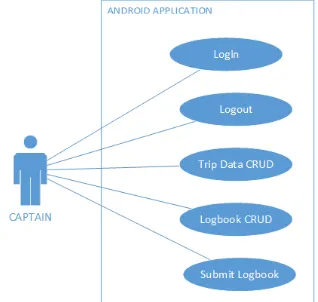
With this method of documentation, the application enables the company to have an updated real time data about the number of fish caught, furthermore the MMAF at the same time can monitor the trips of the fishing ships. The design of the mobile application is in Figure 5. The user of the application is the captain of the ship. The application will have 5 functions, login and logout of the system, managing the data trip, managing the logbook information and submit the data.
Figure 5: Functionality Design Of Mobile Based
Application
4.2.2 Web based application
[image:5.595.304.507.446.697.2]The web based application is basically serves as an intermediary application for both the fishing company and the MMAF. The functions cover the monitoring, licensing the fishing trip and licensing the tuna export. The web application is also connected with the mobile application database server to share the fishing trip information. For more details, the design can be seen in Figure 6 and 7.
Figure 6: Functionality Design Of Web Based
Application (Company Role)
Figure 7: Functionality Design Of Web Based
[image:5.595.110.269.569.720.2]From Figure 6 and 7 we can see that the fishing trip report is generated automatically by the application. Use case See Trip Recap for user ministry extends to See Trip Recap by Date, See
Trip Recap by Ship and See Trip
Recap by Company. It means that the MMAF can take a comprehensive monitoring for all the fishing trips.
4.3 The User Interface Design
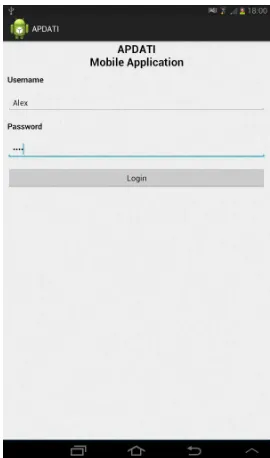
[image:6.595.335.476.110.433.2]In order to develop a more efficient and simpler application for users, we design the user interface based on the Graphical User Interface (GUI). For the mobile based application we design a shallow menu and clear field instruction to provide the user convinient access [9]. The information is clustered based on the tasks. Trip data, logbook data and submission. The fishing location also can be viewed in a simple map. The details of the user interface design for mobile based application are illustrated in Figure 8 until Figure 12.
Figure 8: Login Menu In Mobile App
[image:6.595.124.259.418.647.2]Figure 9: Home Menu In Mobile App
[image:6.595.340.477.488.720.2][image:7.595.258.507.70.627.2]
Figure 11: Submit Daily Menu
Figure 12: Map Of Fishing Location
As in the mobile based application, the user interface design for the web based application is also designed in efficient and simple user interface.
[image:7.595.315.509.121.274.2]Web based application for the MMAF has 7 sub menus as in Figure 13.
Figure 13: The Web Menu Of The MMAF Role
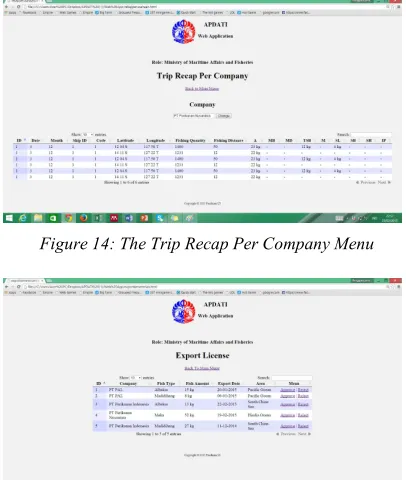
The menu that enables the MMAF to monitor the fishing activities of all the fishing company is in sub menu Trip Recap Per Company in Figure 14. It also can be used for the report when making a decision on the export licensing as in Figure 15.
[image:7.595.303.506.365.605.2]Figure 14: The Trip Recap Per Company Menu
Figure 15: The Export License Decision Menu
The user interface design for the fishing company is closely similar to the one in the MMAF design except for the sub menu Trip Recap Per Company.
[image:7.595.116.249.434.664.2][image:8.595.87.279.181.291.2]
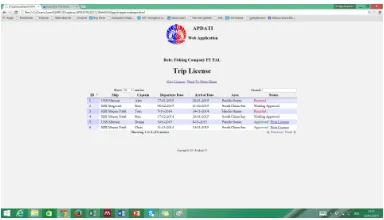
approved. Once the license is approved, the company can print the documents for further official travel documents. The processes are also applied for the export license process.
Figure 16: The Trip License Request Menu
Furthermore the MMAF and the fishing companies can communicate and share trip information through this integrated system.
5. CHALLENGE OF THE E-FISHING LOGBOOK IMPLEMENTATION FOR THE MMAF
In order to successfully implement IS/IT systems, organisations must be aware various challenges and obstacles, so that they can take some actions to mitigate their impacts [9, 10]. Thus, it is required that organisations know critical success factors (CSFs) of IS/IT implementation that may differ projects to projects [11]. E-Fishing Logbook APDATI is aimed to integrate both the government (the MMAF) and the fishing companies from the private sectors. Implementing such an application may impose some challenges, which can be categorized into five issues namely: leadership issue, management process issue, organization environment issue, technical system issues and personnel issues [9]. Therefore, in this paper we outline some challenges that should be considered when implementing the E-Fishing Logbook
APDATI. We adopted the challenge
implementation issues taken from [12] and combined with our CSFs from our previous study [13] for framing our idea.
5.1 Leadership Issues
Some drawbacks of the leadership in most of
ministries in Indonesia and many large
organizations are inefficient top level leadership, a hierarchical leadership style and tend to have less supervision [10], whereas it has been proven in some previous research in Indonesia [11][12] that
leadership is one of key success if e-government implementation. Therefore, in order to have E-Fishing Logbook successfully implemented, it needs the support of the leader, in this case is the MMAF, so that all fishing companies will use the E-Fishing Logbook APDATI. Thus, one of the challenges is to convince the MMAF about the
benefits of E-Fishing Logbook APDATI
implementation for fisheries management in Indonesia. When E-Fishing Logbook APDATI gains support from the MMAF, other aspects will follow as the MMAF serves as regulator where all stakeholders should comply to government regulations.
5.2 Management Process Issues
One of the challenges in the management process is developing a strategic plan as a blue print of organization activities. Fortunately, the Ministry of Marine Affair and Fishery Indonesia has already a strategic plan [7], in which one of its strategies is to have IT systems to support the fisheries management in Indonesia. In addition, our government puts their concern to the maritime related programs, thus E-Fishing Logbook APDATI seems to fit our government concerns. Therefore, we consider management process is not a big issue in E-Fishing Logbook implementation.
5.3 Organisation Environment Issues
Most of crucial environmental issues in Indonesia is related to the political issue. The political climate in Indonesia, which consists of many parties, causing often an e-government initiative was not supported if it does not add economic values to the party. Implementation of E-Fishing Logbook which has a strategic value in the current government may lead to competition among political parties, as they do not want our government succeeded in carrying out its functions.
5.4 Technical System Issues
We have identified a critical technical issues regarding the implementation of E-Fishing Logbook in Indonesia. The geographical condition of Indonesia, which consists of thousands of islands, whereas the fishing activities usually occur
in remote location with less IT and
the outer islands. Thus it is still a challenging task
or almost impossible to have IT and
telecommunication infrastructure that cover all areas in Indonesia, both land and sea.
5.5 Personnel Issues
According to the United Nation Development Program, the Human Development Index for Indonesia is in rank 108 out of 187 countries [13]. The e-logbook implementation requires people to have IT literacy, which may be challenging for ship crews.
6 CONCLUDING REMARKS
6.1 Conclusion
APDATI, the E-Fishing Logbook for integrated tuna fishing data management is one of the implementations of the Integrated Framework Tuna Fishery Data Management. The application system design introduced in this paper is based on the business proccess and therefore it is aligned with the user requirements. Based on the requirements for both mobile based system and web based system have gone through the stages conducted in the system development. We have succeded to design a well suited E-Fishing Logbook for integrated tuna fishing data management system that contributes to the development of the Indonesian fishing industry. In addition we also have identified some of the challenges of the system implementation in the future, so that the MMAF becomes more aware of the things that can hamper the E-Fishing Logbook implementation.
6.2 Limitation of Study
The requirements of application in this study is identified from 2 resources; the MMAF and a tuna fishing company. To deliver a good application design based on the user requirement, it is necessary that the resources must cover all stakeholders in the industry including the other fishing companies.
6.3 Future Works
The future works of this study will be in developing an intelligent system to determine the tuna potential fishing zones. The system will utilize the data gathered from this documentation application. Combined with necessary oceanographic characeristics, the system will generate a fishing ground mapping for tuna production. In addition, we would like to explore the possibility of using cloud computing
technology, as many industries feel benefit of it. [14], [15].
ACKNOWLEDGEMENT
We would like to express our gratitude to Universitas Indonesia for research support through ‘Hibah Riset UI 2014-PUPT (BOPTN)’ No. 2706/H2.R12/HKP.05.00/2014. The authors also would like to thank PT. Perikanan Nusantara for the opportunity to have observations in PT.PN Cabang Benoa, Bali.
REFERENCES
[1] B. Mahyudin, “Kebutuhan Teknologi Untuk Pengembangan Penangkapan Ikan,”
Makalah Ka-Balai, 2012. [Online]. Available: http://bbppi.info/files/Makalah-KaBalai.pdf. [Accessed: 05-Mar-2013]. [2] D. Fitrianah, N. H. Praptono, R. A. M. Zen,
A. N. Hidayanto, and A. M. Arymurthy, “An Integrated System Architecture in Managing Fishery Data in Indonesia,” pp. 101–108, 2014.
[3] H.-W. Huang and C.-T. Chuang, “Fishing capacity management in Taiwan: Experiences and prospects,” Mar. Policy, vol. 34, no. 1, pp. 70–76, Jan. 2010. [4] R. N. Muallil, S. S. Mamauag, R. B.
Cabral, E. O. Celeste-Dizon, and P. M. Aliño, “Status, trends and challenges in the sustainability of small-scale fisheries in the Philippines: Insights from FISHDA (Fishing Industries’ Support in Handling Decisions Application) model,” Mar. Policy, vol. 44, pp. 212–221, Feb. 2014. [5] P. Falco, A. Belardinelli, A. Santojanni, N.
Cingolani, A. Russo, and E. Arneri, “An observing system for the collection of fishery and oceanographic data,” J. Ocean Sci., vol. 3, no. 2, pp. 189–203, 2007. [6] F. Bastardie, J. R. Nielsen, C. Ulrich, J.
Egekvist, and H. Degel, “Detailed mapping of fishing effort and landings by coupling fishing logbooks with satellite-recorded vessel geo-location,” Fish. Res., vol. 106, no. 1, pp. 41–53, Oct. 2010.
[7] MMAF Indonesia, Strategic Plan Ministry of Marine Affair and Fisheries 2010-2014. 2014.
[9] B. J. Jansen, “The Graphical User Interface: An Introduction .,” SIGCHI Bull., vol. 30, no. 2, pp. 22–26., 1998.
[10] I. Muhsin, “Membangun Organisasi Kementerian Keuangan yang Sehat,” Situs Kementrian Keuangan Republik Indonesia,
2014. [Online]. Available:
http://www.kemenkeu.go.id/Artikel/memba ngun-organisasi-kementerian-keuangan-yang-sehat.
[11] E. A. Sosiawan, “Tantangan dan Hambatan dalam Implementasi E-Government di Indonesia,” in Seminar Nasional Informatika 2008, 2008, pp. 99–108. [12] A. N. Hidayanto, Y. R. Ningsih, P. I.
Sandhyaduhita, and P. W. Handayani, “The Obstacles of The E-Government Implementation: A Case of Riau Province, Indonesia,” J. Ind. Intell. Inf., vol. 2, no. 2, pp. 126–130, 2014.
[13] Program Development United Nation, “2014 Human Development Report,” 2014.
[Online]. Available:
http://www.undp.org/content/undp/en/home /librarypage/hdr/2014-human-development-report.html#.
[14] A. N. Hidayanto, Y. Y. Karnida, and G. Moerita, “Analysis of Software as Service (SaaS) for Software Service Provision Alternative: A Case Study of E-Office on Demand Service of PT. Telkom Indonesia,”
Int. J. Innov. Learn., vol. 12, no. 3, pp. 294–318, 2012.