R E S E A R C H
Open Access
Choosing the target difference and
undertaking and reporting the sample size
calculation for a randomised controlled trial
–
the development of the DELTA
2
guidance
William Sones
1, Steven A. Julious
2, Joanne C. Rothwell
2, Craig Robert Ramsay
3, Lisa V. Hampson
4,5, Richard Emsley
6,
Stephen J. Walters
2, Catherine Hewitt
7, Martin Bland
7, Dean A. Fergusson
8, Jesse A. Berlin
9, Doug Altman
1,
Luke David Vale
10and Jonathan Alistair Cook
1*Abstract
Background:A key step in the design of a randomised controlled trial is the estimation of the number of participants needed. The most common approach is to specify a target difference in the primary outcome between the randomised groups and then estimate the corresponding sample size. The sample size is chosen to provide reassurance that the trial will have high statistical power to detect the target difference at the planned statistical significance level. Alternative approaches are also available, though most still require specification of a target difference.
The sample size has many implications for the conduct of the study, as well as incurring scientific and ethical aspects. Despite the critical role of the target difference for the primary outcome in the design of a randomised controlled trial (RCT), the manner in which it is determined has received little attention. This article reports the development of the DELTA2guidance on the specification and reporting of the target difference for the primary outcome in a sample size calculation for a RCT.
Methods:The DELTA2(Difference ELicitation in TriAls) project has five components comprising systematic literature reviews of recent methodological developments (stage 1) and existing funder guidance (stage 2), a Delphi study (stage 3), a 2-day consensus meeting bringing together researchers, funders and patient representatives (stage 4), and the preparation and dissemination of a guidance document (stage 5).
Results: The project started in April 2016. The literature search identified 28 articles of methodological developments relevant to a method for specifying a target difference. A Delphi study involving 69 participants, along with a 2-day consensus meeting were conducted. In addition, further engagement sessions were held at two international
conferences. The main guidance text was finalised on April 18, 2018, after revision informed by feedback gathered from stages 2 and 3 and from funder representatives.
(Continued on next page)
* Correspondence:[email protected] 1
Centre for Statistics in Medicine, Nuffield Department of Orthopaedics, Rheumatology and Musculoskeletal Sciences, University of Oxford, Botnar Research Centre, Nuffield Orthopaedic Centre, Windmill Rd, Oxford OX3 7LD, UK
Full list of author information is available at the end of the article
(Continued from previous page)
Discussion:The DELTA2Delphi study identified a number of areas (such as practical recommendations and examples, greater coverage of different trial designs and statistical approaches) of particular interest amongst stakeholders which new guidance was desired to meet. New relevant references were identified by the review. Such findings influenced the scope, drafting and revision of the guidance. While not all suggestions could be accommodated, it is hoped that the process has led to a more useful and practical document.
Keywords:Target difference, Clinically important difference, Sample size, Guidance, Randomised trial, Effect size, Delphi
Background
Deciding upon an appropriate sample size is a key part of designing a randomised controlled trial (RCT) [1]. A sam-ple size calculation is typically carried out. Too small a sample size could result in a difference being overlooked, whilst a sample size which is too large could be a waste of resources and also lead to spurious findings [2].
In the healthcare setting, the majority of RCTs adopt a conventional approach (Neyman–Pearson) to determin-ing the sample size. With this approach, the sample size required for a RCT depends upon the magnitude of dif-ference to be detected (the‘target difference’) along with the risk of reporting a difference when none exists (type I error) and the risk of reporting no difference when a difference of the specified magnitude does exist (type II error). The sample size is highly dependent upon the magnitude of difference, the target difference or effect size, as it has often somewhat imprecisely been referred to. For example, reducing the target difference by a half, quadruples the sample size in a two-arm parallel-group trial with 1:1 allocation and a continuous outcome, which is assumed to be normally distributed [3].
Until recently [2], little has been published looking at methods to inform the choice of target difference. Initial guidance was prepared for standard (non-adaptive su-periority two-arm parallel group) trials to be designed and analysed according to the Neyman–Pearson ap-proach [4]. However, that guidance does not cover trials of different hypotheses (i.e. equivalence/non-inferiority trials), any complex designs (e.g. multi-arm or adaptive trials), or other alternative statistical approaches (such as Bayesian and precision based). It is clear that limitations in the scope and conception (as it was developed pri-marily for researchers) of the initial DELTA guidance means that it does not fully meet the needs of funders and researchers. The DELTA2 project [5] sought to ad-dress this gap. This paper reports on the development of the DELTA2guidance.
Aim and objectives
The DELTA2project aimed to update and expand upon the previous DELTA guidance for researchers and fun-ders to assist in the determination and corresponding
reporting of the target difference (‘effect size’) when per-forming a sample size calculation for a RCT.
The specific project objectives were:
1. To review existing guidance provided by funders to researchers and scientific review panel/board members
2. To identify key methodological developments or changes in practice that have emerged since undertaking the comprehensive DELTA review [2,6] and update the DELTA guidance
3. To determine the scope of guidance that would aid researchers and address funders’needs
4. To achieve consensus on what structured guidance for choosing the target difference (effect size) should comprise
5. To identify future research needs
To achieve these objectives, a five-stage project was developed [5]. This publication briefly summarises the methods of the project, before proceeding to presenting the findings from stages 1–4, which informed the devel-opment of the guidance.
Methods
A summary of the methods used in each stage are given below. The final guidance is available [7] and has been sum-marised in a companion paper (Cook JA, et al.: DELTA2 guidance on choosing the target difference and undertaking and reporting the sample size calculation for a randomised controlled trial - new guidance, forthcoming). The process of developing the guidance is described below.
Stage 1 and 2. Identifying relevant literature and eliciting expert opinion
Literature search
had been published [2, 6], supplemented by other leading journals in epidemiology, health economics, health research methodology, statistics and trials. Full details of the search strategy used can be found in Additional file1.
In addition to the systematic review of publications, a review of existing online guidance provided by funding schemes and advisory bodies was performed.
Search for guidance
Guidance documents prepared by trial funding and advis-ory bodies to assist applicants applying for funding for a RCT were inspected for relevant text. Searches were car-ried out for documents associated with UK trial funding schemes run by the National Institute for Health Research (NIHR), including Efficacy and Mechanism Evaluation (EME), Health Technology Assessment (HTA), the Re-search for Patient Benefit (RfPB) Programme, Programme Grants for Applied Research (PGfAR), Public Health Re-search (PHR), Invention for Innovation (i4i), and Health Services and Delivery Research (HSDR), the Medical Re-search Council (MRC) Developmental Pathway Funding Scheme (DPFS), the Arthritis Research UK, the British Heart Foundation (BHF), Cancer Research UK (CRUK) (phase III clinical trial, new agent, population research), and the Wellcome Trust (Health Challenge Innovation Fund). The UK Health Research Authority's (HRA) docu-mentation was searched. A search of guidance documents provided by the NIHR Research Design Service (RDS) was also performed. Similar searches were performed for lead-ing international fundlead-ing streams and regulatory agencies (Agency for Healthcare Research and Quality (AHRQ), Canadian Institutes of Health Research (CIHR), European Commission Horizon 2020 (H2020), Food and Drug Ad-ministration (FDA), Health Canada, National Health and Medical Research Council (NHMRC), National Institutes of Health (NIH), and Patient-Centered Outcomes Re-search Institute (PCORI)). Information contained within guidance for applicants applying for trial funding from funders and research advisory bodies regarding the choice of target difference was extracted.
Inclusion and exclusion criteria
The title and abstract of articles identified within the PubMed database search were independently assessed by two reviewers to identify publications worthy of further as-sessment. The full-text of a publication deemed worthy of further assessment was then analysed by a reviewer and in-cluded if considered to report a development not already encompassed within the previous DELTA review [2,6].
Data extraction
Publications viewed to be of relevance were reviewed by an expert reviewer and aspects of interest noted. Infor-mation on undertaking a sample size calculation and the
target difference choice was identified within the web-sites of trial funding and advisory bodies and the content assessed by two reviewers. A third (content expert) member of the team acted as arbiter for all disagree-ments or where further content expertise was required.
Stage 3. Delphi study
A multi-round Delphi study was conducted with stake-holders known to have an interest in the design of RCTs. Participants were asked about what guidance was needed on specifying the target difference in a RCT sample size calculation. A 2-day consensus meeting and a one-off stakeholder engagement session were embedded within the Delphi study (stage 4; see below for details). Findings from the first Delphi round were considered by the 2-day consensus meeting to aid construction of a draft DELTA2guidance document. A second-round question-naire was sent with a hyperlink to the draft guidance document. Views and comments on the draft guidance overall, main body of the document, case studies, appen-dices and references were requested. Round 1 and 2 questionnaires are available in Additional file2.
A group of known methods experts, the inclusion of which was informed by the DELTA review and findings from Stage 1, alongside representatives of key trial groups were invited to participate in the Delphi study. Representatives for groups including the UKCRC network of clinical trial units (CTUs), the MRC Hubs for Trials Methodology Research (HTMRs), NIHR/MRC/CRUK funding programme panels, the NIHR statistics group and the NIHR RDS were contacted using publicly available contact information and invited to partici-pate. Participants comprised of one named individual per group (unit, board, MRC HTMR, RDS centre or programme; e.g. the director, chair or senior methodolo-gist). These groups represent UK centres and networks of excellence that undertake high-quality trials research. As of July 1, 2016, there were 48 (fully or provision-ally) registered CTUs, 5 MRC HTMRs and the 10 re-gions in the NIHR RDS in England, and the Research Design and Conduct Service in Wales.
Based upon the premise that a minimum of 30 partici-pants would be required to participate in the Delphi process, and assuming one-third of invitees would agree to participate, it was felt that at least 90 invitations needed to be made. Due to the arbitrary nature of this target, no strict maximum was applied and 162 invitations were made.
Stage 4. Two-day consensus meeting and one-off stakeholder engagement sessions
Two-day consensus meeting
face-to-face, 2-day meeting. Additionally, a number of participants gave presentations that provided an overview of the use of specific approaches and/or personal experience of working in this area. Stakeholders, selected to cover a range of per-spectives, areas of expertise and roles within RCT design, discussed and refined the proposal for the guidance docu-ment and reached a consensus on the format of the draft guidance document.
One-off stakeholder engagement sessions
To gain a broader range of opinions, engagement sessions were held at the Society for Clinical Trials (SCT) 37th An-nual Meeting on May 17, 2016, Statisticians in the Pharma-ceutical Industry (PSI) Conference on May 16, 2017, and on the Joint Statistical Meetings (JSM) Conference on Au-gust 1, 2017. Participants were invited to provide views on
the scope and structure of the guidance needed and to offer constructive feedback on the draft guidance.
Stage 5. Publication of guidance documentation
The provisional guidance was drafted upon completion of stages 1–4 and circulated amongst the DELTA2 mem-bers and Delphi participants for comments. UK Funder representatives will be asked to assess the guidance to ensure the document meets funding panel requirements and allow implementation of changes required for spe-cific forms of publication.
Results
Stage 1. Systematic literature search results
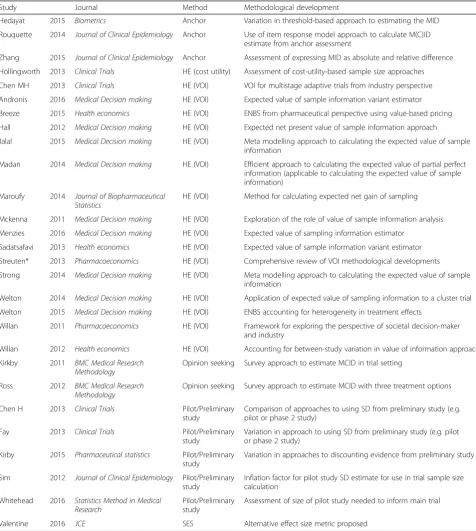
The search identified 1395 potentially relevant reports (Fig. 1). Following the screening of titles and abstracts, 73
[image:4.595.58.544.306.728.2]publications were full text assessed. Of these, 28 were in-cluded in the review as representing a development of one of the previously identified seven broad method types (Table 1 and Additional file 3). Minor developments were identified for the health economic (including cost-utility and
[image:5.595.58.535.174.706.2]value of information), opinion-seeking, pilot/preliminary study and standardised effect size approaches. No new methods were identified. Most developments (n = 17 arti-cles) related to the use of variants of the value of informa-tion approach.
Table 1Included studies from literature review of methodological development in methods for specifying a target difference
Study Journal Method Methodological development
Hedayat 2015 Biometrics Anchor Variation in threshold-based approach to estimating the MID Rouquette 2014 Journal of Clinical Epidemiology Anchor Use of item response model approach to calculate M(C)ID
estimate from anchor assessment
Zhang 2015 Journal of Clinical Epidemiology Anchor Assessment of expressing MID as absolute and relative difference Hollingworth 2013 Clinical Trials HE (cost utility) Assessment of cost-utility-based sample size approaches Chen MH 2013 Clinical Trials HE (VOI) VOI for multistage adaptive trials from industry perspective Andronis 2016 Medical Decision making HE (VOI) Expected value of sample information variant estimator Breeze 2015 Health economics HE (VOI) ENBS from pharmaceutical perspective using value-based pricing
Hall 2012 Medical Decision making HE (VOI) Expected net present value of sample information approach
Jalal 2015 Medical Decision making HE (VOI) Meta modelling approach to calculating the expected value of sample information
Madan 2014 Medical Decision making HE (VOI) Efficient approach to calculating the expected value of partial perfect information (applicable to calculating the expected value of sample information)
Maroufy 2014 Journal of Biopharmaceutical Statistics
HE (VOI) Method for calculating expected net gain of sampling
Mckenna 2011 Medical Decision making HE (VOI) Exploration of the role of value of sample information analysis Menzies 2016 Medical Decision making HE (VOI) Expected value of sampling information estimator
Sadatsafavi 2013 Health economics HE (VOI) Expected value of sample information variant estimator Streuten* 2013 Pharmacoeconomics HE (VOI) Comprehensive review of VOI methodological developments Strong 2014 Medical Decision making HE (VOI) Meta modelling approach to calculating the expected value of sample
information
Welton 2014 Medical Decision making HE (VOI) Application of expected value of sampling information to a cluster trial Welton 2015 Medical Decision making HE (VOI) ENBS accounting for heterogeneity in treatment effects
Willan 2011 Pharmacoeconomics HE (VOI) Framework for exploring the perspective of societal decision-maker and industry
Willan 2012 Health economics HE (VOI) Accounting for between-study variation in value of information approach Kirkby 2011 BMC Medical Research
Methodology
Opinion seeking Survey approach to estimate MCID in trial setting
Ross 2012 BMC Medical Research
Methodology
Opinion seeking Survey approach to estimate MCID with three treatment options
Chen H 2013 Clinical Trials Pilot/Preliminary study
Comparison of approaches to using SD from preliminary study (e.g. pilot or phase 2 study)
Fay 2013 Clinical Trials Pilot/Preliminary
study
Variation in approach to using SD from preliminary study (e.g. pilot or phase 2 study)
Kirby 2015 Pharmaceutical statistics Pilot/Preliminary study
Variation in approaches to discounting evidence from preliminary study
Sim 2012 Journal of Clinical Epidemiology Pilot/Preliminary study
Inflation factor for pilot study SD estimate for use in trial sample size calculation
Whitehead 2016 Statistics Method in Medical Research
Pilot/Preliminary study
Assessment of size of pilot study needed to inform main trial
Valentine 2016 JCE SES Alternative effect size metric proposed
*This review summarised a substantial number of variants/generalisations in the VOI methods applicable to the sample size calculation of a RCT
A number of helpful review articles that summarise dif-ferent methods and variations in application were identi-fied; these covered willingness to pay [8, 9] and value of information [10, 11] health economic based ap-proaches, and estimation of the smallest worthwhile difference formulation of a minimal clinically import-ant difference, which covered anchor, distribution, opinion-seeking and standardised effect size methods [12]. Identified articles on relevant topics (e.g. that address statistical aspects of sample size calculations or an existing method but contain no new develop-ment) were considered as potential references in the guidance document irrespective of whether they were included in this review.
Stage 2. Search for existing guidance
A search for guidance documentation on the websites for the 15 trial funding and advisory bodies listed within the Methodology section was performed (Additional file 4). On the majority of websites, trial design guidance empha-sised the need for applicants to provide sufficient detail to justify the chosen sample size, often going on to discuss techniques employed to calculate sample size but without providing any details or guidance on how this should be done. In particular, there was little specific guidance pro-vided to assist researchers in specifying the target differ-ence. The use of pilot/preliminary studies and ‘interim data’was noted with limited further comment.
Stage 3. Delphi study
Invitations to participate in the Delphi study were sent (by email on July 29, 2016) to 58 methods experts along with 104 named representatives of key trial groups (in-cluding UKCRC network CTUs, the MRC HTMRs, NIHR/MRC/CRUK funding programme panels, the NIHR statistics group and the NIHR RDS). Of the 162 individuals invited to participate, responses were re-ceived from 84 (52%), of whom 78 (48%) accepted the invitation and 6 formally declined to participate. Ac-ceptance of the invitation was allowed up to October 10, 2016 (the last acceptance was received on October 4, 2016).
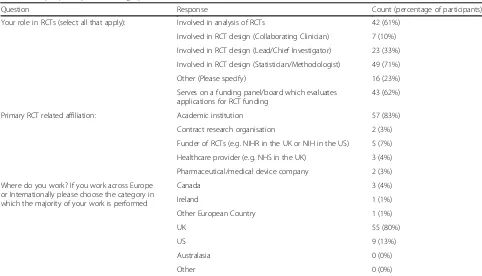
[image:6.595.56.538.446.722.2]The round 1 questionnaire was open for completion between August 11 and October 10, 2016. Of the 78 experts and representatives who agreed to participate, 69 (88%) completed the Round 1 questionnaire once invited by email whilst 9 did not complete it. The demographics of those who ultimately participated in the Delphi study are given in Table2. Participants represented a range of RCT roles, with design, analysis and evaluating funding proposals well represented. The majority of participants (57 of the 69 who completed Round 1; 83%) were pri-marily affiliated with an academic institution, and the majority of participants were from the UK (55 of the 69 who completed Round 1; 80%). Views on whether specific topics and alternative designs (i.e. not a ‘ stand-ard’ two-arm, parallel-group design) should be covered
Table 2Delphi participants’demographics
Question Response Count (percentage of participants)
Your role in RCTs (select all that apply): Involved in analysis of RCTs 42 (61%) Involved in RCT design (Collaborating Clinician) 7 (10%) Involved in RCT design (Lead/Chief Investigator) 23 (33%) Involved in RCT design (Statistician/Methodologist) 49 (71%)
Other (Please specify) 16 (23%)
Serves on a funding panel/board which evaluates applications for RCT funding
43 (62%)
Primary RCT related affiliation: Academic institution 57 (83%) Contract research organisation 2 (3%) Funder of RCTs (e.g. NIHR in the UK or NIH in the US) 5 (7%) Healthcare provider (e.g. NHS in the UK) 3 (4%) Pharmaceutical/medical device company 2 (3%) Where do you work? If you work across Europe
or Internationally please choose the category in which the majority of your work is performed
Canada 3 (4%)
Ireland 1 (1%)
Other European Country 1 (1%)
UK 55 (80%)
US 9 (13%)
Australasia 0 (0%)
Other 0 (0%)
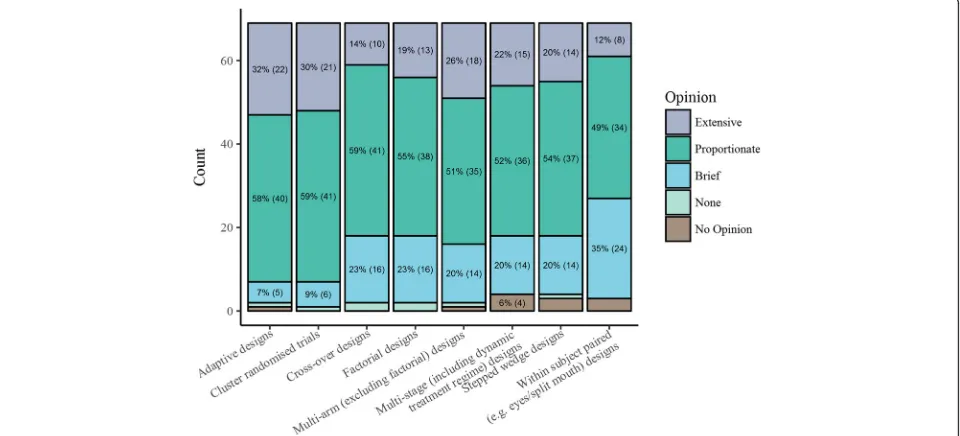
within the guidance are given in Figs. 2 and 3. Delphi participants showed strongest support (≥25%) for exten-sive coverage on alternative research questions and handling multiple primary outcomes. Across most topics there was 50–70% support for proportionate coverage except for mechanistic studies and public and patient perspectives on the choice of the target difference. Regarding alternative study designs, the strongest support for extensive coverage was for adaptive designs, cluster randomised trials and multi-arm trials (all > 25%). Across all designs there was 50–60% support for proportionate coverage.
A total of 56 free-text comments were made covering personal views on specific topics, views on framing of
research questions, and the audience that should be tar-geted for the guidance. Comments also included sugges-tions for additional trial designs to cover, references and case study topics.
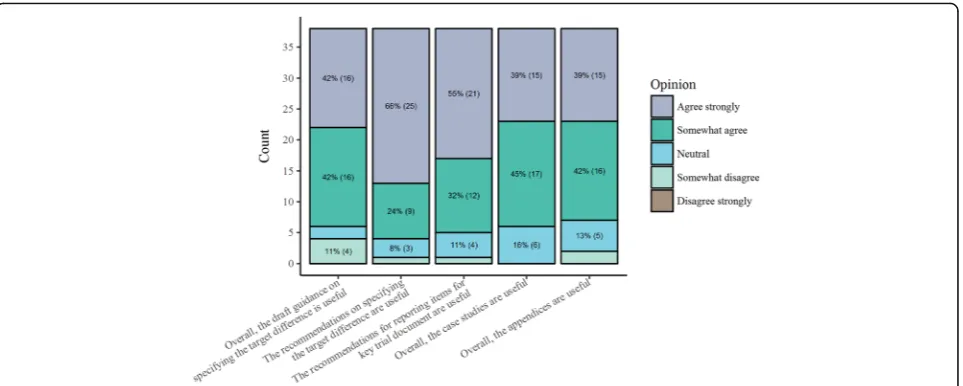
The Round 2 questionnaire was open for completion between September 1 and November 12, 2017. Only participants who completed Round 1 were invited to par-ticipate in Round 2 in which assessment of draft guide-lines was required. Only two rounds were performed to fit with the project timescale and progress. Of the 69 partici-pants invited to participate in Round 2, 38 (55%) com-pleted Round 2. Findings from the Round 2 questionnaire are summarised in Fig. 4. Over 80% either ‘somewhat’or
‘strongly’ agreed that the guidance was useful overall for Fig. 2Round 1 Delphi online questionnaire responses. Specific topics to address within target difference estimation guidance
[image:7.595.59.540.88.284.2] [image:7.595.59.539.495.713.2]the recommendations, case studies and appendices; 21 suggestions for improving the main text were made, 11 re-garding the case studies and 9 on the appendices. In Round 2, 62 free-text comments were provided, which again covered a range of suggestions for improving the main text, adding an executive summary, improving the signposting of sections, views on the case studies and ap-pendices, additional references, raising the issue of esti-mands, and personal views on various topics. Comments made in Round 1 and 2 questionnaires along with feed-back from Stage 4 led to a substantial number of changes to the document prior to its finalisation. The most sub-stantive being incorporating an executive summary and increasing the number of case studies.
Stage 4. Two-day meeting and stakeholder engagement
An engagement session was held at SCT in May 2016, where the project was introduced, and views on the scope and broad content of the guidance were invited through audience participation. Following this, a 2-day workshop was held in Oxford on September 27–28, 2016, and involved 25 participants including CTU direc-tors, study investigadirec-tors, project funder representatives, funding panel members, researchers with experts in sample size methods, senior trial statisticians, and Public and Patient Involvement (PPI) representatives. The workshop included presentations of the findings from the initial two stages of the project, the SCT engagement session and Round 1 of the Delphi study, and focused upon decisions relating to the scope and content of the guidance. An initial structure for the first draft of the guidance was developed in light of the findings from the Round 1 questionnaire available at the time of the meet-ing. A revised structure was agreed by participants at the workshop. Drafting of individual sections was allocated
to individuals. The recommendations on conducting a sample size calculation were initially drafted by JC. The various sections were then developed into the first full draft of the guidance by JC; this was circulated to all of the DELTA2project group for comment, with the draft revised in light of these. An iterative process of com-ments and revisions was followed until the final version was agreed.
Subsequently, two further engagement sessions were held at PSI and JSM conferences. At the time of the ses-sion, the most current draft of the guidance was made available to participants. Both within and post-meeting feedback highlighted the need to consider the role of estimands and the minimum (statistically) detectable difference in the sample size calculation, leading to revi-sions in the guidance document. There was broad con-sensus, though not universal agreement, on the need for such guidance and the main topics it needed to cover from stakeholders across the various meetings and from the Delphi study. Differences of opinion tended to be about which topic needed to be covered and how important it was that they were covered.
Stage 5. Finalisation, adaptation and dissemination
[image:8.595.59.541.87.280.2]utilise the guidance document and adapt to their needs is ongoing.
Discussion
Overview
The target difference is arguably the key value in a conventional sample size calculation but also the most difficult to choose. The DELTA2project sought to pro-duce more detailed guidance for researchers and funder representatives to aid researchers in making this choice and funder representatives in assessing the choice made. Building upon the DELTA guidance, a number of aspects were explored through engagement with stakeholders and the findings are summarised in this paper.
Decisions on scope and content
As part of the process, we explored uncertainty about what methods for sample size determination should be covered. In particular, the views on two methods (value of information and standardised effect size-based ap-proaches), which were included in the DELTA guidance, were debated and the inclusion reconsidered. There was general agreement that they should be included again but in particular the distinctive nature of the value of information approach required greater prominence. The need for some consideration of alternative statistical approaches (aside from the specification of the target difference per se) was also relatively strong. This resulted in specific appendices and boxes within the main guid-ance text covering more common alternative statistical methods and trial designs, and dealing with related as-pects such as compliance analyses and missing data.
The need for more practical guidance was raised mul-tiple times in various responses and in the engagement sessions. This led to two main additions in the final guid-ance document. First, 10 recommendations were made for specifying the target difference and a list of corresponding reporting items was included for when the conventional sample size approach is used. It is hoped that this will go some way to support researchers and funders undertaking and assessing sample size calculations. It is recognised that future adaptation to accommodate other study designs and statistical approaches will be needed. Second, a num-ber of case studies were included, reflecting different trial designs and covering different conditions. Additional case studies could be added over time to provide a more complete coverage of the range of trial designs, statistical approaches and methods for specifying the target differ-ence. Overall, the DELTA2guidance is more comprehen-sive than the original DELTA guidance (and also more detailed, with over 25,000 compared to around 4000 words). It covers a much broader range of trials and ap-proaches, with more practical guidance about how to undertake a sample size calculation for a RCT. A number
of areas for further research were identified. Addressing these evidence gaps would help inform guidance for less common statistical approaches and trial designs.
Strength and limitations
The main strength of this guidance lies in the extensive preparatory work undertaken in both the DELTA2 pro-ject and also the original DELTA work. The multiple avenues for engagement with stakeholders represent an-other strength, since this provided opportunities to so-licit views on relevant topics and feedback on the draft guidance to be expressed by various stakeholders. A variety of methods were used to inform the development of the guidance document, including systematic reviews of the literature, a Delphi study using online question-naires, engagement sessions with stakeholder groups and a 2-day workshop.
Participants in the various stages of the project were self-selected and may not be fully representative of all stakeholders. In particular, despite several attempts, there was limited involvement of industry statisticians with the exception of the PSI stakeholder meeting, and participants were mostly academic statisticians. Overall, those involved were possibly more methodologically in-terested than those who did not engage.
Timings of key meetings meant that flexibility was needed in the conduct of the stages and they were not carried out in a sequential manner as originally envi-sioned. The Delphi study only had 69 participants and had only two rounds, with a substantial drop off be-tween rounds 1 and 2. Unlike other implementations of a Delphi study, a scoring system was not used to rank topics [13], nor was a formalised definition of consensus [14] used, as reflected in the more informal determin-ation of consensus in this applicdetermin-ation.
The scope of some of the stages was purposely limited due to time and resource constraints. The journals searched for methodological developments were those thought to be most likely to publish new developments. It is possible that other developments have been pub-lished in other journals, which would have potentially been missed. Consulted stakeholders were predomin-antly based in the UK and the engagement sessions were limited in number and dependent upon acceptance of the proposal at the respective stakeholder meetings.
Conclusions
substantial changes in the document between the first and final versions. It is hoped that this process has led to a more useful and practical document.
Additional files
Additional file 1:Search strategy details. (DOCX 13 kb)
Additional file 2:DELTA2Delphi Questionnaires. (PDF 176 kb)
Additional file 3:List of included studies. (DOCX 43 kb)
Additional file 4:Findings from the review of relevant guidance. (DOCX 26 kb)
Abbreviations
AHRQ:Agency for Healthcare Research and Quality; BHF: British Heart Foundation; CIHR: Canadian Institutes of Health Research; CRUK: Cancer Research UK; CTU: Clinical trial unit; DELTA: Difference ELicitation in TriAls; DPFS: Developmental Pathway Funding Scheme; EME: Efficacy and Mechanism Evaluation; ENBS: Expected value of net benefit sampling; FDA: Food and Drug Administration; HE: Health economics; HRA: Health Research Authority; HSDR: Health Services and Delivery Research; HTA: Health Technology Assessment; HTMR: Hubs for Trials Methodology Research; i4i: Invention for Innovation; ICH: International Council for Harmonisation of Technical Requirements for Pharmaceuticals for Human Use; IDREC: Inter-divisional Research Ethics Committee; JSM: Joint Statistical Meeting; MCID: Minimal clinically important difference; MID: Minimal important difference; MRC: Medical Research Council; MRP: Methodology Research Programme; NHMRC: National Health and Medical Research Council; NIH: National Institutes of Health; NIHR: National Institute for Health Research; PCORI: Patient-Centered Outcomes Research Institute; PFA: PCORI Funding Announcement; PGfAR: Programme Grants for Applied Research; PHR: Public Health Research; PPI: Patients and public involvement; PSI: Statisticians in the Pharmaceutical Industry; RCT: Randomised controlled trial; RDS: Research Design Service; RfPB: Research for Patient Benefit Programme; SCT: Society for Clinical Trials; SD: Standard deviation; UKCRC: UK Clinical Research Collaboration; VOI: Value of information
Acknowledgements
This project was funded by the MRC-NIHR Methodology Research Programme in the UK in response to a commissioned call to lead a workshop on this topic in order to produce guidance. The members of the original DELTA (Difference ELicitation in TriAls)2group were Professor Jonathan Cook, Professor Doug Altman, Dr Jesse Berlin, Professor Martin Bland, Professor Richard Emsley, Dr Dean Fergusson, Dr Lisa Hampson, Professor Catherine Hewitt, Professor Craig Ramsay, Miss Joanne Rothwell, Dr Robert Smith, Dr William Sones, Professor Luke Vale, Professor Stephen Walters, and Professor Steven Julious. As part of the process of development of the guidance, a 2-day workshop was held at St Hugh’s College in Oxford on September 27–28, 2016. The workshop participants were Professor Doug Altman, Professor David Armstrong, Professor Deborah Ashby, Professor Martin Bland, Dr Andrew Cook, Professor Jonathan Cook, Dr David Crosby, Professor Richard Emsley, Dr Dean Fergusson, Dr Andrew Grieve, Dr Lisa Hampson, Professor Catherine Hewitt, Professor Steven Julious, Professor Graeme MacLennan, Professor Tim Maughan, Professor Jon Nicholl, Dr José Pinheiro, Professor Craig Ramsay, Miss Joanne Rothwell, Dr Robert Smith, Dr William Sones, Professor Nigel Stallard, Professor Luke Vale, Professor Stephen Walters, and Dr Ed Wilson.
The authors would like to acknowledge and thank the participants in the Delphi study and the one-off engagement sessions with various groups, including the Society for Clinical Trials, PSI and JSM conference session attendees, along with the other workshop participants who kindly provided helpful input and comments on the scope and content of this document. We would also like to thank in particular Dr Robert Smith in his role as a member of the public who provided helpful public perspective and input in the workshop and also development and revision of the guidance document. The authors would like to thank Stefano Vezzoli for in-depth comments which helped to refine this document. Finally, the authors acknowledge the helpful feedback from the MRC Methodology Research Panel (MRP) advisory panel, which commissioned the study and provided feedback on a draft version, and also the peer reviewers of this manuscript.
Funding
Funding for this work was received from the MRC-NIHR UK MRP in response to an open commissioned call for an Effect Size Methodology State-of-the-art Workshop. The Health Services Research Unit, Institute of Applied Health Sciences (University of Aberdeen), is core-funded by the Chief Scientist Office of the Scottish Government Health and Social Care Directorates. The funders had no involvement in study design,
collection, analysis and interpretation of data, reporting or the decision to publish.
Copyright
The Corresponding Author has the right to grant on behalf of all authors and does grant on behalf of all authors, a worldwide licence to the Publishers and its licensees in perpetuity, in all forms, formats and media (whether known now or created in the future), to i) publish, reproduce, distribute, display and store the Contribution, ii) translate the Contribution into other languages, create adaptations, reprints, include within collections and create summaries, extracts and/or, abstracts of the Contribution, iii) create any other derivative work(s) based on the Contribution, iv) to exploit all subsidiary rights in the Contribution, v) the inclusion of electronic links from the Contribution to third party material where-ever it may be located; and, vi) licence any third party to do any or all of the above.
Paper’s provenance
This paper summarised the key findings underlying research performed in constructing new guidance produced by the DELTA2. This study was
undertaken in response to an open commissioned call for an Effect Size Methodology State-of-the-art Workshop by the MRC-NIHR UK MRP. The au-thors are all researchers who have been involved in randomised trials of varying types with most involved for 10 plus years. They have varying back-grounds and have worked in a range of clinical areas and on both academic and industry funded studies.
Authors’contributions
JAC and SAJ conceived of the idea and drafted the initial version of the manuscript. JAC and WS performed the search for guidance alongside constructing, inviting participants and contributing to the Delphi study and Workshops. JAC, SAJ, WS, JCR, CRR, LVH, RE, SJW, CH, MB, DAF, JAB, DA and LDV contributed to the development of the guidance and commented on the draft manuscript. All authors have read and approved the final version. The corresponding author attests that all listed authors meet authorship criteria and that no others meeting the criteria have been omitted.
Ethics approval and consent to participate
Ethics approval for the Delphi study which is part of the DELTA2project
was sought and received from the University of Oxford’s Medical Sciences Inter-Divisional Research Ethics Committee (IDREC - R46815/RE001). Informed consent was obtained for all participants in the Delphi study.
Competing interests
All authors have completed the Unified Competing Interest form at www.icmje.org/coi_disclosure.pdf(available on request from the corresponding author). JAB is employee of J&J and holds shares in this company. LVH is an employee of Novartis. The authors declare grant funding from the MRC UK and NIHR for this work. All of the other authors have been involved in design and conducting randomised trials through their roles. Most of the authors have also served on a committee which evaluates trial proposals for a funder (including for the MRC and NIHR UK). The authors declare that they have no other financial relationships that might have an interest in the submitted work, and all authors declare they have no other non-financial interests that may be relevant to the submitted work.
Publisher’s Note
Springer Nature remains neutral with regard to jurisdictional claims in published maps and institutional affiliations.
Author details
1Centre for Statistics in Medicine, Nuffield Department of Orthopaedics,
UK.2Medical Statistics Group, ScHARR, The University of Sheffield, Regent
Court, 30 Regent Street, Sheffield S1 4DA, UK.3Health Services Research Unit,
University of Aberdeen, Health Sciences Building, Foresterhill, Aberdeen AB25 2ZD, UK.4Department of Mathematics and Statistics, Lancaster University, Lancaster LA1 4YF, UK.5Statistical Methodology and Consulting, Novartis
Pharma AG, Basel, Switzerland.6Department of Biostatistics and Health
Informatics, Institute of Psychiatry, Psychology and Neuroscience, King’s College London, De Crespigny Park, Denmark Hill, London SE5 8AF, UK.
7Department of Health Sciences, Seebohm Rowntree Building, University of
York, Heslington, York YO10 5DD, UK.8Clinical Epidemiology Program,
Ottawa Hospital Research Institute, 501 Smyth Road, Box 201B, Ottawa, ON K1H 8L6, Canada.9Johnson & Johnson, One J&J Plaza, New Brunswick, NJ 08933, USA.10Health Economics Group, Institute of Health and Society,
Newcastle University, Newcastle upon Tyne, UK.
Received: 9 July 2018 Accepted: 29 August 2018
References
1. Bland JM. The tyranny of power: is there a better way to calculate sample size? BMJ. 2009;339:b3985.
2. Cook JA, et al. Assessing methods to specify the target difference for a randomised controlled trial: DELTA (Difference ELicitation in TriAls) review. Health Technol Assess. 2014;18(28):v–vi 1–175.
3. Julious S. Sample sizes for clinical trials. Boca Raton: Chapman and Hall/CRC Press; 2010.
4. Cook J, et al. Specifying the target difference in the primary outcome for a randomised controlled trial: guidance for researchers. Trials. 2015;16:12. 5. Cook JA, et al. Choosing the target difference (‘effect size’) for a randomised
controlled trial - DELTA2guidance protocol. Trials. 2017;18(1):271.
6. Hislop J, et al. Methods for specifying the target difference in a randomised controlled trial: the Difference ELicitation in TriAls (DELTA) systematic review. PLoS Med. 2014;11(5):e1001645.
7. Cook, J.A., et al. Choosing the target difference and undertaking and reporting the sample size calculation for a randomised controlled trial -DELTA2guidance for researchers and funder representatives. 2018https:// www.csm.ox.ac.uk/research/methodology-research/delta2/delta2-output. Accessed 20 Aug 2018.
8. Glick HA. Sample size and power for cost-effectiveness analysis (part 1). Pharmacoeconomics. 2011;29(3):189–98.
9. Glick HA. Sample size and power for cost-effectiveness analysis (part 2): the effect of maximum willingness to pay. Pharmacoeconomics. 2011; 29(4):287–96.
10. Willan AR. Sample size determination for cost-effectiveness trials. Pharmacoeconomics. 2011;29(11):933–49.
11. Wilson EC. A practical guide to value of information analysis. Pharmacoeconomics. 2015;33(2):105–21.
12. Ferreira ML, et al. A critical review of methods used to determine the smallest worthwhile effect of interventions for low back pain. J Clin Epidemiol. 2012;65(3):253–61.
13. Pezold ML, et al. Defining a research agenda for patient-reported outcomes in surgery: using a Delphi survey of stakeholders. JAMA Surg. 2016;151(10):930–6.