Scholarly Research Journal for Interdisciplinary Studies, Online ISSN 2278-8808, SJIF 2016 = 6.17, www.srjis.com UGC Approved Sr. No.49366, NOV-DEC 2017, VOL- 4/37 https://doi.org/10.21922/srjis.v4i37.10674
Copyright © 2017, Scholarly Research Journal for Interdisciplinary Studies
A STUDY ON CROP COMBINATION REGIONS IN CHAMARAJANAGARA DISTRICT: A SPATIO-TEMPORAL ANALYSIS
Sowmya. R1 & H Nagaraj2, Ph. D. 1
UGC Junior Research Fellow, DOS in Geography Manasagangotri, University of Mysore
Email: [email protected]
2
Professor DOS in Geography, Manasagangotri, University of Mysore
Email: [email protected]
Agriculture occupies an important status in economy of Chamarajanagara District. Chamarajanagara District is the southern-most district in the state of Karnataka. Chamarajanagara district is consisting of 4 taluks - Chamarajanagara, Gundlupet, Kollegala and Yelandur. The crops are generally grown in different crop combination in Chamarajanagra District. In this research paper made an attempt has been made to study crop combination regions. Crop combination is varies in various talkus of this district are closely influenced by fertility of soil, amount of rainfall, irrigation facilities and topographical features. Selected eleven crops have been identify for the crop combination region in the study area and Weaver’s (1954) method is used for identify the different crop combination regions. Based on this method crops- fruits, cotton, bajra and paddy are plays major role in the district because these are stands in first position in the ranking of crops. Out of the four taluks of Chamarajanagara district in 2005-06 Gundlupet taluk having monoculture crop combination,i.e. cotton, Chamarajanagara and Kollegala taluk having 2 crop combination i.e.,fruits+jowar, maize+bajra respectively and Yelandur taluk has 3 crop combinations i.e., Sugarcane+paddy+ maize. In 2014-15 Kollegala taluk having monoculture crop combination, i.e. bajra, Chamarajanagara and Gundlupet taluk having 2 crop combination i.e., fruits+jowar, cotton +vegetable respectively and Yelandur taluk has 3 crop combinations i.e., paddy +Sugarcane+fruits. Such types of study represents real situation of cropping pattern in Chamarajanagara District and helps to planners and agricultural scientist for agricultural planning in tehsil level.
Keywords: Crop Combination, Ranking, Principle Crops
Introduction:
The crops are generally grown in combination and it is reality that a particular crop occupies a position of total isolation from other crops. The studies of crop combination region constitute an important aspect of agricultural geography as it provides a good basis for agricultural regionalization. The distribution pattern of crops in any region is an outcome of crops predominance of certain or combination of crops. This is in term of emergence of typical crop combination. The statistical technique provides accurate techniques for the study
Sowmya. R & Dr. H Nagaraj (Pg. 8568-8578) 8569
Copyright © 2017, Scholarly Research Journal for Interdisciplinary Studies
of agricultural land use and cropping pattern various methods have used by scholars, scientists and planners – Weaver’s in 1954 has applied least standard deviation techniques for crop combination regions. This is based on the comparison of the actual percentage of cropped areas occupied by the different field crop combination.
Aim and Objectives:
The aim and objectives of the study is to find out the crop combination regions of Chamarajanagara District.
The main objectives are:
1. To identify the principle crops and ranking of crops in Chamarajanagar District
2. To find out the taluk wise crop combination regions in Chamarajanagra District.
Study Area:
Chamarajanagara District is the southern-most district in the state of Karnataka. It was carved out of the original larger Mysore District in the year 1998. Chamarajanagara town is the headquarters of this district. Chamarajanagara district is consisting of 4 taluks - Chamarajanagara, Gundlupet, Kollegala and Yelandur with 16 hoblis.
The study area forms a distinct land unit, besides being a cultural unity lying between 76°.24'and 77°.43' east longitudes and 11°.32'and 12°.16' north latitudes. It is bordered by Mysore and Mandya district of Karnataka state in the North, Nilgiris and Coimbatore districts of Tamilnadu state in the South-East, Waynad district of Kerala state in South-West. It has Geographical area of 5101 Sq. Kms. Chamarajanagara district lies in the southernmost part of Karnataka state.
The Chamarajanagara district has good drainage system the main water sources are: Suvarnavathi, Pallar, Moyar, and Udutore Halla. The south-western and southern parts of the district are begins in the edge of western Ghats, well endowed with sufficient rainfall and known for the production of variety of reunified crops. In addition to reunified cultivation, the canal network of Suvarnavathi and Chikkahole.
Sowmya. R & Dr. H Nagaraj (Pg. 8568-8578) 8570
Copyright © 2017, Scholarly Research Journal for Interdisciplinary Studies
sector to another. The district land will be used in different purpose it is shown in the given Chart no.1
Chart No.1: General Land Use of Chamarajanagara District
Sowmya. R & Dr. H Nagaraj (Pg. 8568-8578) 8571
Sowmya. R & Dr. H Nagaraj (Pg. 8568-8578) 8572
Copyright © 2017, Scholarly Research Journal for Interdisciplinary Studies Data Base and Methodology:
In this present research data has been collected from secondary sources such as, District Census Report 2001 and 2011, District At a Glance from 2005-06 to 2014-15, and Statistical Handbook of Chamarajanagara District.
In this research the time period considered from 2005-06 to 2014-15. Here used simple statistical tools like percentage for total net sown area under cultivation and adapted J C Weaver (1954)’s Minimum Deviation Method for demarcate the crop combination regions and GIS technology used for showing the crop combination map.
Result and Discussion:
In the present study based on J C Weaver (1954)’s Minimum Deviation method has been used to identify the crop combination region in each taluk and given ranks for crops in the Chamarajanagara district these are shown below;
Ranking of Crops:
For the purpose of analysis the crop combination the ranking method were used for each crop. In this present study there are eleven major crops were considered for identify the crop combination it is shown in the Table no.2 and Table no.3. while observing the ranking of crops in the district in from 2005-06 to 2014-15 there six crops were dominating crops in the district and it plays a major role in a agriculture sector viz., Fruits, Cotton, Maize, Sugar Cane, Bajra and Pulses.
Based on the ranking of crops there are two crops were changed in year of 2014-15ti.e., Bajra and Pulses in Chamarajanagara district. While observing the ranking of crops in each taluk there are different crops stands in different position in ranking system.
In Chamarajanagara taluk in the year of 2005-06 the major dominating crops are Fruits, Jowar, Pulses, Ragi and Vegetables, were as in the year of 2014-15 the major crops are Fruits, Jowar,Sugar Cane, Maize and Vegetables here there is changes in two crops over the period.
Sowmya. R & Dr. H Nagaraj (Pg. 8568-8578) 8573
Copyright © 2017, Scholarly Research Journal for Interdisciplinary Studies
In Kollegala taluk in the year of 2005-06 the major dominating crops are Maize, Bajra, Pulses Ragi and Oilseed, were as in the year of 2014-15 the major crops Bajra, Ragi, Maize, Pulses and Sugar cane, here there is one crop changing over the period.
In Yelandur taluk in the year of 2005-06 the major dominating crops are Sugar cane, Paddy, Maize, Fruits and Pulses, were as in the year of 2014-15 the major crops Paddy, Sugar cane, Fruits, Maize and Ragi, here there is one crop changing over the period.
Table No.2: Talukwise Ranking of crops 2005-06 Ranking of Crop 2005-06
Sl.No Name of the
Taluk
1 2 3 4 5 6 7 8 9 10 11
1 Chamarajanagara F J PU R V SC P OS M B C
2 Gundlupet C V J OS PU F B R SC M P
3 Kollegala M B P R OS SC PU F V C J
4 Yelandur SC P M F PU R V J OS B C
Note: P-Paddy, PU-Pulses, R-Ragi, V-Vegetabel, SC-Sugar Cane, OS-Oil Seed, M-Maize,
C-Cotton, F-Fruits, J-Jowar, B-Bajra
Table No.2: Talukwise Ranking of crops 2014-15 Ranking of crops 2014-15
Sl.No Name of the
Taluk
1 2 3 4 5 6 7 8 9 10 11
1 Chamarajanagara F J SC V M PU OS R C P B
2 Gundlupet C V OS J F PU R M B SC P
3 Kollegala B R M P SC F C OS V PU J
4 Yelandur P SC F M R PU V OS J B C
Note: P-Paddy, PU-Pulses, R-Ragi, V-Vegetabel, SC-Sugar Cane, OS-Oil Seed, M-Miaze,
Sowmya. R & Dr. H Nagaraj (Pg. 8568-8578) 8574
Copyright © 2017, Scholarly Research Journal for Interdisciplinary Studies Crop Combination Analysis:
Crop combination is a dynamic concept. Cropping pattern and crop associations change in space and time. Now a day the crop combination analysis in geographical studies has gained its significance. There so many scholars have made an attempt on the crop combination analysis. Among these different methods J C Weaver’s method of minimum deviation has been used to get the crop combination regions.
Theoretical curve for the standard measurement is employed as follows:
1. Mono culture – 100% of the total harvest crop land in one crop
2. 2- crop combination – 50% of each two crop
3. 3- crop combination – 33.33% of each three crops
4. 4-crop combination – 25% of each four crops
5. 5-crop combination - 20% of each five crop…….
Weaver pointed out, the relative, not absolute value being significant square root were not extracted so the actual
Formula used is as follows: Standard Deviation:
S.D. = Σd2 N
Where, d = is the differences between the actual crop percentage and the Appropriate percentage in the theoretical curve
n = no. of crop in a given combination
Talukwise Crop Combination in Chamarajanagara District:
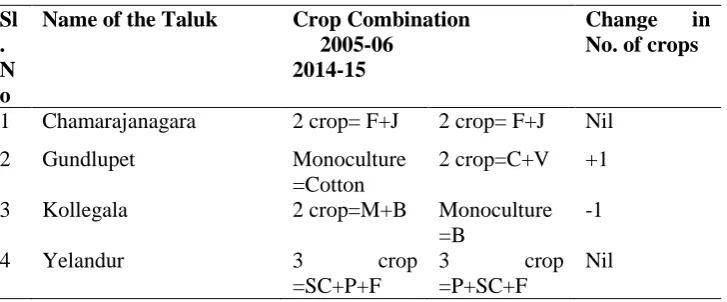
Chamarajanagara district have different crop combination region in each taluk over the period from 2005-06 and 2014-15. The change of crop combinations has shown in the Table No.4. and also shown in the Map No.2 and Map No.3.
Chamarajagara taluks has same two crop combinations in 2005-06 and 2014-15 viz.,
Sowmya. R & Dr. H Nagaraj (Pg. 8568-8578) 8575
Copyright © 2017, Scholarly Research Journal for Interdisciplinary Studies
Gundlupet taluks has monoculture crop combinations in 2005-06 i.e., Cotton and in 2014-15 it has two crop combination viz., Cotton +Vegetable. There is one crops increase over the period due to the irrigation facilities there is one positive change of this taluk.
Kollegala taluks two crop combinations in 2005-06 viz., Maize+Bajra and in 2014-15 it has monoculture i.e., Bajra. There is one negative change in crop combination over the period because it receives less amount of rainfall during this year.
[image:8.595.120.484.355.506.2]Yelandur taluks has three crop combinations in 2005-06 viz., Sugarcane+Paddy+Maize, and in the year 2014-15 also having three crop combination viz., Paddy +Sugarcane+ +fruits. In this taluk three crop combinations are continue over the period but in this three crop combination fruits were taking place of Maize in the year 2014-15. Because the availability of irrigation facilities and improving of marketing facility in this taluk.
Table No.4: Talukwise crop combination of Chamarajanagara District Sl
. N o
Name of the Taluk Crop Combination
2005-06 2014-15
Change in
No. of crops
1 Chamarajanagara 2 crop= F+J 2 crop= F+J Nil
2 Gundlupet Monoculture
=Cotton
2 crop=C+V +1
3 Kollegala 2 crop=M+B Monoculture
=B
-1
4 Yelandur 3 crop
=SC+P+F
3 crop
=P+SC+F
Nil
Sowmya. R & Dr. H Nagaraj (Pg. 8568-8578) 8576
Copyright © 2017, Scholarly Research Journal for Interdisciplinary Studies
Map.No.3: Talukwise Crop combination of Chamarajanagara District 2005-06
Sowmya. R & Dr. H Nagaraj (Pg. 8568-8578) 8577
Copyright © 2017, Scholarly Research Journal for Interdisciplinary Studies Summary and concluding remarks:
Chamarajanagara district has different crop combination in each taluk. In this present study J C Weaver’s method has been used to identify the crop combination region. Based on this method in the year 2005-06 the district has monoculture, two and three crop combination. Gundlupet taluk has monoculture i.e., Cotton, Chamarajanagara taluk, Kollegala taluk has two crop combination viz., Fruits+Jowar and Maize+Bajra respectively, Yelandur taluk has three crop combination viz., Sugarcane+Paddy+Maize. While observing in the year 2014-15 the same crop combination pattern were continue in the district such as Kollegala taluk has Monoculturei.e., Bajra, Chamarajangara and Gundlupet taluk has two crop combination viz., Fruits+Jowar and Cotton +Vegetable respectively. Yelandur taluk has three crop combination viz., Paddy+Sugarcane+Fruits. While observe the changes of crop combination Gundlupet taluk has positive change and Kollegala taluk has negative change in number of crops and there is no changes in Chamarajanagara taluk crop combination the same crop combination were continue over the period. In Yelandur taluk also three crop combinations are continues over the period but in the three crops combination Fruits occupy the Maize place. All these are showing the different crop combination of the district.
References:
Vrishali Deosthali (June - 1997) “Crop Planning for Ahmednagar and solapur District, Maharastra”, The Indian Geographic Journal, Vol .72, No.1, PP No.11-26.
S S Hangaragi (June – 2010) “Pattern of Crop Diversification in Bagalokot District of Karntaka”, The Deccan Geographer Journal, Vol.48, No.1, PP No.49-58.
Ganesh S.M ankar (June – 2010) “ Agricultural Land Use Pattern In Mulshi Tahsil, Pune District”, The Deccan Geographer Journal, Vol.46, No.1, PP No.85 – 92
S S Hangaragi (June – 2011) “Spatio - Temporal Changes in Cropping Pattern in Bagalkot District, Karnataka”, Vol.49, No.1, PP No.27 – 42.
D P Angadi and A S Rayamane (June – 2012) “Impact of Irrigation on Agricultural Development: A Case Study of Belagaum District, Karnataka” Vol.XXXII, No.1,
PP No.60 – 69.
Vibha Singh and Jagadish Singh (June – 2013) “Pattern of Crop Combination and Diversification in
Chandualli District, Uttar Pradesh”, The Deccan Geographer Journal, Vol.51, No.1, PP
No.11 – 22.
Weaver,J.C., (1954), Crop combination regions in the Middle West, Geographical Review, New York, pp. no. 175-200.
Sowmya. R & Dr. H Nagaraj (Pg. 8568-8578) 8578
Copyright © 2017, Scholarly Research Journal for Interdisciplinary Studies
Shyam, Bhatia. (1965), Pattern of crop diversification and crop concentration in India Economic geography, 41(1), pp. 39-56.
Rathod, H.B, & Naik.V., (2009), Agricultural land use and cropping pattern in Yavatmal District, Maharashtra, Geo. Rev. of India, II (6).