Experimental Study on Replacement of Cement by
Using Ceramic Waste in Concrete
M.Dinesh1, V. John Sundar Raj2, K.Vasu3
1, 2, 3
Assistant Professor, Dept of Civil and Structural Engineering, SCSVMV University, Kanchipuram, Tamilnadu 631561, India
Abstract: Ceramic waste is one of the major industrial waste products obtained from ceramic Industry. Indian ceramic production is 100 million ton per year. In the ceramic Industry, about 25% - 30% waste powder is settled by sedimentation and then dumped is land and sea which results in environmental pollution. In addition to this, dust is formed in summer which is threatening both agriculture and public health. Therefore utilization of the ceramic powder in concrete is most essential to develop eco-friendly concrete. In this project, experimental study has been done for the cement to be replaced by ceramic waste powder accordingly in the range of 0%, 10%, 20% and 30% by weight. The grade of concrete used in this project is M20 grade
concrete, the concrete specimen is casted, tested and compared in terms of compressive and split tensile strength to the conventional concrete. These tests were carried out the after curing of 7 days and 14 days. The optimum strength is obtained in this project is by the replacement of ceramic waste by 20% over the cement. On further replacement of ceramic waste it gradually reduces the strength of the concrete. Thus, the efficient replacement is 20% of ceramic waste.
Keyword: ceramic waste powder, optimum strength.
I. INTRODUCTION
The manufacture of ordinary Portland cement is decreasing all over the world in view of the popularity of blended cement on account of lower energy consumption, environmental pollution, economic and other technical reasons. Since Cement manufacture causes environmental impacts at all stages of the process. The amount of CO2 emitted by the cement industry is nearly 900 kg of
CO2 for every 1000 kg of cement produced. So in order to reduce the usage of cement, an alternative material shall be used to
replace this by available materials like ceramic waste.
In addition to helping the environment, uses of recyclable wastes offers eco-friendly nature. According to the Integrated National Plan on waste 2008-2015,NHIW is all waste generated by industrial activity which is not hazardous in order MAM/304/200, of the 8th February, in accordance with the European List of Waste (ELW).
The India produces 100 million ton ceramic waste per year. In the ceramic industry, about 15%-30% waste material generated from the total production. This waste is not recycled in any form at present. However, the ceramic waste is durable, hard and highly resistant to biological, chemical, and physical degradation forces. The ceramic industries are dumping the ceramic powders. This leads to serious environmental and dust pollution and occupation of a vast are of land, especially after the powder dries up so it is necessary to dispose the ceramic waste quickly and use in the construction industry. The pressure on the disposal of ceramic wastes leads to focus on recovery, reuse of natural resources and find other alternatives. The use of the replacement materials offer cost reduction, energy savings, arguably superior products and fewer hazards in the environment.
A. Objectives
Following are the main objective of this article:
1) To understand the characteristics behavior of the ceramic waste concrete.
2) To find out the compressive strength of concrete by replacing ceramic wastes in various proportions.
II.LITRETURE REVIEW
wastes used as partial substitute for cement and fine aggregates could prove to be beneficial since the two materials are the most high-priced during concrete production.
V.V. Agarwal, et.at.(vol.4,2014),“Analysis of the Strength and Durability of the Concrete with Partially Replaced by the Ceramic Slurry Waste Powder” The paper discuss that ceramic slurry waste powder is replaced by cement in concrete. Concrete grade M25 was made by replacing by 0% to 30% of Ordinary Portland 53 grade cement with ceramic slurry waste powder passing through 90 microns. Compressive strength, flexural strength, water absorption and sorptivity are determined with water cement ratio 0.48. The result shows core compressive strength achieved up to 30% replacement of ceramic waste powder without affecting the characteristic strength of M25.
Amit Kumar D. Raval, et.at.(vol.4,2013), “Ceramic Waste effective Replacement of Cement for Establishing Sustainable Concrete” The utilization of the ceramic waste powder in various industrial sectors especially the construction, agriculture, glass and paper industries would help to develop eco-friendly concrete from ceramic waste. In this research study the (OPC) cement has been replaced by ceramic waste powder accordingly in the range of 0%, 10%, 20%, 30%, 40% & 50% by weight of M20 grade concrete. Tests were carried out to evaluate the mechanical properties for 7, 14 and 28 days. As a result, the compressive strength achieved up to 30% replacing cement with ceramic waste. This research work is concerned with the experimental investigation on strength of concrete and optimum percentage of the partial replacement by replacing cement via 0%, 10%, 20%, 30%, 40% and 50% of ceramic waste. Keeping all this view, the aim of the investigation is to study the behavior of concrete while replacing the ceramic waste with different proportions in concrete.
II. MIX PROPOTIONS
[image:3.612.64.522.466.617.2]The mix proportion of M20 grade of concrete with W/C ratio is 0.5.
Table 1.
Cement Fine Aggregate Course aggregate
1 1.49 3.08
Mix Proportions of M20 Grade of concrete
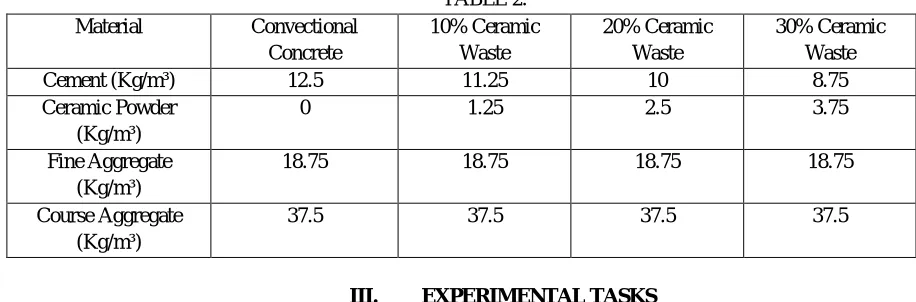
The quantity of the various materials for M20 grade concrete can be worked out for the ratio and their respective replacement values are given below.
TABLE 2. Material Convectional
Concrete
10% Ceramic Waste
20% Ceramic Waste
30% Ceramic Waste
Cement (Kg/m³) 12.5 11.25 10 8.75
Ceramic Powder (Kg/m³)
0 1.25 2.5 3.75
Fine Aggregate (Kg/m³)
18.75 18.75 18.75 18.75
Course Aggregate (Kg/m³)
37.5 37.5 37.5 37.5
III. EXPERIMENTAL TASKS
A. Compression Test
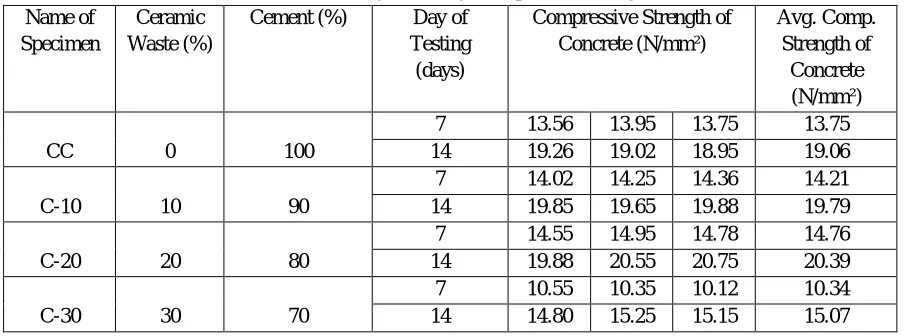
Compression Test was conducted on 150mmX150mmX150mm cubes. Concrete specimens were removed from curing tank and cleaned. In the Compressive testing machine, the cube is placed with the cast face at right angles to that of compressive faces, then load is applied at a constant rate of 1.4Kg/cm² minute up to failure and the ultimate load is noted. The load is increased until the specimen fails and the maximum load is recorded. The compression test is carried out for three samples of each replacement ratios to find the strength at 7 and 14 days.
TABLE 3. 7 days & 14days compressive strength Name of
Specimen
Ceramic Waste (%)
Cement (%) Day of Testing (days)
Compressive Strength of Concrete (N/mm²)
Avg. Comp. Strength of
Concrete (N/mm²)
CC 0 100
7 13.56 13.95 13.75 13.75 14 19.26 19.02 18.95 19.06
C-10 10 90
7 14.02 14.25 14.36 14.21 14 19.85 19.65 19.88 19.79
C-20 20 80
7 14.55 14.95 14.78 14.76 14 19.88 20.55 20.75 20.39
C-30 30 70
7 10.55 10.35 10.12 10.34 14 14.80 15.25 15.15 15.07
B. Compression Strength
The total number of 24 cubes for four mixes i.e. three cubes per mix was prepared for casting of 7 and 14 days curing. The compressive strength test results for the mixes were shown in the graph below. The graph was plotted against ceramic powder % and compression strength (N/mm²).
Graph 1: Compressive strength of cube in 7 days
Graph 1.2: Compressive strength of cube in 14 days by line chart
0 5 10 15 20 25
CC C 10 C 20 C 30
C om p re ss ive s tr en gt h in N /m m 2
Ceramic Waste %
Compressive strength of concerte by line chart
7 Days 0 5 10 15 20 25 30 35
CC C 10 C 20 C 30
C om p re ss ive s tr en gt h i n N /m m 2
Compressive strength of concrete by line chart
C. Tensile Test
Tensile strength is an important property of concrete because concrete structures are highly vulnerable to cracking owing to various kinds of loadings. However tensile strength of concrete is very low as compared to its compressive strength. Tensile test were conducted on four cubes per mixes on split-cylinder test. Split-cylinder test is the standard test, to determine the tensile strength in accordance with IS: 5816-1970. The standard test cylinder of concrete specimen (300mm X150 mm dia) is placed horizontally between the loading surfaces of Compression Testing Machine. The compression load is applied diametrically and uniformly along the length of cylinder until the failure occurs in vertical direction. Concrete cylinders split into two halves along this vertical plane due to indirect tensile stress generated by Poisson’s effect.
Graph 3:Tensile strength of cylinder in 14 days by line chart
From the above results we can observe that in the 20% replacement of the ceramic waste in concrete gives the maximum compressive strength and minimum tensile strength.
IV. CONCLUSION
A. Based on experimental Investigations Concerning the Compressive Strength of Concrete, the Following Observations are made 1) The Compressive Strength of M20 grade Concrete increases when the replacement of Cement with Ceramic Powder up to 30%
replaces by weight of Cement and further replacement of Cement with Ceramic Powder decreases the Compressive Strength. 2) Concrete on 20% replacement of Cement with Ceramic Powder, Compressive Strength obtained is 20.39 N/mm² and vice-versa
the cost of the cement is reduced up to 10% in M20 grade and hence it becomes more economical without compromising concrete strength than the standard concrete. It becomes technically and economically feasible and viable.
3) Utilization of Ceramic waste and its application are used for the development of the construction industry, Material sciences. 4) The replacement of ceramic waste in concrete increases the hydration and the bond between cement and aggregates.
5) It is the possible alternative solution of safe disposal of Ceramic waste.
REFERENCES
[1] Ali Heidari, (2012), “A Study of the Mechanical Properties of Ground Ceramic Powder Concrete”.
[2] Amit Kumar D.Raval, (2013), “Ceramic Waste effective Replacement of Cement for Establishing Sustainable Concrete” [3] Eva Vejmelkova, (2012), “Application of Waste Ceramics as Active Pozzolana in Concrete Production”.
[4] Giridhar Valikala, (2013), “Influence of Water Absorption of The Ceramic Aggregate on Strength Properties of Ceramic Aggregate Concrete”. [5] O.Zimbili, (2014), “A Review on the Usage of Ceramic Waste in Concrete Production”.
[6] V.V.Agarwal, (2014), “Analysis of the Strength and Durability of the Concrete with Partially Replaced By the Ceramic Slurry Waste Powder”. [7] IS: 10262-1982 recommended guidelines for concrete mix design.
[8] IS: 1199-1959 Method of sampling and analysis of concrete.
[9] IS: 383-1970 Specification for coarse and fine aggregates from natural sources for concrete. [10] IS: 456-2000 Plain and reinforced concrete code of practice.
[11] IS: 516 Methods of test for strength of concrete.
[12] M.S. Shetty (2005), “Concrete Technology – Theory and practice”. 0 0.5 1 1.5 2 2.5 3 3.5 4
CC C 10 C 20 C 30
Te n si le s tr e n gth i n N /m m 2
Ceramic Waste %
Tensile strength of line chart
PHOTOGRAPHS
Mixing of Ingredients Casting of cubes
Curing of cubes Testing of Cubes