ScholarWorks @ Georgia State University
ScholarWorks @ Georgia State University
Gerontology Theses Gerontology Institute
Fall 12-1-2012
"Men Don't Talk": Examining the Dynamics of Men's Co-resident
"Men Don't Talk": Examining the Dynamics of Men's Co-resident
Relationships in Assisted Living
Relationships in Assisted Living
Yarkasah P. Paye
Follow this and additional works at: https://scholarworks.gsu.edu/gerontology_theses
Recommended Citation Recommended Citation
Paye, Yarkasah P., ""Men Don't Talk": Examining the Dynamics of Men's Co-resident Relationships in Assisted Living." Thesis, Georgia State University, 2012.
https://scholarworks.gsu.edu/gerontology_theses/33
“MEN DON’T TALK”: EXAMINING THE DYNAMICS OF MEN’S CO-RESIDENT
RE-LATIONSHIPS IN ASSISTED LIVING
by
YARKASAH P. PAYE
Under the Direction of Candace L. Kemp
ABSTRACT
Women outnumber men in assisted living (AL). This gender imbalance promotes the
feminization of AL settings and affects men’s social experiences, particularly their co-resident
relationships. AL research connects peer relationships to resident well-being and suggests gender
that influences co-resident interactions. Yet, few studies have specifically examined men’s social
experiences in AL. This analysis aimed to: (1) learn how men experience co-resident
relation-ships in AL; and (2) identify the factors shaping these peer relationrelation-ships. The analysis utilized
qualitative data collected from two AL settings. Data collection involved participant observation
and informal and formal in-depth interviews. Analysis was informed by principles of Grounded
Theory Method and shows high variability in men’s co-resident connections. A range of
individ-ual- and facility-level factors promoted or constrained relationship development. Gender remains
pivotal in structuring men’s social engagements. Individual- and facility-level factors often
inter-sected with gender and influenced men’s social lives. Ultimately, co-resident relationships are
“MEN DON’T TALK”: EXAMINING THE DYNAMICS OF MEN’S CO-RESIDENT
RE-LATIONSHIPS IN ASSISTED LIVING
by
YARKASAH P. PAYE
A Thesis Submitted in Partial Fulfillment of the Requirements for the Degree of
Master of Arts
in the College of Arts and Sciences
Georgia State University
“MEN DON’T TALK”: EXAMINING THE DYNAMICS OF MEN’S CO-RESIDENT
RE-LATIONSHIPS IN ASSISTED LIVING
by
YARKASAH P. PAYE
Committee Chair: Candace Kemp
Committee: Mary Ball
Elisabeth Burgess
Electronic Version Approved:
Office of Graduate Studies
College of Arts and Sciences
Georgia State University
DEDICATION
With a grateful heart, I dedicate this thesis to my mother, Nancy Golon Paye, whose
si-lent strength and resilience have guided me through life’s meandering paths; and to my wife,
ACKNOWLEDGEMENTS
I would like to acknowledge Dr. Elisabeth Burgess and the Gerontology Institute for
giv-ing me the opportunity to study with a group of committed scholars. I want to say a very big
Li-berian “thank you” to the faculty and staff of the Institute for their support and encouragement.
My committee has been exceptional in their support and guidance. I am grateful to my
Chair, Dr. Candace L. Kemp, and my committee members, Dr. Mary M. Ball and Dr. Elisabeth
TABLE OF CONTENTS
ACKNOWLEDGEMENTS ... v
LIST OF TABLES ... ix
1 INTRODUCTION ... 1
1.1 Statement of the Problem ... 1
1.2 Research Purpose ... 4
2 LITERATURE REVIEW ... 6
2.1 Demographics of the Aging Population ... 6
2.2 Social Relationships in Later Life ... 9
2.2.1 The significance of social relationships in later life ... 10
2.2.2 Types of social relationships in later life ... 11
2.2.3 Factors influencing variations in social relationships in later life ... 11
2.3 Men’s Friendships ... 14
2.4 Understanding Assisted Living ... 17
2.5 Social Relationships in AL ... 19
2.6 Factors Influencing Social Relationships in AL ... 22
2.7 Men’s Co-resident Relationships in AL ... 26
2.8 Purpose of the Research ... 28
2.9 Research Aims and Questions ... 29
3.1 Life Course Perspective ... 30
3.2 Social Constructionist Perspective ... 31
4 METHODS ... 33
4.1 Primary Study ... 33
4.2 Methods and Procedure ... 33
4.3 Subsample and Present Study ... 35
4.3.1 Settings and Participants ... 35
4.4 Available Data ... 40
4.5 Design... 41
4.6 Analysis ... 42
5 RESULTS ... 45
5.1 Presentation of Case Studies ... 46
5.1.1 John Mark – Red Home ... 46
5.1.2 Paul Smith – Pink Home ... 52
5.1.3 Arnold James – Red Home... 54
5.1.4 Mickey House – Pink Home ... 56
5.1.5 Ron David – Red Home ... 59
5.2 Summary of Case Studies ... 63
5.3 Factors Influencing Co-resident Relationships ... 65
5.3.2 Individual-level factors ... 75
5.4 Outcomes of Relationships... 85
6 DISCUSSION ... 89
6.1 Discussion of Findings ... 89
6.2 Implications of the Findings ... 98
6.3 Strengths, Limitations, and Future Direction ... 100
LIST OF TABLES
Table 1.1 Age Distribution by Gender ... 9
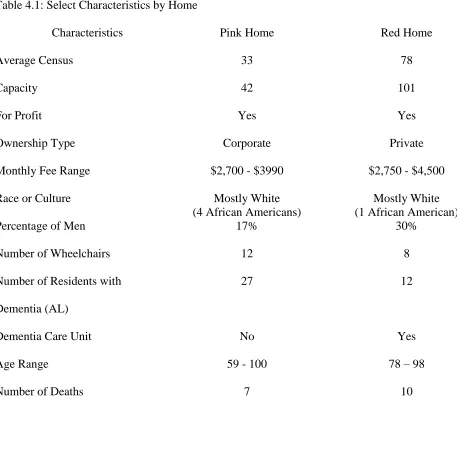
Table 4.1 Select Characteristics by Home ... 40
1 INTRODUCTION
1.1 Statement of the Problem
Demographic projections in the United States unanimously point to an aging society, with
the number of older adults expected to rise exponentially in the coming decades. The U. S.
Cen-sus 2010 projections indicate that by 2030 the number of Americans over 65 years old will
in-crease from 40 million to 70 million (U. S. Census, 2010). While older women will continue to
outnumber older men in the general population, noticeable increases in the number of older men
are apparent. In an analysis of the 2010 census, Werner (2011) observed that the largest growth
rate for a ten-year age group was for men 85 to 94 years old (46.5%). When five-year age groups
are compared, men 90 to 94 years old had the largest growth rate (50.3%) while women in this
age group grew by 23.3%. Despite the growth in their population and, likely as a consequence of
their smaller numbers relative to older women, little is known about older men and their social
relationships, especially in formal long-term care (LTC) settings (Park, Knapp, Shin, & Kinslow,
2009).
Social relationships are important across the life course. Social relationships are “recurrent
patterns of interaction with other individuals” (Krause, 2006, p.182). Social relationships are
par-ticularly salient in later life because of their impact on health and well-being for older adults
(Luger, Cotter, & Sherman, 2009). Moreover, research has determined that social relationships
can reduce morbidity and mortality (Wortman & Conway, 1985), and buffer the effects of stress
on mental and physical health (Bankoff, 1983; Krause, 1986). Yet not all social relationships
have the same influence. For instance, relationships with family and friends present different
op-portunities for older adults (Keller-Cohen, Fiori, Toler, & Bybee, 2006). Relationships with
mo-rale than family (Antonucci & Akiyama, 1995; Fiori, Antonucci, & Cortina, 2006; Keller-Cohen
et al., 2006; Seeman, 2000; Siebert & Mutran, 1999). Research suggests that a variety of factors
influences the scope and utility of social relationships in later life, especially age, living
ar-rangement, and gender. For instance, compared to men, women generally have larger social
net-works and, report receiving more social support from others; meanwhile, older men are more
likely to be married and depend on their spouses for support (Antonucci & Akiyama, 1987;
Wer-ner, 2011). However, older adults are not always able to remain in their homes due to loss of
health, spouse, or increased social isolation resulting from the loss of social network members.
Consequently, when faced with loss of independence and need for instrumental and social
sup-port, a growing number of older adults will transition to formal LTC settings, including assisted
living (AL) (Ball et al., 2009).
AL is a non-medical, social-model option of LTC with home-like environments that
fa-cilitate residents’ privacy and autonomy (Chapin & Dobbs-Kepper, 2001; Frank, 2002; Hawes,
Phillips, Rose, Holan, & Sherman, 2003; Mollica, 2002). Physical and cognitive declines are
prevalent among AL residents, with high occurrences of Alzheimer’s disease and other forms of
dementia (Ball, Perkins, Hollingsworth, & Kemp, 2010). Currently, the AL industry serves
ap-proximately 1 million residents in the United States (National Center on Assisted Living, 2009).
Although there is some variation by gender, age, and other demographic factors (Park-Lee,
Caffrey, Sengupta, Moss, Rosenoff, & Harris-Kojetin, 2011, Polivka & Salmon, 2008), the
typi-cal AL resident is female, Caucasian, older than 85 years. Women account for 70% of the census
(Caffrey et al., 2012). This gender imbalance in AL tends to feminize the social environment and
Research suggests the importance of co-resident relationships in AL (Kemp, Ball,
Hol-lingsworth, & Perkins, 2012; Street & Burge, 2012). Research on co-resident relationships in AL
further suggests their instrumentality in life satisfaction (Park, 2009) and quality of life (Ball,
Perkins, Whittington, Hollingsworth, King, & Combs 2005; Street, Burge, Quadagno, & Barrett,
2007). In addition, positive co-resident relationships contribute to better adjustment in AL (Street
et al., 2007). Residents also draw from the emotional support provided by co-residents who have
previously navigated the transition to AL (Burge & Street, 2010; Rook, 2009; Street et al., 2007).
However, there is considerable variation in co-resident relationships. Co-resident relationships
can include strangers, friends, as well as enemies, and romantic types (Kemp et al., 2012).
Re-searchers attribute this variation to facility factors (e.g., facility size and location, cost, quality
and tenure of staff) and individual factors (e.g., physical and cognitive status of residents, race,
marital status, and gender) that either encourage or limit relationships (Ball et al., 2005; Kemp,
2008).
Gender is among the main individual factors influencing co-resident relationships in AL;
what little research that exists on men in AL suggests that being a man affects how a resident
ex-periences social relationships (Moss & Moss, 2007; Park, Knapp, Jung Shin, & Kinslow, 2009).
For example, men are fewer in number, limiting their opportunities for same-sex friendships, but
increasing their opportunities for opposite-sex relationships (Kemp et al., 2012). In addition,
masculine identity renders some facility activities antithetical to men’s needs, further limiting
opportunities for interactions with other residents (Park et al., 2009). Perhaps unsurprisingly, one
large-scale AL study found that women participate in more social activities than men (Mitchell
& Kemp, 2000). Furthermore, research on married couples in AL demonstrates their propensity
(Kemp, 2008; 2011). As such, married men may experience limited co-resident relationships.
Although existing work provides some insight into men’s experiences in AL, including some
factors that might lead to variation in men’s experiences, research has yet to study men’s
rela-tionships in-depth in these increasingly popular care settings. The paucity of studies that
system-atically examine men’s co-resident relationships in AL means that much remains unknown,
in-cluding the construct of men’s co-resident relationships, the factors influencing such
relation-ships, and the mechanism for sustaining men’s co-resident relationships in AL. Moreover, little
is known about the outcomes of men’s co-resident relationships.
1.2 Research Purpose
This thesis examines men’s social experiences in AL with a focus on their relationships
with other residents. Analysis is guided by life course (Elder, 1994) and social constructionist
perspectives (Gergen, 1985) and by principles of grounded theory (Charmaz, 2006; Strauss &
Corbin, 1998). The thesis is based on qualitative data derived from two AL communities in
met-ropolitan Atlanta. The specific aims of the study are as follow:
Aim 1: To learn how men experience co-resident relationships in AL;
Aim 2: To identify the factors that influence men’s co-resident relationships in
AL; and,
Aim 3: To understand the outcomes of co-resident relationships for men in AL.
This study is pertinent because it not only contributes to the existing corpus of literature
on older men’s lives, specifically their co-resident relationships in AL, but it also provides basis
for policy and programmatic enhancements in AL. Framers of regulations would benefit from
findings that demonstrate the factors influencing men’s co-resident relationships in AL.
evidence about how to structure programs that attend to the needs of men in AL. Findings from
this study supply such evidence. Moreover, if taken up by providers, suggestions for practice
based on the study’s findings could engender enhanced quality of life men as their co-resident
2 LITERATURE REVIEW
In this chapter, I review the aging demographics with special attention devoted to its
gen-der dynamics. In view of the salience of social relationships among olgen-der adults, I review social
relationships in later life. I also discuss the assisted living (AL) setting and the experience of
so-cial relationships in this context. The chapter concludes with an examination of men’s
co-resident relationship in AL.
2.1 Demographics of the Aging Population
In chapter one, I noted that population aging is a present and future reality in the United
States. The portion of the population 65 years and older experienced a growth rate of 15%
be-tween 2000 and 2010 (Howden & Meyer, 2011). This growth is evident across racial, ethnic, and
socioeconomic boundaries. According to the U.S. Census (2010), minorities account for 20.0%
of persons 65 years and over, with African-Americans comprising 8.4%. Persons of Hispanic
origin (who may be of any race) represent 6.9% of the older population. About 3.5% were Asian
or Pacific Islander and less than 1% were American Indian or Native Alaskan. In addition, 0.8%
of persons 65 years and over identified themselves as being of two or more races.
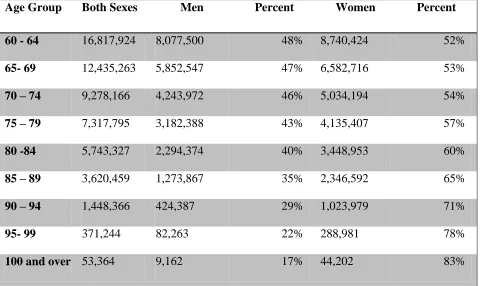
Uneven gender distribution also characterizes the older population. As can be seen in
Ta-ble 2.1, there are more women than men in each age group. The life expectancy gap between
men and women may account for this difference. While older women represented 23 million of
all older adults in 2010, older men accounted for 17.5 million; the female to male sex ratio
in-creases with age, ranging from 112 for the 65-69 age group to a high of 206 for persons 85 and
over (U.S. Census, 2010). Although older women outnumbered older men in the general
popula-tion, noticeable increases in the number of older men in specific age groups were apparent. An
growth rate for a ten-year age group was for males 85 to 94 years old (46.5 percent). Females in
this age group also increased but to a smaller degree (22.9 percent). When five-year age groups
are compared, males 90 to 94 years old had the largest growth rate (50.3 percent) while females
in this age group grew by 23.3 percent.
Observable gender differences in marital status are also evident in the 2010 census
re-port. Compared to older women, a higher proportion of older men were married in 2010 – 72%
of men and 42% of women (Administration on Aging (AoA), 2011). The report from the census
also points to the large number of widows among older women – 40%. Four times as many older
women were widows (8.7 million) compared to men (2.1 million).
Living arrangements for the older population also differed by gender. According to a
port compiled by the AoA (2011), among community dwelling older adults, over half (55%)
re-sided with a spouse in 2010 . More men lived with a spouse than women, as 69% of older men
compared to 41% of older women lived with a spouse; in addition, advanced age further
depreci-ated the percentage of older adults residing with a spouse, with 30% of women 75 years and
above living with a spouse (AoA, 2011). A large percentage of community dwelling older adults
lived alone in 2010, 37% for women and 19% for men (AoA, 2011). Advanced age increased the
likelihood of an older adult living alone. For example, 47% of women 75 years and above lived
alone in 2010 (AoA, 2011).
Institutional environments like nursing homes and AL facilities provide accommodation
for only a small percentage of older adults. However, advanced age elevates the use of
tial facilities by older adults. For example, in 2007 1% of older adults aged 65-74 used
residen-tial facilities, compared to 3.5% of older adults aged 75-84 years and over 13% for older adults
Health and functional status among older adults are key determinants of their abilities to
interact with their environment. Because women have higher life expectancy than men, they
have greater susceptibility to chronic illnesses (Moody, 2010), which contribute to functional
disability (Robb, Small, & Haley, 2008) and may account for the higher prevalence of
disabili-ties and functional limitations incurred by older women compared to older men (Freedman,
Grafova, Schoeni, & Rogowski, 2008).
In “A Profile of Older Americans: 2011”, the AoA (2011) reports that 37% of older
adults self-reported some type of disability in 2010, including hearing, vision, cognition,
ambula-tion, self-care, or independent living. While some disabilities may be minor and present
inconse-quential interferences with life, others compel older adults to require assistance with important
personal needs. Older adults with disabilities and greater functional limitations may experience
Table 2.1: Age Distribution by Gender - 2010
Age Group Both Sexes Men Percent Women Percent
60 - 64 16,817,924 8,077,500 48% 8,740,424 52%
65- 69 12,435,263 5,852,547 47% 6,582,716 53%
70 – 74 9,278,166 4,243,972 46% 5,034,194 54%
75 – 79 7,317,795 3,182,388 43% 4,135,407 57%
80 -84 5,743,327 2,294,374 40% 3,448,953 60%
85 – 89 3,620,459 1,273,867 35% 2,346,592 65%
90 – 94 1,448,366 424,387 29% 1,023,979 71%
95- 99 371,244 82,263 22% 288,981 78%
100 and over 53,364 9,162 17% 44,202 83%
Sources: U. S. Census Bureau, Census 2000 Summary File 1 and 2010 Census Summary File 1.
2.2 Social Relationships in Later Life
Social relationships refer to the recurrent patterns of interactions with other members of
society, which have profound effects on individuals’ physical and mental well-being throughout
the life course (Antonucci, 1985; 1990; Antoncci, Landsford, & Akiyama, 2001; Berkman, 1995,
Berkman, Glass, Brissette, & Seeman, 2000). Social relationships encompass three elements,
in-cluding social network, social support, and social integration (Antonucci, 1990). Social network
or social structure “is the skeleton or structure that provides a foundation from which more
sub-jective aspects of social relations can develop” (Antonucci, Birditt, & Akiyama, 2009, p. 248).
This structure is important because both the size and quality of a social network influence social
perceived to be needed by the provider, the recipient, or both” (Antonucci et al., 2009, p.248).
The third element, social integration, refers to the individual’s attachment or inclusion in a social
structure (also see, George, 1996). Both social structure and social support are dependent on
so-cial integration.
2.2.1 The significance of social relationships in later life
Significant research has documented the salience of social relationships to the quality of
life in later life (Carder, 2002; Combs, 2004). Similarly, others have shown a positive
relation-ship between social relationrelation-ships and various aspects of well-being (Pinquart & Soerensen, 2000;
Stevens, Martina, & Westerhof, 2006; Tomaka, Thompson, & Palacious, 2006). Studies
continu-ally have shown that older adults’ friendships can serve as key ingredients for their well-being
(Aday, Kehoe, & Farney, 2006; Payne, Mowen, & Montor-Rodriguez, 2006; Silverstein, Chen,
& Heller, 1996).
Positive consequences for health and well-being make social relationships paramount in
later life. Studies on older adults indicate that those who maintain positive and supportive social
relationships are better adapted to both sustain their health and recover from health crises
(Antonucci, 1990; Seeman, 2000). It has also been shown that strong social support in later life
reduces the risk of disability (Avlund, Holstein, & Due, 2004). Later life social integration is
as-sociated with better cognitive functioning and decreased risk of depression, serving as a buffer
against psychological distress (Fratiglioni, Wang, Ecrisson, & Mayten, 2000; Keller-Cohen,
Fiori, & Toler, 2006). There is a preponderance of evidence that social integration protects
against dementia and other cognitive disabilities (Crooks, Lubben, Petitti, Little, Chiu, 2008;
Fratiglioni, Paillard-Borg, & Winblad, 2004; Wang, Karp, Winblad, & Fratiglioni, 2002). The
older adults lacking supportive networks have enhanced risks of mortality, disability, and
isola-tion (Berkman et al., 2000; Guilley, Pin, Spini, D’Epinay, Herrman, & Michel, 2005).
Notwith-standing the overwhelming reports of positive association between social relationships and
well-being in later life, negative consequences have also been documented, particularly within marital
relationships, including stress from a spouse (Walen & Lachman, 2000), risk of compromised
well-being from an unsupportive marriage arrangement, and caregiver stress (Christakis &
Alli-son, 2006).
2.2.2 Types of social relationships in later life
Relationships with family and peer group members present varying implications in the
lives of older adults (Antonucci et al., 2009). While family members generally dominate older
adults’ social networks, research has shown that they prefer support offered by friends
(Antonucci, 2009). The preference for friends’ support is a result of feeling less competent when
older adults depend on family members for support (Siebert & Mutran, 1999). Relationships with
friends tend to have more positive effects on the well-being of older adults than relationships
with family (Antonucci, 1990). Moreover, studies have shown that older adults’ friendships can
serve as key ingredients for their well-being (Aday, Kehoe, & Farney, 2006; Payne, Mowen, &
Montor-Rodriguez, 2006; Silverstein, Chen, & Heller, 1996). Declining meaningful contacts
with family and friends contribute to social isolation, which is a key influence on older adults’
transition to LTC. This elevates the need to understand peer relationships in later life,
particular-ly in AL settings.
2.2.3 Factors influencing variations in social relationships in later life
Gender. Gender influences social relationships in later life. Research indicates that
(McLaughlin,Vagenas, Pachana, Begum, & Dobson, 2010). On the other hand, men tend to be
married and rely on their wives as confidents (Kemp, 2008). In 2010, for example, 72% of older
men were married compared to 42% of older women (AoA, 2011). At the same time, 47% of
older women lived alone (AoA, 2011). Siebert, Mutran, and Reitzes (1999) observed gender
dif-ferences in how men and women perceived their reception of social support from relatives. A
subsequent study corroborated the previous findings, observing that grandfathers, for example,
have less contact with their grandchildren and assigned a lesser focus on the grandparent identity
than grandmothers (Reitzes & Mutran, 2004). However, when age and race are factored in, both
older women and men tend to have older, smaller, and more spread-out network; also, African
Americans reported smaller, more family-oriented networks with regularity of contacts (Ajrouch,
Blandon, & Antonucci, 2005).
Men’s perception of manhood and masculinity also influences social relationships in later
life. In an exploratory examination of the construction of masculinity among older men, Alex,
Hammarstrom, Norberg, and Lundman (2008) posited three streams of masculinity including
“being in the male centre”, striving to maintain the male façade”, and “being related.” In this
study the authors looked at masculinity among men aged 85 and over and their finding
elucidat-ed multiple masculinities among older men. Consequently, it is critical to understand the
rela-tionship between masculinity and older men’s social ties.
Marital status. Health-promoting properties of marital status and marital quality have
been documented in existing literature (Umberson, Crosnoe, & Reczek, 2010). For example,
Antonucci, Lansford, and Akiyama (2001) found that spousal relationships are important for
well-being among older adults. In this case, well-being entails both physical and mental
experienced the lowest rates of illness compared to people of other married categories –
di-vorced, remarried, widowed, and separated (Murphy, Glaser, & Grundy, 1997). Similarly,
Prigerson, Maciejewski, and Rosenheck (2000) found that compared to widowed individuals of
the same age group, married individuals aged 50 years and older reported fewer chronic
illness-es, better functional health, fewer nursing home days, and fewer physician visits. Furthermore,
existing evidence suggests that marital happiness, which is influenced by marital quality, is
per-tinent to the mental health of mature adults (Bookwala and Jacobs, 2004). In a study examining
the relationship between marital quality and physical health, Bookwala (2005) confirmed that
physical health is impacted by the quality of marriage for older adults. Both men and women
benefit from the positive marriage prosperities and incur the consequences of negative spousal
behaviors.
Notwithstanding the overwhelming reports of positive association between social
rela-tionships and well-being in later life, negative consequences have also been documented. This
dark side of social relationships (Umberson & Montez, 2010) can result from even the most
posi-tive social network. For example, marriage relationships can be a prime source of both support
and stress for many individuals (Walen & Lachman, 2000). Older adults with unsupportive
mar-riage arrangements may be at risk for compromised well-being. Moreover, caregiving, especially
for a sick or impaired spouse, can impose strains that undermine the health of the care provider,
even elevating mortality risks for the provider (Christakis & Allison, 2006). The consequences of
caring for an impaired spouse may include increased physical and psychiatric morbidity,
im-paired immune function, poorer health behavior, and compromised health for the caregiver
(Schulz & Sherwood, 2008). Additionally, care recipients may be negatively affected by
Age. Advanced age contributes to decline in social network size (Aldwin & Gilmer,
2004). Old adults typically have smaller, family-centered networks compared to younger adults
(Ajrouch, Antonucci, & Janevic, 2001), and maintain fewer peer group members (Antonucci et
al., 2009). Moreover, most research suggests positive association between age and the presence
of highly-supportive relationships (Marsden 1987; Shaw, Krause, Liang, & Bennett, 2007).
Simi-larly, other research argues that older adults dispose of less meaningful relationships as they
ad-vance in age, electing to surround themselves with more emotionally supportive relations
(Fred-erickson & Carstensen 1990).
Health, Race, and Socioeconomic status. There is a close relationship between health,
aging, and social relationships because of an interplay of influences. The importance of social
relationships in late life issues from their influence on the health and well-being of older adults
(Lugar et al., 2008; Park, 2009). Research by Ajrouch et al. (2001) shows that Blacks and Whites
share similarity in the proximity of social networks; however, Blacks tended to have smaller,
more kin-centered networks.Antonucci (1985) suggests that people of lower socioeconomic
sta-tus have depressed networks compared to people of higher socioeconomic stasta-tus.
2.3 Men’s Friendships
Various studies have established that people with friends live longer, healthier lives
(DuPertuis, Aldwin, & Bosse, 2001; Netuveli, Wiggins, Hilden, Montgomery, & Blane, 2006).
At the same time, the difficulty of maintaining friends in later life due to death, illness, and
re-tirement is well known (Antonucci & Akiyama, 1996). This difficulty occurs at a juncture in the
life course of men when they have time to commit to social relationships. Life course studies of
men’s relationships suggest that they have more time in older age to expend on social
(Grief, 2009). As men age, and the requirements of career and family wane, much spare time is
available for leisure and social relationships (Sheehy, 1998). Moreover, the context of social
norms influences men’s friendships, especially older men. While older men have more
opportu-nities for friendships with women, variations in social context influence such friendships. For
example, interaction with sexual overtones may hinder relationships among older men and
wom-en (Felmlee & Muraco, 2009).
Older men constitute friendship using various ingredients. A detailed survey literature
review by Adams (1994) presents both the internal structure of friendship patterns (e.g., the size
of men’s friendship networks and solidarity), as well as the internal processes of friendships,
in-cluding the cognitive, affective and behavioral aspects. The review found that in relation to
net-work size, the research remained inconclusive but tends to demonstrate that women have larger
networks than men (Adams, 1994). In terms of solidarity, the emotional closeness of friendships,
existing research concluded that women’s friendship were emotionally closer (Adams, 1994).
In Adams’ (1994) review of the internal processes of friendships, the result was mixed on
the level of satisfaction with friendships. However, men reported a high degree of consensus
about their definition of a close friend: someone to “pass time with,” “feel comfortable with,”
and “count on” (Adams, 1994, p. 169). In addition, men connected friendship with empathy,
af-fection, trust, loyalty, and satisfaction. Similarly, men were found to connect with one another
around activities, including providing social support and sharing in activities (Adams, 1994).
More recent conclusions by Greif (2009) both confirm and contradict some earlier
re-search. In a large study of 386 men ranging from 21 to 85 years old, Greif and his team used 12
open-ended questions to interview men about their male friendships. In their analysis, the team
you? (b) How have friends helped you (Are you a source of social support)? How have you
helped friends? (c) What are examples of what you do with your male friends? (d) How do you
establish friendships with men and how do you maintain them? (e) Did your father (or a
signifi-cant male parent figure) have many friends and, if so, what messages did you receive about
friendships from him? The baseline conclusion of the study established that friendship is
im-portant to men, and that “men recognize the importance of other men in their lives” (Greif, 2009,
p. 627). This finding contradicts Kaye’s (1997) suggestions that men’s sentiment that they like to
“go it alone” means a lack of interest in friendships (p.233).
In Greif’s conclusions, consistent with Adams’ (1994) findings, men celebrated trust and
having a trustworthy person as salient components of friendships. Important in the definition of
friendships was the ability to share thoughts and feelings with another person (Greif, 2009). This
affective description of friendship differs from concepts of friendships advanced by Kaye (1997)
and Kramer (2002), who implied a sense of isolation in men, when pairing men and women.
Moreover, consistent with Adams’ (1994) observation that men build their friendships around
activities, Greif (2009) found that men seek commonalities in developing friendship, and sports
provide a common avenue for interaction.
Older men’s race also provided distinction in their perception of friendships. According
to Greif (2009), African American men were more apt to speak of their friendships in terms of
sharing thoughts and feelings than Whites. This finding is consistent with earlier conclusions of
expressiveness among older African American men (Ellison, 1990; Mattis et al., 2001).
Com-pared to White respondents, older African American men also made more references to family
that African Americans often employ family metaphors when talking about friendships. Finally,
Whites reported receiving less help from friends than African Americans (Greif, 2009).
In an in-depth study using structural equation modeling to analyze 98 men’s friendships,
Migliaccio (2009) concluded that men’s friendships are more than a product of being a man, but
are a performance of masculinity. Migliaccio argues that a persistent link exists between
mascu-line expectations and men’s interactions with friends. As such, men’s engagement with their
friends is a display of perceived or expected masculine behaviors. According to Migliaccio
(2009), “Friendships should be conceived of as one component in masculine performances, and
not simply as a result of gender” (p.238). Among older men, advanced age results in decreased
contacts with friends and other social networks, this increases social isolation and its
accompany-ing consequences. As a result, the decision is made to transition to AL.
2.4 Understanding Assisted Living
Assisted living is one choice among various formal LTC options. As a non-medical,
com-munity-based living environment, AL distinguishes itself from other senior housing and care
set-tings by emphasizing a social model of care (Mitty & Flores, 2007). The now defunct Assisted
Living Quality Coalition was a group representing consumer groups (the Alzheimer’s
Associa-tion and AARP) and provider associaAssocia-tions (the American AssociaAssocia-tion of Homes and Services for
the Aging, the Assisted Living Federation of America, the American Seniors Housing
Associa-tion, and the American Health Care Association’s National Center for Assisted Living). The
Co-alition (1998) offered the following statement to explain what an AL setting is:
A congregate residential setting that provides or coordinates personal services,
24-hour supervision and assistance (scheduled and unscheduled), activities, and
ac-commodate individual residents’ changing needs and preferences; designed to
maximize residents’ dignity, autonomy, privacy, independence, and safety; and
designed to encourage family and community involvement (p.4).
Five hallmarks of AL extrapolated from the Coalition’s definition include: (a) services and
over-sight available 24-hour a day; (b) services to meet scheduled and unscheduled needs and
facili-tate aging in place; (c) care and services provided or arranged so as to promote independence; (d)
an emphasis on consumer dignity, autonomy, and choice; and (e) an emphasis on privacy and a
homelike environment (Hawes, Phillips, Rose, Holan, & Sherman, 2003).
Currently, the use of AL is on the rise. Recent surveys demonstrate that in 2010 there
were 31,100 assisted living facilities with a total bed count of 971,900 (Park-Lee et al., 2011).
Despite the Assisted Living Quality Coalition’s attempt to reach a consensus on the definition of
AL, much variation exists across states. AL facilities vary in size, ranging from small
“mom-and-pop” homes to very large, apartment-style living facilities (Zimmerman et al., 2003). In
2010, the year with the most recent data, facilities with 4-10 beds accounted for 50% of all AL in
the country. Medium-sized facilities, 11-25 beds, accounted for 16%, while larger facilities with
26-100 beds and extra large facilities with more than 100 beds accounted for 28% and 7 %
re-spectively (Park-Lee et al., 2011).
AL settings also vary in kinds of services provided, regulatory standards, funding, cost,
and resident characteristics (Polivka & Salmon, 2008). Because AL is primarily private pay,
old-er adults with economic means tend to populate these communities (Hawes et al., 2003;
Steven-son & Grabowski, 2010). The baseline monthly cost of AL ranges from $1,980 - $4,700, with
cost (Polivka & Salmon, 2008). Medicaid reimbursement is available in most states, but states
vary in the proportion of residents served and the level of payments (Mollica, 2002).
Resident characteristics have changed somewhat over time, with residents becoming
old-er and frailold-er (Ball et al., 2009). In an extensive national survey, Hawes and colleagues (1999)
noted that women composed 75% of AL residents. Moreover, other scholars assert the average
AL resident is female, Caucasian, over the age of 87, and requires assistance with a least two
ac-tivities of daily living (Seipke, 2008; National Center on Assisted Living, 2009). Cognitive
de-cline, as evidenced by high occurrences of Alzheimer’s and other forms of dementia, is prevalent
in AL (Ball et al., 2010). Physical challenges also characterize residents of AL, with high rates of
hypertension, coronary heart disease, and diabetes (Lewis & Bottomley, 2008). In 2010, 90% of
residents were non-Hispanic Whites and 70% women (Caffrey, Sengupta, Park-Lee, Moss,
Rosenoff, & Harris-Kojetin, 2012). These demographics have implications for social
relation-ships in AL. While research has begun to consider social relationrelation-ships in AL, a noticeable
pauci-ty of research on men’s co-resident relationships in AL remains evident.
2.5 Social Relationships in AL
The transition to AL often is predicated by loss, including loss of support networks and
loss of functional abilities to execute activities of daily living (ADLs) and instrumental activities
of daily living (IADLs) (Ball et al., 2009). Diminishing functional abilities and depressed support
networks compromise older adults’ capability to live independently in their own homes,
precipi-tating the decision to relocate to a residential facility. While most decisions to transition to AL
are prompted by increased functional decline, cognitive and or physical, some moves are also
As such, AL plays a central role in residents’ social relationships. In a qualitative study of
17 AL homes in three suburban-Atlanta counties, Ball and colleagues (2000) arrived at important
observations about social relationships in AL. Selected facilities for the study ranged in size from
2 to 75 residents. Data collection involved structured, face-to-face interviews with residents
(N=55) and staff, and participant observation. The sample reflected the general population of
AL, being mainly White, college-educated, and women aged 65 and over. The team observed
and described three types of relationships in AL environment: (a) external relations, i.e. those
with friends and family outside of AL; (b) co-resident relationships; and (c) relationship with
formal caregivers. Residents reported compensating for the absence of family and friends by
de-veloping co-resident relationships; residents also sought to develop relationships with formal
caregiving staff beyond the caregiving roles. According to the findings, the possibility exists for
co-resident relationships and caregiver relationships to evolve into family-like connections.
However, not all co-resident relationships flourish into family-like connections. Kemp et
al.(2012) found that co-resident relationships can vary from friends to strangers, and may
in-volve enemy and romantic type relationships. Analyzing data from three differing AL
environ-ments, Kemp et al. (2012)furtheridentified neighboring and anti-neighboring as channels of
in-teractions among AL residents. In neighboring inin-teractions, residents tended to greet one another
and engaged in discussion of various topics. Neighboring interactions also were characterized by
sharing behaviors and concern for frail residents. Helping behaviors, including voluntary
assis-tance with meal, prompting others about activities and scheduled events, pushing wheelchairs,
and giving directions also formed part of neighboring interactions. Residents with surrogate,
family-like connections occasionally visited in the privacy of their rooms. Furthermore,
Con-versely, neighboring interactions were unfriendly and even hostile. Residents’
anti-neighboring behaviors included “bullying, name-calling, intolerance, gossiping, shunning,
har-assing, disagreement, and physical confrontation” (Kemp et al., 2012, p.495). Anti-neighboring
behaviors usually occurred within group settings. This behavior can have consequences for
so-cial relationships.
Despite the range in co-resident relationship, one finding consistent among studies is that
these relationships influence well-being (Park, 2009; Kemp et al., 2012). A relatively large study
across eight AL communities in Alabama, which employed face-to-face interviews with
resi-dents and staff, concluded that co-resident relationships were associated with feelings of
satisfac-tion and reduced depressive symptoms (Park, 2009). In addisatisfac-tion, Street et al.(2007) confirmed
the salience of co-resident relationships to residents’ health and well-being. Using data from the
Florida Study of Assisted Living with a sample of 384 cognitively intact AL residents ranging
from age 65 and over, the study concluded that co-residents were important predictors of resident
well-being. Positive relationships with staff and co-residents were associated with higher life
sat-isfaction, while external connections with family and friends did not present significant positive
impact for life satisfaction. Possible explanations for this observed phenomenon resides in the
fact many residents in the sample had lived alone prior to seeking residency in AL; moreover,
Florida is known to be a state of choice for retirees, and some participants in the study were
al-ready accustomed to living away from family and friends.
Cummings (2002) also found a positive association between psychological well-being
and co-resident relationships. In a single facility with 70 residents, Cummings recruited a sample
of 57 participants and employed depression and life-satisfaction scales. Depression was
Depres-sion (CESD) Scale. This scale is a brief measure designed to identify depressive symptoms and
has been used extensively in gerontology research. Lifesatisfaction was measured using a scale
based on the Life Satisfaction Scale Z (LSCZ). The study showed that residents’ psychological
well-being was related more to their perception of received social support from other residents
rather than the number of social programs. Resident involvement in activities facilitated by AL
has been shown to support psychological well-being (Mitchell & Kemp, 2000). However, the
quality of co-resident relationships is more instrumental in well-being than the types and
quanti-ties of social activiquanti-ties (Cummings & Cocherham, 2004). Ample research has demonstrated the
salience of co-resident relationships to health and well-being. As such, it is important to
under-stand the factors that influence the development of co-resident relationships in AL.
2.6 Factors Influencing Social Relationships in AL
Research suggests that factors operating at three differing levels influence social
relation-ships in AL; they include societal, facility, and individual factors (Kemp et al., 2012). Societal
factors include federal, state, and local regulatory frameworks. For example, because AL is
regu-lated by states, societal factors in one state may vary from those in another state. Facility factors
encompass size, physical environment and location, cost, policies, activities, and number and
quality of staff. Individual factors cover ability to pay, level of education, personal history, race,
family involvement, marital status and gender. Individual factors may enhance or limit
co-resident relationships. However, it is possible to observe interplay between and among factors.
For example, the individual factor of gender may interplay with a facility factor if the facility
offers activities that are considered feminine.
The size of a facility is consequential, and smaller facilities have been found to influence
al., 2005). However, smaller facilities can also become impediments to social relationships by
limiting options and opportunities for meeting new people. In smaller facilities with smaller male
populations, men experience decreased opportunities to encounter other men.
The physical environment and location of a given AL community also affects social
in-teraction. In a focus group study on corridor walkability among 50 residents living in six AL
fa-cilities in Texas, Lu, Rodiek, Shepley, & Duffy (2011) found that arrangement of the physical
environment could facilitate social interactions. Lu and team investigated corridor walking
be-haviors and resident perceptions of corridor suitability for walking. The investigators observed
three types of corridor walking: walking to destination, walking for exercise, and walking for
interactions. A female resident commented, “[We] just walk around the esplanade outside. . . .
[We go] to the front because it’s pretty out there . . . because of the flowers and landscaping”
(p.471). The provision of a beautiful court allowed for residents to gather and engage in
co-resident relationships.
Lu et al. (2011) showed that interaction among residents precipitated by facility activities
also promote meaningful co-resident relationships, and invites AL settings to invest in programs
that encourage residents to develop meaningful relationships within the facility (Kane, 2001;
Mitchell & Kemp, 2000). Vigorous and intentional staff involvement may help contribute to an
environment that promotes relationships among residents as suggested by Kemp et al. (2012).
A critical facility factor is mealtime and the space designated for meals. Wikby and
Fagerskiold (2004) found that moving into formal care might provide greater opportunities for
interaction as a result of communal living and mealtime fellowship, as mealtimes tend to
organ-ize daily life and provide opportunities for most residents to be present in the same space at the
interactions among residents during mealtimes including, “greeting, conversations, tiffs, showing
concern, helping and sharing” (pp.495-496). However, mealtime is not always peaceful and
pleasant; disputes about seating can be a source of conflict among residents as observed by Ball
et al. (2005). Facility handling of such conflicts can either enhance or diminish social
interac-tions. Yet, some residents may refrain from active interaction during mealtime because of
per-sonal beliefs. For example, residents may view the dining room as a place to eat and not a place
to socialize. In a study of the phenomenon of being listened to, Jonas-Simpson, Mitchell, Fisher,
and Linscot (2006) used semi-structured interviews with open-ended questions to query 20 LTC
residents. The researchers observed that sharing a table does not ensure that a connection is made
or that social interactions lead to a positive social relationship. The following ethnographic field
note by Curle and Keller (2010) supports previous observation: “Men quiet (waiting for next
course?). All men looking up and forward across the table; they do not appear to be looking at
the other men at the table, but at the surroundings” (Observe 5, Table 20).
In the absence of data on gender attitudes about mealtime in AL, it can be extrapolated
from other studies on gender preferences that women attend mealtime to engage in emotional
connection with co-residents. Men, however, likely attended mealtime for its instrumentality.
Observations about personal preferences support the claim that individual factors do
in-fluence social relationships in AL. Kemp et al.(2012) found that resident individual factors
in-cluding personal characteristics, family involvement, cognitive status, and strategies influenced
their social interactions. Family involvement could limit or promote co-resident social
relation-ships. Residents with active family involvement who tend to spend considerable time away from
the facility may not have significant co-resident interactions. On the other hand, active family
limited family involvement would not benefit from family involvement, further limiting their
opportunities for social engagement. Women, on the other hand, generally enjoy greater family
involvement and would therefore incur the consequences of such family engagement.
Marital status in AL presents unique challenges to co-resident relationships. In AL, men
are more likely than women to be married and often serve as caregivers for their spouses (Kemp,
2008). This arrangement has implications for the outcomes that affect social relationships. A
man providing care for his spouse might earn the admiration of other women, but have limited
opportunities for same sex relationships. While the couple draws on the resources of their
com-panionship, they are often prevented from developing co-resident relationships with other
resi-dents, especially where one spouse is fulfilling caregiver responsibilities for the other spouse
(Kemp, 2008; Kemp et al., 2012). Previous research has identified three kinds of couples in AL
based on the types and degrees of social integration displayed (Kemp, 2008). The types of
cou-ples identified include: (a) independent; (b) inter-reliant; and (c) restricted-independent.
Inde-pendent couples were identified as being social with others and “were social with one another,
spending time playing games together, watching TV, visiting family members, and going to
reli-gious services” (p.243). Inter-reliant couples were “virtually inseparable and rarely left one
an-other’s side” (p.243). Inter-reliance was influenced by lifelong habit, shared health conditions
and by life in the facility. Couples with high cognitive and physical functioning engaged in more
social activities than do couples with cognitive and physical challenges. Restricted-independent
refers to couples in which one spouse continues to be active and independent but is prevented
from fully engaging in social interactions because of the assumption of caregiver role. The
I promised to take care of her, which I am still trying to do…
Yester-day, they were playing volleyball. I would have been down there with
them, you know, if it wasn’t for [my wife], if I was single. So, I just go
and have my meals downstairs and come back up.
This arrangement limits the caregiver’s opportunities for socialization.
Commonalities in residents’ personal and professional biographies promote opportunities
for social interaction (Ball, 2005; Yamasaki & Sharf, 2010). Residents with shared interests and
hobbies tend to engage in social interaction and elicit others with similar interests and hobbies.
For example, men with shared professional experiences (i.e., military, academic, and business)
may seek out one another because of their common knowledge and experiences. However, men
with varied profession backgrounds may seek out other men with similar interests, including
sports and politics.
2.7 Men’s Co-resident Relationships in AL
Men’s co-resident relationships in AL are varied, although only a limited corpus of
re-search has been completed on the subject. Married men in AL generally have their primary
co-resident relationship with their spouses. Couples appreciate the companionship and emotional
support that accompanies having a partner present in AL (Kemp, 2008). A man who serves as the
primary caregiver for their spouse may experience limited opportunities for other co-resident
re-lationships since so much time is spent with the ailing mate. Yet, being married in AL may
pre-sent opportunities to develop co-resident relationships with other married couples, thus
increas-ing men’s chances for co-resident interactions. However, married couples constitute a minority
in AL (Kemp, 2008; 2012). In addition, married men in AL view themselves as protectors of
always conform to popular cultural notions of friendship, including the perception that men
au-tomatically seek out other men for friendship in a social environment.
Consistent with the findings mentioned above, de Medeiros, Saunders, Doyle, Mosby, &
Van Haitsma (2011) found that staff perception of men’s friendship may be contrary to the
reali-ty stated by the men themselves. For example, staff constituted a “men’s table” believing that the
men wanted to sit together and be friends. Co-resident men whom staff identified as friends
usu-ally reported that they were friends with people other than those identified by staff. This finding
is aligned with the observations of Doyle, de Medeiros, & Saunders (2011), who found that staff
perceptions of male friendships did not conform to reports presented by male residents. On the
contrary, men often desire to form co-resident relationships with female residents. Men
em-ployed independence in developing co-resident relationships in AL.
In a multi-year, multi-site study entitled “Bereavement in Long Term Care”, Moss and
Moss (2007) evaluated data from five LTC facilities in the Philadelphia area. The study
exam-ined the cultural construction of death and dying in LTC and included 21 men of varied religious
backgrounds, ethnicity, professional experiences, and marital status. Men in the study ranged in
age from 75 to 99 years old, and had varying tenure in the facility. Findings by Moss and Moss
(2007) support claims of men exercising independence in developing co-resident relationships.
For example, some men in the study preferred to talk about work and family, showing little
in-terest in other relationships. Similarly, some men outright avoided other residents who were sick
and frail. Men seem to make active efforts to distance themselves from other residents. In
addi-tion, Moss and Moss (2007) found that men spoke about their co-resident relationships in terms
of instrumental interaction. Men spoke of their relationships with other residents, especially
which suggested that men focus on work skills and ground their identities in their ability to
per-form a task (Davidson, 2004; Martin & Doka, 2000).
Men’s co-resident relationships in AL are also influenced by their sense of satisfaction
with life in AL. Men tend to think that connections with the domains external to AL would
en-hance their quality of life. It is possible that this attitude prevents men from fostering intimate
interactions with co-residents in AL. In addition, Park et al., (2009) found that men in AL
ex-press greater lack of satisfaction with their lives and participate less in social activities than
fe-male residents. This may result from the absence of opportunities for masculine activities. This
scantiness of social engagement limits men’s opportunities for co-resident relationships.
2.8 Purpose of the Research
Existing research has demonstrated an association between co-resident relationships and
being. Studies have shown that residents’ social ties influence physical and mental
well-being in later life (Cummings, 2002). These social ties can be both external, involving family and
friends outside of the institutional setting, and internal, encompassing staffs and other residents.
Family connections remain salient to residents, but for most residents, family members are not
readily available (Ball et al., 2000; 2005). Consequently, residents may seek relationships with
other residents. These internal, co-resident relationships have been shown to have meaningful
association with residents’ well-being. Park (2009) suggests that co-resident relationships are
predictors of life satisfaction, while Ball et al.(2000; 2005) observed that co-resident
relation-ships were an important aspect of quality of life.
In spite of the growing corpus of literature on co-resident relationships, men’s
experienc-es continue to receive merger attention. To date, the paucity of rexperienc-esearch on men’s lived
known about how men experience social engagement upon their admission to LTC. Research
aimed at understanding the co-resident relationships of men in AL can contribute to the
devel-opment of policies, programs, and strategies that improve the life satisfaction and quality of life
for men. I address the gap in the existing literature by examining the dynamics of men’s
co-resident relationships in AL.
2.9 Research Aims and Questions
The overall goal of this thesis is to examine the dynamics of men’s co-resident
relation-ships in AL. Specifically, the thesis addresses the following research aims and questions:
Aim 1: To learn how men experience co-resident relationships in AL
a) How does being a man influence co-resident relationships in AL?
Aim 2: To identify the factors that influence men’s co-resident relationships in AL
a) How do facility, and individual factors influence men’s co-resident
relation-ships in AL?
Aim 3: To understand the outcomes of co-resident relationships for men in AL
a) What outcomes ensue from men’s co-resident relationships in AL?
b) How do those outcomes influence men’s life satisfaction and quality of life in
3 CONCEPTUAL FRAMEWORK
In this chapter, I explicate the conceptual framework of the research. Two theoretical
per-spectives undergird this exploration. I will provide a brief overview of both theoretical
perspec-tives and elaborate on how they inform the study.
3.1 Life Course Perspective
Using the life course perspective in the study of men’s co-resident relationships allows the
researcher to employ the holistic patterns of men’s lives as they have unfolded across time. Life
course perspective advocates, “taking a long-term, multilevel, contextual, and dynamic view of
aging” (Fuller-Iglesias, Smith, & Antonucci, 2009, p.4). In addition, there is an intentional focus
on the social pathways that encompass the sequence of events, transitions, roles, and experiences
in the lives of individuals (Alwin & Wray, 2005; Settersen, 2007). Analysis using the life course
operates at the macro-level, attempting to understand how the processes of groups, organizations,
and institutions influence the individual within them (Fuller-Iglesias et al., 2009). Elder (1994)
espoused five basic principles of the life course perspective: (a) time and place, (b) life span
de-velopment, (c) linked lives, (d) agency, and (e) timing. These principles will inform the present
study.
Time and place in the life course perspective refers to the sociohistorical contexts that
give meaning to events that are experienced. The life span development principle postulates that
development is not stagnant, but continuous. The linked-lives principle says that generations
in-fluence one another, and successive generations are affected by the preferences, tendencies, and
attitudes of their predecessors. The agency principle recognizes individuality, and maintains that
each person makes choices that inform the pathways of their life course. Finally, the timing
and the influences such event has on the person’s social career. For example, men entered World
War II at different points in their lives. While some men entered the war as teenagers and had not
experienced work or family responsibilities, others entered in their thirties and forties and
expe-rienced substantial disruption in their family and work lives. Each timing presented different
challenges to men’s social careers.
The principles of the life course perspective can inform a study of men’s co-resident
rela-tionships because they promote a comprehensive study of men’s social relarela-tionships. For
exam-ple, the principle of time and place allows for an understanding of men’s sociohistorical
biog-raphies; this is important relevant to a thorough understanding of men’s current co-resident
rela-tionship patterns. Moreover, understanding men’s exercise of agency over the life course
eluci-dates current choices of co-resident relationships. For example, Moss and Moss (2007) found
that men in LTC emphasized their “instrumental styles of interacting with other residents”
(p.51). This style of interaction is likely the product of cultural norms that instructed men to
serve as providers and defenders of their family. Life course principles are clearly demonstrated
in this finding.
3.2 Social Constructionist Perspective
There are three basic concepts of social constructionist perspective−subjective orientation,
meaning, and context (Gubrium & Holstein, 1999). These concepts collaborate to inform men’s
perceptions about themselves, the people around them, and the facility in which they reside. As
such, the social constructionist perspective can be used to understand men’s co-resident
relation-ships in AL.
A social constructionist perspective deals with the meanings and values given to a
particu-lar phenomenon. The perspective posits that meaning and value are not inherent, but assigned
based on the social processes of human relationships (Conrad & Barker, 2010). In other words,
our understandings of the world result from the matrix of social relationships in which we are
engaged (Gergen & Gergen, 2000). A social constructionist approach to men’s co-resident
rela-tionships in AL examines how residents’ interactions contribute to the meaning assigned to their
relationships. In addition, the focus on individual agency and social behavior within social
insti-tutions –such as family and retirement communities− makes the social constructionist
perspec-tive relevant to an examination of co-resident relationships in AL (Putney, Alley, & Bengtson,
2005). In particular, the social constructionist perspective of aging draws attention to the
subjec-tive meaning of aging and the aging experiences in everyday life. Research in this tradition
em-phasizes interest in understanding, if not explaining, individual processes of aging as influenced
by social definitions and social structures (Putney et al., 2005).
Merging the life course and social constructionist perspectives facilitates our
understand-ing of how the effects of previous life trajectories influence men’s interactions with their
co-resident in AL. Men may desire relationships with other co-residents who share comparable
experi-ences. For example, men who experienced World War II may seek out other men with similar
4 METHODS
In this chapter, I describe the methods used for conducting my research. I begin with a
brief description of the primary and follow with an explication of the my methods and
proce-dures. Next, I provide a description of research settings and participants. I also present my
re-search design and conclude with an explanation of my analysis.
4.1 Primary Study
The data for this project come from a larger study of residents’ social relationships in AL
facilities in several metropolitan Atlanta communities. The project, “Negotiating Resident
Rela-tionships in Assisted Living: The Experiences of Residents” (R01 AG030486-01A1, Mary M.
Ball, PI), set out to examine how residents of AL experience and negotiate their social
relation-ships. Enumerated below are the three aims of the study:
1. To learn how residents experience relationships with other residents in the AL setting.
2. To understand how individual, sociocultural, and environmental factors shape how
residents experience relationships with others in AL.
3. To identify successful strategies of AL residents and staff that help residents negotiate
and manage social interactions and relationships with other residents.
4.2 Methods and Procedure
The process of data collection for the larger study involved numerous team members,
in-cluding faculty and student research assistants, and occurred over a period of two years (2009 –
2011). The PI recruited nine AL communities in the metropolitan Atlanta region. The homes
var-ied in terms of location, size, type of ownership, and resident profiles. Data collection in each
facility entailed survey of residents, participant observation, informal interviews, and formal
The team developed an observation guide. The guide provided a roadmap and structure for
researchers’ observation of facility activities as well as the physical and social environments.
Team members were trained and encouraged to conduct informal interviews as part of the natural
interactions with residents and staff. Team members remained alert to conversations and
interac-tions, and spontaneously generated questions when relevant bits of information appeared on their
radar. Further, on-going data analysis informed the kinds of questions that team members posed.
Observations and informal interviews were recorded in detailed field notes.
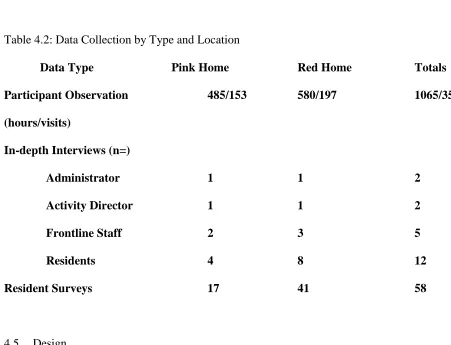
In addition to participant observation and informal interviews, the team conducted
for-mal, in-depth interviews with administrators (N=8), activity staff (N=9), formal caregiving staff
(N=24), and residents (N=251). Formal interviews were conducted at different time points
dur-ing the study. Formal in-depth interviews with administrators were conducted within the first
month of the study, lasting an average of an hour and a half. Interviews with administrators
sought to understand several components of resident’ relationships including: information about
policies and procedures related to residents’ relationships, knowledge about residents’
relation-ships, understanding of factors influencing resident relationrelation-ships, and attitudes about the
im-portance of resident relationships. In-depth interviews with activity staff also probed their
under-standing of relationships and the influence of facility programs on resident relationships. In
addi-tion, in-depth interviews with frontline staff sought to understand their awareness and level of
attitude toward to resident relationships. They were encouraged to reflect on their knowledge of
residents’ relationships and their thoughts on the factors influencing such relationships. These
interviews occurred after the team had developed rapport with staff, generally three months into
the study. The final category of in-depth interviews involved cognitively intact residents who had