Munich Personal RePEc Archive
Thresholds in institutional spaces
Pyastolov, S.M.
National Research University Higher School of Economics
2010
Online at
https://mpra.ub.uni-muenchen.de/43854/
Sergey Pyastolov,
professor of economics, Moscow Region State University [email protected]
Thresholds in institutional spaces
Threshold effects in behavioral patterns as well as in the public domain seem to be special among peculiar phenomena concentrated in a rather short time period in Russia (e.g. Russian labor market paradoxes). Examples of such changes are chosen among peculiar phenomena concentrated in a rather short time period in Russia (e.g. Russian labor market paradoxes, inertia of the power property system etc.). The observed cases give a possibility to check the validity of the proposed Helical Institutional Development Scheme (HIDS). The paper shows that the HIDS might be regarded not only as a sketch of a decision making model and a pattern for an institutional space. It may show the direction in which the evolutionary theory is developing: from the analysis of situations with the stable certainty (complete and perfect information) to the “stable” uncertainty and then to “unstable uncertainty” cases where peoples’ preferences and beliefs are changing. Within the frameworks of HIDS the paper offers an explanation for the quantum structures in Russian institutional matrixes.
Keywords:Individual Labor Supply Curves, Institutional matrix, Threshold Effects, Institutional Space
Introduction
While one is considering a problem of a development of institutions it is supposed that
there exists a certain (progressive or not) direction in a certain (institutional) space. This is
especially urgent for a country in transition like Russia for example. Here they declared at the
beginning of 1990-ies that the goal of the social and economic reforms was to create a free
market economy. But actually one can observe a phenomenon which resembles more a power
property system, a bureaucratic state rather than a desired formation: although the achievement
of the goal had been proclaimed in the “Conception 2020”1, Economic Freedom, Corruption Perception and other indices measured by international organizations demonstrate that Russian
institutional parameters are quite far from genuine market economy conditions.
Attempts to introduce liberal institutions and institutes into the Russian context failed
quite too often. Such effects were already described by G.Myrdal as “Asian Drama” for other
countries (Myrdal, 1968) and rediscovered in Russia and in some other post - soviet countries.
Actually the reformers have not got enough political, administrative and economic power to
implement a new “Great Transformation” in Russia as it happened in Great Britain a couple of
centuries before (Polanyi, 1944).
1
Following Polanyi’s trend of thought the author also claims that the main part of the
“Great Transformations” takes place in people’s minds which is revealed in behavioral patterns
and mentality changes. So in the quest for an institutional space design we cannot define
institutes simply as social forms (norms, rules, conventions) that enable or constrain human
action by setting incentives, providing orientation, or settling frameworks for certain activities.
Other research domains lye close to decision making and institutional development
theories, the economics of knowledge and knowledge management. The scholars whose
contribution should be praised here are H.Simon (for the studies of informal layer of specific
organizational culture among others), K.Arrow (for the studies of correlation between
information and knowledge), M.Polanyi (for the tacit knowledge concept development) P.David,
R.Cowan, D.Foray (for their version of knowledge topography) and others.
Concerning the transformation phenomena description we are mostly interested in the
construction of an institutional space where knowledge is generated, accumulated and multiplied.
After D.North (North, 1990) we regard institutes as carries of historical experience, i.e.
knowledge of a community, organization, or people. Thus the epistemological and ontological
coordinates might be found rather helpful for an institutional space mapping.
Institutional space mapping
It is worth noting that one needs a combined complex method to describe complicated
phenomena which depend on quite a few economic, social, historic and cultural factors. Thus the
research field lies on intersections of various traditional scientific domains and findings are
usually strictly questioned by representatives of sometimes alternative schools. As R. Scott
noted: “an astonishing variety of approaches and sometime conflicting assumptions limits
scholarly discourse” (Scott, 2004).
It is actually not so a simple task to represent a methodology for an institutional change
phenomenon description because quite a few concepts from different domains ought to be put
together. Still we suggest that the Helical Institutional Development Scheme (HIDS - Pyastolov,
2007b) might be helpful for this purpose.
The first basic assumption for the HIDS’s construction is that although a man is uncertain
about the exact utility value of a good to be consumed he is nonetheless aware of the good’s
level in his personal hierarchy (in Maslow’s sense). To adjust the Goods Hierarchy Levels to
Weberian ideal types of human behavior2 we limit its number by four. So we distinguish: S (zero level) that corresponds to survival (the implicit need of any living creature); LLG – low level
2
goods; MLG – middle level goods; HLG – higher level goods. Thus the Goods may be regarded
as parameters of order in the multidimensional space of human choices and actions.
The second basic assumption is that the consumption of a Good takes time and a certain
amount of energy-information (EI) (in the simplest cases the energy-information concept is
replaced by that of money). And the higher is the level of a Good the more EI is needed to
consume it. Obviously an ordinary man needs more Goods of lower levels than of higher ones.
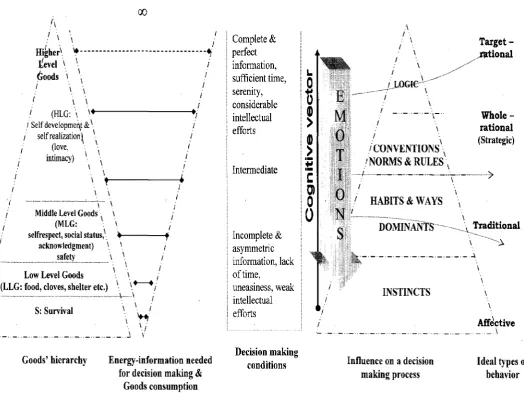
So on fig. 1, where factors affecting human behavior are presented, the triangles of Goods and EI
are placed together. The “pyramid” of Goods is wider at the bottom (the quantity of Goods
needed is more here than in the higher levels) and at this level it corresponds to the narrowest
part of EI angle (it takes the least amount of EI to get and to consume a Good at this level) which
is open at the top.
[fig. 1 is about here]
Further the decision making process conditions are formulated. Complete and perfect
information, sufficient time, serenity, considerable intellectual efforts are needed to make
rational choices, i.e. to behave target-rationally and thus to get the desired HLG. It may be noted
here that a HLG has almost no substitution as a rule, but a LLG generally has (in another case it
must be reconsidered whether it is really a LLG, not a HLG – a might be symbol or fetish).
Then, if the decision making conditions change, the man’s behavior also does so. From
the top on fig. 1 the target – rational behavior turns into whole – rational (strategic), then into
traditional, and affective at last (this classification is a bit different from that of M.Weber: he
took the traditional behavior as the basic type). Psychologists, sociologists and economists name
the factors that influence a decision making process. Phenomenological characteristics of a man
who makes decisions under those factors influence can be lined up from the bottom to the top of
the scheme on fig.1. (along with the cognitive vector) as follows:
Bioid – a man whose actions are influenced by instincts, emotions and dominants of the
lowest level (affective behavior type);
Executor – a man whose activity is subordinated to routines, habits, is economically or
technologically determined;
Social man – a man whose characteristics correspond to the description of SRSM, OSAM or
RREEMM models3;
3
Intellectual man – a man whose characteristics correspond to the description of the REMM
model.
Note that emotions are included in the set of factors that affect human behavior because
they as a psychological reaction of a man in a decision making process strengthen the influence
of lower level factors (Brams, 1997).
Then in order to create a basis for a dynamic institutional model we should formulate the
third basic assumption which is actually composed of a set of ones:
1. A Need of a certain level may be actualized only if the Good of this level exists
(as an individual mental representation).
2. The Man’s choice whether to consume this Good or not and his behavior are
affected by factors of the level corresponding to the Good. A decision about the
Good’s consumption is made as a result of the analysis to what extent the personal
rules coincide with public institutes. The decision will be positive, if needs and
personal rules of the subject …
(a) do not contradict informal institutes («everybody does so»),
(b) do not contradict formal institutes («the law does not forbid this»),
(c) will ensure such performance of the decision, that the results will benefit to the
subject and will not do much harm to other people,
(d) will ensure such performance of the decision, that the results will bring harm to
other people and advantage (benefit) to the subject, but the subject decides to use
«the right of force».
The conditions (а), (b) define conformity (or submission) of personal rules to
«strong» institutes, condition (c) - to «weak» institutes. The presence of a Written
Rule by itself does not provide stimulus for acceptance of the decision.
3. As a rule, the subject does not spend more EI on process of acceptance of the
decision about consumption of the Good, than it is required for its consumption.
4. There is a positive dependence between quantity and «rigidity» of institutes and
quantity of objects (Goods) of the appropriate level.
5. A Man estimates the utility of an institute for himself depending on to what extent
it is useful to him in consumption of appropriate Goods.
While speaking about a decision making process one cannot help mentioning the
contradiction between the formal coordination ethics and the normative ethics of values. This
problem known also as the contradiction between the business ethics and Kant’s ethical
Goods). The Goods in this case can be regarded as parameters of order that influence the
processes of coordination in transition from one EI level to another. The idea is not actually new
(W. Jevons, K. Menger and other scholars ought to be praised for their contributions). But one
cannot yet formally describe the coordination mechanism when values and beliefs are changing.
This takes place in transitive economies or when we are considering educational phenomena.
Actually one seeks answers to the following questions:
A. At what moment and under what conditions beliefs of certain individuals become
public value?
B. At what stage of a decision making process the coordination of actions of the subject
with the requirements of the convention happens?
C. What are the conditions under which such informal mechanisms of coordination are
most likely to emerge and be maintained?4
D. How such mechanism is changing and whether it is possible to foster its
development by legal means?
With the help of assumptions formulated above we can create a new scheme that will
allow us to evidently express changes of individual values, preferences and beliefs and also how
a mutual influence each of these factors and public institutes (formal and informal) is realized.
And thus to find the desired answers. We can see three groups of incorporated objects on the
figure 2:
[fig. 2 is about here]
Group A: The hierarchical structure of the Goods which consumption satisfies people’s
wants;
Group B: The types of human behavior models which may be useful under different
conditions (i.e. various degrees of uncertainty);
Group C: The types of Social Institutes which regulate the human behavior under various
degrees of uncertainty.
The types of coercion, which also are shown on the scheme, do not form a separate group
of elements but show the ways the institutes format different kinds of human activity. The same
remark refers to the types of motivation5.
There are also several dimensions shown on the scheme. First of all the space on fig.2 is
divided in two domains: that of Individuality (where the individual’s thought activity is shown)
4
The initial formula of the questions A-C can be found in (Khight, 1998).
5
and the Social domain (where one can see the factors which affects the relations between the
individual and the society).
The area of the “Ideal World” and the areas of the “Material world” and the “World of
Objects” are designated also. These are the worlds constructed according to Plato’s
interpretation: The Idea and The Matter. The breakthrough of the “Ideal World” amidst (in
boundary area) the “Material world” and the “World of Objects” deserves a special comment. It
might be considered illogic especially if one would approach the consumption of HLG. But we
will not find any contradiction if we consider for example some religious doctrines. Thus the
creation of The “Kingdom of God on Earth” in Christianity means in fact the total reorganization
of human activity, the Buddhism teaches how to overcome the physical human nature for the
sake of the Enlightenment and so on. And the secular ethics would highly appreciate man’s
spiritual achievements only if they do not contradict social norms. And moreover if a man would
seek some spiritual enjoyments outside social ethics and if he would not even do any harm to
other people (e.g. taking drugs for himself) it will not be considered a Good neither for the man
nor for the society.
Numbers (in circles) on fig.2 correspond to the stages of the representations, norms, rules
and institutions emergence and maintenance process:
1 – First stage: a Want is being actualized. Note: the multitude of Wants that can
be actualized is determined by the multitude of norms and rules of the
corresponding level that the individual posses. An object can not be a motivation
by itself6.
2 – Second stage: the target function determination (the decision about the means
and the ways of meeting one own Wants is being made; the Goods, that are to be
consumed to meet the Want are estimated ex ante)7. This forms the answer to the question B.
3 – Third stage: actions are being undertaken in order to get and to consume the
Goods8.
6
It is important to note, that individual’s believes, norm and the rules determine a set of needs of the appropriate level, which can be actualized. The decisions cannot be imposed to the individual from the outside, even if they “are rational”.
7
The personification of a thing occurs at this moment as well as the materialization of an image of the subject. The matter has been thoroughly studied in traditional Marxist philosophy which actually pays much attention to the categories of “Thing”, “Object”, “Vergegenständlihung”, “Versachlihung” (reification), “Entäuserung” and “Entfremdung” (alienation). But this very stage of a decision making was somewhat omitted in description of the corresponding processes or mixed with reification. In the classical economic theory they did not take it into account either.
8
4 – Forth stage: the utility of the consumed Goods is estimated (ex post)9.
5 – Fifth stage. At the given stage the individual estimates the marginal utility of a
subject (object of the convention), taking into account the EI volume which he
receives as a result of consumption of the appropriate Good, or loses, if it is – a
negative Good (antigood). As a result of the process of the Good’s
“dematerialization” the preferences and beliefs of the man are formed and
developed:
5a – If the utility is negative – the man has not got the desired Good and/or has
been punished (has got an Anti-Good), the individual rule or norm which has had
been in the basis of the Need actualization and the decision making is being
deactivated and is going to the subconscious level (but it never completely
disappears);
5b – If the utility is positive the individual rule or norm is being secured in the
Subjectus normative individual structure. The rule becomes fixed in the active
normative matrix for the long run if the Subjectus gets enough experience of
receiving Goods as a result of following the rule or norm.
One can recognize the Hegelian triad elements at every stage of a decision making in the scheme
on fig.2. Hence the formation and development of individual values and beliefs processes may
be regarded as rational, i.e. the subject of such sciences as New Institutional Economics (NIE).
So microeconomic concepts and algorithms such as Bayesian or others from the Game theory
can be used to describe the processes. A helical movement can be recognized in sequence of
stages on fig.2 which might be described as the pivot mechanism (Kreps, Wilson, 1982) or
according to the author’s interpretation the Helical Institutions Development scheme (HID).
The spiral is twisting inwards if the development of representations, beliefs and institutes follows
the way5a, the quantity of conventional objects appropriate to HLG decreases, the institutional
subjects ”. “The relations between the people take the form of the relations between things”, this phenomenon is frequently called as “fetishism of the subject forms” in Marxists’ theories. They also used to consider a non-material form of such reification; however a philosophical judgment of ХХ century science achievements, the idea of the material essence of energy and space-time first of all, forces one to consider the reification as a uniform process.
9
field is narrowed. The quantity of objects of the civil and the market conventions is reduced, first
of all. And as a result the share of shadow economy sector grows.
The reduction of quantity of legal institutes that ensure access to the Goods of the higher levels,
results in reduction of density of distribution of personal beliefs at the same levels10. The sociological researches show a decrease in the generalized parameter of trust in a society that
means above all - trust to the government and to legal norms (Pyastolov, 2005; Pyastolov,
2007a). Consequently it results in a reduction of a legal transactions quantity and in a decrease of
the total number of legal and illegal ones as well.
The spiral is untwisting outwards, if the development of representations, beliefs and institutes
follow the way 5b. It means that the personal beliefs and values with a greater probability
become parts of public institutes (See question A). And it is a self supported process: the
strengthening of public institutes opens access to the Goods of higher levels. As transactions
result in consumption of a HLG they form and strengthen the appropriate personal preferences
and beliefs11. Moreover the growing level of trust in a society (community) increases probability of positive synergy effects. This must be the most probable answer to the question D.
Let's note also some other properties of HIDS:
i. The movement from one group of elements to another in the HIDS format is
carried out clockwise only. Thus, for example, the preferences (beliefs) of an individual
cannot be generated under influence of the right of force, informal or formal social
norms, and even of logic. However preferences can appear as a result of experience under
influence of various kinds of stimulus as an opportunity to receive the appropriate Good
(or AntiGood), and also can be inherited from the parents or the society (community) (as
a result of education). Consequently the ex post mechanism of coordination dominates
during the formation of new institutes process (import and - or legalization) because the
appropriate qualities of the human capital are not yet generated.
The following formulation of this property is known in NIE: it is possible to consider any
institution both as a means and as a consequence of the formation of expectations and
preferences; the institution creates its own stability by forming expectations and preferences.
ii. The elements of two neighboring groups only can cooperate in the decision
making process in a transition from one stage to another. So, for example, presence of
any of the possible Goods (the presence of the information about an opportunity of
reception of the Goods) can not by itself cause occurrence of effective public institutes,
10
The idea proposed by such NIE scholars as R. Posner, S. Goldman S., S. Norton etc.
11
excluding the phase of appropriate individual preferences and beliefs appearances and,
then the occurrence of public conventions.
Consequently the coordination of individual actions can be carried out on the basis of common
expectations, beliefs and values (mechanism of coordination ex ante) only in developed societies
(communities) with established institutes.
My suggestion is that according to the helical representation polar coordination system
will be more convenient. Hence in interpreting the HIDS on fig.2 one can determine a cognitive
vector starting from point 1 to the sector B direction. The characteristics of this vector can be
taken from the description made by D.Kahneman (Kahneman, 2003) similar description was
partly made in this paper when fig. 1 was presented. Another dimension of the space under
construction is phenomenological which is unwrapping along the angle of the polar coordinate.
It is essential to note that the direction of the cognitive vector corresponds to the direction
of the EI growth in individuality domain and one can interpret the corresponding levels in the
social domain as those of synergy. In learning by study when explicit knowledge is being formed
a learning individual uses logic and his behaviour is close to target-rational. On lower EI levels
knowledge of experience12 is being formed.
The predetermined place for information technologies is in the social domain and they are
placed on higher synergy levels because logic implicit in algorithms is used to code and decode
the information.
But one should also have in mind that since information transfer needs symbols an
imaginary thinking is engaged in this process. This is especially true when it concerns
hieroglyphs. It is difficult to say that knowledge is “encoded” (verbally expressed) in this case; it
is more likely to have been pictured and presented as a set of images.
Thus the border between the knowledge transfer by information technologies and the
learning by penetration of images (in implicit form, not verbally) is rather provisional. The role
of an organization in connection to the matters discussed consists of creating new knowledge as
a result of implicit and explicit types of knowledge interpenetration. This new knowledge might
be expressed in new product or service characteristics, new information or new human capital
qualities. Hence an organization can be determined as a social and economic coordination
system which mission is to create conditions for interaction and interpenetration of different
knowledge types in order to achieve socially significant goals and to create a new knowledge in
particular.
12
Then as a development of M. Granovetter (Granovetter, 1985) and A.Lam’s (Lam, 2004)
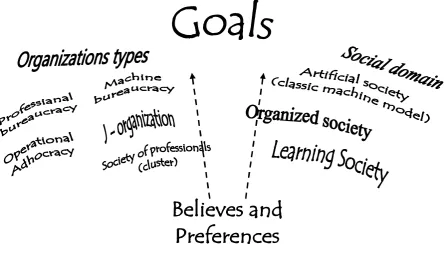
theses about social embeddedness of firm’s internal knowledge HIDS offers an explanation of
the dynamics of organizational types in interaction with knowledge based society structures (fig.
3).
[ fig. 3 is about here]
The K.Polanyi concept of transformation (Polanyi, 1947) presumes that changes in social
and economic structures in order to be successful must be followed by the changes in peoples’
minds13. Hence new institutes importers besides other goals ought to solve a problem of reshoeing of the “human material”. World history offers quite a few examples of particular goals
of such kind and of methods used. The hammer as a symbol on State Emblems of Austria, Soviet
Union, China etc. serves this particular purpose.
The reshoeing of “human material” means education and training above all. HIDS
explains these processes in a form of phenomenological educational spiral: [Want] à (1)
[Motive] à [Need] à (2) [Image of the Object (to be consumed)] à [Object] à (3) [The Idea
of the Good] à [Energy – Information]à (4) [Consumption of the Good]à (5) [New Motive:
5b – strengthening; 5a - weakening]à … (numbers in brackets signify the stages of the decision
making process on fig. 2).
Findings in the field of behavioral patterns
The effects of interaction between society’s institutional structures and households
economic strategies were discovered in our survey (Pyastolov, 2005, 2007a). The project
“Individual Labor Supply Parameters Survey” is being undertaken by the author and his
colleagues during the recent years since 2002. The project's objective initially was to determine
typical individual strategies of workers on local labor markets in various Russian regions, the
influence of values and norms distributions and other parameters on the revealed strategies. The
initial assumption included a thesis that workers strategies may be revealed with the help of the
individual labor supply (ILS) schedules, which were later classified.
We had taken ILS curves forms as a proxy for workers’ strategies, also seeking the
approval in other parameters. The classification for “primary” and “secondary” workers of the
“poor” households (households at the subsistence level), borrowed from M. Dessing (2002), had
been developed be the types of “artists”, “institutional” workers from “reach” households besides
13
“classic” workers from the book. The dummies for regions and professions as well as
“institutional numbers” (Utility, Interpretative Rationality, Empathy and Trust’s Indicators) were
successfully used in order to improve the regression quality.
Some of Institutional Norms’ indicators turned out to be valid regression independent
target variables for the ILSF shape as well as for the wage function. Moreover the correlation
between target variables and norms’ values in some age strata were revealed to be even stronger
than between target variables and traditionally measured educational parameters: years of
schooling, ages, work experience etc.
It was found out that the probability for a certain ILS curve type, which had been
considered a correlation for a strategy on a labor market, depended on regional labor market
conditions, ages, years of schooling and on norms as well. It was revealed that threshold effects
noted as changes in the market strategies (= shifts to a different ILS curve type), take place
because workers behavioral patterns are framed by certain types of conventions. So behavioral
patterns tend to change when a convention, that a worker positions him(her)self in, is changing.
The degree of such effects probability increases when households are forced by external factors
to review their economic strategies.
The results in the most parts prove the preliminary conclusions about the behavioral
patterns of different types of the workers. Thus the log of the working hours (lnH) turns out to be
the only valid variable for the “secondary” workers of the “poor” households. The negative
influences of the same variable and also of the working week’s length and the regional and
profession’s dummies should be noted, while regarding the results for the “primary” workers of
the “poor”.
Besides other facts we have found that the direction of strategies development (from a
destructive to innovative) correlated with the direction of depersonified trust vector development
but not with the utilitarianism one (yet the later norm serves as in indicator of the probability of a
household’s strategy change).
Among other results we can also name no significant correlation between years of
schooling (EdT), professional learning (EdS) and the ILS elasticities (Elasticity) at different
levels of russian labor market choices. Although correlations between some of the Institutional
Values and the target function are marked by significant values of t-statistics. The influence of
EdT on labor market choices (on ILS curves types) is found insignificant. Only special education
(EdS), which is desired to correct the shortages of general education and to improve it,
Some of our findings presented on fig.4 and fig.5 besides other results demonstrate that
changes in strategic choices are caused by or at least correlated with changes in individual
institutional matrixes. Thus workers from “richer” households demonstrate higher degrees of
Trust for higher strategy levels, but the revealed correlation between Trust and household
income (HHIncom) is negative for lower strategy levels.
[ fig. 4 and 5 are about here]
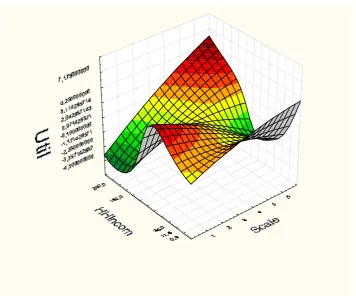
The same kind of interdependence has been revealed for other norms (e.g. fig. 6 shows
Interdependence between Utilitarianism values, household incomes and ILS curve types). These
interdependences differ in details but similar in common features for other norms.
[ fig. 6 is about here]
One can also observe that the trend of households’ strategies development, as long as we
distinguish it from the destructive, conservative, constructive strategies to innovative ones, does
not coincide with the development vector of the Utility indicator, although it correlates with the
trend of depersonalized Trust development.
Possible switches from one strategy to another presumably a better one often seem to be
hindered by certain types of thresholds: expectations and believes that frame workers’ decisions.
The number and the qualitative characteristics of those thresholds (to be more exact – of those
that the worker takes into account) are generally determined by the market activity experience.
So one may expect that that a higher level of economic education would help a worker to
overcome those thresholds or even ignore them.
Thresholds in the public domain
These findings and arguments suggest that innovations more often take place at the lower
levels of rationality if the latter would be connected with utilitarianism. Obviously one observes
more utilitarianism in bureaucratic organizations than in those of operational adhocracy or
J-organisations (the least amount of utilitarianism can be seen in Russian clusters). Thus a
paradoxical feature is revealed: the more is the organization level in a society the less is its
ability to generate, accumulate and propagate tacit knowledge.
Hence while internal colonization of a new convention is taking place knowledge is
generated and accumulated. Then as the space the knowledge can occupy is filled up
organizational forms are to be changed in quantity as well as in quality.
Under the transformation (it means a change of public conventions first of all) the
for clusters as well. But furthermore the system would follow the law of the entropy growth if
the economic behaviour patterns would not be regulated by common norms (ideas).
Some experts diagnosed Russian people’s state of conscience from the midst of 1990-es
and up to nowadays asschizophrenia: the split mind. Actually on the one hand the possibility to
gain profit and to have a rich consumer choice attracts people but on the other hand they do not
wish to part with state guaranteed income equal distribution, economic and social security etc.
The experience of the latest decades prove that a society can not reach a free market
convention from the point where Russian economy was situated in an institutional space before
the reforms of 1990-es (it can be actually described as a symbiosis of a command economy and a
power-property system) directly (by a leap = shock therapy) (fig. 7). The HIDS can interpret
such an attempt as an effort to move counter-clockwise: from a market institutions import to a
creation of new preferences and believe, i.e. representations, in people’s minds.
[fig. 7 is about here]
The duality of Russian institutional system, the two phase nature of the management
cycle (Pyastolov, 2008) caused the choice of a clanship organizational type during the short
period of stability characterized first of all as a seeming absence of external military and political
threat. The prevalence of kinships and clanship organizations in Russian economy
preconditioned the inward helical movement in the institutional space so that the trajectory
almost reached the subsistence core (see fig. 2). The sociologists reported that level of trust
among the Russian population fell as low as 34% and film producers would name this time as a
“glacial epoch”.
The mortal threat (that meant in particular increasing mortal rates for the people and the
death of the Russian Federation by scattering of its regions for the government) made Russian
people accept the switch to the bureaucracy management mechanism undertaken by president
Putin’s team.
This development trend might signify that the national organization is again trapped in
the “Instability” – “Stability” (or “Threat” – “No Threat”) dilemma. Will there be other steps
further out of this trap towards a market convention?
The HIDS suggests that there may be not so many alternatives: one way is through the
learning society model to an organized society (the history of China’s transformation is regarded
as a good national example in this case) another is the way back to the command system (an
Conclusion
The changing economy cases need a dynamic theoretical approach which is realized in
the form of the proposed Helical Institutional Development Scheme (HIDS) – a specific model
of an institutional space form. The paper shows that the HIDS offers the direction in which the
dynamic institutional and organizational theory is developing: from the analysis of situations
with the stable certainty (complete and perfect information) to the “stable” uncertainty and then
to “unstable uncertainty” cases where peoples’ preferences and beliefs are changing. It also may
explain some of so called quantum effects in human behavior and in a society’s development
occurring during these processes of change14.
As the world economic history demonstrates successful market economies and
organizations tend to choose one phase management cycle models which are actually less loaded
with thresholds. Within the frameworks of HIDS the paper offers an explanation for these
phenomena. Besides other things this also means that an exit from the organizational
development traps of “Instability” – “Stability” types (which turn to be an equivalent to the
“Threat” – “No Threat”) is possible in the form of an organized society under the conditions of
unifying values and expectations generation.
References:
Brams S.J. (1997)Game Theory and Emotions. Rationality and Society, 9, pp. 91-124
Dessing М. (2002) Labor supply, the family and poverty: the S-shaped labor supply
curve/ Journal of Economic Behavior & Organization, Vol. 49, рр. 433–458.
Etzioni A. (1961) A Comparative Analysis of Complex Organizations. New York: The
Free Press.
Granovetter M. Economic action and social structure: The problem of embeddedness.
American Journal of Sociology, 1985, 91 (3): 481-510.
Kahneman D. Maps of Bounded Rationality: Psychology for Behavioral Economics. The
American Economic Review, 2003, v.93, # 5, pp.1449-1474
Knight J. (1998) The Bases of Cooperation: Social Norms and Rule of Law. Journal of
Institutional and Theoretical Economics (JITE), vol.154, p.754-763.
Kreps D., Wilson R.Sequential equilibria. Econometrica, 1982, v.50, pp.863-894.
14
Lam A. Tacit Knowledge, Organizational Learning and Innovation: A Societal
Perspective. DRUID WP# 98-22. 1998.
Linndenberg S. (1985)An Assesment of the New Political Economy: Its Potential for the
Social Sciences and for Sociology in Particular. Sociological Theory. Spring 1985, p.99-113.
Nonaka I. A Dynamic Theory of Organizational Knowledge Creating. Organizational
Science, 1994, 5, pp. 14-37.
Polanyi K. (1947)The Great Transformation. The political and Economic Origins of our
Time. [in Russian]. St. Petersburg, Altheia Publishing House, 2002.
Pyastolov S.M. (2005) Russain Households Labor Supply Peculiarities. Voprosy
Economiky, № 8, pp.124-138 (Пястолов С.М.Особенности предложения труда российских
домохозяйств//Вопросы экономики, № 8, 2005, стр. 124-138).
Pyastolov S. (2007a) Norms as Indicators of Human Capital Investments Effectiveness.
Investment Research and Analysis Journal. Volume 2, N 1, Spring 2007, pp. 25-37.
Pyastolov S.M. (2007b) Prospects of the Theory of Prospects. Voprosy Economiky, №
12, pp. 43-60 (Пястолов С.М. Перспективы теории перспектив // Вопросы экономики, №
12, 2007, c.43-60).
Pyastolov S. (2008) Two phase cycle concept in Russian organizational model. The
Proceedings of the 9th World Congress of International Federation of Scholarly Associations of
Management (IFSAM), July 26-28, 2008, Fudan University, Shanghai, China (CD-ROM).
Scott R.W. (2004) Institutional Theory: Contributing to a Theoretical Research
Program. http://www.si.umich.edu/ICOS/Institutional%20Theory%20Oxford04.pdf. Last
assessed: 23/01/08.
Weber M. Gesammelte Aufsätze zur Soziologie und Sozialpolitik, J. C. B. Mohr,
Fig.2. Illustration of the representations, believes, norms and institutions emergence and
Fig. 3. An explanation of the dynamics of the knowledge based society structures within the HIDS framework.
Utility Trust
Notation:
workers from higher income households;
workers from middle income households;
workers from lower income households.
[image:19.595.102.529.391.580.2]Success St rat egy Prob. Education (Years)
Fig.4. Interdependence between Utility indicator and Probability of successful
strategy realization
Fig.6. Interdependence between Utilitarianism values, household incomes
and ILS curve types.
Fig. 7. Possible ways for a market oriented transformation in Russia.
Clanship Bureaucracy
[image:20.595.135.484.438.588.2]