An Analysis of the Utilization of Asian
Development Bank’s Loans for Books
Procurement: A Case Study of Loan
Provided to Technical Education Project,
NWFP (1996-2004)
Khattak, Sharafatullah and Hussain, Anwar Hussain
Pakistan Instittute of Development Economics Islamabad Pakistan
2009
Online at
https://mpra.ub.uni-muenchen.de/41994/
AN ANALYSIS OF THE UTILIZATION OF ASIAN DEVELOPMENT BANK’S
LOANS FOR BOOKS PROCUREMENT: A CASE STUDY OF LOAN PROVIDED
TO TECHNICAL EDUCATION PROJECT, NWFP (1996-2004)
SHARAFATULLAH KHATTAK* and ANWAR HUSSAIN**
* Government Polytechnic Institute, Nowshera, Pakistan
** Department of Economics, University of Peshawar, Peshawar, Pakistan
ABSTRACT
This study has been conducted in 2007 to show how the loans provided by Asian Development Bank (ADB) are utilized in NWFP. The analysis has been confined to the loan named 1373 PAK(SF) disbursed for books procurement to different technical institutions of the province under Technical Education Project (TEP). As the project was assisted by the ADB from 1996-2004, so for the analysis, secondary data was used. Facts and figures were documented from the official documents of the project and Audit Reports. The study revealed that a total loss to the government ex-chequer was found Rs.5869704.00 in Rs.7956132.00. Net total value of books purchased from the local firm was Rs.6113887.00 instead of Rs.7956132.00. On the average Rs.4027459.00 out of Rs.79883667.00 was spent on Undemanded/non-essential/un-useable books. Offer of 5% donation was not entertained. That is, the firm did not provide books worth Rs.399418.00 to different institutions. Rs.362946.00 as price differences was not taken into account. Total cost of books and income tax were not found in the required ratio. 44.43% of the total cost of books was spent on buying 2.8% of the total number of books from the firm at an average rate of Rs.8312.48 per book. 55.54% of the total cost of books was spent on buying 6.9% of total number of books at an average rate of Rs.4201.27 per book. Deduction of Rs.25462.30 was noted in the supplier record but could not be traced in the relevant provided record. In short, the loans were not properly utilized as should be. Based on findings of the study, it is recommended that Checks should be made on the employees’ selection and performance. Arrangements for availing 5% donation offer on total purchase of books should be made on emergency basis and ways and means should be devised to stop such practices in future. Un-demanded/non-essential/un-usable books should be returned to the supplier. Research and development cells of each department in the province may be given the chance to work under the ministry of Higher Education of Science and Technology. Project managers, officers of the Planning and Development Department, and ADB officers should properly check quarterly progress reports of projects and they should be made responsible for any mishap.
Key words: Analysis, utilization, loans, books procurement, technical education
Citation: Khattak, S. and A. Hussain. 2009. An analysis of the utilization of asian development bank’s loans for books procurement: A case study of loan provided to technical education project, NWFP (1996-2004). Sarhad J. Agric. 25(2): 355-367.
INTRODUCTION
Technical institutions have a prominent role in supporting the building and developing up Scientific and Technological infrastructure in their areas of competence. The importance of technical education in Pakistan was realized in the mid-fifties and as a result two polytechnics, one each in Karachi and Rawalpindi, were established. One such project namely Technical Education Project, NWFP, was also initiated. There are several components of Technical Education Project (TEP), i.e. civil works; provision of workshops’ equipment; establishment of computer labs and provision of furniture for the labs; staff development both local and foreign; establishment of Research and Development Cell; provision of books and introduction of Computer and Electrical Technologies.
The Finance Department of Government of NWFP gave approval of the incurrence of an expenditure amounting to Rs.261.049 million including Rs.144.816 million foreign component out of Rs.2395.146 million (subject to cost reduction of Rs.24.45 million) on 13-03-1996 under the scheme approved by the Executive Committee of the National Economic Council (ECNEC) on 17-12-1995. In the approved revised provincial PC-1 of the project Rs.13.745 million in a total of Rs.307.913 million were earmarked only for the provision of library books/instructional materials to technical institutions. As per one of the progress report of the Provincial Implementation Unit (PIU), Rs.1.021 and Rs.9.950 million were spent on purchase of 14 numbers of textbooks printed under the project and library books respectively for different institutions of the province while Rs1.00 million were given to Board of Technical Education (BTE), NWFP, Peshawar for the purpose (Official documents TEP, 2004).
The ADB used to provide loans for strengthening technical education in NWFP in different time periods. The aid leads to burgeoning of government bureaucracy with increasing interference, inefficiency, lack of accountability, corruption. The aid is more commonly used for consumption than investment, to serve political purposes rather than achieve development. The accountability and evaluation mechanisms for assessing the real impact are weak, and there are weak feedback and improvement systems. Aid is effective only when there is good governance in the country.
The latest loan was provided to Technical Education Project (TEP) in 1996. But unfortunately the loans disbursed were not utilized appropriately. Maladjustments are responsible for it. There is a need to answer the questions like: Are the loan provided far-reaching results as should be? Will the loans should be utilized on the same manner in future? How much red-tapism existed in official statements? Are authentic figures are used in official documents? Is there a need to have checks on the part of policy makers? No attention has been given in past to answer these questions. The researcher should focus on such issues.
Different studies were conducted on the related issue. Jeon and Michael (2005) studied the integration and
utilization of public education resources in remote and homogenous areas, taking the Upper Peninsula of Michigan
as a case study. He also observed the utilization of loans for the same. Boyd (2006) studied the economic benefits of
a traditional college education relativeto a high school degree are well known to students and economistsalike. He
also analyzed the loans disbursed for education system.
In Third World countries corruption is popular every where. In one specific reference to Bangladesh, the Asian Development Bank (ADB) investigated $300 million in defaults on loans which the ADB and two other banks had provided to two nationalized Bangladeshi banks. It found that local businessmen had borrowed cash for projects "without any serious intention of pursuing such projects" (Adams, 1991).
The Asian Development Bank (ADB) and the Comparative Education Research Centre of the University of Hong Kong, highlighted the relationships between education, economic growth, poverty and social change and outlined policies for the development of high quality, equitable, and adequately financed education systems (Adams, 2002).
Chapman (2002) studies the trends and issues in education management and efficiency in developing member countries in the ADB. In terms of higher education, he identified four education management issues that will be especially relevant over the next decade. These include: the development of new/alternative funding streams; students transfer and the transfer of credits across institutions; the formulation and imposition of standards and the implementation of accreditation systems; and the translation of faculty creative talent into income streams for the institution. Recommendations were made for ways in which governments can strengthen the administration of their education systems. The present study is different from all of the above studies in the sense that it will critically evaluate the utilization of funds disbursed by Asian Development Bank for books procurement under Technical Education Project.
also provide as feedbackfor the review and improvement of on-going and future assistance policies, programs and projects.
MATERIALS AND METHODS
The study has been conducted in District Peshawar in the year 2007 to critically analyze the utilization of the specific Loan No. 1373 PK(SF) given to Technical Education Project, NWFP. The loan was disbursed by Asian Development Bank for the purpose of books’ procurement for different technical institutions of NWFP. According to the nature of the objectives, secondary data was used. As the duration of the project was from 1996 to 2004, so all facts and figures have been documented for the given time period. The main sources of data were Project Implementation Unit (PIU), Audit Report, supplier information and information obtained from different institutions of the province for which the books purchased. Appropriate tabulation, classification, averages and percentages have been used for the analysis.
RESULTS AND DISCUSSION
Cost of Total Invoices
[image:4.612.74.542.416.593.2]Total invoices cost of books purchased from a local firm, net value of books and institutes-wise cost of books as calculated by the PIU are compared with the corresponding values computed by R & D Cell. The firm’s reported total value of books Rs.8286278.00 and the PIU and R&D Cell’s calculated total invoices cost Rs.8279269.00 (Table-I) differ by Rs.7009.00. The firm might have added Rs.4331.40- Rs.1443.80 for each PSI01709, PSI01715, and PSI01718 invoice, and Rs.2750.00- less claimed amount for item at serial No. 8 of invoices NOR00644, to the original invoices cost Rs.8279270.00. Thus, by adding Rs.7081.40 to the original invoices cost, total cost of books will stand at Rs.8286350.00. This figure gives Rs.81.00 more than the supplier reported figure. If it is assumed that the firm has taken into account the less claim amount Rs.78.70of item at serial No.11 of invoice NOR681, Table-III, then by adding this figure to our calculated total invoices cost, we will then have Rs.8286273.00 which is less than the firm reported value by only Rs.5.00. Thus, it can be concluded that the total invoices value of books as computed by R & D cell matches with the supplier reported value. In the proceeding sections, Rs.8279269.00 will be taken as standard total original invoices cost of books.
Table I. Total invoices cost and Institute-wise cost of books purchased from a local firm
S. No
Description Org. Inv. (3)
PIU (4)
R & D (5)
Diff. (3 & 4)
Diff. (3 & 5)
Diff. (4 & 5) 1 GCT 1944550 1804625.78 1810138.99 139924.4 134411.2 5515.04 2 GPI (W) 1079025.1 1064983.74 1064983.5 14041.34 14041.58 0.0 3 GPI ATD 364450.96 358492.57 358493.05 5957.91 5957.91 0 4 GPI BNU 365019.92 359287.07 359286.69 5733.0 5733.0 0 5 GPI DIK 367982.4 364462.84 364464.0 3519.56 3519.18 0 6 GPI HRP 369118.4 3576631.58 357632.0 11486.82 11486.36 0 7 GPI KT 352158.4 347637.54 347638.25 4520.86 4520.15 0 8 GPI MNS 196143.0 197395.28 197395.05 -1252.28 -1252.05 0 9 GPI NSR 882787.27 873664.64 873616.41 6122.63 9170.86 -49.02 10 GPI SWB 884698.02 874944.69 874944.69 975333.0 9783.04 0 11 GPI SWT 919712.34 900562.91 904546.95 19149.43 15165.39 3983.95 12 GPI DIR 428469.94 350072.56 350073.58 78397.38 78396.36 0 13 GTTTC 125153.25 125153.0 125153.0 0 0 0
Total 8279269.16 7978914.55 7988366.96 300354.71 290902.20 9449.97
Source: Official Documents, Project Implementation Unit (PIU), TEP, NWFP.
Total amount of books calculated by the PIU can only be justified if it equals: to the amount obtained from the original invoices cost minus deduction made by the PIU, to the sum of the amount paid/payable to the firm and income tax as per PIU record, to the amount paid/payable to the firm divided by 0.965, or to the amount paid/payable to income tax department divided by 0.035. In the following, each step will be further elaborated.
deduction of Rs.1650.0 from the firm, the figure can be termed as unrealistic. Total deducted amount from the firm in the PIU record was found as Rs.300355.00 against the R & D Cell calculated amount of Rs.290902. The two amounts differ by Rs.22783.00 (Rs.7978915 - Rs.7956132). This makes the two (PIU) calculated amounts as dubious and none of these can be treated as correct. The supplier reported net cost of books along with the deduction made by the PIU is shown in Table-II. Amount of Rs.25462.00 was shown as price differences in the supplier documents. This amount was not traceable in the relevant provided files. Total cost of books determined from the amount paid/payable to the firm is Rs.7935694.00 = (Rs.7438867+ Rs.227023-227023.00*3.5/100)*0.965. This amount is less than the total amount paid/payable to the firm and income tax department (Rs.7438867.00+Rs.227023+Rs.290241.00 = Rs.7956131.00) by Rs.20437.00. This difference again makes the PIU calculated net amount of books as unreliable.
Total cost of books calculated from income tax paid stands at Rs.8292600.00 (Rs.290241/0.035). This figure also cannot be treated as trustworthy because it exceeds by Rs.327468.00 (Rs.8292600.00-7956132.00.0) from the total shown paid amount.
Table II. Difference between the PIU and the firm reported total net value of books
S. No Description Amount as Reported by Difference Supplier PIU 7008.84
2 Short Supply 97987.00 97987.00 0.00
3 Price Differences 232160.00 206698.00 25462.00
4 Paid amount to Firm 7438867.00 7438867.00 0.00 5 Income Tax Deducted 290241.00 290241.00 0.00
6 Balance 227023.00 227023.00 0.00
Sum of serial 2-6 8286278.0 8260815.0 25462.0
Source: official documents, Project Implementation Unit (PIU), TEP, NWFP.
Note: Price differences at serial No.3 were reported by the firm but were difficult to trace these in the
relevant provided files.
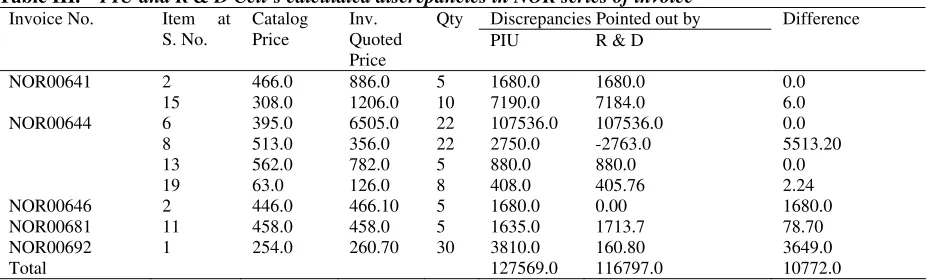
Discrepancies pointed out by the PIU in the catalog prices and those mentioned in the invoices have been compared with the corresponding values calculated by the R & D Cell and are shown in Table-III. Quoted price of item at serial No.8 of NOR00644 invoice was Rs.356.0 against the catalog price Rs.513.0. In other words invoice quoted price was less than the catalog price and the difference obtained could be added to the firm claimed amount rather than subtraction. The negative sign in column-7 of the table indicates amount less charged in the invoice by the firm.
[image:5.612.77.544.250.364.2]Further, twenty-five copies of a book “Time Saver Standard for Landscape Architecture (with CD)” was purchased by spending Rs.273732.00 (after discount rate of 20%) at the rate of Rs.13686.58 per copy. These copies were purchased in covers. The institute, according to the audit report (2003-04), was provided only with CD and not the book. On subtracting this amount from Rs.7988367.00, one will get total value of books as Rs.7714635.00. Other books reported as short by one of the institute were not taken into account.
Table III. PIU and R & D Cell’s calculated discrepancies in NOR series of invoice
Discrepancies Pointed out by Invoice No. Item at
S. No.
Catalog Price
Inv. Quoted Price
Qty
PIU R & D
Difference
2 466.0 886.0 5 1680.0 1680.0 0.0 NOR00641
15 308.0 1206.0 10 7190.0 7184.0 6.0 6 395.0 6505.0 22 107536.0 107536.0 0.0 8 513.0 356.0 22 2750.0 -2763.0 5513.20 13 562.0 782.0 5 880.0 880.0 0.0 NOR00644
19 63.0 126.0 8 408.0 405.76 2.24 NOR00646 2 446.0 466.10 5 1680.0 0.00 1680.0 NOR00681 11 458.0 458.0 5 1635.0 1713.7 78.70 NOR00692 1 254.0 260.70 30 3810.0 160.80 3649.0 Total 127569.0 116797.0 10772.0
[image:5.612.73.537.568.708.2]Price Differences
As far as price discrepancies are concerned it was found that seven copies of the Grammar 2nd edition were
procured to five institutions at a cost of Rs.519.22 per copy while ten copies of book were supplied to seven institutions at Rs.873.38. Likewise Harrep’s Combined Science Min, Dampness in Building and Estimating and Tendering for Construction were supplied to some institutes at Rs.545.46, Rs.2410.11 and Rs.2754.51 per copy successively while other institutes received their books at Rs.155.00, Rs.1966.49 and Rs.2513.04 respectively. For calculating such discrepancies, as said earlier, a consolidated institutes-wise lists of all the books were prepared. Books in these lists were arranged alphabetically in order to find out the number of books having the same titles but different prices. Price differences were only computed for books purchased from the local firm. The number of different titles of books for which price differences were considered are thirty-nine. The price differences for these thirty-nine different titles of books were calculated as Rs.362946.00 (Official Documents TEP, 2004). This difference was found in addition to the price differences taken into account by the PIU. The price discrepancies need thorough checking and comparison of prices mentioned in the invoices with those given in the catalog and printed prices and foreign invoices. It will be wise here to suggest that for all imported books, foreign invoices rates should need to be checked, as the supplier invoices are dubious. As there was no mention of authors of books and of actual currencies in the invoices, therefore, attention in price differences computation was focused on titles of books only.
In principle, the firm was bound to write name of author(s) against each title of book in the invoices. Another firm that supplied 568 number of books, worth Rs.143713.00 (inclusive of income tax) to the college of technology, followed the requisite rules. Thus, on subtracting Rs. 362946.00, total value of books purchased from the firm will fall to Rs.7351689.00. Errors may exist because of books having the same titles but different authors. Physical checking of such books, due to monitory and other constraints, was not made (Official documents TEP, 2004). Discount rate differences for books purchased from the National Book Foundation were also observed. Some institutes were provided with books on different discount rates. Examples of such books are: Electronic devices and Circuits (ELT-214), Computer Applications (Comp-122), Principles of Electrical Engineering ET-115, Workshop Practices-I (MT-116) etc. Further, low quality paper being used, does raise the question of durability of these books. In the preparation of TLR materials copy and past method was adopted and efforts towards simplification of contents of books printed through PIU/BTE seem dim (Official documents TEP, 2004).
Five Percent Donation on Total Purchase
The firm purchased books from a leading books seller of the country at 30% discount and was sold to the PIU at 20%. It means that opportunity of open competition to leading booksellers of the country was not provided. By doing so it (PIU) could save Rs.795613.20. From the highlights of procurement process it can be concluded that the firm did not fulfill the offer of 5% donation on total purchase to the organization. Cost of 5% donation on Rs.7988367.00 stands Rs.399418.00. Since the amount of 5% donation on total purchase lies outstanding against the local firm, therefore, it would be wise enough to subtract this amount from the net amount of books determined in the preceding section. This will reduce total value of books to Rs.6952271.00 (Official documents TEP, 2004).
Foreign Currencies Conversion Rates
Majority of the books purchased from the local firm were imported books were priced in US dollars, British pounds and Indian rupees. For imported books, the supplier was supposed to provide up to 20% of foreign publishers invoices (Audit Report 2003-2004) but these were not available in the said files. The supplier as a rule was bound to mention actual prices of imported books in foreign as well as Pak. rupees in the bills. The procedure for all the imported books was not followed. Invoices Nos. NOR000663 and NOR000659 are examples of violation of the procedure. Prices of imported books given in foreign currencies were converted to Pak rupees at exchange rates higher than the rates of the State Bank of Pakistan - conversion factor 68.88 was taken instead of 58.50 per US dollar, which is presumably against the written commitment of the firm with the PIU office. The firm made calculation of currencies conversion complicated by showing different prices in different currencies for books having the same titles and the same authors. For instance, the prices of a book “ Dampness in Building” in invoices PSI001712 and PSI001901 at serial Nos. 33 and 1 have been shown as US $34.99 and British pounds 17.99 respectively (Official documents TEP, 2004).
GPI (W) is concerned, the prices of books in dollars were taken from the list of books provided by the institute. Total quantities of such books were taken from the consolidated list of books procured to different institutions. This resulted in over payment of Rs.669408.00 to the firm. Audit report for the year 2003-2004 shows overpayment made to the firm for books purchased in dollar as Rs.838384.00. According to the auditor, he has counted all books purchased in dollar therefore it will be wise to deduct his calculated dollar discrepancies from the total net value obtained in the previous section. By doing so, one will be left with net value of books as Rs.6113887.00 (Official documents TEP, 2004).
In the calculation, the prices of imported books which were converted into rupees at higher rates than the State Bank rates without mentioning their prices in actual currencies and the conversion of other currencies i.e. British pound and Indian rupees were not taken into account which will further reduce the total value of the purchased books. In other words, precise over payment made to the supplier due to higher exchange rates than the actual ones cannot be sorted out from the invoices precisely until prices of all the books purchased from the firm are thoroughly physically checked and compared with foreign invoices rates.
In order to avoid unnecessary duplication it was imperative for the purchaser to circulate the approved lists of books to the concerned institutions for comparison/checking with their existing stock of books. Efforts in this connection were not made by the concerned quarter.
Cost of Un-demanded Books
Procedure adopted for the calculation of un-demanded books was that Proforma were developed for demanded and un-demanded books. Efforts were made to circulate these proforma in all technical institutions including GCT and GTTTC. But due to lack of resources and too much dependency of the Cell, the required circulation was not made. Despite these difficulties, data about demanded/un-demanded/non-essential/un-useable books were collected from four institutions. Also purchase of books under technical education project was discussed with three other institutions inclusive of GTTTC.
Cost of un-demanded books purchased for the four institutions was Rs.1805945.00. Total cost of books purchased for these institutions stood at Rs.3582048.00. If Rs.7988367.00 (R&D calculated amount) is taken as total value of books, then total amount spent on un-demanded books will stand at Rs.4027459.00 or 50.41. (Official documents TEP, 2004). Furthermore, it was revealed that the books worth Rs.350073.58 were un-demanded and that the institute was not provided with the shelves to keep the books in. Those books were kept in the library’s attached bathroom because of non-availability of shelves and other proper place in the institute, and termites’ tracks were seen on the nearby walls. It does mean that proper environment for the library in the institutions does not exist. The induction of this amount will further enhance the spending on un-demanded books.
Amount Incurred on Expensive Books
One of the problems of Technical Vocational Education (TVE), mentioned in the national education policy 1998-2010, is that “the imported books, besides being very expensive and posing language problem, do not cover entire course contents, and in most cases more than one book is needed”. Let us see the purchase of books from the local firm in the light of this problem. Rs.143713.00 was paid to the principal of Government College of Technology, Peshawar for the purchase of library books on his own end. He managed to purchase 568 numbers of books on 10 percent discount. Teachers of each department/technology of the college in the process of purchasing books were involved directly. The most costly book, “Construction Management” by David, purchased at price Rs.1396.98 (Rs.1552.2 without 10% discount). By accepting the purchase made by the principal of the college as genuine, the books, the cost of which was more than Rs.1552.20 could be termed as costly and beyond comprehension of the level of students for which the books were purchased. The price of a book also needs to be compared with the number of contents of a book that could be of interest to the students/teachers. This requires further study.
prices more than 1552.20 were placed in a second group while books having prices less than Rs.1552.20 were placed in a third group. The amount spent on books of the first group stands as Rs.3549428.00 while on the second group, inclusive of the first group, it stands at Rs.4436546.00 (Official documents TEP, 2004).
Quantity of books, corresponding cost of books, average price per book, books percentage, and the respective percentage costs are shown in Table-IV.
TableIV Quantity, cost, average cost per book, percentages of total books and cost
S. No Quantity Amount Spent Rs.
Average price/book Rs.
%age of total Books
%age of total Cost
1 427 3549428.00 8312.48 2.8 44.43
2 1056 4436546.00 4201.27 6.9 55.54
3 14190 3551821.00 250.30 93.07 44.46
Source: Official Documents, Project Implementation Unit (PIU), TEP, NWFP.
Prices of 2.8% expensive books vary between Rs.2016.97 and Rs.171856.00.and that of 6.9% lie between Rs.1552.20 and Rs.171856.00. The data of the second and fifth columns for the first two groups are shown graphically in figure-I and that of the last two columns are drawn in figure-2 for further elaboration. The two figures show that 44.43% and 55.54% of total spending were wasted on only 2.8% and 6.9% of total number of books respectively. That is more than half of the total amount of the books were spent on only about one thousand number of books. This gives per book average price as Rs.4201.27 while 2.8% of total books were purchased at an average rate of Rs.8312.48 per book. The corresponding amounts spent on 2.8% and 6.9% of total number of books supplied by the local firm are shown in Fig. 3.
0 1000 2000 3000 4000 5000 6000 7000 8000 9000
1
2
Number of books Avg. price
427
Rs.4201.27 Rs.8312.48
1056
[image:8.612.74.538.151.224.2]C
0 10 20 30 40 50 60
1
2
%age of Books
%age of Total Cost
2.8% 6.9%
44.43%
[image:9.612.124.488.86.275.2]55.54%
Fig. 2. Percentage of costly books against percentage of total cost from the local firm
0 500000 1000000 1500000 2000000 2500000 3000000 3500000 4000000 4500000
2.8%age 6.9%age
Cost (Rs.)
Rs.3549428.00
Rs.4436546.00
Fig.3. Amount spent on 2.8% and 6.9% of books that were purchased
Net Discrepancy
Net discrepancy, setting aside the amount of un-demanded/unessential/unusable and costly books purchased from the firm, can be calculated from the amount shown as paid/payable to the firm and to the income tax office and from the amount calculated by the R & D Cell in the following as:
Amount shown by PIU as paid/payable = Rs.7956132.00
Amount calculated by R & D Cell = Rs.6113887.00
Over Paid Amount to the Firm and I. Tax Office = Rs.1872245.00
Income tax shown as paid/payable = Rs.290241.00
Income Tax calculated by R & D = Rs.213986.00
Over Paid Amount To Income Tax Office = Rs.66255.00
[image:9.612.125.412.329.531.2]ADB-GOP Share Differences
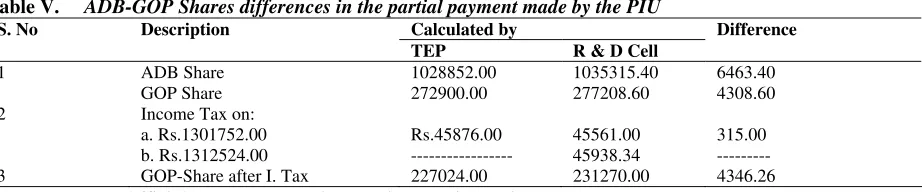
In this section, differences in ADB-GOP shares in partial payment as well as in net amount paid/payable to the firm will be discussed. Let us first compare ADB-GOP shares and income tax that were computed for the partial payment with that calculated by the PIU and see how each quarter had put its share in calculating and checking of payments.
[image:10.612.79.540.207.303.2] [image:10.612.73.539.385.477.2]Income tax at the rate of 3.5% on Rs.1301752.00 was determined as Rs.45876.0 in place of Rs.45561.32. That is grass amount was taken Rs.1310752.00 instead of Rs.1301752.00. But according to R&D cell’s calculation as summarized in Table-V, net payable amount after considering over deducted amount stands at Rs.1312524.00. Differences in GOP and income tax shares are Rs.4346.26 and Rs.377.34 respectively for the partial payment.
Table V. ADB-GOP Shares differences in the partial payment made by the PIU
Calculated by S. No Description
TEP R & D Cell
Difference
1 ADB Share
GOP Share
1028852.00 272900.00
1035315.40 277208.60
6463.40 4308.60 2 Income Tax on:
a. Rs.1301752.00 b. Rs.1312524.00
Rs.45876.00 ---
45561.00 45938.34
315.00 --- 3 GOP-Share after I. Tax 227024.00 231270.00 4346.26
Source: Official Documents, Project Implementation Unit (PIU), TEP, NWFP.
Table-VI shows overall ADB-GOP and income tax differences. There is a loss of Rs.1842245.00 to the government ex-chequer in a total of Rs.7956132.00. Over payments made to the firm from ADB and GOP shares respectively stand as Rs.1105347.00 and Rs.736898.00. It can be seen that Rs.76255.00 were paid in excess to the income tax department only.
Table VI ADB-GOP Share differences in overall payment after corrections
Calculated/paid by S. No Description
TEP (Rs) R & D Cell (Rs)
Difference (Rs)
1 Total cost of books 7956132.00 6113887.00 1842245.00
2 ADB Share
GOP Share
4773679.20 3182453.00
3668332.00 2445555.00
1105347.00 736898.00 3 Income Tax on:
a. Rs.7956132.00 b. Rs.6113887.00
290241.00 ---
278465.00 213986.00
1776.00 76255.00
Source: Official Documents, Project Implementation Unit (PIU), TEP, NWFP.
Table VII Summary of the detected discrepancies
S. No Description PIU
Calculated
R & D Cell Calculated Differences
I (a) Net Amount of books paid/payable 7956132.00 6113887.00 1842245.00
(b) Short books 97987.00 373368.00 275381.00
(c) Price Differences detected 79129.00 442075.00 362946.00
(d) Excess amount charged by the firm 127569 116797.00 10772.00
(e) Income Tax paid/payable 290241 213986.00 76255.00
(f) Higher Dollar Conversion Rates --- 838384.00 ---
(g) 5% donation on Rs.7988367.00 --- 399418.00 --- Amount Spent on Costly and Un-demanded Books
II (a) Amount spent on costly books --- 4436546.00 ---
(b) Amount spent on un-demanded/non-essential/unusable books
--- 4027459.00 ---
III Amount spent on demanded expensive books
--- II (a) – II(b) =
409087.00
---
IV Amount spent on expensive and un-demanded books
--- III – II (b) = II (b) = 4027459.00
---
Source: Official Documents, Project Implementation Unit (PIU), TEP, NWFP.
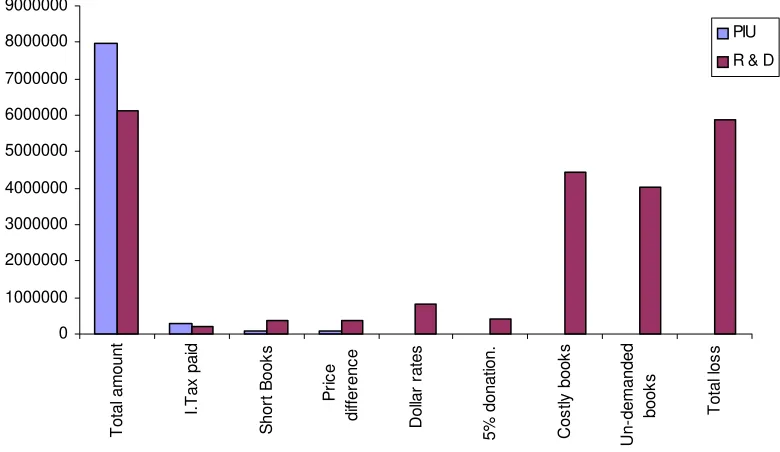
0 1000000 2000000 3000000 4000000 5000000 6000000 7000000 8000000 9000000 T o tal am ount I. T a x pa id S hor t B ook s Pr ic e di ff er enc e D o lla r ra te s 5% donati on. C o st ly b o o ks U n-demand ed book s T o ta l lo s s PIU R & D
Fig. 4. Possible discrepancies that occurred in the purchase of library books from the local firm
Non-Uniform Distribution of Books
[image:11.612.98.488.289.515.2]Table VIII. Non-uniform distribution of library books to GCT, to GTTTC, and to GPIs of NWFP
Number of books purchased from
S. No
Name of Institute
Number of Technologies
Number of Students
NBF Local Firm
Total Books-Students’ ratio
1 GCT 6 1140 2418 2635 5621 4.94/5.4
2 GPI (W) 3 150 1164 1623 2787 18.58
3 GPI, Nowshera 3 450 1468 1616 3084 6.85 4 GPI, Swabi 3 490 1320 2009 3329 6.79 5 GPI, Swat 3 450 613 2009 2622 5.21 6 GPI, Timergara 3 360 730 786 1516 4.46 7 GPI, Haripur 4 540 300 825 1125 2.08 8 GPI, Abbottabad 3 450 190 797 987 2.19 9 GPI, Mansehra 1 150 10 500 1915 3.40 10 GPI, Kohat 3 450 502 801 1303 2.87 11 GPI, Bannu 3 450 1843 797 2640 5.87 12 GPI, DIKhan 4 540 1115 800 1915 3.55
13 GTTTC - - 242 327 569 -
Total 5600 11915 15246 27161/27729 Source: Official Documents, Project Implementation Unit (PIU), TEP, NWFP.
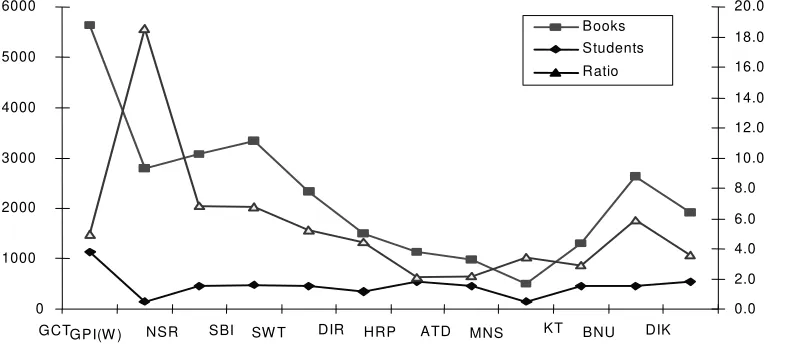
0 1000 2000 3000 4000 5000 6000
GCTGPI(W ) NSR SBI SW T DIR HRP ATD MNS KT BNU DIK
0.0 2.0 4.0 6.0 8.0 10.0 12.0 14.0 16.0 18.0 20.0 Books
Students
Ratio
Fig. 5. Books-Students ratio in different institutions of the province
Misleading Figures
[image:12.612.85.478.309.481.2]
Table IX. Amounts paid/payable to the firm and the National Books Foundation
Amount Paid/payable to The Firm Amount Paid/payable to the NBF S. No.
Date Cheque/Ref. No.
Rs. Date Cheque/Ref.
No.
Rs.
1 30-01-2004 191067 1787186.00 --- --- 188792.00 2 // 191068 1798689.00 7-12-2002 152399 52394.00 3 8-6-2004 636177 1087205.00 30-3-2002 P-60/152 18560.00 4 // 636179 1082135.00 12-3-2001 139681 175800.00 5 25-6-2004 688006 654800.00 15-7-2003 191026 153522.00 6 30-9-2004 191091 1028852.00 --- --- 188184.00 7 --- Balance 227024.00 16-12-2002 152398 136442.00 8 I. Tax @ 3.5% 290241.00 --- --- 117558.00
Total 7956132.00 1031252.00
Source: Official Documents, Project Implementation Unit (PIU), TEP, NWFP.
PC-1 allocated amount, amount shown in progress report, and amount shown as paid are depicted in table-10. It can be seen that actual figures were not used in the progress reports of PIU. Textbooks worth Rs.1.031 million were purchased from National Book Foundation against the reported Rs.1.021million. It means that the PIU reported amount was less than the actual amount by Rs.0.010 million. For library books Rs.1.850 million were shown more than the actual amount paid. The mishandled Rs.1.855 million in the net total cost of library books has not been included in the figures of Table-X. According to the PIU calculations Rs.1.774 million was left unutilized.
Table X. Allocated amount, shown in progress reports and actual paid amount.
Amount for Books/Instructional Materials Provision of Instructional Materials and
Text /Library books to GCT/GPIs through Allocated
Rs. (million)
Shown in Progress Reports
Rs. (million)
Paid Rs. (million)
Difference Rs. (million)
14 No: of Text Books printed
1.021 1.031 0.010
PIU
Library Books
11.045
9.950 8.100 1.850
BTE 133 Text Books 2.700 1.000 1.000 0.000
Total 13.745 11.971 10.131 1.860
Source: Official Documents, Project Implementation Unit (PIU), TEP, NWFP.
From the available record, it can be seen that consultants’ services were neither utilized effectively nor they were asked to prepare list of books that could help in the promotion of teaching learning process. Comments were also reflected in the audit report of 2003-2004. Books purchased may not help improve the quality of technical education because experts of the subjects were not consulted either in writing up or in the selection of these books. The language used in the writing up of teaching learning resource materials, like the language of imported books, is also beyond the comprehension of the level of the students for which the books were purchased. The purchase of such books and teaching learning resource materials might be not a step forward in the implementation of the national education policy 1998-2010.
CONCLUSION AND RECOMMENDATIONS
[image:13.612.76.537.345.471.2]were made to provide required books shelves to the institutions. ADB did not bother about the standard, cost, and distribution of books to different institutions and foreign currencies conversion rates. Conversion of foreign currencies was neither made according to the State bank rates and nor according to the commitment of the supplier.
Good economic governance is needed for checking income tax payment, un-demanded/non-essential/un-useable books purchase, delay in procurement and right use of the resources. Irrelevant books should be returned to the supplier. Research and development cells of each department in the province may be given the chance to work under the ministry of Higher Education of Science and Technology. The work they will do should be forwarded through the ministry to the concern ministries for implementation. PC-1 should be based on realistic data and government should not wholly solely rely on foreign consultants’ data. Project managers, officers of the planning and development department, and ADB officers should properly check quarterly progress reports of projects and comparison be made with the previous progress reports in order to ensure that they have correct information.
REFERENCES
Adams, D. 2002. Education and national development: priorities, policies and planning, education in developing Asia, Vol. 1. Hong Kong: Asian Development Bank and the Comparative Edu. Res. Centre, The Univ. of Hong Kong.
Adams, P., D. Odious and L. Lending. 1991. Corruption and the third world environmental legacy. London, Earthscan. 252 p.
Albrecht, D. and Z. Adrian. 2005. Student loans: an effective instrument for cost recovery in higher education?. World Bank Res. Observer. 8(1): 71-90.
Boyd, L. A. 2006. Analyzing postsecondary returns: does educational loan default play a role? Contemporary Econ. Policy. 13(4): 80-92.
Chapman, D. 2002. Management and efficiency in education: goals and strategies. Educ. in dev. Asia, 2, Manila,
The Philippines: Asian Dev. Bank. Available at: http://www.adb.org/Documents/Books/Education_NatlDev_Asia/ Management_Efficiency/.
Jeon, Y. and P.S. Michael. 2005. Integration and utilization of public education resources in remote and homogenous areas: a case study of the upper Peninsula of Michigan. Contemporary Econ. Policy. 23(4):601-614.
Poutvaara, P. 2004. Educating Europe: should public education be financed with graduate taxes or income-contingent loans?. CESifo Econ. Studies. 50(4):663-684.