Munich Personal RePEc Archive
Modest expectations: Causes and effects
of migration on migrant households in
source countries
Hagen-Zanker, Jessica
Maastricht Graduate School of Governance
2010
Online at
https://mpra.ub.uni-muenchen.de/29507/
Causes and effects of migration on migrant
households in source countries
© Jessica Hagen‐Zanker, 2010
All rights reserved. No part of this publication may be reproduced, stored in a retrieval ystem, or transmitted in any form, or by any means, electronic, mechanical, photocopying,
ithout the prior permission in writing, from the author. s
recording or otherwise, w
ISBN 978 90 8666 128 2
)
Causes and effects of migration on migrant households in source countries
DISSERTATION
to y,
on the authority of the Rector Magnificus, Prof. dr. G.P.M.F. Moobtain the degree of Doctor at the Maastricht Universit ls, in accordance with the decision of the Board of Deans, to be defended in public on 12 March 2010, at 10:00 hours
Supervisor: Prof. Dr. Chris de Neubourg
o‐supervisors: rsity of Warsaw
Dr. Pawel Kaczmarczyk, Unive C
Dr. Carlo Azzarri, World Bank
ssessment Committee:
an) of Oxford
A Prof. Dr. Hans Heijke (chairm
rsity
Dr. Hein de Haas, Unive
Dr. Talip Kilic, World Bank
Prof. Dr. Joan Muysken Prof. Dr. Hildegard Schneider
Acknowledgments
The work in this thesis is based on several papers that were published or are in the process of being published as journal articles, working papers and conference papers. The table below gives an overview of the main sources for each chapter. I would like to express my gratitude to the co‐authors, conference‐organizers, eviewers and discussants for making these publications and this dissertation
ossible. r
p
apter
Ch Main sources
2 Hagen‐Zanker, Jessica (2008) literature, MGSoG Working paper 2008/002, Maastricht Why do people migrate? A review of the theoretical 3 Hagen‐Zanker, Jessica and Siegel, Melissa (2007) review of the literature, MGSOG Working paper 2007/003
vations to The determinants of remittances: A
4
Hagen‐Zanker, Jessica and Siegel, Melissa (2007) A critical discussion of the moti remit in Albania and Moldova, MGSoG Working paper 2007/007
e Hagen‐Zanker, Jessica, Siegel, Melissa and De Neubourg Chris (2009) Strings attached. Th impediments to migration, Southeast European and Black Sea Studies, 9(4)
Hagen‐Zanker, Jessica and Azzarri, Carlo (2008) Are internal migrants in Albania leaving for the better?, Published in conference proceedings of International Conference on 5 Environment, Forced Migration and Social Vulnerability, October 2008, Bonn, Germany
and upcoming in Eastern European Economics
Preface
Many people contributed to this thesis, directly as supervisors, co‐authors and colleagues or indirectly as friends and family. I am grateful for all their support. First of all, I would like to thank Chris de Neubourg, You created the school, together with Annemarie Rima, and most importantly the warm and inspiring atmosphere that can be found here. I felt right at home and found friends for life. Going to work every day or returning after my baby breaks was always something I looked forward to, due to the unique work environment you created. Thank you for your vision, your unconditional support and the critical discussions we had about the contents of this PhD. I would also like to thank Annemarie for her trust in my programme management and actions and for relieving me of these responsibilities at the right time.
My co‐supervisors Pawel Kazymarkzyk and Carlo Azzarri both helped me greatly in many ways. Pawel’s inspiring classes on migration helped me to focus my work on migration on the families of migrants. Thank you Pawel for your faith in me and for your feedback and guidance on all aspects of my work, and especially the theoretical sections. I asked Carlo Azzarri to become my supervisor after he had given me very useful comments on my first empirical Albanian paper. He agreed, without ever having met me, and we had a most fruitful cooperation ever since then. You’re the only supervisor I know, who is available to chat on Skype and Messenger any time of the day and any day of the week. Thank you for your extensive and thorough comments, Carlo, that made me re‐think and refine methodologies and data interpretations many times. They helped me to really improve the quality of my work and I have learnt much from you.
Thank you to the reading committee members Prof. Dr. Hans Heijke, Prof. Dr. Joan Muysken, Prof. Dr. Hildegard Schneider, Dr. Hein de Haas and Dr. Talip Kilic for reading my dissertation so enthusiastically and so quickly. Thank you for your comments that helped me to put the finishing touches on this dissertation.
At the School, I thank Mindel van de Laar and Franziska Gassmann for being very understanding and supportive during the course of my PhD. Working on the Social Protection course coordination and with the MPP students was a nice complement to the PhD work and also allowed me to cooperate more extensively with the support staff. Thank you especially Celine, Mieke, Susan, Janneke, Charlotte and Ruta for your support related to my PhD and coordination tasks, but especially for your friendship.
vi
most ethical economist I know. Judith, I am so glad you came back to Maastricht. Robert and I have the best and silliest laughs with you! Mirtha wrote the first paper on remittances with me and right from that first paper until her defence, she
s n
was my example on how to do a PhD. Thank you for your inspiring pa sion a d your warm friendship.
Melissa and I quickly joined forces as the migration PhD students. Going to conferences will never be as much fun, as it was with you, Melissa: Chatting till late at night, “sleeping in” while you went running, going shopping, long dinners, walking everywhere… and yes, we also went to the conference sessions. Thank
,
you Melissa, for making my PhD more fun. You and Flo will always be very good friends.
My other co‐author Florian and I got to know each other better in the muddy streets of peri‐urban Tirana, where we collected our data. I am very grateful to you and Sonila for the nice times we have shared, your friendship, your humour and support in difficult times. I appreciate the hospitality of you and your families; spending time with you I also learnt so much about your country and culture. Part of the privilege of working at the School is attending international weddings. Paty’s and David’s in Mexico was beautiful. Thank you for the fun and interesting chats we had, about Economics or family, at home or at the School. Zina, I still regret not being able to attend yours and Yasser’s Egyptian wedding. Our joint motherhood‐PhD experiences created a strong bond and friendship between us. Let’s hope we become mother in laws to our oldest children one day. Thank you for always understanding me!
I also thank my friends Denisa and Victor for always being ready for a mini‐break with me, for the memorable holiday in Brasov and for being my daughter’s biggest fans! Thank you to my other friends at the School, Bianca, Britta, Cheng, Frieda, Hao, Henry, Keetie, Jinjing, Pascal, Maha, Metka, Michal and Renée, for their friendship and the nice dinners, movies, chats or holidays we shared. Thank you to the many colleagues at the School who have babysat my kids! I am also immensely grateful to Miriam for being a supportive friend for twenty years already, both spiritually and with never‐ending supplies of gummy bears. Dear Annika, no‐one can motivate me like you can!
I am also grateful to my family. I want to thank my siblings Felix, Franzisca, Jonas and Clara, who take me for who I am and always make me forget about my work when it was necessary. Thank you especially to glorified nanny Franny for lots of help with the kids over the years and for calling me almost every day. My parents, Sabine and Johannes, I want to thank for always believing in me, even when I went off to study Economics, which I knew nothing about, in the Netherlands, a country I had never been to. Your love, support, patience and interest have been immensely
lso my
helpful. I a thank parents‐in‐law, Bonnet and Martin, for accepting and supporting the work‐focused lifestyle of Alex and me.
to make efficient use of my time.
Alex knows this thesis almost as well as I do. Thank you for your encouragement, patient advice and practical help, at any time of the day. Thanks for all the maps you made for me! With your continuous interest and difficult questions, you made sure that I delved deeply into the research and enjoyed it too. And finally and most of your love and the happiness I have with you, I had the h with this PhD.
Contents
Acknowledgments iii
Preface v
Contents ix
List of Figures xii
List of Tables xiii
1 Introducti 1
o
n
1.1 Motivation 1
es
logy
1.2 Objectiv 5
1.3 Methodo 5
1.4 Outline 7
2 Why do people mig 9
rate?
2.1 Introduction 9
2.2 The level of analysis 10
2.3 Macro‐theories of migration 11
n
Labour Migration
2.4 Micro‐theories of migratio 13
2.5 Family‐decision making and the New Economics of 15
n of migration
amework of migration decision making
2.6 Perpetuatio 18
2.7 A general fr 20
2.8 Conclusion 22
3 The determinants of remittance 25
3.1 Introduction 25
3.2 The determinants of remittances 25
s
3.2. Theoretical de 25
3.2. Empirical dete 29
3.3 Conclusions 33
1 terminants of remittances
2 rminants of remittances
4 The determi
nants of migration and remittances in Albania and
Moldova 35
4.1 Introduction 35
4.2 Theoretical framework 38
4.2. Determinants of migration 38
4.2. Determinants of remittanc 43
4.3 Data and methodology 46
1
2 es
4.3. Data 46
4.3. Methodology 46
4.4 Why do people migrate? 48
1
2
4.4.1 Descriptive statistics 48
x
4.5 Why do migrants send remittances? 56
4.5. Descriptive sta 56
4.5. Empirical anal 59
4.6 Conclusions 70
1 tistics
2 ysis
5 Are internal migr 75
5.1 Introduction 75
5.2 Literature review 79
ants in Albania leaving for the better?
5.2. Determinants of internal migration 80
5.2. Effects of internal migration 81
5.3 Data and Descriptive Statistics 82
1
2
5.3.1 Data 82
5.3.2 The Albanian households 83
5.3. Rural and peri-urban 84
5.3. Peri-urban migrant h 91
5.4 Empirical analysis 93
3 households
4 ouseholds: is there a time effect?
5.4. Methodology 93
5.4. Empirical resu 95
5.5 Conclusions 99
1
2 lts
6 How has inte
rnal migration in Albania affected transfers amongst ?
kinship members 103
6.1 Introduction 103
6.2 Literature Review 105
6.3 Data and Methodology 107
6.3.1 Data 107
6.3. Descriptive Statistics 109
6.3. Methodology 111
6.4 Empirical Results 113
2
3
6.4. Qualitative ana 113
6.4. Econometric re 115
6.5 Conclusions 120
1 lysis
2 sults
7 Conclusions a 123
7.1 Main findings 123
nd Discussion
7.1.1 Why do people migrate? 123
7.1.2 What are the motivations of migrants to send remittances? 126
7.1. What is the economic impact of migration on m 128
7.1. How has migration affected transfers amongst 129
7.2 Discussion and policy recommendations 132
3 igrant households?
4 kinship members?
References 135
A Appendix to Chapter 3 147
B Appendix to Chapter 4 153
B.1 Summary statistics for Section 4.4 153
B.2 Summary statistics for Section 4.5 155
C Appendix to Chapter 5 157
C.3 Alternative specification 159
D Appendix to Chapter 6 161
f transfers
D.1 Incidence of receipt o 161
D.2 Codified results from the qualitative interviews 162
fferent count models
D.3 ZIP and ZINB models 163
D.4 Measures of fit between di 164
D.5 Alternative specifications 165
Summary 170
Samenvatting 174
xii
List of Figures
Figure 1.1 International and internal migration flows 1990‒2004 6
n decision making
Figure 3.1 the case of loan repayment
Figure 2.1 A general framework of migratio 21
Figure 3.2
A theoretical average remittance function in 28
Figure 4.1 rope
Insurance motives for remitting 32
Figure 4.2
Location of Albania and Moldova in Eu 35
remittances
Figure 4.3
Albania emigration and 36
Figure 4.4
Moldova emigration and remittances 37
Figure 4.5
The Welfare Pentagon 39
decision making process
Figure 4.6
The migration 43
Figure 4.7
The level of remittances/ consumption quartile 57
Figure 5.1 flows 1990‒2004
Years abroad 58
Figure 5.2
Internal and international migration 76
s 1919‒2009
Figure 5.3
Urbanisation trend 77
Figure 5.4
Main inter‐district migration flows 78
Figure 5.5 me shares
Poverty indicators 87
Figure 5.6
Participation in income‐generating activities and inco 88
for adults of the household
Figure 5.7 dden illness
Unemployment ratio 91
Figure 5.8
Whether someone in household has a su 92
Figure 6.1
Wellbeing indicators 92
Figure 6.2 fter migration
Origin districts of surveyed households 104
igure C.1
Predicted frequency of transfers by age, for transfers before and a 117
The distribution of the propensity score by treatment group 157
igure D.1 Residuals of the tested model for frequencies of all transfers 164
F F
List of Tables
Table 2.1 Theories of migration defined by level of analysis 10
tion
Table 3.1 es
Table 2.2 Theories of migration defined by initiation or perpetuation of migra 10
Table 4.1
Theoretical effects of certain factors on remittances for different motiv 26
Table 4.2
Differences between migrants and non‐migrants: Control variables 49
Table 4.3
Differences between migrants and non‐ migrants: Family institutions 50
Table 4.4
Differences between migrants and non‐migrants: Market institutions 51
Table 4.5 itutions
Differences between migrants and non‐migrants: Social network institutions 52 Membership association inst
Table 4.6 Public authority institutions
Differences between migrants and non‐migrants: 53
ts and non‐migrants:
Table 4.7
Differences between migran 54
Table 4.8
Probit analysis on the probability to be a migrant 55
C
Table 4.9 R
haracteristics of remitters 59
Table 4.1
esults of the Tobit regression for the combined model 62
the Albania model
Table 4.1 the Moldova model
0 Results of the Tobit regression for 66
Tobit regression for
Table 5.1 istics
1 Results of the 69
Table 5.2
General household character 84
Table 5.3 yment
Demographics 85
lo
Table 5.4
Education and emp 86
Table 5.5
Wellbeing indicators 87
Table 5.6
Housing outcomes 89
Table 5.7
Health outcome and infrastructure 89
Table 5.8
Schooling outcomes and expectations 90
Table 5.9 Variable (IV) results
Propensity Score Matching results 96
rumental
Table 6.1
Ordinary Least Squares (OLS) and Inst 98
Table 6.2
Household characteristics in the sampled areas 109
Table 6.3
Transfer likelihood from different kin 110
Table 6.4
Transfer frequency from different types of kin 111
eceiving transfer
Table 6.5 arate NBRM (before and after migration)
Results from NBRM: Frequency of r 116
Table A.1
Differences in coefficients from sep 119
Table A.2
Effects for the probability to remit 147
s
Table A.3 robability & level of remittances (Tobit)
Effects for the level of remittance 149
Table B.1
Effects for the joint solution of p 150
Table B.2
Summary statistics for Moldova 153
Table B.3
Summary statistics for Albania 154
Table B.4
Summary statistics for Moldova 155
Table C.1
Summary statistics for Albania 156
Table C.2 ous variable
Diagnostic tests for the IV regression 158
y endogen
Table D.1
Alternative specification with migration as dumm 159
161
Incidence of receipt of transfers before and after migration
Table D.2 Question E.6 What kinds of contact do you have? 162
Table D.3
Question H4.1 How did the move to Tirana change your relations with other people
(including family)? 162
Table D.4
different t Question H4.4 Can you describe the kind of support you receive from others? How is this
Table D.5 of all transfe 4
o the past, before you moved? 162
Table D.6
Sum of predicted and actual mean count of the tested models for frequencies rs16 s
Table D.7 nsfers
Results from NBRM including income: Frequency of receiving transfer 165
Results from NBRM and ZINB: Frequency of receiving all combined tra 167
f
1
Introduction
1.1
otivation
Migration is a topic everyone ranging from politicians to shopkeepers has an opinion on and that is in the news almost every day. People are interested in migration because almost everyone is affected by migration, directly or indirectly. Migration affects all areas of life ‒ social, economic and political ‒ which makes the analysis of migration extremely relevant as well as more complicated. Due to the recent influential immigration experiences of Europe and the USA, to many people, politicians and also researchers migration is synonymous with immigration. This
M
dissertation looks at the opposite end of the spectrum, at migrant‐sending households and migrant households in source countries.
I start with the important question of why people migrate. The simple answer to this question is: People want to be better off. If migration makes people better off,
why do not more people migrate? Current news coverage of migration issues is not proportional to current migration flows. Only 3% of today’s world population has migrated internationally (Koser, 2007). So in order to understand the current migration trends, there is the need to analyse thoroughly why people do or indeed do not migrate.
While migration is as old as humanity itself, theories about migration are fairly new. Early migration models (e.g. Zipf, 1946) used the physical concept of gravity and explained migration as a function of the size of the origin and destination population and predicted migration flows to be inversely related to distance. In the 1950s migration theory moved from purely mechanical models to more sophisticated theories, in which migration occurs as a result of differences in the urban/ rural wages and employment rate (Harris & Todaro, 1970). While the early analyses look at aggregate data and often see migration as equilibrating mechanism, further research focused on elaborate microeconomic models. These models analyse individual motivations to migrate, but also consider structural community level factors like poverty (e.g. Wolpert, 1965). More modern approaches link the micro and macro level and also include less economic concepts, for example social capital (Faist, 1997, 2000). The New Economics of Labour Migration developed in the 1980s sees migration as a household decision and includes a more complete explanation for migration flows (e.g. Stark, 1991). Few authors take advantage of the complementarities between the different theories however; this is an aspect that I will emphasize.
It is known that a considerable fraction of labour migrants goes abroad in order to send remittances to family members back home.1 Even those migrants that leave or other reasons (e.g. personal freedom, persecution), often transpire to remit as
well. Remittance flows have been growing and are increasingly better measured in the past decade and have consequently received a lot of public attention. The 2005 “World Economic Prospects 2006” report by the World Bank, that also motivated my interest in this topic, is widely quoted, especially the astonishing figure that global remittances reached $216 billion in 2004
2 i
d
2 (World Bank, 2006). Remittances outgrew global foreign aid and also foreign direct investment in many countries. Even if the exact overall amount of remittances is disputed due to measurement problems, the order of magnitude of this figure gives a clear indication that remittances are substantial and consequential.
For many politicians in poor source countries, remittances are seen as a major solution to domestic problems. These politicians believe that channelling more remittances to their countries for the benefit of the country as a whole (see discussion on the impact of migration and remittances below), is complementary to or a substitute of domestic social policy. Such large sums of money arouse the interest of not only politicians but also of researchers. The crucial question by all is: Who sends remittances under what circumstances? This is a particularly difficult question to answer and to draw general conclusions on, as the decision to remit is private and the personal considerations made in such a decision‐making process are hard to measure. Consequently, the literature on the motivations to
e
remit is still xtremely dynamic. In this thesis I contribute to the discussion and I also analyse why and under what circumstances remittances are sent.
After having reviewed why people migrate and more specifically why they send remittances back home, the question of why not more people migrate comes up again. People migrate and send remittances to improve living standards for themselves and their families. It also appears that large shares of the global population would benefit from migration, but that they do not migrate. One might infer that the costs of migration are too high for many of the world’s poor, but another reason could be that the impact of migration is not as positive as one would expect. Therefore the second part of my dissertation concentrates on the impact of migration.
A vibrant discussion on pressing methodological issues accounts for a significant fraction of the literature on the impact of migration. The conclusions on the actual impact are no less disputed. The answer depends on what is measured and at who is looked at: Does one look at the impact of migration in general, or remittances in particular? Does one look at the impact on the migrant or the family left behind or the wider community? Does one look at the impact on household finances, income and expenditures, or other factors of wellbeing, like health, housing or education? Very briefly, the literature finds both negative and positive effects of migration. Sending a household member abroad, might result in labour and parenting shortages in the household, but also results in remittances that can be spent on education, health or bare survival.
Looking at the impact of migration in general on household income, poverty or nequality, there is much evidence that international migration and remittances ecrease poverty (e.g. Adams & Page, 2005). The effects on inequality are generally
less positive, as the extremely poor are often not able to migrate (Chimhowu et al, 2003). The precise impact depends very much on migrant selection and correcting for the endogeneity bias. One exceptional study that tracked internal and international migrants in Tanzania before and after migration, thus avoiding a bias,
t o l f
c
finds tha migrati n has increased the consumption leve o migrants (Beegle et al, 2008).
Another way of measuring the impact of migration is looking at the use of remittances. Use of remittances studies focus heavily on whether remittances are used for investment. Firstly, it is disputable what is considered investment. Expenses on food are generally considered “consumptive”, but the literature is becoming less rigorous on this issue, as people being well‐fed and healthy is fundamental to being productive. The country context, for example the investment climate, is also imperative. Investment of remittances in housing are widely found (e.g. Durand et al, 1996), but since many migrant houses are not lived in for large period of times, these are generally considered non‐productive investments. Furthermore, there is some evidence that return migrants are more likely to become entrepreneurs at home (e.g. Dustman & Kirchkamp, 2002, Black et al, 2003), but this discussion is far from closed. There is some evidence that households with a migrant spend more on education or that migrant’s children are less likely to leave school (Adams, 2006 and Edwards & Ureta, 2003).
Moreover one should also take the effect of migration on household employment into account. Firstly migrants leaving the household, means there is a “lost labour effect”, i.e. there are fewer people to work locally, to tend the land or to look after children. Secondly, a migrant remitting to his/her family back home without visiting frequently could potentially result in moral hazard.3 If remittances are periodically sent to cover living expenses, the family might decrease their labour
r force participation and opt for more leisure, as Gubert (2000) finds fo Mali, Germenji & Swinnen (2004) find for Albania and Hanson (2007) finds for Mexico. Finally one should consider the effects on the community or country as a whole. Remittances spent by individuals will have indirect multiplier effects at the meso and macro level (especially important is Taylor’s work (e.g. Adelman, Taylor & Vogel, 1988)). These higher level effects can be positive, such as more investment leading to higher economic growth or lower unemployment, or negative such as the Dutch disease4 or the much d rain. However, these effects are not the focus of my dissertation.
The literature on the impact of international migration is still growing and the
conclusion on whether migration is indeed a good strategy for migrants and their families are not clear‐cut yet. Nevertheless, I decided to focus on a bigger gap in the literature and to investigate the impact of internal migration more closely. Internal
migration is the movement of people from one region to another in the same ountry and is predominantly rural‐urban, but not exclusively so. Internal
ebated brain d
3 Moral hazard is the danger that people insured in some sense (e.g. regularly getting remittance
payments) change their behaviour compared to being fully exposed to all risks.
4 In the remittances context the Dutch disease is essentially an exchange rate appreciation resulting
migration is understudied despite the fact that the global number of internal migrants, 740 million people, is considerably higher than the number of international migrants, 200 million people (Bell & Muhidin, 2009). In the second half of my dissertation I will concentrate on the impact of internal migration, looking at the specific case of internal migration to peri‐urban areas in Albania’s
4
capital Tirana, as Albania experienced significant internal migration, besides the enormous international migration flows it is known for.
For internal migration there is even less evidence whether migration has positive or negative effects on income. Yap (1977) reviews a number of papers and finds that, despite higher living expenses in urban areas and missed in‐kind rural income, migrants generally experience income gains. Tunali (2000), on the other hand, shows that not everybody benefited from internal migration in Turkey in the 1960s, and that a sizeable fraction of internal migrants experienced income shortfalls. Not much research has been done on other effects of migration, but local case studies e.g. in China (see Davin, 1999) show a non‐surprising picture: Migrants usually live in worse living conditions than locals, have volatile employment and poor access to the health sector. I will deal with this question
m
rigorously and analyse the i pact of migration for migrant households using a wide range of criteria.
Remittances are not limited to international migration. As anyone should know from personal experience, financial, in‐kind or services transfers exchanged between close family members or within a wider kinship networks living in the same country are common. International and internal migration may change the location of network members and the nature of these networks. A number of studies in the 1950s in the USA showed that rural‐urban migration affected relationships amongst kinship members considerably (see Blumberg & Bell, 1959). While some exchange still took place, especially in the beginning, increasingly residual functions of relationships, e.g. visiting, became more important (ibid). Since then not much specific research has been done on the effects of internal migration on the relationships and transfers between kinship members. My last chapter contributes to this gap in the literature.
In academia, research on origin countries is still dwarfed by immigration research. Extensive empirical research on the causes and especially impacts of migration on the country of origin has only been really dynamic in the past ten years. This dissertation will therefore contribute to the growing literature on the causes and effects of migration for households in source countries. As argued above, this type
understa a
of research is vital in nding the links between migration nd development and is therefore important not only in academic terms.
1.2
Objectives
This dissertation has the objective to investigate the causes and effects of migration on migrant households in source countries.
It aims to further understanding of the reasons of why people migrate and send
s n f g
remittances. It al o intends to a alyse the consequences o mi ration on the wellbeing of migrant households and on the relationship between family members. In addition two broad themes are analysed throughout all chapters: The te investigation of migrant households, i.e. the families of migrants or comple households that have moved, and the focus on source countries.
Mo sre pecifically, I would like to gain insight into the following questions: 1. Why do individuals migrate?
2. What are the motivations of migrants to send remittances?
Wha c on s
r i
3. t is the e onomic impact of migrati on migrant household ? 4. How has mig at on affected transfers amongst kinship members?
While questions 1‒2 analyse international migration, questions 3‒4 focus on internal migration.
1.3
Methodology
Impact analysis is tricky in any field, but especially so in migration studies. Aspiring migrants self‐select themselves to be migrants (i.e. it is a more or less a free decision to migrate) and are therefore different to the people who do not migrate in a number of characteristics. Some of these differences can be measured (e.g. the education level), but others are more difficult to assess (e.g. the level of risk‐taking). One can expect that these differences influence a straightforward comparison between migrants and non‐migrants, so one needs to apply more advanced techniques to analyse the impact of migration. A further complication is that one can expect to find reverse causality between migration and common dependent variables, like income. Essentially it is not known whether migrant’s families that stay behind are richer due to migration and remittances or whether it is the family’s wealth that enabled the migrant to migrate in the first place. These
n
issues eed to be dealt with thoroughly before drawing any conclusions on the impact of migration.
Unlike in the natural sciences, experiments with a random selection of people being allowed to migrate are not feasible.5 Measuring the impact thus requires other solutions. Chapter 5 and Chapter 6 come up with two different ways of solving the problem of bias: Chapter 5 uses advanced econometric techniques (Propensity Score Matching and the Instrumental Variable Method) to correct for ome of the bias. In this case migrant households can be compared to households s
5 Very rarely a “natural experiment” comes along that achieves almost the same result that one would
that did not migrate. Chapter 6 compares the same household’s family solidarity pattern after the move to their behaviour before the move.
Except for the theoretical chapters, all other chapters use Albania as at least one of the empirical applications. Albania is situated in South‐Eastern Europe and has land borders with Greece, Montenegro, Serbia and Macedonia and a sea border
l o n
with Ita y. It has a population of ar und 3.6 millio , is a lower‐middle income country and thus one of the poorest countries in Europe.
Albania is an excellent case study for measuring the causes and impacts of migration. Since the fall of communism in 1990, it is virtually a “country on the move” (Carletto et. al., 2006). Considerable shares of the population are affected by migration. Almost 50% of Albanian households have had one or more household members abroad since 1990 (ibid). In addition to international migration, there are also large internal rural‐urban migration flows. Two characteristics define
s w
recent Albanian migration: Its sheer intensity and the uddenness ith which it took place (King, 2005).
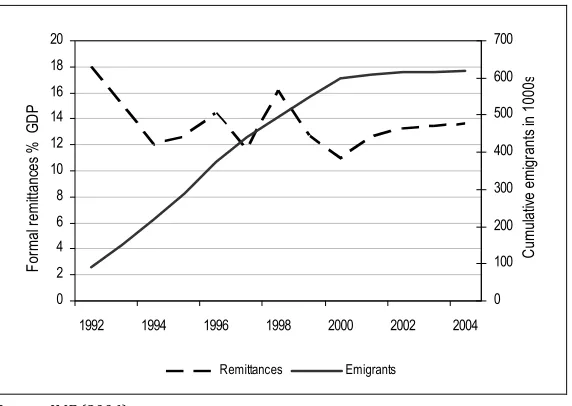
Albania is historically a migration country, but both internal and international migration was outlawed under the communist regime of Hoxha. Since 1990 the number of internal and international migrants has risen sharply, especially during times of shocks, such as the political and economical uncertainty following the fall of Communism in 1990 and the pyramid savings scheme crisis in 1997. International migrants constitute at least one fifth of population (Carletto et. al., 2006). In terms of internal migration 5.7% of the population moved from one region to another and twice that many people moved across districts between the two Censuses in 1989 and 2001 (INSTAT, 2004). Figure 1.1 compares internal to international migration flows and shows that there are considerable differences in the timing and intensity of their flows.
Figure 1.1International and internal migration flows 1990‒2004
0
25
00
0
50
00
0
#
o
f m
igr
an
ts
1990 1991 1992 1993 1994 1995 1996 1997 1998 1999 2000 2001 2002 2003 2004
Year moved to current residence
6 Internal International
Source: Own calculations, based on 2005 Albania ALSMS
Since migration was outlawed under Communism and increased very quickly thereafter, Albania can be thought of as a laboratory for migration. The time period where almost no migration took place is still recent, which means that the situation today can be compared to the base scenario of no migration. The Albania Living Standard Measurement surveys of the World Bank take advantage of this feature and in their very extensive questionnaires they also include questions on the household’s living standards in 1990, as well as complete migration histories of individuals in households. I was able to make use of this valuable database, as well as data I collected myself during fieldwork in Albania in 2008.
1.4
Outline
My first step in shedding light on the question of why people migrate is by systematically reviewing the theoretical literature on the causes of migration in Chapter 2. I focus mostly on the economic literature. The literature can be divided by the level of analysis: The micro‐level looks at the decision making process of individuals. The meso level studies how individuals and groups of individuals (e.g. families) are affected by their wider social setting. The macro‐level, on the other hand, focuses on economy‐wide opportunity differentials and differences between countries.
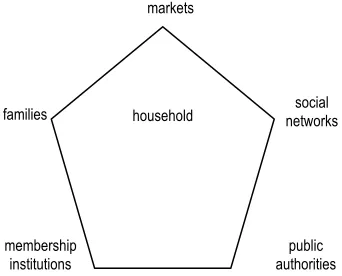
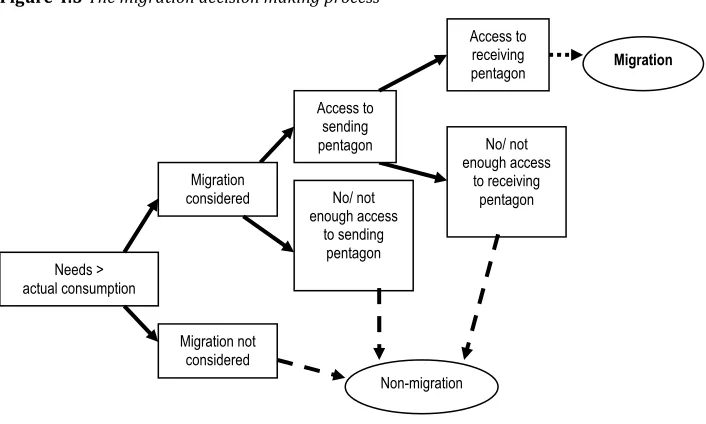
In Chapter 4 I link migration theories in another way by placing them in the context of the Welfare Pentagon. The Welfare Pentagon (de Neubourg, 2002) is a framework that explains how people maximise income and smooth consumption by accessing different parts of the Welfare Pentagon, namely families, markets, membership associations, social networks and public authorities. When a potential migrant has no or not significant access to some of these institutions and thus cannot make ends meet at home, the individual may decide to migrate. At the same time access to some of these institutions is also necessary in order to migrate, e.g. social networks. In Chapter 4 I also explore this framework empirically with data for Albania and Moldova and give a first indication of characteristics of people in those countries that do migrate.
I investigate the motives of remitters by reviewing the remittances literature and by looking at the specific cases of Albania and Moldova. In Chapter 3 I extensively review the empirical and theoretical literature of the determinants of remittances. According to Lucas and Stark (1985) remitting motives can be classified either as “pure altruism”, “pure self‐interest” or something in between, “tempered altruism or “enlightened self‐interest”. In reality these motives are interlinked and hard to measure separately. In Chapter 4 I systematically attempt to apply some of the determinants of remittances theories to the cases of Albania and Moldova and extensively discuss the methodological concerns specific to this literature.
In Chapter 6 I focus more on the social impact of internal migration, in particular how relationships and transfers amongst family members are affected by
8
migration. Here I only look at migrant households and compare their transfer mix and network before internal migration to the current situation.
hapter 7 is my conclusion. Apart from answering my specific research questions, I eflect on the links between the papers and draw some policy considerations. C
2
Why do people migrate?
2.1
Introdu tion
Massey et. al.’s (1993) paper is ground‐breaking in the migration literature because discusses and
c
unifies different migration theories. However, their review and synthesis is not complete and deep enough for researchers interested in a deeper understanding of the migration theory literature. This chapter therefore aims to review the complete spectrum of economic migration theory from the 1950s until today and to show the differences and complementarities between the different approaches.
Migration is the temporary or permanent move of individuals or groups of people from one geographic location to another for various reasons ranging from better employment possibilities to persecution. While migration is as old as humanity itself, theories about migration are fairly new. One of the early writers on modern migration is Ravenstein, who in the 1880s based his “Laws of Migration” on empirical migration data. This collection of empirical regularities, for example the fact that most migrants only travel short distances, was far from a complete theory of migration. Early migration models (e.g. Zipf, 1946) used the physical concept of
gravity and explained migration as a function of the size of the origin and destination population and predicted migration to be inversely related to distance. In the 1950s migration theory moved from purely mechanical models to more sophisticated theories. Theoretical predictions of migration flows are first made in the dual‐economy models of Lewis in the 1950/60s, in which migration occurs as a result of differences in the supply and demand of labour between the rural and urban sector. The Harris‐Todaro models of the 1970/80s augment these models to account for some particular empirical observations and to make the models
t
specifically abou migration. Other macro‐theories include the world systems theory and dual‐labour market theory, which consider institutions in more detail. While the early analyses look at aggregate data and often see migration as equilibrating mechanism, the focus since the 1980s is on more elaborate microeconomic models. These models analyse individual motivations to migrate, but also consider structural community level factors. More modern approaches link the micro and macro level and also include less economic concepts, for example social capital. Another contribution of the more recent literature is the differentiation between causes and perpetuation of migration. The New Economics of Labour Migration developed in the 1980s sees migration as a household decision and includes more explanations regarding the decision to migrate. This theory will be discussed more extensively. It stands out from the classical theories
f i o
o migration n that it tries to model the decision‐making pr cess more realistically by including a wide range of decision making factors.
be critically discussed in the next sections. While the emphasis is on economic theories, some of them are closely linked to sociological, geographical and anthropological theories. The review will focus on voluntary labour migration, thus disregarding forced migration, asylum seeking family reunion etc. The chapter will conclude by unifying the most important theories into one framework.
10
2.2
The level of analysis
Migration theories can be classified according to the level they focus on. Micro‐ level theories focus on individual migration decisions, whereas macro‐level theories look at aggregate migration trends and explain these trends with macro‐ level explanations. The meso‐level is in between the micro and macro level, e.g. on the household or community level and can explain both causes and perpetuation of migration. Table 2.1 gives an overview of the theories along the level of analysis, whereas Table 2.2 gives an overview of the migration theories in terms of their classification as a cause or perpetuation of migration. As will become clear later on, some theories fit into several categories.
Table 2.1Theories of migration defined by level of analysis
Micro‐level Meso‐level Macro‐level
Migration cause: Migration cause/ perpetuation: Migration cause/ perpetuation:
Individual values/ desires/ expectancies e.g. improving survival, wealth Collectives/ so e.g. social ties cial networks Macro‐level opportunity structure e.g. economic structure (income t opportunities etc. M and employmen differentials) M ain theories: •Lee’s push/ pull factors •Neoclassical micro‐migration
theory
•Behavioural models •Theory of social systems
Main theories: •Social capital theory •Institutional theory •Network theory •Cumulative causation Economics of Labour ration •New Mig ain theories:
•Neoclassical macro‐migration theory
•Migration as a system •Dual labour market theory •World systems theory •Mobility Transition Source: Faist (2000) and own elaboration
Table 2.2Theories of migration defined by initiation or perpetuation of migration
This chapter will discuss the theories in rough chronological order. Therefore macro‐level theories be discussed first, followed by micro and meso theories and I will finish the literature review by looking at the perpetuation of migration, which is a fairly new field.
2.3
Macro-theories of migration
The neoclassical macro migration theories explain migration as part of economic development. Internal migration occurs as a result of geographical differences in the supply and demand of labour, mostly between the rural traditional agricultural sector and the urban modern manufacturing sector. The basic model (Lewis, 1954 and Ranis & Fei, 1961) that grew out of trade theory, assumes perfect markets and a labour surplus in the traditional agricultural sector that is absorbed by the modern sector. The modern sector grows through capital accumulation and by poaching labour from the traditional sector. Rural workers are attracted by the
a o
positive wage differential and migr te t the urban sector, i.e. they are pulled to migrate. In these models migration occurs until wage equalisation has taken place. Todaro and Harris (Todaro, 1969 and Harris & Todaro, 1970) augmented this model to account for the significant urban unemployment that was found in many less developed countries. Migration is not completely risk‐free, because the migrant does not necessarily get a job upon arrival in the city. Rural‐urban migration occurs, as long as the expected real income differential is positive. Expected income is a function of the rigid, institutionally determined urban wages and the urban employment rate. Migration costs can be included. The employment rate is the probability of finding a job, i.e. being selected from the pool of labour, which increases over time, for example due to wider networks of the migrants. Migration thus increases if urban wages increase or the urban employment rate increases (ceteris paribus). The authors show that it can be perfectly rational to migrate, despite urban unemployment, due to a positive expected income differential. This model has clear predictions and while the significance of income differentials is undisputable in labour migration decisions, it is probably not as excessive as Harris and Todaro describe it. Some of the model’s empirical predictions e.g. wage equalisation, have not been found reality.
fluctuates according to the economic cycle, making it unstable and uncertain work, again unattractive to native workers. Therefore there is a strong demand for temporary migrant labour that acts as a pull factor to migration. This model is important because it explains some of the post‐war migration trends in Europe
12
Nevertheless the migration system models are vague and do not allow concrete prediction of migration trends.
Politics matter in migration theory, as migration laws and thus the right to cross a border legally directly influence migration flows. These laws of nation states are the result of the relative power of different interest groups. They are influenced by profits (thus linking up with Priore’s dual labour market theory), national identity, considerations of national security and the extent of multiculturalism in the state. In a historical analysis it is important to point out that acquired rights, laws or and the United States, but the focus is too narrow with only one pull factor being analysed and with no deeper analysis of migrant decision making.
The world systems theory (Wallerstein, 1974), which takes a historical structural approach, stresses the role of disruptions and dislocations in peripheral parts of the world that result from colonialism and the capitalist expansion of neoclassical governments and multinationals. It thus takes account of structural factors that other theories neglect. The capitalist expansion has had profound consequences for migration issues, as not only the capitalist mode of production, but also affecting culture and stronger transportation, communication and military links penetrate peripheries. Land consolidation, new capitalist farming methods and manufacturing plants have created a socially uprooted population with weakened attachments to their land and that are more prone to migration. A strong immigrant labour demand in global cities acts as a pull force to migration. According to this theory, migration follows the dynamics of market creation and structure of the global economy, but more individual motivations are not considered. The exact mechanisms of migration are also not clear. Recent examples
n
of this theory are globalisation in general and the transition of Central a d Eastern Europe after the fall of Communism.
existing institutions will always influence migration flows, irrespective of economic considerations, like the business cycle (Hollifield, 2000). Globalisation not only affects the demand for labour or facilitates migrant networks, but also leads to loss of border control. Zolberg (1981) argues that it is not just the economic factors that matter in making the structural setting of migration, for example some of the countries that would be considered peripheral in the world systems theory (the Communist countries) chose to do so due to political reasons and political motives also influence migration flows (e.g. of refugees). The political setting is thus an important structural factor in migration decisions.
Zelinsky’s hypothesis of mobility transition (1971) argues that migration is part of the economic and social changes inherent in the modernisation process. It is part of the wider range of functionalist theories of social change and development, which try to link theories to past empirical trends. He argues that patterns and rates of migration can be closely linked to the stage of modernisation (e.g. industrialisation) and demographic factors (e.g. high birth rates). He emphasizes that the preference for more personal freedom is part of the modernisation process. While Zelinsky’s theory broadly make sense when looking at past migration patterns in industrialised nations, it is vague, does not allow differentiation of different types of migration and it does not consider the individual migration decisions. This decision is the starting point of the micro‐ theories of migration.
2.4
Micro-theories of migration
Lee (1966) was the first to formulate migration in a push‐pull framework on an individual level, looking both at the supply and demand side of migration. Positive and negative factors at the origin and destination push and pull migrants towards (non) migration. They are hindered by intervening factors, e.g. migration laws and are affected by personal factors, e.g. how the migrant perceives the factors. He makes a number of predictions, for example that greater diversity among people leads to more migration and for this reason there are high rates of migration
t
[
]
00
0 () () () () () ()* =
−
= =
∫
D ED D D − EO o rt − tt p t p tY t NR t p tY t e dt C
ER .1
The expected returns depend on the expected benefits and migration costs. Migration costs C consist of the monetary travel costs and non‐monetary opportunity costs and psycological costs. The expected benefits consist of the within the United States. This heory is barely a theory, it is more a grouping of factors affecting migration, without considering the exact causal mechanisms. The human capital approach is the neoclassical micro‐level migration theory. Based on the work of Sjaastad (1962) migration is treated as an individual investment decision to increase the productivity of human capital, thus again focusing on the labour market, but at the same time explaining the selectivity of heterogeneous migrants. Individuals make a rational cost‐benefit calculation of the expected discounted returns of migration over future time periods, migrating only when the expected returns are positive. Equation 2.1 is one of the many variations that is used to model this approach.
n
discounted earnings (dependent on income at the destination YD and origin YO, respective employment probabilities pED and pEO and the deportation probability pD) and non‐monetary returns (NR), e.g. a preference for the new location. The theory emphasizes that migration might lead to occupational upgrading (i.e. investment in human capital of the migrant). Age of the migrants obviously plays a significant factor here, therefore the expected returns are discounted over the remaining lifetime. This model predicts that the young and educated migrate in the first phase. In the basic model information is freely available. The model can easily be criticised on unrealistic assumptions. Fischer, Martin & Straubhaar (1997) therefore propose a more advanced version of the model, where the no risk and asymmetric information assumptions are dropped. The human capital approach is
14
non‐economic factors and societal influences, but are very vague and rational decision making is still assumed.
Complimentary to the dual labour market theory is Hoffmann‐Novotny’s approach of explaining migrations as a theory of social systems (Hoffmann‐Novotny, 1981). interesting and useful in explaining the selectivity of migrants, but it is very hard to test empirically. It also ignores more important structural factors.
Wolpert’s stress‐threshold model (1965) describes a behavioural model of internal migration, similar to a cost‐benefit analysis, but assuming individuals that intend to be rational ex‐ante, are not necessarily so ex‐post. Individuals have a threshold level of utility they aspire to. They compare place utilities to this threshold in order to decide whether to migrate or not and to which place. Place utilities for the current position are based on past and future rewards, whereas place utilities for possible destinations depend on anticipated rewards. Knowledge is based on the subjective and incomplete knowledge that individuals have in their personal action spaces, so rationality is bounded. Action spaces depend on personal characteristics, the variability of the environment and life‐stage of the individual. Migration flows thus occur as a consequence of these individual place utility evaluations and are not necessarily optimal according to rational and perfect information standards. This model leaves out some of the unrealistic assumptions
i
of the human capital approach, but it is even more diff cult to test. In a way Wolpert only changes the terminology of the human capital approach.
According to this theory migration is a result of resolving structural tensions (power questions) and anominal tensions (prestige questions). Migrants hope to achieve their desired status in the destination country, but often tensions are transformed instead of reduced. How successful they are depends on the global distribution of different countries among “status lines”. A migrant coming from a country with a low rank is unlikely to achieve a high internal rank at the destination. “Undercasting” of migrants takes place, which means that migrants take on the lowest position in society, whereas lower stratum natives experience upward mobility, at least in terms of power or income. This theory does not exclude economic push factors for migration, but instead places them in a wider context of other societal push factors and also considers what happens to migrants at their destination. The theory broadly makes sense and furthermore includes structural factors, which most micro theories neglect. It is not easy to apply and test it however.
d
2.5
Family-decision making and the New
Economics of Labour Migration
The more traditional migration approaches focus either on aggregate migration movements or individuals making migration decisions. They thus assume that individuals independently make the decision to migrate. Some of the migration literature includes a seemingly wider decision‐making framework, for example Harbison (1981) paper is entitled “Family Structure and Family Strategy in Migration Decision Making”. However, the migration decision is still not seen as a strategic family decision; the paper only acknowledges that families can influence the individual migrant’s decision, e.g. through the demographic structure. When looking at migration from a gender perspective, family structure can influence the migration decisions of women in particular. As Morokvasic (1984) points out, women migrate not only because of economic motives, but also to get married, due to social constraints, low rights and lack of protection against domestic violence. Sandell (1977) and Mincer (1978) on the other hand view migration as a family decision. The family as a whole migrates if their net gain is positive. If only one partner finds a (better) job at the destination, the family only migrates if gains of one family member internalise the losses of the other family member. The family migration decision is thus in essence an aggregation of individual migration utilities. Bigsten (1988) also considers migration a household decision in which a family allocates labour to the urban or rural sector depending on the marginal products of combined wages.
The New Economics of Labour Migration (NELM) goes one step further. According to this approach decisions are often made by household members together and for the wellbeing of the family as a whole.6 Households also do not migrate together (as in Mincer, for example), but rather send one or more household members off as migrants. The NELM is a fundamentally different theory of migration that was eveloped by Oded Stark in the 1980s, in collaboration with David Bloom, Eliakim