Munich Personal RePEc Archive
An analysis of the ambiguous welfare
effects of parallel trade freedom
Mueller-Langer, Frank
Max Planck Institute for Intellectual Property and Competition
Law, International Max Planck Research School for Competition
and Innovation
10 March 2010
An Analysis of the Ambiguous Welfare Effects of Parallel Trade Freedom
Frank Müller-Langer
Abstract:
The regulation of parallel trade has become a critical issue in the global trading system, as the welfare effects of parallel trade freedom are generally ambiguous. In this paper we investigate the welfare effects of parallel trade freedom for low, intermediate, and high trade costs and different levels of market size. By analyzing a game played between a domestic monopolistic manufacturer of pharmaceuticals and a foreign exclusive distributor we, first, show that parallel trade reduces the profit of the manufacturer and his incentives to invest in R&D. In addition to this first finding, we show, secondly, that the question as to whether parallel trade freedom has positive or negative welfare properties depends on the level of trade cost and the heterogeneity of countries in terms of market size. In particular, we find that parallel trade freedom has a positive effect on global welfare if countries are sufficiently heterogeneous in terms of market size and if trade costs are intermediate and low, respectively. Surprisingly, this result even holds in a situation where parallel trade freedom implies the closure of the smaller market. If, however, countries are virtually homogenous in terms of market size, parallel trade freedom may be detrimental to global welfare for specific levels of trade costs.
JEL: L43, L51, O34;
Keywords:Parallel Trade, Welfare Effects, Pharmaceuticals, Intellectual Property Rights
I wish to thank Jürgen Eichberger, Hans-Bernd Schäfer, Thomas Eger, Eberhard Feess, and seminar participants in Hamburg, Heidelberg, Munich, Copenhagen, and Toulouse for their valuable comments.
Corresponding author. E-mail address: [email protected]. Phone: +49 89 242 46 407, Fax: +49 89 242 46 503. Postal address: Dr. Frank Müller-Langer, Max Planck Institute for Intellectual Property, Competition and Tax Law, Marstallplatz 1, D-80539 Munich, Germany.
1 Introduction
The regulation of parallel trade in the eld of pharmaceuticals has become a critical issue in the
global trading system, as the welfare effects of parallel trade of pharmaceuticals are generally
ambiguous.1 For instance, Maskus and Ganslandt (2002) suggest in a non-technical article on
parallel trade in the pharmaceutical industry that parallel trade freedom may increase prices in
low-income countries and that small markets may end up not being served. We will show that
this assertion is correct for speci c combinations of parallel trade cost and heterogeneity of
countries in terms of market size. However, we will also show that parallel trade freedom still
has a positive effect on global welfare in this case even though small markets remain unserved.
To the best of our knowledge, this speci c conclusion has not been drawn before in the prior
theoretic literature on the welfare effects of parallel trade freedom. For instance, Malueg and
Schwartz (1994) nd that global welfare under uniform pricing associated with parallel trade
freedom will be lower than under international price discrimination if parallel trade freedom
implies that some markets are dropped.2
The research-intensive pharmaceutical sector relies heavily on patents.3 In particular, the value
of a patent depends on the monopoly power afforded in terms of scope for price differentiation,4
which depends on the existence of barriers to parallel trade. Put differently, the value of patent
rights depends, to a certain extent, on “the scope for price discrimination within the area of
exhaustion”.5 Furthermore, the narrower the area of exhaustion the greater is the scope for
price differentiation, and thus the higher isceteris paribusthe value of a patent. Consequently, advocates of strong patent rights for new pharmaceutical products support a global policy of
banning parallel trade.6 For instance, representatives of the pharmaceutical industry argue that 1 See Grossman and Lai (2008) on p. 390ff, Maskus and Chen (2004), and Danzon and Towes (2003). See
also Maskus (2001) and Ganslandt and Maskus (2004) on p. 1036ff. See Valletti and Szymanski (2006) for a comprehensive analysis of the impact of parallel trade freedom on global welfare in the presence of `generic' products.
2 See also Jelovac and Bordoy (2005) and Bar eld and Groombridge (1999).
3 For instance, Mans eld (1986) in a ranking of industries' reliance on patent protection for innovation showed
that the pharmaceutical sector is more than twice as dependent on patent protection as the next sector (chemicals). See also Harhoff and Reitzig (2004) on p. 457 and Harhoff et al. (2003).
4 See Ganslandt and Maskus (2004) on p. 1036. 5 See Ganslandt and Maskus (2004) on p. 1037. 6 For instance, see Bar eld and Groombridge (1998).
if parallel trade of pharmaceuticals were permitted it would cut pro ts in the pharmaceutical
industry, and thus would reduce the incentives to invest in R&D for new drugs.7 Nevertheless,
policy makers in many developing countries not endowed with the technical and non-technical
input factors required for innovation support an open regime of parallel trade.8 In particular,
they place a larger emphasis on the affordability of pharmaceuticals than on promoting R&D
abroad, arguing that it is important to be able to purchase pharmaceuticals from the cheapest
sources possible.9
The main purpose of this paper is to contribute to the ongoing debate about the welfare effects of
parallel trade. It is organized as follows. In section 2, we give an overview of the determinants
of parallel trade. In section 3, we develop a double marginalization model with complete
infor-mation which is played between a domestic monopolistic manufacturer of pharmaceuticals and
a foreign exclusive distributor. In section 4, we investigate the impact of parallel trade freedom
on the manufacturer's pro t, consumer surplus, and national welfare. In section 5, we analyze
the net effect of parallel trade freedom on global welfare for low, intermediate, and high trade
costs and different levels of heterogeneity of the two countries where the manufacturer and the
distributor are located. The paper concludes with some ideas for further research.
2 Legal and Economic Determinants of Parallel Trade
Parallel imports are also known as gray-market imports.10 More speci cally, a parallel-imported
product is a legitimately manufactured product under intellectual property protection that is rst
placed into circulation in one country. Then, the product is imported to a second country without
the consent of the owner of the intellectual property rights (henceforth, IPRs) that are attached
to the product in the second country.11
The ability of an owner of IPRs to exclude parallel trade stems from the importing country's
7 See Danzon (1998). However, see also Grossman and Lai (2008) for an opposing view on this topic. 8 See Maskus (2000a) on p. 211.
9 See Maskus (2001) on p. 2.
10 See Müller-Langer (2007) for an overview of the prior theoretic literature on the determinants of parallel trade.
See also Maskus (2000a) on p. 208 and Maskus (2001) on p. 2.
11 For instance, see Chard and Mellor (1989) and Danzon (1998). See also Maskus (2001) on p. 1.
treatment of exhaustion of IPRs.12 On the one hand, under a regime of national exhaustion
IPRs end upon rst sale within a country, and right-holders are awarded the right to prevent
parallel trade from other countries.13 Hence, right owners retain full rights for distributing their
goods either themselves or through authorized dealers; this also includes the right to exclude
imports. On the other hand, a regime of international exhaustion of IPRs makes parallel trade
from other countries legal, as “rights are exhausted upon rst sale anywhere”.14 Countries
permitting parallel trade do not provide rightful owners with full rights for distributing their
goods themselves, effectively invalidating any right to control the import of goods in circulation
abroad. At present, countries are free to determine their preferred exhaustion regime for each
form of intellectual property rights under the law of the World Trade Organization (WTO).15
Put differently, countries can freely decide on whether to allow or ban parallel trade.
There are several economic theories on the causes of parallel trade.
First, in many circumstances ef cient international distribution of goods and services requires
multinational enterprises that typically build markets through exclusive territorial dealership
rights, in order to vertically control the operations of their of cial licensees. Nevertheless, in
foreign markets it may be dif cult to enforce private contractual provisions prohibiting sales
outside the authorized distribution chain, so that parallel trade may occur.16
Second, in some industries such as the pharmaceutical industry national governments intervene
in private markets by regulating prices in order to achieve particular social objectives, i.e. to
make medicines affordable for low-income consumers and to limit public health budgets. As
these government interventions result in signi cant international price differences there is a
po-tential for arbitrage between markets: parallel importing rms purchase a certain product in
more regulated (lower-price) markets and re-sell the product in less regulated (higher-price)
12 See Müller-Langer (2009) on p. 144ff for an overview of the legal framework regarding parallel trade. 13 See Maskus (2000a) on p. 208ff.
14 See Maskus (2001) on p. 3.
15 For instance, Article 6 of the Agreement on TradeRelated Aspects of Intellectual Property Rights (TRIPS)
-being the only provision in the various multilateral agreements of the WTO that explicitly addresses the treatment of parallel trade - simply prescribes: “For the purposes of dispute settlement under this Agreement, subject to the provisions of Articles 3 and 4, nothing in this Agreement shall be used to address the issue of the exhaustion of intellectual property rights.”
markets.17 For instance, Ganslandt and Maskus (2004) take into account international
differ-ences between the regulatory regimes in the pharmaceuticals area. They explore the effect of
the entry of parallel traders on the prices of pharmaceutical producers in Sweden from 1994
to 1999. Prior to Sweden's entry into the European Union on 1 January 1995 parallel trade of
pharmaceuticals was prohibited. However, after its entry Sweden had to adopt the EU-wide
principle of exhaustion of patent distribution rights and thus permitted parallel trade.
There-fore, the Swedish market provides a natural example for testing and estimating the effect of
the exogenous shock to the patented pharmaceutical market, due the introduction of parallel
trade. Ganslandt and Maskus (2004) nd that the prices of pharmaceutical products subject
to competition from parallel trade fell relative to other pharmaceutical products over the
pe-riod 1994-1999. They conclude that parallel trade signi cantly reduces prices, by 12-19 per
cent, relative to other pharmaceutical products not subject to competition from parallel trade.
Arguably, parallel trade represents a signi cant form of competition in Sweden.18
A third determinant for parallel trade is that parallel importing rms have the incentive to free
ride on investments in marketing as well as on the before- and after-sales services of of cial
licensees and authorized distributors.19
3 Double Marginalization Game with Complete Information
3.1
The Model
We consider a simple model with two countriesAandB and two rms. In CountryAthere is
a monopolistic manufacturer, henceforthm. In CountryB there is a single authorized
indepen-dent rm, henceforthr, which is responsible for the distribution and retail of the manufacturer's
product. The manufacturer holds a patent on his product in both countries. We assume that
17 For instance, see Brekke, Grasdal and Holmås (2009) and Grossman and Lai (2008). See also Jelovac and
Bordoy (2005), Richardson (2002), and Danzon (1997).
18 However, Ganslandt and Maskus (2004) do not consider the dynamic effects of parallel trade on R&D for
new pharmaceutical products. For instance, see Grossman and Lai (2008), Li and Robles (2007), Valletti and Szymanski (2006), Szymanski and Valletti (2005), Valletti (2006), and Li and Maskus (2006) with respect to the dynamic aspects of parallel trade in the context of R&D for new products.
19 See Chard and Mellor (1989) and Bar eld and Groombridge (1998). See also Maskus (2000a) on p. 212ff,
ef cient international distribution of the product requires the manufacturer to build a market
in Country B through exclusive territorial dealership rights. For instance, suppose that the
exclusive distributor in Country B has already established costly distribution channels.20
Fur-thermore, we assume that the countries differ in market size and in price elasticity of demand.
The strategies available to the manufacturer and the distributor are the different prices they
might charge.21 Demand for the product in CountryAis
DA(pA) = a bpA
with > 1. pA denotes the price in CountryA. Let denote the pro t of the manufacturer
and the pro t of the distributor, respectively. For simplicity, we assume that marginal costs of
productioncare equal to zero in both countries.22 Demand for the product in CountryB is
DB(pB) = a bpB:
is a measure for the homogeneity of the two countries. If ! 1, the two countries are
vir-tually homogenous. Put differently, the higher the more heterogeneous are the two countries
in terms of markets size. As >1the price elasticity of demand in CountryAis lower than the
price elasticity of demand in Country B. Thus, standard economic theory tells us that, in the
absence of parallel trade, the single manufacturer engages in third-degree price discrimination
and sets a price in Country Athat exceeds the price in CountryB. We assume that there is an
exclusive distributor in Country B that is of cially approved by the authorities in Country A
for re-importing the quantities of the product he can buy from the monopolistic manufacturer.
Hence the distributor sells to consumers in Country B at rst, but may also engage in parallel
trade from Country B to Country A. We also assume that arbitrage by individual consumers
between B and A is legally prohibited. The marginal costs of engaging in parallel trade are
denoted by t. The costs of parallel trade include distribution cost as well as advertising cost.
20 See also Maskus (2000a) on p. 213 and Gallini and Hollis (1999) on p. 2.
21 For instance, assume that disposal costs are equal to zero. Negative prices are not feasible, but any
non-negative price can be charged.
22 This is a common assumption in models that deal with the strategic decisions of pharmaceutical companies,
For instance, the costs of re-packaging and re-labeling are incurred by the parallel-importing
distributor as well as other parallel trade-speci c transaction costs such as import duties on
par-allel trade.23 Furthermore, we assume that the parallel import product is a perfect substitute for
the product sold by the original producer in CountryA.
Before we proceed to the analysis of the double marginalization game in which the exclusive
distributor in CountryBmay engage in parallel trade we will rst analyze the case that the
man-ufacturer of the patented product is awarded the right to prevent parallel trade as a benchmark.
3.1.1 Double Marginalization Game without Parallel Trade
Suppose that the manufacturer can itself become involved in the retail of the product in Country
A, but sells the product in CountryBthrough an exclusive distributor. Furthermore, we assume
that the distributor in Country B has a monopoly on the retailing business in Country B. We
make the simplifying assumption that retailing in CountryB does not involve any cost, except
for the cost incurred by the distributor in buying the units of the product from the manufacturing
rm.
In the rst stage, the manufacturing rm sets a wholesale price pw
B for the distributor, and the
distributor sets a price pB for the retail trade in CountryB in the second stage. We will rst
assume that the manufacturer is awarded the right to prevent parallel trade of the product from
Country B, i.e. he is awarded an explicit right of importation of the product. Arbitrage by
individual consumers between the two countries is legally prohibited.
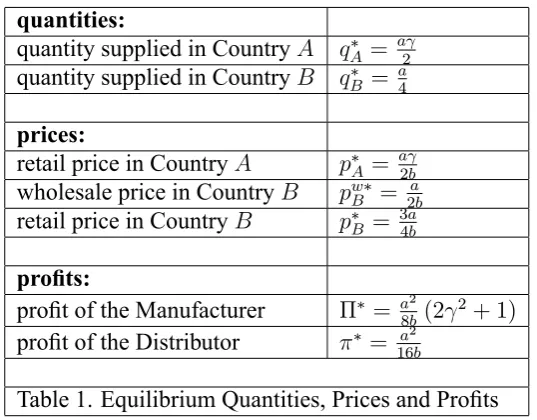
Using backward induction we obtain the following quantities, prices and pro ts:
quantities:
quantity supplied in CountryA qA= a2
quantity supplied in CountryB qB =
a
4
prices:
retail price in CountryA pA= a2b
wholesale price in CountryB pw
B = 2ab
retail price in CountryB pB = 3a
4b
pro ts:
pro t of the Manufacturer = a2
8b(2
2+ 1)
pro t of the Distributor = a2
[image:9.595.164.433.103.313.2]16b
Table 1. Equilibrium Quantities, Prices and Pro ts
Note that the distributor marks up the price of the product,pB, by 50 percent, compared to the
wholesale pricepw B .
So far, we have assumed that the manufacturer is awarded the right to prevent parallel trade. In
the following section, we relax this assumption and allow for parallel trade, in order to explore
the important strategic decision faced by the manufacturer as to at which wholesale price the
product is sold to the distributor in CountryB, anticipating that part of the quantities sold can
be re-imported.
3.1.2 Double Marginalization Game with Parallel Trade
Suppose that the manufacturer cannot contractually limit or even prohibit parallel trade. The
timing of the game is as follows:
In the rst stage, the manufacturing rm chooses the wholesale pricepw
B,pwB 2[0;1), at which
he sells the product to the distributor in CountryB.
In the second stage, the distributor chooses the retail pricepB,pB 2[0;1), in CountryB.
In the third stage, the manufacturer m and the exclusive distributor r simultaneously choose
the price at which they sell the product in Country Ain a Bertrand model of duopoly, e.g. pm A,
pm
A 2 [0;1), and prA, prA 2 [0;1), respectively. We solve the game starting with the last
stage and working backwards to the rst stage, in order to look for the sub-game perfect Nash
Proposition 3.1 Parallel trade will never occur in any sub-game perfect Nash equilibrium in a double marginalization game with complete information and Bertrand price competition in the last stage.
Backward Induction We start with the last stage where the manufacturer and the
dis-tributor play a Bertrand game24 and simultaneously choose prices for the product in CountryA.
Prices and demand served must be consistent with the following rules:
qm A =
a bpm
A ifpmA < prA
1
2(a bp
m
A) ifpmA =prA
0ifpm A > prA.
Similarly,
qr A =
a bpr
AifprA< pmA
1
2 (a bp
r
A) ifprA=pmA
0ifpr
A> pmA.
The manufacturer has xed cost of zero and marginal cost of zero. The distributor also has xed
cost of zero. However, the distributor treats the sum of the wholesale pricepw
B and the per unit
cost of engaging in parallel tradet as his marginal cost of selling the product in CountryA in
the third stage.
First, note that a rm would never charge a price that is lower than its marginal cost. In this
case, the rm could increase its pro ts by simply reducing the quantities produced. On the
one hand, the manufacturer could supply a positive quantity of the product as long as the price
is non-negative, as his marginal costs are zero. On the other hand, the distributor would not
charge a price smaller than his marginal costpw
B+t. Hence, the manufacturer can monopolize
the market in Country A and steal all of the customers from the parallel importing distributor
by setting a price that is in nitesimally smaller than the marginal cost of the distributor. Put
differently, the manufacturer will always set a pricepm
A < pwB+t. Consequently, the distributor
will not stay in the market in CountryAand will not engage in parallel trade [Proposition 3.1]. Note that this result holds for any non-negativepw
B and any positivet.
Nevertheless, in the second stage, the distributor anticipates that he will be driven out of the
market in Country A in the third stage. Hence the maximization problem of the distributor
24 See Müller-Langer (2007), footnote 60, with respect to the advantages of Bertrand's approach over the
is identical to the maximization problem we have already discussed in the previous section.
Working backwards to the rst stage, the maximization problem of the manufacturer is to
max-imize the total pro t generated in Country A and Country B, subject to the constraint stated
in pm
A pwB +t25 and subject to the non-negativity restrictions stated inpmA 0and pwB 0.
Adopting the Kuhn-Tucker Method, the maximization problem has the following format:
max (pm
A; pwB) = ( a bpmA)pmA +
1 2 p
w
B(a bpwB) (1)
subject to pm
A 0
and pwB 0
and pm
A p
w
B t:
Let us write the classical type of the Lagrangian function,L, as follows
L(pmA; p w
B; 1; 2; 3) = ( a bpmA)p m A +
1 2 p
w
B(a bp w
B) + 1pmA + 2pBw+ 3(t+pwB p m A)
We obtain the following rst-order conditions:
@L @pm
A
= a 2bpmA + 1 3 = 0;
@L @pw B
= 1
2 a bp
w
B+ 2+ 3 = 0;
1pmA = 0;
2pwB = 0;
3(t+pwB p m
A) = 0:
pmA 0; p w B 0;
t+pw
B pmA 0:
1 0; 2 0; 3 0:
We must now nd solutions (pm
A; pwB; 1; 2; 3) that satisfy all rst-order conditions. As we
have three Lagrange multipliers that are either positive or equal to zero, we have to distinguish
between nine different cases. After checking each of the nine cases with regard to the question
as to whether it satis es all rst-order conditions we obtain two solutions: (pm
A ; pwB ; 1; 2; 3)
25 Note that the manufacturer always sets a price in CountryAthat undercuts the distributor's marginal costs.
and(pm
A ; pwB ; 1 ; 2 ; 3 ). The rst solution is given by: 0 B B B B @ pm
A = 6ab(2 + 1) + t
3;
pw
B = 6ab(2 + 1)
2t
3; 1 = 0;
2 = 0; 3 = a3( 1)
2bt 3 : 1 C C C C A
Note that the optimal price the manufacturer sets in Country A always exceeds the optimal
wholesale price the manufacturer charges the distributor in CountryB ast > 0. More speci
-cally, pm
A pwB = t. Furthermore, we can see that the optimal wholesale price decreases ift
increases, and that the optimal price the manufacturer sets in CountryAincreases iftincreases,
respectively. Put differently, the higher the parallel trade cost tfor a given and thus the less
pro table parallel trade the higher ispm
A and the lowerpwB . However, we can also see that the
non-negativity restriction for 3 is only satis ed for speci c values of the parameter t. More
speci cally, from 3 0follows
t a
2b( 1):
Henceforth, we will refer to this threshold as the upper bound for the trade cost, that is t =
a
2b ( 1).
To summarize,(pm
A ; pwB ; 1; 2; 3)only satis es all rst-order conditions ift t.26 If, how-ever, t > t, i.e. for high parallel trade cost and a relatively low ,(pm
A ; pwB ; 1; 2; 3)is not a solution for the maximization problem given by (1), due to the fact that the non-negativity
restriction for 3would not be satis ed. Thus we have to consider the second solution given by 0 B B B B @ pm A = a
2b;
pw
B =
a
2b;
1 = 0; 2 = 0; 3 = 0:
1 C C C C A
By comparing these results with the results from the previous section (see Table 1), we nd that
pm
A is equal to the monopoly price in a double marginalization game in which parallel trade is
prohibited, andpw
B is equal to the pro t-maximizing wholesale price in a double
marginaliza-tion game in which parallel trade is prohibited, respectively. Intuitively, if the two countries are
26 See Appendix 1 for the proof that for the non-negativity restriction forpw
B to be satis ed it is suf cient that
virtually homogeneous( !1)and the parallel trade costs are so high thatt > t, the
distribu-tor will not be willing to engage in parallel trade. Put differently, if t > t, the outcome of the
double marginalization game in which parallel trade is permitted is equal to the outcome of the
double marginalization game in which the manufacturer is awarded the right to prevent parallel
trade.
4 Effects of Parallel Trade Freedom on Pro ts, Consumer Surplus
and National Welfare
4.1
Equilibrium Prices and Quantities
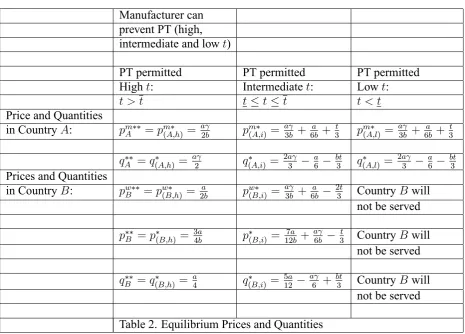
Table 2 provides a summary of the equilibrium prices and quantities in CountryAand Country
B when the manufacturer is awarded the right to prevent parallel trade (PT) and when parallel
trade is permitted for low trade cost (denoted by subscriptl), intermediate trade cost (denoted
by subscripti) and high trade cost (denoted by subscripth).
Manufacturer can prevent PT (high, intermediate and lowt)
PT permitted PT permitted PT permitted
Hight: Intermediatet: Lowt:
t > t t t t t < t
Price and Quantities
in CountryA: pm
A =pm(A;h) =
a
2b p
m
(A;i) =
a
3b + a
6b + t
3 p
m
(A;l)=
a
3b + a
6b + t
3
qA =q(A;h) = a2 q(A;i) = 2a3 a
6
bt
3 q(A;l)= 2a 3 a 6 bt 3 Prices and Quantities
in CountryB: pw
B =pw(B;h)=
a
2b p
w
(B;i) =
a
3b + a
6b
2t
3 CountryB will
not be served
pB =p(B;h) = 3a
4b p(B;i) = 7
a
12b + a
6b t
3 CountryB will
not be served
qB =q(B;h) =
a
4 q(B;i) = 5
a
12
a
6 +
bt
3 CountryB will
[image:13.595.71.537.397.731.2]not be served
Table 2. Equilibrium Prices and Quantities
with and without parallel trade are identical ift > t, withtbeing theupperbound fort. There is, however, also a lowerbound for t under a regime of international exhaustion of IPRs with parallel trade as we will see in the following. The distributor will only be willing to sell the
product in CountryBas long as he can sell a quantity of the product in CountryBthat is equal
to or greater than zero and as long as the retail price he can charge is equal to or greater than the
wholesale price set by the manufacturer. Put differently, fromp(B;i) pw
(B;i) (and q(B;i) 0) follows
t a
2b
5 2 :
Henceforth, we will refer to this threshold as the lower bound for the trade cost, that is t=
a
2b
5
2 . Intuitively, if trade costs are very low, i.et < t, potential competition from parallel trade is so erce that the manufacturer has to charge such a high wholesale price in CountryBin
order to deter parallel trade that the distribution of the good in CountryBbecomes unpro table.
In this case, the market in CountryB will not be served.
To summarize, we have to consider three different scenarios. First, parallel trade costs are so
high – more speci callyt > t– that parallel trade is not a worthwhile activity for the distributor
and thus a non-credible threat. In other words, for very high trade costs, the equilibrium
out-come will be the same no matter whether or not the manufacturer is awarded the right to prevent
parallel trade. More speci cally, parallel trade does not have any impact on pro ts, consumer
surplus as well as national and global welfare. However, the analysis of the second scenario
with trade costs at an intermediate level – more speci callyt t t– is not trivial. As we will
see in the following, for intermediate trade costs, the manufacturer will strategically set prices
in order to deter parallel trade under a regime of international exhaustion of IPRs. However, the
wholesale price will be suf ciently low so that the distribution of the product in CountryB is
still a worthwhile activity. In the third scenario with very low trade costs – more speci cally
t <t– the manufacturer will charge such a high wholesale price in CountryB, in order to deter
parallel trade under a regime of international exhaustion of IPRs that the market in CountryB
In the following sections, we will analyze the impact of parallel trade freedom on the pro t of
the manufacturer and on global welfare for intermediate and low trade costs, respectively.
4.2
Effect of Parallel Trade Freedom on the Pro t of the Manufacturer
Appendix 2 shows that the following proposition holds.
Proposition 4.1 The threat of parallel trade – under a regime of international exhaustion of
IPRs – leads to lower pro ts of the manufacturer (i) if trade costs are intermediate and (ii) if trade costs are low, respectively.
The intuition behind this result is the following. First, the equilibrium pro t of the
manufac-turer will be the same no matter whether or not the manufacmanufac-turer is awarded the right to prevent
parallel trade if trade cost are very high. In this case, parallel trade is not a credible threat and
does not erode the manufacturer's ability to discriminate prices which is the rst-best outcome
from the manufacturer's perspective. If, however, trade costs are intermediate or low, parallel
trade is a credible threat and the manufacturer strategically sets prices in order to deter it.
Con-sequently, a credible threat of parallel trade erodes the manufacturer's ability to discriminate
prices and thus reduces his pro t as compared to a situation where he is awarded the right to
prevent parallel trade.
Nevertheless, an important point in favor of banning parallel trade is the following. By the time
the manufacturer chooses to invest in R&D for a new product, he will be more willing to do so,
anticipating that he will be able to raise more money from the development of a new product.
In other words, under the assumption that the R&D investment leads with certainty to the
de-velopment of a new product, the maximum amount that the manufacturer is willing to invest in
R&D for the product is just the pro t that he can generate. As the pro t of the manufacturer
if he is awarded the right to prevent parallel trade is higher than his pro t under parallel trade
freedom, the incentive of the manufacturer to invest in R&D – for low and intermediate trade
costs – is higher if he can prevent parallel trade.27
To summarize, Proposition 4.1 suggests that the manufacturer can never be better off under
parallel trade freedom. Hence, if the unique social objective were to spur R&D for new products
by protecting the manufacturer who holds a patent on the product in Country A and Country
B, our model suggested that the manufacturer should be awarded the right to prevent parallel
trade.
However, the protection of the manufacturer is clearly not the only social objective. Indeed,
we have got to take a closer look at the welfare effects of parallel trade freedom. Therefore,
a central purpose of the following sections is to explore the question as to whether parallel
trade should be permitted or prohibited from a global welfare perspective if trade costs are at an
intermediate level and if trade costs are low.
However, in order to be able to calculate global welfare, we rst derive the pro t of the
dis-tributor, consumer surplus, as well as welfare in Country A and Country B if trade costs are
intermediate and low, respectively.
4.3
Pro t of the Distributor
If the manufacturer is awarded the right to prevent parallel trade, the pro t of the distributor is
the same for high, intermediate and low trade costs and given by
= h = (pB p w
B )qB =
a2
16b:
Note that the distributor generates the same pro t if parallel trade is permitted but trade costs
are high, h.
If, however, trade costs are intermediate and parallel trade is permitted, the distributor will make
a pro t according to
i = p(B;i) pw(B;i) q(B;i)=
25a2
144b +
5at
18 +
bt2
9
5a2
36b at
9 +
a2 2
36b :
Parallel trade freedom is detrimental to the distributor in this case as i = i < 0.28
The intuition behind this result is the following. If the threat of parallel trade is credible, the
manufacturer will charge a higher wholesale price in CountryB– as compared to the wholesale
price under a regime in which parallel trade is prohibited – in order to deter parallel trade.
28 To see that this is true note that
ihas its unique maximum at the lower bound fort,t. Furthermore, iis
Consequently, the distributor will sell less at a higher price resulting in a lower pro t under a
regime of parallel trade freedom.
Finally, recall that neither the distribution of the good in Country B nor parallel trade is a
worthwhile business activity if trade costs are low as the manufacturer strategically charges a
prohibitively high wholesale price in Country B in order to deter parallel trade. Hence, the
pro t of the distributor for low trade costs is equal to zero if parallel trade is permitted.
4.4
Consumer Surplus in Country
A
We obtain the consumer surplus in Country A if the manufacturer has the right to prevent
parallel trade as follows:
SA =S(A;h) =
1 2qA
a b p
m
A =
a2 2
8b :
Note that the consumer surplus in Country A if parallel trade is permitted but trade costs are
high,S(A;h), is equal toSA.
Furthermore, the consumer surplus in CountryAfor intermediate trade costs if parallel trade is
permitted is given by
S(A;i)=
1 2q(A;i)
a b p
m
(A;i) =
a2
72b + at
18+
bt2
18
a2
9b
2at
9 + 2a2 2
9b :
Finally, we obtain the consumer surplus in Country A for low trade costs if parallel trade is
permitted as follows
S(A;l) = a
2
72b + at
18+
bt2
18
a2
9b
2at
9 + 2a2 2
9b :
4.5
Consumer Surplus in Country
B
We obtain the consumer surplus in CountryBif the manufacturer is awarded the right to prevent
parallel trade as follows:
SB =S(B;h) = 1 2qB
a
b pB = a2
32b:
Note that the consumer surplus in Country B if parallel trade is permitted but trade costs are
high,S(B;h), is equal toSB.
permitted is given by
S(B;i) =
1 2q(B;i)
a
b p(B;i) =
25a2
288b +
5at
36 +
bt2
18
5a2
72b at
18 +
a2 2
72b :
Finally, recall that the distribution of the good in CountryB is not a worthwhile business
ac-tivity if trade costs are low as the manufacturer charges a prohibitively high wholesale price in
CountryB in order to deter parallel trade. Hence, consumer surplus in Country B is equal to
zero if parallel trade is permitted and trade costs are low.
4.6
National and Global Welfare
By adding the relevant pro ts and the corresponding consumer surpluses we obtain national
welfare as well as global welfare levels for high, intermediate and low trade costs if the
man-ufacturer has the right to prevent parallel trade and if it is permitted, respectively. Table 3
summarizes the results.
Manufacturer can prevent PT (high, intermediate and lowt)
PT permitted PT permitted PT permitted
Hight: Intermediatet: Lowt:
t > t t t t t < t
Welfare in CountryA: WA =W(A;h) W(A;i) = i +S(A;i) W(A;l)= l +S(A;l)
= +SA = a
2
18b
5at
18
5bt2
18 = a2 72b at 18 bt2 18 = a 2
8b +
3a2 2
8b + a2
18b + at
9 + 7a2 2
18b
a2
18b at
9 + 4a2 2
9b
Welfare in CountryB: WB =W(B;h) W(B;i) = i +S(B;i) W(B;l) = 0
= +SB =
3a2
32b =
25a2
96b +
5at
12 +
bt2
6 5a2
24b at
6 +
a2 2
24b
Global Welfare: W =Wh Wi =W(A;i)+W(B;i) Wl =W(A;l)
=WA +WB = 91a
2
288b +
5at 36 bt2 9 = a2 72b at 18 bt2 18 = 7a
2
32b +
3a2 2
8b
11a2
72b
at
18 +
31a2 2
72b
a2
18b at
9 + 4a2 2
[image:18.595.71.575.367.731.2]9b
Table 3. National and Global Welfare Levels
the cases of high, intermediate, and low trade costs.
5 Effect of Parallel Trade Freedom on Global Welfare
We derive the net effect of parallel trade freedom on global welfare by subtracting global welfare
if the manufacturer has the right to prevent parallel trade from global welfare if parallel trade
is permitted. The intuition behind this is the following. If this difference is negative, parallel
trade is detrimental to global welfare and thus the manufacturer should be awarded the right
to prevent parallel trade. If, however, this difference is positive, it would indicate that global
welfare is higher if parallel trade is permitted.
5.1
Net Effect of Parallel Trade Freedom on Global Welfare if Trade Costs
are High
We already know from the analysis in the previous sections that the outcome of the double
marginalization game if parallel trade is permitted is equal to the outcome of the double
mar-ginalization game without parallel trade if trade costs are high,t > t. Therefore, even if parallel
trade were permitted, the (non-credible) threat of parallel trade would not have any impact on
global welfare because parallel trade is not a worthwhile business activity for the distributor
due to prohibitively high trade costs. However, let us now analyze the other two cases with
intermediate and low trade costs in which potential competition from parallel trade may arise
as parallel trade is a worthwhile business activity for the exclusive distributor.
5.2
Net Effect of Parallel Trade Freedom on Global Welfare if Trade Costs
are at an Intermediate Level
5.2.1 Net Effect of Parallel Trade Freedom on Global Welfare for Intermediate Trade
Costs and 5=2
In this section, we will show that the following proposition holds.
Proposition 5.1 Parallel trade freedom increases global welfare if trade costs are
intermedi-ate and 5=2.
are at an intermediate level. We obtain Wi as follows:
Wi =Wi W =
7a2
72b +
5at
36
bt2
9
11a2
72b
at
18 +
a2 2
18b : (2)
Note that Wi is a quadratic function oft. If Wi is positive, parallel trade freedom has a
positive effect on global welfare. If, however, it is negative, parallel trade freedom is detrimental
to global welfare. First, note that Wi = 0at the upper bound fort, t = 2ab( 1). Hence, in
order to show that Wiand thus the effect of parallel trade freedom on global welfare is positive
it is suf cient to show that Wi is a monotonically decreasing function oftfor t t t. Let
us rst nd out whether Wi has a unique maximum. From
@ Wi
@t = 5a 36 2bt 9 a
18 = 0
follows:
tmaxi =
a
2b
5
4 2 :
Note that tmax
i is the unique maximum as
@2 Wi
@2t = 2
9b < 0asb > 0. Ast max
i is the unique
maximum, Wi decreases in t for any t > tmaxi . In other words, if t > a
2b
5
4 2 , Wi
decreases int. Furthermore, taking into account that Wi = 0att= 2ab( 1), it follows that
Wi > 0fort > 2ab 54 2 . In the following, we consider for which values of the parameter
tmax
i is smaller than or equal to the lower bound t. It is straightforward to see thattmaxi t
if 5
2. In other words, for
5
2 the unique maximum of Wi is located on the left-hand side of the lower bound fort. Furthermore, Wi monotonically decreases inton the interval
between the lower bound and the upper bound fort. Hence, taking into account that Wi = 0
at the upper bound fort, Wi and thus the impact of parallel trade on global welfare is positive
if 52 as stated inProposition 5.1.
5.2.2 Net Effect of Parallel Trade Freedom if Trade Costs are at an Intermediate Level
and < 5
2
If < 52, we cannot apply the same logic as in the previous section in order to answer the
question as to whether Wi is positive or negative. Note that – for < 52 – the lower bound
t = a
2b
5
2 would be negative. However, astis positive we set the lower bound fortequal to zero in this case. Furthermore, note that - for < 52 - Wi has its unique maximum at
tmax
i =
a
2b
5
4 2 which is positive as <
5
positive or negative at the lower bound fort. For instance, if we can show that Wi is positive
at t = 0 this would imply that Wi is also positive between the lower bound and the upper
bound taking into account that Wi = 0 at the upper bound for t. In the following we will
show that Wiis positive att= 0if 74 < 52.
5.2.3 Net Effect of Parallel Trade Freedom on Global Welfare for Intermediate Trade
Costs and 74 < 5
2
In this section, we will show that the following proposition holds.
Proposition 5.2 Parallel trade freedom increases global welfare if trade costs are at an
inter-mediate level and 74 < 5 2.
By settingt= 0in (2) we obtain
Wi =
7a2
72b
11a2
72b + a2 2
18b :
Note that Wi is greater than or equal to zero if 74.29 Consequently, if 74, Wi is
positive between zero and the upper bound for t. Thus, parallel trade freedom has a positive
impact on global welfare if 74 < 52 [seeProposition 5.2]. However, let us now consider the case if1< < 74.
Net Effect of Parallel Trade Freedom on Global Welfare for Intermediate Trade Costs and
1< <7=4 In this section, we will give an example in order to illustrate that the following
proposition holds.
Proposition 5.3 Parallel trade freedom can have negative welfare properties if trade costs are
at an intermediate level and is suf ciently low [1< < 7 4].
We already know from the previous section that Wi = 0at the upper bound
_
t = a
2b ( 1).
However, by looking at (2), it becomes apparent that Wihas another null at
t = a 2b
7
2 2 :
Note that – in contrast to the previous sections –tis positive in this case as <7=4. However,
the following example illustrates thatProposition 5.3holds.
29 For instance, we can see that7 11 + 4 2
= 0if =7
4 and that7 + 4 2
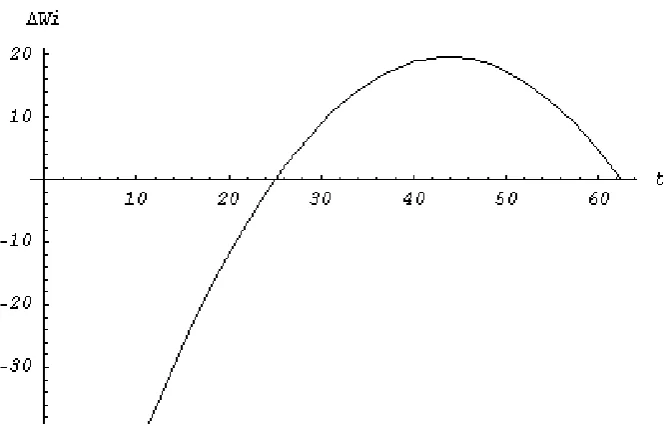
Figure 1. Net Welfare Effect of Parallel Trade Freedom (a= 100,b= 1
2 and =
13 8 )
Example 5.1 We seta= 100,b = 1
2 and =
13 8.
Figure 1 shows that Wihas one null att= 25and the other null att= 62:5which is also the
upper bound. Furthermore, Wihas its unique maximum attmaxi = 43:75and the lower bound
att= 0.
We can see from Figure 1 that Wi < 0 8t 2 (0;25) which suggests that Proposition 5.3
holds. The intuition behind this result is the following. As we have shown before, parallel trade
freedom harms both the manufacturer as well as the distributor. Parallel trade freedom is also
detrimental to consumers in Country B because it leads to a higher retail price and a lower
quantity sold in Country B. Hence, consumers in Country A are the only bene ciaries from
parallel trade freedom. As long as is suf ciently high, 74 , the positive effect of parallel
trade freedom on the consumer surplus in CountryAceteris paribus more than outweighs the sum of the negative effects of parallel trade freedom on the pro t of the manufacturer, the pro t
of the distributor and the consumer surplus in County B. If, however, Country A and B are
virtually homogeneous, 1 < < 74, consumers in Country A will bene t less from parallel
trade freedom. In this case, the net effect of parallel trade freedom on global welfare will be
5.3
Net Effect of Parallel Trade on Global Welfare if Trade Costs are Low
In this section, we shall show that the following proposition holds.
Proposition 5.4 Parallel trade freedom increases global welfare if trade costs are low and
is suf ciently high ( > 52).
If trade costs are low, t > t, the effect of parallel trade freedom on global welfare is given by:
Wl=Wl W =
67a2
288b at
18
bt2
18
a2
18b at
9 + 5a2 2
72b : (3)
Note that Wl is a quadratic function oft. Moreover, recall that – astis positive – must be
greater than 52. For smaller values of the parameter would automatically end up in one of the
other scenarios mentioned above. However, by differentiating (3) we obtain
tmaxl =
a b
1
2 + :
Note thattmax
l is the unique maximum as
@2 Wl
@2t = 1
9b < 0asb > 0. Furthermore, note that
tmax
l <0asa >0,b >0and >0. However, by settingt = 0in (3) we obtain
Wl =
67a2
288b
16a2
288b +
20a2 2
288b :
We can see that – att = 0– Wl >0if > 52.30. Furthermore, by settingt =t
_ =
a
2b
5 2
in (3) it follows that
Wl=
a2
4b + a2
8b :
Note that Wlis positive as > 52.31 Consequently, taking into account that Wlis a quadratic
function of t, tmax
l < 0, Wl > 0 at t = 0, and Wl > 0 at t
_, it is straightforward to see
that Wl is positive if trade costs are low and suf ciently high ( > 52) [see Proposition
5.4]. In other words, parallel trade freedom still has a positive effect on global welfare in this case even though the market in Country B remains unserved. Intuitively, if is suf ciently
high the positive effect of parallel trade freedom on the consumer surplus in CountryAceteris paribus more than outweighs the negative effect of parallel trade freedom on the pro t of the manufacturer and the closure of the market in CountryB.
30 For instance, note that20 2
16 67>0if >5 2:
6 Conclusion
Our model suggests that parallel trade in a double marginalization game with complete
infor-mation will never occur in the sub-game perfect equilibrium, as it is always bene cial for the
manufacturer to monopolize the market in CountryA. However, the question arises as to how
the manufacturer strategically chooses prices in order to prevent the occurrence of parallel trade.
As we have shown, this depends on the level of the heterogeneity of the two countries in terms
of market size – as measured by – and the trade coststfor given values foraandb. If parallel
trade cost are high,t > t, potential competition from parallel trade does not arise and thus the
manufacturer will always charge the monopoly price in Country Aand the optimal wholesale
price in Country B. Intuitively, parallel trade is a non-credible threat if parallel trade cost are
high and the two countries are virtually homogeneous, i.e. if ! 1. If, however, parallel
trade cost are low,t t, potential competition from parallel trade arises and the manufacturer
strategically sets the wholesale price in CountryB and the price in CountryA, in order to
pre-vent that parallel trade occurs. Maskus and Ganslandt (2002) suggest in a non-technical article
on parallel trade in pharmaceuticals and its implications for low-income countries that, under
plausible circumstances, parallel trade may increase prices in low-income countries and that
smaller markets might end up not being served. Indeed, the analysis of our parallel trade model
shows that this assertion is correct if trade cost are low and is suf ciently high, i.e. > 52.
More speci cally, we nd that – for low trade costs – potential competition from parallel trade
is so erce that the manufacturer charges such a high wholesale price in CountryB in order to
deter parallel trade that the distribution of the product in CountryB becomes unpro table. In
this case, the market in CountryB will not be served. Consequently, it would be desirable for
CountryB to discourage parallel trade and to encourage price discrimination in order to open
the otherwise unserved domestic market.32 As to the impact of parallel trade freedom on the
pro t of the manufacturer, we come to the following conclusion. If parallel trade is permitted,
the credible threat of parallel trade leads to lower pro ts of the manufacturer and thus reduces
his incentives to invest in R&D [Proposition 4.1].
As to the welfare properties of parallel trade, parallel trade freedom increases global welfare
if is suf ciently high, > 52 [Proposition 5.1andProposition 5.4]. If, however, trade costs are intermediate and is suf ciently low,1< < 7
4, parallel trade freedom can have negative
welfare properties [Proposition 5.3]. In this case, the negative effect of parallel trade freedom on the manufacturer, the distributor as well as on the consumers in Country B more than
out-weighs the positive effect of parallel trade freedom on the consumers in CountryA.
As a rst idea for further research, we suggest a more elaborate theoretical and empirical
analy-sis of the parameter t which is of signi cant importance for the results of our model. For
instance, suppose that t is very low. In this case, Country B is likely to end up not being
served at all under parallel trade freedom. As already mentioned, costs of packaging and
re-labeling are incurred by the parallel-importing distributor as well as other parallel trade-speci c
transaction costs such as import duties on parallel trade. One may argue that the parameter t
can to some extent be in uenced by the manufacturer, i.e. through special labeling, language,
warnings etc. that make re-packaging and re-labeling more expensive for the parallel-importing
distributor.33 Intuitively, on the one hand, the manufacturer may prefer to make parallel trade as
costly as possible, in order to prevent parallel trade. Consider again the case of very low parallel
trade costs where CountryB ends up not being served. In this case, it may be bene cial for the
manufacturer to increasetso that he can sell his product in CountryB even under parallel trade
freedom. On the other hand, to increasetthrough special labeling, language and warnings may
also be costly for the manufacturer so that a trade-off arises between the costs of increasingt
and the bene t from preventing parallel trade.
As a second idea for further research, we suggest analyzing the strategic behavior of foreign
governments to protect consumers in their country from excessive pricing, i.e. through price
caps or compulsory licensing.
7 Appendix
Appendix 1: Proof with respect to the Non-negativity Restriction for the Equilibrium
Wholesale Price in CountryB
In the following we show that for the non-negativity restriction for pw
B to be satis ed it is
suf cient that the non-negativity restriction for 3,t a
2b( 1), is satis ed. Recall that pwB =
a
6b(2 + 1)
2 3t 0
, t a
4b (2 + 1):
Hence, the non-negativity restriction for pw
B is satis ed if the non-negativity restriction for 3
is satis ed as a
4b(2 + 1)> a
2b ( 1).
Appendix 2: Proof of Proposition 4.1
Effect of Parallel Trade Freedom on the Manufacturer's Pro t for Intermediate Trade
Costs
At an intermediate level of t, t t t, the equilibrium pro t of the manufacturer if parallel
trade is permitted is given by
i = (A;i)= (B;i) =p
m
(A;i)q(A;i)+p
w
(B;i)q(B;i) =
a2 24b at 3 bt2 3 + a2
6b + at
3 +
a2 2
6b :
However, at an intermediate level oft, the equilibrium pro t of the manufacturer if he is awarded
the right to prevent parallel trade is given by
i = = A + B =p
m
A qA +p w
B qB =
a2
8b + a2 2
4b :
Note that i = l = h = as the pro t of the manufacturer is always the same if he is
awarded the right to prevent parallel trade. The question arises as to whether parallel trade – at
an intermediate level of t– has a positive or negative impact on the pro t of the manufacturer.
In particular, let i denote the difference between the equilibrium pro t of the manufacturer
if parallel trade is permitted and the equilibrium pro t of the manufacturer if he has the right to
prevent parallel trade. Hence,
i = i i =
a2 12b at 3 bt2 3 + a2
6b + at
3
a2 2
12b :
feature. It is straightforward to see that a negative i would indicate that the manufacturer
can generate a higher pro t if he were awarded the right to prevent parallel trade. In other
words, in order to show that, for intermediate trade costs, parallel trade harms the manufacturer
it is suf cient to show that i is negative. Intuitively, i = 0 ift = t as the equilibrium
quantities and prices are identical in both situations with and without parallel trade. In order to
see that this intuition is correct, sett=t= a
2b( 1)in i. Furthermore, note ithat has
its maximum att =tas
@ i
@t = a
3 2bt
3 +
a
3 = 0
, t= a
2b ( 1)
and
@2
i
@2t =
2b
3 <0
as b > 0. To summarize, i is a quadratic function of t and has its unique maximum at
t. Furthermore, i = 0at t. Hence, i is negative for any other value of the parameter
t. Therefore, for intermediate trade costs, parallel trade freedom harms the manufacturer as it
leads to a lower pro t [Proposition 4.1 (i)].
However, let us now turn to the question as to whether the same reasoning applies to the case
with low trade costs in the following.
Effect of Parallel Trade Freedom on the Manufacturer's Pro t for Low Trade Costs
In this section, we consider the case of very low trade costs, t <t. Recall that trade costs are
positive. Hence, we can see fromt <t= a
2b
5
2 that must be greater than
5
2 in this case.
For smaller values of the parameter we would automatically end up in one of the other two
scenarios mentioned above. Intuitively, if is very low, i.e. !1, parallel trade may not be
a highly attractive business activity for the distributor even if trade costs are very low.
However, if trade costs are very low and > 5
2, the market in CountryB will end up not being served. Hence, the manufacturer will only generate a pro t in Country A if parallel trade is
permitted. The pro t is given by
l =p m
(A;l)q(A;l) =
a2
36b at
9
bt2
9 +
a2
18b + at
9 + 2a2 2
However, for low trade cost, the equilibrium pro t of the manufacturer if he is awarded the right
to prevent parallel trade is given by
l = i =
a2
8b + a2 2
4b :
The question arises as to whether the threat of parallel trade – for low trade cost – has a positive
or negative impact on the pro t of the manufacturer. Let ldenote the difference between the
equilibrium pro t of the manufacturer if parallel trade is permitted and the equilibrium pro t of
the manufacturer if he has the right to prevent parallel trade. Hence,
l = l l =
11a2
72b at
9
bt2
9 +
a2
18b + at
9
a2 2
36b :
Note that l is a quadratic function oft. Let us now nd the maximum of l. We obtain
the maximum as follows
@ l
@t = a
9 2bt
9 +
a
9 = 0
() t= a
2b( 1)
and
@2
l
@2t =
2b
9 <0
as b > 0. l has its unique maximum at t = 2ab( 1). Hence, in order to show that l
is negative for t <t it is suf cient to show l that is negative att. Therefore, by plugging
t = a
2b ( 1)into lwe obtain
l =
a2
8b <0
as a > 0 and b > 0. It follows that, for low trade costs, the pro t of the manufacturer – if
he is awarded the right to prevent parallel trade – is higher than the pro t of the manufacturer
if parallel trade is permitted. Therefore, for low trade cost, parallel trade freedom harms the
manufacturer as it leads to a lower pro t [seeProposition 4.1 (ii)].
8 References
Arfwedson, J. (2004), Parallel trade in pharmaceuticals, IPI Policy Report No. 182, Lewisville: Institute for Policy Innovation.
over parallel imports", Journal of World Intellectual Property, 1(6), 903-939.
Bar eld, C. E. and M. A. Groombridge (1999), "Parallel trade in the pharmaceutical indus-try: implications for innovation, consumer welfare, and health policy", Fordham Intellectual Property, Media and Entertainment Law Journal, 10(1), 185-266.
Brekke, K. R., A. L. Grasdal, and T. H. Holmås (2009), "Regulation and pricing of pharmaceu-ticals: reference pricing or cap regulation?", European Economic Review, 53, 170-185.
Chard, J. S. and C. J. Mellor (1989), "Intellectual property rights and parallel imports", World Economy, 12(1), 69-83.
Danzon, P. M. (1997), Pharmaceutical price regulation, Washington, D.C.: American Enterprise Institute Press.
Danzon, P. M. (1998), "The economics of parallel trade", PharmacoEconomics, 13(3), 293-304. Danzon, P. M. and A. Towes (2003), "Differential pricing for pharmaceuticals: reconciling access, R&D and patents", International Journal of Health Care Finance and Economics, 3(3), 183-205.
Fink, C. (2005), "Entering the jungle of intellectual property rights exhaustion and parallel importation" in Fink C. and K. E. Maskus (ed.), Intellectual property and development: lessons from recent economic research, 171-188, World Bank and Oxford University Press.
Gallini, N. T. and A. Hollis (1999), "A contractual approach to the gray market", International Review of Law and Economics, 19(1), 1-21.
Ganslandt, M. and K. E. Maskus (2004), "Parallel imports and the pricing of pharmaceutical products: evidence from the European Union", Journal of Health Economics, 23(5), 1035-1057. Grossman, G. M. and E. L.-C. Lai (2008), "Parallel imports and price controls", RAND Journal of Economics, 39(2), 378-402.
Harhoff, D. and M. Reitzig (2004), "Determinants of opposition against EPO patent grants - the case of biotechnology and pharmaceuticals", International Journal of Industrial Organization, 22(4), 443-480.
Harhoff, D., F. M. Scherer, and K. Vopel (2003), "Citations, family size, opposition and the value of patent rights", Research Policy, 32(8), 1343-1363.
Jelovac, I. and C. Bordoy (2005), "Pricing and welfare implications of parallel imports in the pharmaceutical industry", International Journal of Health Care Finance and Economics, 5(1), 5-21.
Li, C. and K. E. Maskus (2006), "The impact of parallel imports on investments in cost-reducing research and development", Journal of International Economics, 68(2), 443-455.
Li, C. and J. Robles (2007), "Product innovation and parallel trade", International Journal of Industrial Organization, 25, 417-429.
Malueg, D. A. and M. Schwartz (1994), "Parallel imports, demand dispersion, and international price discrimination", Journal of International Economics, 37(3/4), 167-195.
Mans eld, E. (1986), "Patents and innovation: an empirical study", Management Science, 32(2), 173-181.
Maskus, K. E. (2000a), Intellectual property rights in the global economy, Washington, DC: Institute for International Economics.
Maskus, K. E. (2001), Parallel imports in pharmaceuticals: implications for competition and prices in developing countries, Geneva: Final Report to the World Intellectual Property Organi-zation.
Maskus, K. E. and Y. Chen (2004), "Vertical price control and parallel imports: theory and evidence", Review of International Economics, 12(4), 551-570.
Maskus, K. E. and M. Ganslandt (2002), "Parallel trade in pharmaceutical products: impli-cations for procuring medicines for poor countries" in Granville, B. (ed.), The economics of essential medicines, 57-80, London: Royal Institute of International Affairs.
Müller-Langer, F. (2007), A game theoretic analysis of parallel trade and the pricing of pharma-ceutical products, German Working Papers in Law and Economics, vol. 2007, art. 6, Berkeley Electronic Press.
Müller-Langer, F. (2009), Creating R&D incentives for medicines for neglected diseases: an economic analysis of parallel imports, patents, and alternative mechanisms to stimulate phar-maceutical research, Wiesbaden: Gabler.
Richardson, M. (2002), "An elementary proposition concerning parallel imports", Journal of International Economics, 56(1), 233-245.
Szymanski, S. and T. M. Valletti (2005), "Parallel trade, price discrimination, investment and price caps", Economic Policy, 20(44), 705-749.
Valletti, T. M. (2006), "Differential pricing, parallel trade, and the incentive to invest", Journal of International Economics, 7(1), 314-324.
Valletti, T. M. and S. Szymanski (2006), "Parallel trade, international exhaustion and intellectual property rights: a welfare analysis", Journal of Industrial Economics, 54(4), 499-526.