Munich Personal RePEc Archive
Communication, Coordination and
Networks
Choi, Syngjoo and Lee, Jihong
University College London (UCL), Yonsei University
20 November 2009
Online at
https://mpra.ub.uni-muenchen.de/19055/
Communication, Coordination and Networks
Syngjoo Choi
yUniversity College London
Jihong Lee
zBirkbeck College London
and Yonsei University
November 2009
Abstract
We study experimentally how the network structure and length of pre-play com-munication a¤ect behavior and outcome in a multi-player coordination game with con‡icting preferences. Network structure matters but the interaction between net-work and time e¤ects is more subtle. Under each time treatment, substantial varia-tions are observed in both the rate of coordination and distribution of coordinated outcomes across networks. But, increasing the communication length improves both e¢ciency and equity of coordination. In all treatments, coordination is mostly ex-plained by convergence in communication. We also identify behaviors that explain variations in the distribution of coordinated outcomes both within and across net-works.
JEL Classi…cation: C70, C92, D61, D63, D82, D83
Keywords: experiment, pre-play communication, coordination, network, e¢-ciency, equity
The paper has bene…ted from suggestions by Matthew Jackson and seminar participants at Bristol, Cambridge, Warwick and IMEBE 2009. We would like to thank Brian Wallace for writing the experimental program, Tom Rutter for helping us run the experiment and Sang-Hyun Kim for his research assistance. We acknowledge the Economic and Social Research Council (UK) via the Centre for Economic Learning and Social Evolution (ELSE) for …nancial support.
yDepartment of Economics, University College London, Gower Street, London WC1E 6BT, UK (Email:
[email protected], URL: http://www.homepages.ucl.ac.uk/ uctpsc0)
zSchool of Economics, Yonsei University, Seoul 120-749, Korea (Email: [email protected], URL:
1
Introduction
In numerous social and economic situations, individuals engage in pre-play communication to achieve coordination explicitly. Debating which restaurant to dine in, sharing informa-tion about the relative merits of competing compatibility standards for a new product and exchanging views about alternative public good projects or politicians in a local community all capture such e¤orts to resolve uncertainty inherent in coordination problems.
Despite the prevailing use of pre-play communication, however, our understanding of how its structure a¤ects behaviors and outcomes remains incomplete. There is ample evidence that social networks play an important role in the formation of beliefs and opinions that shape individual choices (e.g. Goyal (2007) and Jackson (2008)). Workers rely on the existing communication protocol within a …rm and its structure is often crucial for the determination of coordination outcomes for the …rm (e.g. Chandler (1962) and Milgrom and Roberts (1992)). This paper investigates experimentally how the network structure of pre-play communication in‡uences individuals’ communication and coordination behaviors and, hence, the e¤ectiveness of pre-play communication on coordination.
When networks play a central role in these settings, it is natural to question not only whether communication improves the chance of coordination but also how the bene…ts of coordination are distributed among individuals. In a given network, some individuals may occupy locations that enable them to derive greater strategic in‡uence and payo¤s than others.1 We therefore explore both issues ofe¢ciency andequity in the context of pre-play communication and coordination. Speci…cally, we consider as our underlying game a four-player extension of Battle of the Sexes with con‡icting preferences about how to coordinate. Prior to playing the underlying game, the four players engage in multiple rounds, denoted by T, of structured pre-play communication in which they announce non-binding, hence cheap talk, messages about their intended actions in the underlying game.
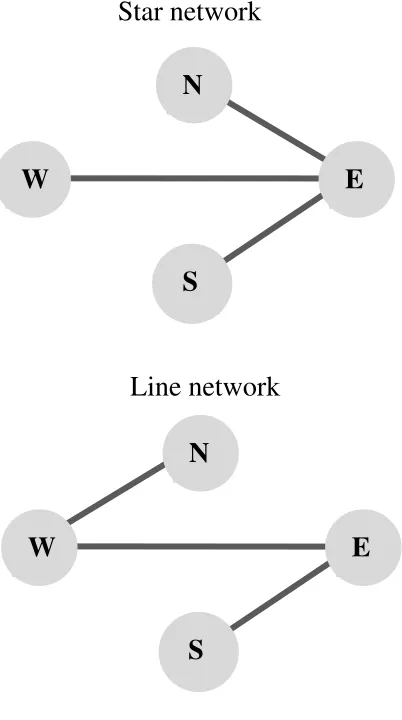
While the standard analysis of cheap talk has mainly been concerned with the role of extra communication opportunities in achieving e¢ciency (e.g. Farrell (1987) and Rabin (1994)),2 the key variable in our setup concerns the extent to which each player observes the past history of players’ announcements, which we interpret as the network structure of pre-play communication. Speci…cally, at the beginning of each round of communication and the underlying game, a player observes past messages of another player if and only if there is anundirected edge between the two players. Four networks or undirected graphs are considered in our four-player setup, as illustrated by Figure 1 below. Nodes in each network, denoted byN, E,S and W, represent players.
- Figure 1 about here
In the complete network, each player can communicate with every other player. In thestar network, one central player (player E) can communicate with every other player while each of the other three players can communicate only with the central player. In the
kite network, three players (playersN; E and S) can communicate with each other, while the remaining player (playerW) can communicate only with one of the …rst three players (player E). In the line network, two players (players E and W) can communicate with two other players and each of the two remaining players can communicate only with one of the …rst two players. The last three networks are sometimes referred to as incomplete
networks.
Each network structure facilitates its own distinctive communication ‡ows. Although there exist other four-player networks, the four networks we consider provide a rich enough ground to study the role of network structure of pre-play communication. Since we are interested in the issue of equity as well as e¢ciency, a particular attention will be given to the behavior of hub players in each of the three incomplete networks: E in the star and kite networks,E and W in the line network. These players occupy strategically in‡uential locations in that some players rely entirely on their announcements to learn about others’ intentions.
The games that we study allow a very rich set of histories and strategies, thereby admitting a large number of equilibria. Thus the theory does not provide strong predictions about which outcomes are likely to be observed in the experimental data. However, the network structure of pre-play communication assigns particular roles to players which may guide their behavior. To further this intuition, we focus on certain classes of equilibria in which the asymmetry in players’ node characteristics translates into payo¤ asymmetry. In particular, we note that the complete symmetry of players in the underlying game can be broken by the network structure itself, and not by randomization, in the star and kite networks but not in the line network.3 Also, the equilibrium analysis clari…es the sources of multiple equilibria in our setup; for instance, unlike in the two-player game studied by Farrell (1987) an “agreement” to coordinate on a particular action in the underlying game can take a variety of forms in our setup. These insights enable us to navigate a rich data set with the lens of theory.
In the experimental design, we consider treatments that combine the four networks and two di¤erent lengths of pre-play communication,T = 2andT = 5. In addition, we consider the underlying game without communication. By varying both the network structure and
3In the star or kite network, one can construct asymmetric sequential equilibrium in which players with
length of communication, we examine how the network and time structure interact to determine subjects’ communication behavior and in‡uence coordination outcomes in terms of both e¢ciency and equity.
Our experimental results …rst establish a signi…cant network e¤ect on both e¢ciency and equity of the coordination outcome: both when T = 2 and when T = 5, signi…cant di¤erences in the coordination rate and the distribution of coordinated outcomes are ob-served across networks. However, the results also show that extra communication not only improves the chance of coordination but also reduces asymmetry in the distribution of coordinated outcomes. The details of these results are as follows:
E¢ciency: Both when T = 2 and T = 5, there is no signi…cant di¤erence in
coordination rates between the complete, star and kite networks while coordination rate in the line network is signi…cantly lower. In all networks, coordination rate is higher when T = 5 than whenT = 2 but the increase is statistically signi…cant only in the line network.
Equity: Both when T = 2 and T = 5, coordination occurs most frequently in the
hub’s favorite outcome in the star and kite networks while coordinated outcomes appear to be uniformly distributed in the complete and line networks. Under each time treatment, the frequency of coordination on the hub’s favorite outcome is greater in star than in kite; given star or kite, this frequency is lower whenT = 5 than when T = 2.
We next examine the experimental data from pre-play communication. In all treat-ments, the subjects’ announcements tend to converge but less than unanimity is usually su¢cient to ensure corresponding coordination.
Communication dynamics: In all treatments with pre-play communication,
coor-dination rate is mostly explained by the frequency of convergence to super-majority or unanimity in the communication stage.
Behavior:
- In the star network, the hub is highly likely to display non-switching behavior both whenT = 2and whenT = 5. But, conditional on such behavior, the frequency of his favorite message/action is lower when T = 5 than when T = 2. In the kite network, the hub displays a strong tendency of non-switching only when T = 2.
- Players N and S in the kite network conform less to the hub than other players in both star and kite networks.
- There is evidence that all four players behave symmetrically in the complete and line networks.
The rest of the paper is organized as follows. The next section discusses the related literature. Section 3 describes our setup and presents some theoretical observations that guide our experimental design and data analysis. Section 4 outlines the research questions to be addressed with the experimental data. Section 5 describes the experimental design and procedures. Section 6 collects the experimental results, followed by some concluding remarks in Section 7.
2
Related Literature
Our paper contributes, above all, to the experimental literature on pre-play communication via cheap talk (see Crawford (1998) and Camerer (2003) for related surveys). A most closely related paper is Cooper, DeJong, Forsythe and Ross (1989) who consider the two-player Battle of the Sexes with cheap talk. They study two di¤erent communication structures: one-way communication versus two-way communication. In the former treatment only one player can send a message to the other player, whereas the two players send messages simultaneously to each other in the latter. They …nd that coordination rates are much higher in the one-way treatment than in the two-way treatment and also that the sender in the one-way treatment sends his favorite message, thereby inducing coordination on his favorite outcome, with a very large frequency. The two communication structures here can be interpreted as two possible (directed) networks with two players.4 In contrast to their two-player setup, our multi-player setup enables us to consider a richer variety of networks. Also, their setup does not take account of how network e¤ect may interact with the length of communication.
Pre-play communication in social networks has been studied elsewhere in theoretical models of Chwe (2000), Calvó-Armengol and de Martí (2007, 2009) and Galeotti, Ghiglino
4Cooper, DeJong, Forsythe and Ross (1992) and Burton, Loomes and Sefton (2005) also compare the
and Squintani (2009), among others. In their setups, prior to playing the underlying game players simultaneously send messages about their private information to others whom they are linked with (possibly in a directed way). Chwe (2000) and Calvó-Armengol and de Martí (2007, 2009) consider coordination games with common interest and show that coordination can be achieved in networks with fewer links than the complete network. In a setup that allows for con‡icting preferences, Galeotti, Ghiglino and Squintani (2009) examine how players’ incentives to report the truth and their welfare are related to the network structure.5 Thus, the central issue in these papers is the role of network structure on e¢ciency. In contrast, our paper deals with the distributional issue as well as e¢ciency. Moreover, unlike theirs, our setup allows for multiple rounds of communication, thereby shedding light on the e¤ects of the dynamics of communication on e¢ciency and equity.
There is a large literature in sociology concerned with the impact of communication networks on group outcomes (see, for example, Wasserman and Faust (1994)). By focusing on the structural properties of networks, this literature proposes a number of indices that capture the relative importance of di¤erent nodes within a network and the network as a whole. One such notion that may be closely related to our analysis is that of betweenness centrality (Freeman (1977)).6 A player, or a node, in a network is said to be between a pair of other nodes if the node falls between the pair of other nodes on the shortest path connecting them. A node located between other nodes controls the others’ beliefs about what they cannot directly observe and, in this sense, a higher degree of betweenness makes the node more important.7 Measures such as betweenness centrality, however, usually lack behavioral foundations based on individual incentives and, therefore, how they could be used for interpreting experimental data is not a straightforward issue.
Finally, our paper is related to a growing literature of network experiments in eco-nomics (see, for example, Kosfeld (2004) for a survey). Among them, Choi, Gale, Kariv and Palfrey (2009) also study experimentally the role of network structure on coordina-tion.8 They consider a class of monotone games that can be interpreted as dynamic public good games and use networks to describe a variety of information structures about the history of past contributions. Their …ndings suggest that network structure makes partic-ular strategies salient, and this serves to reduce strategic uncertainty and hence facilitate e¢cient coordination.
5Hagenback and Koessler (2009) consider the issue of endogenous network formation in a coordination
setup with pre-play communication.
6For other notions of centrality, see Chapter 5 of Wasserman and Faust (1994).
7This node centrality measure can be used to de…ne centrality of a network. In our setup, the star
network is most central, followed by kite, line and complete.
8Experimental studies on the relationship between network structure and coordination have also been
3
The Setup
3.1
The game
We study games in which multiple players share a common interest to coordinate but each player has his own preferred outcome. The following describes theunderlying game. There are four players, indexed by I = N; E; S; W, and each player simultaneously and inde-pendently chooses an action, aI, from a common set fn; e; s; wg. Let a= (aN; aE; aS; aW) denote an action pro…le. A player obtains a positive payo¤ if all players choose a single common action. Otherwise, a player receives nothing. Each player has his preferred action corresponding to his label: player I obtains a higher payo¤ if all players choose action i. Player I’s payo¤, uI(a), is given by
uI(a) = 8 <
: 0
k1
k2
if if if
aI 6=aJ for some J 6=I
aI =aJ 6=i for all J 6=I
aI =aJ =i for all J 6=I;
where k2 > k1 >0. If there are only two players, the game corresponds to the well-known
Battle of the Sexes. In this sense, the underlying game can be interpreted as a four-player version of Battle of the Sexes.
Prior to playing the underlying game, the players engage in …nite periods of pre-play communication, sometimes referred to as the communication stage. Pre-play communica-tion is cheap talk in the usual sense that it is non-binding and payo¤-irrelevant. Let T denote the number of periods in the communication stage. In each period t = 1;2; :::; T, each player I simultaneously and independently chooses a message, denoted by mt
I, from the set fn; e; s; wg. A message therefore can be interpreted as the player’s intended ac-tion. We shall sometimes refer to T + 1 as the period in which the players engage in the underlying game.
To complete the description of pre-play communication, we specify information available to each player at the beginning of each communication period. This is represented by an undirected graph, ornetwork. We say that playerI can communicate with playerJ if and only if there is an undirected edge or link between the two players,I and J. If playerI can communicate with player J then, at the beginning of period t+ 1, each of the two players knows the history of messages chosen by the other player up to, and including, period t. The network structure is common knowledge. As illustrated in Figure 1, we consider four networks: complete, star, kite and line.
hub is a player who is linked to at least one periphery: E in the star network, E in the kite network, and E and W in the line network. We shall sometimes refer to the entire game that includes both theT-period communication stage with a given network and the subsequent underlying game simply as the game with the particular network.
3.2
Theoretical background
Our four-player games allow a very rich set of histories and strategies, thus admitting a large number of equilibria. Despite the multiplicity problem, however, theory points to some useful clues as to how one should analyze experimental data. In this section, we identify several such guidelines that will enable us to approach the data with the lens of theory.
Since we are interested in the impact of network structure on behavior and outcome, it is natural to adopt the notion of symmetry in equilibrium. In a given game with pre-play communication, we can identify pre-players that occupy symmetric locations/nodes in the sense that, with appropriate re-labelling of the messages/actions, they are endowed with the same strategy set and any pair of such players exchanging their strategies exchange their payo¤s as well. In the complete network game, all four players are symmetric; in the star network, each of the three peripheries, N, W and S, can only communicate with E and, hence, their strategies are identical mappings (from histories to messages/actions); in kite, N and S are similarly symmetric; and …nally, line network is symmetric across the middle and has two pairs of symmetric players: E andW, and N andS. We shall consider symmetric (subgame perfect or sequential) equilibria in which players with identical node characteristics adopt symmetric strategies (relative to our labels).
Before we overview the issue of multiple equilibria in the games with pre-play commu-nication, we …rst note that symmetry does not o¤er a unique prediction in our underlying game. To see this, it is easy to …nd a symmetric mixed-strategy Nash equilibrium in which each player plays his favorite action with probability k2
3k1+k2 and each of the other three
actions with equal probability k1
3k1+k2. But, unlike the two-player game, there also exists a
symmetric equilibrium in pure strategies in which each player plays his favorite action and thus coordination is not reached.9
In the games with pre-play communication multiple (symmetric) equilibria arise through a variety of patterns in the communication stage. Players randomize their messages in or-der to reach an “agreement” which will then induce the corresponding pure-strategy Nash equilibrium in the underlying game. With four players, however, an agreement can take a variety of forms. For instance, symmetric mixed-strategy equilibria can be constructed such
9Note however that the probability of coordination in the symmetric mixed-strategy equilibrium is
that not only unanimous announcement of a common message but also a super-majority outcome (i.e. all but one player choose the same message) or a majority outcome (i.e. only two players choose the same message) constitutes an agreement to achieve coordina-tion. Another source of multiplicity of symmetric equilibria in our four-player games is the possibility of partial agreements. That is, the players may treat certain communica-tion outcomes as an interim basis for further negotiacommunica-tion. A partial agreement could, for instance, narrow down the set of randomized messages in the continuation play, thereby increasing the likelihood of improved agreements and later coordination. In Appendix I, we provide detailed examples of multiple equilibria along these lines for the case of complete network. The equilibrium features that we address here are also present in games with other networks.10
As mentioned earlier, we are interested in the role of network structure on e¢ciency and equity of the coordination outcomes. For a given network, the likelihood of coordination depends, for instance, on the de…nition of agreement: a more strict form of agreement is indeed associated with a lower coordination rate in equilibrium (see Appendix I). Thus, the multiplicity problem makes it impossible to draw any conclusion about how network structure will a¤ect e¢ciency.
We next discuss what game theory can tell us about the role of network structure on the issue of equity. In particular, we consider the set of symmetric equilibria in games with incomplete networks in which the hub acquires a higher bene…t than the other players. This is because of the intuition that by strategically controlling the ‡ow of information players with greater access to past play of a game may derive a greater payo¤ than those who observe less.
Our …rst observation shows that, in the star and kite networks, the complete symmetry of players in the underlying game can be broken by the network structure of pre-play communication.
Observation 1 In the game with star or kite network, there exists a symmetric equilibrium
in which coordination on action e occurs with probability 1. In the game with line network, there does not exist a symmetric equilibrium in which coordination on a particular action occurs with probability 1.
The reasoning behind the statement is straightforward. In the star or kite network, for example, every player always playing message/action e can be supported as a symmetric sequential equilibrium. Player E’s insistence on message e is met with the belief by each periphery that the others have also chosen the same message and will play action e in the underlying game; observation of any other messages byE triggers the (o¤-the-equilibrium)
10In the two-player game considered by Farrell (1987), these issues do not arise, and the restriction of
belief that some other player has deviated, leading to coordination failure. Such an equilib-rium is indeed symmetric across the peripheries. In the game with line network, however, symmetry cannot yield sure coordination on a particular outcome since that will require asymmetric behavior from one of the two pairs of symmetric players, E and W or N and S.
The above observation provides a sense in which the star and kite network structures serve the role of symmetry breaking such that disproportionate payo¤s are conferred on the most central player, the hub. In contrast, in the line network, randomization is needed to break the symmetry across the two pairs of players. Our next observation demonstrates that, in all three networks, there exist alternative equilibrium dynamics, involving random-ization, which generate outcome paths that confer asymmetric bene…ts on the hub(s).
Observation 2 Consider the game with star, kite or line network. If T 3, there exists
a symmetric equilibrium with the following properties:
1. Coordination on each action occurs with positive probability.
2. Coordination on each hub’s favorite action is most likely to occur.
The details of the equilibria are provided in Appendix I. Let us brie‡y sketch the construction for the star network with T = 3. In periodt= 1, each periphery randomizes among the entire message set; the hub, E, announces arbitrarily. In the next two periods, the peripheries play arbitrary messages while the hub reports a single message twice if there was a unanimous agreement among the peripheries on that message in t = 1and any two di¤erent messages otherwise. Upon observing the same message from the hub in the last two periods of the communication stage, the players coordinate on the corresponding action in the underlying game; otherwise, they play their own favorite actions with probability 1. As shown in Appendix I, the above behavior constitutes a sequential equilibrium with an appropriate o¤-the-equilibrium punishment scheme. Furthermore, the calculation of mixing probabilities int= 1reveals that, in equilibrium, coordination on the hub’s favorite action, e, occurs more frequently than each of the other actions. It is important to note that, in this equilibrium, while each periphery announces his intended action the hub merely serves the role of information transmission; that is, his messages indicate di¤erent message pro…les of only the other players that he is linked to.
transmission, which is distinct from the behavior in the equilibria of Observation 1. In the line network, only randomization can induce similar asymmetric outcomes.11
4
Research Questions
We now list the set of questions that the previous theoretical discussion motivates in our experimental study. Our research questions are four-fold. The …rst two questions are concerned with the overall impact of the treatments (time and network e¤ects) on the …nal outcome of the underlying coordination game along two central issues: e¢ciency and equity. The standard equilibrium analysis suggests that, for a given network, greater op-portunities to communicate will improve the chance of coordination and hence payo¤s but the multiplicity of equilibria makes it unclear if and how payo¤s will depend on the network structure, or indeed what the combined e¤ect of the length and network structure of com-munication will be. On the other hand, in an incomplete network, a hub player has more links than others and, therefore, we are interested in whether such informational advantage translates into asymmetric outcomes and, if so, whether the length of communication plays any role.
Question 1 (E¢ciency) How is the likelihood of coordination a¤ected by the length and
network structure of pre-play communication?
Question 2 (Equity) How is the distribution of coordinated outcomes a¤ected by the
length and network structure of pre-play communication?
We observed in the previous section that the problem of multiple equilibria is caused primarily by di¤erent communication dynamics that are possible in equilibrium. This poses a challenge in interpreting the experimental data for the communication stage. Despite this, we want to …nd whether there are, on average, any regular patterns in the observed communication dynamics and how communication relates to coordination outcome. This motivates our next research question.
11There is an alternative equilibrium which confers larger payo¤s toE andW in the line network. The
two players randomize among just the two messageseandwsuch that an agreement results in their playing
the corresponding pure strategy Nash equilibrium in the underlying game. NandSsimply play the action
corresponding to their hubs’ messages in periodT in the underlying game. Furthermore, randomization
can also lead to symmetric outcomes/payo¤s in all three networks. For example, letT = 2, and consider
strategies with the following properties. All four players mix among the entire message set in t = 1
and the hub maintains/switches his message in t = 2if there was an agreement/disagreement in t = 1.
Question 3 (Communication dynamics) How is the pattern of pre-play communica-tion a¤ected by the length and network structure of pre-play communicacommunica-tion? What is the relationship between the dynamics of communication and the coordination outcome in each game?
Our …nal question concerns the behavior of players at di¤erent locations within each network. The theoretical discussion in the previous section suggests that (i) subjects at di¤erent locations in a given network may serve distinct roles in communication and hence determination of the coordination outcome and, moreover, (ii) such behavioral patterns may depend on the treatment (i.e. network and time structures of communication) itself. Thus, we are interested in identifying any regular patterns in subjects’ behavior and linking them to outcomes in communication and coordination.
Question 4 (Behavior) Are there any regular and distinct patterns in subjects’ behavior
across treatments?
5
Experimental Procedure
The experiment was run at the Experimental Laboratory of the Centre for Economic Learn-ing and Social Evolution (ELSE) at University College London (UCL) between May 2008 and November 2008. The subjects in the experiment were recruited from an ELSE pool of UCL undergraduate students across all disciplines. Each subject participated in only one of the experimental sessions. After subjects read the instructions, the instructions were read aloud by an experimental administrator. Throughout the experiment we en-sured anonymity and e¤ective isolation of subjects in order to minimize any interpersonal in‡uences that could stimulate cooperation. Each experimental session lasted between one hour and one and a half hours. The experiment was computerized and conducted using the experimental software z-Tree developed by Fischbacher (2007). Sample instructions are reported in Appendix II.
throughout the session. In each round, the subjects were randomly formed into four-person groups. The groups formed in each round were independent of the groups formed in any of the other rounds.
The table below summarizes the experimental design and the number of observations in each treatment. The …rst number in each cell is the number of subjects and the second is the number of observations per treatment/session.
Network
Communication length Complete Star Kite Line Short (T = 2) 16 / 80 16 / 80 16 / 80 16 / 80 Long (T = 5) 20 / 100 16 / 80 20 / 100 16 / 80
No (T = 0) 20 / 150
Each round was divided into two stages: a communication stage, which consists of T (either2or5) decision-turns, and an action stage, which consists of a single decision-turn. In the no-communication treatment, there was only an action stage in each round. In the action stage, four actions were available: n, e, s and w. The communication stage that preceded the action stage involved each participant sending messages. In each decision-turn of the communication stage each participant was asked to choose a message from n, e, s and w, which were labeled by the same letters as the actions available in the action stage. It was illustrated that a message may indicate a subject’s intended action in the subsequent action stage but the subject does not have to follow that message when it comes to making an action choice. When every participant in the group had made his or her decision, each participant received the messages chosen by the participants to whom he or she was connected in the network. This completed the …rst decision-turn of the communication stage. This process was repeated in the remaining decision-turns of the communication stage.
When the communication stage ended, each participant was asked to choose an action out of the four possible actions without knowing the actions selected by other participants. After every participant made a decision in the action stage, the computer informed subjects of the actions chosen by all the participants in the group and their earnings. It was illustrated and emphasized that the earnings in each round are determined only by the actions chosen in the action stage and the messages chosen in the preceding communication stage are entirely irrelevant to earnings. After each subject observed the results of the …rst round, the second round started with the computer randomly forming new groups of four participants with distinct types. This process was repeated until all 20 rounds were completed.
If all participants in the group chose a common action, a participant whose label corre-sponded to the letter of the common action received3 tokens while the other participants received 1 token each. Otherwise, all participants received zero token. Thus, the total payment to a subject was equal to $0:50 times the total number of tokens earned over
20 rounds (30 rounds in the one-shot game treatment), plus a $5 participation fee. The
average payment was about$13. Subjects received their payments privately at the end of
the session.
6
Experimental Results
6.1
Coordination outcomes
We begin our analysis of the experimental data by examining the …nal outcomes of coordi-nation in each treatment. As summarized in Section 4, the focus of our interest lies in the impact of our treatments on both e¢ciency and equity of …nal coordination outcomes. To address the issue of e¢ciency, we consider therate of coordination; for equity, we examine thedistribution of coordinated actions.
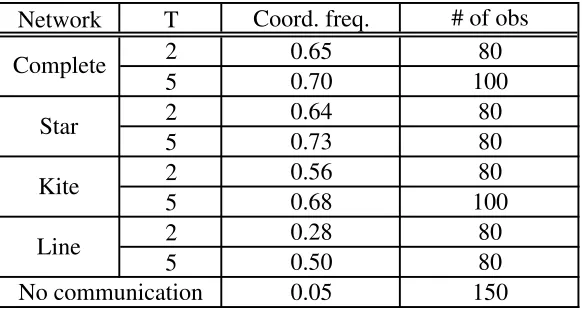
Table 1 below reports coordination rates across treatments (the top panel) and results of the chi-square nonparametric test that compare coordination rates between each pair of treatments (the bottom panel).
- Table 1 about here
-We …rst check whether communication is indeed e¤ective. The coordination rate in the treatment without communication is 0:05, while the coordination rates in treatments with communication vary from0:28to0:73. The di¤erence between the no-communication treatment and each communication treatment is highly signi…cant (p-value in each compar-ison is far below0:001). Thus, we can conclude that communication is an e¤ective means of achieving coordination.
We also check if a longer communication stage increases the likelihood of coordination within a network. A …rst glance at the top panel of Table 1 suggests that this is indeed the case for every network; the increases in coordination rate from T = 2 to T = 5 are 0:05 (complete), 0:09 (star), 0:12 (kite) and 0:22 (line). However, results of the pair-wise nonparametric test in the bottom panel (darker-shaded cells) show that these di¤erences are in fact not statistically signi…cant with the usual signi…cance levels in the complete, star and kite networks. This suggests that the value of communication is mostly realized by two rounds of communication in the three networks. In contrast, the likelihood of coordination increases signi…cantly in the line network fromT = 2 toT = 5.
These …ndings are summarized below.
Result 1 (E¢ciency) 1. Coordination rates are higher in treatments with
communi-cation than in the treatment with no communicommuni-cation.
2. Given any time treatment T, coordination rates are not statistically di¤erent across the complete, star and kite networks, while coordination rate in the line network is signi…cantly lower than in the other three networks.
3. Given any network treatment, coordination rate increases from T = 2 to T = 5, although the di¤erences are not statistically signi…cant in the complete, star and kite networks.
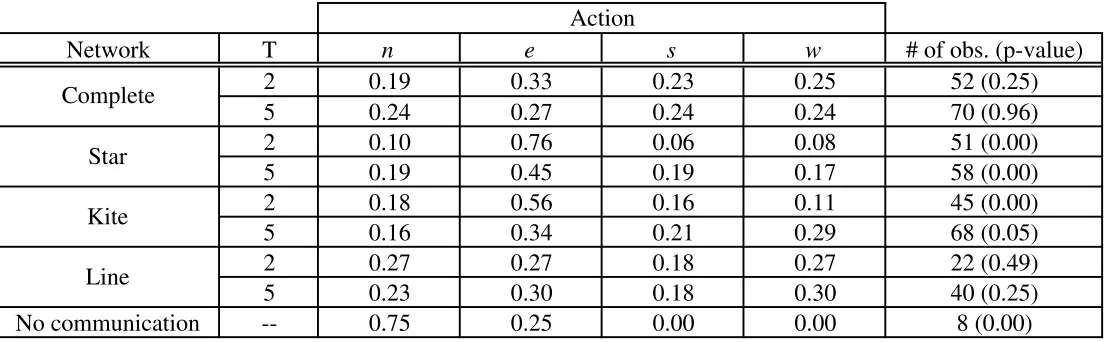
Our next Table summarizes the distribution of coordinated outcomes in the underlying game along with the number of corresponding observations. The number in parentheses in the last column presents a p-value from the chi-square nonparametric test for uniform distribution.
- Table 2 about here
-There are considerable variations in the frequency of each coordinated outcome, n,e, s orw, across treatments. In order to further clarify our results, we present the observations across networks for eachT in Figures 2A and 2B.
-Figure 2A and 2B about here
it is indeed interesting to con…rm the strategic advantage of the hub in the star and kite networks; furthermore, just as the theory suggests, the outcomes in the complete network turn out to be symmetric. Also interesting, in light of Observation 2, is that the two hubs, E and W, in the line network do not actually obtain greater bene…ts.
Second, both when T = 2 and whenT = 5, the likelihood of coordination on action e is higher in the star network than in the kite network. This appears to suggest that an additional link betweenN andS in the kite network compared to the star network reduces the hub player E’s strategic advantage. We shall further investigate this issue in Section 6.3 below.
Third, there is a strong evidence of time e¤ect in the star and kite networks. Here, the longer the players engage in cheap talk, the less frequently is that they coordinate on action e. Furthermore, in the star network, the likelihood of coordination on each of the other three actions appears to increase by equal proportion as we go from T = 2 toT = 5; in the kite network, on the other hand, the decrease in the likelihood of coordination on the hubE’s favorite action is matched mainly by an increase in the likelihood of the periphery W’s favorite action.
In summary the data support the following results.
Result 2 (Equity) 1. Both when T = 2 and when T = 5, the distribution of
co-ordinated actions is highly concentrated on action e in the star and kite networks, whereas the distribution does not di¤er statistically from the uniform distribution in the complete and line networks.
2. Given any T, the frequency of coordination on action e is higher in the star network than in the kite network; given star or kite, this frequency is lower when T = 5 than when T = 2.
Despite the multiplicity of equilibria, our experimental results strongly support regu-larity of certain patterns in outcomes. The network structure of communication indeed matters for both e¢ciency and equity of coordination outcomes. However, the length of communication also plays an important role. Our results suggest that allowing the players to communicate longer will not only improve e¢ciency but also make the coordination outcome more equitable in the networks that produce asymmetric coordination outcomes.
6.2
Communication and coordination
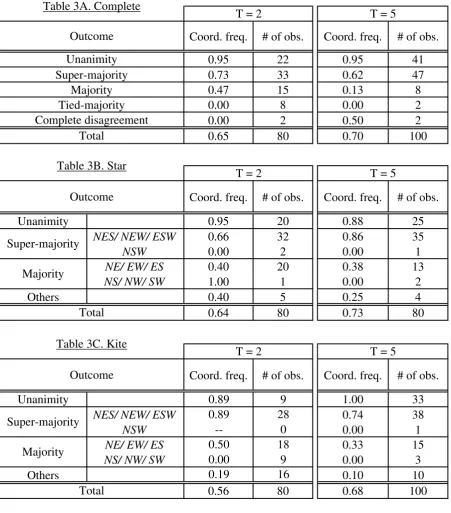
underlying game contingent on each possible outcome in the last period of the communi-cation stage, together with the number of observations for each communicommuni-cation outcome. In the complete network, communication outcomes are divided into …ve categories: una-nimity, super-majority, majority, tied-majority and complete disagreement. Unanimity is an outcome in which all four players announce the same message; super-majority is an outcome in which all but one player choose the same message; majority is an outcome in which only two players announce the same message; tied-majority is an outcome with two distinct pairs of two players who choose the same message; and complete disagreement is an outcome in which each player announces a distinct message. In the incomplete (star, kite and line) networks, we divide super-majority and majority further by identifying whether such an outcome includes the hub player(s). For example, a super-majority outcomeN ES in the star network represents players N, E, and S choosing the same message in period T.12
- Table 3 about here
-There is a strong relation between what happens in the last period of the communication stage and coordination across all treatments: a wider consensus improves the chance of coordination. Unanimity leads to coordination almost with certainty in all treatments. Super-majority (including the hub(s) in the incomplete networks) is very likely to induce coordination in most of the treatments, one possible exception being the line network with T = 2 where the coordination rate contingent on super-majority in period T is 0:35.13
On the other hand, we observe high frequencies of unanimity and super-majority in the last period of communication, especially in the complete, star and kite networks. For instance, in the complete network, the subjects reach super-majority or unanimity by period T in 69% of observations when T = 2 and 88% of observations when T = 5. This therefore leads us to our next Table, which reports the frequency of unanimity or super-majority occurring in each period t T.
- Table 4 about here
-There is a clear pattern of convergence towards “agreement”, i.e. unanimity or super-majority, in all treatments. The chance of an agreement in the …rst period is low, ranging from 0:04 (line network withT = 5) and 0:29 (star network withT = 2), but it increases monotonically over time in all treatments. Moreover, in all treatments, the chance of eventual coordination (the last column) is mostly explained by the chance of successfully
12Due to small number of observations, tied-majority and complete disagreement are treated as one
outcome in each of the incomplete networks.
13Notice also that, in each of the incomplete networks, almost all super-majority outcomes in periodT
reaching such an agreement. This implies that the role of network structure in determining e¢ciency of outcome indeed depends on how well it facilitates the ‡ow of information and hence the formation of agreement among the players.
Another interesting observation is related to the role of extra communication. Notice …rst that the marginal increase in the proportion of agreement across two periods (the number in parentheses) is larger when T = 2 than when T = 5 in each network. More interestingly, the improvement in coordination rate as we go from T = 2toT = 5 is larger in the networks that are less e¤ective in inducing agreement.
We summarize these results below.
Result 3 1. In all treatments, the coordination rate is mostly explained by the frequency
of convergence to super-majority or unanimity in the communication stage.
2. The increase in coordination rate from T = 2 to T = 5 is greater in a network with lower frequency of convergence.
6.3
Behavior in the star and kite networks
The distributions of coordinated outcomes in the star and kite networks turn out to be highly asymmetric in favor of the hub, player E, but extra communication reduces such asymmetry. Also, given T, the degree of inequity is greater in the star than in the kite network. In order to identify any behavioral patterns responsible for these observations, we compare strategies by nodes.
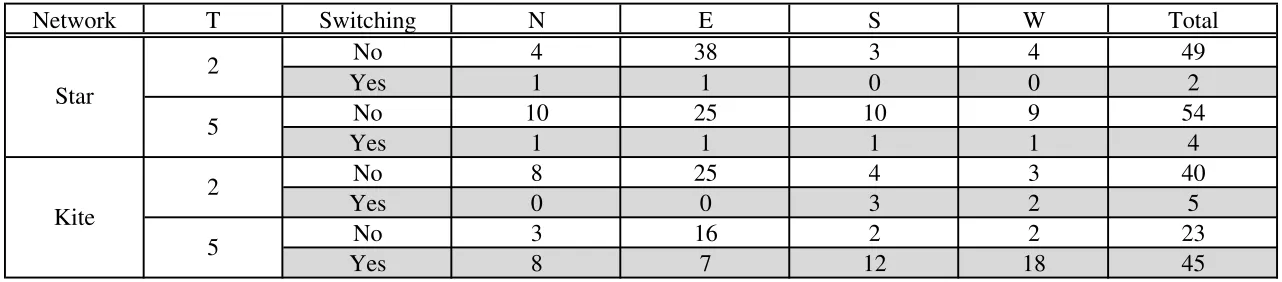
Hub The equilibrium constructions of Section 3.2 suggest a number of strategies of the hub that can result in this player obtaining disproportionately large payo¤s. We focus on identifying one such strategy. Akin to Observation 1, non-switching behavior refers to the case in which a subject with the role of a hub chooses his initial message constantly throughout the entire game (including the underlying game); any other observed behavior is referred to asswitching behavior. Table 5A presents the frequencies of non-switching and switching behaviors in the star and kite networks, together with the frequency of the hub initially choosing his own favorite message conditional on each category (in parentheses).
-Table 5A about here
-Table 5B shows how reluctant the hub is to switch from his initial message when he …nds himself in con‡ict with every other player in t = 1, together with the number of observations (in parentheses).
-These two tables report a marked di¤erence in the hub’s behavior across the star and kite networks. First, the hub in the star network exhibits a strong tendency to insist his initial message (even after complete disagreement) throughout the game both when T = 2 and whenT = 5, while the hub in the kite network shows such tendency only whenT = 2. Second, conditional on non-switching, the hub in the star network chooses his own favorite message/action with a signi…cantly larger frequency when T = 2 than when T = 5, while the corresponding frequencies in the kite network are almost the same.
Next, Table 5C presents the distribution of coordinated actions in the underlying game, conditional on the hub’s behavior.
- Table 5C about here
-There are a couple of notable patterns here. First, in both time treatments for the star network, coordination occurs mostly when the hub does not switch from his initial message: 0:96(= 49=51) whenT = 2and0:93(= 54=58) whenT = 5. A similar pattern is established in the kite network withT = 2: 0:89 (= 40=45). However, in the kite network with T = 5, coordination is more likely to occur when the hub switches from his initial message: 0:66 (= 45=68). Second, when coordination occurs with non-switching behavior, it mostly falls on action e, the hub’s favorite action. This holds even true in the kite network with T = 5. When coordination results from switching, however, the distribution of coordinated actions is not concentrated on action e. In particular, in the kite network with T = 5, coordination appears to be slightly more likely to occur on actionw.
Putting these observations together, we can conclude that the positive time e¤ect on equity in the star and kite networks is driven by di¤erent behaviors across the two networks. This is summarized below.
Result 4 1. In the star network, the hub displays a strong tendency of non-switching
behavior both when T = 2 and when T = 5. But, conditional on non-switching, the hub is less likely to choose his own favorite message/action when T = 5 than when
T = 2.
2. In the kite network, the hub displays a strong tendency of non-switching behavior when
N and S in the kite network Now that we have identi…ed how increasing the length of communication generates more equitable outcomes in the star and kite networks, it remains to investigate why the hub’s advantage is lower in the kite than in the star network for each T. Since the only structural di¤erence between the two networks is the additional link between players N and S in the kite network, behavior of these players should hold key to answering this question. But, in order to address these two players, we must …rst consider how other nodes behave in the two networks.
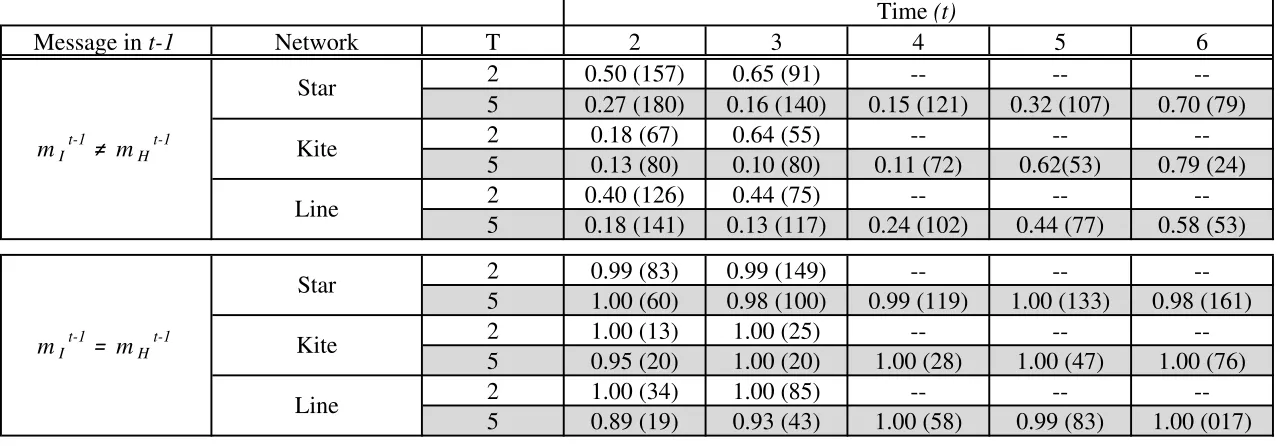
Table 6 below presents the behavior of peripheries in the star, kite and line networks. Since information about past play of the game ‡ows to a periphery only through the hub that he is linked to, it is natural to examine a periphery’s willingness to conform to the hub. For this purpose, we divide the relevant histories of observations at the beginning of each period t T + 1 (including the action stage) into whether or not a periphery’s message in the previous period coincided with the message chosen by the hub.
- Table 6 about here
-The following patterns are observed in all treatments. Not surprisingly, at a history in which the periphery and hub chose a common message (the bottom panel of Table 6) the periphery continues to choose the same message almost surely. At other histories with disagreements, the periphery’s tendency to copy the hub’s previous message increases signi…cantly in period t=T of the entire game. Also, for a given network, this probability is higher at the end of the game withT = 5than withT = 2. The probability of conformity, i.e. following the hub’s message when their messages con‡icted in the previous period, at the action stage is high in both star and kite: 0:65(star) and0:64(kite) whenT = 2; 0:70 (star) and 0:79 (kite) when T = 5.14
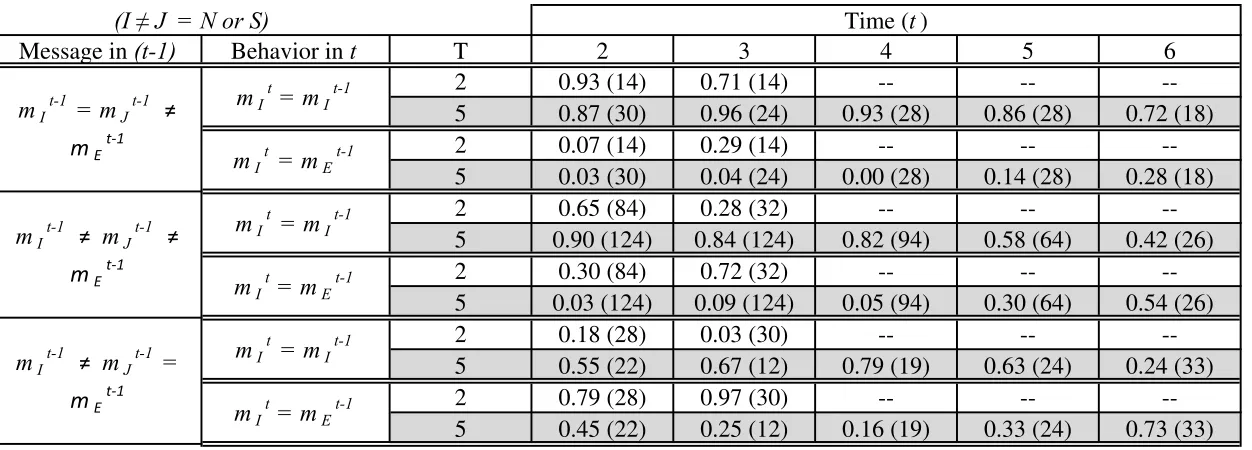
Let us now compare these observations with the behavior of N and S in the kite network. We examine the histories at which either of the two players is in disagreement with the hub, E. Since N and S can observe each other’s past messages, the relevant histories at the beginning of t T + 1 are partitioned into the following three sets about the three players’ messages in t 1: (i) N and S played the same message di¤erent from E’s message; (ii) all three players played distinct messages; and (iii) either N orS played the same message as E. Table 7 presents the behavior of players N and S in the kite network at these histories.
- Table 7 about here
-14The corresponding probabilities for the line network are somewhat smaller. This may explain the
The di¤erence in behavior between these two players and a periphery is most clearly seen by the decisions made by N and S contingent on the …rst type of histories. Here, in both time treatments, the two players are much more likely to stick with their own previous message than to conform with the hub. In this case, the probability that either N or S switches to the hub’s message when playing the underlying game is just 0:29when T = 2 and 0:28 when T = 5. Even when all three players played di¤erently, the probability of conformity is signi…cantly lower whenT = 5(equal to 0.54), compared to the corresponding tendency exhibited by the periphery, W, in the same treatment (equal to 0.79) as seen in the previous table. But, when one of N and S agreed with E in the previous period, the other player is likely to conform to E. Together with the high tendency of conformity by the peripheries in the star and kite networks (Table 6), these observations (Table 7) lead to the following result.
Result 5 Both when T = 2 and whenT = 5, players N and S in the kite network are less
likely to conform to the hub than the peripheries in the star and kite networks.
We have already seen that, whenT = 2, the hub in both star and kite networks exhibits non-switching behavior (Result 4) and also such behavior is very frequently accompanied by the hub’s own favorite message/action (Table 5A). Thus, Result 5 gives an explanation for why under this time treatment the distribution of coordinated outcomes is less asymmetric in the kite network than in the star network. Furthermore, Result 5 suggests that the less conforming behavior of N and S is what induces the hub in the kite network to switch his messages much more frequently when T = 5, which in turn reduces the hub’s payo¤ advantage.
6.4
Behavior in the complete and line networks
Another interesting feature of Result 2 in Section 6.1 is the symmetry of coordinated outcomes in the complete and line networks. On the one hand, the observations in the complete network support the symmetric equilibrium as a useful framework to approach our games that are fraught with multiple equilibria; on the other hand, one wonders why in the line network the two hubs, E and W, do not enjoy greater bene…ts than the two peripheries, N and S. In this section, we engage in a more detailed examination of the subjects’ behavior in these two networks.
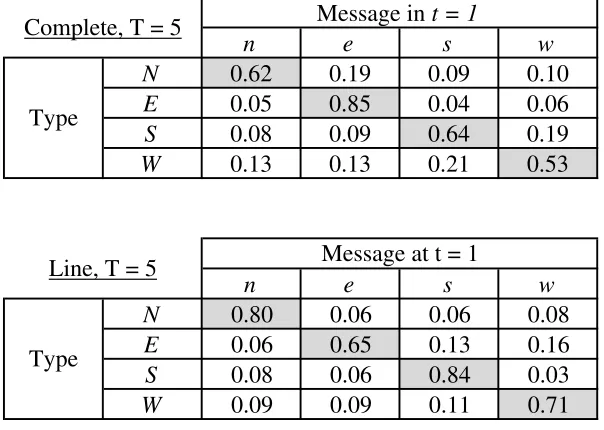
Table 8 presents the frequency of each message played by each subject in the …rst period of communication, together with the frequency of each action in the no communication treatment.
-In all reported treatments, all four players appear to randomize over the entire message set, each attaching the greatest weight on his own favorite message. As expected, the fre-quency of playing one’s own favorite message is higher in treatments with communication than the treatment without communication. Interestingly, however, there appears to be no signi…cant di¤erence in the reported frequencies across the complete and line networks un-der both time treatments. In particular, for each corresponding treatment, the frequencies of playing messages other than one’s own favorite are fairly evenly distributed.
We next examine what the communication evolves into. Speci…cally, we consider the distribution of messages in the last period of the communication stage conditional on an agreement (i.e. unanimity or super-majority) having been reached.15
- Table 9 about here
-The reported distributions are all fairly close to be uniform. Given the observations of Table 8, this indicates that the subjects behave symmetrically not just in the …rst period but throughout the communication stage. This gives our …nal result.
Result 6 Both when T = 2 and when T = 5, there is evidence indicating that all four
players in the complete and line networks behave symmetrically.
7
Conclusion
We have explored the role of network structure and length of pre-play communication in a coordination game with con‡icting preferences, which can be naturally interpreted as an extension of Battle of the Sexes. By introducing network variations, we have been able to address not only the issue of e¢ciency, which has been the focus of standard cheap-talk literature, but also the issue of equity. Our main conclusion is that network structure has important implications on behavior and outcome, and on both issues of e¢ciency and equity. In particular, we have identi…ed how certain network structures break the symmetry of players in the underlying game and confer strategic edge, and hence higher payo¤, to some players. Nonetheless, the extent of such strategic advantage depends on the length of communication. When communication lasts longer, this advantage becomes weaker, which in turn makes coordination outcomes more equitable.
In this paper, we have chosen one particular underlying game to investigate the role of network structure of pre-play communication. Our approach can be applied to study di¤erent games, for instance, other coordination games such as ones with Pareto-ranked equilibria. Cooper, De Jong, Forsythe and Ross (1989, 1992) provide experimental evidence
that one-way communication is more e¤ective in Battle of the Sexes, whereas two-way com-munication is more e¤ective in Stag Hunt. Their …ndings with two-player games suggest that network structure of pre-play communication generate di¤erent implications in di¤er-ent coordination games. Extending our analysis to other classes of underlying game may also call for an even richer set of network variations, for instance, including directed, as well as undirected, graphs. Another potentially interesting extension is to consider cheap talk games with incomplete information (pioneered by Crawford and Sobel (1982)). We shall leave these issues for future research.
References
[1] Aumann, R. J. and S. Hart (2003), “Long Cheap Talk,”Econometrica, 71, 1619-1660.
[2] Burton, A., G. Loomes and M. Sefton (2005), “Communication and E¢ciency in Co-ordination Game Experiments,” inExperimental and Behavioral Economics, Advances in Applied Microeconomics, vol. 13, ed. J. Morgan, 63-85. JAI Press.
[3] Calvó-Armengol, A. and J. de Martí (2007), “Communication Networks: Knowledge and Decision,”American Economic Review, Papers and Proceedings, 97, 86-91.
[4] Calvó-Armengol, A. and J. de Martí (2009), “Information Gathering in Organizations: Equilibrium, Welfare and Optimal Network Structure,”Journal of the European Eco-nomic Association, 7, 116-161.
[5] Camerer, C. (2003). Behavioral Game Theory: Experiments in Strategic Interactions. Princeton University Press.
[6] Chandler, A. D. (1962). Strategy and Structure: Chapters in the History of the Amer-ican Industrial Enterprise. MIT Press.
[7] Choi, S., D. Gale, S. Kariv and T. Palfrey (2009), “Network Architecture, Salience and Coordination,”mimeo.
[8] Chwe, M. (2000), “Communication and Coordination in Social Networks”, Review of Economic Studies, 67, 1-16.
[9] Cooper, R. W., D. V. De Jong, R. Forsythe and T. W. Ross (1989), “Communication in the Battle of the Sexes Game: Some Experimental Results,” Rand Journal of Economics, 20, 568-587.
[11] Crawford, V. (1998), “A Survey of Experiments on Communication via Cheap Talk,”
Journal of Economic Theory, 78, 286-298.
[12] Crawford, V. (2007), “Let’s Talk It Over: Coordination via Pre-play Communication with Level-k Thinking,” mimeo.
[13] Crawford, V. and J. Sobel (1982), “Strategic Information Transmission,” Economet-rica, 50, 579-594.
[14] Farrell, J. (1987), “Cheap Talk, Coordination and Entry,”Rand Journal of Economics, 18, 34-39.
[15] Fischbacher, U. (2007), “z-Tree: Zurich Toolbox for Ready-made Economic Experi-ments,” Experimental Economics, 10, 171-178.
[16] Freeman, L. C. (1977), “A Set of Measures of Centrality Based on Betweenness,”
Sociometry, 40, 35-41.
[17] Galeotti, A., C. Ghiglino and F. Squintani (2009), “Strategic Information Transmis-sion in Networks,”mimeo.
[18] Goyal, S. (2007).Connections: An Introduction to the Economics of Networks. Prince-ton University Press.
[19] Hagenbach, J. and F. Koessler (2009), “Strategic Communication Networks,” forth-coming in Review of Economic Studies.
[20] Jackson, M. O. (2008). Social and Economic Networks. Princeton University Press.
[21] Kearns, M., S. Judd, J. Tan and J. Wortman (2009), “Behavioral Experiments on Biased Voting in Networks,” Proceedings of the National Academy of Sciences, 106, 1347-1352.
[22] Kosfeld, M. (2004), “Economic Networks in the Laboratory: A Survey,” Review of Network Economics, 3, 20-41.
[23] Milgrom, P. and J. Roberts (1992).Economics, Organization and Management. Pren-tice Hall.
[24] Rabin, M. (1994), “A Model of Pre-Game Communication,” Journal of Economic Theory, 63, 370-391.
Appendix I - Equilibrium Constructions
1. Complete network
Symmetric equilibria with alternative de…nitions of agreement Consider the
following strategy pro…le:
t = 1
Each player I 2 fN; E; S; Wg plays each message j 2 fn; e; s; wg, j 6= i, with probability q1 and messagei with probability 1 3q1;
t = 2; : : : ; T
If there was an “agreement” int 1 (we de…ne an “agreement” below), eachI plays the corresponding message with probability 1; otherwise, I plays each messagej 6=i with probability qt and message i with probability1 3qt;
t =T + 1 (underlying game)
If there was an “agreement” in T, each I plays the corresponding action with prob-ability 1; otherwise, I plays action i with probability k2
3k1+k2 and each j 6= i with
probability k1 3k1+k2.
16
An “agreement” in period t takes one of three forms - (i) unanimity; (ii) unanimity and super-majority; or (iii) unanimity, super-majority and majority (each of these terms are de…ned in the main text above). We next describe a recursive process that gives the equilibrium mixing probabilities qt under each agreement form. For t = 1; : : : ; T + 1, let
ut denote the equilibrium continuation payo¤ to each player at the beginning of period t, conditional on no agreement having been reached.
(i) Unanimity
For each t = 1; : : : ; T, the following indi¤erence condition characterizes the equilib-rium:
ut=q
3
tk2 + (1 q 3
t)ut+1 =q 2
t(1 3qt)k1+ [1 q 2
t(1 3qt)]ut+1:
Letting k1 = 1 and k2 = 3 as in the experiments, we obtain a recursive equation
16Any observed deviation during the communication stage is punished by continuation play of the pure
system
qt =
1 ut+1
6 4ut+1
ut= 3q
3
t + (1 q
3
t)ut+1
uT+1 =
1 72:
Let the probability of agreement/coordination at t be denoted by t. We have t= 4q3
t(1 3qt). The probability of coordination is then equal to
1+ (1 1) 2+ +
T Y
t=1
(1 t) T+1: (1)
(ii) Super-majority
Fix any t T, and suppose that there was no agreement in t 1. Given symmetry, without loss of generality, consider player N playing message n and any other mes-sage, say, e. For each case, we summarize all possible events and their likelihoods, together with the corresponding continuation payo¤s:
N choosesn.
outcome likelihood continuation payo¤ unanimity (on n) q3
t 3
super-majority onn 3 (q2
t q
3
t) 3
super-majority not on n 3(1 3qt)q2
t 1
disagreement 1 q2
t(6 11qt) ut+1
N choosese.
outcome likelihood continuation payo¤
unanimity (on e) q2
t(1 3qt) 1
super-majority onn q3
t 3
super-majority one 2qt(1 3qt)(1 qt) + 3q3
t 1
super-majority onw or s 2(1 3qt)q2
t 1
disagreement 1 2qt+ 5q2t q
3
t ut+1
This sets up the indi¤erence equation and a recursive system, similarly to the una-nimity case above. We can also compute the probability of agreement at t T to be 4 [(1 3qt)(3q2
t 2q
3
t) + 3q
4
t] (the corresponding probability forT + 1 is
1 108).
Fix any t T, and suppose that there was no agreement in t 1. Given symmetry, consider playerN playing messagen or any other message, say,e. For each case, we summarize all possible events and their likelihoods, together with the corresponding continuation payo¤s:
N choosesn.
outcome likelihood continuation payo¤
unanimity (on n) q3
t 3
super-majority onn 3 (q2
t q
3
t) 3
super-majority not on n 3(1 3qt)q2
t 1
majority on n 9q3
t + 6q
2
t(1 3qt) + 3qt(1 3qt)
2
3 majority not onn 6 [q3
t +q
2
t(1 3qt) +qt(1 3qt)
2
] 1
disagreement 1 9qt+ 36q2t 49q
3
t ut+1
N choosese.
outcome likelihood continuation payo¤
unanimity (on e) q2
t(1 3qt) 1
super-majority onn q3
t 3
super-majority one 2qt(1 3qt)(1 qt) + 3q3
t 1
super-majority onw or s 2(1 3qt)q2
t 1
majority on n 2q2
t(1 qt) 3
majority on e 1 7qt+ 22q2t 22q
3
t 1
majority on w ors 2qt(1 3qt+ 2q2t) 1 disagreement 3qt 13qt2+ 19q
3
t ut+1
This sets up the indi¤erence equation and a recursive system. We can also compute the probability of agreement at t T to be4qt(3 18qt+ 49qt2 51q
3
t).
In the following table, we report some key features of the symmetric equilibrium above, for di¤erent de…nitions of an agreement and communication lengths. Given the payo¤s used the experimental design (k1 = 1 and k2 = 3), we simulate for each game (i) the
Unanimity Super-majority Majority
T Coord prob Mix prob Coord prob Mix prob Coord prob Mix prob 1 0:018 0:502 0:133 0:589 0:576 0:774 2 0:027 0:505 0:228 0:627 0:663 0:942 3 0:036 0:507 0:302 0:662 0:667 0:997 4 0:045 0:509 0:359 0:694 0:667 0:999 5 0:053 0:512 0:404 0:723 0:667 1:000
A symmetric equilibrium with partial/interim agreements Suppose that T = 2.
As in the experiments, k1 = 1 and k2 = 3. We establish the following symmetric mixed
strategy equilibrium:
t = 1
Each player I 2 fN; E; S; Wg plays each j 2 fn; e; s; wg, j 6= i, with probability q and iwith probability 1 3q.
t = 2
(1) If there was super-majority or unanimity int= 1, eachIplays the corresponding message with probability 1.
(2) If there was majority and message i was played in t = 1, each I plays message i with probability1 2x and each of the other two previously played messages with probability x.
(3) If there was majority and message i was not played in t= 1, eachI plays each of the three previously played messages with probability 1
3.
(4) If there was tied-majority and message i was played in t = 1, each I plays message iwith probability 1 y and the other previously played message with probability y.
(5) If there was tied-majority and message i was not played in t = 1, each I plays each of the two previously played messages with equal probability;
underlying game
If there was super-majority or unanimity in t = 2, each I plays the correspond-ing pure-strategy Nash equilibrium; otherwise, each I plays the symmetric mixed-strategy Nash equilibrium (yielding each player a payo¤ of 1
72).
17
In order to establish this equilibrium, let us …rst go through each continuation game at t= 2(numbered as above). We compute the mixing probabilities and continuation payo¤s that support subgame perfectness.
(1) The speci…ed continuation strategies are clearly optimal.
(2) Given symmetry, without loss of generality, consider player N and suppose that the messages played in the previous period are n, e and s. Let ux refer to the player’s expected continuation payo¤ in this case.
If he chooses message n, his expected payo¤ amounts to
ux = 3
x2
3 |{z} unanimity onn
+ 3 2x 3 |{z} super-majority onn
+ 2x(1 2x) 3
| {z }
super-majority oneors + 1
72 1 4x
3 +x
2
| {z }
otherwise If he chooses e, the expected payo¤ is
ux =
x(1 2x) 3
| {z }
unanimity one
+3 x
2
3 |{z} super-majority onn
+ 1 x
3 | {z } super-majority one
+ x(1 2x) 3
| {z }
super-majority ons + 1
72 2 3
x
3 +x
2
| {z }
otherwise
:
Thus, we obtain x= 0:141717 and ux = 0:38276.
(3) Consider playerN, and suppose that the messages played in the previous period are e,s and w. Let u0
x refer to the expected continuation payo¤ in this case. If he chooses e, then we have
u0
x = x
2
(1 2x)
| {z }
unanimity one
+2 x(1 2x) (1 x) +x3
| {z }
super-majority one
+ 2x2
(1 2x)
| {z }
super-majority onsorw + 1
72 1 2x+ 3x
2
| {z }
otherwise
:
Substituting for x calculated above, we obtain that u0
x= 0:23397.
(4) Consider playerN, and suppose that the messages played in the previous period are n and e. Let uy refer to the expected continuation payo¤ in this case.
17Any observed deviation in period 2 is punished by continuation play of the pure strategy NE of the
If he chooses message n, we have
uy = 3
y
4 |{z} unanimity onn
+ 3 y 2 +
1 y
4
| {z }
super-majority onn
+ 1 y
4 | {z } super-majority one
+ 1 72
2 y
4 | {z } otherwise
(2)
If he chooses e, the expected payo¤ is
uy =
1 y
4 | {z } unanimity one
+ 3 y
4 |{z} super-majority onn
+ 1 y 2 +
y
4
| {z }
super-majority one + 1
72
1 +y
4 | {z } otherwise
(3)
However, (2) can be rewritten as 145 144 +
359
288y, which is strictly larger than 1 for any
y 2[0;1]. Thus, we obtain thaty= 0 and uy = 1:00694:
(5) Consider playerN, and suppose that the messages played in the previous period are e and w. Let u0
y refer to the expected continuation payo¤ in this case. If he chooses e, then
u0
y =
y(1 y) 2 | {z } unanimity one
+ 1 y+y
2
2
| {z }
super-majority one
+ y(1 y) 2 | {z } super-majority onw
+ 1 72
1 y+y2
2
| {z }
otherwise
:
Given y= 0, we obtainu0
y = 0:50694.
(6) Consider player N. Let u0
z refer to the expected continuation payo¤ in this case. If he chooses message, then
uz = 3z3+ 9(z2 z3) + 3z2(1 3z) + 1
72 1 z
2
(6 11z)
If he chooses any of the other messages, say e, then
uz =z
2
(1 3z)+3z3
+ 2z2
(1 3z) + 2z(1 z)(1 3z) + 3z3
+1
72 1 z(2 5z+z
2
)) :
We therefore obtain z = 0:13691 and uz = 0:19915.
Next, let us consider each player’s incentives in t = 1, given the continuation payo¤s computed above. First, suppose that player N plays message n. We summarize all the possible events and their likelihoods in t = 1 as well as the corresponding continuation payo¤s in the …rst of two tables below. Second, suppose that player N plays any other action, say, e. The second table below summarizes all the possible events, their likelihoods and continuation payo¤s.
A simulation exercise from these …gures demonstrates that there exists a unique q 2
0;1
3 that solves the indi¤erence condition and it amounts toq = 0:122713. The
N choosesn.
outcome in t= 1 likelihood continuation payo¤ unanimity (on n) q3
3 super-majority onn 3(q2
q3
) 3
super-majority not on n 3q2
(1 3q) 1
majority on n 9q3
+ 6q2
(1 3q) + 3q(1 3q)2
ux majority on e 2q3
+ 2q2
(1 3q) + 2q(1 3q)2
ux majority on s 2q3
+ 2q2
(1 3q) + 2q(1 3q)2
ux majority on w 2q3
+ 2q2
(1 3q) + 2q(1 3q)2
ux tied-majority (on n) 3[q3
+ 2q2
(1 3q)] uy
complete disagreement 2q3
+ 3q2
(1 3q) + (1 3q)3
uz
N choosese.
outcome in t= 1 likelihood continuation payo¤
unanimity (on e) q2
(1 3q) 1
super-majority on n q3
3 super-majority on e 3q3
+ 4q2
(1 3q) + 2q(1 3q)2
1 super-majority on s q2
(1 3q) 1
super-majority on w q2
(1 3q) 1
majority on n 2q2
(1 q) ux
majority on e and n played by no-one 2q3
+ 3q2
(1 3q) + (1 3q)3
u0
x majority on e but n played by someone 2q(1 2q)2
+ 4q3
ux majority on s and n played by no-one q(1 3q)2
+q2
(1 3q) +q3
u0
x majority on s but n played by someone q3
+ 2q2
(1 3q) ux
majority on wand n played by no-one q(1 3q)2
+q2
(1 3q) +q3
u0
x majority on wbut n played by someone q3
+ 2q2
(1 3q) ux
tied-majority, not including n 2q3
+ 2q2
(1 3q) + 2q(1 3q)2
uy tied-majority, including n 2q3
+q2
(1 3q) u0
y complete disagreement 3q3
2. Incomplete networks
Star and kite networks The following construction is for the star network. It is
straightforward to extend it to the kite network. Also, without loss of generality, suppose that T = 3. Consider the following strategies. Beliefs are Bayesian whenever possible.
t = 1
The hub, player E, mixes among the four messages with arbitrary probabilities. Each J 6=E plays message j with probabilityp, eachk 6=j; e with probabilityq and message e with probability r (such thatp+ 2q+r= 1).
t = 2 and t= 3
If in t = 1 the other three players all played the same message (an “agreement”) then, in both t = 2 and t = 3, E announces that message; otherwise, E announces two (arbitrary) di¤erent messages in t = 2 and t = 3. Each J 6=E makes arbitrary announcements in t = 2 and t= 3.
underlying game
– If there was an agreement in t = 1 and he played as above in t = 2;3, E plays the corresponding action with probability 1; if there was no agreement int = 1 but he deviated from above by playing the same message,i, in t= 2;3,E plays everyj 6=i each with probability 1
3; otherwise, E plays e with probability 1.
– IfE announced the same message,i, int = 2;3and he himself playediint = 1, each J 6=E plays i with probability 1;
IfE announced the same message, i, int= 2;3but he himself did not playiin t= 1 and i6=j, eachJ 6=E plays j with probability 1;
IfE announced the same message, i, int= 2;3but he himself did not playiin t= 1 and i=j, eachJ 6=E plays e with probability 1;
Otherwise, eachJ 6=E plays j with probability 1.
To establish that the strategies constitute an equilibrium, note …rst that, in equilibrium, the indi¤erence condition of each J 6=E is given by
k2q 2
=k1pq=k1r 2