© 2016, IRJET | Impact Factor value: 4.45 | ISO 9001:2008 Certified Journal
| Page 1316
COMPARITIVE STUDY OF USED FOUNDRY SAND AND MARBLE DUST ON
GEOTECHNICAL PROPERTIES OF SILTY SOIL
Bipin Prajapati
1, Dr. A.K. Sachan
2, Dr. R.P. Tiwari
3, Nitin Kumar Singh
41
Research scholar, Civil Engineering Department, MNNIT Allahabad, U.P, INDIA
2
Professor
,
Civil Engineering Department, MNNIT Allahabad, U.P, INDIA
3
Professor, Department of Civil Engineering, MNNIT, Allahabad, U.P, India.
4
P.G. scholar, Civil Engineering Department, KNIT Sultanpur, U.P, INDIA
Abstract: This paper portrays the outcomes of exploration office examination coordinated to evaluate the impact on sub-grade characteristics of silty soil blended with foundry sand and marble dust. Foundry sand and Marble dust are waste materials procured from different business undertakings compelling dangerous effect on environment and human prosperity. The Target of study is to assess the attainability of mechanical waste like marble dust as soil adjustment material. The marble is a most lean toward stone of India and accessible for the most part in Rajasthan and Madhya Pradesh. The Quick development of businesses of marble produces dangerous waste materials at a vast degree which makes a major issue to the people encompassing them and in addition goes about as a toxin so influence the biological arrangement of nature. It demonstrates that there is critical requirement for investigating the option of transfer of these materials. Regardless of the way that utilization of foundry sand is continuing growing, yet in the meantime there is extensive sum that remaining parts unutilized. The normal properties of foundry sand can be used to get a convincing sub-grade material with mix soil and the issues of their exchange can be understood to some degree. The results exhibit that with development of foundry sand to soil;its quality and compaction traits are pushed ahead.
Keywords: Silty soil, foundry sand, quality, compaction, marble dust.
1.
Introduction
:
A foundry is an assembling office that produces metal castings by emptying liquid metal into a preformed mold to yield the subsequent solidified cast. The essential metals cast incorporate iron and steel from the ferrous family and aluminum, copper, metal and bronze from the nonferrous family. Foundry sand is fantastic silica sand
© 2016, IRJET | Impact Factor value: 4.45 | ISO 9001:2008 Certified Journal
| Page 1317
with the chemicals; a force begins the reaction that curesand cements the mass. There are diverse compound clasp systems used as a part of the foundry business. The most common chemical binder systems used are phenol-urethanes, epoxy-resins, fury alcohol, and sodium silicates.Transfer of waste materials produced from various commercial enterprises causes numerous issues like environment contamination in the adjacent territory, shortage of area for transfer, and so on. Mechanical Waste like impact heater slag, fly-cinder, silica-rage, rice husk powder and stone dust, and so on are considered as option materials for soil adjustment. The marble dust is produced from cutting and cleaning of marble stone. The measure of marble slurry created is extremely significant, being in the scope of 5-6 million tons for each annum. This paper imagines the impact of marble dust powder on the list properties of silty soil. In geotechnical engineering, soil stabilisation or different techniques are required when a given site does not have appropriate building properties to bolster structures, streets and establishments. One method is to get the foundation considering geotechnical conditions at the site territory. Another framework is to improve the outlining properties of the soils at the site territory. Dependent upon the circumstances, this second strategy may be the most proficient for upgrading the soil moreover this is refined by mixing the soils with included substances. Such materials incorporate fly slag (cokca, 1999; Indraratna et al. 1991, 1995), rice husk(Muntohar, 1999); (Muntohar and Hantoro 2000), (Preethi et.al 2014), (Ashkan GHolipoor Norozi et.al 2015).Many analysts (Shyam Singh. 2014; Gupta, 2014; Osman, 2014; Amit, 2013; Celik and Sabah, 2007;) have reported that marble has high lime (CaO) content up to 55 % by weight. Therefore, adjustment qualities waste marble dust is principally because of their high lime (CaO) content. On the other hand, on the planet, marble creation whole was 21.7 million tons in the year of 1986; However in 1998, this was extended to 51 million tons (DPT, 2001). The degree of marble discharged as waste in the midst of square era at the quarries is comparable to 40-60% of the general creation volume (Celik 1996). Out of which simply little package of the waste marble things is utilized fiscally, by far most of them are secured on territories. Extending of utilization fields of waste marble things will discard the possibly dangerous effects of them on environment and minimize the cost in view of limit. Various examination works have been done toward utilizing of marble dust
waste into the dirt adjustment procedure in around the globe
.
2. Experimental Program:
2.1 Material used:
The soil taken in this study is from Kunda, Pratapgarh, Uttar Pradesh which is silty in nature and the foundry sand used is made available from V.P.G. Enterprises at Jamshedpur, West Bengal, INDIA working for TISCON.
Physical properties of foundry sand:
S.no
Physicalproperties
Foundry
Sand
1.
Specific gravity 2.6062.
Maximum dry density 1..5733.
Optimum moisture content(OMC), (%) 6.0
4.
Liquid limit (%) -5.
Plastic limit (%) -6.
Plasticity index (%) -7.
Uniformity coefficient, Cu 1.848.
Coefficient of curvature, Cc 0.979.
Soaked CBR (%) 9.77The Marble dust was acquired from a locally accessible marble cutting and cleaning industry. The Marble dust contains:
SiO2 -6.2%, Fe2O3 -0.8%, Al2O3 -4.8% CaO-30.1%
2.2 Testing Method:
Following are the tests which are performed on soil mixed with foundry sand and marble dust in the ratio of 100:0, 95:5, 90:10, 85:15, 80:20, 75:25, and 70:30 respectively. 1. Particle size distribution
2. Liquid limit & Plastic limit 3. Hydrometer
© 2016, IRJET | Impact Factor value: 4.45 | ISO 9001:2008 Certified Journal
| Page 1318
2.2.1 EXPERIMENTAL INVESTIGATIONS WITH FOUNDRY SAND
[image:3.612.159.524.176.327.2]Particle size distribution:
Figure 1: Particle size distribution of soil mixed with foundry sand
OMC & MDD
:The water content-dry density of silty soil blended with foundry sand content fluctuating from 5% to 30% are appeared in figure 2. It is watched that most noteworthy maximum dry density (MDD) of silt foundry sand composite augmentations with the extension in foundry sand content up to 20% after which it is lessened.This happens because of the reason that the void spaces between the sand particles are possessed by the dirt particles up to a specific rate from that point the additional sand substance isolates the particles which has a tendency to diminish the density.
[image:3.612.144.514.467.650.2]© 2016, IRJET | Impact Factor value: 4.45 | ISO 9001:2008 Certified Journal
| Page 1319
CBR
:
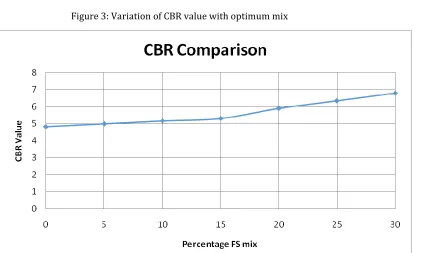
The aftereffects of California bearing proportion (CBR) tests on silty soil treated with foundry sand are appeared in figure 3. It is watched that CBR estimation of silty soil increased with development of foundry sand. The [image:4.612.109.509.204.386.2]estimation of CBR decays from 4.82% for un-settled soil to 6.80% for offset soil. The adjustment in CBR quality may be credited to better compaction and squeezing of the mix particles with extension of foundry sand
.
Figure 3: Variation of CBR value with optimum mix
[image:4.612.37.472.413.666.2]© 2016, IRJET | Impact Factor value: 4.45 | ISO 9001:2008 Certified Journal
| Page 1320
Liquid Limit & Plastic Limit:
Figure 5: Variation of liquid & plastic limit with different foundry sand mixes
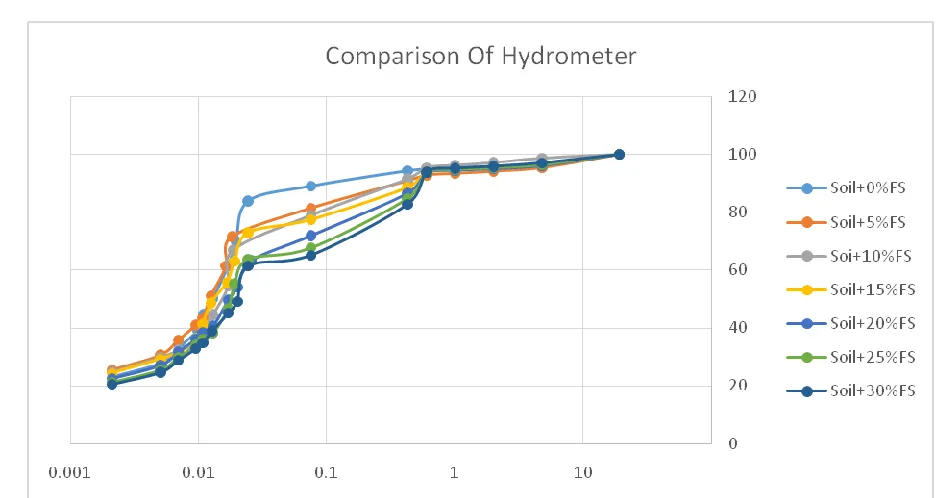
Hydrometer:
[image:5.612.84.553.428.677.2]© 2016, IRJET | Impact Factor value: 4.45 | ISO 9001:2008 Certified Journal
| Page 1321
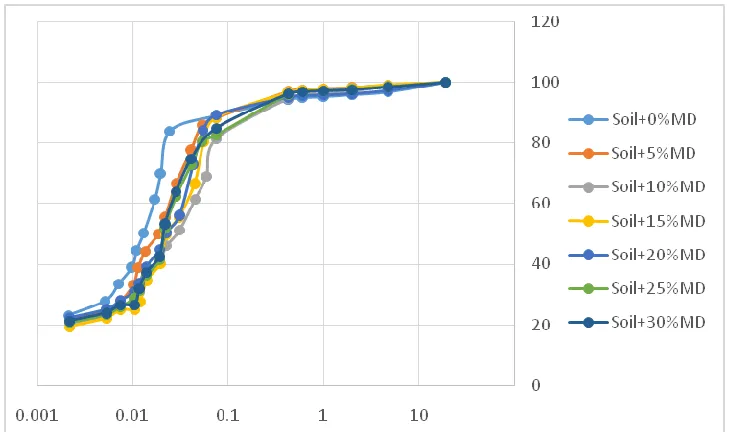
2.2.2 EXPERIMENTAL INVESTIGATIONS WITH MARBLE DUST
[image:6.612.37.444.157.394.2]Particle size distribution:
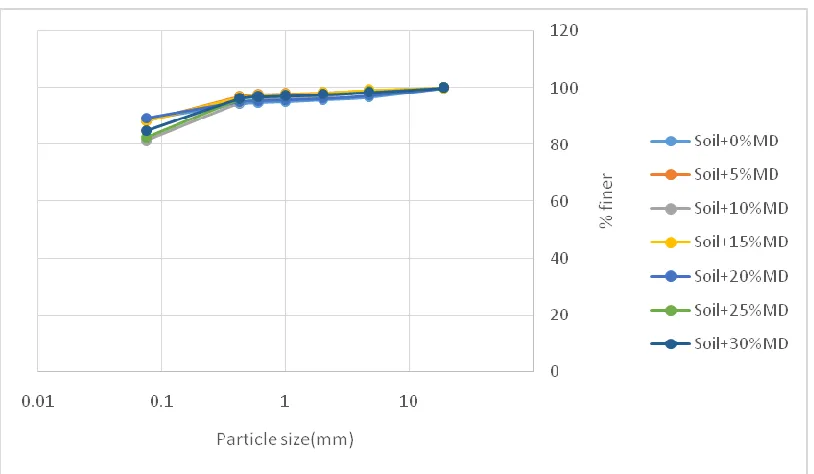
Figure 7: Particle size distribution of soil mixed with marble dust
OMC&MDD
:
The water content-dry density of silty soil blended with foundry sand content fluctuating from 5% to 30% are appeared in figure 8. It is watched that most noteworthy
maximum dry density (MDD) of silt marble dust composite augmentations with the extension in marble dust is lessened.
[image:6.612.141.476.497.693.2]© 2016, IRJET | Impact Factor value: 4.45 | ISO 9001:2008 Certified Journal
| Page 1322
CBR
:
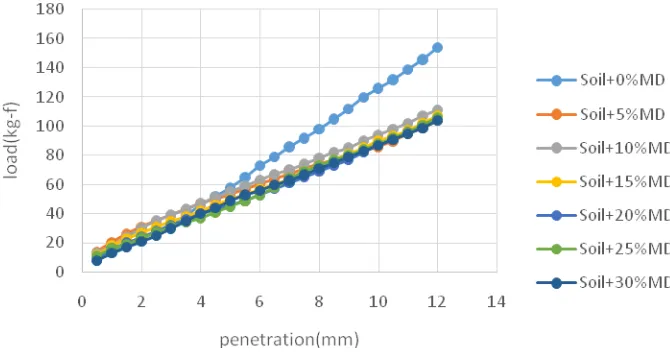
The aftereffects of California bearing proportion (CBR) tests on silty soil treated with marble dust are appeared in figure 9. It is watched that CBR estimation of silty soil decreased with development of marble dust. The
[image:7.612.158.493.209.387.2]estimation of CBR decays from 4.82% for un-settled soil to 3.53% for offset soil. Thus, it can be well said that with the increase in the percentage of marble dust, the CBR value decreases.
[image:7.612.73.481.451.635.2]Figure 9: Variation of CBR value of soil mixed with marble dust
© 2016, IRJET | Impact Factor value: 4.45 | ISO 9001:2008 Certified Journal
| Page 1323
[image:8.612.67.544.116.314.2]Liquid Limit & Plastic Limit:
Figure 11: Variation of liquid & plastic limit with different marble dust mixes
Hydrometer:
[image:8.612.142.507.390.606.2]© 2016, IRJET | Impact Factor value: 4.45 | ISO 9001:2008 Certified Journal
| Page 1324
3.
Conclusion:
1.
The most critical estimation of maximum dry density is refined for soil-foundry sand mix of 80:20 took after by various degrees (Figure 2). This happens because of the reason that the voids between the foundry sand particles are involved by the dirt particles when the sand substance is less however bigger sand content isolates the particles and the most extreme dry thickness diminishes. On the contrary,the
MDD is kept on decreasing when the percentage of marble dust is increased.2. The optimum moisture content of soil foundry sand mix decreased with the extension of foundry sand (up to 15% substance) however it extended a brief timeframe later (Figure 2). This happens in view of lower measure of water required to oil up the foundry sand particles which are coarser differentiated and earth particles.In case of soil mixed with marble dust, the OMC is kept on increasing (Figure 9).
3. The California bearing proportion estimation of silty soil increases fundamentally i.e. from 4.82% to 6.80% with expansion of foundry sand (Figure 3). On the other the CBR value is decreasing when the soil is mixed with marble dust.
4. In this manner, silty soil settled with foundry sand can be used as a sub-base material for improvement of versatile pavements in natural boulevards with low development volume in comparison to marble dust
.
4. References:
[1] Kenneth. A., Hegazy, Y., and Jasperse, B. (2001) Adjustment of Delicate Soils by Soil Blending. Delicate Ground Innovation: pp. 194-205. doi: 10.1061/40552(301)16.
[2] ASTM D422-63, "Standard test strategies for hydro meter investigation of soils," American Culture for Testing of Materials, Pennsylvania, Dad, USA.
[3] ASTM D698-07e1, "Standard test strategies for research center compaction qualities of soil utilizing standard exertion," American Culture for Testing of Materials, Pennsylvania, Dad, USA.
[4] ASTM D854-10, "Standard test strategies for particular gravity of soil," American Culture for Testing of Materials, Pennsylvania, Dad, USA.
[5] ASTM D1883-05, "Standard test strategies for California bearing proportion test for soils," American Culture for Testing of Materials, Pennsylvania, Dad, USA.
[6] ASTM D2487-11, "Standard practice for order of soils for building purposes (bound together soil arrangement framework)," American Culture for Testing of Materials, Pennsylvania, Dad, USA.
[7] ASTM D4318-10, "Standard test techniques for fluid cutoff, plastic point of confinement, and pliancy file of soils," American Culture for Testing of Materials, Pennsylvania, Dad, USA.
[8] ASTM D5239-2004, "Standard practice for describing fly fiery remains for use in soil adjustment," American Culture for Testing of Materials, West Conshohocken, Dad, USA.
[9] ASTM D6913-04, "standard test strategies for molecule size dispersion of soils," American Culture for Testing of Materials, Pennsylvania, Dad, USA.
[10] Abichou T, Edil TB, Benson CH, Bahia H. Advantageous utilization of foundry by-items in expressway development. In: Geotechnical building for transportation ventures: Procedures of geo-trans 2004, Jul 27-31 2004. Los Angeles, CA, Joined States: American Culture of Structural Designers, Reston, VA 20191-4400, Joined States; 2004.
[11] Abichou, T., Benson, C.H., Edil, T.B., and Tawfiq, K., "Water powered Conductivity of Foundry Sands and Their utilization as Pressure driven Boundaries," In: Aydilek, A.H. and Wartman, J. (Eds.), Reused Materials in Geotechnics, Geotechnical Unique Distribution 127. ASCE, Baltimore, Maryland, 2004.
[12] Baser O (2009), “Stabilization of Expansive Soils Using Waste Marble Dust”, Master of
Science Thesis, Submitted to Civil Engineering Department, Middle East, Technical University.
© 2016, IRJET | Impact Factor value: 4.45 | ISO 9001:2008 Certified Journal
| Page 1325
International Conference on Emerging Frontier inTechnology for Rural Area.
[14] Gourley, C. S., Newill, D., and Shreiner, H. D., 1993, Expansive soils: TRL’s research strategy. Proc., 1st Int. Symp. On Engineering Characteristics of Arid Soils.
[15] Agrawal Vinay,Gupta Mohit (2011) ―Expansive Soil Stabilization Using Marble Dust,‖ International Journal of Earth Sciences and Engineering ISSN 0974-5904, Volume 04, No 06 SPL, October 2011, pp 59-62.
[16] Ashkan GHolipoor Norozi Siavash Kouravand and, Mohammad Boveiri (2015).‖ A review of using the waste in soil stabilization‖,International Journal of Engineeing Trends and Technology(IJETT), ISSN 2231-5381 Volume 21 No 1, PP 33- 37.