ORIGINAL RESEARCH ARTICLE
PROTOCOL DESIGNED WITH ENHANCED POWER SAVING FEATURES ALONG WITH INCREASED
THROUGHPUT FOR MOBILE ADHOC NETWORK
*Rahul Mukherjee
Electronics and Telecommunication Engineering Department, Rungta College of Engineering and Technology
(RCET), Bhilai, India
ARTICLE INFO ABSTRACT
Mobile Ad-hoc Network (MANET) is an autonomous system of mobile nodes connected by wireless links. The nodes are free to move about and organize themselves into a network. These nodes change position frequently. To accommodate the changing topology special routing algorithms are needed. The Media Access Control (MAC) data communication protocol sub-layer provides addressing and channel access control mechanisms that make it possible for network nodes to access common wireless channel through distributed coordination function (DCF).This work proposes a new power controlled MAC protocol based on IEEE 802.11. Network Simulator 2 (NS2) has been used for simulation. It saves considerable amount of power and achieves the performance matching with that of IEEE 802.11.
Copyright © 2018,Rahul Mukherjee. This is an open access article distributed under the Creative Commons Attribution License, which permits unrestricted use, distribution, and reproduction in any medium, provided the original work is properly cited.
INTRODUCTION
A Mobile Ad-hoc network (MANET) is a network formed and functioning without any established infrastructure or centralized administration and consists of mobile nodes that use a wireless interface to communicate with each other. These mobile nodes serve as both hosts and routers so they can forward packets on behalf of each other. Hence the mobile nodes are able to communicate beyond their transmission range by supporting multihop communication. Mobile nodes can move freely, and organize themselves randomly i.e. each host can dynamically enter and leave the network. Thus, the network topology may change frequently and rapidly. This means that the network has to adapt itself to the current topology. A MANET may either work as self-configured stand-alone network or may be connected to the Internet through gateway nodes.
Hidden and Exposed Node Issue
The transmission range of stations in wireless network is limited by the transmission power; therefore, all the station in a LAN cannot listen to each other. This means that normal carrier sense mechanism which assumes that all stations can listen to each other, fails.
*Corresponding author:Rahul Mukherjee
Electronics and Telecommunication Engineering Department, Rungta College of Engineering and Technology (RCET), Bhilai, India.
In particular, this gives rise to hidden node and exposed node problem. Consider stations A, B, C and D as shown in figure.
CSMA/CA: The most important part of a MAC protocol is Channel Access Mechanism. The channel access mechanism is way of regulating the use of physical channel among the stations present in the network. It specifies when a station can send or receive data on the channel. CSMA/CA (Carrier Sense Multiple Access) is derived from CSMA/CD (Collision Detection) which is the channel access mechanism used in wired Ethernets. Since the transmission range of wireless stations is limited, collision cannot be detected directly. This protocols tries to avoid the collision. On arrival of a data packet from LLC, a station senses the channel before transmission and if found idle, starts transmission. If another transmission is going on, the station waits for the length of current transmission, and starts contention. Since the contention is a random time, each station get statistically equal chance to win the contention. CSMA/CA is asynchronous mechanism for medium access and does not provide any bandwidth guarantee. It’s a best effort service and is suited for packetized applications like TCP/IP. It adapts quite well to the variable traffic conditions and is quite robust against interference.
Classification of Mac protocol: MAC protocols for ad-hoc wireless networks can be classified into several categories based on various criteria such as initiation approach, time
ISSN: 2230-9926
International Journal of Development Research
Vol. 08, Issue, 12, pp.24460-24466, December, 2018
Article History:
Received 22nd September, 2018
Received in revised form 14th October, 2018
Accepted 04th November, 2018
Published online 26th December, 2018
Available online at http://www.journalijdr.com
Key Words:
MANET, 802.11 MAC, DCF, CSMA
Citation: Rahul Mukherjee, 2018. “Protocol designed with enhanced power saving features along with increased throughput for mobile Adhoc network”,
International Journal of Development Research, 8, (11), 24460-24466.
synchronization, and reservation approach. Ad MAC protocols are classified in three types;
Contention based protocols.
Contention based protocols with reservation mechanism.
[image:2.595.319.553.48.444.2] Contention based protocols with scheduling mechanism.
[image:2.595.40.284.132.308.2]Figure 1. Ad-hoc Wireless Network
[image:2.595.41.283.335.479.2]Figure 2. Hidden & Exposed node problem
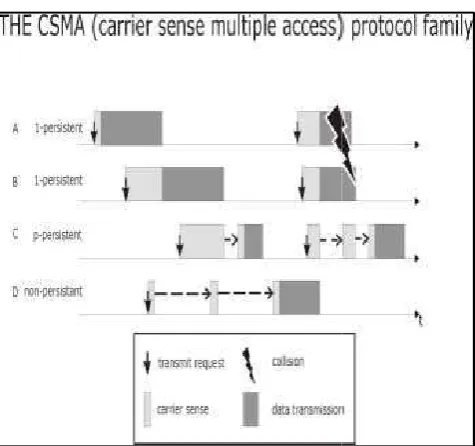
Figure 3. CSMA Channel Access Mechanism
synchronization, and reservation approach. Ad-hoc Network
Contention based protocols with reservation mechanism. Contention based protocols with scheduling mechanism.
hoc Wireless Network
2. Hidden & Exposed node problem
Mechanism
Figure 4. Flow chart of CSMA/CA
A. Contention Based Protocols
contention based channel access policy. A node doesn’t make any resource reservation in priori. Whenever it receives a packet to be transmitted, it
nodes for access to the shared channel. These are further divided into two types;
Sender initiated protocols
Receiver initiated protocols
B. Contention Based Protocol with Reservation Mechanisms: Ad-hoc wireless networks sometimes may need to support real time traffic, which requires QoS guarantees to be provided. In order to support such traffic, certain protocols have mechanism for reserving bandwidth in priori. These protocols are classified into two types;
Synchronous protocols
Asynchronous protocols
C. Contention Based Protocol with Scheduling Mechanisms: These protocols focus on packet scheduling at nodes, and also scheduling nodes for access to the channel. Node scheduling is done in a manner so that all nodes are treated fairly. Scheduling based scheme are also used for enforcing priorities among flows whose packets are queued at nodes.
Figure 4. Flow chart of CSMA/CA
Contention Based Protocols: These protocols follow a contention based channel access policy. A node doesn’t make any resource reservation in priori. Whenever it receives a packet to be transmitted, it contends with other nodes for access to the shared channel. These are further
Sender initiated protocols protocols
Contention Based Protocol with Reservation
hoc wireless networks sometimes may need to support real time traffic, which requires QoS guarantees to be provided. In order to support such traffic, certain protocols have mechanism for reserving bandwidth in priori. These protocols are classified into two types;
nchronous protocols
Contention Based Protocol with Scheduling
[image:2.595.44.282.508.731.2]Figure 5. MAC Architecture
IEEE 802.11 OPERATION
The IEEE 802.11 MAC offers two kinds of medium access methods, namely Distributed Coordination Function (DCF), and Point Coordination Function (PCF). DCF is the basic access method in 802.11 and requires no infrastructure.
Figure 6. DCF-PCF Coordination
[image:3.595.313.554.61.364.2]The IEEE 802.11 MAC offers DCF, and PCF. DCF requires no infrastructure. When wireless stations are within transmit range of each other, they form a Basic Service Set (BSS), and can communicate to each other using DCF. If the BSS contains only two stations, it is called Independent Basic Service Set (IBSS). Many BSSs may be connected by a Distribution System (DS) to form an Extended Service (ESS). An access point (AP) is the station that prov access to DS services. The IEEE 802.11 MAC is designed for wireless LANs. The requirements of multi-hop ad-hoc networks are more challenging than those of wireless LANs. In this research, we investigate the operation of IEEE 802.11 MAC in centralized multi-hop ad-hoc networks. The terms station and node are used interchangeably throughout the thesis. Multi-hop cooperative wireless ad-hoc networks will be simply referred to as multi-hop networks.
Figure 7. 802.11 Architecture
Figure 8. Multi-hop Scenario
Consider a multi-hop centralized scenario, as shown in the figure. For convenience, the stations inside the network are classified into following categories:
Central station: is the central controlling station. Most of the traffic in the network is directed towards it.
Inner stations: are within one hop boundary of the central station.
[image:3.595.41.284.410.588.2]Boundary stations: are at one hop boundary of the central station. These stations act as relaying stations for the stations outside the reach of central node. Outer stations are outside the communication range of central node.
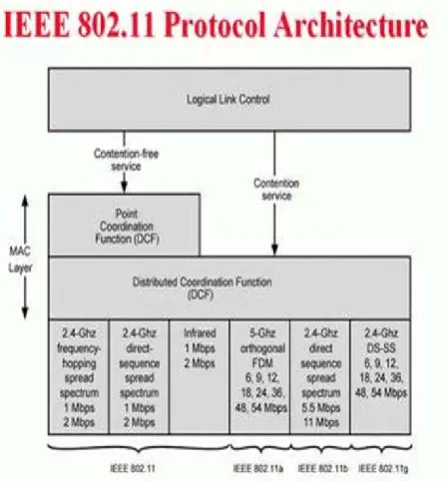
Figure 9. IEEE 802.11 Protocol Architecture
[image:3.595.322.546.541.782.2]IEEE 802.11 SCHEME SPECIFICATION
IEEE 802.11 specifies two medium access control protocols, PCF (Point Coordination Function) and DCF (Distributed Coordination Function). PCF is a centralized scheme, whereas DCF is a fully distributed scheme. We consider DCF in this paper.
Transmission range: When a node is withi
transmission range of a sender node,
correctly decode packets from the sender node. In our simulations, the transmission range is 250 m when using the highest transmit power level.
Carrier sensing range: Nodes in the carrier sensing
range can sense the sender’s transmission.
sensing range is typically larger than the transmission range, for instance, two times larger than the transmission range. In our simulations, the carrier sensing range is 550 m when using the highest powe level. Note that the carrier sensing range and transmission range depend on the transmit power
Carrier sensing zone: When a node is within the carrier
sensing zone, it can sense the signal but cannot decode it correctly. Note that, as per our defi
carrier sensing zone does not include transmission range. Nodes in the transmission range can indeed sense the transmission, but they can also decode it correctly. Therefore, these nodes will not be in the carrier sensing zone as per our definition. The carrier sensing zone is between 250 m and
[image:4.595.308.558.295.455.2] [image:4.595.46.284.416.659.2]highest power level in our simulation.
Figure 10. Carrier Sensing
MAC SUB LAYER IN IEEE 802.11
The IEEE standard 802.11 specifies the most famous family of WLANs in which many products are already available. This means that the standard specifies the physical and medium access layer adapted to the special requirements of wireless LANs, but offers the same interface as the others to higher layers to maintain interoperability.
System architectur: The basic service set (BSS) is the
fundamental building block of the IEEE 802.11 architecture. A
SPECIFICATION
medium access control protocols, PCF (Point Coordination Function) and DCF (Distributed Coordination Function). PCF is a centralized scheme, whereas DCF is a fully distributed scheme. We consider DCF in this
When a node is within it can receive and decode packets from the sender node. In our simulations, the transmission range is 250 m when
level.
Nodes in the carrier sensing transmission. Carrier sensing range is typically larger than the transmission range, for instance, two times larger than the transmission range. In our simulations, the carrier sensing range is 550 m when using the highest power level. Note that the carrier sensing range and transmission range depend on the transmit power level.
: When a node is within the carrier sensing zone, it can sense the signal but cannot decode it correctly. Note that, as per our definition here, the carrier sensing zone does not include transmission range. Nodes in the transmission range can indeed sense the transmission, but they can also decode it correctly. Therefore, these nodes will not be in the efinition. The carrier and 550 m with the
The IEEE standard 802.11 specifies the most famous family of products are already available. This means that the standard specifies the physical and medium access layer adapted to the special requirements of wireless LANs, but offers the same interface as the others to higher
The basic service set (BSS) is the fundamental building block of the IEEE 802.11 architecture. A
BSS is defined as a group of stations that are under the direct control of a single coordination function (i.e., a DCF or PCF) which is defined below. The geographical area covered by the BSS is known as the basic service area (BSA), which is analogous to a cell in a cellular communications network. Conceptually, all stations in a BSS can communicate directly with all other stations in a BSS. H
medium degradations due to multipath fading, or interference from nearby BSSs reusing the same physical characteristics (e.g., frequency and spreading code, or hopping pattern), can cause some stations to appear hidden from other stations. An ad hoc network is a
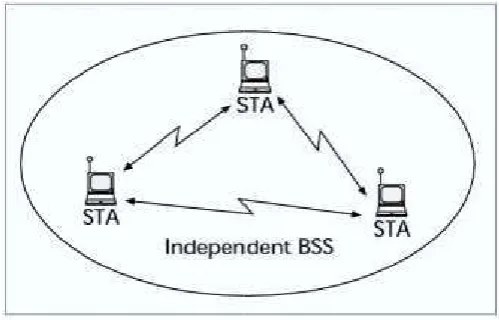
into a single BSS for the purposes of internetworked communications without the aid of an infrastructure network. Given figure is an illustration of an independent BSS (IBSS), which is the formal name of an ad hoc network in the IEEE 802.11 standard. Any station can establish a direct communications session with any other station in the BSS, without the requirement of channeling all traffic through a centralized access point (AP).
Figure 11. System Architecture of an Ad
In contrast to the ad hoc network, infrastructure networks are established to provide wireless users with specific services and range extension. Infrastructure networks in the context of IEEE 802.11 are established using APs. The AP supports range extension by providing the integration points necessary for network connectivity between multiple BSSs, thus forming an extended service set (ESS). The ESS has the appearance one large BSS to the logical link
each station (STA). The ESS consists
integrated together using a common distribution system (DS). The DS can be thought of as a backbone network that is responsible for MAC-level transport of MAC service data units (MSDUs).
Figure 12. Example of infrastructure network
BSS is defined as a group of stations that are under the direct control of a single coordination function (i.e., a DCF or PCF) ed below. The geographical area covered by the BSS is known as the basic service area (BSA), which is analogous to a cell in a cellular communications network. Conceptually, all stations in a BSS can communicate directly with all other stations in a BSS. However, transmission medium degradations due to multipath fading, or interference from nearby BSSs reusing the same physical-layer characteristics (e.g., frequency and spreading code, or hopping pattern), can cause some stations to appear hidden from other stations. An ad hoc network is a deliberate grouping of stations into a single BSS for the purposes of internetworked communications without the aid of an infrastructure network. Given figure is an illustration of an independent BSS (IBSS), ormal name of an ad hoc network in the IEEE 802.11 standard. Any station can establish a direct communications session with any other station in the BSS, without the requirement of channeling all traffic through a
11. System Architecture of an Ad-hoc network
In contrast to the ad hoc network, infrastructure networks are established to provide wireless users with specific services and range extension. Infrastructure networks in the context of shed using APs. The AP supports range extension by providing the integration points necessary for network connectivity between multiple BSSs, thus forming an extended service set (ESS). The ESS has the appearance of link control (LLC) sub layer of consists of multiple. BSSs that are integrated together using a common distribution system (DS). The DS can be thought of as a backbone network that is level transport of MAC service data
[image:4.595.314.558.645.773.2]DCF OPERATION
The DCF is the fundamental access method used to support asynchronous data transfer on a best effort basis. The DCF is based on CSMA/CA. The carrier sense is performed at both the air interface, referred to as physical carrier sensing, and at the MAC sub layer, referred to as virtual carrier sensing.
Physical carrier sensing detects presence of A. Inter frame
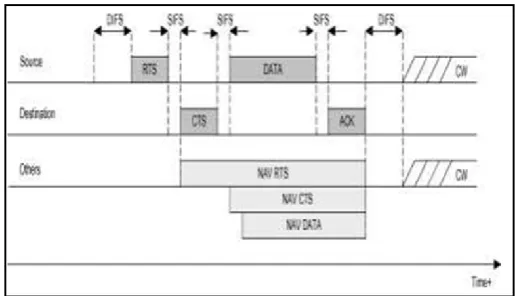
Spacing. IFS is the time interval between frames. IEEE 802.11 defines four IFSs – SIFS (short inter frame space), PIFS (PCF inter frame space), DIFS (DCF inter frame space), and EIFS (extended inter frame space). The IFSs provide priority levels for accessing the channel. The SIFS is the shortest of the inter frame spaces and is used after RTS, CTS, and DATA frames to give the highest priority to CTS, DATA and ACK, respectively. In DCF, when the channel is idle, a node waits for the DIFS duration before transmitting any packet. In figure, nodes in transmission range correctly set their NAVs when receiving RTS or CTS. However, since nodes in the carrier sensing zone cannot decode the packet, they do not know the duration of the packet transmission. To prevent a collision with the ACK reception at the source node, when nodes detect a transmission and cannot decode it, they set their NAVs for the EIFS duration. The main purpose of the EIFS is to provide enough time for a source node to receive the ACK frame, so the duration of EIFS is longer than that of an ACK transmission. As per IEEE 802.11, the EIFS is obtained using the SIFS, the DIFS, and the length of time to transmit an ACK frame at the physical layer’s lowest mandatory rate, as the following equation:
EIFS = SIFS + DIFS + [(8·ACKsize) + Preamble Length + PLCP Header Length] / Bit Rate
other users by analyzing the activity in the channel through where ACK size is the length (in bytes) of an ACK frame, and the received signal strength.
Bit Rate is the physical layer’s lowest mandatory rate. Preamble
A station performs virtual carrier sense by Length is 144 bits and PLCP Header Length is 48 bits . Using a 1 examining the received MPDU (MAC Protocol Data Unit) Mbps channel bit rate, EIFS is equal to 364 μs information in the header of RTS, CTS and ACK frames. The stations in BSS use this information to adjust their Network Allocation Vector (NAV), which indicates amount of time that must elapse until the current transmission is complete and the channel can be sampled again for idle status.
BASIC POWER CONTROL PROTOCOL
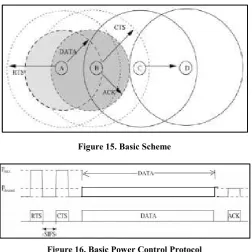
Here nodes A and B send RTS and CTS, respectively, with the highest power level so that node C receives the CTS and defers its transmission. By using a lower power for DATA and ACK packets, nodes can conserve energy. In the Basic scheme, the RTS–CTS handshake is used to decide the transmission power for subsequent DATA and ACK packets. This can be done in two different ways as described below. Let pmax denote the maximum possible transmit power level.
Suppose that node A wants to send a packet to node B.
Node A transmits the RTS at power level pmax. When B
receives the RTS from A with signal level pr, B can calculate the minimum necessary transmission power level, pdesired, for the DATA packet based on received power level pr, the transmitted power level, pmax, and noise level at the receiver B. We can borrow the procedure for estimating pdesired from. This procedure determines pdesired taking into account the current noise level at node B. Node B then specifies pdesired in its CTS to node A. After receiving CTS, node A sends DATA using power level pdesired. Since the signal-to-noise ratio at the receiver B is taken into consideration, this method can be accurate in estimating the appropriate transmit power level for DATA.
In the second alternative, when a destination node receives
an RTS, it responds by sending a CTS as usual (at power level p max). When the source node receives the CTS, it calculates p desired based on received power level, pr, and transmitted power level (p max), as
P desired = p max/pr · Rxthresh · c,
[image:5.595.309.560.376.586.2]where Rxthresh is the minimum necessary received signal strength and c is a constant. We set c equal to 1 in our simulations. Then, the source transmits DATA using a power level equal to p desired. Similarly, the transmit power for the ACK transmission is determined when the destination receives the RTS.
Figure 13. DCF access using RTS/CTS
Figure 14. NAV duration in transmission range and carrier sensing zone
[image:5.595.305.563.617.765.2]Figure 15. Basic Scheme
Figure 16. Basic Power Control Protocol
DEFICIENCY OF THE BASIC PROTOCOL
[image:6.595.309.555.295.398.2]In the Basic scheme, RTS and CTS are sent using pmax, and DATA and ACK packets are sent using the minimum necessary power to reach the destination. When the neighbour nodes receive an RTS or CTS, they set their NAVs for the duration of the DATA–ACK transmission. When D and E transmit the RTS and CTS, respectively, B and C receive the RTS, and F and G receive the CTS, so these nodes will defer their transmissions for the duration of the D–E transmission. Node A is in the carrier sensing zone of D (when D transmits at pmax) so it will only sense the signals and cannot decode the packets correctly. Node A will set its NAV for EIFS duration when it senses the RTS transmission from D. Similarly, node H will set its NAV for EIFS duration following CTS transmission from E. When transmit power control is not used, the carrier sensing zone is the same for RTS–CTS and DATA–ACK since all packets are sent using the same power level. However, in Basic, when a source and destination pair decides to reduce the transmit power for DATA–ACK, the transmission range for DATA–ACK is smaller than that of RTS–CTS; similarly, the carrier sensing zone for DATA–ACK is also smaller than that of RTS–CTS.
Figure 17. Basic Scheme
PROPOSED POWER CONTROL MAC PROTOCOL
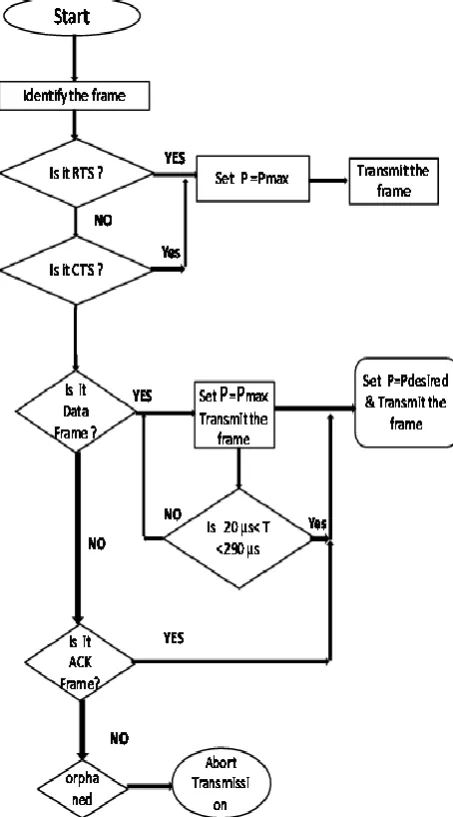
Proposed power control MAC (PCM) is similar to the Basic scheme in that it uses power level pmax for RTS–CTS and the minimum necessary transmit power for DATA–ACK transmissions. We now describe the procedure used in PCM.
1. Source and destination nodes transmit the RTS and CTS
using pmax. Nodes in the carrier sensing zone set their NAVs for EIFS duration when they sense the signal and cannot decode it correctly.
2. The source node may transmit DATA using a lower
power level, similar to the BASIC scheme.
3. To avoid a potential collision with the ACK (as
discussed earlier), the source node transmits DATA at the power level pmax, periodically, for just enough time so that nodes in the carrier sensing zone can sense it.
4. The destination node transmits an ACK using the
minimum required power to reach the source node, similar to the BASIC scheme.
Figure 18. PCM periodically increases
Figure shows how the transmit power level changes during the sequence of an RTS–CTS–DATA–ACK transmission. After the RTS–CTS handshake using pmax, suppose the source and destination nodes decide to use power level p1 for DATA and ACK. Then, the source will transmit DATA using p1 and periodically use pmax. The destination uses p1 for ACK transmission. The main difference between PCM and the Basic scheme is that PCM periodically increases the transmit power to pmax during the DATA packet transmission. With this change, nodes that can potentially interfere with the reception of ACK at the sender will periodically sense the channel as busy, and defer their own transmission.
Accordingly, 15 μs should be adequate for carrier sensing, and time required to increase output power (power on) from 10% to 90% of maximum power (or power-down from 90% to 10% of maximum power) should be less than 2 μs. Thus, we believe 20 μs should be enough to power up (2 μs), sense the signal (15 μs), and power down (2 μs). In our simulation, EIFS duration is set to 212 μs using a 2 Mbps bit rate. In PCM, a node transmits DATA at pmax every 190 μs for a 20μs
duration. Thus, the interval between thetransmissions at pmax
[image:6.595.56.276.592.774.2]at higher power level for a very fraction of time, in order to make the neighboring nodes understand that transmission is going on and they should restrict their transmission during that period so that collision does not take place hence saving power consumption.
Figure 19. Flow chart of Proposed Protocol
SIMULATION RESULTS
The given table shows all the different parameters taken into account for conducting the simulation in NS-2 atmosphere. In this table the values of all the different parameters are shown, using which the simulation for aggregate throughput and total data delivered per joule in accordance with Data rate per flow and Packet size is calculated for all three schemes namely, BASIC, 802.11 and Proposed protocol’s.
Conclusion
It is shown that the Basic scheme increases collisions and retransmissions, which can result in more energy consumption and throughput degradation. Hence, the proposed protocol is more efficient than Basic scheme and 802.11 yielding better throughput with much less power consumption, hence yielding better performance compared to the rest protocols.
SUGGESTION FOR FUTURE WORK
We have shown the throughput of proposed protocol
comparable to 802.11 with less power consumption for random topology ad hoc network.
In future the same power consumption scheme will be
conducted for grid topology.
One possible approach to the mobile ad hoc network
power control scheme is that, it is only applied to the Random topology ad hoc scenario but it can also be made applicable for Grid Topology power control scheme without degrading the network throughput. Where the nodes will be placed sequentially in a proper manner i.e, in an arranged fashion.
REFERENCES
Awerbunch, B., D. Holmer, and H. Rubens, The medium time metric: High throughput route selection in multi-rate adhoc wireless network.
Ruay-Shiung Chang and Shing-Jiuan Leu, January 2006, “Long-lived Path Routing With Received Signal Strength for Ad Hoc Networks”, IEEE International Symposium on Wireless Pervasive Computing.
Wattenhofer R., L. Li, P. Bahl and Y.M. Wang, 2001. Distributed topology control for power efficient operation in multihop wireless ad hoc networks, Vol. 3 pp. 1388– 1397.
Poojary N., S.V. Krishnamurthy and S. Dao, 2001. Medium access control in a network of ad hoc mobile nodes with heterogeneous power capabilities, in: Proc. IEEE International Conference on Communications (ICC 2001), Vol. 3 pp. 872–877.
Marina M.K. and S.R. Das, 2001, “On-Demand Multipath distance vector routing in ad hoc Networks” in: Proceedings of 9th IEEE International Conference on Network Protocols (ICNP).
Performance analysis of AODV, DSDV AND DSR in MANETS, International Journal of Distributed and Parallel Systems (IJDPS) Vol.2, No.6, November 2011
Geetha Jayakumar and G. Gopinath, Performance comparison of Two On- demand routing protocols for Ad-hoc Networks based on random way point mobility model.‖ –
Department of Computer Science, Bharathidasan
University, Triuchirapalli- 620 023, India