3696
IMAGE STEGANOGRAPHY BASED THE BEHAVIOR OF
PARTICLE SWARM OPTIMIZATION
1INAAM RABAH MOHAMMAD, 2Dr.ZIYAD TARIQ MUSTAFA AL- TA'I
1Universityof Diyala - Collage of Science, Department of Computer Science, Iraq
2University of Diyala – Collage of Science, Department of Computer Science, Iraq
E-mail: 1[email protected], 2[email protected]
ABSTRACT
The growing possibilities of modern communications and the explosive growth of information technology imposed special means of security. Image steganography is one class of this security. However, in the modern world new techniques are appeared continuously such as swarm intelligence. Therefore, this work presents an enhancement of security in the field of image LSB steganography using the behavior of PSO algorithm. Specifically, SPSO algorithm represents the standard behavior of PSO, QPSO algorithm represents the quantum behavior of PSO and HPSO algorithm represents the human behavior of PSO. In this paper, three image steganography techniques are proposed using (SPSO, QPSO, and HPSO) algorithms. These algorithms are used to determine the best locations in the cover image pixels to embed the secret text message using LSB technique. Therefore, this paper presents a comparison and evaluations between these types of PSO algorithms in the field of image steganography. Experimental results for hiding different size text messages in four BMP cover images with different sizes, prove that the proposed image steganography using QPSO has best performance. However, PSNR of QPSO system stegocovers is (81.709 dB), the PSNR of HPSO system stegocovers is (81.143 dB), and the PSNR of SPSO system stegocovers is (81.012 dB). Hence, the proposed method using quantum behavior of PSO algorithm is the best performance system from steganography point of view.
Keywords: PSO, SPSO, QPSO, HPSO, LSB.
1. INTRODUCTION
In the growing linked modern world, one may wish to be able to protect not only secrecy of the
communication but also privacy of the
communicators [1]. Therefore, information hiding gets its way in modern communication. Information hiding is the process of hiding amount of data called secret message into a cover media that may be audio, video or image in an imperceptible way to build a covert channel [2].The two basic requirement of information hiding system are usually referred to as transparency and robustness. Transparency means that the stego- medium should be similar to cover medium according to a suitable distortion measure. Whereas, robustness means that hiding message should survive the implementation of any data processing method with a certain class to stego - medium [3].This paper presents an efficient image hiding scheme based on the behavior of PSO in order to find best locations in cover image to hide text secret message.
The rest of the paper is organized as follows: Section 2 presents related work. Section 3 explains PSO, QPSO, and HPSO. The proposed technique for secret message embedding and extraction is explained in section 4. Section 5 presents the experimental results with discussion. Finally, section 6 draws the conclusion of this paper and Suggestion for future work.
2. RELATED WORK
In this section, we will show some of the previous studies about PSO algorithm in the field of image steganography
3697 secret messages correctly without knowing the substitution matrix.
* Ruchika Bajaj et. al. (2010) [5], developed a method for embedding secret messages of variable length with high embedding capacity based on SPSO. This method finds the best pixel positions in the cover image, which can be used to conceal the secret message. In the proposed method, M bits of the secret message are substituted into M least significant bits of the image pixel, such as M varies from 1 to 4 depending on the message length. * Feno Heriniaina Rabevohitra and Jun Sang (2011) [6], proposed a secure data hiding scheme for embedding secret message into a cover image with least significant bit (LSB) substitution in discrete cosine transformation domain (DCT). Firstly, the secret message was divided into partitions, whereas the cover image splits into blocks of 2x2 size. The DCT was used to change the blocks from spatial to frequency domain. The proposed method results an increasing in efficiency, as well the security level, because SPSO algorithm is used for finding an optimal transformation matrix T.
* Parisa Gerami et. al. (2012) [7], developed a technique which is based on SPSO algorithm to find the best pixel locations, thus the secret image is transformed inside the cover image. Optimal Pixel Adjustment (OPA) scheme is used to further increase the quality image. Moreover, the proposed approach was compared to other previous approaches. The results show that the proposed method provides better PSNR. The quality of cover image did not change very much and achieved better imperceptibility with the same payload capacity. * Anu Garg and Navdeep Kaur (2014) [8], proposed a new method for data hiding that is using the hybrid algorithm of PSO with ACO. The results were calculated using PSNR and MSE values providing increased security and quality of the stego image. * Vaddadi Swetha et. al. (2016) [9], implemented biometric feature for skin tone region of images. Data hiding is done at detected skin tone regions. A novel steganography scheme was proposed that uses particle swarm optimization algorithm (PSO) for data hiding. It assured high security, good invisibility and robustness. The secret data is embedded with a cover image to improve the security of stego images by means of PSO algorithm.
The previous related works show that image steganography using PSO is not a new field. However, these previous works did not take in consideration the effect of an individual's behavior
in PSO algorithm. Therefore, there is no similar claims published in this field based on behavior of PSO. In other words, this paper is concerned with building image steganographic system depending on behavior of PSO.
3. SPSO, QPSO AND HPSO
3.1 Standard Particle Swarm Optimization (SPSO)
Particle swarm optimization (SPSO) [10], is a heuristic optimization method based on the behavior of social insects, such as ants, termites, bees, and wasps; as well as of other animal societies as flock of birds; or a school of fish. SPSO model consists of a swarm of particles, which are initialized with a population of random candidate solutions. They move iteratively through the d-dimension problem space to search for the new solutions, where the fitness, f, can be calculated as the certain qualities measure [11]. Each particle has a position represented by a position-vector xi (i is the index of the particle), and a velocity represented by a velocity-vector vi. Each particle remembers its own best position value is pbest(pid)[11]. The best position among the swarm value is gbest(pgd). Essentially, SPSO is simply described by the following two straightforward velocity and position update equations, shown in equations (1) and (2)
respectively [12].
V(id+1) = w vid + c1 r1* (pid xid) +c2 r2 * (pgd -xid) (1)
3698
Figure 1 Pseudo code of PSO (SPSO)
3.2 Quantum Behaved–Particle Swarm Optimization (QPSO)
Recently, inspired by quantum mechanics and dynamical analysis of SPSO algorithm [13], Sun et. al. proposed a new version of SPSO which is Quantum-Behaved Particle Swarm Optimization (QPSO) algorithm [14] [15]. QPSO makes use of a strategy based on a quantum delta potential well δ model to sample around the SPSO best positions. As per classical PSO[10], a particle is stated by its position vector x and velocity vector v, which determine the trajectory of the particle. The particle moves along a determined trajectory following Newtonian mechanics. However if we consider quantum mechanics, then the term trajectory is meaningless, because x and v of a particle cannot be determined simultaneously
according to uncertainty principle. QPSO differs
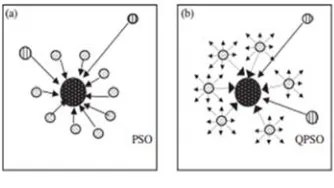
[image:3.612.336.503.443.537.2]from SPSO algorithm in some characteristics. Firstly, the exponential distribution of positions makes QPSO global convergent. Also, the introduced mean best position (mbest) into the evolution equation of QPSO is a second improvement of QPSO. In SPSO, each particle converges to its global best position independently. While in the QPSO with mbest position, each particle cannot converge to global best position without considering its colleagues as shown in Figure 2.
In the quantum model of a PSO, the state of a particle is depicted by wave function Ψ (x, t) instead of position and velocity. The particles can appear anywhere in the feasible region, even a position far away from the current position, according to the probability density function depending on the potential field the particle lies
in[16]. The particles move according to the
following iterative equations [14] [15]:
x(id+1)=p+α| mbest- x(id) | * ln(1∕u) if k≥ 0.5 (3)
x(id+1)=p- α| mbest- x(id) | * ln(1∕u) If k<0.5 (4)
Where
p=Q pid + (1-Q) pgd (5)
mbest = ∑ p (6)
Mean best (mbest) of the population is defined as the
mean of the best positions of all particles, u, k, Q
are uniformly distributed random numbers in the interval [0,1]. The parameter α is called contraction expansion coefficient. The pseudo code of QPSO algorithm is shown in figure 3 after [16].
Figure 3 pseudo code of QPSO algorithm
3.3 Human behavior – Based particle Swarm Optimization (HPSO)
Hao Liu et al. [17], proposed a new version of SPSO based on human behavior, which is called HPSO. HPSO is used to enhance the implementation of SPSO. With SPSO [10], all particles only learn from the best particles Pbest and Gbest. Obviously, it is an ideal social condition. However, considering the human behavior there exist some people who have bad habits or behaviors around us, at the same time, as we all known that these bad habits or behaviors will bring some effects on people around them. It is beneficial to take warning from these bad habits or behaviors. Conversely, it is harmful to learn from these bad habits or behaviors .Therefore, Begin
Generate an initial random population positions and velocities with size M and the dimensions D of the particles.
Repeat
For i = 1 to M do
if (f(Xi)<f(Pi )then Pi = Xi , G=argmax (f(Pi)) For j = 1 to D do
Update Velocity with Eq. (1); Update Position with Eq. (2);
End/end for loop j; End/end for loop I; Until termination criterion is met. End
Initialize Swarm Begin
While the condition termination not met Do
Calculate mbest by equation (6)
Update particle positions by using equation (3) Update pbest
Update gbest End do End
[image:3.612.92.298.591.712.2]3699 it is better to give an objective and rational view on these bad habits or behaviors. To simulate the human behavior, the global worst particle was introduced into the velocity equation of SPSO, and the learning coefficient r3 which obeys the standard normal
distribution that is r3 ∈N(0,1), can balance the
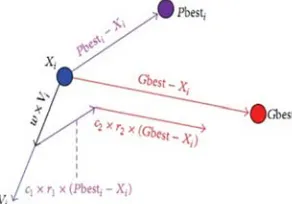
exploration and exploitation abilities by changing the flying direction of particles. At the same time, the acceleration coefficients c1 and c2 have been replaced with two random numbers, whose sum is equal to 1 in [0, 1]; this strategy decreases the dependence on parameters of the solved problem [17]. In SPSO, the cognition and social learning terms move particle i towards good solutions based on personal best position Pbest and global best position Gbest in the search space. This strategy
[image:4.612.316.523.218.379.2]makes a particle fly fast to good solutions, so it is easy to trap in local optima as shown in figure 4. From figure 5, both impelled learning term and penalized term can be clearly observed to provide a particle with the chance to change flying direction. Therefore, the impelled/penalized term plays a key role in increasing the population diversity, which is beneficial in helping particles to escape from the local optima and also to enhance convergence speed. In HPSO, the impelled/penalized learning term performs a proper trade between the exploration and exploitation [17].
Figure 4 Cognition and social termsin SPSO
Figure 5 Impelled/penalized term in HPSO
Therefore, the velocity equation has been changed as shown in the following two equations:
V(id+1)=V(id)+r1(Pbest-X(id) )+r2(Gbest-X(id)) +r3(Gworst-X(id)) (7)
X(id+1)= X(id)+ V(id+1) (8)
The pseudo code of HPSO algorithm is shown in Figure 6 after [17].
[image:4.612.124.270.285.387.2]
Figure 6 Pseudo code of HPSO algorithm
4. THE PROPOSED METHOD
The aim of research is to evaluate the behavior of PSO algorithm classically, quantitatively and humanly using image steganography. The three types of PSO algorithm are used as powerful swarm intelligence search technique for finding the best hiding positions in the cover image to hide a secret messages so that the produced stego image has good quality and robust to certain image stegoanalysis attacks.
4.1 Transmitter side
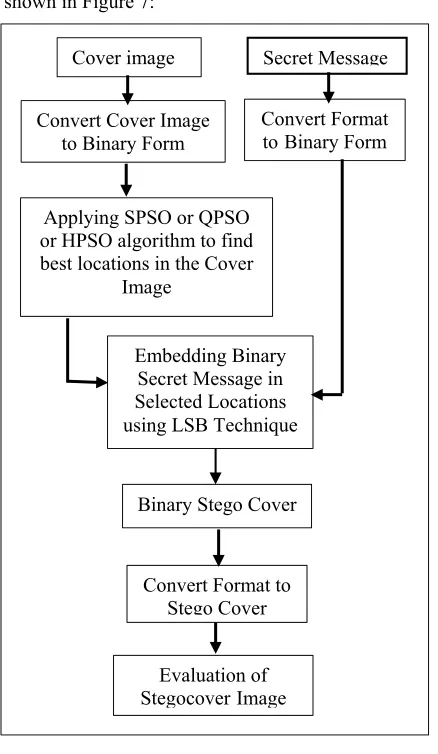
In the transmitter side, SPSO, QPSO, HPSO techniques is used for finding the best hiding locations in image cover. These output locations of the SPSO or QPSO or HPSO algorithms are then used to embed the secret massage data by using LSB technique in order to obtain the stego image. The steps of embedding secret message in a cover image are shown in Algorithm1
Initialize the swarm with size M,Initialize
Pbest ,Gbest and Gworst.
Set t= 0.Evaluate fitness of all particles. Begin
While the condition termination not met Do
For i=1 to M do
Update Velocity according to eq. (6); Update Position according to eq. (7); End for
Update Pbest, Gbest
and
Gworst; [image:4.612.91.294.562.679.2]3700
Algorithm1: The Proposed Embedding Side
Algorithm
[image:5.612.88.307.292.669.2]The proposed framework for transmitter side is shown in Figure 7:
Figure 7: Block Diagram of the proposed Method at the Transmitter Side
4.2 Receiver Side
In the reciever side, SPSO, QPSO, HPSO techniques is used for finding the best hiding locations in stego cover image. These output locations of the SPSO or QPSO or HPSO algorithms are then used to extract the secret message data by using LSB technique in order to obtain secret text message. The steps of extracting secret message in a stego cover image are shown in Algorithm2
Algorithm 2: The Proposed Extracting Side Algorithm
The proposed framework for receiver side is shown in Figure 8:
Figure8: Block Diagram of theProposed Method at
Receiver Side
Cover image Secret Message
Convert Cover Image to Binary Form
Convert Format
toBinary Form
Applying SPSO or QPSO or HPSO algorithm to find best locations in the Cover
Image
Embedding Binary Secret Message in Selected Locations using LSB Technique
Binary Stego Cover
Convert Format to Stego Cover
Evaluation of
StegocoverImage
Input: Cover image size (M*N); Secret message size (L).
Output: Stego image.
Step1: Convert Cover image and secret message to binary form.
Step2: Using SPSO (Pseudo code (1)) or QPSO (pseudo code (2)) or HPSO (Pseudo code (3)) as a search technique in order to obtain the best pixels’ locations in the cover image.
No. of best locations= 8 * No. of secret characters.
Step3: Secret message bits are embedded in best locations (obtained by step 2) of the cover image using LSB technique.
Step4: Convert binary sequence into pixels format.
Step5: Get the output of (step 4) as a stego
Stego Cover
image Convert format
SPSO or QPSO or HPSO algorithms to find
best locations for extraction
Extraction Using LSB from Selected
locations
Binary Secret Message
Convert Format Secret Text
Message Input: Stego image size (M*N)
Output: Secret message size (L)
Step1: Convert Stego image to binary form Step2: Using the secret keys that are founded by PSO (Pseudo code (1)) or QPSO (pseudo code (2) or HPSO (Pseudo code (3)) in order to obtain the locations of hidden bits
Step3: Secret message bits are extracted from locations (obtained by step 2) of the stego image using LSB technique
3701
5. EXPERIMENTAL RESULTS AND
DISCUSSION
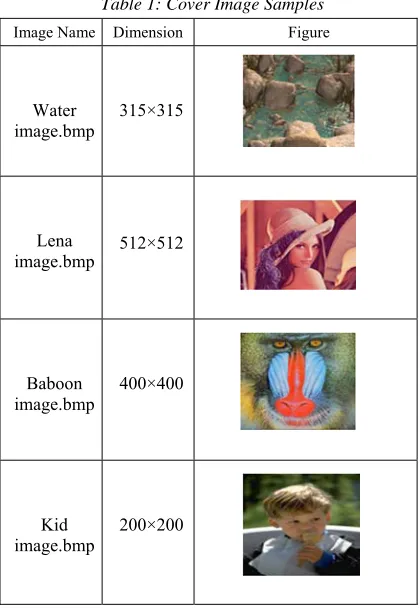
[image:6.612.307.529.32.257.2]To evaluate the quality of stego cover image, it is important to test secret messages on many different images. Four standard test cover images are used and for a fair comparison the same size of secret messages are tested on these cover image samples. In this work the size of secret message is set to 256 and 512 secret bits. Test cover image samples are shown in table 1.
Table 1: Cover Image Samples
Image Name Dimension Figure
Water
image.bmp 315×315
Lena
image.bmp 512×512
Baboon
image.bmp 400×400
Kid
image.bmp 200×200
5.1 Results by Positions and Values
This subsection shows the results of finding hiding positions in the image cover using (SPSO, QPSO, and HPSO) algorithms. The relationship between the positions and the values for (water, Lena, baboon and kid) image covers based on the behavior of PSO are given in Figure 9.
(a)Water Image (b) Lena Image
(c)Baboon Image (d) Kid Image
Figure9: Relationship between Values and Positions of Cover Images
It has been shown from Figure 9 that (SPSO, HPSO, and QPSO) algorithms can be used as a suitable search method in steganography Paradigm. Also, figure 9 shows how the particle in PSO behaves to select best positions whether standard, quantitative or human behaviors.
5.2 Quality Metrics Results
Different objective quantitative measures are used for comparison between the cover images and stego images. These measures are: Peak Signal Noise Ratio (PSNR), Mean Squared Error (MSE), Number of Pixel Change Rate Test (NPCR) and Unified Average Changing Intensity Test (UACI).The results of these measures on stego images for the proposed method (PSO, QPSO and HPSO) with secret message of lengths: (256, 512) and the total time required for embedding and extraction (sec) are shown in Table 2.It has been shown from table 2 that in most cases of the cover images used, the quality metrics by the proposed method using quantum behavior of PSO algorithm gives better stegocover quality than the proposed methods using human behavior based PSO algorithm, in which it is, in turn, better than the proposed image steganography method using the classical behavior of PSO. However, the quality metrics of three proposed image steganography system (SPSO, HPSO, QPSO) depended on the nature of cover image and text size.
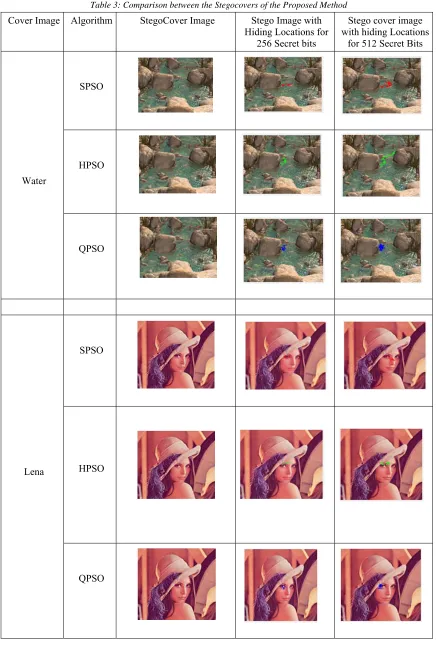
[image:6.612.90.300.216.520.2]3702 The stego images and stego images with hiding locations on (Water, Lena, Baboon, and Kid) cover images for the proposed method using the three types of PSO are shown in Table 3.
Figure 10 shows that the histograms of the PSNR quality measure of the proposed method for (Water, Lena, Baboon and Kid) stegocover images for 256, 512 Secret Bits using the quantum behavior of PSO
[image:7.612.91.526.201.625.2]obtained best performance than the proposed methods using human behavior based PSO algorithm, and the proposed image steganography method using the classical behavior of PSO so that the produced stego image has good quality and robust to certain image stegoanalysis attacks..
Table 2: Quality Metrics Comparison Results
Cover Image
Evolution Criteria
256 Secret Bits 512 Secret Bits
SPSO HPSO QPSO SPSO HPSO QPSO
Water
PSNR 76.4833 76.89111 77.02491 73.8809 74.1524 74.20535
MSE 0.00146 0.001350 0.001289 0.00266 0.002499 0.0024691
NPCR 0.14613 0.135007 0.128999 0.266061 0.249937 0.2469135
UACI 0.000570 0.000517 0.000503 0.001039 0.000976 0.000964
Total Time 00:00:28 00:00:26 00:00:30 00:00:44 00:00:36 00:01:08
Lena
PSNR 81.0128 81.143489 81.7092 78.05109 78.35420 78.47804
MSE 0.00051 0.0004997 0.00043 0.001018 0.000949 0.000923
NPCR 0.05149 0.049972 0.04386 0.101854 0.094989 0.092315
UACI 0.00020 0.000195 0.00017 0.000398 0.000370 0.000360
Total Time 00:00:44 00:00:42 00:01:08 00:01:30 00:01:38 00:02:16
Baboon
PSNR 78.77321 78.900955 79.49014 75.82631 75.89065 76.21000
MSE 0.00086 0.0008375 0.00073 0.0017 0.001675 0.001556
NPCR 0.08625 0.08375 0.07312 0.17 0.1675 0.155625
UACI 0.00033 0.0003271 0.00028 0.000664 0.000654 0.000607
Total Time 00:00:38 00:00:32 00:00:34 00:01:16 00:01:00 00:01:12
Kid
PSNR 72.7212 72.816014 73.0793 69.96839 69.96839 70.17200
MSE 0.00347 0.0034 0.0032 0.00655 0.00655 0.00625
NPCR 0.3475 0.34 0.32 0.655 0.655 0.625
UACI 0.00135 0.001328 0.00125 0.002558 0.002558 0.002441
3703
Table 3: Comparison between the Stegocovers of the Proposed Method
Cover Image Algorithm StegoCover Image Stego Image with
Hiding Locations for 256 Secret bits
Stego cover image with hiding Locations
for 512 Secret Bits
Water
SPSO
HPSO
QPSO
Lena
SPSO
HPSO
3704 Baboon
SPSO
HPSO
QPSO
Kid
SPSO
HPSO
3705 Water
PSNR quality measure of the proposed method for (Water) stegocover with 256
Secret Bits
PSNR quality measure of the proposed method for (Water) stegocover with 512
Secret Bits
Lena
PSNR quality measure of the proposed method for (Lena) stegocover with 256
Secret Bits
PSNR quality measure of the proposed method for (Lena) stegocover with 512
Secret Bits
Baboon
PSNR quality measure of the proposed method for (Baboon) stegocover with 256
Secret Bits
PSNR quality measure of the proposed method for (Baboon) stegocover with 512
Secret Bits
Kid
PSNR quality measure of the proposed method for (Kid) stegocover with 256
Secret Bits
PSNR quality measure of the proposed method for (Kid) stegocover with 512 Secret
Bits
3706
6. CONCLUSION AND FUTURE WORK
In this paper, we have defined a new framework For evaluating the behavior of PSO algorithm classically, quantitatively and humanly using image steganography. The three types of PSO algorithm are used as powerful swarm intelligence search technique for finding the best hiding positions in the cover image to hide a secret messages. The experimental results indicate that quantum behavior of PSO algorithm obtained best performance than classical, and human behaviors of PSO in the field of image steganography. In a future research, using these three types of PSO in another applications such as feature extraction, 3D watermarking. Also, another types of behaviors of PSO will be investigated.
REFRENCES:
[1] Ziyad Tariq Mustafa Al-Ta'i, “Development of Multilayer New Covert Audio Cryptographic Model ", International Journal of Machine Learning and Computing, Vgraphyol. 1, No. 2, June 2011. [2] NOMAN ABED, Hazim “Robust and Secured
Image Steganography using LSB and Encryption with QR Code”, Journal of AL-Qadisiyah for Computer Science and Mathematics, vol. 9, No. 2, pp. 1-9, August 2017.
[3] Pierre Moulin, and Joseph A. O’Sullivan, " Information-Theoretic Analysis of Information Hiding", IEEE Transactions on Information Theory, Vol.49, No. 3, March 2003.
[4] Xiaoxia Li, Jianjun Wang " A steganography Method Based Upon JPEG and Particle Swarm Optimization Algorithm" , Proceeding Of An International Journal ELSEVIR , Information Sciences , Volume 177, Issue 15, Pages 3099-3109, 1 August (2007).
[5] RuchikaBujaj, PunamBedi, S. K. Pal “Best Hiding Capacity Scheme For Variable Length Messages Using Particle Swarm Optimization”, First International Conference On Evolutionary And Memetic Computing, Vol. 6466 Of The Series Lecture Notes In Computer Science PP 230-237, 2010.
[6] Feno Heriniaina, Rabevohitra and Jun Sang, “Using PSO Algorithm For Simple LSB Substitution
Based Steganography Scheme in DCT
Transformation Domain”, Springer –Verlag Berlin Heidelberg, 2011.
[7] Parisa Gerami, Subariah Ibrahim, Morteza Bashar doost "Least Significant Bit Image steganography Using Particle Swarm Optimization and Optical Pixel Adjustment”, International Journal of
Computer Applications (0975- 8887), Vol. 55, No. 2, October 2012.
[8] Anu Garg , Navdeep Kaur " Steganography Using PSO Based Hybrid Algorithm " , International Journal Of Advanced Research In Computer Science And Software Engineering , Vol. 4 , Issue 11 , pp. 554-558, November 2014.
[9] E.Divya,P.Rajkumar "Steganographic Data Hiding using DWT and Particle Swarm Optimization" , International Journal of Computer Applications (0975 – 8887),Volume 117 – No.14, May 2015. [10] J. Kennedy, R.C. Eberhart, Particle swarm
optimization, in: Proceedings of IEEE International Conference on Neural Networks, IEEE Service Center Piscataway, NJ, Vol. IV, 1995, pp. 1942– 1948.
[11] Ajith Abraham , He Guo and Hongbo Liu "Swarm Intelligence : Foundations ,Perspectives and applications" , Part of the studies in computational Intelligence book series (SCI) , Springer – verlag Berlin Heidelberg Volume 26 , pp. 3-25, 2006. [12] Ahmed H. and Glasgow J. , " Swarm Intelligence
Concepts , Models And Applications" , Technical Report 2012-585, school of computation Queen's university Kingston , Ontario , Canada K7L3N6 , February 2012.
[13] M. Clerc, J. Kennedy, The particle swarm – explosion, stability, and convergence in a
multidimensional complex space, IEEE
Transactions on Evolutionary Computation, pp. 58–73, Volume: 6, Issue: 1, Feb 2002. [14] J. Sun, B. Feng, W. Xu, Particle swarm
optimization with particles having quantum behavior, In Proceedings of the 2004 IEEE
Congress on Evolutionary Computation,
Piscataway, NJ, pp. 325 – 331, 2004. [15] J. Sun, B. Feng, W. XU, A Global search strategy
of quantum-behaved particle swarm optimization, In Proceedings of the 2004 IEEE Conference on Cybernetics and Intelligent Systems, Singapore, pp. 111–116, 2004.
[16] J.Sun, W. Fang, X. Wu, V. Palade, W. Xu. "Quantum-Behaved Particle Swarm Optimization: Analysis of Individual Particle Behavior and Parameter Selection", Evolutionary Computation, in press. 20(3): pp. 349 – 393, 2012.
[17] HaoLiu,GangXu,Gui-yanDing,and Yu-bo Sun "
Human Behavior-Based Particle Swarm
Optimization" ,Hindawi Publishing Corporation ,The Scientific World Journal, 2014, Article ID 194706 ,14 pages.