ISSN: 1992-8645 www.jatit.org E-ISSN: 1817-3195
CLASSIFICATION, EVALUATION AND ASSESSMENT OF
SERIOUS GAMES IN BUSINESS FIELD
1
BAKKALI YEDRI OTHMAN, 2SLIMANI ABDELALI, 3BELAHBIB AMINE, 4EL AACHAK LOTFI, 5EL OUAAI FATIHA, 6BOUHORMA MOHAMED
1,2,3,4,5,6
Computer science, systems and telecommunication Laboratory (LIST), Tangier, Morocco
E-mail: [email protected], 2 [email protected], [email protected],
4
[email protected], [email protected], [email protected]
ABSTRACT
The teaching manners have been improved and becoming more interactive with the technological progress that the educational field has known, and especially with the integration of the video games in the learning process. However, in order to promote their business, several companies are keeping the challenge by using some existing games, trying to develop their own serious games. In this paper we hope to present the art of state of several works corresponding to the business field. This paper resumes the analysis of the existing study of serious game for business process. However, they raise many challenges into different sectors. Indeed, the comparative study of some existing games will describe some characteristics used to classify all surveyed games and present them into graphs and charts with their corresponding discussion.
Keywords: Serious Games, Business, E-Training, Assessment, Classification
1. INTRODUCTION
A serious game is a computer application whose initial intention is to combine with consistency, both serious aspects (Serious) such as teaching, learning, communication or information, with playful springs from the video game (game) [1].
Business is an organization involved in the provision of services, goods or both of them to consumers. However, the company invests in a given area in order to collect benefits. These are often evaluated from a financial point of view, but employees present a significant benefit to the company. An employee, who received good vocational formation, through direct training, an intermediate training or over years of experimentation, provides certainly good value to the organization in which he works. Employee training is essential because the productivity of workers by enhancing their skills. Therefore, it can be considered as a rentable investment for the company, although, for companies that need massive recruitment every month like call center, malls and so on has considered training more expensive. Indeed, some employees consider the traditional ways of learning are boring. However, applying serious games to the business can help to
solve several issues that most of traditional ways of learning are facing. Games can project the player into a real situation that changes according to his choices; this interactivity allows to them to live an unforgettable experience full of instructive messages and information.
According to a study [2] the Business game, hosted on Disney.com, receives 294.934 unique visitors/month even though it is buried deep within the Disney site.
In this perspective of research, we aim in this article to present the core process of serious games in business field and show their importance to incorporate gamification into their business process. Then, we will present a comparative study that includes 53 (number) serious games in various areas. Finally, according to characteristics cited above we classify all surveyed games and present them into graphs and charts with corresponding discussion.
2. SERIOUS GAMES CLASSIFICATION
ISSN: 1992-8645 www.jatit.org E-ISSN: 1817-3195
various forms) is the primary goal, rather than entertainment [3]’.
Another definition of ‘serious gaming’ offered by Zyda defines a serious games as, “a mental contest, played with a computer in accordance with specific rules, that uses entertainment to further government or corporate training, education, health, public policy, and strategic communication objectives [4]”.
Another definition “Computer application, whose original intention is to combine with consistency, both serious aspects (Serious) as, but not limited to, non-exclusive, teaching, learning, communication, or information with playful springs from the video game (game) [1].”
According to the variety of definitions, we can say that serious games are games which learning is the first purpose.
Serious Games are presented in a large area of knowledge. Michael proposes the following thematic classification [3]: Military Games, Government Games, Educational Games, Corporate Games, Healthcare Games, Political and Religious Games. The findings are summarized in table 1.
Table 1: Classification And Examples Of Serious Games
Domain Serious games examples
Education [5] [6] [7]
Healthcare [2] [8]
Government [9]
Military [4] [10]
Corporate [11]
Political and religion [12][13]
Facing the very rich typology of Serious Games identified News Games, Advergames, Military Games, Exergames, Edugames, Datagames, etc… it seems apt to clarify this aspect, by putting in place a classificatory system. However, there are some studies classifying serious games according to specific criteria.
The first classification of video games was presented by Julian Alvarez and Damien Djaouti based on the game principles.
2.1 Classification by game principle: gameplay bricks
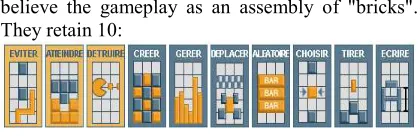
Gameplay requires the existence of mechanisms related to the rules of a game. The rules will come packaged with this game (action) without partitioning that uses thereof [14]. It is always possible to turn a set of rules. The authors
[image:2.612.313.523.96.164.2]believe the gameplay as an assembly of "bricks". They retain 10:
Figure 1: Gameplay Bricks (Alvarez & Djaouti)
2.2 Classification by play principle, intent and economic sector: the G / P / S system
To understand the diversity of the Serious Game, it is important to classify both by his playful side and its utilitarian dimension [15]. However, they propose the classification of serious games around three poles called "G / P / S":
G: named gameplay, which as has been seen, refers to the way the game should be played. The bricks implements gameplay to clarify these points.
P: allows to focuses on practical objectives that the serious game must aim: what message to broadcast? How to provide training? How to foster the exchange of data between the player and the game for training?
S: suggests the game following a market (education, military, health, etc.) and public (the general public to professionals).
These three combined criteria allow to reflect the "Playful" dimension (Gameplay) and the "Serious" dimension (Purpose + Sector) by the designer of a "Serious Game" [15]. However, players can use a video game in a way that has not necessarily provided by its designer. It is then allows for example to use for Serious purposes a game basically designed for the entertainment [15].
2.3 Classification by target audiences: Taxonomy of Serious Game
ISSN: 1992-8645 www.jatit.org E-ISSN: 1817-3195
2.4 Classification by analogy between gaming principles and pedagogical activity
According to Marc Prensky [16], the game-based learning applications are on a balance between learning and engagement concept that is defined by the particular "style" of play. It lists three primary elements: The competition, The fantastic appearance, Curiosity (quest, investigation ...)
If these items need to be cut by a "kind" game, an element necessary for the production of a video game, it lists the following "genres": Action Games, Adventure Games, Fighting games, Puzzle Games, Role play game, Simulation, Sports Games and Strategy Games [16].
Marc Prensky subsequently derived one second classification, organized around the types of learning. Thirteen types of statements, Prensky adds examples, educational activities, and game styles.
2.5 Classification by educational benefit: (Maja Pivec & Michela Moretti)
« For an educator, a teacher, a trainer that needs to achieve specific learning objectives, which game typology could be introduce in the didactic, so as to foster the achievement of those objectives? What particular features should games have in order to correctly support the achievement of specific learning objectives? [17] »
Maja Pivec & Michela Moretti part of the expected results and desired by the organizer of the experiment, to go up to the game [17]. Thus, they summarized their classification around six major objectives: Memory / Repeat / Hold (factual learning), Dexterity / Broadcast / Accuracy / Psychomotor (sensorimotor skills), Applying concepts / rules (adapt and transfer knowledge in a new context; use information, methods, and theories in new situations), Decision making / problem solving and strategy (analysis of knowledge based on problem solving, prediction, projection conclusions choice argument), Social Interactions / values / cultures (understanding the social environment and others) and Ability to learn / Self evaluation (assessment).
2.6 Evaluative classification of the learner profile, the context, the teaching method and the realism of the game: Four Dimensional Framework
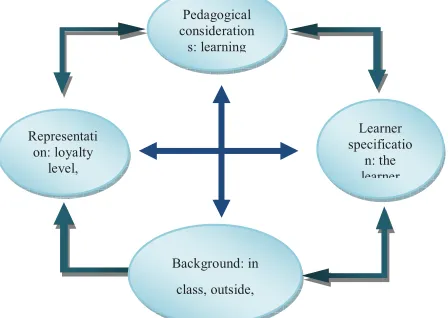
The researcher Sarah Freitas Coventry University has developed a classification method Evaluative trend of serious games. This method is based on a device with four inputs: The characteristics the player / learner, The specific
[image:3.612.311.535.155.314.2]characteristics of serious games as a video game, Specific characteristics seriously game as game to learn and Characteristics related to the method and preferred educational goals in the game [18].
Figure 2: Four dimension framework
Context. The context of the game and its use is central to the effectiveness of how the game is utilized; The context will therefore have a direct bearing upon which game is selected; Socio-political contexts and institutional contexts may also play an informing role in selection and use of games [18].
Learner specification. The learner or learner group is also central to which game is selected and used. Aspects such as age, stage of study, demographics, conversancy with ICT and games technologies and past learning experiences will all have a bearing upon the selection of games used [18].
Representation. The representation of the game itself, level of learner group immersion, familiarity with interface and the internal reality and narrative of the game will also have a bearing upon effective learning. Although there has been a long debate about fidelity – and levels of fidelity in the literature around learning with simulations, the findings are inconclusive about how high the level of fidelity needs to be for effective learning transfer to take place; However young learners are becoming accustomed to high levels of immersion and interactivity in leisure games, so different learner groups may require different levels[18].
Pedagogic model or approach used. learning with a game is rarely if ever a learning experience in itself, more usually it is embedded into a set of activities and processes according to the pedagogic approach adopted [19]. The role of debriefing is central to the use of simulations and it
Pedagogical consideration s: learning
Representati on: loyalty level, interactivity
Learner specificatio
n: the learner
Background: in
ISSN: 1992-8645 www.jatit.org E-ISSN: 1817-3195
is also important for game-based learning, whether debriefing is through post-exercise discussion, reflection with peers or the tutor, this aspect of learning in immersive worlds is central[20].
2.7 Outcomes Classification by the teacher and student user experience: Key Criteria for Game Design
Eric Sanchez, a researcher in education science at the University of Sherbrooke has defined criteria for good design a serious game for education. These criteria are divided into three broad categories: the educational potential of a share of ownership and factors, usability (ergonomics) and the other utility [21].
2.8 Conclusion
As motioned above there are a variety of classifications concerning serious games, those classifications are based on different criteria, where, each classification has both strong and weak points, and can be used according to the need of the user, and what he want to classify. However, to prove serious games effectiveness we need assessment classification to define important axis. According to these research works, our research team has establish several classifications concerning several serious games that belong to the business field, the proposed classifications will be discussed in the comparative study below.
3. THE EMPLOYMENT OF SERIOUS GAMES TO PROMOTE BUSINESS
Nowadays, some organizations such IBM, Renault, Ford and Cisco are notably using serious games to train their employees in different kinds of fields to develop their competence and career from compliance to leadership. New employees are not very engaged and motivated by traditional ways of learning. This is a huge problem for most fields especially economy, business and finance, thought serious games are attractive and more engaging, and thus companies have found that the application of this new approach for training is helping them to improve employee’s performances. In this part of this article, we will present some serious games applied in finance/ business training, marketing and sales.
There are many applications dedicated to business process such as Deloitte Business Simulation game, which is designed to train employees. The game enables players to experiment with a realistic model of their company and its potential future scenarios. During the game, the players go through various scenarios
and are confronted with the consequences of their decisions just as in the real world. This hands-on experiential learning helps to sharpen management skills through practice and feedback.
Financial literacy is defined as the ability of people to make financial decisions in their own best short- and long-term interests" [22]. The true office is serious game for objective to deliver engaging compliance training. True Office enables employees to explore scenarios such as anti-money laundering and insider trading through interactive gameplay and immersion. True Office also provides a variety of games that can be tailored to match each company’s own internal policies through customizable narratives [23]. €conomia is a serious game based on the monetary policies of the European Central Bank to teach employees about the impact of interest rate changes on unemployment, production growth, inflation, and other vital economic indicators [24].
Marketing and sales training can deliver significant business benefits. IBM’s CityOne is a serious game which aims to influence the behavior of the employees, business partners, clients and future clients [25].
As we show, serious games are more and more benefit to promote business. However, some potential key benefits of serious games are outlined below: Performance improvement, Competency testing, Assessment, Recruitment process, Motivational tool, Promotional tool, Collaboration, Negotiation, Motivation and so on
4. COMPARATIVE STUDY
The proposed classifications are based on three related subjects: Serious game, Business and player. Focusing on serious game subjects, we can classify by game functionality. For business subject, we can classify by application area or game objectives. In this part we define some criteria related to serious games off business, in that we find, interaction technology, game interface, number of players, game engine…
The descriptions of our classification are based on:
Interaction technology has the different paradigms for establishing communication between humans and computers. Both hardware and software are included.
Game interface is related to the virtual world inside the game, which can simulate the real world in three dimensions (3D) or simpler world environment in two dimensions (2D).
ISSN: 1992-8645 www.jatit.org E-ISSN: 1817-3195
Game engine is a system designed for the creation and development of the game. The engine provides an API to access lower level functionalities and a set of predefined models, materials and scenes.
Platform means the hardware that the application runs on.
Support: means the device that the platform runs on. AMIGA, AMSTRAD CPC, APPLE II, Arcade, Atari 400, Atari 800, Playstation (PSX), PS2, PS3, PS4, PSP, PC DOS, PC LINUX, PC WINDOWS, Tablet ANDROID, Tablet WINDOWS, Wii, Wii U, Xbox, X360, Xbox One, Super Nintendo, Nintendo 64, Nintendo DS, Mobile, Mobile Android, Mobile Java, Mobile Windows Mobile, Mobile Windows phone, Mobile Blackberry.
Assessment, the evaluation of the player’s achievement on parties of the game. Offers an important benefice for the player by giving him information about development career, recruitment or management. Exploring his personality, potential, values and intellectual abilities, they can draw a detailed profile of the individual as well as its proven strengths and needs of potential development.
Game genre is a category related to the game play; we can distinguish edu game, adver game, news game, edu market game, exergame, among others.
Domain, which describe the part of real world being modeled by software. In the serious game for business field, we will distinguish the main aspect: management, recruitment, communication and marketing, business teaching, social security, Construction, Creative industries, life sciences, information and communications technology, Tourism, food and drink.
Age range can be defined as the age group that objective of the game is oriented to that generation.
5. RESULTS
In this section, we present the surveyed games with respect to the proposed classifications. To present the result, we create Table1 that collects the information of games designed for professional and non-professional.
ISSN: 1992-8645 www.jatit.org E-ISSN: 1817-3195
Serious Games Domain or business sectors
Environ ment
Interactive Tool Multi-Players
Assessm ents
Game Genre
Game Engine
Platform Age Range
Publ icati on Year Innov’Nation [26] Management 2D Keyboard,
Tactile, mousse
Yes Yes Newsgame Html5 Mobile/Web >25 2011
SFR (mon entretien d’embauche)
Recruitment 3D Mousse No Yes Edumarketg
ame
Unity 3D Web >25 2012
Moonshield (Thalès )
Recruitment - Joystick,
Keyboard, Tactile, mousse
- - Edu market
game
Flash Web/ mobile/ PC /IOS
>25 2008
Academy Factor Recruitment 3D Mousse No Yes Edu market
game
- Web >25
E-Calling Game Management 3D Mousse Yes Yes Exergame Unity 3D Web >25 2013
La Forêt Durable Social Security 2D Joystick, Keyboard, Tactile, mousse
No Yes Edu market
game
HTML5 Web/ mobile/ PC /IOS
<14 2014
2020 energy Social Security 2D Joystick, Keyboard, Tactile, mousse
No Yes Edu market
game
HTML5 Web/ mobile/ PC /IOS
14 - 25 2012
3D VIRTUAL OPERATING
ROOM
Social Security 3D - Yes Yes Edugame - Web >25 2013
Mecagenius [27] Management 3D Joystick, Keyboard, Tactile, mousse
Yes Yes Edugame - Web/ mobile/
PC /IOS
14 - 25 2010
PULSE[28] Social Security 3D Joystick, Keyboard, Tactile, mousse
No No Edugame - Web/ mobile/
PC /IOS
14 - 25 2007
Renault Academy Communication-Marketing
3D - No Yes Edugame - - >25 2009
Reveal Recruitment 2D Mousse No Yes Edumarket
game
Flash Web >25 2010
SixSigma Management 2D Mousse No Yes Edugame Flash Web >25 2012
BUSINESS QUEST
Management 2D Mousse No Yes Edugame Unity 3D Web >25 2011
en-Jeu professional Recruitment 2D Mousse No No Edumarket
game
Flash Web >25 -
CORPORATE TRAINING MARKETS
Management - - - - Edumarket
game
- - 14 - 25 -
Sweatshop Management 2D Mousse No Yes Newsgame Flash Web <14 2011
Star Bank The Game
Management 3D - - - Edumarket
game
- Web >25 -
GoVenture Small Business
Management 2D Mousse No No Edugame Flash Web 14 - 25 2011
B2P
Communication-Marketing
2D Joystick, Keyboard, Tactile, mousse
No No Advergame Unity 3D Web/ mobile/
PC /IOS
>25 2012
Practice Marketing Communication-Marketing
3D Joystick, Keyboard, Tactile, mousse
Yes Yes Edumarket
game
- Web/ mobile/ PC /IOS
>25 -
Venture Strategy Communication-Marketing
2D Mousse,
Keyboard
Yes Yes advergame Flash Web 14 - 25 -
SimVenture[29] Management 2D Mousse No Yes Advergame - PC >25 2006
Virtual Trader Management - - - - Edu market
game
- - >25
Explorateur des Métiers de l’Artisanat
Communication- marketing
2D mousse,
keyboard
No No Newsgame - PC <25 2015
Innov8 Management 3D Mousse No Yes Edu market
game
ISSN: 1992-8645 www.jatit.org E-ISSN: 1817-3195
Working at Height Training
Social Security 3D Joystick, Keyboard, Tactile, mousse
No Yes Edu game - IOS/Android >25 2015
TeamUp Management 3D Keyboard Yes Yes Edu market
game
Unreal Developme
nt Kit
PC >14 2009
MSP Challenge Management 2D Mousse,
Keyboard
Yes - Edu market
game
Flash PC >25 -
Hazard Recognition Game
Social Security 3D Mousse No Yes Edu game Unreal
Developme nt Kit
PC >25 -
HIITS Communication-Marketing
2D Mousse No Yes Advergame - PC >25 -
McDonald's[30] Communication-Marketing
- - - - Edu market
game
- Web >25 2006
Spent Finance - - - - Edu game - - >14 2011
Show Business, The Economics of Entertainment
Finance - - - - Edugame Unity 3D Web >14 2005
N4G; need for greed[31]
Communication-Marketing
2D Tactile, mousse, keyboard
No Yes Edu market Flash mobile/ PC
/IOS
>14 2014
SMART GRIDS Management - - - - Edu market
game
- Web >14 2013
FORD Management 3D Mousse - - Exergame - PC >25 2012
ENERGY TASK FORCE
Communication-Marketing
- Tactile, mousse, keyboard
- - Edu market - mobile/ PC
/IOS
>14 2012
Virtual Training Suite
Marketing 3D - No Yes Exergame - PC >25 2012
META VALS Finance 2D Tactile, mousse,
keyboard
No - Edu game - mobile/ PC
/IOS
>14 2011
iScen Management-
Social Security
2D - Yes Yes Edu game - PC >14 2013
Security Game: Sensibilisation à la
cybersécurité
Social Security 3D Tactile, mousse, keyboard
No Yes Exergame HTML5 mobile/ PC
/IOS
>14 2016
Stairway to Tax Heaven
Communication- marketing
finance
2D Tactile, mousse, keyboard
No No Newsgame HTML5 mobile/ PC
/IOS
>14 2016
Planète EXE Recruitment - Tactile, mousse, keyboard
No - Advergame - mobile/ PC
/IOS
>25 2016
CCI Intelligence Economique
Communication 2D mousse,
keyboard, joystick
No Yes Edugame - PC >14 2016
Explorateur des Métiers de l’Artisanat
Communication- marketing
2D mousse,
keyboard
No No Newsgame - PC <25 2015
AgriManager Assurance- finance- Management
2D - No No Edumarket PC >14 2015
Mission refueling Management- Social Security
3D mousse,
keyboard
No No Newsgame Unity3D mobile/ PC
/IOS
>14 2015
Granulats Game Management- Social Security
3D - No - Edugame - - >14 2014
Supply Chain Gaming
Management-Logistiques
- - No - Newsgame - mobile/ PC
/IOS
>14 2014
Dream Job Recruitment 2D - No - Newsgame - - >14 2014
Practice Operations Management 3D mousse, keyboard
No No Edumarketg
ame
- mobile/ PC
/IOS
<2( 2014
Backstage-game Management 3D mousse,
keyboard
- - Newsgame - mobile/ PC
/IOS
ISSN: 1992-8645 www.jatit.org E-ISSN: 1817-3195
6. ANALYSIS AND FINDING
The information collected from Table2 has been used to compare the characteristics of the surveyed serious games with respect to different parameters. Focusing to the domain of the developed serious games, we can see that their applications are quite varied between Finance, Management, Recruitment, Communication-Marketing, and Social Security.
Figure 3: Breakdown of the “Publication Year” number of games per year.
In the figure 3, we present numbers of surveyed serious games for business sector according to the year of publication.
Figure 4: Breakdown of the “Game objective” values present in our survey.
We notice a big diversity of application area, proves that serious games have established their selves as a significant contribution in business field, in addition we notice that the most part of those games are dedicated especially for management, view to the important role that the management play in economy.
Figure 5: Breakdown of the “Game Genre” values present in our survey.
The chart presents the distribution of serious games according to the genre, which they have been designed: Newsgame, Edugame, Advergame, Exergame, and Edumarket game. We notice that the most of Serious Games are made for adugame and edumarket game, because they offer a good environment for coaching thanks to their interactivities and also they are closer to the real world, with those two advantages we can envisage different realistic scenarios what will make the experience of playing those kinds of serious games more beneficial for learners.
Focusing on assessments, the majority of game mentioned above in comparison was based on a system of evaluation to assess the knowledge of learner that will be acquired during the sequence of video game and measure their level of understanding, with the
integration assessment system video games have became a perfect tool for learning.
Figure 6: Breakdown of the “Assessments” values present in our survey.
ISSN: 1992-8645 www.jatit.org E-ISSN: 1817-3195
[image:9.612.93.301.132.263.2]assessment in their core, the existent is not enough to respond to the need of professionals.
Figure 7: Breakdown of the “Age Range” values present in our survey.
Focusing to the target players of serious games in Business, Our studies are defined on the age players, we notice that their application are designed with a quite variety to the people who have an age higher than 25 years (79%), it’s presents the targeted field required a specific knowledge that achieved with study and experience. Despite the small percentage that represent the business serious games dedicated for children, we notice an important emergence of serious games for kids, view the intrinsic interest that serious games can provide on teaching business and apply learnt lessons in real-life environment
related to business dice their young age.
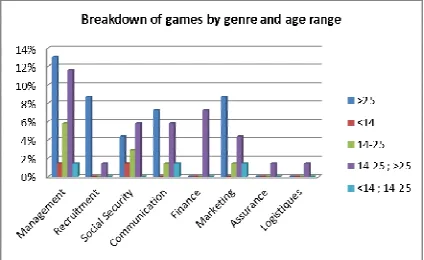
Figure 8: Breakdown of the combination between “Business Sectors” and “Age Range” values present in
our survey.
The chart presents the distribution of serious games according to the business sectors, which they have been designed: Management, Recruitment, social security, Communication, marketing, and Finance. We notice that the most of Serious Games are made
for professionals because much company desire to promote their business, with some who choose to use available games and others attempt to create Serious games and to incorporate gamification into their business process.
To resume, serious games create a fantastic tool to foster knowledge and prove an additional mean to promote challenge in Business management with regard to training, simulating and evaluation of user performance.
7. DISCUSSION
In the last few years the number of serious games addressed to business has become more and more important this makes the field more interesting for a number of researchers. As presented above, different existing classifications highlighted, we find a rich tapestry to extract parameters or criteria needed for business field. According to this study, our research team has established several conclusions and defines a various needed aspect. However, the big diversity of domains management, recruitment, social security, communication and marketing are addressed to professionals as presented in chart 7 which proves that several companies use serious games in their business process. Indeed, management takes the big part of games market due to their importance and classic algorithm needed which are used like making decision and it can be played one player. Also the other fields like marketing need multi player and very difficult algorithm like negotiation, collaboration and so on which makes the development process very hart and more expensive.
There are a number of interactive tools like eye tracking and leap motion which are not used by a number of business games. All the existing uses the classic interactive tools like mousse and keyboard.
[image:9.612.90.302.486.616.2]ISSN: 1992-8645 www.jatit.org E-ISSN: 1817-3195
Assessment is an important field in serious games, but as we show in the study it’s focused on learner achievement. According to the classification of Maja Pijec [17] there are more field more interesting for business serious games like assess player performance, motivation, engagement, player competences, collaboration, adaptation, feedback and so on. These criteria are difficult to include them in one game because each one needs a special development if we study the developer scope. However, Assessment can be done by counting things like the number, regularity, and length of contributions [33]. The assessment data could be compared per single user and per groups of users over time with common characteristics, researching learning evolution, common behavior patterns using learning analytics.
The detailed description and classification of all the previous successful games presented here can be useful for researchers developing new games by raising the awareness of the different possibilities. While we cannot make hard predictions on the future of serious games for business, we expect two different directions: new, innovative games exploring the rest of the parameter space of our classification like assessment, and trying to present difficult process to be developed as a service.
8. CONCLUSION
Therefore all companies around the world look forward improving their services tend to use new technologies in order to develop their business. As we've seen through this study, Serious games has been used in several fields, thus they solved several issues in training, simulation and surely they are going to solve more as long as they get more improved and sophisticated. Serious games has been applied to the business field and already got success, we can easily imagine future games that will include bench on new technologies where big video games actors will be involved. In our study, serious games surveyed are from academic and commercial environments dealing with business field, including management, recruitment, marketing and healthcare. The games have been classified according to the game objective (Management, recruitment, marketing and healthcare security). Additionally, 9 criteria dealing with the game technology have been selected for classification: game objective, assessment, environment, multi-player, game genre, platform, game engine, interactive tools and age range.
In order to foster the sense of entrepreneurial, the detailed description and classification of all previous surveyed games can be useful to develop a serious game engine by raising the awareness of the different possibilities. Our tendencies are to make games more flexible and adaptive for the consumer in business field.
REFRENCES:
[1] P. Fauquet-Alekhine, “Human or avatar: psychological dimensions on full scope, hybrid, and virtual reality simulators,” in Proceedings of the Serious Games &
Simulation Workshop, 2011, pp. 22–36.
[2] T. Marsh, W. L. Wong, E. Carriazo, L. Nocera, K. Yang, A. Varma, H. Yoon, Y. L. Huang, C. Kyriakakis, and C. Shahabi, “User experiences and lessons learned from developing and implementing an immersive game for the science classroom,” in
Proceedings of HCI International 2005, 2005.
[3] D. R. Michael and S. Chen, Serious Games:
Games that Educate, Train and Inform.
Thomson Course Technology, 2006.
[4] M. Zyda, “From visual simulation to virtual reality to games,” Computer, vol. 38, no. 9, pp. 25–32, 2005.
[5] International Conference on the Foundations of Digital Games, R. M. Young, Association for Computing Machinery, SIGART, Association for Computing Machinery, Special Interest Group on Computer Science Education, SIGGRAPH, Association for Computing Machinery, Special Interest Group on Management of Data, Association for Computing Machinery, and H. and W. Special Interest Group on Hypertext, ICFDG 2009: proceedings, Fourth International Conference on the Foundations of Digital Games,
Orlando, FL, USA, April 26-April 30, 2009.
2009.
[6] F. Bellotti, R. Berta, A. D. Gloria, and L. Primavera, “Enhancing the educational value of video games,” Comput. Entertain., vol. 7, no. 2, p. 1, Jun. 2009.
[7] E. Lotfi, B. Amine, and B. Mohammed, “Teaching Arabic Sign Language through an Interactive Web based Serious Game,” Int. J.
Comput. Appl., vol. 116, no. 3, pp. 12–18, Apr.
2015.
ISSN: 1992-8645 www.jatit.org E-ISSN: 1817-3195
[9] G. Rebolledo-Mendez, K. Avramides, S. de Freitas, and K. Memarzia, “Societal impact of a serious game on raising public awareness: the case of FloodSim,” 2009, p. 15.
[10] W. L. Johnson, N. Wang, and S. Wu, “Experience with serious games for learning foreign languages and cultures,” in
Proceedings of the SimTecT Conference, 2007.
[11] F. L. Greitzer, O. A. Kuchar, and K. Huston, “Cognitive science implications for enhancing training effectiveness in a serious gaming context,” J. Educ. Resour. Comput., vol. 7, no. 3, p. 2–es, Nov. 2007.
[12] P. Corbinais, “La valeur ajoutée du jeu vidéo à la médiation d’information.”
[13] E. Lotfi, B. Amine, E. Fatiha, and B. Mohammed, “Learning to pray, islamic children’s game,” 2014, pp. 622–627.
[14] “Serious Game Classification : Principe de classification.” [Online]. Available: http://serious.gameclassification.com/FR/about /bricks.html#GAMEPLAY. [Accessed: 01-Nov-2015].
[15] J. Alvarez and D. Djaouti, “An introduction to Serious game Definitions and concepts,”
Serious Games Simul. Risks Manag., p. 11,
2011.
[16] M. Prensky, Digital game-based learning. New York: McGraw-Hill, 2001.
[17] M. Pivec and M. Moretti, Eds., Game-based
learning: discover the pleasure of learning.
Lengerich: Pabst Science Publ, 2008.
[18] S. De Freitas, “Learning in immersive worlds,”
Lond. Jt. Inf. Syst. Comm., 2006.
[19] D. A. Kolb, “Experiential Learning.” .
[20] V. A. M. Peters and G. A. N. Vissers, “A Simple Classification Model for Debriefing Simulation Games,” Simul. Gaming, vol. 35, no. 1, pp. 70–84, Mar. 2004.
[21] N. Baldissin, S. Bettiol, S. Magrin, and F. Nonino, Business game-based learning in
management education. Lulu.com, 2013.
[22] “Overcoming the Saving Slump: How to Increase the Effectiveness of Financial ... -
ﺐﺘﻛ
Google.” [Online]. Available:
https://books.google.co.ma/books?hl=ar&lr=& id=1M3RUvoG6l4C&oi=fnd&pg=PA257&dq =Mandell,+2008&ots=v4G7IRel_Z&sig=QvT
H9LzLlc7N9hLBQ2LbZqoWk-4&redir_esc=y#v=onepage&q=Mandell%2C% 202008&f=false. [Accessed: 06-Mar-2016]. [23] “NYSE: NYSE Governance Services.”
[Online]. Available:
https://www.nyse.com/governance. [Accessed: 17-Dec-2015].
[24] “€conomia game.” [Online]. Available: http://www.ecb.europa.eu/ecb/educational/eco nomia/html/index.en.html. [Accessed: 17-Dec-2015].
[25] “IBM CityOne Game,” 21-Apr-2009. [Online].
Available:
http://www-01.ibm.com/software/solutions/soa/innov8/city one/index.jsp. [Accessed: 17-Dec-2015]. [26] “Innovnation.” [Online]. Available:
http://www.innovnation.eu/?lang=fr. [Accessed: 02-Dec-2015].
[27] “Un serious game en génie mécanique pour découvrir, apprendre, fabriquer | mecagenius.univ-jfc.fr.” [Online]. Available: http://mecagenius.univ-jfc.fr/. [Accessed: 22-Feb-2016].
[28] N. F. Cook, T. McAloon, P. O’Neill, and R. Beggs, “Impact of a web based interactive simulation game (PULSE) on nursing students’ experience and performance in life support training — A pilot study,” Nurse
Educ. Today, vol. 32, no. 6, pp. 714–720, Aug.
2012.
[29] “SEGAN: SimVenture.” [Online]. Available: http://seriousgamesnet.eu/games/view/823. [Accessed: 22-Feb-2016].
[30] “McDonald’s Video Game.” [Online]. Available:
http://www.mcvideogame.com/index-fra.html. [Accessed: 22-Feb-2016].
[31] “Need 4 Grid | La Grande Aventure Electrique | N4G | RTE.” [Online]. Available: http://www.need4grid.com/fr. [Accessed: 10-May-2016].
[32] E. Parodi and M. Vannucci, “A Competence Performance Analyser Tool for Assessing Players’ Activity in Serious Games,”
Pedagog.-Driven Serious Games PDSG 2012,
2012.
[33] K. Swan, J. Shen, and S. R. Hiltz, “Assessment and collaboration in online learning,” J.
Asynchronous Learn. Netw., vol. 10, no. 1, pp.