A HYBRID PARALLEL HASH MODEL BASED ON
MULTI-CHAOTIC MAPS FOR MOBILE DATA SECURITY
1B. MADHURAVANI, 2Dr. D.S.R MURTHY
1
Department of Computer Science & Engineering, MLR Institute of Technology, Dundigal, Hyderabad,
Telangana, India
2
Professor., Department of Computer Science & Engineering, Geethanjali College of Engineering &
Technology, Keesara, Hyderabad, Telangana, India
E-mail: [email protected], [email protected]
ABSTRACT
Today, with the advancement of internet and technology security of information has become the prime concern in mobile and online applications. Extensive amount of research have been carried out since years to provide secure and reliable hash functions for information interchange. Chaos based hash functions have gained a lot of attraction by the researchers due to its non-linearity, randomness and unpredictable results. Various chaotic based hash functions have been implemented in the past decade to achieve confidentiality, integrity and authentication. But, most of the traditional chaos based hash functions are processed in sequential approach with a single dimensional map, which restricts their execution speed and performance in the mobile computing applications. To overcome these problems, a novel parallel chaotic hashing model is proposed in this paper. This model integrates multiple chaotic maps as a single chaotic system to generate an n-bit hash value for a given input message. This model provides more security, high computation speed, limit memory resources and less computation overhead in the standalone and mobile applications. Experimental results show that proposed model has high computational speed, bit variation and collision resistance as compared to traditional parallel chaotic models.
Keywords: Parallel chaotic , Hash fucntion, Mobile computing, Integrity, Authentication
1.
INTRODUCTIONMessage digest is a significant cryptographic algorithm which has its application in digital signature authentication, message authentication code, digital steganography, digital time stamping and, so on. In the year 1995, National Institute of Standards and Technology introduced this algorithm. Later various research efforts are made to integrate SHA with other approaches to achieve extended security and integrity. Hash function accepts variable-length message as input string and produces fixed-length digest as output after processing. SHA cannot prevent attacks and collisions of hash values which are the major problem of this algorithm. These algorithms are not very efficient for mobile applications which are dynamic in nature. SHA is also categorized into different algorithms- SHA, MD5 etc. Similar to other hash functions, SHA comes up with the message having arbitrary input length but a digest of fixed length. The original messages are converted into blocks of small fixed sizes.
For ensuring the integrity and authenticity, most of the digital applications such as digital documents, electronic mail, office automation, and electronic funds transfer were implemented using message digest as a security parameter. Hash functions are used as the basic component in various security protocols like TLS, SSL, and S-MIME. Also, hash function is regarded as the core part of digital signature and has gained a lot of attention amongst the various researchers.
parallel chaotic hash function is not secured against the statistical attacks.
To overcome this problem, complex chaotic-based hashing techniques are developed which are non-linear, random and dynamic in nature. It can be represented by either discrete or continuous systems. Henon mapping and logistic mapping can be categorized under discrete, whereas Lorenz and Rossler system comes under continuous. This system is highly responsive to initial conditions. Lyapunov exponents are one of the important components of chaotic system which decides whether the given system is chaotic or not. Our proposed scheme involves various logical functions and is developed according to the complex temporal behavior and provides high sensitivity to the initial constraints of the high-dimensional chaotic maps.
The main objective of a chaotic-hashing system is the convergence property in the complex chaotic systems. The features responsible for this convergence are:- a) Both are deterministic. b) Both are complex and not predictable. c) In chaotic system, a small change in the initial conditions can affect and reflect a huge change in the output. Similarly, in hashing a minor change in the key or plain text will modify the hashing output to a great extent. As convergence, there are some features responsible for divergence of these two areas of research. Those are:- a) Chaotic systems are represented by continuous spaces, but hashing is represented by discrete and finite spaces.
2.
RELATED WORKSMany efforts have been made by different researchers to merge chaotic theory with hashing mechanisms since years. Some of those works are mentioned below:-N. Abdoun et.al. implemented Chaotic Neural Network and developed an advanced secure hash algorithm [1]. They introduced a Chaotic Generator as the first part of their hash function and generated Neural Network parameters. The second part was termed as Chaotic Neural Network which is again categorized into input, output and hidden layer. Each layer is responsible for calculating a transfer function. The transfer function can be calculated by using the parameters provided by the Chaotic Generator. They validated their theory and proved that, their newly developed hash algorithm is collision resistant and has better statistical properties.
K. Atighehchi et.al. implemented considered hash tree approach in their research and developed a new
parallel algorithm [2]. They emphasized on critical applications running on multi-core processors for optimized performances. Though their algorithm provides parallelism, it lacks a proper scheduling technique which can decrease the overhead. K. Ganesan, et.al. implemented a previously existing algorithm for encryption using chaotic chebyshev maps [3]. They encrypted texts and performed cryptanalysis for backup and recovery purpose. The authors proposed an extended hashing technique for added security. In order to encrypt multimedia data, they used both hashing and scrambling techniques. They showed that, their technique added extended robustness and security.
L. Gao, X. et.al. analyzed the drawbacks of traditional hashing technique like the need of vast amount of resources [4]. In order to overcome this problem, they integrated Discretized Chaotic Map Network (DCMN) with Tandem-DM. Their function uses integer fields instead of using floating points. They simulated their theory and got better efficiency and collision resistance than that of conventional algorithm.
W. Ghonaim, et.al. implemented an advanced version of chaotic hashing technique and implemented that in Parallel Chaotic Neural Networks [5]. Their proposed function is collision resistant and gives better performance, as proved by simulation results. The researchers also stated a new type of attack and termed it as Semi-Collision attack. Their introduced method is prone to the above said attack. Therefore, further research is necessary to prevent this attack.
R. Guesmi et.al. implemented a new algorithm to encrypt image data by merging DNA masking, SHA-2 and Lorenz system [6]. One of the most important pros of this approach is better information entropy. The authors validated their work and demonstrated that their approach is secure from statistical and exhaustive attacks. Most useful application of this technique is digital image encryption.
To add increase security [8] merged chaotic function with OTP scheme and developed a new algorithm which is able to prevent attacks [8]. By using chaotic scramble-sort algorithm and Henon-mapping chaotic hashing, they formed the above said One Time Password. Their proposed approach contains all the advantages of chaotic hashing along with the additional security of new OTP technique.
W. Jizhi, et.al. made a thorough survey on chaotic one-way hashing schemes and found absence of proper mapping technique [9]. They also stated that the hash values may collide with each other, if a wrong mapping technique is encountered. The authors proposed a non-linear mapping and validated that through experimental analysis. Their approach solves an important problem i.e., poor diffusion.
Y. Li, D. Xiao, et.al. presented parallel chaotic hashing based on 4-D Cellular Neural-Network [10]. They divided their whole process into four steps- Message expansion, followed by parameters utilization, followed by parallel processing and hash value generation. The authors validated their work and resulted better performance and security than that of conventional hashing.
M. Nouri, A et.al. introduced a dynamic hashing scheme combined with chaotic mapping [11]. Along with all features of chaotic system, their algorithm also supports parallel processing. The index of message blocks produces parameters of above said algorithm dynamically, which ensures the dynamic nature of hashing technique. Better efficiency, collision resistant, controllable parameters, security against attacks are some of the advantages which are validated by the researchers through their experiments.
Y. Song et.al. presented a new methodology for hashing by using Chaotic Coupled Map Network [12]. This technique is responsible for transformation of variable-length message to fixed-sized hash. While experimenting they found that, their algorithm is highly responsive to initial values and coupled factor. As it has all the advantages of chaotic mapping, it can be applied in the secure digital signature scheme.
Y. Wang, et.al. used iterated-chaotic mapping technique to develop a new algorithm for one-way hashing [13]. They split the whole space and different chaotic sub-spaces were formed by using density distribution function. Each individual sub-divided space is represented by a unique bit. The chaotic value is calculated dynamically, whereas
hash value is represented as bit sequence. The authors demonstrated that the proposed approach can prevent most of the attacks like birthday attack , statistical attack and man-in-the-middle attack.
Q. Zhang, et.al. proposed an algorithm using both one-way hashing and chaotic functions [14]. Variable-sized input strings are split into fixed-sized output and iterated by using standard mapping. The output of iteration calculates initial values and the next iterations. Output of the last iteration is converted to hash value. They simulated their approach and stated that, their proposed algorithm is collision resistant, irreversible and sensitive to initial values. To make this algorithm more secure, further work is needed to increase the length of hash value.
M. T. Mohammed, combined hashing with chaotic system and introduced a new technique, which is collision resistant and having better avalanche effects [15]. They implemented this algorithm using Lorenz system. The authors validated their theory through experiment and found that, their technique is more secure with good performance as compared to the conventional ones. Further works are needed to integrate this algorithm with various other security protocols.
P. Fei, et.al. implemented elliptic curves and chaotic system to develop a new digital signature algorithm [16]. They integrated one-way hashing, 2D hyper-chaotic mapping with public key algorithm to form their new approach. Their algorithm prevents duplicate signature key attack. As the proposed algorithm is reliable, secure and simple it can be implemented in practical scenarios. In this section we have thoroughly studied various works in the field of chaotic-based secure hash algorithms. We have analyzed and identified their objectives, empirical validations, pros and cons of each approach.
3.
PROPOSED MODELany 32-bit value, it is generally selected from the set of 128, 256, 512 and 1024 bit value.
In this section, we describe our model to multi-chaotic system that overcomes the issues of parallel chaotic systems. Traditional parallel chaotic systems failed to initialize the parameters to the chaotic maps. Also, initialization parameters are vulnerable to several well known attacks such as permutation, diffusion and statistical attacks.
Non-Linear Chaotic-Maps:
The non-linear chaotic map in the dynamic systems is represented as equation (1):
Controlled Chebyshev Chaotic Map:
Let n be a real integer x from the set G onto G such that ,
n
T (x) : G
− >
G :[ 1,1]
−
− > −
[ 1,1]
1 n
T
=
k cos(n.cos x)
− --(1)The recurrence relation to the equation (1) is given as
n n 1 n 2
T (v)
=
(vT
−(v) T
−
−(v)) / k
0 1
and
T (v)
=
k,T (v)
=
kv.
Extended Quadratic Map:
The non-linear quadratic map in the dynamic systems is given as equation (2):
2 n 1 n
X
++
kX
=
c
---(2)2
n 1 n
X
+= −
c
kX
Here, c values lies between 0 to 2. i.e
c
∈
(0, 2)
andk
∈
(0,1)
.Generally, chaotic map have areas on the plotted graph with split point known as Bifurcation. These split points occurs at fixed points such that
n n
f(X )
=
X
In chaotic maps, one or more solutions are possible with attraction to the fixed point and repulsion from the fixed point. In case of attractive, the fixed point is stable, whereas in repulsive case all possible fixed points are unstable.
Case 1: if x is fixed .
2
kx
+ − =
x
c
0
1/ 2 /1 (1 4c)
x
2k
+ −
− ± +
=
Since , fixed points exist in the neighborhood of the chaotic maps.
2
n n
Since,s∆ is small factor,∆ (x)) is even smaller, we have
n 1+
2k
n 1+(x)X
∆
= − ∆
----(3)This equation gives the stability of x with respect to k.
Two possible solutions from the equation (3) include:
n 1 n
n 1 n
1) if | | | |, there is a case of repulsion from x w.r.t k.
2) if | | | |, there is a case of attraction towards x w.r.t k.
+
+
∆ > ∆
∆ < ∆
Extended DCS:
Traditional DCS(Dynamic chaotic system)[1] uses weighted parameters with the range 0 to 1.Also, existing DCS has uniform distribution over all the possible values of Xn and r, while two constant
parameters are fixed as constant (
w
αα
and w
ββ
).Since, r of DCS with logistic mapis in the range of (0,16) ,the distribution of r with respect to Xn are easily predicted using the
statistical and frequency attacks. To overcome these issues, we extended the traditional DCS[1] scheme with a non-linear chaotic map as a third parameter to improve the security in the mobile computing applications. In this extended model we used three weighted components
α β γ
, ,
within range (0,1] using the following equation (4).2 2
n 1 n n
2 n
EDCS X ( , , ) w (r.A X w (16 r).A X )
(w w )
w ( ) A X (4) 2
+ α β
α β
γ
= α β γ = α + β −
α + β
+ γ − − − − −
Figure 1: Bifurcation Of Non-Linear Chaotic Map
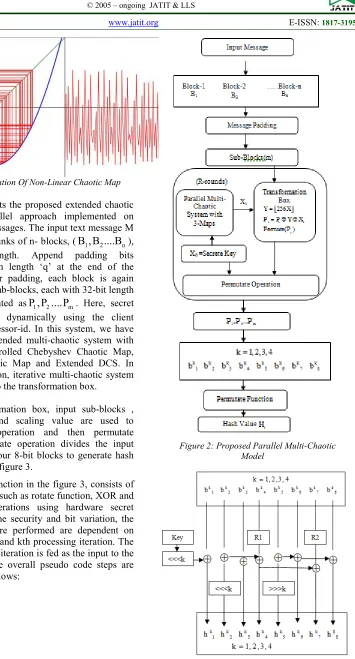
Figure 2, represents the proposed extended chaotic model with parallel approach implemented on arbitrary input messages. The input text message M is divided into chunks of n- blocks, (
B , B ....B
1 2 n), each with r-length. Append padding bits (10000…00)2 with length ‘q’ at the end of themessage M. After padding, each block is again divided into ‘m’ sub-blocks, each with 32-bit length and it is represented as
P , P ....P
1 2 m. Here, secret key is generated dynamically using the client mobile/PC’s processor-id. In this system, we have introduced an extended multi-chaotic system with three maps: Controlled Chebyshev Chaotic Map, Extended Quadratic Map and Extended DCS. In each round function, iterative multi-chaotic system generates output to the transformation box.In the transformation box, input sub-blocks , chaotic output and scaling value are used to perform XOR operation and then permutate operation. Permutate operation divides the input XOR value into four 8-bit blocks to generate hash value as shown in figure 3.
The permute function in the figure 3, consists of logical operations such as rotate function, XOR and circular shift operations using hardware secret key.To improve the security and bit variation, the shift operations are performed are dependent on each bit sequence and kth processing iteration. The output of the each iteration is fed as the input to the next iteration. The overall pseudo code steps are summarized as follows:
Figure 2: Proposed Parallel Multi-Chaotic Model
[image:5.612.165.520.56.715.2]Algorithm Steps:
Input: M(Input message),Secret key, initialization parameters.
Step 1: Read a message M .
If message size is not multiple of ‘n’ then
Append the bit sequence 1000…000 at the end of the message.
Step 2: Divide the message into blocks of length n as
B , B ....B
1 2 n.Step 3: After padding, each block is again divided into ‘m’ sub-blocks, each with 32-bit length and it is represented as
P , P ....P
1 2 m.Step 4: Secret key is generated using the client’s mobile/PC processor-id as S. Generated secret key is initialized as X0 for multi-chaotic system.
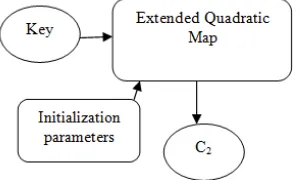
Step 5: Extended multi-chaotic system with three maps:Controlled Chebyshev Chaotic Map, Extended Quadratic Map and Extended DCS are used using equation (1), (3),and (4).
Step 6:In each round function, iterative multi-chaotic system generates output Xi to the
transformation box as shown in Figures 4,5,6.
X
i=
C
1⊕
C
2⊕
C
3Step 7: In the transformation box, the following operations are performed on the Y and chaotic output.
'
i i i
' i
Y 256X
P P Y X
Permute(P )
=
= ⊕ ⊕
Step 8: Generates Hash value as
'
i i
1 2 3 m
H
Permute(P )
Hash
H
H
H ....H
=
[image:6.612.327.502.101.204.2]=
+
+
Figure 4: Controlled Chebyshev Chaotic Map Operation
[image:6.612.93.253.422.593.2]Figure 5: Extended Quadratic Map Operation
Figure 6: Extended DCS Operation
4.
EXPERIMENTAL RESULTSIn this section, we perform different experiments to find the efficiency of our parallel hash function against traditional models. We also provide experimental results with traditional hash models in terms of hash sensitivity, confusion and diffusion.
Hash Sensitivity:
Hash sensitivity of the input message to the changed message are evaluated using different conditions. Experimental results demonstrate the high sensitivity of the original to the changed one in different cases.
Experimental-1: Proposed Model Vs Kanso [15]
Original Message: This is a message for testing !!
Hash Value
a54cc13a7c81f87e5f205944f19356210efb5675e4ff ea724ef6b803105efc16
Binary Value
00111000000010000101110111100011101101010 11010110110001010101010001110011101001001 00111101111000011010011110111111100000111 10101010110000111111110001010111111011111 11010110010100101001011111011100101001111 01011111001010101000110110011110000011100 1111010011
T-1: This is a message for testing !?
Hash Value
:89516b01e790ddd4f14cc6529d6c8be8a7817a4c82 d543086bf6018521c42b77
Binary Value
:10110001010110010011011011100010010100101 11110111011111101111110110010001001111010 00100100101010111101001000001101101011000 11101111111111111111011110000101100010111 11111011000001101010011101011010000110001 10011111000110100010100110100110100010110 0010100100
Proposed Bit Change:140
[image:6.612.109.259.628.718.2]T-2: Thes is a message for testing !!
Hash Value
:d9eb62ec69b136c7f2dcec4282080f0fd7c31fcb209 0dec4642fa512ce58b392
Binary Value
:11100001111000110011111100001111110111001 10110100101010001101101110010110000111010 10001100111010111010111110011111101111111 11010100011111011110010010101001101101101 11011111010111110111101110011010111001010 10101011100010001101010001010101000110000 0001000001
Proposed Bit Change:146
Kanso Bit Change:131
T-3: This is a message for tsting !!
Hash Value
:f97ac3d75034d5b4351a73c61abd4b08cc3ad0a03e 4a5805df075d36424adc24
Binary Value
:11000001011100101001111000110100111001010 10111111011011100011110000011001100100000 11110010111110011100110101001010101011111 11101100101000100010101011010010111011100 00110010111101110001011110000001010101111 10110100100011000100010111010111010101011 1111110111
Proposed Bit Change:140
Kanso Bit Change:128
T-4: This is a message for tsting !!
Hash Value
:cad52e03e2feced38321e9004a18773ae970cdd2a2 d10e37bbd31673616793b5
Binary Value
:11110010110111010111001111100000010101111 00101011010110001111001101110101111001110 10011001111000001000111111011110010111110 01111101100010000111101000111001011110101 11111011010000100111010010100111000110101 00111101111001001110000110110010111111000 0001100110
Proposed Bit Change:145
Kanso Bit Change:135
Experimental-2: Proposed Model Vs [16]
Hash Value:
be412c4af3b1f7a3b29bde63db5d98e139dc3d1d083 fcffb7e9d195e9c2d5b96
Binary Value:
10000110010010010111000110101001010001101 10110101001010100001001100010110100100110 01000100011011101100101011001001111000000 10100011000011010001110110111111000001111 01010101101011100110100001101011010011100 11111100000000010101111000011011101001010 0001000101
Hash Value
:e5bf884791614cd17938e90e4feac752d966749cfa9 1552b7d33b77f10c711aa
Binary Value
:01100011111101101111100111101110110101111 01110111101100111011000111100100111000101 11100000010101111111010101100010111111010 00110101110001100010111000011011111000000 11111100101110110011101011011100100111010 10001010111011101011110000000011010001110 0111101111
Proposed Bit Change:150 Chenaghlu[16] Bit change:138
Hash Value
:ccdf6c1978e17263e99a95ef0c1c8b22ef13d82bc9b 453398d07125b1881b499
Binary Value
:01001010100101100001110110110000001111100 01110111110011101101010011000101101001100 00010011110100101111101010111011110011001 10110100011101011000001101111110010110011 11001110111010110101101111110011100111100 00011110010010100011110100001011100100111 0011011100
Proposed Bit Change:141 Chenaghlu[16] Bit change:114
Hash Value
:b2e2c2bd70cbf96cff307333de8c0ae3744e14afa1a 25fbd79617dd967b0d4b8
Binary Value
:00110100101010111011001100010100001101100 00100010110110001100101011101000111100111 10001000101000011011000011111001110010111 10111000101011110110110100011010011110101 01001111100010111001001110111100110110000 11010011101110100111001011101101101111111 0011111101
Hash Value
:b2e2c2bd70cbf96cff307333de8c0ae3744e14afa1a 25fbd79617dd967b0d4b8
Binary Value
:00110100101010111011001100010100001101100 00100010110110001100101011101000111100111 10001000101000011011000011111001110010111 10111000101011110110110100011010011110101 01001111100010111001001110111100110110000 11010011101110100111001011101101101111111 0011111101
Proposed Bit Change:141 Chenaghlu[16] Bit change:135
ba86e448c62113e616f42759fd5fffc78d7c2c061a6a 4129f46a726f93dcf228
Binary Value
:00111100110011111001010111100001100000001 11110111000011011101111100111011011110110 11011001000010010011111110110110000111110 10011111011001101111110011011111001101110 11110011000010100111101011110100000010001 10110010010011001010110001100000001110110 1001101101
Proposed Bit Change:143 Chenaghlu[16] Bit change:131
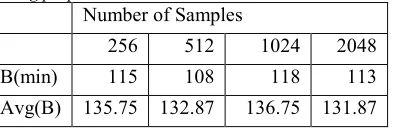
[image:8.612.90.287.541.605.2]From the above two experimental results , it is clear that any change in the original message has a huge impact on the final output. From these experimental results, we conclude that our proposed model has high hash sensitivity compared to traditional models[15][16].
Table 1:Statistical analysis of “yahoonews” text datasets
using proposed model
Number of Samples
256 512 1024 2048
B(min) 115 108 118 113
Avg(B) 135.75 132.87 136.75 131.87
5.
CONCLUSIONIn this paper, a novel parallel chaotic hashing model is analyzed with experimental results; whose structure can ensure the randomness, high sensitivity and collision resistance. This model integrates multiple chaotic maps as a single chaotic system to generate an n-bit hash value for a given input message. This model provides more security, high computation speed, limit memory resources
and less computation overhead in the standalone and mobile applications. Experimental results show that proposed model has high computational speed, bit variation and collision resistance as compared to traditional parallel chaotic models. In future, this work can be extended to encryption based chaotic model on mobile devices.
REFRENCES:
[1] N. Abdoun, S. El Assad, Md. A. Taha, R. Assaf, O. Deforges and Md. Khalil, “Hash Function Based on Efficient Chaotic Neural Network”, “10th International Conference for Internet Technology and Secured Transactions”, 2015. [2] K. Atighehchi and T. Muntean, “Generic
Parallel Cryptography for Hashing Schemes”, “IEEE 12th International Symposium on Parallel and Distributed Computing”, 2013. [3] K. Ganesan, I. Singh and M. Narain, “Public
Key Encryption of Images and Videos in Real Time Using Chebyshev Maps”, “5th International Conference on Computer Graphics, Imaging and Visualization”, 2008. [4] L. Gao, X. Wang and W. Zhang, “Chaotic hash
function based on Tandem-DM construction”, “International Joint Conference of IEEE TrustCom-11”,2011.
[5] W. Ghonaim, N. I. Ghali, A. E. Hassanien and S. Banerjee, “An improvement of chaos-based hash function in cryptanalysis approach: An experience with chaotic neural networks and semi-collision attack”, “Memetic Computing”, 5(3), pp.179-185, 2013.
[6] R. Guesmi , M. A. B. Farah, A. Kachouri and M. Samet, “A novel chaos-based image encryption using DNA sequence operation and Secure Hash Algorithm SHA-2”, “Nonlinear Dynamics”, pp. 1123-1136, 2016.
[7] W. Guo, X. Wang, D. Hea and Y. Cao, “Cryptanalysis on a parallel keyed hash function based on chaotic maps”, “Physics Letters A, 373(36)”, pp.3201-3206, 2009. [8] N. Jiang, R. Yang and X. Liu, “The Design and
Implementation of Password authentication System Based on chaos”, “International Workshop on Chaos-Fractals Theories and Applications”, 2009.
[9] W. Jizhi, X. Shujiang, T. Min and W. Yinglong, “The analysis for a chaos-based one-way hash algorithm”, “International Conference on Electrical and Control Engineering”, 2010. [10] Y. Li, D. Xiao, H. Li and S. Deng, “Parallel
cellular neural network”, “Neural Computing and Applications 21.7”, pp.1563-1573, 2012. [11] M. Nouri, A. Khezeli, A. Ramezani and A.
Ebrahimi, “A Dynamic Chaotic Hash Function Based upon Circle Chord Methods”, “6th
International Symposium on
Telecommunications”, 2012.
[12] Y. Song and G. Jiang, “Hash Function Construction Based on Chaotic Coupled Map Network”, “IEEE 9th International Conference for Young Computer Scientists”, 2008.
[13] Y. Wang, D. Yang, M. Du and H. Yang, “One-way Hash function construction based on iterating a chaotic map”, International Conference on Computational Intelligence and Security Workshops”, 2007.
[14] Q. Zhang, H. Zhang and Z. Li, “One-way Hash Function Construction Based on Conservative Chaotic Systems”, “5th International Conference on Information Assurance and Security”, 2009.
[15] A. Kanso, H. Yahyaoui, M. Almulla,” Keyed hash function based on a chaotic map”,” Information Sciences 186 (2012) 249–264. [16] Meysam Asgari Chenaghlu ∗, Shahram Jamali,
Narjes Nikzad Khasmakhi,” A novel keyed parallel hashing scheme based on a new chaotic system”, Chaos, Solitons and Fractals 87 (2016) 216–225.
[17] B. Madhuravani, Dr. DSR Murthy, “An Efficient Authentication Protocol to amplify collision resistance using Dynamic Cryptographic Hash Function & LSB Hop based Image Stegano-graphic Technique”, International Journal of Applied Engineering Research ISSN 0973-4562 Volume 11, Number 7 (2016) pp 5293-5296. Research India Publications. http://www.ripublication.com. [18] B. Madhuravani, D. S. R. Murthy, P. Bhaskara
Reddy, “Novel Authentication Protocol Using Multi Cryptographic Hashfunctions And Steganography”, International Journal of Advanced Computing (IJAC), Vol. 48, May 2015.