ORIGINAL RESEARCH ARTICLE
PEDAGOGICAL PERSPECTIVE OF CONTRIBUTION OF EDUCATIONAL TECHNOLOGY IN
ENGINEERING TEACHING
1
DéboraValim Sinay Neves,
2Kelly Cristine Barreto Alves Santos and
3KéziaBarreto Santos
1
PhD student at UNIVATES/BR and Master in Teaching Exact Sciences by UNIVATES/BR
2
Graduating Student in Electrical Engineering with emphasis in eletrotechnics and electronics at Faculdade
Independente do Nordeste - FAINOR
3
Holds a Degree in Computer Engineering from Faculdade, Independente do Nordeste – FAINOR
ARTICLE INFO ABSTRACT
The use of technologies in academic environment has become a common practice today. Since the end of twentieth century virtual and media components have corresponded to a facilitator of teaching and learning process. Those resources have added a high level of effectiveness, to the point of promoting face-to-face education, in addition to incorporating Distance Education (EAD). The present study has analyzed pedagogical perspectives of Virtual Learning Environment - AVA Moodle in mediation of scientific knowledge, fomenting the formation of undergraduate students in areas of electrical engineering and production engineering in Higher Education Institution (IES), a large private institution located in the city Vitória da Conquista, Bahia. From that perspective, this research has a qualitative approach, with emphasis on case study. The participants of research have been composed of 20 students from the third semester of courses of electrical engineering and production engineering of IES researched, enrolled in the period of 2017.1, who had studied Methodology of Scientific Research - MPC. Through the current investigation with development based on pedagogical perspectives in areas of engineering, it has been possible to consummate the achievement of convergent results to veritable contribution of technology for benefit of education, noting that the institutional environment, the student and teacher have strengthened in acquisition and transmission of knowledge.
Copyright © 2018, DéboraValim Sinay Neves et al. This is an open access article distributed under the Creative Commons Attribution License, which permits unrestricted use, distribution, and reproduction in any medium, provided the original work is properly cited.
INTRODUCTION
Knowing that education can’t be consolidated by means of a unidirectional way of transmitting information, it has been well known that the society which promotes educational advancement in order to enhance methodological proposals of teaching, therefore, is verified adequacy in new and favorable to ascendancy of knowledge and educational perspectives. Pedagogical proposals have followed the effects of technological tools influence, benefiting from promising possibilities, in order to incorporate prosperous effects of technology allied to education into instructional planning and teaching practices.
*Corresponding author:Kelly Cristine Barreto Alves Santos
Graduating Student in Electrical Engineering with emphasis in eletrotechnics and electronics at Faculdade Independente do Nordeste - FAINOR
It is true that training structure of pedagogical practices and teaching in area of engineering has shown receptive when planned together with technological assistance, resulting in productivity and interactivity of graduates, actively connected to virtual environment. In order to carry out this research, the chosen field has been a large private college, located in the city of Vitória da Conquista, Bahia, where AVA, Moodle, was implemented for development of school activities, attending courses of various knowledge areas. The Moodle in institution, field of this research, has been used as an aid to live training lessons of graduation and post-graduation. The participants of research were composed of 20 students from electrical engineering and production engineering courses, who have attended the third term, during the course of MPC (Methodology of Scientific Research), 2017.1 in the morning and night shifts.
ISSN: 2230-9926
International Journal of Development Research
Vol. 08, Issue, 06, pp.21063-21068, June, 2018
Article History: Received 10th March, 2018 Received in revised form 24th April, 2018 Accepted 20th May, 2018 Published online 30th June, 2018
Key Words:
Virtual Environment. Learning. Teaching.
Citation: DéboraValim Sinay Neves, Kelly Cristine Barreto Alves Santos and KéziaBarreto Santos, 2018. “Pedagogical perspective of contribution of
educational technology in engineering teaching”, International Journal of Development Research, 8, (06), 21063-21068.
Distance Education course and development of its educational and normative methodologies
Distance education in Brazil has been presented since the beginning of its use as a possibility to foment education in order to achieve a projected development in expansion of gathering of teaching process through a new modality that, besides being able to complement the system of education, allowed the expansion of education beyond physical boundaries. According to Brazil (2017, digital text), Art. 1 For purposes of this Decree, distance education has been considered to be educational modality in which didactic-pedagogical mediation in teaching and learning processes occurs with use of information and communication media and technologies, with qualified personnel, with policies access, with compatible monitoring and evaluation, among others, and develop educational activities by students and education professionals who are in different places and at different times. With practice of distance education course surrounded by a contingent of expectations and possibilities, to detriment of evaluative limitation of this modality, the legislation was based on parameters of traditional model, since, the consistency of that teaching model, by itself, did not could guarantee a safety of its composition to establish a normative set specified in law. In that sequence, Rocha (2014, p.2), has dealt with functions of evaluation, which states that, Understanding evaluation as a dynamic process is fundamental in that as its elements have a strong relation to the mode or instructions that define its functions in the daily teaching action [...]. In this context, the following five functions present, in a certain way, the expectation about each one of them in the evaluation process, being: in process [...] the self-assessment ... the motivation [...] to deepen learning [...] and to help learning. In that way, it can be seen that the desired result of EaD and face-to-face modality has the same orientation, consisting in achieving learning through a teaching source and transmission of information.
It is understood that, with distinction of each modality is characterized by its peculiarities, the first, based on flexibility of physical location, transmission of information by digital pathways, and the second, based on traditional model of teaching. Thus, the need to establish legislative conditions and regulations followed the existing parameters of evaluation, shaping them according to evolution of distance learning. In 1996, in Brazil, the modality of teaching EaD was sanctioned, through Federal Law no. 9,394. From that period, the Law of National Education Directives - LDB came into force and defined several requirements, which has established the regiment, consubstantiating its effectiveness with mandatory institutional evaluation (BRASIL, 1996). The support provided by LDB to EaD is registered in Article 80 of respective law, stating that "Public Power will encourage the development and delivery of distance education programs at all levels and modalities of education and continuing education" ( BRASIL, 1996). With the establishment of LDB, it was possible to cover the adherence of that education system, since, likewise, specified in article 80 above, the incentive to move forward with this model of education would count on collaboration of government. Nevertheless, to determine the method of evaluation would provide a clarification of the evaluative learning process. Simões (2016) has stated that "appraisal of learning is thus a process to be dimensioned from a singular, unique pedagogical project that corresponds to a social need, be it local, regional or national." In that sequence, in a
dynamically structured scenario, it is possible to orientate the results of learning through normative techniques, determined in a dynamically structured setting, in order to follow analysis and ordering of contents and results in teaching and learning space. In that context, it is understood that using an evaluation approach with the contribution of delimitations of in-person teaching, verifying that to add this operation by the need to examine the quality of learning is essential among approaches in context of teaching. Bearing in mind that the characteristics of EaD modality are favorable to classroom teaching practices and aid, it also expresses a segment of social compensation through interconnection composition of pedagogical proposals in a classroom environment, favoring student's connectivity in comprehending the possibilities of curricular offerings. In this way, it is possible to verify that in Ordinance no. 1.134 (2016), it is specified in Article 3 the opening of EaD modality within pedagogical composition of face-to-face teaching, higher education institutions should include the updating of pedagogical project of in-person courses with the offer of distance disciplines, in accordance with provisions of this administrative rule, for analysis and evaluation purposes, and protocol for applications for recognition and renewal of course recognition (BRAZIL , 2016). In accordance with provisions presented in Article 3 above, it should be emphasized that the recognition of integration of EAD modality in courses within the current context are being accompanied by support of technologies and pedagogical plans, being adhered in institutions of higher education , not only with the ascendancy of integration of courses, but presenting the need for a legislative recognition in order to achieve a pedagogical validation in educational scenario (LESSA, 2011). With that, it has become possible gathering aspects of EaD at on-campus environment.
Educational vision through ICTs that promote interactivity and autonomy in learning in AVA (Virtual Learning Environment)
importance. It has been observed that space is related to AVA, mediated by information and communication technologies - TICs, and time is related to the way of learning of student being able to be synchronous or asynchronous. As stated, Barros (2008, p.6), Synchronous communication tools are the ones that allow participation of students and teachers in marked events, with specific schedules, via internet, like chats. For this kind of interactivity, real-time communication allows the participants to feel a sense of group, of community, which can be determinant for continuity of course, since it preserves motivation, interaction in real time, return and immediate criticism, regular meetings, etc. Asynchronous communication tools such as Forum, Diary, dialogue, lesson, among others, are considered as revolutionary because it enables the user to make his intervention in a more organized way, since he will have time to systematize his opinion, comment, answers, etc. By dealing with learning, that is feasible to refer to achievement of something that has been acquired or the ability to develop, through a source of information, or data collected in an environment, in documents etc. Therefore, interactivity has provided collective knowledge through communication in which participants may not have access to information at the same time as the subject who generated it, knowing that learning time is different for each individual. Similarly, Ferreira (2011, p.23) testifies that,
The use of digital technologies breaks down important barriers such as time and space, while at the same time fostering the development of fundamental skills, such as: development of
critical sense, imagination, abstraction, memorization,
classification, reading of texts and images, development of hypothetical and deductive thinking, among others. Its applicability to educational field has been considered by a significant number of educators, as well as by educational institutions, as a possibility of modernization of school system. Through the process of knowledge construction, virtual environment has become a helper for more effective methods in use of communication, so that students have opportunity to learn together, accompanying the development of activities proposed by teacher. As Silva Júnior (2011, page 16) corroborates, AVA is a computer system implemented through a programming language, which has brought together, in unique software (called a platform), possibilities for online access to course content. It also offers several communication / interaction / construction resources among the subjects that participate in environment.
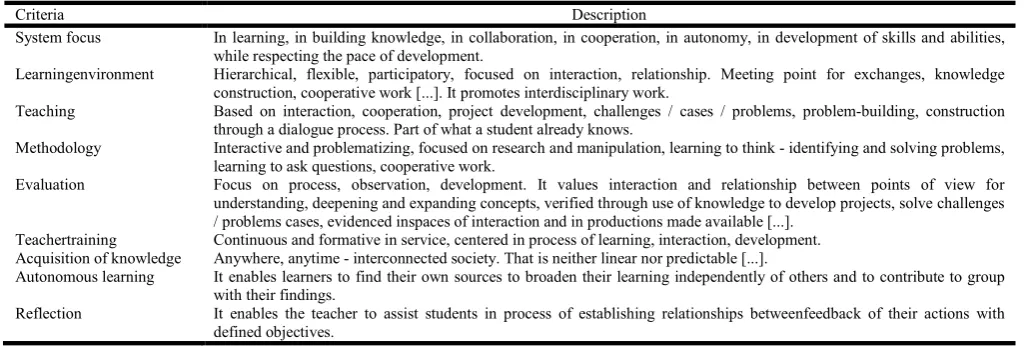
Thus, virtual learning environments can be used both to help and extend interaction spaces in courses in on-site mode, as well as to manage courses offered in on-line part mode and / or fully at a distance. Communication is a method of transferring information, messages, signals, algorithms, etc., from one point to another, in order for such a transfer from a transmitting way to a receiver to take place, a transfer channel is used. This communication principle is of great importance, both for social and economic life, in areas of health and engineering, being a basic criterion for establishing a reliable and consistent educational parameter, where a teacher and a student have a place. As Silva Júnior (2011, p.9) states that, Consolidating the style of distance learning and teaching leaves the obligation of updating the means of teaching to ensure a good application of those technologies aimed at distance learning. There are many possibilities and resources to explore. Those include: audio, video, audio-video, texts and animations. Inserted in that context, teacher ceases to be the center of whole teaching process and begins to act as indispensable and irreplaceable agent that will guide the student in his journey in search of knowledge. When analyzing the concept of effective teaching, it is verified that pedagogical planning, didactics in explanation and adequate transfer of program content were carried out efficiently, where learning was the result proportional to effort required and performed, as Simões affirms (2016) that "teaching has no service without its correspondent - learning - and the 'subject who is learning'". In this context, it has been essential to carry out studies on pedagogical perspectives to improve the way of sharing knowledge (teacher), the channel (virtual learning platform Moodle) and the receiver (student), which through of methodologies applied in classroom and in AVA, with effective planning. Table 1 shows a didactic-pedagogical perspective according to Fagundes and Schlemmer (2000, p 10). Therefore, stimulating the decrease in communication failure, the number of redundancies in doubts among students, thus contributes to learning and teaching in didactic form and with expected return, considering that, when the student has possibility of develop his census of critical knowledge, in addition to searching network, enabling the production of information, it is understood that knowledge has been transmitted skillfully.
[image:3.595.44.560.75.248.2]Methodological approach: The current investigation has been developed in a private college, located in the city of Vitória da Conquista, Brazil. In order to carry out data collection, 20
Table 1. Didactic-pedagogical perspective
Criteria Description
System focus In learning, in building knowledge, in collaboration, in cooperation, in autonomy, in development of skills and abilities, while respecting the pace of development.
Learningenvironment Hierarchical, flexible, participatory, focused on interaction, relationship. Meeting point for exchanges, knowledge construction, cooperative work [...]. It promotes interdisciplinary work.
Teaching Based on interaction, cooperation, project development, challenges / cases / problems, problem-building, construction through a dialogue process. Part of what a student already knows.
Methodology Interactive and problematizing, focused on research and manipulation, learning to think - identifying and solving problems, learning to ask questions, cooperative work.
Evaluation Focus on process, observation, development. It values interaction and relationship between points of view for understanding, deepening and expanding concepts, verified through use of knowledge to develop projects, solve challenges / problems cases, evidenced inspaces of interaction and in productions made available [...].
Teachertraining Continuous and formative in service, centered in process of learning, interaction, development. Acquisition of knowledge Anywhere, anytime - interconnected society. That is neither linear nor predictable [...].
Autonomous learning It enables learners to find their own sources to broaden their learning independently of others and to contribute to group with their findings.
Reflection It enables the teacher to assist students in process of establishing relationships betweenfeedback of their actions with defined objectives.
students from electrical engineering and production engineering courses of third semester, in the period of 2017.1, enrolled in MPC curricular component, in the morning and night shifts have been selected as participants of research. The methodological approach used during the research has been qualitative and quantitative, with emphasis on case study, so that with quantitative data it was possible to verify and demonstrate the results obtained and intensity of participation during the entire research process. Regarding the qualitative approach, dimensioning of learning in its quality was added. It has applied an online questionnaire with AVA Moodle access with structured questions for students, being constituted in part by the Term of Free and Informed Consent (TCLE) in order to fulfill the ethical requirements during the research, clarifying structure and purpose of investigation. With the need to perform the analysis and discussion of data, following methodological procedures specified in constitution of research, the work of Bardin (2009) was based on qualitative analysis through its Content Analysis, assuming that quantitative data analyzed were analyzed and expressed through tables.
Perspective on use of technology in favor of education: Technology has provided to different fields a diversity of possibilities for its advancement and increase of its performance. As far as educational scenario is concerned, technology has provided an opening of opportunities in
practices of its segment. Based on Ferreira (2011, p. 41),The
new ICTs, when incorporated into educational field, must therefore seek emancipation of learners as human beings, class or individuals, propitiating articulation of notions of time, space, communication, expression, nature, citizenship, health, languages, politics, economics and culture. This is very important in the knowledge-building process, through cooperative and collective activities, which in turn enable a
true social management of knowledge.It has been understood
that, through instigation based on vision of engineering students, it was verified that the influence of a technological environment made possible a wide communication regarding the manipulation of necessary program contents to be studied and discussed, with a view that the availability of materials favored dynamization and provoked interactions capable of consubstantiating the knowledge generated from information
transited in environment. According to participant7, The
sharing of information and activities within a virtual learning platform, with help of teacher, increased the set of academic interactions, making it possible to widen the connection spectrum between individual and collective knowledge.
Thus, it has been observed the strengthening of pedagogical proposal directed to practices of students had been effective, once access was obtained to the content addressed with a focus on teaching. Souza and Santos (p.4, 2008) corroborates that in these situations,
The student passes from passive condition and receiver of information, to construct a knowledge that forms in collaborative learning networks. School ceases to be a single physical space for an infinite territorial space, without limits, without barriers; a transdisciplinary space of knowledge. Knowing that there are facilitating resources for exposition and aggregation of knowledge constructed through structured learning, making technology available to generate those resources to individuals has potentiated efficiency of elaboration of an educational structure, resulting in a 98%
affirmation of students in what refers to dynamics of access to technological environment, promoting a facilitation in performance of skills related to absorption of information, considering that rapid access to educational contents that
technology provides, generates positive impacts for
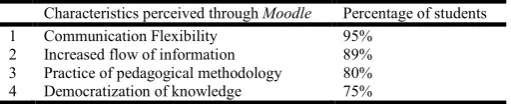
construction of knowledge directed to students. Thus, it has been possible to verify that 93% of students had affirmed to acquire with the use of AVA a new world-wide view on advantages of use of a technology in aid of teaching. Therefore, it promoted a perception of communication and manipulation of information with greater ease. Access to technology is readily available to society. In this way, a possible barrier is overcome, considering that adapting to virtual methods of transmission and information sharing would not be a difficulty, which would require a remodeling of the way to gain access to knowledge. Table 2, describes the
[image:4.595.307.563.282.334.2]characteristics perceived by students through Moodle.
Table 2. Perception of students with Moodle experience
Characteristics perceived through Moodle Percentage of students 1 Communication Flexibility 95%
2 Increased flow of information 89% 3 Practice of pedagogical methodology 80% 4 Democratization of knowledge 75% Source: Own authorship (2017).
With the development of research it has been found that 90% of students formed a consensus that the use of technology is a trend which only has to expand, given that currently most people are linked to use of modern technology, facilitating the progress of education. The teaching provides a direct
communication between teacher and student which
allowsexposing the content to be studied at the time of communication, disseminating strands and characteristics of pedagogical proposal in real time. As participant 12 says, "technology has to be used in a beneficial way to education, stimulating the imagination of students and supporting the work of teacher, promoting learning and theoretical foundation, enriching knowledge." Combining the advantages of technology such as dynamisation, flexibility, time saving and interactivity makes up a scenario which contemplates a higher performance, both with respect to construction of knowledge, and in communication between individuals acting in the environment. A virtual environment has presented a considerably high level of importance in academic world, as 96% of the students say, when the need to add knowledge presents itself before the demands to be fulfilled, originating from pedagogical proposals. The opportunity to progress amidst the demands can be enhanced by using tools available to meet the needs presented. Thus, with the influence of virtual learning platform, 80% of students ensured that knowledge had been acquired dynamically and gained experience with AVA to build knowledge. In the mediation of process of knowledge construction, it has been known technological tools and didactic methods are used in order to provide an experiment with a satisfactory result, so that the knowledge receiver can benefit from the advantages of presented subsidies, being possible , thus intensifying the learning process, considering the minimization of search time and contact with precursor material, source of knowledge breeding. In that follow-up, Barros and Carvalho (2011, page 218) point out that,
other students and with teacher, from the moment in which a teaching is proposed that considers as a priority the forms of learning and consequently, learners. The possibility of interacting, through technological tools, implies reviewing all the roles of those involved inteaching and learning process, as well as methodology used to promote this learning. In that context, it is understood that an instructor, which provides a guide with encouraging practices, structured observations and a theoretical basis in teaching process, corroborates the construction of scientific knowledge. As participant 2 affirms, this process is successfully performed "due to availability of teacher to answer all questions and seek to teach classes dynamically", since adding technologies favorable to reach of pedagogical measures, it benefits the role played by teacher in the context from perspective of teaching and acquiring knowledge. It is understood that teacher is a driving factor for student, considering that technology favors methodologies applied by teacher. Thus, Barros and Carvalho (2011: 219) state, "therole of teacher is broadened. It should promote, through a pedagogical intervention, the autonomy of student, in sense of helping him to rework the existing knowledge ". It
can be seen that in higher education, Moodle virtual
environment is used in MPC course, which enhances the
process of scientific development, as 90% of students say, being structured in accordance with methods listed for a projection of scientific project. Theparticipant 9 completes, "is a tendency to expand, so that, currently, most individuals are linked to use of technology, which favors the practice of education." According to Carvalho (2017: 22), "the incorporation of new information and communication technologies into education has consequences both for teaching practice and for learning processes". Therefore, it is understood that the results through a pedagogical methodology of teacher, based on advance of teaching model distance learning with the benefits of technology influence the development of learning. On that bias, participant 7 states, "increasing influence on virtual platforms and applications would propitiate student performance in favor of education through the use of technology."
Considering that, in the area of engineering, some subjects
have been taught with help of virtual platform Moodle.
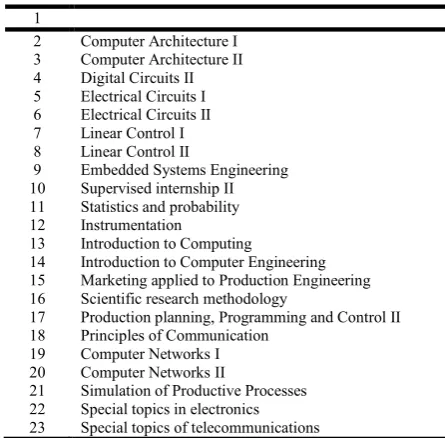
Knowing that students are the main focus of the use of virtual environments, they were questioned as to the appropriateness of technological support in curricular components of engineering course, thus obtaining a positive return on their use by corresponding 95% of individuals. Table 3 shows the relationship of courses offered in engineering courses in
research field of thiscurrentwork, which have the Moodle
platform as mediator of teaching and learning process. Thus, it is clear that those disciplines present a technological and scientific aspect in their composition of curriculum, since in their approach, planning and practice, execution of theoretical, simulation and practical components is required. In this context, Carvalho (2017, p.12) states that "technological convergence is possible, but rather that educator and students have a digital education directed to the production of shared pedagogical content." Nevertheless, it is valid to infer that the
aid of a virtual learning platform, Moodle, has favored the
accomplishment of activities of each component. In this context, UNESCO (2014, p.24) states that learning is essentially composed of five factors, which compete in their effective development: "1. active student participation; 2. cooperative learning; 3. frequent interaction with resources and with feedback; 4. connections with real world; and 5. the role
[image:5.595.320.543.130.349.2]of teacher as resource orchestrator and referential of students ", so that optimization of teaching and study time can be promoted by mediating content and sharing knowledge online, enabling the teacher to play their pedagogical practice.
Table 3. Disciplines offered in Moodle
1 Algorithms and Computer Programming I
2 Computer Architecture I 3 Computer Architecture II 4 Digital Circuits II 5 Electrical Circuits I 6 Electrical Circuits II 7 Linear Control I 8 Linear Control II
9 Embedded Systems Engineering 10 Supervised internship II 11 Statistics and probability 12 Instrumentation
13 Introduction to Computing
14 Introduction to Computer Engineering 15 Marketing applied to Production Engineering 16 Scientific research methodology
17 Production planning, Programming and Control II 18 Principles of Communication
19 Computer Networks I 20 Computer Networks II
21 Simulation of Productive Processes 22 Special topics in electronics 23 Special topics of telecommunications Source: HE institutes Moodle researched (2017) adapted.
Final considerations
With understanding of possibility of covering levels of reception and outcrop of knowledge, the participants of AVA
Moodle were encouraged to obtain a performance in sharing
of information and accomplishment of instructional
pedagogical proposals, linked in both virtual and classroom environment, in order to make it possible to identify the reaction of individuals when confronted with a flow of information originating from several strands synchronously and asynchronously, finding that the interest in agglutinating knowledge was strongly accentuated, thus generating a timely
interactivity in learning process. Given that Moodle has a
broad base of possible means of communication and transmission of information, the reflection of trainees was found to continue with experience when using AVA, testifying that it has been possible to cover the needs presented during the process of research in the virtual environment, so that the organization of platform and provision of programmatic and pedagogical contents allowed to have access to the content in question with agility and flexibility, making sure that adequate conditions were provided to build learning. It has been corroborated, through analysis of need to use AVA to contribute to the progress of education, obtaining technological support, the veracity to satisfy and guide parameters required for students, developing the composition of projects and planning involved in learning process, serving of support to access of contents, within established parameters according to the proposal of teaching, evaluation and learning within virtual platform to the aid of on-campus education.
REFERENCES
Assembleia Legislativa. Portaria nº 1134, de 10 de outubro de
2016. Portaria nº 1.134, de 10 de outubro de 2016.
Decreto nº 9057, de 25 de maio de 2017. Decreto nº 9.057, de
25 de maio de 2017.Assembleia Legislativa, Goiás, DF,
26 mai. 2017. Disponível em:
<http://www.planalto.gov.br/ccivil_03/_ato2015-2018/2017/decreto/D9057.htm>. Acesso em: 10 jun. 2017.
BARDIN, L. Análise de conteúdo. Lisboa: Edições 70, 2009.
BARROS, M. G. A contribuição da interatividade nos
ambientes virtuais de aprendizagem colaborativa.
(UEPB). Universidade Federal de Pernambuco. 1 ed. 2008.
BARROS, M. G; CARVALHO, A. B. G. As concepções de
interatividade nos ambientes virtuais de aprendizagem.
Campina Grande: EDUEPB, 2011.
BRASIL. Assembleia Legislativa. Lei nº 9394, de 20 de
dezembro de 1996. Lei nº 9.394, de 20 de dezembro de
1996. Brasília, DF, 23 dez. 1996. Disponível em:
<http://www.planalto.gov.br/Ccivil_03/leis/L9394.htm>. Acesso em: 13 jan. 2017.
CARAM, N. R.; BIZELLI, J. L. Aspectos da regulação sobre
o ensino a distância no Brasil. Universidade Estadual
Paulista – UNESP. São Paulo. 2014.
CARVALHO, R. As tecnologias no cotidiano escolar:
possibilidades de articular o trabalho pedagógico aos recursos tecnológicos. 2017.
FAGUNDES, L. C.; SCHLEMMER, E. Uma proposta para avaliação de ambientes virtuais de aprendizagem na
sociedade em rede. Informática na Educação:teoria
&prática. UFRGS, v. 3, n. 1, setembro, 2000.
FERREIRA, M. H. M. Design pedagógico em ambientes
digitais: perspectivas de análise para o campo da
alfabetização e letramento. Dissertação. Universidade Federal De Minas Gerais. Belo Horizonte. 2011.
FILHO, M. Portaria Nº 1.134. Associação Brasileira de
Mantenedoras de Ensino Superior – ABMES. Ministério da Educação. Gabinete do Ministério. Seção 1.,p. 21 out. 2016.
LESSA, S. C. F. Os reflexos da legislação de educação a
distância no Brasil.Associação Brasileira de Educação a
Distância. vol. 10. 2011.
NEVES, D. V. S. Educação a Distância e suas
Potencialidades na Formação de Formadores: um estudo
de caso. 2013. 151f. Dissertação (Mestrado) – Curso de Pós-Graduação Stricto Sensu. Mestrado em Ensino de Ciências Exatas. UNIVATES, Lageado/RS. 2013.
Disponível em: < https://www.univates.br/bdu/
handle/10737/325>. Acesso em: 20 ago. 2016.
Revista Profissão Docente Uberaba. Universidade de Uberaba – UNIUBR. v. 15, n.32, p. 131-139. 2015.
ROCHA, E. F. Avaliação na EaD:estamos preparados para
avaliar?Maio. 2014.
SEBASTIÃO, A. P.F.A utilização do ambiente virtual de
aprendizagem Moodle em uma instituição de ensino
superior pública.Dissertação.
SILVA JÚNIOR, T. M. S. Avaliação de ambientes virtuais de
aprendizagem - AVAs de acordo com as perspectivas
tecnológicas e comunicacional/social,
didático-pedagógica e gestão. 2011. Monográfica (Graduação) –
Curso de bacharelado em Ciências da Computação. Graduação em Ciências da Computação. Universidade Estadual do Sudoeste da Bahia – UESB. Vitória da Conquista – Bahia. 2011.
SIMÕES, C. F. 20 anos de avaliação da aprendizagem em
EaD: algumas questões éticas e normativas. Universidade
Federal de São Carlos - UFSCar. Simpósio Internacional de Educação a Distância. Encontro de Pesquisadores em Educação a Distância. São Carlos - São Paulo. set. 2016.
SOUZA, H. B.; SANTOS, J. Z. A práxis pedagógica em
ambientes virtuais de aprendizagem:uma possibilidade de
educar por meio da transdisciplinaridade. 2° Simpósio Hipertexto e Tecnologias na Educação: multimodalidade e ensino. Universidade Federal de Pernambuco. ed. 1. 2008. Recife: Anais Eletrônicos.
UNESCO. Tecnologias para a transformação da educação:
experiências de sucesso e expectativas. Organização das Nações Unidas para a Educação a Ciência e a Cultura.2014.