R E S E A R C H A R T I C L E
Open Access
Video-based feedback of oral clinical presentations
reduces the anxiety of ICU medical students: a
multicentre, prospective, randomized study
Matthieu Schmidt
1,2,3*, Yonathan Freund
4, Mickael Alves
5, Antoine Monsel
6, Vincent Labbe
7, Elsa Darnal
6,
Jonathan Messika
7, Jerome Bokobza
8, Thomas Similowski
1,2,3†and Alexandre Duguet
1,2,3†Abstract
Background:Oral presentations of clinical cases by medical students during medical rounds in hospital wards are a source of anxiety and little is known about how this anxiety can be alleviated. The objective of this study was to investigate whether video-based feedback of public oral presentations can reduce anxiety in 4th year medical students. Methods:Multicentre randomized study conducted in six intensive care units (ICU) and emergency departments (ED) in France over a 9-month period in 2012. One hundred and forty two 4th year medical students were randomized to two groups: intervention and control. Students in the intervention group were recorded while making an oral presentation of a patient during morning ward rounds, followed by video-based feedback. Students in the control group conducted presented classical oral presentations without being filmed and with no formal feedback. Anxiety levels during a public oral presentation were assessed using the Spielberger State Anxiety Inventory (STAI-S). The primary outcome was the difference in STAI-S scores between groups at the beginning and at the end of a 3-month ICU or ED internship. Results:Seventy four students were randomized to the‘video-based feedback’group and 68 were randomized to the control group. In both groups, STAI-S scores were significantly lower after 3 months of internship. However, the reduction in STAI-S scores was significantly greater in the“video-based feedback”group than in controls (−9.2 ± 9.3 vs.–4.6 ± 8.2,
p= 0.024. Compared to the control group, significantly fewer students with high-level anxiety were observed in the “video-based feedback”group after 3 months of internship (68 vs. 28%,p<0.001).
Conclusions:Compared to“usual practice”, video-assisted oral feedback reduced anxiety and significantly decreased the proportion of students experiencing severe anxiety.
Keywords:Oral feedback, Video tape, Medical education
Background
Oral presentations of clinical cases are performed daily by medical students during medical rounds in hospital wards. Public oral presentations are anxiogenic, particularly when they are associated with direct professional implications. However, the anxiety induced by oral presentations is alle-viated only after years of experience, and little is known about how this anxiety can be reduced. Anxiety can have
multiple consequences on the student’s personal and aca-demic development [1-3]. Medical students [4,5] often re-port that anxiety increases their feelings of personal inadequacy [6]. Anxiety may also have a negative impact on the quality of the presentation, which may be a source of medical errors and which may affect the patient’s out-come [7-9]. It is therefore important to improve commu-nication skills during medical training by ensuring a positive frame of mind.
Video-based feedback is already used in medicine, and good results [10-12] have been obtained in resuscitation of cardiac arrest [11,13] and surgical techniques using video-based feedback [14-16] have been shown to im-prove the efficacy of simulation-based teaching [17,18]. * Correspondence:[email protected]
†Equal contributors
1
Sorbonne Universités, UPMC Univ Paris 06, UMR_S 1158“Neurophysiologie Respiratoire Expérimentale et Clinique”, Paris F-75005, France
2
INSERM, UMR_S 1158“Neurophysiologie Respiratoire Expérimentale et Clinique”, Paris F-75005, France
Full list of author information is available at the end of the article
Similarly, the oral communication skills of psychiatrists are significantly improved after receiving feedback on their previous videotaped interviews [14-16,19]. Although there is undisputed evidence supporting the efficacy of video-based feedback when teaching clinical skills, the specific value of video-based feedback to reduce the anxiety of medical students has not been previously investigated. We hypothesized that systematic videotape-assisted feedback, as a composite teaching tool, decreases the anxiety of medical students. To test this hypothesis, we evaluated whether the students’anxiety was reduced after receiving feedback from videotaped oral presentations compared with “usual” oral presentations without formal feedback. We also evaluated the students’ perceptions of this new educational tool.
Methods
This multicentre, prospective, randomized, controlled study was conducted in six departments (three medical in-tensive care units (ICU), two surgical ICUs, and one emer-gency department (ED)) in urban university-affiliated hospitals (Université Paris 6 Pierre et Marie Curie), over a 9-month period in 2012. The protocol was approved by an independent institutional review board (“Comité de Pro-tection des Personnes”, Paris Ile de France VI). All partici-pants gave their written informed consent.
Study population
After their first two years in medical school, French med-ical students spend half of their time in hospital and change wards 3 times a year. During this in-hospital train-ing period, they learn how to examine patients, write med-ical reports, and apply their theoretmed-ical knowledge to various clinical settings. They also attend ward rounds with a senior physician and receive training in general medical practice.
At our university, 4th year medical students must complete a mandatory 3-month training period in an ICU or ED. All students completing a 3-month internship in each participating department (i.e. three 3-month in-ternships) were asked to participate in this study. Foreign-exchange students were not involved, as they follow a different curriculum.
Study design
Eligible students were invited to participate in the study during the first 2 days of their ICU/ED training. Students were informed that the primary objective of the study was to test the impact of VBF on the level of anxiety induced by oral presentation. After being given a brief description of the study and after signing the informed consent form, medical students were asked to fill in an online question-naire on sociodemographic data and anxiety assessment (see below). The students were then randomized on the
same day using the Excel® (Excel 2007, Microsoft) random-number generation function. The medical students were assigned to either the“video-based feedback” (VBF) group or the control group (i.e. with no video feedback). In both arms, students had to perform a formal oral presentation of a patient on a regular basis during morning ward rounds or during handovers. Paper or clinical file supports were avail-able for the student during the presentation. Depending on the group to which the student was randomized, the oral presentation was taped by means of a small portable cam-era on a mini-tripod (Q3 Handy Video Recorder, Zoom, Japan) or was not taped.
In the VBF group, after completing the ward rounds/ handover, a senior physician performed formal feedback on the content and structure of the student’s oral presen-tation, in the presence of all other VBF students at the same centre, but with no students from the control group. Students of the control group were not filmed and did not receive any formal feedback, in line with standard practice in our wards: comments and criticisms of the oral presen-tation were left to the physician’s discretion in each centre. At the end of their training (i.e. 3 months), all students again filled in the same online questionnaire.
Questionnaire content
Sociodemographic data were collected from all students at the beginning of their internship. Anxiety levels were assessed using the validated French version of the Spielber-ger State Anxiety Inventory (STAI-S) [20]. This score mea-sures the transitional emotional status evoked by a stressful situation, such as an oral presentation, using 20 items each rated by a 4-point Likert scale (possible score range: 20– 80). Higher scores are positively correlated with higher levels of anxiety. A score >37 for men and >42 for women reflects high anxiety, and a score >48 for men and >55 for women corresponds to anxiety liable to interfere with per-formance [21]. The level of anxiety was evaluated in all stu-dents at the beginning and at the end of the 3-month emergency room or ICU internship.
All online questionnaires were self-administered by the students. In addition to the STAI-S questionnaire, the stu-dents were asked for feedback on their perception and sat-isfaction with the filmed observation method. The first questionnaire was completed before randomization and on the first day of hospital training.
Endpoints
Statistical analysis
This study followed CONSORT recommendations for reporting randomized and controlled trials.
Sample size was calculated using the STAI-S value of typical healthy French students [20], which indicated that 141 students were needed to show a 5-point reduction in STAI-S score between the beginning and end of intern-ship, with a power of 80% and aP-value of 0.05.
All data distributions were normal according to the Kolmogorov–Smirnov test. The data were therefore expressed as mean ± SD. Continuous variables were com-pared with Student’s t-test, whereas categorical variables were compared with a chi-square test. The primary end-point (i.e. reduction in the STAI-S) in each group was compared using Student’s t-test. The proportion of stu-dents with high anxiety and anxiety that might interfere with the oral presentation at the beginning and at the end of the 3-month internship were compared using the paired McNemar test.
AllPvalues were two-tailed andP<0.05 was considered significant. Statistical analyses were performed using Stat-View 5.0 (SAS Institute Inc., Cary, NC) software.
Results
A total of 150 4th year medical students were enrolled in the study over a 9-month period. Two students re-fused to participate, while 8 students were excluded from the analysis due to insufficient data. Seventy four students were randomized -to the ‘video-based feed-back’group and 68 four students were randomized to the control group.
Population characteristics
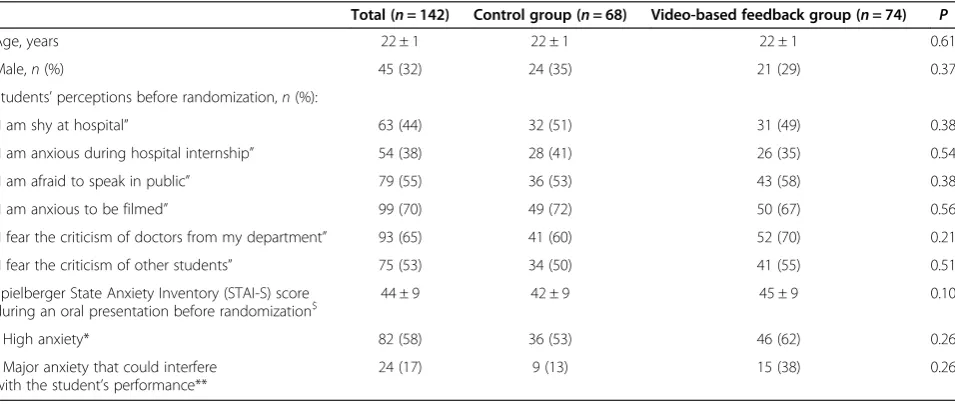
The characteristics and mean pre-intervention STAI-S scores for each group are summarized in Table 1. No sig-nificant differences were observed between the two groups. Of note, 44% of all students reported being shy, and 38% reported being anxious during their hospital training. In addition, before randomization, 55% (n= 79) of students re-ported being afraid of speaking in public. Each of the 74 students in the VBF group received a mean of 6 ± 1 VBF sessions devoted to their own performance during the 3-month period: each lasted 16 ± 7 min, while students in the control group did not receive any formal feedback.
Self-assessment of anxiety generated by an oral presentation
Fifty-eight per cent (n= 82) of students reported signifi-cant anxiety (i.e., STAI-S score >37 for men and >42 for women) during oral presentations at the beginning of their ER or ICU internship: 62% in the VBF group vs. 53% in the control group (p= 0.26). In addition, 17% reported that this high level of anxiety interfered with the quality of their oral presentation (Table 1).
Impact of video-based feedback
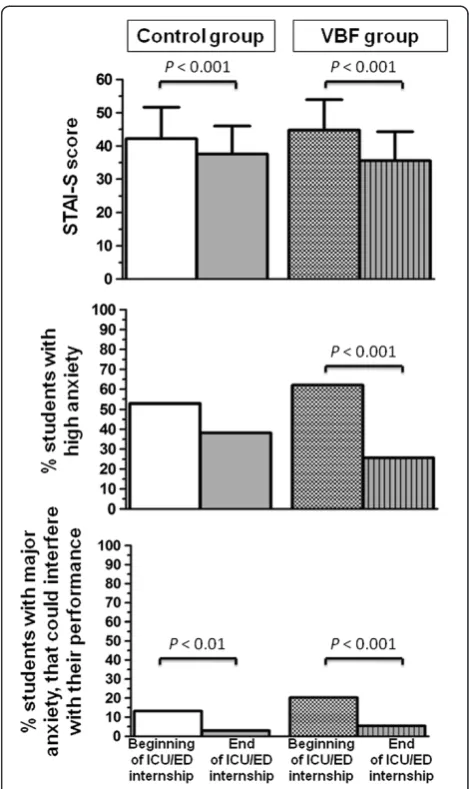
The STAI-S scores and the numbers of students with major anxiety that could interfere with their performance significantly decreased in both groups by the end of their internship. However, the reduction in the STAI-S score was significantly greater in the VBF group compared to the control group (−9.2 ± 9.3 vs. –4.6 ± 8.2, p= 0.024). Similarly, the number of students with high anxiety was
Table 1 Student characteristics and pre-randomisation perceptions of anxiety and public speaking
Total (n= 142) Control group (n= 68) Video-based feedback group (n= 74) P
Age, years 22 ± 1 22 ± 1 22 ± 1 0.61
Male,n(%) 45 (32) 24 (35) 21 (29) 0.37
Students’perceptions before randomization,n(%):
“I am shy at hospital” 63 (44) 32 (51) 31 (49) 0.38
“I am anxious during hospital internship” 54 (38) 28 (41) 26 (35) 0.54
“I am afraid to speak in public” 79 (55) 36 (53) 43 (58) 0.38
“I am anxious to be filmed” 99 (70) 49 (72) 50 (67) 0.56
“I fear the criticism of doctors from my department” 93 (65) 41 (60) 52 (70) 0.21
“I fear the criticism of other students” 75 (53) 34 (50) 41 (55) 0.51
Spielberger State Anxiety Inventory (STAI-S) score
during an oral presentation before randomization$ 44 ± 9 42 ± 9 45 ± 9 0.10
- High anxiety* 82 (58) 36 (53) 46 (62) 0.26
- Major anxiety that could interfere with the student’s performance**
24 (17) 9 (13) 15 (38) 0.26
$
Spielberger State Anxiety Inventory (STAI-S), score from 20–80.
*Significantly elevated anxiety is defined as a STAI-S score of >37 for men and >42 for women.
markedly and significantly lower in the VBF group than in the control group after 3 months of internship (62 vs. 28%,p<0.001) (Figure 1).
Students’perceptions of VBF
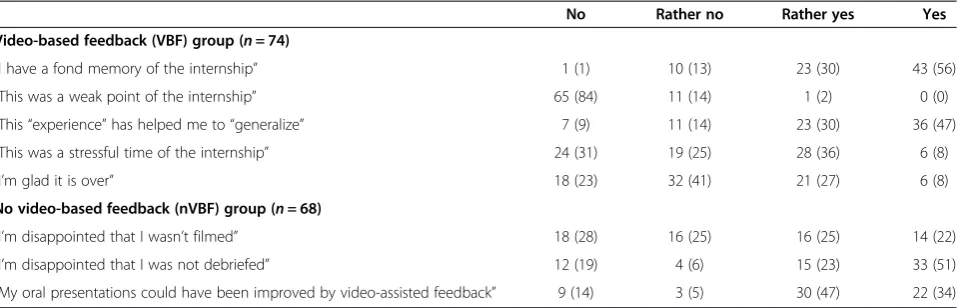
Video recording of oral presentations was described as a stressful experience, but, overall, most students in the VBF group reported a favourable memory of the experience (Table 2). Seventy-seven percent of students in the video group reported that this “teaching experience” should be extended to internships in other wards. Similarly, 74% of students in the control group regretted not having re-ceived personalized debriefing of their oral presentations. Only two students refused to take part in this study, reflecting the good adherence of the students.
Discussion
This study confirms that oral presentation is a major source of anxiety for medical students. Video-based feed-back significantly amplified the anxiety-attenuating effects of repeating public oral presentations and the associated “oral”feedback during a 3-month internship period. It also decreased the proportion of students with anxiety suffi-ciently severe to impair their performance.
To our knowledge, this is the first study to evaluate the benefit of VBF on anxiety generated by oral presen-tation during ward rounds. The principle of debriefing is a classical element in project management, sport training, and, more recently, in simulation-based medical teaching [22,23]. Debriefing can focus on positive aspects, can iden-tify failures, and can suggest corrective actions to remedy mistakes made during the presentation. The immediate ef-fect of debriefing immediately after the oral presentation in the presence of other students who can make con-structive criticisms is to reduce the accumulated pressure and stress experienced by the student who is being ap-praised. However, the methods used to conduct feedback are of utmost importance. Empathy during video debriefing is more effective that harsh criticism to avoid demotivating the student and decreasing his/her future performance [5,24]. The students in our study showed good adhesion to these debriefings, as suggested by the significant decrease in anxiety after VBF. The students were also keen to extend this concept to subsequent training sessions (Table 2).
Feedback now appears to be an essential part of med-ical simulations and education [22,25,26]. Some authors suggest that the addition of video review does not pro-vide any advantages over oral feedback alone [22,27]. However, we believe that VBF increases the didactic im-pact of the feedback [28,29]. Previous studies in the field of medical education demonstrate that VBF improves ef-ficiency when participants have several opportunities to review their performance [28,29]. Repeated and targeted VBF (mean: 6 ± 1 times) in our study may therefore have
contributed to significantly reducing the anxiety of stu-dents in the VBF group.
Public oral presentation is difficult and causes high levels of distress to many students. The STAI-S score be-fore randomization was 41 ± 9 for men and 45 ± 9 for women, respectively. In comparison, similar STAI-S scores were found in a French population of patients with burn injuries (42 ± 12 and 45 ± 10 for men and women, respect-ively) or before a surgical operation (41 ± 9 and 45 ± 8) [20]. In addition, 58% of our students experienced high anxiety levels during an oral presentation at the beginning of their internship, and 17% experience anxiety that was so severe as to interfere with their performance (Table 1).
Just as a coach teaches athletes how to cope with stress before a competition, senior physicians should try to de-crease the anxiety induced by oral presentations. A VBF could help achieve this goal (Figure 1). To the best of our knowledge, no formal training is available to help medical students with oral presentations. We consider this anxiety to be a matter for concern. VBF also generates a positive dynamic within the debriefed group and reduces inter-student resentments [3,30]. Lastly, because anxiety can interfere with performance [31-33], VBF may also have en-hanced the quality of oral presentations.
This study has several limitations. Firstly, this study was not designed to demonstrate a specific benefit of the videotaped presentation alone. The study was designed to assess the combined effect of videotaping, formal debrief-ing and feedback, rather than the sole added value of videotaping. In order to address the specific benefits of video to reduce anxiety, a future study would need to compare formal versus video-assisted oral case presenta-tions, with similar debriefing and feedback in both groups. Secondly, feedback in the control group was not standard-ized. Because the study was probably the subject of many informal discussions between students, it is possible that even those in the control group received some advice from their fellow students. This possible crossover could par-tially explain the significant decrease in the STAI-S score after the 3-month period, even in the control group. Thirdly, the higher baseline STAI-S score in the VBF group, although not significant, could partially explain the more marked reduction of the STAI-S score at the end of the study. Lastly, the Hawthorne effect [34], a situation in which the results of an experiment are not caused by ex-perimental factors, but rather because the subjects were aware that they were tested, is an inherent limitation to this type of study and cannot be eliminated.
Conclusions
Oral case presentations by medical students are part of the daily routine in ICUs and ERs, though they can often
be stressful. Video-assisted review of oral presentations is simple, not time-consuming, and is very popular. Invest-ment in this educational methodology could reduce major anxiety after only a short period. However, the specific im-pact of feedback on the quality of the oral presentation needs to be investigated in future studies.
Abbreviations
ED:Emergency department; ICU: Intensive-care units; STAI-S: Spielberger State Anxiety Inventory; VBF: Video-based feedback.
Competing interests
The authors declare that they have no competing interests.
Authors’contributions
Conception and design: MS, YF, TS, AD. Acquisition of data: MS, YF, MA, AM, VL, ED, JM, JB. Analysis and interpretation of data: MS, YF, TS, AD. Drafting the article: MS, YF, TS, AD. Revising it critically for important intellectual content: MA, AM, VL, ED, JM, JB, TS, AD. Final approval of the version to be published: MS, YF, MA, AM, VL, ED, JM, JB, TS, AD.
Authors’information
Dr Schmidt Matthieu is a fellow in the Department of Pneumology and Medical ICU, Hôpital Pitié-Salpêtrière and Université Pierre et Marie Curie, Paris, France.
Dr Freund Yonathan is a fellow in the Emergency Department, Hôpital Pitié-Salpêtrière and INSERM U956, Université Pierre et Marie Curie, Paris, France. Dr Alves Mickael is a fellow in the Department of Medical ICU, Hôpital Saint Antoine and Université Pierre et Marie Curie, Paris, France.
Dr Labbe Vincent and Dr Messika Jonathan are fellows in the Department of Medical and Surgical ICU, Hôpital Tenon and Université Pierre et Marie Curie, Paris, France.
Dr Monsel Antoine and Dr Darnal Elsa are fellows in the Department of Surgical ICU, Hôpital Pitié-Salpêtrière and Université Pierre et Marie Curie, Paris, France.
Dr Bokobza Jerome is a fellow in the Emergency Department, Hôpital Pitié-Salpêtrière, Université Pierre et Marie Curie, Paris, France.
Prof. Similowski Thomas is professor and Chairman of the Department of Pneumology and Medical ICU, Hôpital Pitié-Salpêtrière and Université Pierre et Marie Curie, Paris, France.
Prof. Duguet Alexandre is professor in the Department of Pneumology and Medical ICU, Hôpital Pitié-Salpêtrière and Université Pierre et Marie Curie, Paris, France.
Acknowledgements
The authors wish to thank the 4thyear medical students at the Medical
University Paris 6, Pierre and Marie Curie, Paris, for participating in this study and Prof. Bruno Riou for review of the manuscript.
Table 2 Students’perceptions of video-based feedback
No Rather no Rather yes Yes
Video-based feedback (VBF) group (n= 74)
“I have a fond memory of the internship” 1 (1) 10 (13) 23 (30) 43 (56)
“This was a weak point of the internship” 65 (84) 11 (14) 1 (2) 0 (0)
“This“experience”has helped me to“generalize” 7 (9) 11 (14) 23 (30) 36 (47)
“This was a stressful time of the internship” 24 (31) 19 (25) 28 (36) 6 (8)
“I’m glad it is over” 18 (23) 32 (41) 21 (27) 6 (8)
No video-based feedback (nVBF) group (n= 68)
“I’m disappointed that I wasn’t filmed” 18 (28) 16 (25) 16 (25) 14 (22)
“I’m disappointed that I was not debriefed” 12 (19) 4 (6) 15 (23) 33 (51)
Author details
1
Sorbonne Universités, UPMC Univ Paris 06, UMR_S 1158“Neurophysiologie Respiratoire Expérimentale et Clinique”, Paris F-75005, France.2INSERM,
UMR_S 1158“Neurophysiologie Respiratoire Expérimentale et Clinique”, Paris F-75005, France.3AP-HP, Groupe Hospitalier Pitié-Salpêtrière Charles Foix,
Service de Pneumologie et Réanimation Médicale (Département“R3S”), Paris F-75013, France.4Emergency Department, Hôpital Pitié-Salpêtrière and
INSERM U956, Université Pierre et Marie Curie, Paris, France.5Department of Medical ICU, Hôpital Saint Antoine and Université Pierre et Marie Curie, Paris, France.6Department of Surgical ICU, Hôpital Pitié-Salpêtrière and Université Pierre et Marie Curie, Paris, France.7Department of Medical and Surgical ICU,
Hôpital Tenon and Université Pierre et Marie Curie, Paris, France.8Emergency Department, Hôpital Pitié-Salpêtrière, Université Pierre et Marie Curie, Paris, France.
Received: 8 May 2013 Accepted: 11 April 2014 Published: 22 May 2014
References
1. Spiegel DA, Smolen RC, Hopfensperger KA:Medical student stress and clerkship performance.J Med Educ1986,61:929–931.
2. Spiegel DA, Smolen RC, Jonas CK:An examination of the relationships among interpersonal stress, morale and academic performance in male and female medical students.Soc Sci Med1986,23:1157–1161. 3. Dyrbye LN, Thomas MR, Shanafelt TD:Medical student distress: causes,
consequences, and proposed solutions.Mayo Clin Proc2005,80:1613–1622. 4. Wolf TM, Randall HM, von Almen K, Tynes LL:Perceived mistreatment and
attitude change by graduating medical students: a retrospective study.
Med Educ1991,25:182–190.
5. Wilkinson TJ, Gill DJ, Fitzjohn J, Palmer CL, Mulder RT:The impact on students of adverse experiences during medical school.Med Teach2006,
28:129–135.
6. Benbassat J:Undesirable features of the medical learning environment: a narrative review of the literature.Adv Health Sci Educ Theory Pract2013,
18(3):527–536.
7. Leonard M, Graham S, Bonacum D:The human factor: the critical importance of effective teamwork and communication in providing safe care.Qual Saf Health Care2004,13(Suppl 1):i85–i90.
8. Lingard L, Espin S, Whyte S, Regehr G, Baker GR, Reznick R, Bohnen J, Orser B, Doran D, Grober E:Communication failures in the operating room: an observational classification of recurrent types and effects.Qual Saf Health Care2004,13:330–334.
9. Williams RG, Silverman R, Schwind C, Fortune JB, Sutyak J, Horvath KD, Van Eaton EG, Azzie G, Potts JR 3rd, Boehler M, Dunnington GL:Surgeon information transfer and communication: factors affecting quality and efficiency of inpatient care.Ann Surg2007,245:159–169.
10. Lockyer J, Armson H, Chesluk B, Dornan T, Holmboe E, Loney E, Mann K, Sargeant J:Feedback data sources that inform physician self-assessment.
Med Teach2011,33:e113–e120.
11. Allan CK, Thiagarajan RR, Beke D, Imprescia A, Kappus LJ, Garden A, Hayes G, Laussen PC, Bacha E, Weinstock PH:Simulation-based training delivered directly to the pediatric cardiac intensive care unit engenders preparedness, comfort, and decreased anxiety among multidisciplinary resuscitation teams.J Thorac Cardiovasc Surg2010,140:646–652. 12. Howe A:Detecting psychological distress: can general practitioners
improve their own performance?Br J Gen Pract1996,46:407–410. 13. Li Q, Ma E-L, Liu J, Fang L-Q, Xia T:Pre-training evaluation and feedback
improve medical students’skills in basic life support.Med Teach2011,
33:e549–e555.
14. Snyder CW, Vandromme MJ, Tyra SL, Porterfield JR Jr, Clements RH, Hawn MT:Effects of virtual reality simulator training method and observational learning on surgical performance.World J Surg2011,35:245–252. 15. Solomon B, Bizekis C, Dellis SL, Donington JS, Oliker A, Balsam LB, Zervos M,
Galloway AC, Pass H, Grossi EA:Simulating video-assisted thoracoscopic lobectomy: a virtual reality cognitive task simulation.J Thorac Cardiovasc Surg2011,141:249–255.
16. Joyce DL, Dhillon TS, Caffarelli AD, Joyce DD, Tsirigotis DN, Burdon TA, Fann JI:
Simulation and skills training in mitral valve surgery.J Thorac Cardiovasc Surg2011,141:107–112.
17. Hamilton NA, Kieninger AN, Woodhouse J, Freeman BD, Murray D, Klingensmith ME:Video review using a reliable evaluation metric
improves team function in high-fidelity simulated trauma resuscitation.
J Surg Educ2012,69:428–431.
18. Owen H, Sprick C:Simulation debriefing and quantitative analysis using video analysis software.Stud Health Technol Inform2008,132:345–347. 19. Gask L, Goldberg D, Lesser AL, Millar T:Improving the psychiatric skills of
the general practice trainee: an evaluation of a group training course.
Med Educ1988,22:132–138.
20. Spielberger C, Gorsuch R, Lushene R, Vagg P, Jacobs G:Manuel de
L’inventaire D’anxiété État-Trait Forme Y (STAI-Y). Editions du Centre de
Psychologie Appliquée.Paris: (M. Bruchon-Schweitzer & I. Paulhan, Adapt.
Française); 1993.
21. Spielberger C:Manual for the State-Trait Anxiety Inventory.Palo Alto, California: Consulting Psychologists Press; 1983.
22. Savoldelli GL, Naik VN, Park J, Joo HS, Chow R, Hamstra SJ:Value of debriefing during simulated crisis management: oral versus video-assisted oral feedback.Anesthesiology2006,105:279–285. 23. Fanning RM, Gaba DM:The role of debriefing in simulation-based learning.
Simul Healthc2007,2:115–125.
24. Lempp H, Seale C:The hidden curriculum in undergraduate medical education: qualitative study of medical students’perceptions of teaching.BMJ2004,329:770–773.
25. Morgan PJ, Kurrek MM, Bertram S, LeBlanc V, Przybyszewski T:Nontechnical skills assessment after simulation-based continuing medical education.
Simul Healthc2011,6:255–259.
26. Hart D, McNeil MA, Griswold-Theodorson S, Bhatia K, Joing S:High fidelity case-based simulation debriefing: everything you need to know.
Acad Emerg Med2012,19:E1084.
27. Hecimovich MD, Maire J-A, Losco B:Effect of Clinician Feedback Versus Video Self-Assessment in 5th-Year Chiropractic Students on an End-of-Year Communication Skills Examination.J Chiropr Educ2010,24:165–174. 28. Birnbach DJ, Santos AC, Bourlier RA, Meadows WE, Datta S, Stein DJ, Kuroda MM,
Thys DM:The effectiveness of video technology as an adjunct to teach and evaluate epidural anesthesia performance skills.Anesthesiology2002,96:5–9. 29. Scherer LA, Chang MC, Meredith JW, Battistella FD:Videotape review leads
to rapid and sustained learning.Am J Surg2003,185:516–520. 30. Sheehan KH, Sheehan DV, White K, Leibowitz A, Baldwin DC Jr:A pilot
study of medical student“abuse”. Student perceptions of mistreatment and misconduct in medical school.JAMA1990,263:533–537.
31. Vytal K, Cornwell B, Arkin N, Grillon C:Describing the interplay between anxiety and cognition: from impaired performance under low cognitive load to reduced anxiety under high load.Psychophysiology2012,49:842–852. 32. Choi JM, Padmala S, Pessoa L:Impact of state anxiety on the interaction
between threat monitoring and cognition.Neuroimage2012,59:1912–1923. 33. Tennyson RD, Woolley FR:Interaction of anxiety with performance on
two levels of task difficulty.J Educ Psychol1971,62:463–467. 34. Hsueh Y:The Hawthorne experiments and the introduction of Jean
Piaget in American industrial psychology, 1929–1932.Hist Psychol2002,
5:163–189.
doi:10.1186/1472-6920-14-103
Cite this article as:Schmidtet al.:Video-based feedback of oral clinical presentations reduces the anxiety of ICU medical students: a multicentre, prospective, randomized study.BMC Medical Education201414:103.
Submit your next manuscript to BioMed Central and take full advantage of:
• Convenient online submission
• Thorough peer review
• No space constraints or color figure charges
• Immediate publication on acceptance
• Inclusion in PubMed, CAS, Scopus and Google Scholar
• Research which is freely available for redistribution