Clustering System of Finding Secure Route in
MANET using Neighbor Node
1Chetan Chaudhari , 2Rajesh Sharma, 3Gagan Sharma
Sri Satya Sai College of Engineering, RKDF university Bhopal M.P., India
Abstract- An Ad-hoc framework is a social event of remote mobile hubs eagerly making a fleeting system without the utilization of any center existing system foundation or incorporated organization. MANET has a few restrictions inferable from framework, versatility, capacities of portable hubs or because of framework in general. Confinements because of foundation or framework, Broadcast nature of correspondences, regular detachments/allotments, Limited data transmission, and bundle misfortune because of transmission blunder, variable limit joins. Helpful methods, Exposed medium, powerfully differing framework topology, insufficiency of incorporated checking, Nonexistence of clear line of resistance. There is no layered security in MANETs like in wired system. Information parcels steered between a sender hub (source) and a collector hub (goal) of a MANET regularly cross along a way spreading over numerous connections, which is known as the multichip way. Coordinating arrangement of principles of Ad-hoc organize actually change themselves with the present conditions which may differ with high versatility to low portability in extremes alongside high transmission capacity. Dynamic source steering set of principles is an utilitarian convention in remote portable specially appointed system (MANET). Information Safekeeping and discovery of pernicious hub in a MANET is a basic occupation in any system. To accomplish unwavering quality and accessibility, steering conventions ought to be intense against pernicious assaults. This theory propose a novel way to deal with recognize the time and area based assault and similarly hold innocuous the framework from pernicious hubs. The paper proposed a secured trust esteem, which helps approve the hub and furthermore be careful, the framework from malicious hubs. Tentatively result demonstrated that framework is fine fitting and upgraded information correspondence. The structure likewise finish secured steering to protect MANET against noxious hub. The results uncovered that the plan security and throughput of the framework is improved.
Keywords-MANET, secure routing, malicious attack, location and timestamp attacks, backup nodes, trust value.
I. INTRODUCTION
Because of the characteristically self-inspired nature of the versatile system topology, the current connections are repetitively harmed, and new connections are regularly perceived. Assurance of connection lifetime, information security, discovery of malignant hub and secure data transmission in a MANET is a vital undertaking in any versatile system. Identification of connection lifetime of versatile hubs with the assistance of steering data is additionally dangerous in a specially appointed system because of its ongoing adjusting topology. Enhance the information conveyance apportion and execution of MANET and furthermore recognize and rectify interface lifetime is the fundamental issue in MANET.
The reliability of disseminating information parcels from end to end utilizing multi-jump middle person hubs is an imperative issue in the portable Adhoc arrange. The disseminated portable hubs make connections to frame the MANET, which may incorporate fiendish and narrow-minded hubs. Building up the trust-based framework is exceptionally testing issue in MANET. With a specific end goal to sift through making trouble hubs we proposes a model which help in secure course disclosure, information transmission and answer to the MANET about any fiendish hub. Furthermore, find secure information way for secure information transmission. We gauge the safe estimation of every hub utilizing timestamp of the operation. At that point, to choose a secured track for message sending to recognize the harmed and pernicious hubs, which should dispatch organize frustration.
In portable Adhoc arrange, arrange security assume a genuine part in system association examination and observing. Amid flooding forms connect scanner inactively gathers bounce numbers of built up examination messages at MANET hubs. In light of the reconnaissance that harmed connections can bring about difference between got bounce numbers and system topology. The protest of connection scanner is to make accessible a rundown enveloping every single conceivable connection disappointments. With such a rundown, more recuperation and investigation systems wind up plainly conceivable, including (a) changing steering approach for the related hubs, (b) finding the underlying drivers of watched signs in the system, (c) commitment the assistant rundown of lifetime connections for each hub. Our strategy ensures that multi cast information is transported from the source to the partners of the multi cast gatherings, even within the sight of assaults, the length of the gathering individuals are available through non adversarial track. Here for validation trust esteem is utilized to expel outside adversaries and certification that exclusive affirmed hubs achieve certain operation.
Segment 2 gives the MANET, directing and foundation identified with MANET. Area 3 speaks to proposed work, calculation of proposed work. Segment 4 gives the execution points of interest. Segment 5 finishes the paper with a synopsis and dialog of future research headings.
BACKGROUND
The thoughts of dynamic source directing is made on the source transmitting which implies the spark of the information bundle make accessible a methodical rundown of hubs rendering to which information parcel go through in the framework. The key note this directing example is that middle of the road hubs require not to track the data of the steering through which bundle will cross in the system as source hub as of now has a choice with respect to the courses. Usage of source transmitting enables the information bundle to go on the up and up free condition, evade the prerequisites for refreshing the steering data in the middle hub, enables the hub to forward the parcel to store the moving information in them for future. All parts of convention work altogether on request. DSR works in veryself-arranging and sorting out without pre presence of organized system for somewhat current framework organization or substructure. The convention deals with the two essential components. i.e. „RouteDiscovery [5]' and 'Course Maintenance'. Course disclosure is a strategy for discovering the protected course in the system, when a source hub's wanting to transmit the information bundle to the objective hub, where each hub holds a course store of source courses it has comprehended or caught. Course support is the system by which originator gadget perceive the adjustment happened in the system topology with the end goal that it comprehends about the life span of the course accessible to the goal due to the hub in the course rundown is moved out of the range.
the data in its course reserve. Convention itself communicate the topological learning in the system among the hubs. Source course conveys the right data of course as it being tried by the bundle streaming in the system alongside them. DSR use the source courses where bundle flies out as indicated by acquired source course from the course store itself or by finding through the flooding in the system. This makes DSR to pick up the advantages regarding mounted data, free from the circle that to without overhead cost.
Course upkeep is the way toward keeping up the courses in system if the connection disappointment happened. DSR takes after this system to erase the broken link [7] from the system while engendering the bundle from the source to the goal. The fundamental idea of course support in DSR is that each hub is in charge of recognizing that the following hub in the source way had gotten the bundle. In the event that any hub does not got such affirmation it will send mistake message to the originator or the initiator in the system. After when the originator gets the blunder message from the specific hub, it erases that course from course store and select the other best course accessible in its reserve. Assume an is the originator it will send the information parcel as indicated by course in its course store. As each hub is in charge of affirmation or getting the demand, the further hubs B and C will do likewise. On the off chance that if C is not getting affirmation message it will sit tight for time and resend the demand however in the wake of sending solicitation to some time it will course blunder message and send this to the originator by consecutive numbers in its course reserve. In addition, source hubs will listen course blunder message and after that erase the connection, the same different hubs will do by catching the message. Presently hub A will utilize another best course by using its course reserve else, it will starts the course disclosure.
II. PROPOSED WORK
We have proposed an area and time based dependence supervision model to safe the information transmitting convention between source hub and goal hubs relies on upon the dependence estimation of individual hub in the pathway. The recommended demonstrate considers the area and time based assaults, which may irritate the system. We have utilized timestamp and area of the hub for figuring the conviction estimation of the hub. Distinctive hubs in the Adhoc arrange saw exclusively other's conduct so as to make a dependence affiliation express the level of consistency single hub can put on one more hub. These affiliations are valuable to bolster hubs settle whether to propelling information bundles to a specific neighbor or not. The conviction esteem is thought about between neighbors if esteem is coordinated then it set apart as verified and information
can be exchanged. In the event that the conviction esteem is thought about between neighbors if esteem is not coordinated then it set apart as unauthenticated and information cannot be exchanged. In situation set up, we have utilized 50 hubs in system. DSR is utilized as a steering strategy in our calculation. The underlying limit information esteem is set as 0.9 in calculation, which is utilized to compute the certainty esteem. This ascertained esteem is connected for secured data transmission. On the off chance that the hub is confirmed by the system then information is transported to the goal hub, generally unique neighbor is chosen for secure information transmission.
Step 1: Scenario setup, Node setup, Routing convention setup, Source and goal setup
Threshold value setup
Step 2: setting introductory trust value
Step 3: Request send by source using generated trust value
Step 4: Calculation of confidence value..
The confidence value is computed by using node * threshold value * trust value.
This confidence trust value is used to authenticate the node.
Step 5: Creating cluster upon association made utilizing trust value and closest neighbor
Step 6: Check whether answer RREP by substantial and verified node
If node is authenticated then
Marked system is valid Source can transmit information Else
Check hop count of the system If hop count exceeded then System is invalid
Go to End Else
Go to step 2 ask for send by RREQ End if
Step 7: Test data packet distribution ratio of the system If data packet distribution ratio drop to the given threshold then
Starting source node arbitrarily pick the supportive address of any one-nodeneighborto malicious node Send request to the node
If anyone node reply from other path except neighbor node then take the reverse locating program and direct check data packets
Check messages to detect time and location dependent malicious node
Data source node give list of malicious node onto time and location dependent Malicious
Go to End End if
Step 8: Create backup node list, select closest neighbor from trusted backup node
Step 9: secure information transmission. Step 10: End
The initial phase in our proposed work is to setup the situation i.e. to setup the hub utilized as a part of calculation. To setup the source and goal utilized as a part of the framework. Set the limit an incentive for parcel conveyance proportion. It likewise set the directing parameters, steering conventions, parcel measure, dimensional territory, and rate of transmission. The resulting step is to send the demand produced by source RREQ. The following stride is to check whether the source get the answer RREP by legitimate and verified hub. Since the area and time, assaulted hub can likewise produce the RREP flag. The conviction esteem is looked at between neighbors if esteem is coordinated then it set apart as verified and information can be exchanged. In the event that message from the confirmed hub then framework is, set apart as a validated and source can transmit information to the predefined and secured way. In the event that RREP answer is from invalid or unauthenticated hub then initially tally the quantity of bounces. In the event that number of jump tallies surpassed then checked framework is invalid and exit from the system. To locate another safe neighbor hub go to the RREQ source ask for step. Source hub haphazardly pick trap address of one jump neighbor to goad malevolent hub. Make reinforcement hub list, select closest neighbor from confided in reinforcement hub. Check messages to recognize time and area subordinate pernicious hub and source hub list malignant hub onto time and area subordinate vindictive. The resulting stage is to check information parcel conveyance proportion of the system.
We have allotted introductory conviction incentive to every hub, which finds confirm, neighbors.
The segments of our proposed model are trust esteem, suggested put stock in neighbors, and secure way. The limit information esteem is measured as 0.9. The certainty key is composed as hub * trust esteem * limit esteem.
Assume we have hub 20 to check for verification then its trust esteem is ascertained by the limit an incentive as
Confidence value = 0.9 * 20 * 1462252574 = 26320546332.0
III. IMPLEMENTATION
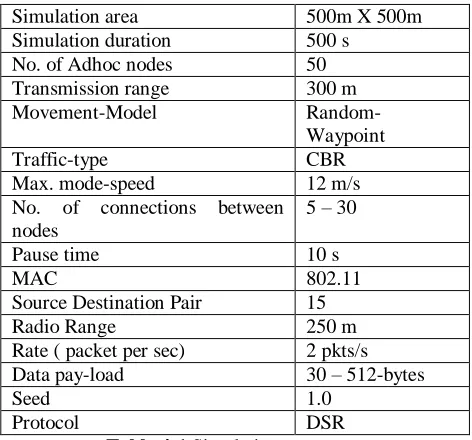
We have executed our proposed work with the assistance of NS2 test system. NS2 will give reproduction condition to MANET arrange. For recreation we have utilized i3 3.0 GHz machine with 4GB RAM. The program is created in TCL dialect and a few capacities are additionally actualized in C/C++ dialect.
Simulation area 500m X 500m
Simulation duration 500 s
No. of Adhoc nodes 50
Transmission range 300 m
Movement-Model
Random-Waypoint
Traffic-type CBR
Max. mode-speed 12 m/s
No. of connections between nodes
5 – 30
Pause time 10 s
MAC 802.11
Source Destination Pair 15
Radio Range 250 m
Rate ( packet per sec) 2 pkts/s
Data pay-load 30 – 512-bytes
Seed 1.0
Protocol DSR
Table 4-1 Simulation parameter
The area and time assault diminishes bundle conveyance proportion in light of the fact that the foe reaction to each approaching parcel by misleadingly saying that it is the goal of parcel. This action prompts more number of dropped parcels at foe and zero sending of bundles through foe hub and subsequently there is a significant drop of parcel conveyance proportion.
End-to-End Delay – it notices to the time involved for an information parcel to be exchanged through a system from source to goal. Area and time assault builds end-to-end defer in light of the fact that the enemy hub holds up already coordinating way reaction information parcel. This holding up period is equivalent to the time taken through an information parcel to make a trip from end to end framework separate as the resistance offers an engraving that the information bundle moved to the valid hub. This aggravates the end-to-end delay.
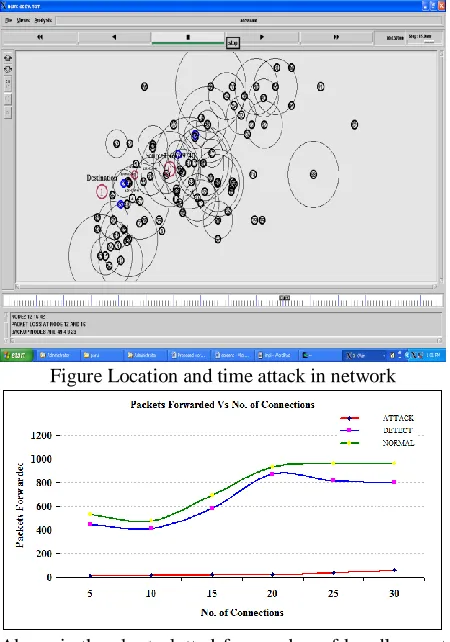
Figure Location and time attack in network
Above is the chart plotted for number of bundles sent versus most extreme number of associations. Number of associations fluctuates from 5 to 30. Situations G to L, at 15 m/s of hub speed, are plotted for DSR under area and time number assault, DSR with recognition module and ordinary DSR.
Parcels sent Vs Max No. of Connections
As it can be seen from the diagram that the aggregate number of parcels sent in the system for DSR under assault ranges from 11 to 61. Typical DSR and DSR with discovery module advances bundles regularly and with increment in number of associations, which additionally expands number of parcels in the system, the aggregate number of parcels sent likewise increments. Typical DSR advances bundles well from 477 to 962. The discovery module additionally demonstrates generous change and advances bundles from 411 to 871.
IV. CONCLUSIONS AND FUTURE WORK The review and development of cell phones and 802.11 Wi-Fi remote systems is on request theme of research in MANET. Specially appointed system does not rely on upon any focal organization or stable foundation, for example, base. Ongoing applications in MANET require certain QoS elements, for example, negligible end-to-end information parcel interim and adequate information misfortune. DSR set of standards is a
sensible convention in remote portable impromptu system. The brilliance of administration must satisfy source end to goal end information bundle exchange without parcel misfortune. The reliability of conveying information bundles from end to end utilizing multi-bounce mediator hubs is a striking trouble in the versatile Adhoc arrange. Because of the inherently self-spurred nature of the versatile system topology, the current courses cannot be secure. Assurance of connection disappointment, information security, discovery of malevolent hub and secure data transmission in a MANET is a critical errand in any versatile system. Adhoc organize utilizing dynamic source steering under malevolent assault with secure directing and information transmission. Our proposed convention find the area and time based assault and if unique course is breakdown then new secure hub is built up and data is exchanged from recently made course. We proposed a protected trust esteem which validates the hub and furthermore be careful the system from pernicious hubs. We proposed recognition and redress of area and time assault in multipath versatile Adhoc arrange and to build execution and reliability of portable Adhoc organize utilizing dynamic source steering under malevolent assault with certain directing and data transmission. The reproduction results found that the framework throughput, security and execution of the framework is progressed. We want to actualize our technique genuine condition and assess the system execution. A course of future examination is to soften the message up little parts and secure information appropriation utilizing encryption system.
REFERENCES
[1] Amit N Thakre ,MrsM.Y.Joshi “Performance Analysis of AODV & DSR routing Protocol in Mobile ad-hoc network”, IJCA special Issue on “mobile ad-hoc network”, MANETs 2010
[2] David A. Maltz, “On demand routing in multi-hopwireless mobile ad-hoc network” CMU-CS-01-130, PhD. Desertion, School of computer science Carnegie Mellon University, Pittsburgh PA- 2001.
[3] Tanvi Arora, AmarpreetKour, Mandeep Singh,” Review of various routing protocols and routing Models for MANRTs”, International Journal of Innovation & Advancement in CS ,IJIACS,ISSN 2347- 8616,Vol.4 Special Issue, MAY 2015. [4] Elizabeth M Royar and Chai Kunhtoh,”A Review of current
routing protocol for ad-hoc mobile Wireless network”,Technical report, University of California and Georgia Institute of Technology,USA,1999.
[5] David B Johnson,David A. Maltz , Josh Broch ,”DSR: The dynamic source routing protocol for Multi-Hop wireless Ad-hoc network”, Computer Science Department, Carnegie Mellon
University, Pittsburgh,PA
15213-3891,http://www.monarch.cs.cmu.edu.
[6] Antesar M. Shabut, Keshav P. Dahal, Sanat Kumar Bista, and Irfan U. Awan, Recommendation Based Trust Model with an
Effective Defence Scheme for MANETs, IEEE
[7] H. Deng, W. Li, and D. Agrawal, “Routing security in wireless adhoc networks,” IEEE Commun. Mag., vol. 40, no. 10, pp. 70–75,Oct. 2002.
[8] B. Wu, J. Chen, J. Wu, and M. Cardei, “A survey of attacks andcountermeasures in mobile ad hoc networks,” in Wireless Network Security. New York, NY, USA: Springer, 2007, pp. 103–135.
[9] N. Pissinou, T. Ghosh, and K. Makki, “Collaborative trust-basedsecure routing in multihop ad hoc networks,” in Proc. Netw. Netw.Technol., Services, Protocols; Perform. Comput. Commun. Netw.;Mobile Wireless Commun., 2004, pp. 1446– 1451.
[10] S. Buchegger and J. Y. Le Boudee, “Self-policing mobile ad hocnetworks by reputation systems,” IEEE Commun. Mag., vol. 43,no. 7, pp. 101–107, Jul. 2005.