American Journal of Applied Chemistry
2013; 1(3): 37-42Published online August 30, 2013 (http://www.sciencepublishinggroup.com/j/ajac) doi: 10.11648/j.ajac.20130103.11
Preparation, characterization and theoretical study of
metal complexes derived from N
5
acyclic ligand
Mahmoud Najim Al-jibouri
1, Omar Hamad Shehab AL-Obaidi
2, *1Chemistry Department, College of Science ,Al-Mustansrya University 2Chemistry Department, Women Education College, Al-Anbar University
Email address:
[email protected](M. N. Al-jibouri), [email protected](O. H. S. Al-Obaidi)
To cite this article:
Mahmoud Najim Al-jibouri, Omar Hamad Shehab AL-Obaidi. Preparation, Characterization and Theoretical Study of Metal Complexes Derived from N5 Acyclic Ligand. American Journal of Applied Chemistry. Vol. 1, No. 3, 2013, pp. 37-42.
doi: 10.11648/j.ajac.20130103.11
Abstract:
The complexes of a new pentadentate acyclic ligand derived from 1,2-diamino benzen and 2,6-diacetylpyridine ,with vanadium(IV), Mn(II) and Fe(III )have been synthesized and characterized on the bases of their elemental analysis, GS mass for ligand, conductivity, magnetic moments in addition to spectral data of IR and UV-Visible Spectra. Metal to ligand ratio in all complexes has been found to be (1:1). The polydentate ligand behaves as N5 systemupon linkage with Fe(III) and Mn(II) ions. All the complexes have been assigned as octahedral geometries of general formula [MnL]Cl, [FeLCl]Cl2 and [VOL]SO. A theoretical treatment of the formation of complexes in the gas phase was
studied; this was done using the HYPERCHEM-6 program for the Molecular mechanics and Semi-empirical calculations.
Keywords: Preparation, Characterization, Theoretical Study, Metal Complexes, Acyclic Ligand
1. Introduction
The coordination complexes of the Schiff bases have been widely investigated due to their manifestation of novel structural features, unusual magnetic properties and relevance to biological processes (1-3). The coordination compounds pent dentate Schiff bases have been reported to act as inhibitors for enzymes (4). Considerable interest has been shown in the synthesis of transition metal complexes of pent dentate Schiff bases (5-6). Pyran-2-one derivatives containing hydroxyl, acetyl and phenylazo substitutes have been employed as complexion agents (7-10). Literatures survey reveals that very little work, however, have been reported on conduct metric studies of macro cyclic metal complexes involving pyridine moiety. In the present article we reported the synthesis and characterization of a new penta dentate ligand (L) derived from 2, 6-diacetylpyridine and 1, 2-diamino benzene and its complexes with oxo-vanadium (IV), Fe (III) and Mn(II).
2. Experimental
2.1. Physical Measurements and Analysis
Melting points were recorded on Gallen Kamp melting
point apparatus and were uncorrected. The FTIR spectra were recorded using FTIR – 8300 Shimadzo in the range (4000-400)cm-1and ?Samples of metal complexes were measured as CsI – disc,while the free ligand was done in KBr–disk The UV-Visible spectra of compounds were recorded on Shimadzu model spectrophotometer. Magnetic susceptibility of the sold complexes were done at room temperature using magnetic balance–model MS-BMK1 at AL-Nahrain University by Gouy method using mercury tetrathiocyanato cobalt(II) as calibrante. Metal estimations were carried out spectrophotometrically using atomic absorption Shimadzo AA-670 spectrophotometer.
Molar conductance of the solutions of the complexes in DMF (10-3M) were measured on PW9526 digital conductivity meter. The elemental analysis data of the ligand and complexes were obtained on a Carlo- Erba Model EA 1108 (C.H.N.) Elemental analyzer. The presents of metal complexes were estimated in Ibn-Cina center via Shimdzu AA680 G atomic absorption spectrophotometer. 2.2. Materials and Preparations
2, 6-diacetylpyridine, starting material for synthesis of N5 ligand (L) was purchased from Fluka Company. All the
38 Mahmoud Najim Al-jibouri
(11)
. Dilute solutions of the metal ions and liganed (N under study of 2.5 * 10-6M, 1 * 10-6M, 2.5 * 10
5
M and 1 * 10-4M were prepared with accurate dilution. 2.2.1. Synthesis of the Schiff base (L)
A methanolic solution of 2,6-diacetyl pyridine 0.01 mole in 25ml) was added to a methanolic 1,2-diamino benzene (0.523, 0.02 mol
mixture was refluxed on a water-bath for 2hr. The excess of solvent was partially evaporated under vacuum, and the separated yellow precipitate was filtered under reduced pressure, washed with ethanol and crystallized from ethanol. The compound was dried in vacuum at room temperature over silica gel as described in
physical properties of ligand shown in table (1)
H3C
N N N C C O CH3 H3C
O
NH2
+
2
NH2
Scheme (1). synthesis of acyclic ligand N
2.2.2. Preparation of the Complexes
The metal complexes were prepared by refluxing hot methanolic solutions of metal chloride (0.01 mol) [except in case of Fe (III) and vanadium (IV) complexes where DMF solutions were used] and the ligand (0.01mol) for on a water bath. The complexes separated on adjusting the PH 6-8. were filtered, washed with m
and then left overnight to afford colored crystals of the metal complexes.
N
N CH3
H3C
N
H2N NH2
N H3C
N
NH2
M
Cl
+ MClx
M =Fe(III), x=2 M= Mn(II), X=1
etanol
Scheme (2). synthesis of metal complexes
jibouri et al.: Preparation, Characterization and Theoretical Study of Metal Complexes Derived from N5 Acyclic Ligand
Dilute solutions of the metal ions and liganed (N5)
M, 2.5 * 10-5M, 1 * 10 -M were prepared with accurate dilution.
diacetyl pyridine (1.56gm, a methanolic solution of mole in 10ml), the bath for 2hr. The excess of evaporated under vacuum, and the separated yellow precipitate was filtered under reduced pressure, washed with ethanol and crystallized from ethanol. The compound was dried in vacuum at room as described in scheme (1). The es of ligand shown in table (1)
N
N CH3
N
H2N NH2
synthesis of acyclic ligand N5 [L]
The metal complexes were prepared by refluxing hot solutions of metal chloride (0.01 mol) [except IV) complexes where solutions were used] and the ligand (0.01mol) for 5hr, on a water bath. The complexes separated on adjusting the
methanol,diethyether afford colored crystals of the
N CH3
H2N
Clx
of metal complexes
2.3. Study of Complex Form
The complexes of the ligand (L) with the selected metal ions Fe(III),V(IV) and Mn(II) were studied in solution using ethanol as solvent, in order to determine (M:L) ratio in the prepared complexes, following molar ratio method(10) . Series of solutions wer
constant concentration (C) 10 chlorides or vandal sulfate VO ( (L).
The [M: L] ratio was determined from the relationship between the absorption of the absorbed light and the mole ratio of [M: L]. the result of complexes formation in solution was listed in table (2).
3. Results and Discussion
The free tetra dentate ligand (L) has been prepared by condensation reaction of two moles of
tow moles of 1, 2-diamino propane
was stable in atmosphere, and insoluble in common organic solvents except DMF and DMSO.
3.1. Elemental Analysis
The physical and analytical data of the legend (L), and its metal complexes are given in
which are in a satisfactory agreement with the calculated values. The electron impact mass spectrum of ligand, as shown in fig. 1, confirms the proposed formula by showing a peak at 341 amu corresponding to acyclic
[ (C21H21N5 ) atomic mass 343.18
peaks, i.e. 39, 90, 131, 145 and 250 amu, etc. corresponding to various fragments. Their intensity gives an idea of stability of fragments.
formulas for all complexes are supported by the subsequent spectral, and molar ratio , as well as magnetic moment and molar conductivity in 10-3M solution of
of Λm (table 2) show that
electrolytes in ratio 1:1 , whereas complex is conductive in 2:1(1
Fig. 1. Electron impact mass spectrum of ligand (L)
: Preparation, Characterization and Theoretical Study of Metal
Formation in Solution
The complexes of the ligand (L) with the selected metal Mn(II) were studied in solution using ethanol as solvent, in order to determine (M:L) ratio in the prepared complexes, following molar ratio of solutions were prepared having a ) 10-3M of the hydrated metal VO (SO4)2.5H2O, and the ligand
] ratio was determined from the relationship between the absorption of the absorbed light and the mole result of complexes formation in listed in table (2).
Results and Discussion
The free tetra dentate ligand (L) has been prepared by condensation reaction of two moles of dactyl pyridine and diamino propane scheme (1). The ligand and insoluble in common organic except DMF and DMSO.
The physical and analytical data of the pent dentate (L), and its metal complexes are given in table (1), re in a satisfactory agreement with the calculated The electron impact mass spectrum of ligand, as shown in fig. 1, confirms the proposed formula by showing a peak at 341 amu corresponding to acyclic moiety 343.18]. It also shows a series of peaks, i.e. 39, 90, 131, 145 and 250 amu, etc. corresponding to various fragments. Their intensity gives an idea of stability of fragments. The suggested molecular are supported by the subsequent molar ratio , as well as magnetic moment and M solution of DMF . The Values show that Mn(II) complexes are electrolytes in ratio 1:1 , whereas VO(IV) and Fe(III)
(14)
.
American Journal of Applied Chemistry
Table (1).
Compound Color Yield (%)
Ligand Yellow
[ VO (L)]SO4 Olive
[Fe(L) Cl]Cl2 Pale green
[Mn(L) Cl]Cl Cream
d = decomposed,*=analysis of metal content via flame atomic absorption
3.2. Infra- Red Spectra
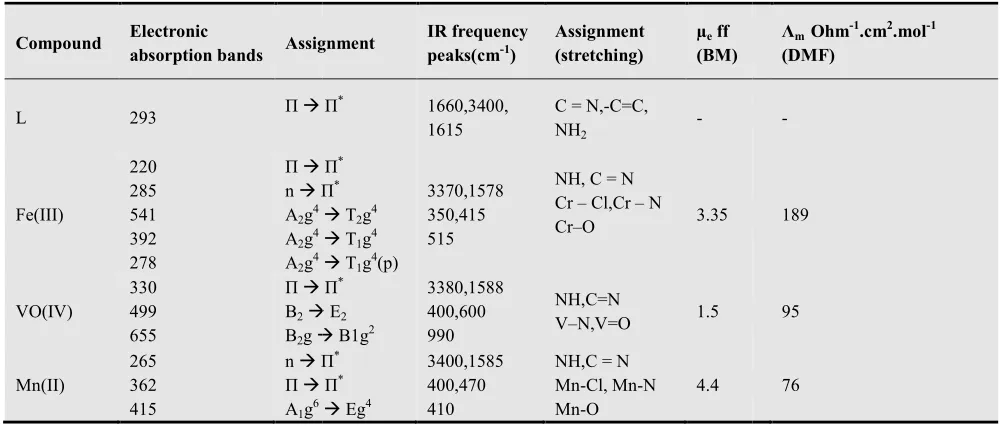
Table (2) lists the most useful infrared assignments for those bands most diagnostic of the mode of coordination of ligand (L). The infrared spectra of all metal complexes a decrease in the frequency by (15-20)cm
for υ(C=N) and υ(NH2) and are constant with coordination
carbonyl oxygen and azomethan nitrogen atoms,
Table (2). U.V. - visible,
Compound Electronic
absorption bands Assignment
L 293 Π
Fe(III) 220 285 541 392 278 Π n Π A2g4 A2g4 A2g4 VO(IV) 330 499 655 Π B2 B2g Mn(II) 265 362 415
n Π Π A1g
6
3.3. Electronic Spectra and Magnetic Moment Stu The UV-visible spectra of the ligand and
complexes were recorded for their solutions in ethanol and DMSO as solvents in the range (200
vanadyl complex show a weak peak in the visible region 365, 560 and 750nm which are assigned
2
B2
2
B1 and 2
B2
respectively(17) which are consistent with octahedral environment of V(IV) complexes. The magnetic moment of oxovanadium complex is consistent with presence of one unpaired electron(18). The electronic
solution of Fe (III) complex exhibits two
American Journal of Applied Chemistry 2013; 1(3): 37-42
Table (1). physical and analytical data for the ligand and their complexes
Yield (%) M.P. Co Elemental analysis Calc.(found)
C% H%
88 133– 135 74.79
(73.44)
6.02 (5.77)
77 288d 54.98
(53.13)
4.26 (3.66)
76 300 52.02
(51.44)
5.06 (56.71)
65 312d 55.87
(54.88) 4.65 (4.00)
flame atomic absorption
Table (2) lists the most useful infrared assignments for those bands most diagnostic of the mode of coordination of L). The infrared spectra of all metal complexes a 20)cm-1 on complication are constant with coordination carbonyl oxygen and azomethan nitrogen atoms, moreover
the presence of bands at range. 415 415cm-1 are assigned to υ(M
respectively. The infrared spectra of chloro complexes show one new band at 295 –
Cl) of trans - isomer (17). A strong band in the oxo vanadium(IV) complex was observed at
assigned to υ(V=O)(18).
visible, I.R. spectra and other physical properties of the prepared compounds
Assignment IR frequency peaks(cm-1)
Assignment (stretching)
µe ff
(BM)
Π* 1660,3400,
1615
C = N,-C=C,
NH2 -
Π* Π*
T2g4 T1g4 T1g4(p)
3370,1578 350,415 515
NH, C = N Cr – Cl,Cr – N
Cr–O 3.35
Π* E2 B1g2 3380,1588 400,600 990 NH,C=N
V–N,V=O 1.5
Π* Π* Eg4 3400,1585 400,470 410
NH,C = N Mn-Cl, Mn-N Mn-O
4.4
Magnetic Moment Studies visible spectra of the ligand and their metal complexes were recorded for their solutions in ethanol and (200 – 1000) nm . The vanadyl complex show a weak peak in the visible region
750nm which are assigned to 2B2
2
E ,
2
A1 transitions
which are consistent with octahedral The magnetic moment of oxovanadium complex is consistent with presence of one electronic spectra of green wo bands in the 624
and 455 nm region which are assignable to
4
T2g (υ1) and 4A2g 4T
ratio is 1.22 which is very close the value of 1.42 obtained for octahedral d3 complexes
shows a slightly low value magnetic moment as to spin-only value (5.92 B.
investigated on the basis of presence spin solid phase (22).
The results shown in table(2), indicate that the molar ratio of(1:1) for complexes yielded high stability. Furthermore the molar absorptivities for all complexes is rather high, this probably was investigated on the presence of pent dentate ligand of N
39
Elemental analysis Calc.(found)
N% %M*
7.43
(6.66) -
4.97 (5.00) 11.33 (10.00) 5.68 (6.71) 12.01 (13.87)
(4.00) 14 .17
(13.00)
11.43 (12.00)
the presence of bands at range. 415 – 610 and 395 – are assigned to υ(M-N) (15-16) and υ(M-O) respectively. The infrared spectra of chloro complexes – 350cm-1 as assigned to υ(M-. A strong band in the oxo-vanadium(IV) complex was observed at 990cm-1 which is
rties of the prepared compounds
Λm Ohm-1.cm2.mol-1
(DMF)
-
189
95
76
which are assignable to 4A2g
T1g (f)υ1 transitions. The (υ2/υ1)
which is very close the value of 1.42 obtained complexes (21). The Mn(II) complexes magnetic moment as compared .M). The low value may be presence spin – exchange in the
40 Mahmoud Najim Al-jibouri et al.: Preparation, Characterization and Theoretical Study of Metal Complexes Derived from N5 Acyclic Ligand
kinetically due to the formation of six-membered ring with the central metal ion(23).On the bases of magnetic data and spectral studies, oxovanadium(IV), Fe(III) and Mn(II) complexes According to previous data reported by Fengetal have been assigned octahedral. (24)
Molar Conductance of complex:
By using the relation Λm =K/C the molar conductance of
the complex (Λm) can be calculated where is the molar
concentration of 10-3M of their solutions at (25 ± 2C°) were measured. it is calculated from the results that Mn(II), V(IV) and Fe(III) are electrolytes in 1:1 and 1:2ratio respectively(14).General suggested stereo chemistry structures of complexes:
According to the results obtained from the elemental and spectral analysis, the general structures of the above mentioned complexes can be illustrated as shown in Fig.(2) bellow:
3.4. Theoretical Study
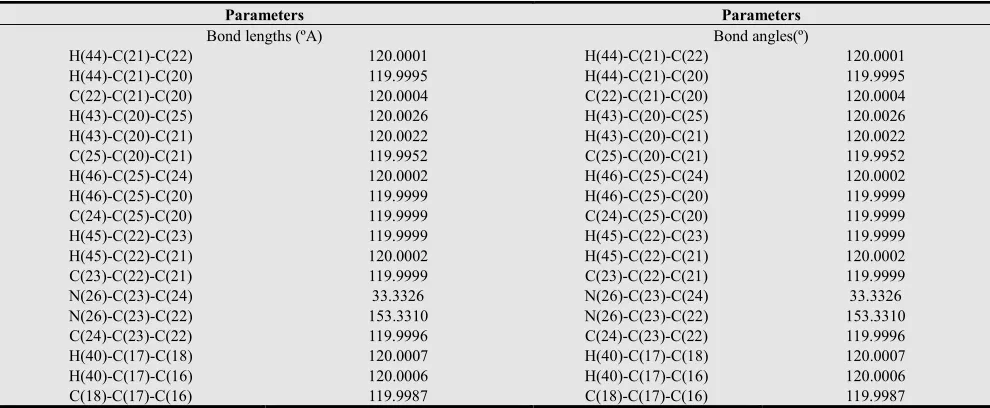
The ball and cylinders and some of selected structural parameters (bond length and angles) of the optimized geometries are shown in Table (3) ,Fig.(3). As shown in this figure, there is no obvious trend for the variation of these parameters. The values of the bond length and angles of the optimized geometries are quite similar to the experimental results of the corresponding compounds.
Fig (3). The optimized structural geometry of Fe(III) complex
Fig(2). The proposed structural prepared complexes
Table (3). structural parameters, bond length (ºA) and angles(º) of the [Fe(L)Cl]Cl2 complex
Parameters Parameters
Bond lengths (ºA) Bond angles(º)
H(44)-C(21)-C(22) 120.0001 H(44)-C(21)-C(22) 120.0001
H(44)-C(21)-C(20) 119.9995 H(44)-C(21)-C(20) 119.9995
C(22)-C(21)-C(20) 120.0004 C(22)-C(21)-C(20) 120.0004
H(43)-C(20)-C(25) 120.0026 H(43)-C(20)-C(25) 120.0026
H(43)-C(20)-C(21) 120.0022 H(43)-C(20)-C(21) 120.0022
C(25)-C(20)-C(21) 119.9952 C(25)-C(20)-C(21) 119.9952
H(46)-C(25)-C(24) 120.0002 H(46)-C(25)-C(24) 120.0002
H(46)-C(25)-C(20) 119.9999 H(46)-C(25)-C(20) 119.9999
C(24)-C(25)-C(20) 119.9999 C(24)-C(25)-C(20) 119.9999
H(45)-C(22)-C(23) 119.9999 H(45)-C(22)-C(23) 119.9999
H(45)-C(22)-C(21) 120.0002 H(45)-C(22)-C(21) 120.0002
C(23)-C(22)-C(21) 119.9999 C(23)-C(22)-C(21) 119.9999
N(26)-C(23)-C(24) 33.3326 N(26)-C(23)-C(24) 33.3326
N(26)-C(23)-C(22) 153.3310 N(26)-C(23)-C(22) 153.3310
C(24)-C(23)-C(22) 119.9996 C(24)-C(23)-C(22) 119.9996
H(40)-C(17)-C(18) 120.0007 H(40)-C(17)-C(18) 120.0007
H(40)-C(17)-C(16) 120.0006 H(40)-C(17)-C(16) 120.0006
American Journal of Applied Chemistry 2013; 1(3): 37-42 41
Parameters Parameters
H(39)-C(16)-C(17) 120.0016 H(39)-C(16)-C(17) 120.0016
H(39)-C(16)-C(15) 120.0007 H(39)-C(16)-C(15) 120.0007
C(17)-C(16)-C(15) 119.9977 C(17)-C(16)-C(15) 119.9977
H(41)-C(18)-C(17) 120.0003 H(41)-C(18)-C(17) 120.0003
H(41)-C(18)-C(13) 119.9998 H(41)-C(18)-C(13) 119.9998
C(17)-C(18)-C(13) 119.9999 C(17)-C(18)-C(13) 119.9999
H(38)-C(15)-C(16) 119.9998 H(38)-C(15)-C(16) 119.9998
H(38)-C(15)-C(14) 119.9999 H(38)-C(15)-C(14) 119.9999
C(16)-C(15)-C(14) 120.0003 C(16)-C(15)-C(14) 120.0003
N(19)-C(14)-C(15) 105.0733 N(19)-C(14)-C(15) 105.0733
N(19)-C(14)-C(13) 120.7995 N(19)-C(14)-C(13) 120.7995
C(15)-C(14)-C(13) 119.9999 C(15)-C(14)-C(13) 119.9999
H(47)-N(26)-Fe(27) 124.6682 H(47)-N(26)-Fe(27) 124.6682
H(47)-N(26)-C(23) 124.6693 H(47)-N(26)-C(23) 124.6693
Fe(27)-N(26)-C(23) 110.6624 Fe(27)-N(26)-C(23) 110.6624
H(42)-N(19)-Fe(27) 130.2129 H(42)-N(19)-Fe(27) 130.2129
H(42)-N(19)-C(14) 130.2130 H(42)-N(19)-C(14) 130.2130
Fe(27)-N(19)-C(14) 99.5741 Fe(27)-N(19)-C(14) 99.5741
C(25)-C(24)-C(23) 119.9986 C(25)-C(24)-C(23) 119.9986
C(25)-C(24)-N(12) 128.9979 C(25)-C(24)-N(12) 128.9979
C(23)-C(24)-N(12) 111.0001 C(23)-C(24)-N(12) 111.0001
H(37)-C(11)-H(36) 109.5200 H(37)-C(11)-H(36) 109.5200
H(37)-C(11)-H(35) 109.4614 H(37)-C(11)-H(35) 109.4614
H(37)-C(11)-C(9) 109.4618 H(37)-C(11)-C(9) 109.4618
H(36)-C(11)-H(35) 109.4419 H(36)-C(11)-H(35) 109.4419
H(36)-C(11)-C(9) 109.4424 H(36)-C(11)-C(9) 109.4424
H(35)-C(11)-C(9) 109.4999 H(35)-C(11)-C(9) 109.4999
Fe(27)-N(12)-C(24) 103.9999 Fe(27)-N(12)-C(24) 103.9999
Fe(27)-N(12)-C(9) 82.9100 Fe(27)-N(12)-C(9) 82.9100
C(24)-N(12)-C(9) 115.0003 C(24)-N(12)-C(9) 115.0003
C(18)-C(13)-C(14) 119.9984 C(18)-C(13)-C(14) 119.9984
C(18)-C(13)-N(8) 128.9982 C(18)-C(13)-N(8) 128.9982
C(14)-C(13)-N(8) 110.9999 C(14)-C(13)-N(8) 110.9999
H(34)-C(10)-H(33) 109.5197 H(34)-C(10)-H(33) 109.5197
H(34)-C(10)-H(32) 109.4619 H(34)-C(10)-H(32) 109.4619
H(34)-C(10)-C(7) 109.4621 H(34)-C(10)-C(7) 109.4621
H(33)-C(10)-H(32) 109.4416 H(33)-C(10)-H(32) 109.4416
H(33)-C(10)-C(7) 109.4420 H(33)-C(10)-C(7) 109.4420
H(32)-C(10)-C(7) 109.5000 H(32)-C(10)-C(7) 109.5000
Fe(27)-N(8)-C(13) 104.0001 Fe(27)-N(8)-C(13) 104.0001
Fe(27)-N(8)-C(7) 84.3869 Fe(27)-N(8)-C(7) 84.3869
C(13)-N(8)-C(7) 145.3303 C(13)-N(8)-C(7) 145.3303
H(31)-C(6)-C(5) 122.1913 H(31)-C(6)-C(5) 122.1913
H(31)-C(6)-C(1) 122.1913 H(31)-C(6)-C(1) 122.1913
C(5)-C(6)-C(1) 115.6174 C(5)-C(6)-C(1) 115.6174
C(10)-C(7)-N(8) 129.3801 C(10)-C(7)-N(8) 129.3801
C(10)-C(7)-C(4) 129.3802 C(10)-C(7)-C(4) 129.3802
N(8)-C(7)-C(4) 101.2398 N(8)-C(7)-C(4) 101.2398
H(30)-C(5)-C(6) 115.3083 H(30)-C(5)-C(6) 115.3083
H(30)-C(5)-C(4) 115.3094 H(30)-C(5)-C(4) 115.3094
C(6)-C(5)-C(4) 129.3823 C(6)-C(5)-C(4) 129.3823
Cl(28)-Fe(27)-N(26) 154.7606 Cl(28)-Fe(27)-N(26) 154.7606
Cl(28)-Fe(27)-N(19) 154.7606 Cl(28)-Fe(27)-N(19) 154.7606
Cl(28)-Fe(27)-N(12) 154.7606 Cl(28)-Fe(27)-N(12) 154.7606
Cl(28)-Fe(27)-N(8) 107.5482 Cl(28)-Fe(27)-N(8) 107.5482
Cl(28)-Fe(27)-N(3) 107.5484 Cl(28)-Fe(27)-N(3) 107.5484
N(26)-Fe(27)-N(19) 0.0000 N(26)-Fe(27)-N(19) 0.0000
N(26)-Fe(27)-N(12) 0.0000 N(26)-Fe(27)-N(12) 0.0000
N(26)-Fe(27)-N(8) 90.0001 N(26)-Fe(27)-N(8) 90.0001
N(26)-Fe(27)-N(3) 90.0001 N(26)-Fe(27)-N(3) 90.0001
N(19)-Fe(27)-N(12) 0.0000 N(19)-Fe(27)-N(12) 0.0000
N(19)-Fe(27)-N(8) 90.0001 N(19)-Fe(27)-N(8) 90.0001
N(19)-Fe(27)-N(3) 90.0001 N(19)-Fe(27)-N(3) 90.0001
N(12)-Fe(27)-N(8) 90.0001 N(12)-Fe(27)-N(8) 90.0001
N(12)-Fe(27)-N(3) 90.0001 N(12)-Fe(27)-N(3) 90.0001
42 Mahmoud Najim Al-jibouri et al.: Preparation, Characterization and Theoretical Study of Metal Complexes Derived from N5 Acyclic Ligand
Parameters Parameters
C(7)-C(4)-C(5) 128.9979 C(7)-C(4)-C(5) 128.9979
C(7)-C(4)-N(3) 110.9996 C(7)-C(4)-N(3) 110.9996
C(5)-C(4)-N(3) 119.9999 C(5)-C(4)-N(3) 119.9999
N(12)-C(9)-C(11) 129.7038 N(12)-C(9)-C(11) 129.7038
N(12)-C(9)-C(2) 100.5917 N(12)-C(9)-C(2) 100.5917
C(11)-C(9)-C(2) 129.7045 C(11)-C(9)-C(2) 129.7045
Fe(27)-N(3)-C(4) 104.0001 Fe(27)-N(3)-C(4) 104.0001
Fe(27)-N(3)-C(2) 103.9997 Fe(27)-N(3)-C(2) 103.9997
C(4)-N(3)-C(2) 115.0006 C(4)-N(3)-C(2) 115.0006
C(9)-C(2)-N(3) 110.9996 C(9)-C(2)-N(3) 110.9996
C(9)-C(2)-C(1) 128.9986 C(9)-C(2)-C(1) 128.9986
N(3)-C(2)-C(1) 119.9992 N(3)-C(2)-C(1) 119.9992
H(29)-C(1)-C(6) 119.9997 H(29)-C(1)-C(6) 119.9997
H(29)-C(1)-C(2) 119.9997 H(29)-C(1)-C(2) 119.9997
C(6)-C(1)-C(2) 120.0006 C(6)-C(1)-C(2) 120.0006
References
[1] S.Tuba ,T.Serap and Cigdem I., J. Chem and Eng.(2011),54(4),pp.978-983.
[2] S.D.Poonam, Amit R.Yaud, J.Bohjan, and S.A.Aswar, World J. of Chem.,(2010),5(1),pp.57-61.
[3] A.S. Munde, V.A. Shelke, S.M.Jadhav, A.S. Kirdant and T.K. Chondhekar , Appl .Sci. J.(2012),3(1),pp.157-182. [4] K.Popov,P.Igor,W.Hams,and,V.Andrey,Internationalprof.Tes
t.J.,(2007),9(2),pp.13-17.
[5] Smith, R.M, Martel,A.E."The selection of critical stability constants in chemical equilibrium and reaction models" American J. Chem. ,(1995),soc.42.
[6] Tubas, chin. Chem. Letters,(2003),14,No.11,pp.1207-1210. [7] B.M.Kalshetty, S.S.Surarkandin, P.S.Hiremath and M.B.
Kalashetti" International J. of Appl.Techn",(2011),2,Issu2. [8]
[9] Majia.R.,A.Kassim, S.Ahmed Zaher,Nor.Azah Y.and HossR in A.,Int J.Electrochem.,(2011),sci.6.pp.4378-4387. [10] R.Marie, V.Peter and V.K. Krizovn, "Inorg. Chem.
J",(2009),3,pp.26-32.
[11] "Fundamentals of Analytical chemistry",Interscience, Skoog, and,D.A.,NewYourk, (1998),p.536.
[12] "Textbook of Quantitative an Inorganic Analysis", A.I. Vogel, Longmous Green London,(1961).
[13] W.H.Brock, K.A.Jensem, C.K.Jorgensem and, G.B.Kaufmam, Polyhedron, (1983),2,pp.1-7.
[14] "Principle of Inorganic Chem.5thed.",Cotton and Wikons,(1981).
[15] Conductivity of coordination compounds in oraganic solvent, W.Geary,(1970).
[16] Heterocyclic chemistry ,Yamanaka H.Obba S. and Sokamoto,(1975), 31,pp. 1115- 1127.
[17] Ain seough A.W.,and Plowmam
R.A.Aust.J.Chem,(1970),699,p.23.
[18] A.K.Rama and ShahJ.R.,Indian J.Chem.,(1981),soc.58. [19] "Inrared and Ramam spectra of Inorganic coordination
compounds", K.Nakamoto,John Wiely and Sous,(1986). [20] "Determination of chemical structure",Pasto DJ and UK.,
Prentcehall, (1969) .
[21] H.C.Zahid,M.A.AKhter and T.Scloud in bioinorg. chem. And application ,article, (2006), ID83131, pp.1-13.
[22] Pandeya,K.B,ompraksh and Singh R.P. , Indian J.Chem.,(1983),soc.531.
[23] "Elements of magneto chemistery,2nded".,Data R.L and Symal A., west east press New Delhi,(1993),p.101.
[24] Satish,M. Annigeri, M.P.Suthish and V.K. Revankar, "Spectroscopic studies of bridge binuclear complexes of Co(Π),Ni(Π),Cu(Π) and Zn(Π) transition metal Chem." , springer,(2007),32,pp.81-87.